How The Once Elusive Dream Of Laser Weapons Suddenly Became A Reality曾经遥不可及的激光武器梦想如何突然成为现实
One of Lockheed Martin's top directed energy minds explains how breakthroughs in communications and industrial tech made laser weapons possible.
新闻视频
Updated Dec 10, 2020 6:24 AM EST
After decades of toiling and dead-ends, the dream of operational laser weaponry is about to become a reality. So, what changed that made what had been bulky systems go from clumsy pipe dreams to hardened, miniaturized, and reliable weapons that will be able to be deployed even in the harshest of conditions?
We recently had an in-depth interview with Dr. Rob Afzal, Lockheed Martin Senior Fellow, Laser and Sensor Systems, where I pressed him on everything related to laser weaponry and the emerging military applications that go along with it. In the course of answering my maelstrom of queries, Dr. Afzal eloquently conveyed how we have suddenly arrived in an era where laser weapons will become widespread across the battlefield. In this first piece in our two-part series with Lockheed’s directed energy guru, I wanted to share his explanation with you, as it is fascinating in its own right.
Here, as it was conveyed to me directly, is what technological developments have made the dawn of laser warfare possible according to Dr. Afzal:
“If you think back, that the laser is actually invented in roughly 1960. So, it begs the question, that’s 50 years—why aren’t there laser weapons all over the place today? There are really two reasons for that.
The first reason is that the initial application they envisioned for the laser weapons is for strategic defense mission; really, the hardest—most difficult technologically—mission that there is, defending the homeland against incoming ballistic missiles. So, first of all, that was extraordinarily difficult, but it did develop a lot of core fundamental technologies and demonstrations that showed that a laser weapon system can be put together, you can do acquisition, tracking, pointing a laser beam, as well as delivering a lethal laser beam to a target, like a boost-phase ballistic missile on the Airborne Laser program . The issue, though, was that those systems were basically just too big, literally. They were physically too big to really be deployed in the tactical environment, on a truck or on an airplane, even on a ship, without taking up large portions of the ship.
The abortive YAL-1 Airborne Laser filled-up an entire 747 with its chemical laser components. The program was canceled a decade ago after huge sums of money spent and lack of meeting operationally relevant requirements. , USAF
Even though the systems were possible, the irony was that the laser technology wasn’t there yet, to make a small enough, powerful enough laser, to be tactically relevant. Now, the threat landscape also started to change, and we went from a strategic defense to a tactical defense. The threats today are really evolving. We’re talking now about swarms of low-cost, low capability threats, like armed UAVs or large quantities of mortars or rocket barrages. Those systems are shorter range, and many of the systems are… not sophisticated; meaning traditionally sophisticated countermeasures, like jamming and redirecting and things like that, don’t work. Like, for instance, a mortar does not have a guidance system on it. So, there’s not something you can easily do to defend against a mortar. And the timeline of a mortar shot is very short, so you need to react extraordinarily quickly and be able to defend in a very short period of time.
So, the threat landscape is evolved. And then in the technology space, there were two revolutions that really started to take place. The first was fiber-optic telecommunication, so I’ll get to why that’s relevant to directed energy.
All of a sudden, in the ’90s, billions and billions of dollars started to pour into the development of fiber-optic communications equipment—how to make the optical fiber, how to pull kilometers and kilometers of it with high purity, how to make high-speed electronics to be able to do communications, semiconductor diode lasers to send the data down the fibers. The whole industrial infrastructure for that capability started to really be built out. Then the bubble burst in the early 2000s and a number of the companies that were in that space began looking for new markets that this fiber-optic, fiber-laser technology actually could scale in power to hundreds of watts to kilowatts of optical power. What we found—we, meaning the community—was that that you could do a whole bunch of industrial applications using fiber-laser technology and very cost-effectively. What I mean by that is mainly cutting, welding, and drilling. So, all of a sudden, all sheet metal that’s cut for home appliances and so forth, was starting to be cut by high-power fiber-lasers of the kilowatt-type power levels.
Cutaway of a fiber-optic cable and fiber-optic cabling being installed in a city. , Bidgee/Wikicommons and Srleffler/Wikicommons
All the microelectronics and iPhones and so forth, were starting to be drilled and the touch screens were being scribed, and all this whole industrial space opened up, and the reason was that these fiber lasers were very efficient at converting electrical power to optical power. The beam quality that came out of the fiber-laser, meaning the ability for that beam to be focusable, to provide a high-intensity spot to do things, like melt metal and drill holes, the beam quality was very high. So, all of a sudden, the industrial space really opened up and the development of high-power fiber-lasers really, really took off.
That was particularly interesting, except for the fact that the power out of a fiber-laser doesn’t scale to a weapons class, right? It’s one thing to cut metal that’s centimeters away, it’s another thing to take out a mortar at two kilometers. So, the innovation that changed the game in the last five years or so, Lockheed Martin was a real leader or the leader in this innovation, and the innovation involved bringing together the technologies from fiber-optic communications and the technologies of high-power lasers for industrial applications to figure out a way to scale fiber-lasers to weapons class power.
The way that’s done is, instead of just building a single laser at 50 kilowatts or 100 kilowatts or something like that, we are actually taking individual fiber-lasers and combining the outputs of the beams into a single high-power beam, and we do that using a technique we call Spectral Beam Combination… Fundamentally, what we did was we took something, if you’re familiar with wavelength division multiplexing in telecommunication—how to break up the spectrum that’s available to you into many different laser-lines and send all that light down a fiber to increase your communications bandwidth. So, all of a sudden, we took a large number of fiber-laser channels, all closely spaced in wavelength or in frequency, and then by reflecting those beams off an object. We could call it a grating, or you can think in your mind of it like a prism, the beams all combine into a single output beam. Patty always loves this analogy I use, which is Pink Floyd’s Dark Side Of The Moon record cover.
The iconic Dark Side Of The Moon cover. , Harvest Records/Pink Floyd
So, if you look at that prism, there’s a white light beam that comes into the prism and it breaks up into the colors of the rainbow, you could run that in reverse, you could have a whole bunch of beams that cover the different spectrums, and if you put it through the prism, they all combine and output a single beam. We call it kinda the ‘reverse prism effect.’ So what all of a sudden we were able to do was to scale laser power in a modular way. Instead of just trying to build a bigger and bigger laser, we’re actually scaling by adding lasers up .
Think of it as a mainframe computer breaking up into a supercomputing cluster. So, instead of just building a bigger device, we’re combining in parallel. And so, what that enabled us to do is build a high-power laser that’s scalable by adding modules that delivered a weapons class beam, but with very high beam qualities.
Lockheed Indirect Fire Protection Capability-High Energy Laser (IFPC-HEL) , which is now aiming for a 300kW class rating, will provide an all-new countermeasure against rockets, drones, and artillery. , Lockheed Martin
I’ll get to this from a laser weapon system perspective, it’s more than just laser power that’s important, it’s the ability to focus that beam, for that beam to be able to propagate over a long distance, stay tightly focused. And of course, in the weapon system, it’s important that you’re able to do acquisition tracking and line of sight stabilization to keep the spot on the soft zone of the target. The fiber-laser technology is also, as I mentioned, the most efficient at converting electric power to laser light. So, all of a sudden that meant that the platform demands, whether you’re on a ship, a truck, or an airplane, of being able to provide power and then cooling is minimized; it’s certainly not zero, and we’re talking about 30% to 35% efficiency at converting electric power into a usable laser beam. That may not sound that great to you, but compared to old solid-state laser technology, it was more like 10%.
It’s a big, big deal.
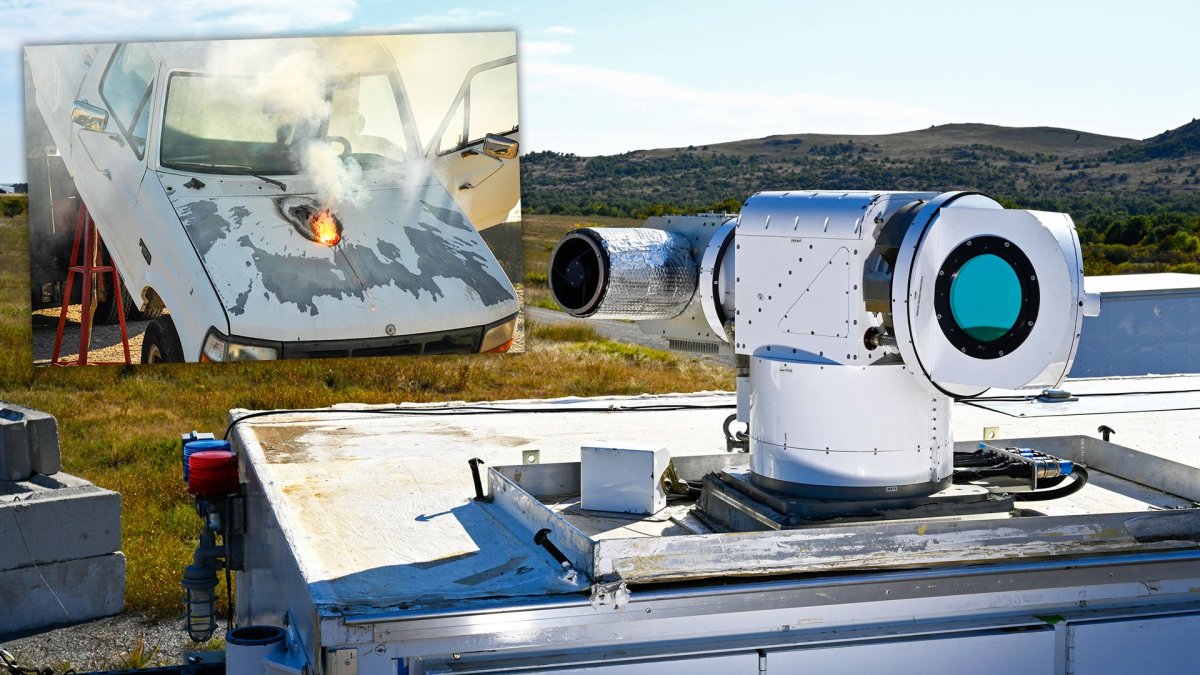
Lockheed’s ATHENA laser punches a hole in a target vehicle. , Lockheed Martin
What that meant was that the system demands, the platform demands were greatly reduced, and it meant that the laser weapon, not just the laser, the whole laser weapon, could now start being made small enough, powerful enough, to now be deployed on Army vehicles, Navy ships, and even on aircraft. So, that’s really what changed the game. And as you can see, there’s a lot of activity in this domain from our customers, all the services are now advancing capability in laser weapon systems for land, sea, and air. Lockheed Martin is a premier provider of this technology in all these domains, and we are working in all these domains.
So, the kind of the key message is the final piece of the puzzle to enable the fielding of laser weapons was solved using the fiber, the beam combined—spectrally beam combined fiber laser technology. Now what we’re looking at is we’re moving beyond S&T, Science and Technology demos… Is this even possible? We are now seeing those initial systems being built and ready to be deployed on platforms. For example, we have the program, the HELIOS [High Energy Laser and Integrated Optical-dazzler and Surveillance] program, which is to build, integrate, and install a laser weapon system on a DDG Arleigh Burke class destroyer.
HELIOS concept art. , Lockheed Martin
What’s fundamental about that is it goes beyond the technology of the laser and the acquisition tracking and pointing, it’s tying the laser weapon into the combat system that is on the ship. That’s another area where, of course, we take great pride in being a leader in that domain. It’s really that ability when you’re in at the console and looking at the battlespace, being able to make decisions on what the threats are, and what’s the best counter for that threat, whether it’s a directed energy counter or a kinetic energy counter, and we see those capabilities operating… I don’t know what’s the right word… Synergistically? symbiotically? They’re going to work together and provide choices and using the best option for the combatant commanders.
One would imagine that if you have a large number of low-cost threats, you don’t want to use high-cost, highly capable kinetic missiles against low-cost UAVs, right? You want to use your laser that has a low operating cost after the install and then you can hold your kinetics for more hardened threats that maybe the laser is inappropriate for. So, being able to provide choices, capabilities, to take on the evolving threat landscape, I think really is the value proposition that we are trying to provide our customers. So, that’s kind of it in a nutshell.
Lockheed Martin, we’ve been in this business for about 40 years, really starting with the Airborne Laser program, where Lockheed Martin was the lead on the beam control system, and it’s evolved over time, where we have built capabilities in beam control, tracking, line of sight stabilization, and then platform system integration, which is really a key core competency of Lockheed Martin, right? We also build a lot of the platforms, so how you install and interface these systems with the combat systems or the control stations, and providing that interface to the user is really important.”
Make sure to check out the Q&A portion of the interview linked here . We get into some unique topic areas where Dr. Afzal was really able to clear up a lot of misconceptions and get to the reality of what is feasible and what isn’t in the near term when it comes to directed energy applications. Overall, the exchange paints a clearer picture of what’s to come in this quickly accelerating area of defense technology.
Contact the author: Tyler@thedrive.com
Comments couldn’t be loaded. Please refresh the page.
更新于美国东部时间2020年12月10日上午6:24。
经过数十年的努力和屡屡碰壁,实用激光武器的梦想即将成为现实。那么,究竟是什么改变了这一切,使得原本笨重的系统从不切实际的幻想变成了坚固耐用、小型化且可靠的武器,即使在最恶劣的条件下也能部署使用?
我们最近对洛克希德·马丁公司激光与传感器系统高级研究员罗伯·阿夫扎尔博士进行了一次深度访谈。在访谈中,我向他详细询问了所有与激光武器及其新兴军事应用相关的问题。在回答我一连串的问题时,阿夫扎尔博士精辟地阐述了我们是如何突然进入一个激光武器将在战场上广泛应用的时代。在本系列文章的第一篇中,我想与大家分享这位洛克希德定向能专家的见解,因为这本身就非常引人入胜。
以下是阿夫扎尔博士直接向我传达的信息,他指出,正是以下技术发展使得激光战争的出现成为可能:
“回想一下,激光实际上是在大约 1960 年发明的。那么,这就引出了一个问题,50 年过去了——为什么今天激光武器还没有遍地开花?这其实有两个原因。”
第一个原因是,他们最初设想的激光武器应用是战略防御任务;实际上,这是最艰巨、技术难度最高的任务——保卫国土免受来袭弹道导弹的攻击。因此,首先,这项任务极其困难,但它确实开发了许多核心基础技术和演示,表明激光武器系统是可以组装的,可以进行目标捕获、跟踪、激光束指向,以及将致命激光束投射到目标上,就像“机载激光”计划中的助推段弹道导弹一样。然而,问题在于这些系统体积太大,字面意义上的太大。它们体积庞大,难以在战术环境中部署,无论是卡车、飞机,还是舰船,都会占用舰船的大量空间。
夭折的YAL-1机载激光器项目耗费了大量资金,其化学激光组件几乎装满了一整架747飞机。该项目在十年前因耗资巨大且未能满足实际作战需求而被取消。
尽管这些系统在理论上可行,但讽刺的是,当时的激光技术还不够成熟,无法制造出足够小巧、足够强大的激光器,使其具备战术意义。如今,威胁形势也开始发生变化,我们从战略防御转向了战术防御。当今的威胁正在不断演变。我们现在面临的是大量低成本、低能力的威胁,例如武装无人机、大量迫击炮弹或火箭弹。这些系统的射程较短,而且很多系统并不复杂;这意味着传统的复杂反制措施,例如干扰和重定向等,都无法奏效。例如,迫击炮没有制导系统。因此,你很难找到有效的防御迫击炮的方法。而且迫击炮的发射时间非常短,所以你需要做出极其迅速的反应,并在极短的时间内完成防御。
所以,威胁形势已经发生了变化。而在技术领域,也出现了两场真正的革命。第一场是光纤通信,稍后我会解释它与定向能技术有何关联。
上世纪90年代,数十亿美元的资金突然涌入光纤通信设备的研发领域——如何制造光纤,如何以高纯度铺设数公里长的光纤,如何制造用于通信的高速电子设备,以及如何制造用于在光纤中传输数据的半导体二极管激光器。围绕这一能力的整个工业基础设施开始迅速建设。然而,在21世纪初,光纤通信泡沫破裂,许多相关企业开始寻找新的市场,以期将光纤和光纤激光技术的功率扩展到数百瓦甚至千瓦级别。我们发现——这里指的是整个行业——光纤激光技术可以非常经济高效地应用于许多工业领域。我主要指的是切割、焊接和钻孔。因此,突然之间,所有用于家用电器等产品的金属板材切割都开始使用千瓦级的高功率光纤激光器进行。
城市中光纤电缆及光纤布线安装的剖面图。(图片来源:Bidgee/Wikicommons 和 Srleffler/Wikicommons)
微电子产品、iPhone 等等,都开始采用光纤激光器进行钻孔和触摸屏刻蚀,整个工业领域由此蓬勃发展。原因在于光纤激光器能够非常高效地将电能转换为光能。光纤激光器输出的光束质量极高,这意味着光束具有很强的聚焦能力,能够提供高强度光斑,用于熔化金属和钻孔等操作。因此,工业领域突然间蓬勃发展,高功率光纤激光器的研发也取得了长足的进步。
这一点尤其有趣,但光纤激光器的输出功率无法扩展到武器级别,对吧?切割几厘米外的金属是一回事,摧毁两公里外的迫击炮弹又是另一回事。因此,在过去五年左右的时间里,一项改变游戏规则的创新——洛克希德·马丁公司是这项创新的真正领导者——是将光纤通信技术和用于工业应用的高功率激光技术结合起来,找到了一种方法,使光纤激光器的功率能够扩展到武器级别。
实现方法是这样的:我们不是简单地建造一台功率为 50 千瓦或 100 千瓦之类的单个激光器,而是将多个光纤激光器的输出光束组合成一束高功率光束。我们采用一种叫做光谱光束合成的技术来实现这一点……从根本上讲,我们借鉴了电信领域的波分复用技术——将可用频谱分成许多不同的激光线,并将所有这些光通过光纤传输以提高通信带宽。所以,我们突然间就得到了大量波长或频率非常接近的光纤激光通道,然后通过将这些光束反射到一个物体上(我们可以称之为光栅,或者你可以把它想象成棱镜),所有光束就组合成一束输出光束。帕蒂总是很喜欢我用的这个比喻,那就是平克·弗洛伊德乐队的《月之暗面》专辑封面。
标志性的《月之暗面》封面。Harvest Records/Pink Floyd
所以,如果你观察那个棱镜,你会看到一束白光射入棱镜后分解成彩虹的各种颜色。反过来,你也可以得到很多覆盖不同光谱的光束,然后让它们穿过棱镜,最终汇聚成一束光。我们称之为“反向棱镜效应”。因此,我们突然能够以模块化的方式扩展激光功率。我们不再只是试图制造越来越大的激光器,而是通过叠加激光器来实现扩展。
你可以把它想象成一台大型计算机拆分成一个超级计算集群。所以,我们不是简单地制造一台更大的设备,而是并行地组合多个模块。这样一来,我们就能制造出一台高功率激光器,它可以通过添加模块进行扩展,产生武器级光束,同时保持极高的光束质量。
洛克希德·马丁公司研发的间接火力防护能力-高能激光(IFPC-HEL)系统,目前目标是达到300千瓦的功率等级,将为对抗火箭弹、无人机和火炮提供一种全新的对抗手段。
我将从激光武器系统的角度来谈谈这个问题。重要的不仅仅是激光功率,还有聚焦光束的能力,这样光束才能远距离传播并保持高度聚焦。当然,对于武器系统而言,目标捕获跟踪和视线稳定也至关重要,以确保光斑始终锁定在目标的薄弱区域。正如我之前提到的,光纤激光技术也是将电能转换为激光的效率最高的技术。因此,无论是在舰船、卡车还是飞机上,平台都需要能够提供足够的电力,同时最大限度地减少冷却需求;当然,冷却需求并非为零,我们所说的电能到可用激光束的转换效率在30%到35%之间。这听起来可能并不高,但与传统的固态激光技术相比,其效率仅为10%左右。
这是件大事。
洛克希德·马丁公司的ATHENA激光武器在目标车辆上打出一个洞。
这意味着系统和平台的需求大幅降低,激光武器(不仅仅是激光器本身,而是整个激光武器系统)现在可以做得足够小巧、足够强大,从而能够部署在陆军车辆、海军舰艇甚至飞机上。这才是真正改变格局的关键所在。正如您所见,我们的客户在这个领域非常活跃,所有军种都在提升陆、海、空激光武器系统的能力。洛克希德·马丁公司是所有这些领域领先的技术供应商,我们也在所有这些领域积极开展工作。
因此,关键信息在于,实现激光武器部署的最后一块拼图已经通过光纤光束合成——光谱光束合成光纤激光技术——得以解决。现在我们看到的是,我们正在超越科技演示阶段……这真的可能吗?我们现在看到这些初始系统正在建造中,并准备部署到各种平台上。例如,我们有HELIOS(高能激光与集成光学眩目器和监视系统)项目,该项目旨在建造、集成并在阿利·伯克级驱逐舰上安装一套激光武器系统。
HELIOS概念图,洛克希德·马丁公司
其根本在于它超越了激光技术本身以及目标捕获、跟踪和指向的范畴,而是将激光武器与舰载作战系统紧密结合。当然,我们在这方面也引以为豪,因为我们在该领域处于领先地位。这种能力体现在,当你在控制台上观察战场时,能够判断威胁是什么,以及应对威胁的最佳方案是什么,无论是定向能武器还是动能武器。我们看到这些能力协同运作……我不知道用什么词来形容……协同?共生?它们将共同努力,为作战指挥官提供多种选择,并选择最佳方案。
可以想象,如果威胁数量众多且成本低廉,你肯定不想用高成本、高威力的动能导弹去对付低成本的无人机,对吧?你会想用安装后运行成本低的激光武器,然后把动能导弹留给那些激光武器可能不太适用的更复杂的威胁。所以,能够提供多种选择和能力来应对不断变化的威胁形势,我认为这才是我们真正想为客户提供的价值主张。简而言之,就是这样。
洛克希德·马丁公司在这个行业已经有大约40年的历史了,最初是从机载激光项目开始的。当时,洛克希德·马丁公司是光束控制系统的牵头方。随着时间的推移,我们的技术不断发展,积累了光束控制、跟踪、视线稳定以及平台系统集成方面的能力。平台系统集成正是洛克希德·马丁公司的核心竞争力之一,对吧?我们还制造了许多平台,因此,如何安装这些系统并将其与作战系统或控制站连接,以及如何为用户提供这种接口,都至关重要。
请务必查看此处链接的访谈问答部分。我们探讨了一些独特的话题,阿夫扎尔博士澄清了许多误解,并阐明了定向能应用在短期内哪些可行,哪些不可行。总而言之,这次交流让我们对这个快速发展的国防技术领域的未来前景有了更清晰的认识。
联系作者:Tyler@thedrive.com
评论加载失败,请刷新页面。