This Is The Only Photo Of A U.S. Navy Supercarrier Being Sunk (Updated)这是唯一一张美国海军超级航母被击沉的照片(更新)
The haunting image depicts a scene that hopefully won't ever be repeated during an operational deployment.
新闻视频
Updated Jul 16, 2019 2:00 AM EDT
Supercarriers are the ultimate form of American power projection and remain a capability no other Navy on the planet possesses. They are the most expensive ships—let alone weapons—on the planet. In the coming decade, a single Ford class supercarrier , the successor of the venerable Nimitz class, will cost nearly the entire annual defense budget of Canada, and this doesn’t include the billions worth of aircraft deployed as part of the ship’s air wing . But what’s really irreplaceable are the close to 6,000 souls that call the ship home while underway.
With all this in mind, it’s hard to imagine one of these national treasures being sunk in combat, although Hollywood has played with the idea from time to time. But quite frankly, it is a real possibility, especially now, when peer-state foes are on the rise and anti-surface warfare is becoming a far more complex and deadly affair —one full of new low and high-end threats .
USS Gerald R. Ford (CVN-78) the first new U.S. Navy supercarrier class in five decades., USN
Those tasked with designing and building these leviathans of the sea have to take this reality into account and, at the very least, do what can be done to improve the survivability of the ship and its crew if the nearly unthinkable should become reality.
As the Navy looked towards the future of its carrier fleet in the 2000s, it set out to design a new class of supercarrier. But in order to make it more survivable, they needed data on what the actual effects of certain types of weapons and their resulting damage was on one of these huge fighting ships. The problem was that since USS Forestall’s (CV-59) appearance on the high seas in the 1950s, an American supercarrier had never been sunk. Data was largely simulated and based on the sinking of older, smaller aircraft carriers and surface combatants that didn’t really represent the unique attributes of a supercarrier.
USS America’s island seen during a 1976 cruise. Note the diverse group of aircraft on her deck—A-7s, A-3s, A-5s, S-2s, and F-4s. A SH-2 can also be seen., USN
Spurred by the wind-down of the Cold War, America’s conventionally powered carriers were drawn out of service in the 1990s and 2000s. Although some organizations tried to acquire these ships as museums, they ended up proving to be too large and expensive to convey and sustain and were sold off for scrapping . Just USS John F. Kennedy (CV-67) , which is in somewhat of a class of her own, is still being held for donation. Recently, USS Kitty Hawk (CV-63) was being eyed for refurbishment and return to service to help fulfill the Navy’s 355 ship inventory goal , but this plan has been passed over, likely for valid reasons .
USS America during a cruise in the early 1980s. , USN
But one of these mothballed supercarriers, USS America (CV-66), was spared the scrapper’s torch in exchange for Davy Jones’ Locker. The Kitty Hawk class carrier that had ended its active service life in 1996 would act as a destructive test platform so that the Navy could gain new insights into how a supercarrier would soak-up different forms of attack. Those lessons would then be applied directly to the Nimitz class successor supercarrier program.
It was a noble but morbid cause for the storied ship.
Still, there was opposition. The idea that a ship named USS America would be sunk on purpose angered some including veterans who served aboard her. The ship had been part of so many important moments in American history—taking part in Vietnam and Persian Gulf Wars, and in combat operations over Libya, along with many other notable missions—and tens of thousands of sailors called the vessel home during her comparatively short 31 year operational career.
Four US Navy carriers form “Battle Force Zulu” following the 1991 Gulf War; America (bottom right) cruises with Midway (top left), Theodore Roosevelt (top right) and Ranger (bottom left)., USN
Still, the Navy was adamant about using the ship for this one final purpose. In 2005, then Vice Chief of Naval Operations Admiral John Nathman explained the Navy’s reasoning :
“ America will make one final and vital contribution to our national defense, this time as a live-fire test and evaluation platform. America ‘s legacy will serve as a footprint in the design of future carriers—ships that will protect the sons, daughters, grandchildren and great-grandchildren of America veterans. We will conduct a variety of comprehensive tests above and below the waterline collecting data for use by naval architects and engineers in creating the nation’s future carrier fleet. It is essential we make those ships as highly survivable as possible. When that mission is complete, the America will slip quietly beneath the sea. I know America has a very special place in your hearts, not only for the name, but also for your service aboard her. I ask that you understand why we selected this ship for this one last crucial mission and make note of the critical nature of her final service.”
“ America will make one final and vital contribution to our national defense, this time as a live-fire test and evaluation platform. America ‘s legacy will serve as a footprint in the design of future carriers—ships that will protect the sons, daughters, grandchildren and great-grandchildren of America veterans. We will conduct a variety of comprehensive tests above and below the waterline collecting data for use by naval architects and engineers in creating the nation’s future carrier fleet.
It is essential we make those ships as highly survivable as possible.
When that mission is complete, the America will slip quietly beneath the sea. I know America has a very special place in your hearts, not only for the name, but also for your service aboard her. I ask that you understand why we selected this ship for this one last crucial mission and make note of the critical nature of her final service.”
After being prepared for a SINKEX operation , on April 19th, 2005, the ex- USS America was towed hundreds of miles off the Virginia coast. Soon after taking up station, the onslaught began. The ship was pummeled by explosions both above and below the waterline. After nearly four weeks of these activities, the carrier was scuttled. On May 14th, 2005, the vessel’s stern disappeared below the waterline and the ship began its voyage to the seafloor.
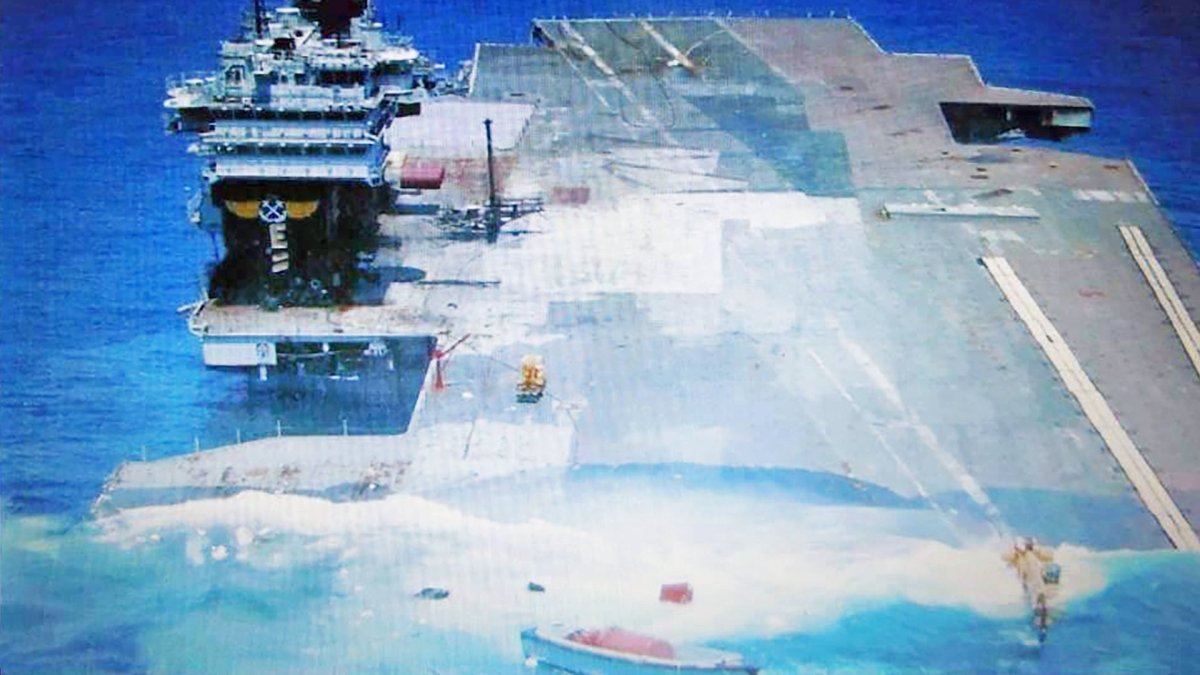
The image came to my attention when one of our most esteemed commenters and veteran S-3 Viking sensor operator, AncientSubHuntr, posted it in our discussion section. It shows the carrier’s bow deeply buried below the waterline, with waves coming up to the middle of the ship. But amazingly, beyond that, the tough ship looks well intact. Regardless, this is a haunting image that one can hope never gets repeated during an operational cruise, although some of America’s foes clearly wish otherwise .
The exact location of the ship, which at the time of its sinking was said to be roughly 300 miles off Virginia, was actually quite a bit further out according to this interesting article about its final resting place. The depth it rests at is also quite telling—nearly 17,000 feet down. Clearly, the Navy didn’t want anyone nosing around the hulk after it sunk.
The results of this mother of SINKEX drills remain classified, as do any other pictures or video of the operation. Hopefully, the exercise did help inform the design of USS Gerald R. Ford (CVN-78) and its successors. The closest thing to a test like this that the Navy’s new class of carriers will see will be shock trials , but the Navy has pushed to delay this critical series of tests possibly until the second Ford class supercarrier, USS John F. Kennedy (CVN-79) is plowing the seas. By that time, the third ship in the class, USS Enterprise (CVN-80) will already be deep in construction . And this is nothing compared to a SINKEX, as shock trials are used to see how critical components react to a nearby concussive blast and are not highly destructive in nature.
A photo shot not long after the tough ship slipped below the waves. , USN
But regardless, considering America stood up to four weeks of abuse and only succumbed to the sea after demolition teams scuttled the ship on purpose once and for all, it’s clear that America was built to sustain heavy damage in combat and still stay afloat. The big question now is do they still make ’em like they use to?
As for the USS America name, a new vessel sails with it today, the amphibious assault ship USS America (LHA-6) of the America class , which is already in its second design iteration .
It’s unlikely that another SINKEX of this magnitude will occur anytime in the foreseeable future. America’s nuclear supercarriers are far more challenging and expensive to dispose of compared to their conventionally powered predecessors. Scrapping USS Enterprise (CVN-65), America’s first nuclear supercarrier, is slated to take a decade and a half and cost a whopping $1.5B . Making one of these ships environmentally suitable for sinking would likely cost far more money and that’s if it’s even really feasible at all.
A wider angle of the image was posted on Facebook in one of the groups I follow. It shows the bow totally submerged. Supposedly it hangs somewhere in the Pentagon:
Facebook user submission
The ship’s deck was bowed downward around the landing area and large holes were punctured in the deck around the forward catapults. Supposedly, the ship’s hull had massive fissures in it and the hangar deck was obliterated by the time it was ready to be scuttled.
In addition, we have found out from another source that the carrier’s hangar bay was packed with ex-Ohio Air National Guard A-7Ds that had been sent to Aberdeen Proving Ground. They were barged over to the carrier and loaded aboard before it headed out to the target area. So one of the goals of the operation was to see how aircraft reacted to explosions inside the ship’s hangar bay.
We can’t thank everyone enough for helping provide new information about this intriguing story and for sharing their personal experiences of their time aboard this iconic ship. Please keep them coming!
Contact the author: Tyler@thedrive.com
Comments couldn’t be loaded. Please refresh the page.
更新于美国东部时间2019年7月16日凌晨2:00
超级航母是美国力量投射的终极形式,也是世界上其他任何海军都不具备的能力。它们是世界上最昂贵的舰艇——更不用说其搭载的武器了。在未来十年,一艘福特级超级航母(尼米兹级航母的继任者)的造价将几乎相当于加拿大全年的国防预算,这还不包括部署在舰载机联队中的价值数十亿美元的飞机。但真正无可替代的是近6000名在航母上服役的官兵。
考虑到所有这些因素,很难想象这些国家瑰宝中的一艘会在战斗中沉没,尽管好莱坞也曾不时地玩弄过这种想法。但坦白说,这并非不可能,尤其是在如今,势均力敌的对手日益壮大,反水面作战也变得更加复杂和致命——充满了各种新型的低端和高端威胁。
“杰拉尔德·R·福特”号航空母舰(CVN-78)是美国海军五十年来第一艘新型超级航母。
负责设计和建造这些海上巨兽的人们必须考虑到这一现实,并且至少要尽一切可能提高船舶及其船员的生存能力,以防难以想象的事情成为现实。
进入21世纪,美国海军着手规划其航母舰队的未来,并计划设计一种新型超级航母。为了提高其生存能力,他们需要了解特定类型武器对这种巨型战舰的实际效果及其造成的损害。问题在于,自20世纪50年代“福雷斯托尔”号(CV-59)航母下水以来,美国超级航母从未被击沉过。以往的数据大多基于模拟,且主要来自较老旧、较小的航母和水面作战舰艇的沉没案例,这些案例并不能真正代表超级航母的独特属性。
1976年巡航期间拍摄的“美国”号航空母舰舰岛照片。请注意甲板上种类繁多的飞机——A-7、A-3、A-5、S-2和F-4。还可以看到一架SH-2直升机。(美国海军)
受冷战结束的推动,美国常规动力航母在20世纪90年代和21世纪初陆续退役。尽管一些机构曾试图将这些航母收购并改建为博物馆,但由于其体积庞大、运输和维护成本过高,最终只能出售拆解。只有“约翰·F·肯尼迪”号航空母舰(CV-67)——其特殊性较为突出——目前仍被保留待捐赠。近期,“小鹰”号航空母舰(CV-63)曾被考虑翻新并重新服役,以帮助海军实现355艘舰艇的目标,但该计划已被搁置,很可能是出于正当理由。
20世纪80年代初,美国海军“美利坚”号航空母舰在巡航期间。
但其中一艘封存的超级航母——“美国”号(CV-66)——却免于被拆解,最终沉入海底。这艘于1996年退役的“小鹰”级航母被用作破坏性试验平台,以便海军能够深入了解超级航母如何应对各种形式的攻击。这些经验将直接应用于“尼米兹”级后续超级航母的研发项目。
对于这艘传奇的战舰来说,这是一个崇高却又令人毛骨悚然的事业。
然而,反对的声音依然存在。故意击沉一艘名为“美国”号的军舰的想法激怒了包括曾在该舰服役的老兵在内的一些人。这艘军舰曾参与美国历史上的诸多重要时刻——越南战争、海湾战争、利比亚作战行动以及其他许多著名任务——在其相对短暂的31年服役生涯中,数万名水兵曾以这艘军舰为家。
1991年海湾战争后,美国海军四艘航母组成“祖鲁战斗群”;“美国”号(右下)与“中途岛”号(左上)、“西奥多·罗斯福”号(右上)和“游骑兵”号(左下)一同巡航。
然而,海军坚持要将这艘军舰用于这最后一个用途。2005年,时任海军作战副部长约翰·纳斯曼海军上将解释了海军的理由:
“美国号将为我国国防做出最后一次至关重要的贡献,这次是作为实弹测试和评估平台。美国号的功绩将为未来航母的设计奠定基础——这些航母将保护美国退伍军人的子孙后代。我们将进行一系列水线以上和水线以下的综合测试,收集数据供海军建筑师和工程师用于打造国家未来的航母舰队。确保这些航母拥有尽可能高的生存能力至关重要。任务完成后,美国号将悄然沉入海底。我知道美国号在你们心中有着非常特殊的地位,不仅因为它的名字,也因为你们曾在这艘航母上服役。我恳请你们理解我们为何选择这艘航母执行这最后一次至关重要的任务,并牢记它最后服役的重大意义。”
“美国将为国防做出最后也是至关重要的贡献,这次是作为实弹测试和评估平台。美国的这一贡献将为未来航母的设计留下印记——这些航母将保护美国退伍军人的子孙后代。我们将进行一系列水线以上和水线以下的综合测试,收集数据供海军建筑师和工程师用于打造国家未来的航母舰队。”
我们必须尽可能提高这些舰船的生存能力。
当这项任务完成后,“美国”号将悄然沉入海底。我知道“美国”号在你们心中有着非常特殊的地位,不仅因为它的名字,更因为你们曾在这艘船上服役。我恳请你们理解我们为何选择这艘船执行这最后一次至关重要的任务,并牢记它最后使命的重大意义。
2005年4月19日,在完成击沉演习(SINKEX)准备工作后,前“美国”号航空母舰被拖至弗吉尼亚海岸数百英里外。抵达指定位置后不久,猛烈的攻击便开始了。舰体水线以上和水线以下都遭到了爆炸的猛烈冲击。经过近四周的持续攻击,这艘航母最终被凿沉。2005年5月14日,舰尾沉入水线以下,这艘航母开始了沉没海底的旅程。
这张照片引起了我的注意,是一位我们最尊敬的评论员之一,也是一位经验丰富的S-3“维京”反潜巡逻机操作员——AncientSubHuntr——在讨论区发布的。照片显示,航母的船首深深地埋在水线以下,海浪涌到船体中部。但令人惊讶的是,除此之外,这艘坚固的战舰看起来完好无损。无论如何,这是一张令人不安的照片,我们都希望这样的景象永远不会在作战巡航中重现,尽管美国的一些对手显然并不希望如此。
据称,这艘船沉没时位于弗吉尼亚州海岸约300英里处,但根据这篇关于其最终沉没地点的有趣文章,实际位置要远得多。它的沉没深度也颇具启发性——近17000英尺深。显然,海军不希望任何人在它沉没后靠近这艘残骸。
这次规模空前的沉没演习的结果以及任何其他相关图片或视频都属于机密。希望这次演习确实能为“杰拉尔德·R·福特”号航空母舰(CVN-78)及其后续舰艇的设计提供参考。海军新一代航母将要经历的最接近此类测试的是冲击试验,但海军一直力主推迟这项关键测试,可能要等到第二艘福特级超级航母“约翰·F·肯尼迪”号(CVN-79)下水之后才会进行。届时,该级第三艘航母“企业”号(CVN-80)的建造工作应该已经接近尾声。而且,冲击试验与沉没演习相比简直微不足道,因为冲击试验旨在检验关键部件在近距离冲击波作用下的反应,其破坏性并不强。
这张照片拍摄于这艘坚固的军舰沉入海底后不久。(美国海军)
但无论如何,考虑到“美国”号经受住了长达四周的猛烈攻击,最终只是在爆破队彻底凿沉后才沉入海底,这清楚地表明,“美国”号的设计初衷就是为了在战斗中承受重创并保持漂浮。现在最大的问题是,他们还能像以前那样造出这样的战舰吗?
至于“美国”号这个名字,如今一艘新舰艇正以它命名,即美国级两栖攻击舰“美国”号(LHA-6),该舰已经是第二代设计版本了。
在可预见的未来,不太可能再发生如此大规模的核潜艇拆解事件。与传统的常规动力航母相比,美国的核动力超级航母的处置难度更大,成本也更高。拆解美国首艘核动力超级航母“企业”号(CVN-65)预计耗时十五年,耗资高达15亿美元。而要让其中一艘航母达到环保沉没标准,成本可能远不止于此,而且这还是在技术上可行的前提下。
我在关注的一个Facebook群组里看到了这张更广角的照片。照片显示弓箭完全沉入水中。据说它现在挂在五角大楼的某个地方。
Facebook 用户提交
舰体甲板在着陆区附近向下弯曲,前部弹射器周围的甲板上被戳出了许多大洞。据说,舰体本身也布满了巨大的裂缝,而当这艘船准备凿沉时,机库甲板早已被彻底摧毁。
此外,我们从另一渠道获悉,这艘航母的机库里停满了从俄亥俄州空中国民警卫队调往阿伯丁试验场的A-7D攻击机。这些飞机先用驳船运到航母,装载完毕后,航母才驶往目标区域。因此,此次行动的目标之一就是观察飞机在舰艇机库内爆炸时的反应。
我们衷心感谢大家提供关于这个引人入胜的故事的新信息,并分享他们在这艘标志性邮轮上的亲身经历。请继续分享!
联系作者:Tyler@thedrive.com
评论加载失败,请刷新页面。