We Talk Everything S-97 Raider And SB>1 Defiant With Sikorsky’s Top Program Officials我们与西科斯基公司的高层项目官员畅谈S-97“突袭者”和SB>1“挑战者”的一切
Sikorsky is betting huge on its X2 technology, but there's still much to understand about it and how they see it as the future of vertical lift.
新闻视频
Updated Dec 1, 2019 6:49 AM EST
When it comes to the U.S. military, the very idea of what vertical lift is and what type of aircraft fulfills those roles is slated to drastically change in the coming decades. So much is on the line when it comes to redefining the performance and capabilities of the Pentagon’s helicopter portfolio with the Future Armed Reconnaissance Aircraft (FARA) , Future Long Range Assault Aircraft (FLRAA), and other future multi-faceted Future Vertical Lift (FVL) tenders on the horizon, and others, as well . Whoever wins any of these competitions will be in the driver’s seat when it comes to expanding their proprietary technologies across the Department of Defense and well into the middle part of the 21st Century. Sikorsky, now owned by Lockheed Martin, is in a very interesting position to potentially lead on many fronts in this regard after investing millions in corporate funds into its high-performance X2 helicopter technology over the better part of two decades.
Still, the storied Black Hawk manufacturer has some stiff competition, including from its longtime rival Bell, for both the FLRAA and FARA contracts, while other players are also coming to the table with potentially attractive concepts of varying maturity and complexity that are likely to clock in at a wide range of price points . With the stakes so high, The War Zone reached out to Sikorsky, just as we did with Bell , to get their direct take at the highest levels on many questions surrounding their exciting new aircraft, the competitions that lie ahead, and the future of vertical lift in general.
A remarkably accomplished group of folks over at Sikorsky fielded our questions, including Tim Malia, Director of Sikorsky Future Vertical Lift—Light. Bill Fell, senior experimental test pilot for Sikorsky’s S-97 and joint multi-role programs, also joined in. And last, but certainly not least, Chris Van Buiten, Vice President, Sikorsky Innovations. Here are those exchanges in full:
What makes the S-97, and its X2 Technology that Sikorsky pioneered, different than a normal helicopter?
Bill Fell: “ The X2 is different in that the two rotors are used to balance lift required between the upper and lower discs. By limiting the lift that is required on the retreating side of the disc, we eliminate the aerodynamic speed limit of other rotorcraft known as retreating blade stall. This lift distribution results in a lift imbalance on each individual rotor that is overcome by making the rotors extremely rigid. This rigidity has the added benefit of provide enormous control power for combat maneuvering tactics. Producing most of the lift on the advancing half of the disc means the blades are operating at a very low angle of incidence, resulting in less drag and more load factor capability.”
Some of the terminologies has changed and the schedule has shifted a bit, but this graphic gives a good overview of the evolution of Sikorsky’s X2 technology. , Sikorsky
Is the S-97 RAIDER a technology demonstrator or is Sikorsky looking to push the design directly into production? What informed the design’s unique mix of capabilities?
Tim Malia: “ First, I’d like to say that Sikorsky is proud to have been awarded a contract to design a Future Attack Reconnaissance Aircraft [FARA] prototype. This is the culmination of years of investment in the X2 Technology Demonstrator and the S-97 RAIDER aircraft that have proven the advanced technology and shown its ability to change the future battlefield. The FARA mission is critical to our nation’s defense as our near-peer adversaries continue to improve their capabilities. FARA will plug a critical gap in the Army force structure that requires revolutionary technology and not just incremental improvements to existing platforms.
The original X2 Technology Demonstrator was developed to prove the advancing blade concept was going to unlock speed and maneuverability and increase the survivability under battle conditions. The S-97 RAIDER was a step up from the original demonstrator to make more production representative to get full mission envelope testing. While still considered a demonstrator, its utility expands to include several critical attributes of interest to the Army. We continue to fly the S-97 RAIDER to inform the design for FARA, which provides significant risk reduction to the program schedule and technical objectives. We are eager to continue to support the U.S. Army, and we are excited that the Sikorsky FARA X2 will be ready for this critical mission.
The term X2 Technology refers to a suite of technologies developed by Sikorsky that enable the X2 aircraft to operate at high speed while improving operational capability, maneuverability, agility, survivability, and lethality at the landing zone.”
S-97 RAIDER, Sikorsky
Have there been certain technological hurdles that have been especially challenging to get over during the S-97’s development?
Tim Malia: “ When we started working on X2 Technology, we were focused on designing for speed, maneuverability, and scalability. The X2 Technology Demonstrator made significant improvements in vibration reduction, weight reduction, and blade technology. The rigid coaxial blades help maintain lift and stability at high speeds. We took many of our lessons learned in the design and flight test of the X2 Technology Demonstrator into RAIDER and the Sikorsky-Boeing SB>1 DEFIANT. The process was a logical technical maturation.
The X2 technology demonstrator proved the physics—speed, vibes, and workload. The technology won the Collier award and the demonstrator was put in the Smithsonian. The X2 had a gross weight of 6,000 pounds, RAIDER grows to double the gross weight and adds operational features. DEFIANT grows the gross weight to above 30,000 pounds to demonstrate the long-range, 12-troop transport capability.”
Can you give us some approximate performance targets for the S-97 and the SB>1?
Bill Fell: “ RAIDER is designed to be a 220-230 knot aircraft in level flight. We have achieved 202 knots and will soon push the envelope even more. RAIDER has been test flown at weights of ranging from about 9,500 to 11,000 pounds. DEFIANT is a larger aircraft in excess of 25,000 pounds with more payload, speed capability, and range.”
SB>1 concept art. , Sikorsky
Cost should be a major factor for the Future Vertical Lift tender. How much more expensive will this more complex, fast-flying design be than say one of your UH-60 Black Hawks that continue to roll off the line today? What about the cost to operate it over time?
Tim Malia: “ I think the first point to clarify is that our X2-based FARA is not more complex than a BLACK HAWK. In fact, despite having two main rotors, there are one-half the total parts in the S-97 RAIDER rotor head than on a BLACK HAWK. This reduction in complexity and part count saves money from a sustainment perspective with less parts to maintain and spare. To that end, the rigid rotor system no longer has flapping and lead/lag modes which eliminates the dampers that are a routine maintenance element on a BLACK HAWK.
I’d also add that the development of X2 Technology and the RAIDER program has been funded entirely by significant investments by Sikorsky, Lockheed Martin, and industry partners. As we have made those investments, it has been to change the way we do vertical lift—decrease life-cycle costs, eliminate maintenance burdens. We will provide revolutionary aircraft that not only change the way that we fly our missions and reducing the maintenance requirements that traditional rotorcraft have historically provided. We don’t have to make compromises with X2.
The other big-picture benefit of X2 will become apparent as the Army looks across their vertical lift inventory. X2 is the only scalable technology on the table for the Army to consider in their diverse missions. The Army today has three very different aircraft types to maintain, support, and grow capability through technology insertions. Tomorrow they could all reside on the X2 platform, scaled to serve the three very different mission sets. As you look at having X2 in both the Attack/Recon and the Utility/Long Range Assault FVL variants, you can start to envision maintenance and flight training commonality across the entire fleet. When the attack replacement occurs, they can be on the common technology platform across the service. This is an enormous opportunity for the Army to reduce future costs of operations. With the fiscal constraints across the Army, this will be a very welcome change.”
SB>1 DEFIANT in flight., Sikorsky
In regards to maintenance, how will servicing the S-97 or the SB>1 be different than a traditional helicopter with equal capacity?
Chris Van Buiten: “ The most significant servicing difference between the Rigid Coaxial design and a traditional helicopter is that the rigid rotor does not have Main Rotor Dampers. Dampers are typically the highest maintenance items on a helicopter and we do not need them. Other than that, the complexity and supportability is similar. On our next generation of aircraft, the big difference will come from the advanced diagnostic and prognostic systems both onboard and off-board that optimize system maintenance to control costs and maximize availability.”
SB>1 DEFIANT., Sikorsky
How does a pilot fly the S-97? In other words, how does the aircraft operate different from traditional helicopters from a pilot’s perspective?
Bill Fell: “ RAIDER can be flown the same as every other rotorcraft when the prop is disengaged via a clutch. The rotor is controlled through both a cyclic and collective. When the prop is engaged the pilot releases the collective around 100-knots as the flight control computer (FCC) programs the collective down with increasing speed. RAIDER is flown like an airplane above 100 knots with speed increased by increasing prop pitch via a beeper switch on the collective. In this mode, RAIDER climbs by pointing the nose up and adding prop or lowering the nose to descend. The collective is still functional in high-speed flight such that the pilot can increase the collective to climb but using the prop tends to be more efficient.”
Back in August of 2017, the Raider prototype suffered a hard landing during a test flight. What happened there and what’s the status of the test program now?
Tim Malia: “Aircraft 1 did experience the mishap 21 months ago and we very quickly found the issue in the software that arose from a corner case where the aircraft was going in and out of flight and ground modes while doing air/ground taxi maneuvers. The test pilot immediately knew something was not behaving as expected and put the aircraft down quickly. He performed an orderly shutdown of the aircraft and walked away. It is a testament to the overall design of RAIDER.
We were so confident in the technology and the fix to the software that we immediately launched the completion of aircraft 2 and resumed flight testing. We continue to exceed expectations in flight test, and we are looking forward to continued flights that will demonstrate the game-changing speed and maneuverability capabilities of this aircraft and X2 Technology.”
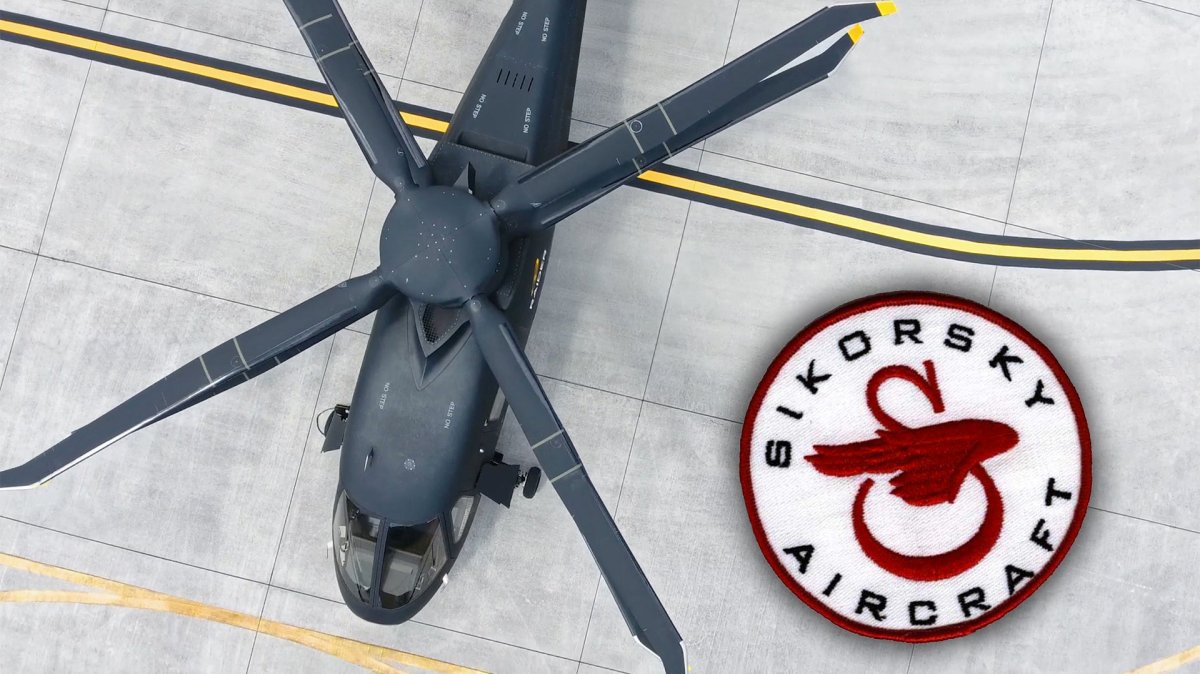
S-97 is one impressive looking flying machine. , Sikorsky
Future Vertical Lift is actually made up by a number of requirement tiers. Do you think there is room for both Sikorsky’s X2 coaxial compound configuration and Bell’s tilt-rotor configuration to satisfy different mission sets? Or do you see it more as a winner takes all proposition with one technology being pursued across all missions requirements?
Chris Van Buiten: “ There is room for both if some of the missions do not require the maneuverability, agility, and other attributes that enable terminal area survivability (surviving at the landing zone). If there are long-range “school bus” missions, we are not focused on them.
Our focus is to provide game-changing capability that is achieved by integrating familiar technologies in a new way. It is important to our team to design an aircraft that will retain what our customers love about a BLACK HAWK while giving them huge advances in speed, efficiency, maneuverability, and survivability.”
What military variants of this compound coaxial helicopter concept do you see as being feasible? How large can it scale up to?
Chris Van Buiten: “ We see a wide spectrum of variants including special operations, recon, attack, assault, Naval, SAR, and VIP. The technology scales. The X2 Technology Demonstrator was 6,000 lb gross weight, RAIDER is 12,000, and DEFAINT is 32,000 lb gross weight. We have executed a study contract looking at a 100,000 lb variant of this configuration.”
Concept art showing the SB>1 next to a gunship variant, both of which could satisfy the Army’s Future Vertical Lift requirement. , Sikorsky
There is a lot of confusion about the Raider’s low-observable (stealth) qualities, or lack thereof. Can you set the record straight when it comes to the design’s radar signature? What about its infrared and acoustic signatures?
Tim Malia: “ We can’t comment specifically about any classified elements of the design or operation in the intended environment. We are focused on the future battle and future adversaries and providing the technology that maximizes the survivability of the platform and the crew. This is a crucial mission. It is at the front lines and into enemy territory, and it takes a platform with both the speed and agility as well as onboard systems and sensors to operate in a contested A2AD environment. We are able to leverage the full strength of Lockheed Martin to provide a solution that will change the way we fight and win any future conflicts.”
H ave elements of the aborted RAH-66 Comanche program carried over to the S-97 or any other Sikorsky program?
Chris Van Buiten: “ While we are not using any specific Comanche parts, some of the technologies and processes from Comanche are being used.”
Who do you see being potential customers for the S-97? How will it fit into the U.S. Army’s Future Attack Reconnaissance Aircraft initiative? Can you explain how you see it fitting into that program and will there be major configuration changes to the Raider’s design in order make the S-97 fit better with the program’s goals?
Tim Malia: “RAIDER is so closely aligned to the solution needed by the Army. It was originally designed for the AAS (Armed Aerial Scout) program and now with the evolving threat and a shift to a near-peer adversary, it is necessary to increase the size of the platform for FARA to best handle the future missions. This involves scaling the platform up slightly to increase its payload/range/time on station performance that retains an asymmetric advantage over future adversaries.
One great advantage to X2 is its scalability from S-97 RAIDER to a FARA configuration, and as evidenced by DEFIANT, up to an aircraft three times larger than RAIDER. With conventional helicopters, it’s questionable if you can scale up slightly in performance marginally to meet FARA desired attributes. If the desired attributes are marginally achieved, we see that as being the end of the road for conventional helicopters, leaving no ability to grow to higher payloads nor higher speeds in the future. Additionally, the handling qualities of the conventional helicopter operating at the far end of the capability curve will hurt the survivability of the platform and crew.
X2 provides the growth that will be needed in the future as the threat evolves and the requirements become more difficult. It is important to remember that these aren’t unsubstantiated claims of a paper design, we are proud to have made tremendous private investment to build and fly RAIDER to prove out the technology and the ability to change the future of aviation.”
S-97 speeding over Florida wetlands during testing. , Sikorsky
How will the S-97 be able to survive on the battlefields of the future? Are there other technologies that Sikorsky is looking to pair with it for synergistic effects?
Chris Van Buiten: “ S-97 RAIDER will survive on the modern battlefield by being nearly twice as fast, twice as maneuverable, and nearly half the sound. When you combine these attributes, you see game-changing survivability. We have quantified this difference using man in the loop survivability simulations. Our MATRIX autonomy solution will enable RAIDER to operate safely very close to the ground at speed to enhance survivability with acceptable workload.
Sikorsky and Lockheed Martin have a full spectrum of additional technologies to deploy to further enhance the survivability beyond the basic vehicle. An interesting future synergistic effect could be directed energy weapons [DEWs]. An X2 Technology airplane with a DEW and inflight refueling provides a remarkable recon attack capability that does not need to rearm and refuel on the ground. The ability to easily refuel at tanker speeds and altitudes is an enabler here. This is a future game changer.”
Is Sikorsky looking at porting the S-97’s X2 technology over to the unmanned space? Bell just unveiled a full-size mockup of their V-247 tilt-rotor combat drone . Could a ‘MQ-97’ compete against it? What about using an unmanned variation of the design the USMC’s new MUX program ?
Chris Van Buiten: “ Our FVL solutions will meet emerging customer requirements to flexibly operate with 2 crew, 1 crew, or zero crew, depending on mission needs. This provides tremendous flexibility to the warfighter. The customer calls this capability “Optimally Piloted.” We are flying on our SARA (Sikorsky Autonomy Research Aircraft) demonstrator now and will be flying on BLACK HAWK in the near future. It is interesting to think about a wolfpack of RAIDER aircraft executing missions in which some are manned and many are not. This technology will also significantly improve the safety of future platforms.”
RAIDER concept art. , Sikorsky
It seems like the S-97 and the SB>1 designs would have many applications outside of Future Vertical Lift or the armed reconnaissance role—or even military uses for that matter—such as search and rescue and even commercial and private applications. Has there been any interest in the designs outside of the Pentagon? Do you see this as a niche capability or will traditional helicopters eventually be viewed as lower-end vertical lift platforms?
Chris Van Buiten: “ There is significant international and commercial interest in the technology. It will be interesting to see what fraction of traditional helicopter applications transition to this capability. This will be much more than a niche.”
How has Lockheed’s acquisition of Sikorsky impacted the S-97 program?
Chris Van Buiten: “ The acquisition has been great for Sikorsky. First of all, the RAIDER program never missed a beat. Lockheed leadership has been supportive of RAIDER 100%. As we proposed an aircraft based on X2 Technology to the Army for the FARA requirements, we are able to bring to bear a wide spectrum of systems and capabilities from across the corporation.”
Can you tell us three things we probably don’t know about the S-97 Raider?
Bill Fell: “ 1. Normal rotor RPM is from 85 to 100% as the rpm decreases automatically with speed to reduce rotor drag.
2. When you fly in helicopter mode with the prop disengaged RAIDER is very quiet.
3. If the engine were to quit at 200+ knots the pilot has on the order of 20-30 seconds of level deceleration holding altitude before he has to lower the collective. The FCC automatically reduces the prop power requirement and energy is fed into the system while decelerating to maintain rotor RPM. This gives the pilot a comparative eternity to search for a forced landing area.
It’s exciting to achieve these high speeds with X2 Technology. It’s undeniably important for the warfighter to get to the mission fast. And once they get there, X2 Technology provides the critical handling qualities that make the aircraft survivable, lethal, and agile. X2 Technology changes the way we fly and fight—we can get there fast, be more effective while on the scene, and we can get out fast.”
A big thanks to all the participants in this Q&A and to Sikorsky’s Melissa Chadwick for working with me to make it happen.
Contact the author: Tyler@thedrive.com
Comments couldn’t be loaded. Please refresh the page.
更新于美国东部时间2019年12月1日上午6:49
就美国军方而言,垂直起降的概念以及执行这些任务的飞机类型将在未来几十年发生翻天覆地的变化。未来武装侦察机(FARA)、未来远程突击机(FLRAA)以及其他即将启动的多用途未来垂直起降(FVL)项目招标,都将重新定义五角大楼直升机产品组合的性能和能力,而这些招标项目以及其他项目也同样至关重要。任何赢得这些竞标的公司都将在国防部推广其专有技术方面占据主导地位,并有望在21世纪中叶继续发挥作用。西科斯基公司(现已被洛克希德·马丁公司收购)在过去近二十年中投入数百万美元用于其高性能X2直升机技术的研发,使其在诸多方面都处于领先地位,这无疑为其在这一领域奠定了非常有利的地位。
尽管如此,这家历史悠久的黑鹰直升机制造商仍面临着激烈的竞争,包括来自其老对手贝尔公司的竞争,双方都在争夺FLRAA和FARA合同。与此同时,其他厂商也纷纷携各自极具吸引力的方案加入竞争,这些方案成熟度和复杂程度各不相同,价格也可能相差悬殊。鉴于此次竞争如此激烈,《战区》栏目联系了西科斯基公司,就像我们之前联系贝尔公司一样,希望从高层那里获得关于其令人兴奋的新飞机、未来竞争以及垂直起降技术未来发展等诸多问题的第一手意见。
西科斯基公司一群杰出的专家回答了我们的问题,其中包括西科斯基未来垂直起降轻型飞机项目总监蒂姆·马利亚 (Tim Malia)。西科斯基S-97和联合多用途飞机项目的高级实验试飞员比尔·费尔 (Bill Fell) 也参与了讨论。最后,但同样重要的是,西科斯基创新副总裁克里斯·范·布伊滕 (Chris Van Buiten) 也出席了会议。以下是完整的交流内容:
西科斯基公司首创的S-97及其X2技术与普通直升机有何不同?
比尔·费尔:“X2的独特之处在于,它利用两个旋翼来平衡上下旋翼盘所需的升力。通过限制旋翼盘后退侧所需的升力,我们消除了其他旋翼机常见的后退桨叶失速的气动速度限制。这种升力分配导致每个旋翼上的升力不平衡,而我们通过使旋翼具有极高的刚性来克服这一不平衡。这种刚性还带来了额外的好处,即为战斗机动战术提供了巨大的控制力。由于大部分升力都由旋翼盘前进侧产生,因此桨叶以极低的迎角运行,从而降低了阻力,提高了载荷系数。”
部分术语有所变化,时间表也略有调整,但这张图表很好地概述了西科斯基X2技术的演变历程。
S-97 RAIDER 是一款技术验证机,还是西科斯基公司打算直接将该设计投入生产?是什么促成了该设计独特的功能组合?
蒂姆·马利亚:“首先,我想说西科斯基公司很荣幸获得未来攻击侦察机(FARA)原型机的设计合同。这是多年来在X2技术验证机和S-97 RAIDER飞机上投入的成果,这两款飞机已经验证了先进技术,并展现了其改变未来战场的能力。随着势均力敌的对手不断提升自身能力,FARA的任务对我国国防至关重要。FARA将填补陆军部队结构中的一个关键缺口,它需要革命性的技术,而不仅仅是对现有平台进行渐进式改进。”
最初的X2技术验证机旨在验证先进的旋翼概念能够提升速度和机动性,并增强战地生存能力。S-97 RAIDER是在最初验证机的基础上改进而来,更具量产代表性,能够进行全面的任务包线测试。虽然它仍被视为验证机,但其用途已扩展至涵盖陆军关注的几项关键属性。我们持续进行S-97 RAIDER的飞行测试,以指导FARA的设计,从而显著降低项目进度和技术目标实现的风险。我们渴望继续支持美国陆军,并对西科斯基FARA X2能够胜任这项关键任务感到无比兴奋。
X2 技术是指西科斯基公司开发的一系列技术,这些技术使 X2 飞机能够在高速飞行的同时,提高其作战能力、机动性、敏捷性、生存能力以及在着陆区的杀伤力。
S-97“袭击者”,西科斯基
S-97 的研发过程中是否存在一些特别难以克服的技术障碍?
蒂姆·马利亚:“我们最初研发X2技术时,专注于速度、机动性和可扩展性的设计。X2技术验证机在减振、减重和桨叶技术方面取得了显著进步。刚性同轴桨叶有助于在高速飞行时保持升力和稳定性。我们将X2技术验证机设计和飞行测试中积累的许多经验应用到了RAIDER和西科斯基-波音SB>1 DEFIANT项目中。这是一个合乎逻辑的技术成熟过程。”
X2 技术验证机验证了其物理特性——速度、振动和工作负荷。该技术荣获科利尔奖,验证机也被史密森尼博物馆收藏。X2 的总重量为 6,000 磅,RAIDER 的总重量是 X2 的两倍,并增加了作战功能。DEFIANT 的总重量增加到 30,000 磅以上,以验证其远程 12 人运输能力。
能否提供 S-97 和 SB>1 的一些大致性能目标?
比尔·费尔:“RAIDER的设计目标是在平飞中达到220-230节的速度。我们已经达到了202节,并且很快会进一步突破这一极限。RAIDER的试飞重量在9500到11000磅之间。DEFIANT是一款更大的飞机,重量超过25000磅,拥有更大的有效载荷、更快的速度和更远的航程。”
SB>1概念艺术图,西科斯基
成本应该是未来垂直起降项目招标中的一个重要考量因素。这种更复杂、飞行速度更快的机型,相比目前仍在生产的UH-60黑鹰直升机,成本会高出多少?长期运营成本又是多少?
蒂姆·马利亚:“我认为首先需要澄清的是,我们基于X2平台的FARA并不比黑鹰直升机更复杂。事实上,尽管它有两个主旋翼,但S-97 RAIDER旋翼头的零件总数只有黑鹰直升机的一半。这种复杂性和零件数量的减少,从维护角度来看节省了成本,因为需要维护和备件更少。因此,刚性旋翼系统不再具有挥舞和前导/后导模式,从而省去了黑鹰直升机上需要定期维护的阻尼器。”
我还想补充一点,X2技术和RAIDER项目的研发完全由西科斯基、洛克希德·马丁和行业合作伙伴的大量投资资助。我们进行这些投资的目的是为了改变垂直起降的方式——降低全寿命周期成本,消除维护负担。我们将提供革命性的飞机,它不仅会改变我们执行任务的方式,还会减少传统旋翼机历来存在的维护需求。使用X2技术,我们无需做出任何妥协。
X2的另一项宏观优势将在陆军审视其垂直起降装备时显现出来。X2是陆军目前唯一可用于执行各种任务的可扩展技术。陆军目前需要维护、支持三种截然不同的飞机,并通过技术升级来提升其能力。未来,它们都可以部署在X2平台上,并根据三种不同的任务需求进行扩展。考虑到X2平台同时应用于攻击/侦察型和通用/远程突击型FVL(未来垂直起降)飞机,我们可以预见整个机队在维护和飞行训练方面将实现通用化。当攻击型飞机进行替换时,全军都可以使用相同的技术平台。这对陆军来说是降低未来作战成本的绝佳机会。在陆军面临财政紧缩的情况下,这将是一个非常受欢迎的变革。
SB>1 DEFIANT 飞行中,西科斯基
在维护方面,S-97 或 SB>1 的维护与同等容量的传统直升机有何不同?
克里斯·范·布伊滕 (Chris Van Buiten) 表示:“刚性同轴旋翼设计与传统直升机在维护方面最显著的区别在于,刚性旋翼没有主旋翼减震器。减震器通常是直升机维护成本最高的部件,而我们不需要它们。除此之外,两者的复杂性和可维护性基本相似。我们下一代飞机的最大区别将体现在机载和机外先进的诊断和预测系统上,这些系统能够优化系统维护,从而控制成本并最大限度地提高可用性。”
SB>1 反抗者,西科斯基
飞行员如何驾驶 S-97?换句话说,从飞行员的角度来看,这种飞机的操作方式与传统直升机有何不同?
比尔·费尔:“当螺旋桨通过离合器脱离时,RAIDER 的飞行方式与其他旋翼机相同。旋翼由周期变距杆和总距杆共同控制。当螺旋桨接合时,飞行员会在速度达到约 100 节时松开总距杆,此时飞行控制计算机 (FCC) 会根据速度的增加自动降低总距杆。RAIDER 在速度超过 100 节后,飞行方式与普通飞机类似,通过总距杆上的蜂鸣器开关来增加螺旋桨桨距,从而提高速度。在这种模式下,RAIDER 通过抬高机头并增加螺旋桨桨距来爬升,或通过降低机头来下降。总距杆在高速飞行中仍然有效,飞行员可以通过增加总距杆来爬升,但使用螺旋桨通常效率更高。”
2017年8月,Raider原型机在一次试飞中遭遇硬着陆。当时发生了什么?目前的测试项目进展如何?
蒂姆·马利亚:“1号飞机在21个月前确实发生过事故,我们很快就找到了软件问题所在。这个问题源于一个特殊情况:飞机在进行空地滑行机动时,频繁地在飞行模式和地面模式之间切换。试飞员立即意识到情况异常,迅速降落飞机。他有序地关闭了飞机,然后离开了。这充分证明了RAIDER的整体设计非常出色。”
我们对这项技术和软件修复方案充满信心,因此立即启动了第二架飞机的制造工作并恢复了飞行测试。飞行测试结果持续超出预期,我们期待着继续飞行,以展示这款飞机和X2技术带来的颠覆性速度和机动性。
S-97 是一款外形令人印象深刻的飞行器。——西科斯基
未来的垂直起降飞行器实际上由多个需求层级构成。您认为西科斯基的X2同轴复合式结构和贝尔的倾转旋翼结构能否同时满足不同的任务需求?或者您认为这更像是一种“赢家通吃”的局面,最终只有一种技术能够满足所有任务需求?
克里斯·范·布伊滕:“如果某些任务不需要机动性、敏捷性以及其他能够确保末段区域生存(在着陆区生存)的属性,那么两者都有存在的空间。如果存在远程‘校车’任务,我们就不会将重点放在这些任务上。”
我们的目标是通过以全新的方式整合现有技术,提供颠覆性的能力。对我们的团队而言,设计一款既能保留客户喜爱“黑鹰”系列飞机的所有优点,又能在速度、效率、机动性和生存能力方面带来巨大提升的飞机至关重要。
您认为这种复合式共轴直升机概念有哪些军用衍生型号是可行的?它的最大尺寸可以扩展到多大?
克里斯·范·布伊滕:“我们看到了各种各样的衍生型号,包括特种作战、侦察、攻击、突击、海军、搜救和要员保护。这项技术可以规模化。X2技术验证机的总重量为6000磅,RAIDER为12000磅,DEFAINT为32000磅。我们已经签署了一份研究合同,考察这种配置的100000磅衍生型号。”
概念图展示了SB>1及其武装直升机变型,两者都能满足美国陆军未来垂直起降(FVT)的需求。——西科斯基
关于“突袭者”战机的低可探测性(隐身)性能,或者说缺乏隐身性能,存在很多误解。您能否澄清一下该战机的雷达反射截面积?它的红外和声学特征又如何呢?
蒂姆·马利亚:“我们无法就设计或预期环境下的操作中的任何机密细节发表具体评论。我们专注于未来的战争和未来的对手,致力于提供能够最大限度提高平台和乘员生存能力的技术。这是一项至关重要的任务。它需要在前线和敌方领土作战,因此需要一个既具备速度和敏捷性,又拥有能够在对抗性反介入/区域拒止(A2AD)环境中作战的机载系统和传感器的平台。我们能够充分发挥洛克希德·马丁公司的全部实力,提供一种能够改变我们未来作战方式并赢得未来冲突的解决方案。”
中止的 RAH-66 科曼奇计划中的某些元素是否被沿用到 S-97 或任何其他西科斯基计划中?
克里斯·范·布伊滕:“虽然我们没有使用任何科曼奇公司的特定零件,但我们正在使用科曼奇公司的一些技术和工艺。”
您认为S-97的潜在客户有哪些?它将如何融入美国陆军的未来攻击侦察机计划?您能否解释一下您认为它如何融入该计划,以及为了使S-97更好地符合该计划的目标,突袭者的设计是否会有重大配置变更?
蒂姆·马利亚:“RAIDER系统与陆军所需的解决方案高度契合。它最初是为武装空中侦察(AAS)项目设计的,但随着威胁的演变以及对手逐渐接近势均力敌,FARA平台必须进行扩容,才能更好地应对未来的任务。这需要对平台进行小幅升级,以提高其有效载荷、航程和在位时间,从而保持对未来对手的非对称优势。”
X2的一大优势在于其可扩展性,从S-97 RAIDER到FARA配置均可实现,而且正如DEFIANT所证明的那样,其尺寸甚至可以达到RAIDER的三倍。对于传统直升机而言,能否通过略微提升性能来满足FARA所需的各项属性尚存疑问。即便勉强达到所需属性,我们也认为传统直升机的发展已接近极限,未来无法再提升有效载荷或飞行速度。此外,传统直升机在性能曲线末端运行时,其操控性能也会受到影响,进而危及平台和机组人员的生存能力。
X2 能够满足未来应对不断演变的威胁和日益严苛的要求所需的增长潜力。需要强调的是,这些并非纸上谈兵,我们为投入巨额私人资金建造并试飞 RAIDER 而感到自豪,这证明了该技术及其改变航空业未来的能力。
S-97 在佛罗里达州湿地进行测试时高速飞行。,西科斯基
S-97导弹系统如何在未来的战场上生存?西科斯基公司是否正在寻求将其与其他技术结合使用,以产生协同效应?
克里斯·范·布伊滕 (Chris Van Buiten) 表示:“S-97 RAIDER 导弹在现代战场上生存能力更强,速度几乎是其他导弹的两倍,机动性也几乎是其两倍,而噪音却只有其一半。这些优势的结合,使其拥有颠覆性的生存能力。我们利用人机交互生存能力模拟,量化了这种差异。我们的 MATRIX 自主系统解决方案将使 RAIDER 能够在极低空高速安全运行,从而在可接受的工作负荷下显著提升生存能力。”
西科斯基和洛克希德·马丁公司拥有一系列可部署的附加技术,能够进一步提升飞机在基本性能基础上的生存能力。定向能武器(DEW)可能带来一种有趣的未来协同效应。配备定向能武器并具备空中加油能力的X2技术飞机,将拥有卓越的侦察攻击能力,无需在地面重新装弹和加油。能够在加油机的速度和高度下轻松完成空中加油,是这项技术的关键所在。这将改变未来的游戏规则。
西科斯基公司是否考虑将S-97的X2技术移植到无人领域?贝尔公司刚刚发布了其V-247倾转旋翼战斗无人机的全尺寸模型。MQ-97能否与之竞争?或者,美国海军陆战队新的MUX项目的设计方案,如果采用无人版本又会如何呢?
克里斯·范·布伊滕 (Chris Van Buiten) 表示:“我们的 FVL 解决方案将满足客户不断变化的需求,根据任务需要灵活地以 2 人机组、1 人机组或无人机组运行。这为作战人员提供了极大的灵活性。客户将这种能力称为‘最优人机协同’。我们目前正在 SARA(西科斯基自主研究飞机)验证机上进行飞行测试,并将在不久的将来在 BLACK HAW 无人机上进行测试。想象一下,一群 RAIDER 无人机执行任务,其中一些有人驾驶,而许多无人驾驶,这真是令人兴奋。这项技术还将显著提高未来平台的安全性。”
《突袭者》概念图,西科斯基
S-97 和 SB>1 设计似乎除了未来垂直起降或武装侦察任务(甚至军事用途)之外,还有许多其他应用,例如搜救,甚至商业和私人用途。五角大楼以外,是否有人对这些设计感兴趣?您认为这是一种小众能力,还是传统直升机最终会被视为低端垂直起降平台?
克里斯·范·布伊滕:“这项技术引起了国际社会和商业界的极大兴趣。看看传统直升机应用中有多少会过渡到这种能力,将会很有意思。这绝不仅仅是一个小众领域。”
洛克希德收购西科斯基对S-97项目产生了什么影响?
克里斯·范·布伊滕:“这次收购对西科斯基来说意义重大。首先,RAIDER项目从未中断过。洛克希德·马丁的领导层对RAIDER项目给予了百分之百的支持。由于我们向陆军提交了基于X2技术的飞机方案以满足FARA的要求,我们能够调动公司内部各种系统和能力。”
你能告诉我们关于 S-97 Raider 的三件我们可能不知道的事情吗?
比尔·费尔:“1. 正常转子转速为 85% 至 100%,转速会随着速度的增加而自动降低,以减少转子阻力。
2. 当螺旋桨脱离啮合,以直升机模式飞行时,RAIDER 非常安静。
3. 如果发动机在200节以上的速度下熄火,飞行员大约有20-30秒的时间保持水平减速并维持高度,之后才需要降低总距杆。飞行控制系统(FCC)会自动降低螺旋桨动力需求,并在减速过程中向系统输入能量以维持旋翼转速。这为飞行员提供了相当长的时间来寻找迫降区域。
借助X2技术实现如此高的速度令人振奋。对于作战人员而言,快速抵达任务地点至关重要。而一旦抵达目的地,X2技术提供的卓越操控性能将赋予飞机生存能力、杀伤力和敏捷性。X2技术改变了我们的飞行和作战方式——我们能够快速抵达,在现场更加高效,并且能够快速撤离。
非常感谢所有参与本次问答环节的人员,还要感谢西科斯基公司的梅丽莎·查德威克与我合作,使本次问答环节得以顺利进行。
联系作者:Tyler@thedrive.com
评论加载失败,请刷新页面。