The Time Air Force One Took Evasive Maneuvers To Defend Itself Against Syrian MiGs空军一号采取规避动作躲避叙利亚米格战机的那次
The obscure incident is a reminder that Air Force One was and still is very much a military machine with crews prepared for anything.
Updated Dec 1, 2019 6:39 AM EST
President Trump’s semi-secret trip aboard Air Force One to Iraq has grabbed many headlines this week. The iconic plane’s special flight into Iraq, which was recounted quite dramatically by the President himself, reminded me of a far more intense incident that occurred 45 years ago in the skies over Syria—an obscure event in aviation and U.S. presidential history that few seem to know even occur.
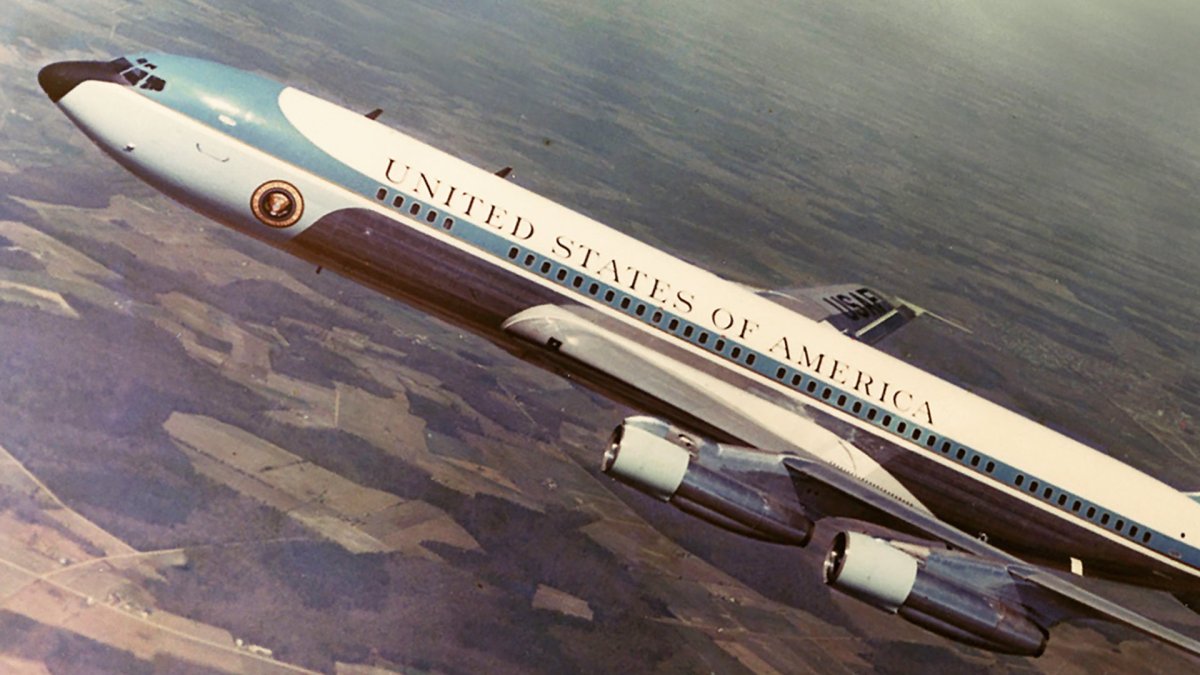
During the Nixon Administration, back in 1974, it was decided that the President would attempt to open up better relations with Syria. In true Nixon fashion, he took to the skies aboard Air Force One—Boeing VC-137Cs at the time—to travel to Syria to meet with President Hafez Al Assad face-to-face as part of a multi-leg trip through the Middle East.
A number of geopolitical events precipitated this historic diplomatic encounter. In 1967, U.S.-Syrian relations were put on ice following the Six Day War , but The Agreement on Disengagement between Israel and Syria that was signed in May of 1974 allowed for high-level diplomatic ties between Washington D.C. and Damascus to be restored. There were high hopes in the Nixon Administration that a stronger relationship between the two often at odds countries could drastically cool tensions in the region and lead to a longer-lasting peace between Israel and Syria, as well as some of its other Arab neighbors.
On June 15, 1974, with the stage set for a historic detente, Air Force One approached Syrian borders on its way to Damascus for the highly anticipated visit. As the VC-137 passed into Syrian airspace, four camouflaged MiGs appeared seemingly out of nowhere and began forming-up off Air Force One’s wing. Air Force One’s captain immediately acted to defend the iconic aircraft and its high-profile passengers.
Nixon aboard Air Force One. , George Mason University
Air And Space Magazine describes the strange encounter as such :
Air Force One pilot Colonel Ralph D. Albertazzie, who, fearing attack, banked violently right. For the next seven minutes , Albertazzie flew a series of evasive maneuvers, including a steep dive. Remembering the incident years later to reporter Kenneth Walsh, author of Air Force One: A History of the Presidents and Their Planes , CNN political analyst David Gergen, at the time a Nixon aide who was on Air Force One, said he wondered if the passengers would survive. He and others had been thrown to the floor.
Air Force One pilot Colonel Ralph D. Albertazzie, who, fearing attack, banked violently right. For the next seven minutes , Albertazzie flew a series of evasive maneuvers, including a steep dive.
Remembering the incident years later to reporter Kenneth Walsh, author of Air Force One: A History of the Presidents and Their Planes , CNN political analyst David Gergen, at the time a Nixon aide who was on Air Force One, said he wondered if the passengers would survive. He and others had been thrown to the floor.
VC-137C Cockpit, AOPA
The whole incident was a big and dangerous misunderstanding. White House officials already in Damascus had been told that the Syrian Air Force had planned to give Air Force One and honorary escort as it crossed into its territory, but nobody had informed Air Force One’s crew about the high-flying welcome wagon of sorts. After attempting to evade being shot down by the MiGs for seven long minutes—pushing the Boeing 707 derivative to the edge of its envelope and probably beyond—air traffic controllers informed Air Force One that the MiGs were not hostile and were there just as a formality as described to the White House advance party.
One of the long-serving and very historic VC-137C that served multiple presidents. , USAF
The flight continued on to land safely in Damascus where Nixon was treated to a full state welcome on the tarmac. A New York Times article published the following day describes the reception:
When Mr. Nixon’s plane landed here in the late afternoon, he was given a 21‐gun salute. The road leading into Damascus was lined with soldiers in camouflaged combat uniforms and with fixed bayonets. The Golan Heights could be seen in the golden haze to the right as the limousine drove out of the airport.
Nixon and Assad meet on the tarmac in Damascus after a harrowing ordeal in the skies. , National Archives
Nixon never publically recounted the terrifying moments in the sky that day, but he had privately told reporter and author Kenneth Walsh that it really did scare him.
As for the diplomatic mission, both leaders made official statements about their high expectations for a new era in relations between the two countries during the visit:
In an exchange of remarks after dinner, President Assad told Mr. Nixon, as had the other Arab leaders this week, that the chances of peace depend on a just settlement of the Palestinian question. “The only lasting and durable peace in this region would be a peace that would terminate Israeli occupation, restore the land to its people, remove the grievances inflicted upon the people of Palestine and assure them of legitimate national rights.” He then told Mr. Nixon that his visit “will mark the beginning of a new phase of relations between our two countries, a phase based on mutual respect, unselfish cooperation and adherence to provisions of the United Nations Charter.” Mr. Nixon, noting that he was the first United States President to visit Syria, said in his reply that although he did not bring “any instant solution” to the Middle East, “I can tell you that the United States is committed irrevocably to working for a just and equitable solution.”
In an exchange of remarks after dinner, President Assad told Mr. Nixon, as had the other Arab leaders this week, that the chances of peace depend on a just settlement of the Palestinian question.
“The only lasting and durable peace in this region would be a peace that would terminate Israeli occupation, restore the land to its people, remove the grievances inflicted upon the people of Palestine and assure them of legitimate national rights.”
He then told Mr. Nixon that his visit “will mark the beginning of a new phase of relations between our two countries, a phase based on mutual respect, unselfish cooperation and adherence to provisions of the United Nations Charter.”
Mr. Nixon, noting that he was the first United States President to visit Syria, said in his reply that although he did not bring “any instant solution” to the Middle East, “I can tell you that the United States is committed irrevocably to working for a just and equitable solution.”
Sadly, stable, long-term, and highly-productive relations between Syria and the United States would never come to pass. In the current decade, under the purview of Hafez Al Assad’s son, Bashar Al Assad, Syria has descended into civil war and now a long list of factions has their fingers in the conflict and in Syria’s uncertain future.
But one thing is certain, those MiG pilots got one hell of a bizarre air show by surprise in the skies over Syria on that hopeful day in June nearly half a century ago.
Contact the author: Tyler@thedrive.com
Comments couldn’t be loaded. Please refresh the page.
更新于美国东部时间2019年12月1日上午6:39
特朗普总统乘坐空军一号秘密前往伊拉克的行程本周占据了各大媒体的头条。这架标志性飞机飞抵伊拉克的特殊飞行,由总统本人绘声绘色地讲述了整个过程,这让我想起了45年前发生在叙利亚上空的一起更为激烈的事件——这是航空史和美国总统史上鲜为人知的一段往事,似乎很少有人知道它的存在。
1974年,尼克松执政期间,决定由总统尝试改善与叙利亚的关系。尼克松一贯的作风是,他乘坐空军一号——当时是波音VC-137C型飞机——前往叙利亚,与哈菲兹·阿萨德总统面对面会晤,这是他中东多站访问行程的一部分。
一系列地缘政治事件促成了这次历史性的外交会晤。1967年六日战争后,美叙关系陷入僵局。但1974年5月签署的《以色列与叙利亚脱离接触协议》使得华盛顿特区与大马士革之间的高层外交关系得以恢复。尼克松政府曾寄予厚望,认为这两个时常交恶的国家之间加强关系,能够显著缓和地区紧张局势,并促成以色列与叙利亚以及其他一些阿拉伯邻国之间更持久的和平。
1974年6月15日,在历史性缓和即将到来之际,空军一号正飞往大马士革,准备进行备受瞩目的访问。当这架VC-137飞机进入叙利亚领空时,四架伪装的米格战机突然出现,并在空军一号机翼附近集结。空军一号机长立即采取行动,保护这架标志性飞机及其尊贵的乘客。
尼克松乘坐空军一号。乔治·梅森大学
《航空航天杂志》是这样描述这次奇特遭遇的:
空军一号飞行员拉尔夫·D·阿尔伯塔齐上校因担心遭到攻击,猛烈向右倾斜飞机。接下来的七分钟里,阿尔伯塔齐进行了一系列规避机动,包括一次陡峭的俯冲。多年后,CNN政治分析员大卫·格根(当时是尼克松的助手,也在空军一号上)向记者肯尼斯·沃尔什(《空军一号:总统及其飞机的历史》一书的作者)回忆起这起事件时说,他当时很担心乘客们能否幸存。他和一些其他乘客都被甩到了飞机地板上。
空军一号飞行员拉尔夫·D·阿尔伯塔齐上校担心遭到攻击,猛烈地向右倾斜飞机。接下来的七分钟里,阿尔伯塔齐进行了一系列规避机动,包括一次陡峭的俯冲。
多年后,CNN政治分析员大卫·格根(David Gergen)在接受《空军一号:总统及其飞机的历史》一书的作者、记者肯尼斯·沃尔什(Kenneth Walsh)采访时回忆起这起事件。格根当时是尼克松的助手,也在空军一号上。他说,他当时很担心乘客们能否活下来。他和一些乘客都被甩到了地上。
VC-137C 驾驶舱,AOPA
整件事是一场巨大而危险的误会。当时已在叙利亚首都大马士革的白宫官员被告知,叙利亚空军计划在“空军一号”飞越叙利亚领空时为其提供荣誉护航,但却没有人告知“空军一号”的机组人员这一“高空欢迎仪式”。在与米格战机搏斗了整整七分钟,试图躲避它们的攻击——这架波音707衍生机型几乎达到了极限,甚至可能已经超出了极限——之后,空中交通管制员告知“空军一号”,这些米格战机并无敌意,只是像之前告知白宫先遣队的那样,以礼节性的方式出现。
这是一架服役时间长、极具历史意义的VC-137C型飞机,曾为多位美国总统服务。(美国空军)
飞机继续飞行,安全降落在大马士革,尼克松在停机坪上受到了隆重的国宾级欢迎。《纽约时报》次日发表的一篇文章描述了当时的欢迎场面:
尼克松先生的飞机于傍晚时分降落在这里,受到了21响礼炮的致敬。通往大马士革的道路两旁站满了身着迷彩作战服、刺刀上膛的士兵。当豪华轿车驶出机场时,右侧金色的薄雾中可以看到戈兰高地。
尼克松和阿萨德在经历了惊心动魄的空中遭遇后,在大马士革的停机坪上会面。(美国国家档案馆)
尼克松从未公开讲述过那天天空中的恐怖时刻,但他私下告诉记者兼作家肯尼斯·沃尔什,那真的吓坏了他。
至于外交访问方面,两国领导人在访问期间均发表了官方声明,表达了对两国关系新时代的殷切期望:
晚宴后,阿萨德总统与尼克松先生进行了交流。阿萨德总统告诉尼克松先生,正如本周其他阿拉伯领导人所言,和平的希望取决于巴勒斯坦问题的公正解决。“该地区唯一持久的和平,是结束以色列占领、将土地归还巴勒斯坦人民、消除巴勒斯坦人民遭受的苦难并保障其合法民族权利的和平。”随后,他告诉尼克松先生,此次访问“将标志着我们两国关系新阶段的开始,这一阶段建立在相互尊重、无私合作和遵守《联合国宪章》的基础上。”尼克松先生在答复中指出,他是首位访问叙利亚的美国总统,并表示尽管他没有为中东带来“任何立竿见影的解决方案”,但他“可以明确地告诉您,美国坚定不移地致力于寻求公正合理的解决方案。”
晚宴后,阿萨德总统在与尼克松先生的交谈中表示,正如本周其他阿拉伯领导人所言,和平的希望取决于巴勒斯坦问题的公正解决。
“该地区唯一持久的和平,是结束以色列占领、将土地归还巴勒斯坦人民、消除巴勒斯坦人民遭受的苦难并保障他们享有合法民族权利的和平。”
随后,他告诉尼克松先生,他的访问“将标志着我们两国关系进入一个新阶段,一个建立在相互尊重、无私合作和遵守《联合国宪章》条款基础上的阶段。”
尼克松先生指出,他是第一位访问叙利亚的美国总统,他在答复中表示,虽然他没有给中东带来“任何即时解决方案”,但他“可以告诉你们,美国坚定不移地致力于寻求公正合理的解决方案”。
令人遗憾的是,叙利亚与美国之间稳定、长期且富有成效的关系始终未能实现。近十年来,在哈菲兹·阿萨德之子巴沙尔·阿萨德的统治下,叙利亚陷入内战,如今众多派别都卷入了这场冲突,并左右着叙利亚前途未卜的未来。
但有一件事是肯定的,在近半个世纪前那个充满希望的六月天,那些米格战机的飞行员在叙利亚上空意外地看到了一场极其怪异的空中表演。
联系作者:Tyler@thedrive.com
评论加载失败,请刷新页面。