Navy’s Cold War-Era Helicopter Crew Escape System Literally Sliced Fuselages Apart冷战时期海军直升机机组人员逃生系统会将机身彻底撕裂
The little-known history of the Navy's wacky escape capsule concept for helicopter crews. Born from a need to save the lives of more aviators, the Navy's escape capsule has an intriguing but little-known history.
新闻视频
Published Aug 7, 2024 6:19 PM EDT
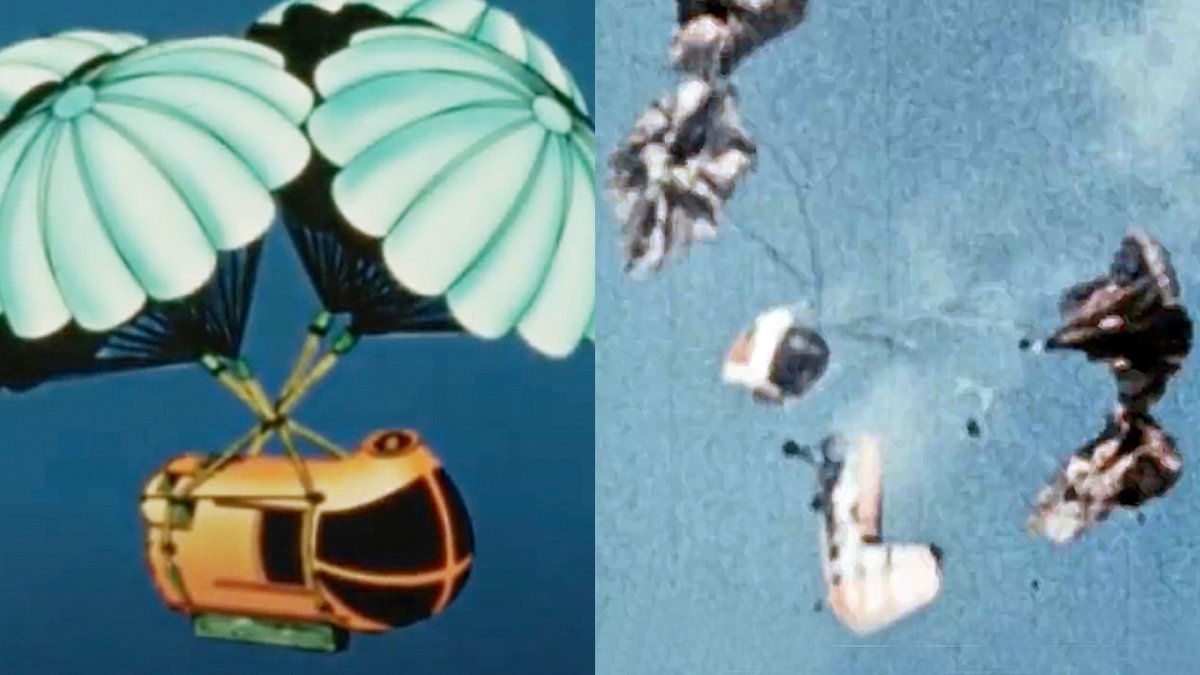
Things can go very wrong very fast in helicopters and sometimes there just aren’t many options to safely mitigate the issue. This was especially true during the early days of the rotary-wing boom. In the face of growing concerns over helicopter-related fatalities and injuries, the U.S. Navy worked on a unique escape module system in the 1960s which was designed to save the lives of as many individuals as possible by literally severing the helicopter in half.
The short clip below, which depicts a test of the system conducted by the Navy in 1966, gives a good depiction of what the novel escape module system was all about. In broad strokes, the service created a system that split apart the fuselage of a helicopter while airborne. A separated section would serve as an emergency escape capsule, allowing personnel lucky enough to be in the module to parachute below to safety — at least that was the idea.
It should be noted that escape capsule systems on aircraft were all the rage during the late 1950s, 1960s and early 1970s within the U.S. aerospace defense sector. The U.S. Air Force’s swing-wing F-111 Aardvark strike jet, for example, received an escape module design that ejected the entire cockpit . The B-58 Hustler, XB-70 Valkyrie, and the B-1A Lancer are some other examples of aircraft the leveraged different escape capsule concepts.
By the early 1960s, the need for some kind of helicopter crew escape system was clear to the Navy. As part of an early 1961 study on the feasibility of such a feature, all data on Navy and Marine Corps helicopter accidents involving critical injuries or fatalities were collated across the period from 1952–1962. It was found that a majority of accident victims could have been saved had an in-flight escape system been installed onboard the helicopters.
It was not long after the 1961 study that the Navy began a program to demonstrate the fuselage escape capsule concept as applied to a wide range of helicopters. That program started in 1964 under the direction of the Naval Air Systems Command (NAVAIR).
A nearly 16-minute video on the helicopter escape module, produced by the Navy, can be seen below, which details its developmental history.
As the video above highlights, the Naval Weapons Laboratory in Dahlgren, Virginia, designed and developed a “ballistic system” for the separation and recovery of a helicopter escape capsule.
The system involved placing roughly 18 feet of continuous, aluminum-sheathed linear charge around the inside of the helicopter to sever the escape module from the rest of the fuselage. Two modified catapult rocket launchers, mounted aft on the port and starboard sides, were also used to ensure the escape module’s separation from the rest of the aircraft.
Explosive charge runs around the circumference of the testbed. U.S. Navy video screencap
A rocket fires to the rear of a testbed to ensure the escape capsule separates. U.S. Navy video screencap
Detonating chord leads were used to sever the helicopter’s rotors and blast them out of the way, thus preventing them from interfering with the deployment of the capsule’s parachutes.
Explosive chart runs around a model helicopter rotor. U.S. Navy video screencap
Helicopter rotors being blasted during a test. U.S. Navy video screencap
From 1964 to 1968, the Navy began testing the system on a number of helicopters, including Boeing Vertol CH-46 Sea Knights, Bell UH-1E Hueys, and Piasecki UH-25B Retrievers.
Between March and June of 1966, alongside testing on the ground, five, full-scale tests of the system were conducted in the air using UH-25B testbeds. Three of the five tests were completed successfully at heights of 74, 143, and 187 feet. “In each case,” a subsequent report by the U.S. General Accounting Office noted, “the escape system functioned perfectly.”
One of the in-air tests taking place. U.S. Navy video screencap
“The fact that it worked at these altitudes is important because the earlier Navy-sponsored analysis revealed that 90 percent of the in-flight emergencies occurred at altitudes between 100 and 600 feet,” the report goes on to say.
On the basis of the successful tests, in June 1967 the Navy began to investigate the adaptability of the system to various helicopters. As part of its study, 14 helicopter types were considered, of which a total of four were deemed viable candidates to receive the in-flight escape system. However, none actually had modifications done for adding the escape module.
The Navy selected two helicopter variants in particular — the Boeing Vertol CH-46 Sea Knight and the UH-1E — for more detailed study, owing to the fact that many of them were in use at that time.
“The emergency in-flight escape system resulting from the study [for the CH-46] included a ballistic subsystem to sever the rotors and unoccupied parts of the helicopter and a recovery subsystem to lower the occupied part to the ground. Other survival features included a crash impact subsystem to protect against impact forces, an emergency flotation subsystem, and a passive defense subsystem,” the Navy noted .
While footage of Navy testing with CH-46s does not appear to exist, an illustration from the service’s subsequent research seen below shows the rear rotor nacelle and both rotors being blown completely off — allowing the entire airframe to be parachuted to the ground.
Illustration showing the CH-46 recovering sequence. U.S. Navy
The recovery system for the UH-1E “consisted of four 36-foot, ballistically deployed parachutes to be used at altitudes above 100 feet and airspeeds from zero to 200 feet per second. Surface impact protection was provided by crash-energy-absorbing troop and crew seats, crash-resistant fuel cells, and breakaway, self-sealing fuel lines.”
Illustration showing the UH-IE recovering sequence. U.S. Navy
In May 1968 the Navy issued a final report on the system, concluding that:
“An in-flight personnel recovery system for helicopters is feasible and practical. Previous tests have demonstrated the feasibility of the concept, and subsequent advancement in the state-of-the-art ballistically deployed and opened parachutes combined with retro-rockets has made the concept efficient and practical.”
In September 1968, NAVAIR proposed a development program in order to pursue the capsule system. This pushed for designing a system applicable to rotary-wing aircraft to be used in the 1975-1980 timeframe, and retrofitting CH-46D aircraft with the escape system. It was estimated that the program would cost $5.3 million (nearly $48 million adjusted for inflation in 2024 dollars) over four years, and could have the potential to “ensure the survival of over 80 percent of helicopter occupants involved in emergency situations.” However, the program was never funded.
NAVAIR went on to propose a new development plan in December 1969 — named the Helicopter Escape, Protection and Survival System — which included a nine-year advanced development program costing some $14.4 million (over $123 million adjusted for inflation in 2024 dollars). This included the development of both the escape capsule and individual-type escape systems, in the form of ejection seats or other unitary extraction methods.
Individual seat ejection/extraction methods. U.S. Navy
Unlike the 1968 plan, the retrofitting of CH-46Ds with escape systems was abandoned, with the emphasis turning to working on survival systems for future aircraft.
Into the early-1970s, however, enthusiasm for the idea of a multi-person helicopter escape module waned. In March 1972, the Navy revealed to a subcommittee of the House Committee on Appropriations that the program was of “low priority,” primarily due to the added weight of fitting the system onto aircraft and the subsequent impact on payload capacity and range. Cost concerns were also noted, alongside issues over maintenance.
1972 also marked a shift by the Navy toward exploring individual escape systems from aircraft more thoroughly. Individual escape systems were worked on by the Navy during the previous decade, it should be noted, with emphasis on creating escape methods for those flying on Bell AH-1 Cobra attack helicopters. However, despite these plans picking up in the early 1970s, they did not end up coming to fruition.
These days, few helicopters feature crew escape systems. A notable exception to the rule is the Russian Ka-52 attack helicopter. This system involves jettisoning the main rotor blades and explosive cord detonating the canopy, before crew members are ejected from the helicopter. Other systems that use parachutes to recover the whole aircraft, crew included, like the Cirrus Airframe Parachute System (CAPS) have seen widespread use and many successful saves.
So there you have it, the intriguing — if little-known — history of the Navy’s attempt at fielding an in-flight personnel escape capsule for helicopters.
Contact the author: oliver@thewarzone.com
Comments couldn’t be loaded. Please refresh the page.
发布于美国东部时间2024年8月7日下午6:19
直升机事故随时可能发生,而且往往迅速恶化,有时几乎没有安全有效的应对措施。在旋翼机发展的早期阶段,这种情况尤为突出。面对日益严重的直升机事故伤亡问题,美国海军在20世纪60年代研发了一种独特的逃生模块系统,其设计目的是通过将直升机拦腰截断来尽可能多地挽救人员生命。
下面这段短片展示了海军在1966年进行的一次系统测试,很好地展现了这种新型逃生舱系统的原理。简而言之,海军研发了一种能够在直升机飞行过程中将机身分离的系统。分离出来的部分将作为紧急逃生舱,让舱内的人员能够通过降落伞安全降落——至少最初的设想是这样的。
值得注意的是,在20世纪50年代末、60年代和70年代初,飞机逃生舱系统在美国航空航天国防领域风靡一时。例如,美国空军的F-111“土豚”可变后掠翼攻击机就采用了一种能够弹射整个座舱的逃生模块设计。B-58“盗贼”轰炸机、XB-70“女武神”轰炸机和B-1A“枪骑兵”轰炸机也是采用了不同逃生舱概念的飞机。
到了20世纪60年代初,海军已经清楚地认识到直升机机组人员需要某种逃生系统。作为1961年初一项关于此类系统可行性研究的一部分,海军和海军陆战队收集了1952年至1962年间所有造成人员重伤或死亡的直升机事故数据。研究发现,如果直升机上安装了飞行逃生系统,大多数事故受害者本可以获救。
1961 年的研究之后不久,海军便启动了一项计划,旨在验证机身逃生舱概念在各种直升机上的应用。该计划于 1964 年在海军航空系统司令部 (NAVAIR) 的指导下启动。
下面可以看到一段由海军制作的关于直升机逃生模块的近 16 分钟的视频,其中详细介绍了该模块的研发历史。
正如上面的视频所展示的那样,位于弗吉尼亚州达尔格伦的海军武器实验室设计并开发了一种“弹道系统”,用于分离和回收直升机逃生舱。
该系统包括将大约18英尺长的连续铝制外壳线性炸药环绕在直升机内部,以切断逃生舱与机身其余部分的连接。此外,还在直升机后部左右两侧各安装了一台改装的弹射火箭发射器,以确保逃生舱与飞机其他部分完全分离。
试验台周围布满了爆炸装置。美国海军视频截图
一枚火箭向试验台后方发射,以确保逃生舱分离。美国海军视频截图
使用引爆索切断直升机的旋翼并将其炸飞,从而防止旋翼干扰太空舱降落伞的展开。
爆炸图围绕着一个模型直升机旋翼旋转。美国海军视频截图
直升机旋翼在测试中被炸飞。美国海军视频截图
从 1964 年到 1968 年,海军开始在多架直升机上测试该系统,包括波音 Vertol CH-46 海骑士、贝尔 UH-1E 休伊和皮亚塞基 UH-25B 救援者。
1966年3月至6月间,除了地面测试外,还使用UH-25B试验平台在空中进行了五次全尺寸系统测试。五次测试中有三次成功完成,高度分别为74英尺、143英尺和187英尺。美国总审计署随后的一份报告指出:“在每次测试中,逃生系统都完美运行。”
其中一次空中测试正在进行中。美国海军视频截图
报告继续指出:“它在这些高度上发挥作用这一事实非常重要,因为海军早期的分析表明,90% 的飞行紧急情况发生在 100 到 600 英尺的高度之间。”
基于成功的测试,海军于1967年6月开始研究该系统对各种直升机的适用性。作为研究的一部分,海军考虑了14种直升机型号,其中共有4种被认为适合安装飞行逃生系统。然而,最终没有一种直升机进行改装以加装逃生模块。
由于当时许多海军直升机都在使用波音Vertol CH-46“海骑士”和UH-1E,因此海军特别选择了这两种直升机型号进行更详细的研究。
海军指出:“(针对CH-46直升机的)研究得出的飞行中紧急逃生系统包括一个弹道子系统,用于切断旋翼和直升机的无人部分;以及一个回收子系统,用于将有人部分降至地面。其他生存功能包括用于抵御冲击力的撞击子系统、紧急漂浮子系统和被动防御子系统。”
虽然似乎没有海军使用 CH-46 进行测试的影像资料,但下面这张来自海军后续研究的插图显示,后旋翼舱和两个旋翼都被完全炸飞——使得整个机身可以借助降落伞降落到地面。
图示CH-46直升机的回收过程。美国海军
UH-1E 的回收系统“由四个 36 英尺长的弹道式降落伞组成,可在 100 英尺以上的高度和 0 到 200 英尺/秒的空速下使用。地面冲击保护由吸收碰撞能量的乘员座椅、抗撞击燃料电池和可分离的自密封燃油管路提供。”
图示UH-1E直升机的回收过程。美国海军
1968年5月,海军发布了关于该系统的最终报告,结论如下:
“直升机空中人员救援系统是可行且实用的。之前的测试已经证明了这一概念的可行性,随后最先进的弹道展开式降落伞与反推火箭相结合,使得这一概念高效且实用。”
1968年9月,美国海军航空系统司令部(NAVAIR)提出了一项研发计划,旨在推进逃生舱系统的开发。该计划的目标是设计一种适用于旋翼飞机的系统,计划于1975年至1980年间投入使用,并对CH-46D型直升机进行改装。据估计,该计划为期四年,耗资530万美元(按2024年通货膨胀率调整后约为4800万美元),并有可能“确保超过80%的直升机乘员在紧急情况下得以生存”。然而,该计划最终未能获得资金支持。
1969年12月,海军航空系统司令部(NAVAIR)提出了一项新的研发计划——“直升机逃生、防护和生存系统”(HEPS),其中包括一项为期九年、耗资约1440万美元的先进研发项目(按2024年通货膨胀率调整后超过1.23亿美元)。该项目包括研发逃生舱和单兵逃生系统,例如弹射座椅或其他一体式撤离方式。
个人弹射/撤离座椅方法。美国海军
与 1968 年的计划不同,CH-46D 直升机改装逃生系统的计划被放弃,重点转向研发未来飞机的生存系统。
然而,到了20世纪70年代初,人们对多人直升机逃生舱的热情逐渐消退。1972年3月,海军向众议院拨款委员会的一个小组委员会透露,该项目“优先级较低”,主要原因是将该系统安装在飞机上会增加重量,进而影响有效载荷能力和航程。此外,成本问题以及维护问题也引起了关注。
1972年,海军开始更加深入地研究飞机上的个人逃生系统。值得注意的是,海军在前十年就已着手研发个人逃生系统,重点是为贝尔AH-1“眼镜蛇”攻击直升机上的飞行员开发逃生方法。然而,尽管这些计划在20世纪70年代初有所推进,但最终并未实现。
如今,配备机组人员逃生系统的直升机已寥寥无几。俄罗斯的卡-52攻击直升机是个显著的例外。该系统通过抛弃主旋翼和引爆座舱盖的爆炸索,将机组人员弹射出机外。其他一些利用降落伞回收整架飞机(包括机组人员)的系统,例如西锐飞机机身降落伞系统(CAPS),也得到了广泛应用,并成功完成了许多救援任务。
这就是海军尝试为直升机配备飞行中人员逃生舱的有趣(尽管鲜为人知)的历史。
联系作者:oliver@thewarzone.com
评论加载失败,请刷新页面。