Making Steam: The Life And Times Of A U.S. Navy Chief Engineer蒸汽时代:一位美国海军首席工程师的生平
Navy Engineer David Taylor gives us an unprecedented insight into what it took to keep America's Navy steaming full speed ahead, and what it would take to bring mothballed ships back from the dead.
新闻视频
Updated Jul 5, 2020 7:16 PM EDT
David Taylor spent 22 years in the Navy, serving from 1969 to 1991. During that time he rose in rank from an enlisted Seaman Recruit to becoming an officer, and eventually retired as a Lieutenant Commander. The majority of his career was spent in one of the most thankless and hidden but absolutely critical jobs in the US Navy—making the steam that propelled the vast majority of the Navy’s fleet through the high seas.
After retiring from the Navy, Taylor worked at Philadelphia Naval Yard, breathing new life into tired old ships and helping to develop the new technologies the Navy set its sights on—for better or worse.
In the first of this two part in depth expose, Taylor gives us an incredibly rare insight into what it took to run the Navy’s mightiest vessels during the height of the Cold War, and what it is like to be Chief Engineer, responsible for more than most would care to imagine, aboard a US Navy surface combatant. We will also learn what it takes to refit a supercarrier, and Taylor will deconstruct the feasibility of returning mothballed ships to the fleet, which is a hot topic as of late .
David Taylor aboard the USS England while on cruise in 1985. , Courtesy of LCDR(R) David Taylor
Arriving as a fresh Engineering Officer aboard the supercarrier USS Kitty Hawk
An extended yard period is the most difficult time in the career of any Navy man, officer or enlisted. The yards are seldom in the ship’s home port and frequently the move is not designated a change of home port, so funding is not available to move families. If moves are authorized, housing near the yards are usually substandard and expensive if available at all. It is usually better to adopt geographic bachelorhood anyway because working 12 hour days, seven days a week, with the only holiday observed being Christmas, does not leave much time for momma and the kiddies.
Even unaccompanied, off duty life is lousy. You can’t stay on the ship, even if habitability services are available, the industrial clamor is nerve wracking. Did you know that at 0300 a needle gun being used to remove paint on the foreword flight deck can jerk you awake while sleeping in a berthing compartment 900 feet and six decks away?
USS KITTY HAWK (CV-63) moored at the Puget Sound Naval Shipyard., USN
There is no time for watchstation or in rate training. There is no equipment to train on. If the Department has enough funds , some sailors may be sent away for advanced technical training, but there is never much money for that, and the candidates for that training are usually your better people, so you end up in that uncomfortable position between a rock and a very hard place.
I came aboard as an Ensign. Because of my enlisted background, my degree and a significant lack of more senior officers, I was given a LT billet, P-1 Division, responsible for 1 and 4 MMR: 4 boilers and two main engines on the outboard shafts, two ship’s service turbine generators (SSTGs) and two evaporators, not mention 50 Boiler Technicians and Machinist Mates. I held that position through the yard period.
There is tremendous pressure. Workload pressure. Schedule pressure. Sometimes ship’s force milestones and yard milestones are mutually exclusive of each other. Then the big milestone looms on the horizon. The Propulsion Evaluation Board (PEB) is coming to conduct a Light Off Exam (LOE) to determine if a main machinery space is safe to steam. They will be checking training records to ensure that you can field a qualified watch team. They will be conducting review boards and administering written exams to determine if your designated watchstanders are as qualified as records say they are. They will be reviewing admin programs like Electrical Safety and Lube Oil Quality Management. They will inspecting for material readiness, including system integrity, cleanliness and valve and piping labeling. They are the Four Horsemen of the Apocalypse and they are coming in ten days !
The space to be scrutinized is a madhouse. There is no room for one more body. Laggers are lagging, barely keeping ahead of the painters, who are being pushed by someone with stencils and can of black striping putting identification signs on the pipes. The Main Propulsion Assistant, a Lieutenant Commander, is in his office, assisted by a Warrant and an Ensign as they sort through a shipping crate of stamped metal disks, used for identifying valves, looking for the tag for MS-3. You will never make it on time. And then you run out of time, and miraculously, you are ready.
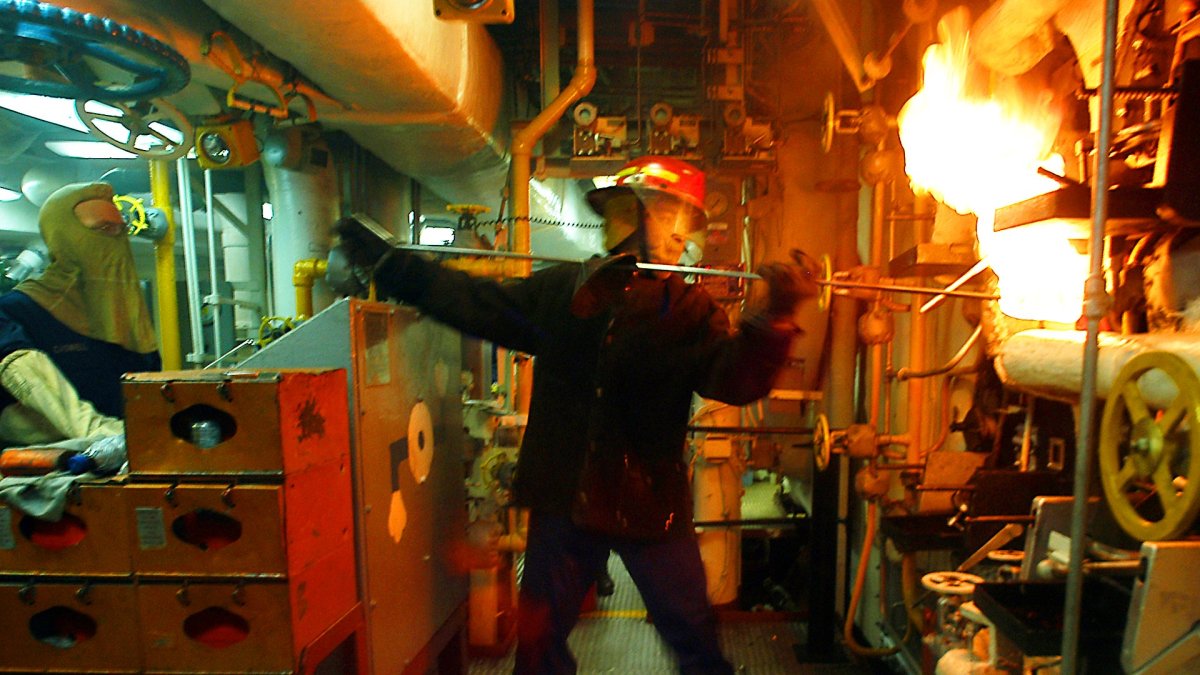
After lighting the boiler, gauges are monitored by a Boilerman Technician in the No. 4 main machinery room aboard the aircraft carrier USS KITTY HAWK, USN
So you put a plate of doughnuts on the wardroom table (I do not know if this works, but I have never dared to risk not doing it), put a smile on your face, and welcome the jack booted monsters who are going to ruin your day, your week and maybe your career.
After a few canned remarks, they depart to do their damnedest and you make sure your quick reaction teams and the yard personnel are standing by to quickly rectify any discovered discrepancies. You hope the Ensign in charge of the Electrical Safety Program doesn’t make an ass of himself and you pray that BT3 Smedley, who you really, really need for your Burnerman does not relapse into his idiot mode.
Then the inspectors sequester themselves in the wardroom and collate their findings. They finally announce that they are ready to submit their report, first in private to the Commanding Officer (CO) and Chief Engineer (CHENG), and then to the world, all gathered in the wardroom. No one smiles. The senior member reads an almost endless list of discrepancies. Your life flashes before your eyes. Then he says, still not smiling, “the board finds #1 MMR safe to steam,” cracks a small smile and departs.
But you can’t afford to celebrate too much. They will be back in six weeks for 4 Main, then 2 and then 3. But you have learned lessons. You get better and more confident. It is still a lot of work, but the anxiety level is lower.
Burnerman ignites a boiler aboard USS KITTY HAWK (CV-63)., USN
But the tempo is increasing, and steam testing is beginning. That means real steaming, but with different yard shops demanding your attention to support their protocols. Things get more and more hectic and the hours get longer the closer you get to the end of the overhaul. There are not enough bodies to go around. On one occasion we needed to get 2A boiler up to provide steam to support testing aft. We did not have anyone to spare because the day shift had not come on yet. My Boiler Technician Chief and I went down to the space, I stuck the torch in, he took the Control Board and we almost had it up to pressure by the time the day crew took over. Yes, not in accordance with procedures, but remember that “can do!” spirit that is both the sterling quality and the greatest shortcoming of a Naval Officer.
Finally the day arrives, you are done, you are going back to San Diego. The flight deck is covered with the personal autos of the crew. That was a blast, up a ramp to a lowered aircraft elevator, ride the elevator to the flight deck, follow the signals of an Aviation Boatswain’s Mate to your parking spot, set the brake and head below to your Sea Detail Station.
Puget Sound Naval Shipyard. Motor vehicles are parked on the deck of the aircraft carrier USS KITTY HAWK (CV-63) as preparations are made to transport them to San Diego, California, USN
Back in San Diego, there was no time to rest. We had to begin our work up for deployment. Carrier quals , Third Fleet exercises, refresher training, and the most terrifying of all, our Operational Propulsion Plant Exam (OPPE).
The jack booted villains were coming back, this time to see if we could safely operate the plant. They were going to recheck everything plus observe us conduct Casualty Control drills, a full power run and a crash back (all ahead flank to all astern full). No conventional aircraft carrier had ever passed an OPPE the first time through. They cut us no slack. They went over our admin and our spaces with a fine tooth comb. They figured we had four spaces, so why not impose four casualties at the same time. By the time my turn was over as Engineering Officer of the Watch, I felt like had had been dragged through the mud, then run over by a Greyhound bus.
The debrief was the same, but perhaps a bit more somber. After a dead pan recitation of our extensive list of discrepancies, the senior member said, “the board has assigned a grade of satisfactory.” The only possible findings were satisfactory and unsatisfactory. Then, instead of leaving, he said, “I have one initial comment. In terms of overall plant knowledge, understanding of procedures and ability to take quick and correct actions, I have never seen anyone as proficient as Ensign Taylor.” As my head began to swell, from the back of the room came a retort from Lt George Wolfe, an old Limited Duty Officer who was retiring as soon as we got back to port, “and you know, Captain, he’s not even the best we have!”
The Engineering Officer of the Watch monitors the ship’s engineering plants in the damage control center aboard the aircraft carrier USS KITTY HAWK (CV-63)., USN
Finally, all tests and trials behind us, we settled into the routine of making steam. It was a blissful, low pressure, predictable time, doing what we had been trained to do and doing it well. We headed to the Western Pacific.
Then the war broke out.
The undeclared war between the Engineering Department and the Air Wing that is. The beauty of it was that the “Airdales” did not even know we were the enemy. We hated those guys. We hated their nicknames—Ripper and Killer etc. We even had a Crash Nash because of a minor mid-air collision—and the way they flew their airplane hands in conversation. You know, “there I was at ten thousand feet…”
Before we deployed, we would mock them at social gatherings. I would be “Tubes” Taylor and another engineer “Chloride Corkum.” We would stand within earshot of them and say things like, “there I was on the Upper Level of #1 Main…”
We ratcheted it up after we deployed. We probably would not have done it, but as soon as we were outside of territorial waters, they broke out the “shit hots.” The greatest compliment that could be given a Naval Aviator was that he was “shit hot” in the air. For the uninitiated, “shit hots” are also non regulation casual flightsuits, made of polyester, in vibrant blue and gold festooned with more badges and decorations than a single glance could encompass. They looked like a professional basketball team’s warm ups. If they were not wearing their real flight suits, they were wearing their shit hots. We were pissed. Truth be told, we were a bit jealous, all we had were flame resistant khaki boiler suits.
A Boilerman Technician opens the discharge valve to the main feed booster pump in the No. 4 main machinery room aboard the aircraft carrier USS KITTY HAWK (CV-63)., USN
Our first plan was to get the aardvark. One of the F-14 squadrons had the anteater from the old “B.C. ” comic strip painted on their vertical stabilizer. They kept a stuffed aardvark in a glass case in their ready room. There was always a junior enlisted man from the squadron on watch in the ready room to protect it. Our plan was simple. We scheduled a fire drill in the passageway outside their ready room. As part of firefighting procedures, a team with a fire hose must set fire boundaries on the opposite side of all bulkheads affected by the fire. Try as hard as they might, our hose team could not get the aardvark watchman to vacate the space.
Back to the drawing board. Our machine shop had the only engraving machine aboard. We made up less than complimentary adhesive backed brass label plates and affixed them to the squadron plaques in the lounge outside the wardroom. When noticed by a member of the affected squadron, indignation would ensue, the plaque would be replaced, and we would victimize another squadron.
VF-114 “Aardvarks” F-4 landing aboard the USS KITTY HAWK., USN
In port, the air wing would put up a wooden partition just inboard of the officer’s brow that displayed all of the squadron plaques. I would come aboard after a night on whatever town we were in, surreptitiously remove one of the plaques (a squadron, never the air wing), stick it under my shirt, walk across the hangar deck to the other sponson, throw the plaque in the drink, climb down the ladder and head to my stateroom to sleep.
Soon, we did not have to do anything. Each squadron thought another squadron was the culprit and a virtual prank war broke out. It got so bad that senior officers took notice. I was Officer of the Deck the afternoon when the CO and the CAG (carrier air group commander) had every squadron commander standing tall, braced, being informed that this shit was going to stop now! I had to retreat to the far side of the bridge and gnaw on my knuckles to keep from laughing out loud.
We decided we had won and quietly declared peace, just as we had quietly declared war.
USS KITTY HAWK underway in 1977., USN
We got a good overhaul from Puget Sound. Other than the “20 Khaki Emergency” I discuss later on, we had few mechanical issues, very few sailors returned by the shore patrol and we only lost one plane and no pilots during cruise. After getting six officers qualified for Engineering Officer On The Watch, I went into a watch rotation topside alternating with my watches in Main Control, in affect a four and eight rotation while the rest of the officers were on a six section rotation (4 hours on 20 hours off).
I gained qualification as an Officer Of The Deck (OOD) and then Surface Warfare Officer (first ever to get both SWO and EOOW on a carrier). I asked for and received a split tour to a small surface combatant and shortly after returning from WESTPAC in 1977, I left for a seemingly endless series of schools intended to transform a Hole Snipe into an operations puke, then on to the USS David R. Ray —once again in the yards!
Life as Chief Engineer aboard the USS Henry B. Wilson (DDG-7) and USS England (CG-22)
Perhaps a bit of compare and contrast would be enlightening. On the surface it would seem that there would be a great similarity between the two classes of ships, at least from the standpoint of a Chief Engineer. Two engine rooms, two fire rooms, all similar auxiliaries. But there was a world of difference between the two.
I received orders to the Henry B. Wilson in early 1983 after Department Head School, chiefly because of the direct intervention of my previous CO at Surface Warfare Officers School. I think it was because he thought I was up to the job and because he wanted to challenge me (I hope it was not because he wanted to consign me to two years on a mankiller). One of the benefits of the job was that it was a Lieutenant Commander billet that was normally filled by a Lieutenant, which triggered a fairly obscure regulation—a spot promotion that was permanent as long as I completed the tour successfully.
The Charles F. Adams class guided missile destroyer USS HENRY B. WILSON (DDG-7)., USN
The Chief Engineer is responsible for the operation and maintenance of the propulsion boilers, turbines and shafting, 60 Hz electrical generation and distribution, potable water distillation and distribution, air condition and ventilation, chill water for electronics, and interior communications systems. These included telephones, sound powered phones, announcing systems, wind speed and direction sensors, ship’s speed sensors and indicators, alarm systems and 400 Hz generation and distribution. Systems from the keel to the masthead, bow to stern. Also included was responsibility for the engines of the small boats, anchor windlass and hydraulic underway replenishment gear. The Chief Engineer was also the Damage Control Officer, with responsibility for training all damage control parties, maintaining fire and flushing pumps and piping, sewage disposal systems and ships welders. But bottom line, the primary responsibility of the Chief Engineer was to ensure that, when the Captain said “…I intend to go in harms’ way” he could.
The Charles F. Adams class was quite a ship for its time. It had 5”/54 caliber guns forward and aft, dual armed Tartar missile launcher aft (a hydraulic nightmare, our Fire Control Technicians called it “Christine” after Stephen King’s eponymous novel), ASROC, even a rudimentary range finding sonar, using a passive dome about a third of the way aft. The propulsion plant was the second generation of 1200 psi, uncontrolled superheat boilers put in service. A truly beautiful ship, it looked like a warship, as opposed to, say, today’s DDG-1000 stealth destroyer. But it was no longer its time. They were old and worn out.
Pacific Fleet destroyers were in constant demand because of their double 5 inch mounts for Naval Gunfire Support in Vietnam. Born before the disastrous incident on the Buchanan , which led eventually to the birth of the Propulsion Examining Board, they were poorly maintained, manned by second tier crew and “rode hard and put away wet.” Designers had not quite figured out how to effectively contain the beast that lay at the heart of the propulsion boilers. It seemed that every drain line had at least one low spot which accumulated water and rotted through, revealing itself only when it started spray steam upon the next light off.
These problems were exacerbated on Wilson because while participating in an operation to extract the SS Mayaguez from Vietnamese possession, (well before I was aboard) she took a hit from a shore based battery at the base of the after stack. The only damage that could not be repaired was warping of the deck on the upper level of the aft fireroom—right where the main feed pumps were located. The end result was that, no matter how hard we, SRF Yokusuka, SRF Guam, SRF Subic, Pacific Northwest Iron Works (Portland OR) or SUPSHIPS San Diego tried, we could never keep 2A Main Feed Pump from leaking around the shaft seals.
I assumed the duties of Chief Engineer as the ship was finishing up a long overhaul at the aforementioned Willamette River yard in early Spring 1983. I took her through work up to deployment, including a successful Ongoing Professional Practice Evaluation (OPPE) and a six month deployment.
My chiefs had just made chief. My E-6s had just sewn on the third chevron. My Limited Duty Officer (LDO) maintenance officer had just come from “Knife and Fork” school. My officers, without exception were Officer Candidate School grads on their first tours. The Navy had a real hard time attracting young officers at that time and standards had been lowered. When I was teaching at Surface Warfare Officers School (SWOS), my students included theatre arts majors and a graduate of a seminary, who was not going to become a chaplain. The Navy was also suffering an acute shortage of Boiler Technicians (BT). The only way I was able to man a three section watch underway was for every single BT to be qualified in at least three watches, and that was only by the end of the deployment.
I came to the position much better prepared than my peers. Not only did I have my experience on Kitty Hawk , but I had a degree in Electrical Engineering, and had also profited from my year amongst the Nukes—the only major difference being the way water was boiled. I had also taken leave on two occasions while an instructor at SWOS to complete courses that were pre-requisites for the Steam Generating Plant Inspector (SGPI) course. After receiving orders to Wilson near the end of Department Head School, I sent a letter to my prospective CO, outlining that I had completed all prereqs for the Steam Generating Plant Inspectors (SGPI) course that was convening at the same time as a firefighting school to which all prospective Chief Engineers were ordered. I noted in my letter that attendance at firefighting might be redundant because I taught the course as part of my duties at SWOS. He sent a letter to Bureau Of Navy Personnel and I received an orders modification for me to attend SGPI in San Diego (where I had a home and family) rather that firefighting school in Great Lakes. Did I mention it was in February and that in firefighting school one got doused in cold firefighting water quite regularly?
I made a good early impression on my snipes . The first time we got underway, enroute to Hood Canal to pick up missiles after completing overhaul, we had a problem with excessive water usage. One feed tank would be lined up to receive water from the evaporators, and then quickly overflow from the sounding tube to indicate it was full. When it would be lined up to make up feed levels as determined by sounding, the tank began to immediately drop. No one could figure out why. I told the chief in charge of the space that as soon as we shut down in port, I wanted the tank pumped out, gas freed and inspected by someone wearing khaki. The chief looked at me rather skeptically, but accustomed to dealing with young officers who thought that the billet imparted wisdom, said “aye, aye” and complied.
USS HENRY B. WILSON underway. , USN
Sure enough, they found a rag blocking a vent, which prevented air from escaping as the tank filled, giving the impression the tank was topped off. It did not take long for the story to filter through the Chiefs’ Mess to the First Class Mess to the berthing compartments. They were my snipes from that point on, although the Boiler Inspector qualification and the fact that I was an E-6 before I was an O-1, didn’t hurt either.
True confession time. I had encountered a similar situation while conducting steam testing on Kitty Hawk while in Puget Sound Naval Shipyard. The Main Propulsion Assistant, who lived across the street from me and I beat our brains out trying to determine the cause of massive feed water usage. We talked about it in the car to and from work, we crawled through the uptakes looking for leaks—a six story hot, dark labyrinth. We went hand over hand over all of the piping systems. We were nearing the end of our rope, and sanity, when one morning as we were walking through the passageway on the way to our offices, we were accosted by an irate first class Dental Technician, who upon ascertaining that we were snipes, ranted that he got so tired of mopping up the water that gushed from the pipe on the bulkhead that he drove a damage control plug into it. Mystery solved.
Evidently the Boiler Technicians had been filling till it flooded, rather than sounding it as it filled. Perhaps it was cheating to use that experience to impress my new snipes, but what is wisdom but applied experience?
I alluded to the opinion that these ships were man killers—or at least Chief Engineer killers. One of my classmates at Department Head School had a nervous breakdown not long after assuming the duties of Chief Engineer on an East Coast DDG. Every time we shut down and the plant went cold, we knew we would have to fix something the next time we had to light off to get underway. It was always arranged to have a tender on alert for emergency repairs two days before underway for this class of ships.
Failing to get underway on time is the most shameful event in a Chief Engineer’s (CHENG) career. For a Monday morning sortie, we would start the light off process on Friday night, because we knew that something would go wrong. On one memorable occasion, one of the tachometers on a forced draft blower (forced combustion air through the outer casing and through the burner vortexes ) was inoperable. Upon investigation, we determined that the shaft on a magnetic rotating element within the tach had bent. Because this particular part never fails, it was not carried in the supply system, nor were there any drawings available.
We tore down a tac from another blower and we hustled it over to the tender for them to fabricate a duplicate. As it was going to take a few hours, after they took measurements and determined the particular alloy of which it was made, we brought the example back and re-installed it. When the tender called and told us the part was ready I sent my Main Propulsion Assistant (MPA) over to get it as I wanted the most reliable person possible to retrieve it. About 30 minutes later, I got a phone call. It was my MPA. He said, “I dropped it. I was leaving the tender and it fell out of my hands and into the water.” After another hour and a very unpleasant phone call from the Repair Officer on the tender, we had the tach back together and continued with light off. Underway on time, too. And this was not even an unusual light off.
Boiler Technician reassembles the upper ball valve into the fire safe fuel oil strainer aboard a destroyer. , USN
I remember another occasion when the packing on an unisolable high pressure drain valve failed. The only way to safely repair it was to cool down the boiler so there was absolutely no pressure and then commence repairs. We did not have that much time. I kicked everyone but the Boiler Technician Senior Chief Petty Officers out of the space and using welding gloves and a welding jacket to cover the valve. We repacked it, violating more than a few safety regulations. If I had caught one of my officers doing that, I would have had their buns for breakfast, but we got underway on time.
That Navy can do spirit, right?
My relief met the ship in Pearl Harbor as we were coming home from deployment. I chose to ride the ship home to allow for a more thorough turnover rather that a quick “you’re it, I quit” and a flight home. That allowed for a nice orderly transition, but it was a mistake from a personal standpoint.
Halfway between Pearl Harbor and San Diego, with the letter signed, I had to sit back and watch him undo all of the innovations and procedures that I had instituted. The department went from a semi-unorthodox group that worked extremely well to a standard Navy organization that might also have worked, but left a bunch of sailors thoroughly confused and disgruntled.
The Leahy class cruisers (CGs), born destroyers (DLGs), were an example of forward looking bureaucrats stumbling over reality. When authorized, the strategic thinkers knew that missiles had superseded guns, so they did not give the class any guns. Then Vietnam happened and suddenly expensive guided missile cruisers were vulnerable to junks with 40mm Bofors cannons mounted on their forecastle.
The solution was to go into the mothball fleet, salvage some open mount 3 inch/50 caliber anti-aircraft guns, bolt them on the 01 level aft port and starboard areas of the ship and pop rivet a woefully small ready-service magazine on the bulkhead behind them. The Gunner’s Mates called them “boom, boom, click” which should give you an idea of how well they performed.
The Leahy class guided missile cruiser USS ENGLAD (CG-22)., USN
Notwithstanding the gun question, the difference between the Wilson and England was astounding. Although Wilson was designed only about ten years earlier, many hard lessons learned had been applied to England’s propulsion plant. The cruisers had not been used as hard as the gun ships and it was evident in the material condition of England that greater investments in maintenance had been made. This was especially obvious because she had not just come out of overhaul as had Wilson .
Technological maintenance improvements had started to show benefits, also. Anti-corrosion flame spray treatment of valves, carbon ribbon packing and the removal of “bar stock” valves greatly decreased hours formerly dedicated to valve maintenance. Improved calibration and on line “flexing” of boiler controls through a On Line Verification (OLV) increased reliability, fuel economy and performance. A gradual evolution away from time-based to condition-based maintenance was also having a positive impact. Tearing down a piece of equipment to inspect and then replace a perfectly good bearing never made sense to me, even as an Electrician’s Mate Fireman earlier in my career.
The effects of huge recruitment and retention bonuses and advanced maintenance training offered to Boiler Technicians was also beginning to be felt. I now had almost as many BTs as the Ship’s Manning Document said I was supposed to have and they were, in the main, good techs, even the young 6YO (six year obligation) sailors coming out of the beefed up training pipeline.
My officers were more experienced, and frankly, better. I had two salty Warrant Machinist’s instead of one green Limited Duty Officer. The line officers were more motivated and had a better handle on the technical and leadership/management issues. My Main Propulsion Assistant (MPA) was dedicated, tireless and took an aggressive attitude of ownership of the plant. I may have been the Chief Engineer, but they were his boilers, turbines and reduction gears.
I thought I had died and gone to heaven.
Another pleasant surprise was the recent re-organization of warships, moving from the traditional Weapons/Operations/Engineering arrangement to a Combat Systems/Operations/Engineering setup. There was a little shuffling of the top side divisions, but the one that meant the most to me was that Interior Communications Electricians (IC) now worked for the Combat Systems Officer. IC problems had been the things that caused me the greatest lack of sleep on Wilson , so when in my first meeting with the Combat Systems Officer, he made it clear that the only way I was going to take the IC gang away from him was to jerk them from his cold, dead fingers, I felt like Br’er Rabbit, wanting to shout “throw me in that briar patch!”
All in all, it was a bit of a culture shock to me. The first time the MPA brought light off orders to me to approve I almost snorted a mouthful of coffee. With an underway time of 0800 on Monday morning, his intention was to stick the first torch in at 2300 Sunday night. This instigated a somewhat heated discussion along the lines of “no way in hell” from me to “but we have had no problems before” from him. We reached a compromise. We would start light-off at noon on Sunday and if we got underway on time without me suffering a heart attack or nervous breakdown or both, I would allow him to delay light off one hour after each success in the future.
As our work up to deployment progressed, we quickly made it back to 2300. In fact, I was so confident in his plant and his people, that by the time we got to Pearl Harbor enroute to a WESTPAC deployment, I shut down and put the snipes on liberty the whole time in Pearl, something I could not have conceived of while assigned to Wilson .
USS ENGLAND (CG-22) at rest in the Persian Gulf. , USN
My MPA and I gradually established a great working relationship. I noted above, his attitude of total ownership of the plant. I am equally obsessive about getting underway on time. On Sundays, prior to Monday underway, he would be onboard getting ready and I would be at home, pacing and worrying and driving my wife crazy. I would regularly call him for status, not being the type to assume that no news is good news. Of course this was decades before cell phones, so every time I called, he would have to drop what he was doing and come to the quarterdeck to answer. I realized that none of us (including my wife) was happy about the situation.
In a stroke of inspiration, I found a solution. I told the Senior Watch Officer that I would be Command Duty Officer one day before we were ordered underway, making the other departments heads and their wives and kids happy, my wife able to retain her sanity, my MPA less irritated and I could sit in the wardroom or my stateroom, doing Command Duty Officer or Chief Engineer things, and able to know what was going on by monitoring space comms and listening to changes in machinery noise.
I mentioned in passing some things that I had done that were a bit unorthodox on Wilson , only to see them undone in the space of half a transit of the Eastern Pacific. While I have never been one to change things just to change things, unwilling to fix what ain’t broke, I gradually applied the methods and procedures that worked on Wilson to England .
In port emergency firefighting teams were generally made up of the hull technicians, damage control men and engineering ratings, with a few of the topsiders mixed in. This was problematic when steaming in port, because a great number of the team’s core members were either on watch in the plant on a port and starboard rotation, or sleeping before going on watch. A drill or actual emergency was at very least annoying to off-watch team members and at the very worst disastrous if the whole team could not form quickly enough.
With the authority inherent in my other title as Damage Control Officer, I instituted an aggressive watch section training program that eventually lead to three duty section teams fully manned without a single hole snipe. The Captain helped with this effort by a adding an additional requirement for an Enlisted Surface Warfare Specialists in at least one of the firefighting team positions.
When most ships are steaming in a liberty port, they relieve the duty section—composed of two or three, if they were lucky, watch standing teams—at 0800. This led to the frequent occurrence of sailors coming back from a night on the town at about 0700, grabbing breakfast and relieving the watch at 0745. Hung over and tired operators standing watch on a high pressure steam plant was not my conception of a good idea.
I made a minor schedule change that benefitted both the ship and crew. By relieving the duty section at noon instead of 0800, the liberty party had a chance to get some sleep, recover from whatever noxious fluids they had ingested and maybe even take care of some personal housekeeping tasks. This change, although greeted with initial skepticism by the Goat Locker , proved to be greatly appreciated by all.
Crewmen on the bridge of the guided missile cruiser USS ENGLAND (CG-22) perform their duties during a transit from Sasebo, Japan, to Hong Kong. , USN
No crew member of a steam ship works harder or longer than the guys in M and B division. They come in early for light off, go home well after everybody else upon returning to port, and by the nature and location of their work, have a tougher time than any sailor on the ship. They are generally under appreciated for their contributions.
Within the structure of the Navy, there is very little an officer can do to recognize their efforts and contributions besides words of praise, and those tend to ring hollow after going six and six for three weeks on the doorstep to Hades. Promotions are determined by the calendar and an exam, pay is determined by Congress. The only reward a CHENG can offer is the gift of time. Time off. Liberty.
After I had a chance to take the measure of my khaki subordinates, and liking what I saw, I established an unofficial liberty policy on England . As long as scheduled and corrective maintenance was up to date, personal watch qualification goals accomplished and spaces and berthing areas clean (as determined by khaki inspection), liberty was in effect. There were long periods of time after we returned from WESTPAC that the only time I saw the Boiler Technicians, other than the duty section, was at quarters in the morning, or when a small group would come in at night to light off, bring the boiler up to pressure and shut down just to renew the steam blanket.
I left the USS England in the Spring of 1986 with orders to Naval Postgraduate School Monterey as part of my transition to the Engineering Duty Officer community. It was the last time I went to sea.
I miss it every damn day.
The differences between keeping a surface combatant and supercarrier running
It is a question of scale. More people to fill the watch bill. More storerooms to hold spares. More redundancy in systems and equipment. We had a Boiler Repair Chief, an almost mythical creature, and a workshop for him to direct depot level repairs. We even had a yeoman for each division rather that just one for the whole department, which was a gift from above, considering the mountain of paperwork associated with a 50 man division. More money for parts and fuel, because the squadrons have to fly and trap and launch and fly at night to keep their quals (qualifications). So you went to sea a lot, for longer periods of time.
After two or three weeks at sea, keeping the “airdales” happy, we used to speculate about how nice it would be to be on a destroyer, conducting weekly ops, steaming Monday through Friday, and getting home every weekend. Then I went to one; arriving late Friday night, in Sunday for underway on Monday, duty Saturday or Sunday. The grass was not as green as it appeared from the flight deck of a carrier.
There is a saying, source unknown to me, that “quantity has a quality all of its own.” That certainly applies to an aircraft carrier.
A-7E Corsair II launched from the USS KITTY HAWK’s waist catapult. , USN
The CO of a carrier, as mandated by law, must be a Naval Aviator. Even though they may have gone through the Senior Officer Ships’ Material Readiness Course (SOSMRC)—a very rigorous syllabus of propulsion engineering (I think nuclear carrier skippers attend a watered down Nuke school). It is a rare carrier CO that understands the plant and appreciates what it takes to keep 32 knots over the flight deck.
Most of the department heads are aviators and the CHENG and the rest of the Engineering Department play second fiddle, almost being treated like second class citizens. As an example, upon returning from WESTPAC, the ship would not provide a working party to rig shore power cables to let us shut down (wives and kids were on the pier) until the working party that was unloading the air wing’s WESTPAC goodies—they were stacked on the hangar deck in such a great quantity that it looked like a warehouse—were done.
Another example: There were two wardrooms on Kitty Hawk . The large one on the main deck was primary, where all normal rules of etiquette applied, with normal meal hours. At midrats (midnight rations), each item chosen was paid for out of pocket, rather than included in our mess bill. The other was up forward, just under the bow catapults. It was a “dirty shirt” wardroom, serving round the clock to accommodate the flight plan. Midrats were not charged extra. Only aviators and the Grumman tech reps onboard to support the initiation of the S-3 into the Fleet were allowed, yet, all officers were charged the same amount in their monthly mess bill.
Another great difference between a carrier and a smaller combatant was the way information was shared. On the destroyer, every officer, through briefings and wardroom conversation, was kept abreast of what was going on. The carrier was much more compartmentalized. In a wardroom that could seat almost 100 officers at a time, you usually sat with your fellows, so there was not a lot of interchange.
The hangar bay aboard the USS KITTY HAWK (CV-63) after dark., USN
Other than the boiler configuration required for flight ops, we were not really affected by aircraft evolutions. We had a video monitor from cameras on the flight deck in Main Control, so we could monitor launches and we obviously did not “blow tubes” (cleaning soot off of the fireside of boiler tubes with steam from installed soot blowers) during flight ops. One exception—there were restrictions on moving aircraft on the flight deck if there was too great a degree of list on the ship (we are talking one to two degrees of list). The Flight Deck Officer would be constantly calling Damage Control Central demanding that we flood or pump out floodable voids to restore the ship to even keel, unaware or perhaps uncaring that it would take eight or nine people at least an hour of lining up and pumping to move the list a half of degree. Finally the Engineer had his fill and got the CO to let him demonstrate to the Air Boss and the Flight Deck Officer that moving one aircraft to the opposite side of the flight deck could change list two degrees in about ten minutes.
One time, while engaged in the big training battle problem during Refresher Training (REFTRA), the final wicket for certification as ready to deploy, with Condition Zebra set throughout the ship and fires and missile strikes being fought by damage control teams, one of the fighter pilots was seen jogging on the flight deck. When brought to the bridge, to face an angry CO and even an angry CAG, still wearing his Nikes and tank top, his explanation was “but I have already seen the movie being shown in the ready room!”
Aircraft carriers usually were assigned second or third tier blackshoe officers. No one at Service Selection Day at Annapolis put carrier engineering at the top of their wish list. The Navy recognized the problem and established the Carrier Readiness Improvement Program, which, among other things, brought hot running Lieutenant (junior grade) and Lieutenants who had achieved their Surface Warfare Officer quals into conventional carrier engineering departments. As an incentive, they were granted follow on orders of their choice. Their arrival had an almost immediate impact.
In my defense, I did not consider myself second or third tier. When I was in college, I doubled up my course work to graduate almost a year early. I went from being evaluated by the sophomore class advisor to being evaluated by the senior class advisor a week before pre-commissioning ratings were due for submission. He did not know me and did not take the time to find out. He rated me last in my class and sent it off.
A crew member monitors boiler activity in the control booth of the No. 4 main machinery room aboard the aircraft carrier USS KITTY HAWK (CV-63). , USN
I was, frankly, devastated. I yearned to be on one of the “Greyhounds of the Pacific” that I had worked on when I was serving on the tender as an enlisted man. But, in the end, it was for the best. The officers in the Engineering Department formed a tight knit group. We worked hard together and we played hard together. We respected each other and helped each other out. Although most of the Ensigns were from that second or third tier, daily interaction with the outstanding engineering crews led to a significant improvement in their performance.
Department cohesion aboard the Kitty Hawk was enhanced by the CHENG, a Limited Duty Officer Commander, laid back and approachable, with a marvelously dry sense of humor. Prior to assuming duties as CHENG he was the AIRPAC Maintenance Officer, so he knew how things worked at the shipyard and we benefitted greatly from his connections. As an aside, he was also the one who discovered the semi-mythical lost machine shop on USS Enterprise .
Both my wife and I agreed that from the standpoint of the people I worked with, and their wives, it was the best tour we had.
Returning to gut and refit the supercarrier Kitty Hawk
The intent of the CV Service Life Extension Program (SLEP) was to ensure we had enough big deck carriers to meet the Navy’s strategic and tactical mission goals until enough nuclear powered carriers came on-line to replace them. It was absolutely necessary because, like the Adams class DDG and the Leahy class CG, they were becoming extremely expensive to maintain and their combat systems outdated to the point of obsolescence—in Navy terms, obsolescence means no more parts are available and no one plans on making any more.
The CV SLEP program accomplished that goal, and even though there were schedule slippages and cost overruns, each iteration was cheaper and faster as the yard applied lessons learned from previous hulls. In the end, the ships came out quicker and cost less money to refurb than to build a new construction nuclear powered carrier (CVN). Only the government’s desire to reap the “peace dividend” kept them from fulfilling their planned operating lifetime.
The carriers were brought to Philadelphia Naval Shipyard principally due to dry dock capacity and a projected lack of work in the yard without them. When they left, they were essentially a new ship, with the obvious exception of the hull and most of the tanks and voids.
Electronic systems throughout the ship were replaced or upgraded. New computer networks were installed. Point defense systems were improved. Berthing and other habitability spaces were renovated—actually they were gutted and re-installed. The capacity of air conditioning and chill water systems was increased. I think they even fixed the escalator from the hangar deck to the bridge. One of the perks of Officer Of the Deck quals was that you got to use it, otherwise it was a 12 deck marathon to get to the bridge.
These upgrades paled in comparison to two other areas—propulsion and the flight deck. All eight boilers were completely rebuilt. This included 100% re-tubing, new fire brick, new casings, and new burners. Force draft blowers were replaced. The most advanced combustion controls were installed. All valves 1 1/2″ or larger were completely replaced or reworked. All steam driven pumps were replaced or renovated at both the turbine and pump end. Electric motors were rewound or replaced and the pumps they drove refurbished. In effect the ship got a brand new plant.
Safety aside, the intent of any mods to the flight deck is to decrease cycle time—the time delay between launches from an individual catapult. To accomplish that in SLEP, virtually all of the flight deck systems were upgraded. Flight deck lighting and communications systems were upgraded from the ‘60s era. Landing aids were improved. The rotary retract engines (the device that returns the catapult shuttle to the starting position) we redesigned to bring the shuttle back as fast as it went out. The catapult troughs were replaced with a harder, tougher alloy that decreased warping and was aligned using lasers.
USS KITTY HAWK (CV-63) pulls out of Philadelphia Naval Shipyard after going through its SLEP in 1991., USN
New arresting gear engines were installed that had a higher stopping capacity, less of a jerk when setting the tail hook and faster recovery. Catapult receivers—the reservoirs that held steam pressure before the launch valve opened to admit steam to the rear of the shuttles— were redesigned to spray water into the receiver after launch which flashed to steam and increased pressure quicker than admitting steam alone. A new, longer lasting non-skid compound was applied to the flight deck itself.
It was a tremendous effort. As I watched the Kitty Hawk leave Philly for the final time, my mind returned to the last time I experienced that ship leave the yards. It was kind of sad to not be leaving with her, but the last time I was in Main Control, at least the view was much better this time.
The tough transition from sea to shore
What makes going out to the sea in ships so special to me is the unity of purpose—the cohesion of officers and crew that occurs on a good ship with good leaders. You have a mission, the work is hard, the environment dangerous, the family separation sometimes tortuous. There is always the possibility lurking in the back of your mind that suddenly, without warning, you may face a very hazardous situation—combat, weather or rocks and shoals. But the rewards, although seldom concrete, either in recognition or financially, are tremendous.
The feeling of working together, as a division, a department or as a whole ship’s crew to accomplish a difficult task, especially one that is in defense of your nation, is hard to describe—just as hard as describing to someone who has never faced the rigors of Navy life at sea the meaning of the word “shipmate.”
Taylor also served aboard the USS TALYOR R. RAY (CG-871) a Spruance class destroyer during the late 1970s., USN
There were no shipmates in the shipyard. There was no wardroom, only a boardroom. There was no real sense of working together for a goal. The only goals that were stressed were cost and schedule, but it seemed that that was only a gauze mask over the real goal—get a star for one of the four Captains assigned to the yard.
Although quality was stressed as propaganda (the yard had adopted Deming’s Total Quality Management for the SLEP program), the definition of quality was the cost of rework, not making sure that the ship left with the best possible overhaul. The mission was so nebulous and the goals so poorly defined, that it was hard to commit to them.
I confess that I am fond of sailors. The courser, more profane, the dirtier the better. During my time of service, our recruit training did a marvelous job of breaking down a disparate group of individuals to the lowest common denominator and building them back up into members of a team. If you could get them to a ship fast enough that spirit remained and they melding into the crew. Sailors are resourceful, show dogged determination and have a genius for problem solving—as long as you keep them informed and motivated, and let them know they are appreciated.
Other than those assigned to the ship, there were very few sailors at the shipyard. The Engineering Duty Officers assigned there generally had only a tour or two at sea and were not interested in going back. I felt, the entire time I was in Philly that I really was not in the Navy anymore.
It was time to retire.
The feasibility of returning Kitty Hawk to service as part of the Navy’s 355 ship, 12 aircraft carrier goal
Author’s note, you can read background on this issue here .
I am certain, regardless of the quality of layup upon decommissioning and the maintenance since, that the Kitty Hawk’s propulsion system can be brought back up. There may be an issue of repair parts, one that will dog the ship for however long her re-incarnation lasts, but there is enough expertise left in the Boiler Code at NAVSEA Philadelphia that the system can be restored. But this won’t last for long as funding and retirements have taken their toll. Foster Wheeler (boiler OEM) is still in business, although owned by foreign concerns now, and some remnants of General Regulator (combustion controls) and Hagan (feed pump controls) must exist as well.
I am certain that communications and computers can be upgraded and A/C and chill water systems can be beefed up to support the new electronics. I am certain that the flight deck can be re-certified. I am certain that berthing compartments can be rehabbed and altered to accommodate a mixed crew. I am certain that all of this can be accomplished in less time and for a lower cost than building a new big deck aircraft carrier.
USS KITTY HAWK (CV-63) stored in reserve in Bremerton, Washington. , Quillc/wikicommons
I am equally certain that, if this all happens, the ship will never be able to operate safely for any period of time. There are no Boiler Technicians left. There are no Automatic Combustion Control Operator and Maintenance courses established and factory courses may suffice for a while, but they are very expensive. There are no 1200 PSI Maintenance Courses left either, and the associated training equipment has probably been cannibalized or salvaged.
There are at least seven Boiler Technician watch stations per fire room, even with a port and starboard watch rotation, that requires 56 watch standers from grades E-3 to E-6. That does not account for maintenance and supervisory personnel, or the Oil & Fuel lab or the Catapult Shop. Finding and training and qualifying, either by recall, rate conversion or recruitment, that many BTs is a nearly impossible task. And, ironically, although it is a large number of techs to find to support this one ship, it is not nearly enough of a trainee load to justify the cost of standing up the aforementioned schools. Oh, yeah, you need BTs for instructors there too.
Nothing is impossible with enough time, money and effort. But I submit that there are better solutions to the “carrier gap” than throwing money at a 56 year old carrier. The first thing that comes to mind is to rethink our policies regarding the necessities for, and use of, an aircraft carrier. Let capabilities drive our operations for a while, rather than the other way around. It is time for long term sustainability planning vice short term strategic thinking.
Regenerating other ships in the Navy’s mothball fleet
Ticonderoga class cruisers have been hanger queens for NAVSEA Philadelphia for so long that I don’t think there is much left of their propulsion systems. They were always overloaded and had very little excess buoyancy remaining. Remember how old they are. They are based on the Spruance class hull (hence the buoyancy problem) and their technology is very old.
Even if you could upgrade their Aegis combat system to current levels, you would still have to install new propulsion and electrical generating turbines. Then you would have to completely overhaul the missile handling and launching system or find a way to install a Vertical Launch System. None of this is going to address the buoyancy issue. In a word, I do not think it’s feasible.
The sorry state of the USS TICONDEROGA (CG-47) at the naval yards in Philadelphia., BIGBIRD78/Wikicommons
If you are looking to boost ship numbers quickly, the Perry class might make you look twice, but they are also old. They are a mélange of foreign systems—NATO frigate, remember. That Otto Melara gun mounted on the O-4 level midships is a popgun and the fire control system (of Dutch origin) is not much better. Same missile launcher issues as the Ticos, they are about the same age, but the FFGs did not have Aegis. Probably have to severely upgrade the A/C and chill water systems to handle the electronics heat load if the combat systems were upgraded. The sonar is pitiful, in either mode. They do have the capacity to house two ASW helicopters, but we never had enough helicopters to give them two—the other hangar made a great gym and weight room—and I don’t think we do now.
Here’s at least one barrier to bringing the battleships back and one barrier to operate them. As far as bringing them back, boiler makers are almost extinct. Navy and civilian shipyards no longer maintain boiler repair shops. As far as operating them, they have very few automated systems, and those they have were kludged from the first time we brought the ships back under Reagan, or the second time in the case of the USS New Jersey .
USS NEW JERSEY (BB-62) before her retirement. Today the Iowa class battleships all serve as museums, but the possibility of bringing them back into service is always a hotly debated, if not far-fetched topic. , USN
Anybody still living who remembers how to operate their boilers, or their guns for that matter, is too old to get down the ladders. Frankly, with the improvement of the accuracy of air or missile delivered munitions, I can find no rationale for trying to resurrect a ship whose sole purpose in life was to hurl a shell the size of a VW Bug halfway to China.
The retirement of the USS Enterprise and the Navy’s seemingly non-existent plan on how to dispose of it
No matter what the official word was, that ship was unsafe to steam. It was designed in the ’50s and has been worked hard ever since being commissioned in the early ’60s. Through my contacts in the last company for whom I worked before retirement, I have some fairly intimate knowledge of the material condition of that ship. Without going into specifics, or revealing anything classified, I cannot say any more other than the fact it was a major accident, but not a nuclear one, waiting to happen.
There is no bigger picture. Any carrier gap would have only gotten bigger, quite suddenly, if the Big E wasn’t tied up.
As far as dismantling the ship, the cores and irradiated structural and mechanical components in the reactor compartments are an issue. The Navy used to operate an Expended Core Facility in Idaho Falls which was just a big swimming pool keeping exhausted cores cool until all the fissionable material had fissioned to non-existence—half life of radioactive Cesium anyone? I am sure it is still there, but I do not know how much room is left.
We would not have that problem—or the one with the waste from municipal reactors—if Jimmy Carter had not, by executive order, prohibited the construction and use of breeder reactors to turn the expended fuel cells into useable reactor fuel. His argument was that he wanted to keep radioactive cobalt out of the hands of rogue states. He was a Nuclear trained man, too.
Decommissioned USS ENTERPRISE (CVN-65) is in limbo as the Navy isn’t sure how to dispose of its first nuclear supercarrier., USN
There is a certain unwarranted paranoia about all things nuclear. I had the distinct honor of having lunch with Dr. Edward Teller after he had addressed the assembled staff and faculty at NPGS Monterey. He asserted that that paranoia had its roots in the terrible destruction of Hiroshima and Nagasaki and that we should have just dropped a demonstration weapon on one of the outlying islands. Great physicist but lousy historian.
Regardless, the precautionary measures that are federally mandated for handling of irradiated materials make it too expensive for maritime salvage operators, who work on a very thin margin which is very vulnerable to market fluctuations, to make any money on salvaging Enterprise . I have no knowledge of what they did with Long Beach.
In the mid ‘90s, I led a team that did an analysis of the possibility of scrapping former Soviet warships at the recently closed Philadelphia Naval Shipyard. One of the roadblocks we encountered was an Environmental Protection Agency advisory that we would have to keep the ships on blocks above the 100 year tide mark for at least ten years because of the PCBs in the paint! If there is that much of a reaction to a rather mundane organic compound, I can only guess at the panic that nuclear waste might cause at a shipyard in the tidewater region.
As part of our study, I sent one of my engineers, a former Soviet Navy warrant officer, with a Congressional delegation to look at some of the possible victims for dismemberment in Philly. You do not want to know how they are caring for their mothballed nuclear surface ships.
Getting more service life out of the ships the Navy already has
One word. Maintenance. Budgets have shrunk funds available for maintenance at all levels, at O (organizational, I (intermediate) and D (depot). Yard worthy items are deferred and deferred and deferred. Operational tempo has impacted proper maintenance and training does not support the execution of O level maintenance, either preventive or corrective.
The DDGs ( Arleigh Burke class destroyers) are well designed, mature weapons systems. Regular good maintenance and regular tech refreshes can keep them going for a long time. We have enough of them that our sailors can gain experience at all levels in the command structure as they progress through their careers, ensuring a robust corporate knowledge. One of the greatest dangers to older ships is tank and void corrosion and hull thinning, but NAVSEA has taken some rigorous steps recently to handle those problems.
It is, I think, a better idea to spend the little money available on maintaining the goods ships you have rather than the billions sunk into R&D, design and procurement of a new class of ships.
The second and final part of our series with LCDR(R) Taylor features recollections of his most memorable moments steaming the high seas during the height of the Cold War, as well as bold commentary on the Navy’s highest-profile weapons programs, some of which Taylor worked on directly, and on the service’s most controversial operational and strategic decisions. We truly saved the best for last.
Contact the editor: Tyler@thedrive.com
Comments couldn’t be loaded. Please refresh the page.
更新于美国东部时间2020年7月5日晚上7:16
大卫·泰勒在海军服役22年,从1969年到1991年。在此期间,他从一名水兵新兵晋升为军官,最终以海军中校军衔退役。他职业生涯的大部分时间都在美国海军中最默默无闻、最不为人知但又至关重要的工作岗位上度过——制造蒸汽动力,为海军舰队在公海上航行提供动力。
从海军退役后,泰勒在费城海军造船厂工作,为老旧的舰船注入新的活力,并帮助开发海军着眼的新技术——无论好坏。
在本系列两部分深度报道的第一部分中,泰勒为我们提供了极其难得的视角,让我们得以了解冷战高峰时期海军最强大舰艇的运作方式,以及在美国海军水面作战舰艇上担任总工程师的日常工作——其职责之重远超大多数人的想象。我们还将了解到超级航母的改装过程,泰勒还将深入剖析近期备受关注的封存舰艇重返舰队的可行性。
1985年,大卫·泰勒在“英格兰”号巡洋舰上。照片由退役海军中校大卫·泰勒提供。
作为一名新晋轮机军官,他登上了超级航母“小鹰”号。
对于任何海军官兵来说,无论是军官还是士兵,长时间的船坞维修都是他们职业生涯中最艰难的时期。船坞维修很少在舰艇的母港进行,而且通常情况下,这种调动并不属于变更母港,因此没有资金用于家属搬迁。即使获得搬迁许可,船坞附近的住房通常条件差,而且价格昂贵,即便有房也未必能租到。无论如何,最好还是选择单身生活,因为每天工作12小时,每周工作7天,只有圣诞节这一个假期,根本没有多少时间陪伴家人。
即使独自一人,下班后的生活也很糟糕。即使有居住服务,你也不能待在船上,因为工业噪音令人心烦意乱。你知道吗?凌晨3点,前甲板上用针枪清除油漆的声音,会把你从900英尺外、六层甲板外的卧舱里惊醒?
美国海军“基蒂霍克”号航空母舰(CV-63)停泊在普吉特海湾海军造船厂。
没有时间值班或进行专业训练。也没有训练所需的设备。如果海军部资金充足,一些水兵可能会被派去接受高级技术培训,但这方面的经费总是很紧张,而且参加培训的人通常都是队里最优秀的水兵,所以最终你会陷入进退两难的境地。
我以少尉军衔入伍。由于我曾是士兵,拥有学位,而且当时高级军官严重短缺,我被分配到P-1部门担任中尉,负责1号和4号主维修区:包括4台锅炉、两台舷外轴主发动机、两台舰载汽轮发电机组(SSTG)和两台蒸发器,更不用说还有50名锅炉技师和机械师。我在船厂维修期间一直担任这个职位。
压力巨大。工作量压力、进度压力。有时,船舶的里程碑和船厂的里程碑甚至相互冲突。而就在这时,一个重要的里程碑即将到来。推进系统评估委员会(PEB)即将进行点火检查(LOE),以确定主机舱是否安全。他们将检查培训记录,确保你们能够派出合格的值班人员。他们将组织评审小组并进行笔试,以确定你们指定的值班人员是否具备记录中所述的资质。他们将审查电气安全和润滑油质量管理等管理程序。他们将检查材料的准备情况,包括系统完整性、清洁度以及阀门和管道的标签。他们就像末日四骑士,十天后就要来了!
待检视的地方简直乱成一团。容不下任何人。工人们步履蹒跚,勉强跟上油漆工的步伐,而油漆工们则被一个拿着模板和黑色喷漆罐的人催促着,在管道上喷涂识别标识。主推进系统助理,一位中校,在他的办公室里,由一名准尉和一名少尉协助,正在翻找一箱用于识别阀门的冲压金属圆盘,寻找MS-3的标签。你永远也赶不上时间。然后,时间真的到了,奇迹般地,你却已经准备就绪。
锅炉点火后,位于美国海军“基蒂霍克”号航空母舰4号主机舱内的锅炉技师会监控仪表读数。
所以,你把一盘甜甜圈放在军官餐厅的桌子上(我不知道这样做是否有效,但我从来不敢冒险不这样做),脸上带着微笑,迎接那些穿着军靴的怪物,他们将会毁掉你的一天、你的一周,甚至可能毁掉你的职业生涯。
说了几句事先准备好的话后,他们就出发全力以赴了。你确保快速反应小组和船厂人员随时待命,以便迅速纠正任何发现的问题。你祈祷负责电气安全项目的少尉别出丑,也祈祷你非常非常需要的“火人节”主持人斯梅德利三级军士长别再犯傻。
随后,检查员们躲进军官餐厅,整理他们的调查结果。他们最终宣布准备提交报告,先私下提交给指挥官和轮机长,然后向聚集在军官餐厅的所有人公开。没有人笑。资深成员宣读了一份几乎无穷无尽的违规清单。你的生命仿佛在眼前闪过。然后,他依然面无表情地说:“委员会认为1号MMR可以安全运行。”说完,他露出一丝微笑,然后离开了。
但你不能庆祝得太早。六周后他们还要参加四场主赛,然后是两场,最后是三场。不过你已经吸取了教训,变得更好、更自信了。虽然工作量依然很大,但焦虑感已经减轻了很多。
一名火工在“小鹰”号航空母舰(CV-63)上点燃锅炉。
但节奏越来越快,蒸汽测试也开始了。这意味着真正的蒸汽作业,但不同的船厂车间都需要你关注,以配合他们的操作规程。随着大修接近尾声,事情变得越来越忙乱,工作时间也越来越长。人手严重不足。有一次,我们需要启动2A锅炉,为后部测试提供蒸汽。由于白班还没上班,我们没有多余的人手。我和我的锅炉技术长官一起下到锅炉舱,我把焊枪插进去,他拿起控制面板,等白班接手时,我们几乎已经把锅炉加压到位了。是的,这不符合程序,但要记住那种“能行!”的精神,这既是海军军官的优良品质,也是他们最大的缺点。
终于到了这一天,任务完成了,你要返回圣地亚哥了。飞行甲板上停满了机组人员的私家车。真是刺激!沿着坡道走到放下的飞机升降机,乘升降机上到飞行甲板,听从航空水手长的指示找到你的停车位,拉起刹车,然后前往你的海上勤务站。
普吉特海湾海军造船厂。机动车辆停放在“小鹰”号航空母舰(CV-63)的甲板上,准备运往加利福尼亚州圣地亚哥。
回到圣地亚哥后,我们没有时间休息。我们必须开始为部署做准备。航母资格认证、第三舰队演习、复训,以及最可怕的——作战推进装置考试(OPPE)。
那些穿着军靴的恶棍又回来了,这次是为了检验我们能否安全操作核电站。他们要重新检查所有设备,还要观察我们进行故障控制演练、全功率运行和紧急返航(从前到后全功率运行)。没有哪艘常规航母第一次就能通过核查。他们毫不留情,对我们的行政管理和岗位进行了细致入微的检查。他们觉得我们有四个岗位,所以干脆一次性模拟四次故障。当我结束值班轮机官的工作时,感觉就像被拖过泥潭,然后又被灰狗巴士碾过一样。
汇报过程和之前一样,但气氛可能更沉重一些。资深成员面无表情地念完我们列出的长长的问题清单后,说道:“委员会给出的评级是合格。” 而评定结果只有合格和不合格两种。然后,他没有离开,而是说道:“我还有一点要补充。就整体工厂知识、对操作流程的理解以及迅速采取正确行动的能力而言,我从未见过像泰勒少尉这样精通的人。” 我正感到一阵眩晕,这时,从房间后排传来乔治·沃尔夫中尉的反驳。沃尔夫中尉是一位资深的有限职责军官,我们一回到港口他就要退休了。“而且,舰长,你知道吗,他甚至还不是我们最好的!”
值班轮机官在“小鹰”号航空母舰(CV-63)的损管中心监控舰上的轮机设备。
最终,所有测试和试验都已完成,我们开始进入蒸汽机制造的常规流程。那是一段轻松、平静、可预测的时光,我们做着训练有素的工作,并且做得很好。我们驶向西太平洋。
然后战争爆发了。
那场发生在工程部和航空联队之间的未宣之战,真是妙不可言。更妙的是,那些“空军士兵”根本不知道我们是敌人。我们恨透了他们。我们恨透了他们的绰号——“开膛手”、“杀手”等等。我们甚至还因为一次轻微的空中碰撞而有了个“坠机纳什”(Crash Nash,指飞机坠毁事故)——还有他们说话时那夸张的“挥舞飞机的手”的姿势。你知道的,就是那种“当时我在一万英尺高空……”
部署之前,我们会在社交聚会上嘲笑他们。我会自称“管子”泰勒,另一个工程师会自称“氯化物·科克姆”。我们会站在他们能听到的地方,说一些诸如“我当时在1号主楼的上层……”之类的话。
部署之后,我们更是变本加厉。我们本来可能不会这么做,但一出领海,他们就穿上了“飞行服”。对海军飞行员来说,最高的赞誉莫过于“飞行技术一流”。对于不了解的人来说,“飞行服”指的是非制式休闲飞行服,涤纶材质,鲜艳的蓝金配色,上面缀满了徽章和装饰,多到一眼都看不完。看起来就像职业篮球队的热身服。他们要么穿着正式飞行服,要么就穿着飞行服。我们当时气炸了。说实话,我们也有点嫉妒,我们只有阻燃的卡其布连体工作服。
美国海军“小鹰”号航空母舰(CV-63)4号主机舱内,一名锅炉技师打开了主给水增压泵的排放阀。
我们的第一个计划是搞到那只土豚。一个F-14中队把老漫画《BC》里的那只土豚画在了垂直尾翼上。他们在战备室里放了一个玻璃柜,里面装着一只土豚标本。中队里总有一个低级士官在战备室值班,保护它。我们的计划很简单。我们安排了一次在战备室外走廊的消防演习。按照消防程序,一支配备消防水带的队伍必须在所有受火灾影响的舱壁对面设置防火隔离带。我们的水带队使尽浑身解数,也没能让守卫土豚的士兵离开。
一切又得从头再来。我们机修车间拥有舰上唯一一台雕刻机。我们制作了一些质量低劣的黄铜背胶标签,贴在军官餐厅外休息室里的中队铭牌上。一旦被受影响中队的成员发现,他们就会非常愤怒,铭牌会被更换,然后我们又会去捉弄另一个中队。
VF-114“土豚”中队的F-4战斗机降落在“小鹰”号航空母舰上。
在港口,航空联队会在军官的额头内侧竖起一块木隔板,上面展示着所有中队的徽章。我会在停靠的城镇过夜后登上飞机,偷偷取下一块徽章(是中队的,绝不会是航空联队的),把它塞进衬衫里,穿过机库甲板走到另一侧的舷侧浮筒,把徽章扔进水里,然后爬下舷梯,回我的舱房睡觉。
很快,我们就什么都不用做了。每个中队都认为另一个中队是罪魁祸首,一场虚拟的恶作剧大战爆发了。事态发展到如此地步,以至于高级军官都注意到了。那天下午我值班,舰长和航母舰载机联队司令让所有中队指挥官站直,严阵以待,并告知他们这种胡闹必须立刻停止!我不得不退到舰桥的另一边,咬着指关节,努力不让自己笑出声来。
我们认定自己已经获胜,于是悄悄宣布和平,就像我们当初悄悄宣布开战一样。
1977年,美国海军“基蒂霍克”号航空母舰航行中。
我们在普吉特海湾进行了一次彻底的检修。除了我稍后会提到的“20卡其紧急情况”之外,我们几乎没有遇到任何机械故障,岸上巡逻队返回的水兵也寥寥无几,而且在巡航期间我们只损失了一架飞机,没有飞行员丧生。在六名军官获得轮机值班资格后,我开始在甲板上轮值,与我在主控室的值班交替进行,实际上是四小时轮值和八小时轮值,而其他军官则实行六小时轮值(值班四小时,休息二十小时)。
我获得了值班军官(OOD)资格,之后又获得了水面作战军官资格(我是航母上第一个同时获得水面作战军官和值班军官资格的人)。我申请并获准前往一艘小型水面作战舰艇进行分段轮换服役。1977年从西太平洋返回后不久,我又踏上了似乎永无止境的一系列培训课程,旨在将一个只会钻空子的人变成一个作战专家。之后,我又去了“戴维·R·雷”号航空母舰——它又一次在船坞里!
在“亨利·B·威尔逊”号驱逐舰(DDG-7)和“英格兰”号巡洋舰(CG-22)上担任总工程师的生活
或许稍加比较和对比会很有启发。从表面上看,这两类船似乎非常相似,至少从轮机长的角度来看是这样。它们都有两个机舱、两个炉舱,辅助设备也大同小异。但实际上,两者之间存在着天壤之别。
1983年初,我完成部门主管学校的培训后,接到调令前往“亨利·B·威尔逊”号航母服役,这主要是因为我之前在水面作战军官学校的指挥官直接介入。我想是因为他认为我能胜任这份工作,也因为他想给我一个挑战(我希望他不是想把我送到一艘杀人舰上服役两年)。这份工作的好处之一是,这是一个通常由少尉担任的中校职位,这触发了一项相当隐晦的规定——只要我顺利完成任期,就可以获得永久性的晋升。
美国海军查尔斯·F·亚当斯级导弹驱逐舰“亨利·B·威尔逊”号(DDG-7)。
轮机长负责推进锅炉、汽轮机和轴系的运行和维护,60赫兹电力生产和分配,饮用水蒸馏和分配,空调和通风,电子设备的冷却水,以及内部通信系统。这些通信系统包括电话、声控电话、广播系统、风速风向传感器、船速传感器和指示器、报警系统以及400赫兹电力生产和分配。系统范围涵盖从龙骨到桅顶,从船首到船尾。此外,轮机长还负责小型艇的发动机、锚机和液压航行补给设备的运行。轮机长同时也是损管官,负责培训所有损管人员,维护消防泵和冲洗泵及管道、污水处理系统以及船舶焊工。但归根结底,轮机长的首要职责是确保当船长说“……我打算冒险”时,他能够做到。
查尔斯·F·亚当斯级驱逐舰在当时可谓相当出色。它前后都配备了5英寸/54倍径舰炮,舰尾还装有双联装“鞑靼人”导弹发射器(液压系统极其糟糕,我们的火控技师们戏称它为“克里斯汀”,取自斯蒂芬·金的同名小说),配备反潜侦察雷达(ASROC),甚至还有一套简易的测距声呐,使用位于舰尾三分之一处的被动式声呐罩。动力装置采用的是第二代1200磅/平方英寸(psi)非控制过热锅炉。这艘舰艇外形优美,看起来像一艘真正的军舰,而不是像如今的DDG-1000隐形驱逐舰那样。但时代已经变了,它们老旧不堪。
太平洋舰队的驱逐舰因其在越南战争中用于海军炮火支援的双联装5英寸炮而需求量很大。这些驱逐舰诞生于“布坎南”号灾难性事故之前(该事故最终导致了推进系统检查委员会的成立),维护状况很差,船员水平参差不齐,而且“饱经风霜,保养不当”。设计人员尚未完全找到有效控制推进锅炉核心部件的方法。似乎每条排水管都至少有一个低洼处,积水后会腐蚀穿孔,只有在下次熄火时喷出蒸汽时才会显露出来。
在“威尔逊”号上,这些问题更加严重。当时,该舰参与了从越南手中夺回“马亚圭斯”号货轮的行动(那时我还没登舰),后烟囱底部遭到岸基炮火的攻击。唯一无法修复的损伤是后部炉膛上层甲板的变形——主给水泵就位于此处。最终结果是,无论我们——横须贺维修站、关岛维修站、苏比克维修站、太平洋西北钢铁厂(俄勒冈州波特兰市)或圣地亚哥维修站——如何努力,都无法阻止2A主给水泵轴封周围的泄漏。
1983 年初春,在上述威拉米特河船厂进行长期大修之际,我接任了轮机长的职务。我带领她完成了部署前的各项工作,包括成功完成持续专业实践评估 (OPPE) 和为期六个月的部署。
我的士官长们刚刚晋升为士官长。我的E-6士官们刚刚缝上第三个军衔臂章。我的有限职责军官(LDO)维修军官刚刚从“刀叉”学校毕业。我的军官们,无一例外,都是军官候选学校的毕业生,而且都是第一次服役。当时海军很难吸引到年轻军官,标准也降低了。我在水面作战军官学校(SWOS)任教时,我的学生里有戏剧艺术专业的学生,还有一位神学院毕业生,但他并不打算成为随军牧师。海军当时也严重缺乏锅炉技师(BT)。我唯一能让三班轮值在航行中维持运转的办法,就是让每一位锅炉技师都至少具备三个班次的资格,而这只能在部署结束前才能实现。
相比同僚,我为这个职位做好了更充分的准备。我不仅在“小鹰”号核电站积累了经验,还拥有电气工程学位,并且在核电站工作的那一年也让我受益匪浅——唯一的显著区别是煮水的方式。此外,在SWOS担任教官期间,我还曾两次请假去完成蒸汽发生装置检查员(SGPI)课程的先修课程。在部门主管学校即将结束之际,我接到调往威尔逊的命令。我给未来的指挥官写了一封信,详细说明我已经完成了蒸汽发生装置检查员(SGPI)课程的所有先修课程。该课程与所有未来的轮机长都要参加的消防学校同时进行。我在信中指出,参加消防学校可能有些多余,因为我在SWOS的职责之一就是教授这门课程。他给海军人事局写了封信,我收到了一份修改后的命令,让我去圣地亚哥(我在那里有家和家人)参加SGPI培训,而不是去五大湖区的消防学校。我有没有说过,那是在二月份,而且在消防学校里,你会经常被冰冷的消防水浇个透?
我很快就给我的“狙击手”们留下了深刻的印象。第一次出海,我们完成大修后前往胡德运河取导弹,途中遇到了用水过量的问题。一个供水箱对准蒸发器供水口,水位迅速从测深管溢出,表明水箱已满。当按照测深结果调整供水量时,水箱里的水位却立即下降。没人能找出原因。我告诉负责这个舱室的长官,一旦靠港停船,就要求把水箱里的水抽干,排出气体,然后由一位身穿卡其布制服的人进行检查。长官半信半疑地看着我,但他早已习惯了和那些自以为是、觉得自己身居要职的年轻军官打交道,于是点头同意,照办了。
“亨利·B·威尔逊”号驱逐舰正在航行中。
果然,他们发现一块破布堵住了通风口,导致油箱注水时空气无法排出,给人造成油箱已加满的假象。这事很快就从士官餐厅传到了头等舱餐厅,再传到了卧铺舱。从那时起,他们就成了我的嘲讽对象,不过,我的锅炉检验员资格以及我晋升为上校之前是E-6军衔的事实也起了作用。
坦白说,我在普吉特海湾海军造船厂为“基蒂霍克”号进行蒸汽测试时,也遇到过类似的情况。当时,住在街对面的主推进助理和我绞尽脑汁地想找出大量给水消耗的原因。我们每天上下班的路上都在讨论这个问题,还爬进六层楼高的管道系统里寻找泄漏点——那简直是个又热又黑的迷宫。我们手把手地检查了所有的管道系统。我们几乎要崩溃了,理智也快要耗尽了。一天早上,我们正走在去办公室的通道里,突然被一个怒气冲冲的一级牙科技师拦住了。他发现我们是来捣乱的,便咆哮道,说他实在受不了从舱壁管道里喷涌而出的水,干脆用损管堵住了。谜团解开了。
显然,锅炉技师们一直往锅炉里注水直到水淹为止,而不是边注水边用声呐探测水位。也许用这种经验来给我的新同事们留下深刻印象有点作弊,但智慧不就是实践经验的结晶吗?
我曾暗示过,有人认为这些舰艇是“杀手”,或者至少是“轮机长杀手”。我的一位系主任培训班的同学,在东海岸一艘驱逐舰上担任轮机长不久就精神崩溃了。每次停机,发动机停止运转,我们都知道下次启动航行时肯定又得修修补补。因此,这类舰艇的惯例是,在出航前两天,就安排一艘补给艇待命,以应对紧急维修。
对于轮机长来说,未能按时起飞是最丢脸的事。为了保证周一早上的飞行任务,我们会在周五晚上就开始点火准备,因为我们知道肯定会出问题。有一次,一台强制通风风机(将燃烧空气强制吹过外壳和燃烧器涡流)上的转速表突然失灵。经过检查,我们发现转速表内部一个磁性旋转元件的轴弯了。由于这个零件几乎从不出故障,所以供应系统中没有配备,也没有相关的图纸。
我们从另一台鼓风机上拆下一个转速表,赶紧把它送到补给船上,让他们重新制作一个。由于需要几个小时,他们测量尺寸并确定了零件的合金成分后,我们把样品带回来重新安装。补给船打电话告诉我们零件做好后,我派我的主推进助理(MPA)去取,因为我想让最可靠的人去取。大约30分钟后,我接到一个电话。是我的MPA打来的。他说:“我把它掉地上了。我正要离开补给船,它从我手里掉进了水里。”又过了一个小时,补给船上的维修官打来一个非常不愉快的电话,我们才把转速表装好,继续航行,指示灯熄灭了。而且也按时起航了。这甚至都不是一次不寻常的指示灯熄灭。
美国海军驱逐舰上的锅炉技师正在将上部球阀重新组装到防火燃油过滤器中。
我还记得另一次,一个不可隔离的高压排水阀的填料失效了。唯一安全的维修方法是先把锅炉冷却到完全没有压力,然后再开始维修。但我们时间紧迫。我把除了锅炉技师高级士官长以外的所有人都赶出了房间,然后自己戴上焊接手套,穿上焊接服,盖住阀门。我们重新填料,违反了好几项安全规定。如果我发现我的哪个军官这么做,我肯定会把他揍得屁滚尿流,但我们还是按时出发了。
海军能展现出那种精神风貌,对吧?
接替我的接班人在我们结束部署任务返回家园的途中,在珍珠港与我会合。我选择随船回家,以便更彻底地完成交接,而不是匆匆忙忙地说一声“该你了,我辞职了”,然后就乘飞机回家。这样确实实现了有序的交接,但从个人角度来看,这却是个错误。
在珍珠港和圣地亚哥之间的半路上,信件签署完毕,我只能眼睁睁地看着他推翻了我之前推行的所有创新和程序。这个部门从一个运作极其高效的半非传统团队,变成了一个标准的海军组织,虽然也可能有效,但却让一群水兵彻底困惑和不满。
莱希级巡洋舰(CG),实际上是驱逐舰(DLG),是高瞻远瞩的官僚们在现实面前屡屡碰壁的典型例子。当初批准建造时,战略家们明明知道导弹已经取代了火炮,所以并没有给这级舰配备任何火炮。然而,越战爆发后,这些造价昂贵的导弹巡洋舰突然变得不堪一击,因为它们很容易被那些在舰艏甲板上架设40毫米博福斯炮的帆船击沉。
解决办法是从封存的舰队中找来一些3英寸/50倍径的敞口式高射炮,把它们固定在舰尾01层左右舷区域,然后在炮后的舱壁上用铆钉固定一个极其简陋的弹药库。炮手们管它们叫“砰、砰、咔哒”,这足以说明它们的性能有多差。
莱希级导弹巡洋舰“英格拉德”号(CG-22),美国海军
撇开火炮问题不谈,“威尔逊”号和“英格兰”号之间的差异令人震惊。尽管“威尔逊”号的设计时间仅比“英格兰”号早了大约十年,但许多惨痛的经验教训已被应用到“英格兰”号的推进系统中。巡洋舰的使用强度远不及炮舰,从“英格兰”号的船体状况来看,显然在维护方面投入了更多资金。这一点尤其明显,因为“英格兰”号不像“威尔逊”号那样刚刚完成大修。
技术维护方面的改进也开始显现成效。阀门的防腐火焰喷涂处理、碳带填料以及“棒材”阀门的淘汰,大大减少了以往用于阀门维护的时间。通过在线验证(OLV)改进锅炉控制系统的校准和在线“柔性测试”,提高了可靠性、燃油经济性和性能。维护方式从基于时间的逐步转向基于状态的逐步转变也产生了积极影响。即使在我职业生涯早期担任电工司炉时,我也始终无法理解为了检查并更换一个完好的轴承而拆卸设备的做法。
巨额招聘和留任奖金以及为锅炉技师提供的先进维修培训的效果也开始显现。我手下的锅炉技师人数几乎达到了船舶人员配备文件规定的上限,而且他们大多都是优秀的技师,即使是那些刚从强化培训体系中出来的、服役六年的年轻水手也不例外。
我的船员经验更丰富,坦白说,也更优秀。我手下有两位经验丰富的准尉机械师,而不是一个初出茅庐的临时职务军官。一线船员更有干劲,对技术和领导/管理问题也掌握得更好。我的主推进助理(MPA)尽职尽责、不知疲倦,对电厂有着强烈的责任感。虽然我是总工程师,但锅炉、汽轮机和减速齿轮都是他的。
我以为自己已经死了,去了天堂。
另一个令人惊喜的是最近军舰的重组,从传统的武器/作战/工程部架构转变为作战系统/作战/工程部架构。高层部门也进行了一些调整,但对我来说意义最大的变化是内部通信电工(IC)现在隶属于作战系统军官。在“威尔逊”号上,内部通信问题一直是我失眠的主要原因,所以当我第一次与作战系统军官会面时,他明确表示,除非我死了,否则休想从他手上把内部通信部门这帮人拉走,我当时的感觉就像布雷尔兔一样,恨不得大喊“把我扔进荆棘丛里!”
总而言之,这对我来说有点文化冲击。第一次海事官员把点火令拿来让我批准时,我差点把一口咖啡喷出来。他计划周一早上8点起航,却打算周日晚上11点点燃第一盏灯。这引发了一场激烈的争论,我断然拒绝,而他则辩解说“我们以前没出过问题”。最终我们达成了一个折衷方案:周日中午开始点火,如果一切顺利,没有让我心脏病发作或精神崩溃(或者两者兼有),以后每次成功起航后,我都允许他把点火时间推迟一个小时。
随着部署工作的推进,我们很快就回到了 2300。事实上,我对他的工厂和他的人员非常有信心,以至于当我们在前往西太平洋部署的途中到达珍珠港时,我关闭了工厂,让狙击手们在珍珠港期间一直休假,这在我被派往威尔逊工厂时是无法想象的。
美国海军“英格兰”号巡洋舰(CG-22)停泊在波斯湾。
我和我的船舶管理员逐渐建立起了良好的工作关系。正如我前面提到的,他对船舶的管理完全负责。而我对按时出航也同样执着。每个星期天,也就是星期一出航前,他都会在船上做准备,而我则待在家里,焦躁不安,焦虑不已,快把我妻子逼疯了。我会经常打电话询问情况,因为我不是那种认为没有消息就是好消息的人。当然,那还是几十年前手机普及之前,所以每次我打电话,他都得放下手头的事情,跑到舰桥来接。我意识到,我们所有人(包括我的妻子)都对这种情况感到不满。
灵光一闪,我找到了解决办法。我告诉值班长,在接到启航命令前一天,我将担任指挥值班官。这样一来,其他部门负责人及其妻儿都高兴了,我的妻子也能保持理智,我的私人助理也不会那么烦躁。而我则可以坐在军官餐厅或我的舱房里,履行指挥值班官或轮机长的职责,通过监听太空通讯和机器噪音的变化来了解情况。
我曾顺便提过我在“威尔逊”号上做的一些不太寻常的事情,结果不到半个航程的东太平洋航程,这些事就都被推翻了。虽然我从来都不是那种为了改变而改变的人,也不愿意去修补没坏的东西,但我还是逐渐把在“威尔逊”号上行之有效的方法和流程应用到了“英格兰”号上。
在港口,应急消防队通常由船体技师、损管人员和轮机员组成,偶尔也会有少量水手加入。这在船舶停靠港口航行时会造成问题,因为大部分核心队员要么在工厂轮值,要么在值班前还在睡觉。演习或实际的紧急情况至少会让非值班队员感到烦躁,如果整个队伍不能迅速集结,最坏的情况则会酿成灾难。
凭借我作为损管官的职权,我推行了一项积极的值班组训练计划,最终使三个值班组人员配备齐全,且无一处漏弹。舰长也为此提供了帮助,他增加了一项额外要求,即至少在一个灭火小组岗位上配备一名水面作战专家。
大多数船舶在休整港航行时,会在早上 8 点交接班——值班组通常由两到三个值班小组组成,如果运气好的话。这就导致经常出现这样的情况:水手们大约在早上 7 点左右结束夜生活回来,吃过早餐后,在 7 点 45 分接班。宿醉未醒、疲惫不堪的操作员在高压蒸汽装置上值班,在我看来绝非明智之举。
我做了一个小小的日程调整,这对船上和船员都有好处。把值班时间从早上八点改为中午十二点,这样休假人员就有机会睡一会儿,恢复一下之前摄入的那些“有害液体”,甚至还能处理一些个人事务。虽然这个调整最初遭到了“山羊储物柜”(Goat Locker,指船员)的质疑,但最终却得到了所有人的赞赏。
美国海军“英格兰”号导弹巡洋舰(CG-22)舰桥上的船员在从日本佐世保前往香港的途中履行职责。
蒸汽船上没有哪个船员比M和B部门的船员工作更辛苦、时间更长。他们早早到岗准备起航,返港后很晚才回家,而且由于工作性质和地点的原因,他们的工作强度比船上任何其他水手都大。他们的贡献往往得不到应有的认可。
在海军的体制内,除了口头表扬之外,军官几乎无法真正认可他们的努力和贡献,而这些表扬在连续三周在险境中奋战之后,往往显得苍白无力。晋升取决于日程安排和考试,薪酬由国会决定。一名普通军官唯一能给予的奖励,就是时间。休假。自由。
在有机会仔细考察了我的卡其色下属之后,我对他们的表现很满意,于是在英国制定了一项非正式的休假政策。只要定期维护和纠正性维护工作按时完成,个人值班资格目标达成,以及舱室和铺位区域保持清洁(由卡其色检查员判定),休假政策就有效。从西太平洋返回后的很长一段时间里,除了值班之外,我只有在早上宿舍里才能见到锅炉技师,或者晚上有一小群人进来点火、将锅炉加压后再关掉,更换蒸汽毯的时候才能见到他们。
1986年春天,我离开“英格兰”号巡洋舰,奉命前往蒙特雷海军研究生院,过渡到轮机值班军官行列。那是我最后一次出海。
我每天都想念它。
水面作战舰艇和超级航母的运行维护有何不同?
这关乎规模。需要更多的人来填补值班表。需要更多的仓库来存放备件。系统和设备需要更多的冗余。我们甚至有一个锅炉维修主管,简直像个神话人物,还有一个专门的车间供他指挥基地级的维修工作。我们每个分队都配备了一名文书,而不是像以前那样整个部门只有一个文书,考虑到一个50人的分队要处理堆积如山的文书工作,这简直是上天的恩赐。需要更多的资金用于零件和燃料,因为中队必须进行夜间飞行、降落、起降等训练才能保持飞行资格。所以,你经常出海,而且每次出海的时间也更长。
在海上待了两三个星期,让那些“空勤人员”满意之后,我们常常会幻想在驱逐舰上工作该有多好,每周执行任务,周一到周五出海,周末回家。后来我真的去了一艘驱逐舰;周五晚上很晚才到,周日才到,周一出海,周六或周日值班。但实际情况远没有从航母飞行甲板上看起来那么美好。
有一句谚语(出处不详)说:“数量本身就具有一种质量。” 这句话用在航空母舰上当然再合适不过了。
A-7E“海盗II”攻击机从“小鹰”号航空母舰的腰部弹射器起飞。
根据法律规定,航母舰长必须是海军飞行员。即便他们可能参加过高级军官舰艇物资准备课程(SOSMRC)——这是一门非常严格的推进工程课程(我认为核动力航母舰长参加的核动力学校课程相对简化一些),真正了解动力装置并懂得如何保持飞行甲板上空32节航速的航母舰长仍然非常罕见。
大多数部门主管都是飞行员,而程教授和工程部的其他人员则处于次要地位,几乎被当作二等公民对待。举个例子,从西太平洋返回后,舰上竟然不肯派人来架设岸电电缆让我们关机(当时家属和孩子都在码头上),直到负责卸载航空联队西太平洋物资的工作组完成工作——那些物资堆积在机库甲板上,数量之多简直像个仓库。
另一个例子:基蒂霍克号上有两间军官餐厅。主甲板上的大餐厅是主餐厅,所有正常的礼仪规则都适用,用餐时间也与普通餐厅相同。午夜餐(午夜配给)时,每道菜都要自费,不包含在伙食费里。另一间军官餐厅位于船首,就在弹射器下方。这是一间“脏衬衫”军官餐厅,24小时营业,以配合飞行计划。午夜餐不额外收费。只有飞行员和格鲁曼公司的技术代表(负责支持S-3系统在舰队的部署)才能进入,但所有军官的每月伙食费都一样。
航母与小型作战舰艇的另一个显著区别在于信息共享方式。在驱逐舰上,每位军官都能通过简报和军官餐厅的谈话了解最新情况。而航母的信息共享则更加分散。在一次能容纳近百名军官的军官餐厅里,通常都是和同僚坐在一起,交流并不多。
夜幕降临后的“小鹰”号航空母舰(CV-63)机库。(美国海军)
除了飞行作业所需的锅炉配置外,飞机起降对我们影响不大。我们在主控室通过视频监视器观看飞行甲板上的摄像头,可以监控飞机起飞情况。显然,在飞行作业期间,我们不会进行“吹管”(用安装的吹灰器喷出的蒸汽清除锅炉管火侧的烟灰)。但有一个例外——如果舰体倾斜角度过大(大约一到两度),则飞行甲板上的飞机移动会受到限制。飞行甲板军官会不断打电话给损管中心,要求我们注水或抽干可进水的空腔,以使舰体恢复平衡。他们要么没有意识到,要么根本不在乎,仅仅将倾斜角度调整半度就需要八九个人排成一排,至少要花一个小时才能完成。最终,轮机长忍无可忍,让舰长允许他向航空主管和飞行甲板军官演示,将一架飞机移动到飞行甲板的另一侧,大约十分钟就能将倾斜角度调整两度。
有一次,在复训(REFTRA)期间,为了通过最后的部署认证,全舰进入“斑马”警戒状态,正在进行大型训练战斗演练。当时,损管小组正在应对火灾和导弹袭击。就在这时,有人看到一名战斗机飞行员在飞行甲板上慢跑。当他被带到舰桥,面对愤怒的舰长和舰载航空联队指挥官时,他仍然穿着耐克鞋和背心,解释说:“但我已经看过休息室里放映的电影了!”
航空母舰通常只配备二三流的高级军官。在安纳波利斯海军学院的选拔日上,没有人把航母工程兵列为首选。海军意识到了这个问题,并设立了航母战备提升计划。该计划的一项重要内容是,将那些身怀绝技、已取得水面作战军官资格的少尉和中尉调入常规航母工程部门。作为激励措施,他们被允许自由选择后续调动方向。他们的到来几乎立即产生了显著效果。
为自己辩解一下,我并不认为自己是二流或三流。大学时,我为了提前近一年毕业,同时修读了双倍的课程。我的评估对象从大二的班主任变成了大四的班主任,而评估时间却在提交军官委任前评级报告的前一周。他根本不了解我,也没有花时间去了解我。他把我评为班上最后一名,然后就把报告提交了出去。
一名船员在“小鹰”号航空母舰(CV-63)4号主机舱的控制室里监控锅炉运行情况。
坦白说,我当时非常沮丧。我无比渴望回到我当兵时在补给舰上服役的那些“太平洋灰狗”战舰上。但最终,这反而是最好的安排。轮机部的军官们组成了一个紧密团结的团队。我们一起工作,也一起尽情玩乐。我们互相尊重,互相帮助。虽然大多数少尉都来自二三线部队,但与这些优秀的轮机人员的日常交流,显著提升了他们的工作表现。
在“小鹰”号上,程先生(CHENG)——一位有限职责的指挥官——极大地增强了各部门的凝聚力。他为人随和,平易近人,而且极富幽默感。在担任程先生之前,他是太平洋航空司令部的维修官,因此他对造船厂的运作了如指掌,我们都从他的人脉关系中受益匪浅。顺便一提,他还发现了“企业”号上那间半传奇的失落机械车间。
我和妻子都一致认为,从我一起工作的人以及他们的妻子的角度来看,这是我们经历过的最好的一次旅行。
重返“小鹰”号超级航母的拆解和改装工程。
航母服役寿命延长计划(SLEP)的目的是确保我们拥有足够的大型甲板航母,以满足海军的战略和战术任务目标,直到有足够的核动力航母投入使用以取代它们。这项计划绝对必要,因为与亚当斯级驱逐舰和莱希级巡洋舰一样,它们的维护成本极其高昂,而且作战系统已经过时到无法使用的地步——在海军术语中,“过时”意味着没有可用的零部件,也没有人计划再生产新的零部件。
CV SLEP项目实现了这一目标,尽管工期有所延误,成本也有所超支,但随着船厂吸取之前船体建造的经验教训,每次迭代都更加经济高效。最终,这些舰艇的翻新速度更快,成本也低于建造一艘全新的核动力航母(CVN)。只有政府急于获取“和平红利”的愿望才阻止了它们达到预定的服役寿命。
这些航母被运到费城海军造船厂主要是因为干船坞的容量有限,而且预计如果没有它们,船厂的工作量将会减少。离开时,除了船体和大部分油箱及舱室之外,它们基本上已经是一艘新船了。
整艘船的电子系统都进行了更换或升级。安装了新的计算机网络。点防御系统得到了改进。舱室和其他居住空间进行了翻新——实际上是全部拆除重建。空调和冷水系统的容量也增加了。我想他们甚至还修好了从机库甲板到舰桥的自动扶梯。值班军官资格的一项福利就是可以使用它,否则去舰桥就得跑遍十二层甲板,简直像一场马拉松。
与另外两个方面——推进系统和飞行甲板——相比,这些升级就显得微不足道了。所有八台锅炉都进行了彻底重建,包括全部更换锅炉管、新的耐火砖、新的锅炉壳体和新的燃烧器。强制通风鼓风机也被更换。安装了最先进的燃烧控制系统。所有1.5英寸及以上的阀门都进行了彻底更换或改造。所有蒸汽驱动泵的汽轮机端和泵端都进行了更换或翻新。电动机进行了重绕或更换,它们驱动的泵也进行了翻新。实际上,这艘船相当于拥有了一套全新的动力装置。
撇开安全因素不谈,对飞行甲板进行任何改装的目的都是为了缩短循环时间——即单次弹射器发射之间的时间间隔。为了在SLEP项目中实现这一目标,几乎所有飞行甲板系统都进行了升级。飞行甲板照明和通信系统都从上世纪60年代的旧系统升级而来。着陆辅助系统也得到了改进。我们重新设计了旋转式收放发动机(将弹射航天飞机返回起飞位置的装置),使其返回速度与起飞速度相同。弹射槽被更换为更坚硬、更耐用的合金,这种合金可以减少变形,并使用激光进行校准。
1991年,美国海军“基蒂霍克”号航空母舰(CV-63)在完成休眠维护后驶出费城海军造船厂。
航天飞机安装了新型阻拦装置发动机,其制动能力更强,尾钩展开时的冲击力更小,回收速度也更快。弹射器接收器(发射阀打开前用于储存蒸汽压力的储罐)经过重新设计,发射后向接收器喷水,水瞬间汽化成蒸汽,比单独注入蒸汽更快地提升压力。飞行甲板上也涂覆了一种新型的、更持久的防滑材料。
那真是一项了不起的壮举。当我目送“小鹰”号最后一次离开费城时,我的思绪回到了上次亲眼见证这艘战舰离开船厂的情景。没能和她一起离开,多少有些遗憾,但至少上次我在主控室的时候,视野比这次好得多。
从海边到岸边的艰难过渡
对我而言,出海航行最特别之处在于目标一致——在一艘优秀的船上,在优秀的领导者带领下,船员和官兵之间会形成一种紧密的联系。你肩负使命,工作艰辛,环境危险,与家人分离有时令人痛苦不堪。你始终会担心,突然之间,毫无预兆地,你可能会面临极其危险的境地——战斗、恶劣天气或暗礁。但回报,尽管很少是实实在在的,无论是荣誉还是金钱,却是巨大的。
作为一个部门、一个单位,或者作为整艘船的船员,共同努力完成一项艰巨的任务,尤其是一项保卫国家的任务,这种感觉很难描述——就像向一个从未经历过海军海上生活的艰辛的人解释“战友”这个词的含义一样困难。
泰勒在20世纪70年代末也曾在斯普鲁恩斯级驱逐舰“泰勒·R·雷”号(CG-871)上服役。
船厂里没有战友,没有军官餐厅,只有会议室。大家没有真正为了共同目标而努力的意识。唯一被强调的目标是成本和进度,但这似乎只是掩盖真正目标的幌子——让船厂里分配到的四位船长之一晋升为上级。
尽管质量被大肆宣传(船厂在SLEP项目中采用了戴明的全面质量管理),但质量的定义却是返工成本,而不是确保船舶出厂时已达到最佳状态。任务如此模糊,目标如此不明确,以至于很难让人真正投入其中。
我承认我喜欢水手。越粗犷、越粗俗、越邋遢越好。在我服役期间,我们的新兵训练做得非常出色,它能将一群性格迥异的人分解成最基本的共同点,然后再把他们重新培养成团队的一员。如果你能尽快把他们送到船上,那种精神就能保留下来,他们也能很快融入船员队伍。水手们足智多谋,意志坚定,而且极具解决问题的天赋——只要你让他们了解情况、保持动力,并让他们知道你欣赏他们。
除了船上的船员之外,造船厂里几乎没有其他水兵。值班的轮机军官通常只有一两次海上服役经历,对重返海上毫无兴趣。我在费城的那段时间,感觉自己好像已经不再是海军的一员了。
是时候退休了。
将“小鹰”号重新投入使用,作为海军355艘舰艇和12艘航空母舰目标的一部分,其可行性如何?
作者注:您可以在这里阅读有关此问题的背景信息。
我确信,无论“小鹰”号退役时的封存质量如何,以及此后的维护情况如何,“小鹰”号的推进系统都能恢复运行。维修零件可能会是个问题,这个问题会一直困扰着这艘船,直到它重获新生。但美国海军海上系统司令部费城分部锅炉规范方面的专家仍然足够,足以修复这套系统。然而,这种情况不会持续太久,因为资金短缺和人员退休已经造成了影响。福斯特·惠勒公司(锅炉原始设备制造商)仍在运营,尽管现在已被外国公司收购;通用调节器公司(燃烧控制系统)和哈根公司(给水泵控制系统)的一些残余力量也应该还存在。
我确信通讯和计算机系统可以升级,空调和冷水系统也可以加强以支持新的电子设备。我确信飞行甲板可以重新获得认证。我确信舱室可以翻新和改造以容纳混合船员。我确信所有这些都可以在比建造一艘新的大型航母更短的时间内以更低的成本完成。
“基蒂霍克”号航空母舰(CV-63)封存在华盛顿州布雷默顿的后备基地。图片来源:Quillc/wikicommons
我同样确信,如果这一切真的发生,这艘船将永远无法安全运行。锅炉技师已经全部失业。自动燃烧控制操作员和维护人员的培训课程也已停办,虽然工厂提供的课程或许能暂时满足需求,但费用极其昂贵。1200磅/平方英寸(PSI)压力下的维护培训课程也已不复存在,相关的培训设备很可能已被拆解或回收利用。
即使实行左右轮值,每个火室也至少有七个锅炉技师值班岗位,这意味着需要56名从E-3到E-6级别的值班人员。这还不包括维护和管理人员、油料实验室或弹射器车间的人员。无论是通过召回、转岗还是招聘,要找到、培训并取得这么多锅炉技师的资格几乎是不可能的。而且,具有讽刺意味的是,虽然为这艘船找到这么多技师确实不容易,但培训人数却远远不足以抵消设立上述学校的成本。哦,对了,这些学校也需要锅炉技师担任教官。
只要有足够的时间、金钱和精力,没有什么是不可能的。但我认为,解决“航母缺口”问题,与其把钱砸在一艘服役56年的航母上,不如有更好的办法。首先,我们应该重新思考关于航母的必要性和使用方式的政策。在一段时间内,应该让能力驱动我们的行动,而不是反过来。现在是时候进行长期可持续发展规划,而不是只关注短期战略了。
对海军封存舰队中的其他舰艇进行修复
提康德罗加级巡洋舰在费城海军海上系统司令部(NAVSEA Philadelphia)长期闲置,我认为它们的推进系统早已不堪重负。它们一直处于超载状态,几乎没有剩余浮力。别忘了它们有多老旧。它们基于斯普鲁恩斯级巡洋舰的船体(因此存在浮力问题),而且技术也十分老旧。
即使你能把他们的宙斯盾作战系统升级到目前的水平,你仍然需要安装新的推进系统和发电涡轮机。然后你还得彻底改造导弹操控和发射系统,或者想办法安装垂直发射系统。所有这些都无法解决浮力问题。总之,我认为这行不通。
停泊在费城海军造船厂的“提康德罗加”号巡洋舰(CG-47)的糟糕状况。(图片来源:BIGBIRD78/Wikicommons)
如果你想快速增加舰艇数量,佩里级护卫舰或许会让你眼前一亮,但它们也老旧了。它们是各种外国系统的拼凑——别忘了,它们是北约护卫舰。舰体中部O-4层安装的奥托·梅莱拉舰炮威力不足,火控系统(荷兰制造)也好不到哪里去。导弹发射器的问题和提科斯级护卫舰一样,它们的舰龄也差不多,但佩里级护卫舰没有宙斯盾系统。如果升级作战系统,可能还需要大幅升级空调和冷却水系统来应对电子设备的散热需求。声呐性能很差,无论在哪种模式下都是如此。它们确实可以容纳两架反潜直升机,但我们以前没有足够的直升机来搭载两架——另一个机库被改造成了很棒的健身房和举重室——而且我认为现在也一样。
至少,让战列舰重返战场和运营它们都面临一个障碍。就重返战场而言,锅炉制造工人几乎绝迹。海军和民用造船厂都不再设有锅炉维修车间。就运营而言,这些战列舰的自动化系统非常少,而且现有的系统都是里根时期第一次让战列舰复出时(或者像“新泽西”号那样第二次复出时)拼凑起来的。
“新泽西”号战列舰(BB-62)退役前的照片。如今,所有“衣阿华”级战列舰都已成为博物馆,但让它们重新服役的可能性始终是一个备受争议,甚至可以说是异想天开的话题。
凡是还记得怎么操作锅炉,或者说怎么操作大炮的人,都年纪太大,下不了舷梯了。坦白讲,随着空投或导弹弹药精度的提高,我实在想不出有什么理由要复活一艘存在的唯一目的就是把一枚大众甲壳虫大小的炮弹扔到中国一半距离的军舰。
“企业”号航空母舰的退役以及海军似乎并不存在的处理计划。
无论官方说法如何,那艘船当时都不适合航行。它设计于上世纪50年代,自60年代初服役以来一直高强度使用。通过我退休前所在公司的人脉,我对那艘船的实际状况相当了解。在不透露具体细节或泄露任何机密信息的情况下,我只能说,这是一起随时可能发生的重大事故,但并非核事故。
没有更宏观的考量。如果不是因为“大E”(指美国电力公司)的困境,任何运营商之间的差距只会迅速扩大。
至于拆解这艘船,反应堆舱室内的堆芯以及受辐射的结构和机械部件都是问题。海军过去在爱达荷福尔斯运营着一个废弃堆芯处理设施,那其实就是一个大型游泳池,用来冷却废弃的堆芯,直到所有裂变材料都裂变殆尽——有人知道放射性铯的半衰期吗?我确信它还在那里,但我不知道还剩下多少空间。
如果吉米·卡特没有通过行政命令禁止建造和使用增殖反应堆将废旧燃料电池转化为可用的反应堆燃料,我们就不会面临这个问题——也不会面临市政反应堆产生的废料问题。他的理由是,他想防止放射性钴落入流氓国家之手。他本人也接受过核能方面的专业训练。
退役的“企业”号航空母舰(CVN-65)目前处境不明,因为海军尚未确定如何处置这艘其首艘核动力超级航母。
人们对核武器的一切都抱有一种毫无根据的偏执。我有幸在爱德华·泰勒博士于蒙特雷国家地质学会向全体教职员工发表讲话后与他共进午餐。他断言,这种偏执源于广岛和长崎的惨痛灾难,我们本应在某个外岛上投放一枚核弹头进行演示。伟大的物理学家,却不是一位优秀的史学家。
无论如何,联邦政府强制规定的处理辐照材料的预防措施,使得利润微薄、极易受市场波动影响的海上打捞作业者,从打捞“企业号”上获利变得过于昂贵。我不知道他们对“长滩号”做了什么。
上世纪90年代中期,我曾带领一个团队分析在最近关闭的费城海军造船厂拆解前苏联军舰的可行性。我们遇到的障碍之一是美国环境保护署的建议:由于油漆中含有多氯联苯(PCBs),我们必须将这些舰船用船墩固定在百年一遇潮位线以上的区域至少十年!如果连这种看似普通的有机化合物都能引起如此大的反应,我简直无法想象核废料会在潮汐区的造船厂引发怎样的恐慌。
作为我们研究的一部分,我派了我的一位工程师,他曾是苏联海军的准尉,随国会代表团前往费城考察一些可能被肢解的受害者。你肯定不想知道他们是如何对待那些封存的核动力水面舰艇的。
延长海军现有舰艇的服役寿命
一句话:维护。预算缩减导致各级维护资金捉襟见肘,从组织级(O)、中级(I)到仓库级(D)无一幸免。需要维修的项目一拖再拖。运营节奏影响了维护工作,而培训也无法支持组织级(O)维护工作的开展,无论是预防性维护还是纠正性维护。
阿利·伯克级驱逐舰(DDG)设计精良,武器系统成熟。定期维护和技术更新可以使其长期服役。我们拥有足够数量的DDG,使水兵能够在职业生涯的各个阶段积累指挥体系中的经验,从而确保他们掌握扎实的专业知识。老旧舰艇面临的最大威胁之一是油箱和空腔腐蚀以及船体减薄,但海军海上系统司令部(NAVSEA)近期已采取一些严格措施来应对这些问题。
我认为,与其投入数十亿美元用于研发、设计和采购新型船舶,不如把有限的资金用于维护现有的货船,这样才是更好的选择。
我们与退役海军中校泰勒的系列访谈第二部分也是最后一部分,回顾了他在冷战高峰时期远航公海的难忘经历,并对海军一些备受瞩目的武器项目(其中一些泰勒曾直接参与其中)以及海军最具争议的作战和战略决策发表了大胆的评论。我们把最好的留到了最后。
联系编辑:Tyler@thedrive.com
评论加载失败,请刷新页面。