Coast Guard Cutters Once Carried Harpoon Anti-Ship Missiles And They Could Again海岸警卫队巡逻艇曾经搭载过“鱼叉”反舰导弹,而且它们可能再次搭载。
The Coast Guard is increasing its presence in dangerous waters far from home to help counter peer state threats. Will new weapons be part of the plan?
新闻视频
Updated Dec 1, 2019 6:04 AM EST
When you mention the U.S. Coast Guard to someone, usually patrolling near America’s territorial waters, drug interdiction , and rescuing boaters come to mind, but the reality is that the Coastie’s mission ranges far from home and into some pretty nasty neighborhoods. At one time, this reality, combined with a very serious foe, resulted in some of the service’s most capable cutters being outfitted with RGM-84 Harpoon anti-ship cruise missiles . Fast forward to today, and we may be on the precipice of another similar sea-change for the service in terms of how heavily armed some of its ships become.
Coast Guard ships are deployed around the globe, from the volatile Persian Gulf to the disputed waters of the South China Sea to the very tense Taiwan Strait , to execute higher-end missions sometimes alongside their more heavily armed U.S. Navy counterparts. As so-called “great power competition” among peer state adversaries heats up, the Coast Guard is getting called on to fill more of these types of missions traditionally executed by Navy surface combatants.
USCGC Bertholf , a Legend class National Security Cutter transitted the tense Taiwan Strait last March., USN
In fact, it has just been announced that the U.S. Coast Guard will be sending three of its newest Fast-Response Cutters to Guam and intends to have a greater presence overall in the region in an attempt to help counter-balance adversaries’ growing influence and capabilities—namely China.
Commandant Admiral Karl Schultz, speaking during a visit to the Philippines, part a large tour of the Indo-Pacific region, said that the Coast Guard is “doubling down on Oceana,” stating in part the following, according to Stars and Stripes :
“In the face of coercive and antagonistic behavior from China, the U.S. Coast Guard offers transparent engagement and partnership at both the professional and personal levels… My goal for the United States Coast Guard is to be a transparent and preferred partner in the region. … We’re on a trajectory where the geostrategic importance of the Oceania region has not been higher here in decades… And it’s a place that the Coast Guard’s looking to be part of the whole-of-government solution set. … I think the Coast Guard operates below that level of lethality of the Department of Defense on the high-end side of things and above that level of diplomacy at State Department… We’re in that sort of sweet spot in the middle.”
“In the face of coercive and antagonistic behavior from China, the U.S. Coast Guard offers transparent engagement and partnership at both the professional and personal levels… My goal for the United States Coast Guard is to be a transparent and preferred partner in the region.
We’re on a trajectory where the geostrategic importance of the Oceania region has not been higher here in decades… And it’s a place that the Coast Guard’s looking to be part of the whole-of-government solution set.
I think the Coast Guard operates below that level of lethality of the Department of Defense on the high-end side of things and above that level of diplomacy at State Department… We’re in that sort of sweet spot in the middle.”
Currently, the Coast Guard’s most powerful vessels, the Legend class National Security Cutters (NSCs), are equipped with a 57mm deck gun, a Phalanx close-in weapon system (CIWS), and some smaller machine guns. It is also outfitted with the AN/SLQ-32V2 SEWIP electronic warfare suite. It has two hangar bays for a pair of helicopters or a helicopter and a handful of drones. The stern has a launch and recovery area for large rigid-hull inflatable boats, as well.
Two U.S. Coast Guard Cutter Waesche crew members prepare to recover the 26-foot Over-The-Horizon boat., USCG
In addition to weaponry and vehicles, these ships have a fairly impressive array of sensors that are supported by its advanced COMBATSS-21 combat management system—the same system used on the Littoral Combat Ships and is slated to be used on the Navy’s new frigate . Still, these ships lack any over-the-horizon weaponry and are not considered potential targets that can ‘bite back’ in anything but the lowest-end of skirmishes.
National Security Cutter USCGC Waesche (WMSL 751) arrives at Joint Base Pearl Harbor-Hickam, Hawaii, June 25, 2014., USN
During the Cold War, a similar ‘great power competition’ reality led to the fielding of RGM-84 Harpoon anti-ship missiles aboard some of the Coast Guard’s Hamilton class high-endurance cutters. Beyond their core functions, ships were designed in the early 1960s to be able to hunt and kill submarines if need be. They had sonar, torpedo tubes, decoy launchers, and more for that mission. These anti-submarine capabilities were upgraded in the 1980s along with other enhancements, such as a modernized deck gun, new sensors and combat systems, the addition of a hangar bay, and more under the Fleet Rehabilitation and Modernization program. The Navy, which was trying to expand its capacity anyway possible under the Reagan-era naval buildup , saw the latent combat potential in the upgraded Hamilton class cutters.
USCGC Hamilton (WHEC-715) seen with her Harpoon launchers. , Public Domain
It was decided that the ships would get further upgrades, including the Phalanx CIWS, Mk38 25mm chain guns, and the RGM-84 Harpoon anti-ship missiles to drastically enhance their lethality. The Navy thought that the upgraded hardy ships could become “assets” instead of “liabilities” when used in more hostile areas for patrols and could even be called upon to fight during an open conflict against a capable foe.
The transcript below gives some background on this initiative as it was maturing into the early 1990s:
Defense Appropriations Senate Hearing transcripts for FY1992. , US Gov Documents
The whole fleet of a dozen Hamilton class cutters did not receive this additional upgrade package, but at least USCGS Hamilton , USCGS Morgenthau, and USCGS Mellon did. Still, the Mk38s and Phalanx would eventually find their way onto all the ships in the class.
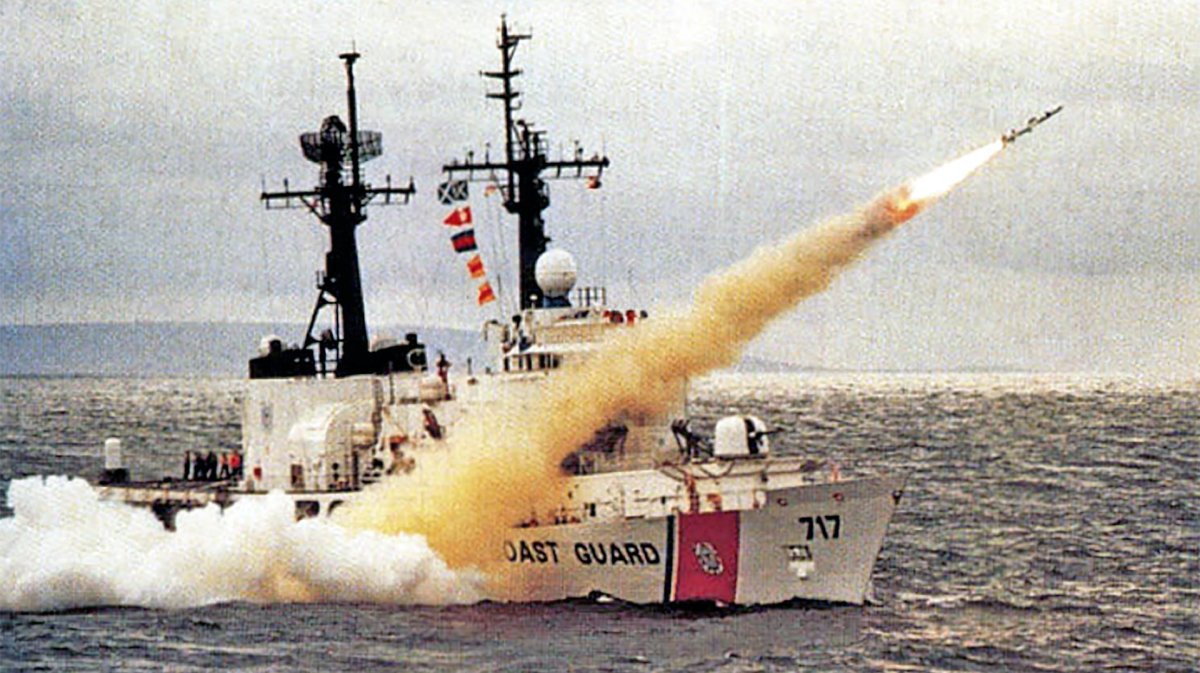
Mellon was the only Hamilton class cutter to fire a Harpoon missile. The test of the ship’s new firepower occurred in 1990., USCG
This configuration only lasted for a short while. The Harpoons and the class’s upgraded anti-submarine warfare capabilities would be eliminated in just a few years time. In the end, the Harpoon’s short career with the Coast Guard was largely about the massive cost cuts that came after the fall of the Soviet Union, not the relevance of the concept itself. The missiles were gone from the ships by the mid-1990s.
USCGC Boutwell (WPG-719; WHEC-719) in foreground; then directly starboard of Boutwell is the USCGC Jarvis (WHEC-725) which is moored ahead of the USCGC Munro (WHEC-724). Munro is astern of Jarvis and inboard of the Morgenthau (WHEC-722)—note the Harpoon launchers on Morgenthau directly behind her main battery—and finally the USCGC Sherman (WPG-720; WHEC-720) is directly astern of the Munro. Photo taken in 1992., USCG
Fast forward to today and we are back into a similar if not more complicated strategic situation. The Navy desperately needs more surface combatant capacity, but will have a very hard time realizing its lofty goal of achieving a 355 ship fleet in the coming decades. In the meantime, the Coast Guard is stepping up its commitment to help out, as the Admiral discussed above.
On top of this, the entire Navy and Marine corps are pushing towards a new era of distributed warfare —one in which cruise missiles could find themselves on all types of new platforms, including sealift ships . The idea is to leverage new modular standoff weaponry to diversify and drastically increase the number of platforms that can execute attacks on ships and on targets onshore at any given time around the globe. This drastically increases the enemy’s defensive and offensive challenges and allows for more efficiency and capacity when it comes to engaging time-sensitive and opportunistic targets.
RGM-84 launch., Navy
The truth is that in many ways the Legend class National Security Cutters are more capable than the Navy’s own Littoral Combat Ships. The LCSs have many known deficiencies , but they pack similar defensive armament, decoys, sensors, and combat systems as the NSCs. In fact, the NCSs have AN/SLQ-32 SEWIP electronic warfare suites that not only help protect the ship in hostile waters, they can also be used to generate Harpoon or other anti-ship missile targeting information passively by homing in and geolocating enemy RF emissions. The Littoral Combat Ships lack SEWIP entirely, but do have some electronic support measures systems.
The Navy has rushed to get anti-ship missile capability onto the woefully under-armed LCSs in recent years, with the first operational deployment of the very capable Naval Strike Missile aboard one of these ships happening just weeks ago. You can and should read about the Naval Strike Missile—which is capable of striking maritime and land targets—in this past feature of ours . Beyond the Naval Strike Missile, the Harpoon has never been more lethal as it is getting new upgrades that will keep it relevant for years to come.
So, why not bolt NSM or Harpoon launchers onto the National Security Cutters that will be deploying on overseas patrols in hostile areas, just like the what the Navy has done for the LCS?
Independence class littoral combat ship USS Gabrielle Giffords (LCS-10) launches a Naval Strike Missile (NSM) during exercise Pacific Griffin on October 1st, 2019., USN
As it turns out, the Coast Guard has already admitted to the possibility of arming their ships that will operate in or very near contested environments with cruise missiles. This specifically came up during a congressional hearing in 2017 in regard to the Coast Guard’s badly needed future icebreakers that will operate in the Arctic. We published a piece on this development and in it, we quoted Coast Guard Commandant Admiral Paul Zukunft as telling the House Homeland Security Committee members the following:
“We need to look differently at what an icebreaker does… We need to reserve space, weight and power if we need to strap a cruise missile package on it… U.S. presence in the Arctic is necessary for more than just power projection; it’s a matter of national security… If they remain unchecked, the Russians will extend their sphere of influence to over five million square miles of Arctic ice and water.”
For decades, the core mission of executing anti-surface warfare via cruise missile had been neglected by the Pentagon, but now it is becoming a high priority across the services. From American nuclear fast attack submarines being reequipped with Harpoons after decades without them, as well as the new Tactical Tomahawk that has anti-ship capabilities, and even more exotic classified anti-ship missiles , to the USAF working to master the delivery of a new generation of standoff naval mines , to the Navy fielding the stealthy Long-Range Anti-Ship Missile (LRASM), to the F-35 being slated to receive the Joint Strike Missile , to the Army even looking to get into the ship-killing business, a new era of anti-ship missile capabilities is rapidly emerging. This is due to the ballooning surface warfare capacity of America’s biggest military competitor, China. Russia’s revamping of its own naval fleet is also a catalyst behind this anti-ship cruise missile renaissance of sorts.
USS Donald Cook fires a Harpoon during an exercise. , USN
With all this in mind, it’s somewhat puzzling that the Coast Guard and its Navy partners haven’t already gone ‘back to the future’ and worked to arm at the NSCs with anti-ship missiles when they deploy for long overseas patrols in hostile areas. Cost-wise, such an endeavor is relatively affordable, especially if the Navy were to help out as these weapon systems are quite modular in nature and can be switched between ships as they cycle in and out of a region. As laid out above, the proof of concept already exists. Regardless, considering we now live in an age of netcentric and increasingly platform-agnostic warfare, the concept is much more relevant now than it was 30 years ago. The added possibility that far less capable vessels could be armed with similar weapons in the future makes doing so with the National Security Cutters too obvious to ignore.
NSC during sea trials. , Huntington Ingalls
To recap, the idea of arming some of the USCG’s most capable ships with anti-ship missiles when they are operating in tense areas far from home is more relevant now than ever because:
The initiative to drastically expand the distributed warfare concept of operations
The same concept was deployed under similar circumstances at the end of the Cold War
It is already being discussed/considered for the service’s future icebreakers
Increased USCG presence in Asia’s contested waters
NSCs are already operating in higher threat areas
Doing so would allow for more independent operations without the need of Navy surface combatants nearby in some situations
Modular nature of these weapon systems makes them easier and cheaper to deploy and swap among hulls
Netcentric warfare concepts mean these ships can be ready and called upon remotely to strike targets of opportunity at a moment’s notice, even targets their own sensors cannot see
Transforms USCGCs from liabilities to assets in higher-risk environments
Would be part of the massive and ongoing push to revamp America’s anti-ship missile capabilities and concepts of operation
Naval Strike Missile and upgraded Harpoon are off-the-shelf solutions that could be bolted on and easily integrated
LCS has already undergone a similar upgrade and shares similar sensors and the same combat system as NSC
Navy doesn’t have enough surface combatants to fulfill demands and will have trouble ever realizing its 355 ship goal
Adding anti-ship missile capabilities is being examined for far less capable ships
So, what do you think? Is it time to ‘up-gun’ some of the USCG’s most capable vessels that consistently operate in dangerous waters far from home? Let us know in the comments below.
Contact the author: Tyler@thedrive.com
Comments couldn’t be loaded. Please refresh the page.
更新于美国东部时间2019年12月1日上午6:04
提到美国海岸警卫队,人们通常会想到在美国领海附近巡逻、缉毒和救援落水船只,但实际上,海岸警卫队的任务范围远不止于此,甚至深入到一些相当危险的地区。过去,正是由于这种现实情况,再加上一个非常强大的敌人,导致海岸警卫队一些最精锐的巡逻艇配备了RGM-84“鱼叉”反舰巡航导弹。如今,海岸警卫队可能正处于另一次类似的重大变革的边缘,其部分舰艇的武装程度将进一步提升。
从动荡不安的波斯湾到充满争议的南海海域,再到局势高度紧张的台湾海峡,美国海岸警卫队的舰艇部署在全球各地,执行高端任务,有时还会与装备更精良的美国海军舰艇并肩作战。随着所谓“大国竞争”在势均力敌的对手之间愈演愈烈,海岸警卫队被要求承担更多以往由海军水面作战舰艇执行的任务。
美国海岸警卫队“伯索夫”号(USCGC Bertholf)是一艘传奇级国家安全舰,去年三月曾穿越局势紧张的台湾海峡。
事实上,美国海岸警卫队刚刚宣布将向关岛派遣三艘最新的快速反应巡逻舰,并计划在该地区扩大整体存在,以帮助平衡对手(即中国)日益增长的影响力和能力。
据《星条旗报》报道,美国海岸警卫队司令卡尔·舒尔茨海军上将在访问菲律宾期间发表讲话,称海岸警卫队正在“加倍重视大洋洲事务”。此次访问是他大规模印太地区巡视的一部分。舒尔茨上将的部分讲话如下:
“面对来自中国的胁迫和对抗行为,美国海岸警卫队在专业和个人层面都秉持透明的合作与伙伴关系……我希望美国海岸警卫队成为该地区透明且首选的合作伙伴。……大洋洲地区的地缘战略重要性达到了数十年来的最高点……海岸警卫队希望成为政府整体解决方案的一部分。……我认为,在高端军事行动方面,海岸警卫队的杀伤力低于国防部,外交能力高于国务院……我们正处于两者之间的最佳位置。”
“面对中国的胁迫和对抗行为,美国海岸警卫队在专业和个人层面都提供透明的接触和伙伴关系……我希望美国海岸警卫队成为该地区透明且首选的合作伙伴。”
大洋洲地区的地缘战略重要性已达到数十年来的最高点……海岸警卫队希望成为政府整体解决方案的一部分。
我认为海岸警卫队的行动能力在高端作战方面不如国防部那样具有杀伤力,但在外交方面又高于国务院……我们正处于这种最佳平衡点。”
目前,海岸警卫队最强大的舰艇——传奇级国家安全舰(NSC)配备一门57毫米甲板炮、一套密集阵近防武器系统(CIWS)和一些小型机枪。它还配备了AN/SLQ-32V2 SEWIP电子战系统。舰上有两个机库,可容纳两架直升机或一架直升机和数架无人机。舰尾还设有大型硬壳充气艇的下水和回收区域。
美国海岸警卫队“韦斯切”号巡逻艇的两名船员准备回收这艘26英尺长的“超视距”号潜艇。(美国海岸警卫队)
除了武器和车辆外,这些舰艇还配备了一系列相当先进的传感器,并由其先进的COMBATSS-21作战管理系统提供支持——该系统也用于濒海战斗舰,并计划用于海军的新型护卫舰。然而,这些舰艇缺乏任何超视距武器,因此除了在小规模冲突中,它们并不被认为是能够“反击”的潜在目标。
2014年6月25日,美国海军国家安全舰“韦斯切”号(USCGC Waesche,WMSL 751)抵达夏威夷珍珠港-希卡姆联合基地。
冷战期间,类似的“大国竞争”现实促使美国海岸警卫队在其部分汉密尔顿级高续航巡逻舰上部署了RGM-84“鱼叉”反舰导弹。除了核心功能外,这些舰艇在20世纪60年代初的设计就考虑到了必要时进行反潜作战的能力。它们配备了声呐、鱼雷发射管、诱饵发射器等设备。在20世纪80年代,这些反潜能力以及其他方面的改进,例如现代化甲板炮、新型传感器和作战系统、增设机库等,都根据舰队改造和现代化计划进行了升级。在里根时代的海军建设浪潮下,美国海军正竭尽所能地扩大自身实力,他们看到了升级后的汉密尔顿级巡逻舰所蕴含的潜在作战能力。
美国海岸警卫队“汉密尔顿”号巡逻艇(WHEC-715)及其鱼叉导弹发射器。(公共领域)
最终决定对这些舰艇进行进一步升级,包括加装“密集阵”近防系统、Mk38 25毫米链式舰炮和RGM-84“鱼叉”反舰导弹,以大幅提升其杀伤力。海军认为,升级后的坚固舰艇在敌对区域执行巡逻任务时,能够从“累赘”转变为“资产”,甚至可以在与实力相当的敌人发生公开冲突时投入战斗。
以下文字记录介绍了这项计划在 20 世纪 90 年代初发展成熟的背景:
1992财年国防拨款参议院听证会记录,美国政府文件
十二艘汉密尔顿级巡逻舰并非全部都获得了这项额外的升级,但至少“汉密尔顿”号、“摩根索”号和“梅隆”号都获得了升级。不过,Mk38型近防炮和“密集阵”近防系统最终还是会安装到该级所有舰艇上。
“梅隆”号是唯一一艘发射过“鱼叉”导弹的汉密尔顿级巡逻舰。该舰新火力测试于1990年进行。(美国海岸警卫队)
这种配置只持续了很短一段时间。“鱼叉”导弹及其升级后的反潜作战能力在短短几年内就被淘汰。最终,“鱼叉”导弹在海岸警卫队的短暂服役生涯,很大程度上是由于苏联解体后大规模的成本削减,而非其概念本身的实用性问题。到20世纪90年代中期,这些导弹就从舰艇上拆除了。
前景为美国海岸警卫队“布特韦尔”号巡逻舰(WPG-719;WHEC-719);“布特韦尔”号右舷紧邻“贾维斯”号巡逻舰(WHEC-725),该舰停泊在“门罗”号巡逻舰(WHEC-724)前方。“门罗”号位于“贾维斯”号后方,位于“摩根索”号巡逻舰(WHEC-722)内侧——请注意“摩根索”号主炮正后方的鱼叉反坦克导弹发射器——最后,“门罗”号正后方为美国海岸警卫队“谢尔曼”号巡逻舰(WPG-720;WHEC-720)。照片拍摄于1992年,美国海岸警卫队。
时至今日,我们再次面临类似甚至更为复杂的战略形势。海军迫切需要更多水面作战舰艇,但在未来几十年内实现拥有355艘舰艇的宏伟目标将难上加难。与此同时,正如上文提到的,海岸警卫队正在加大力度提供援助。
此外,整个海军和海军陆战队正在推动分布式作战的新时代——巡航导弹可能部署在包括海运舰在内的各种新型平台上。其理念是利用新型模块化防区外武器,使能够随时在全球范围内对舰船和陆上目标发动攻击的平台数量多样化并大幅增加。这将极大地增加敌方的防御和进攻难度,并提高打击时效性和机会主义目标的效率和能力。
RGM-84发射,海军
事实上,在许多方面,“传奇”级国家安全舰的性能都优于海军自身的濒海战斗舰。濒海战斗舰虽然存在诸多已知缺陷,但它们配备的防御武器、诱饵、传感器和作战系统与国家安全舰类似。实际上,国家安全舰配备了AN/SLQ-32 SEWIP电子战系统,该系统不仅有助于在敌对水域保护舰艇,还能通过追踪和定位敌方射频辐射,被动地生成“鱼叉”或其他反舰导弹的目标信息。濒海战斗舰完全没有SEWIP系统,但确实配备了一些电子支援措施系统。
近年来,美国海军一直在加紧为火力严重不足的濒海战斗舰(LCS)配备反舰导弹能力。就在几周前,性能卓越的海军打击导弹(NSM)首次部署到其中一艘LCS上。您可以阅读我们之前关于NSM的专题报道,了解这种能够打击海上和陆地目标的导弹。除了NSM之外,鱼叉反舰导弹也得到了升级,其杀伤力空前强大,这将使其在未来几年内保持竞争力。
那么,为什么不把NSM或鱼叉导弹发射器安装到即将部署到敌对地区进行海外巡逻的国家安全舰上,就像海军为濒海战斗舰所做的那样呢?
2019年10月1日,在“太平洋狮鹫”演习期间,独立级濒海战斗舰“加布里埃尔·吉福兹”号(LCS-10)发射了一枚海军打击导弹(NSM)。(美国海军)
事实证明,海岸警卫队已经承认有可能为其将在冲突地区或附近海域执行任务的舰艇配备巡航导弹。2017年,在一次国会听证会上,海岸警卫队急需在北极地区服役的未来破冰船项目被提上日程,而此事正是在这次听证会上被提及的。我们曾就此发表过一篇文章,文中引用了海岸警卫队司令保罗·祖昆夫特海军上将向众议院国土安全委员会成员发表的以下讲话:
“我们需要重新审视破冰船的作用……如果需要在其上搭载巡航导弹,我们就需要预留空间、重量和动力……美国在北极的存在不仅仅是为了投射力量;这关乎国家安全……如果不加以遏制,俄罗斯将把其势力范围扩展到超过500万平方英里的北极冰层和水域。”
几十年来,五角大楼一直忽视了利用巡航导弹执行反水面作战的核心任务,但如今,它正成为各军种的重中之重。从美国核动力快速攻击潜艇在数十年后重新装备“鱼叉”导弹,到具备反舰能力的新型“战术战斧”巡航导弹,以及更为先进的机密反舰导弹;从美国空军致力于掌握新一代远程水雷的投放技术,到海军部署隐形远程反舰导弹(LRASM),再到F-35战斗机计划装备联合打击导弹,甚至陆军也开始考虑涉足反舰领域,反舰导弹能力的新时代正在迅速到来。这主要归因于美国最大的军事竞争对手——中国——日益膨胀的水面作战能力。俄罗斯对其海军舰队的改造也是推动反舰巡航导弹复兴的催化剂之一。
美国海军“唐纳德·库克”号驱逐舰在演习中发射了一枚鱼叉导弹。
考虑到以上种种,令人费解的是,海岸警卫队及其海军伙伴为何尚未“重返未来”,为国家安全舰艇配备反舰导弹,以便在敌对区域进行长期海外巡逻时使用。从成本角度来看,这项工作相对经济实惠,尤其是在海军的协助下,因为这些武器系统具有相当高的模块化特性,可以根据舰艇轮换进出同一区域的情况进行更换。正如上文所述,概念验证已经存在。无论如何,考虑到我们现在生活在一个以网络为中心且日益平台无关的战争时代,这一概念比30年前更具现实意义。此外,未来性能远逊于此的舰艇也可能装备类似武器,这使得为国家安全舰艇配备此类武器显得尤为重要,不容忽视。
NSC在海上试验期间。,亨廷顿·英格尔斯
总而言之,为美国海岸警卫队一些最强大的舰艇配备反舰导弹,尤其是在远离本土的紧张海域执行任务时,这一想法比以往任何时候都更加重要,原因如下:
大幅扩展分布式作战概念的倡议
在冷战末期,类似的理念也在类似情况下被运用。
目前已经在讨论/考虑将其作为该服务未来破冰船的配置方案。
美国海岸警卫队加强在亚洲争议水域的部署
国家安全委员会已经在高威胁地区开展工作。
这样做可以允许开展更多独立行动,在某些情况下无需海军水面作战舰艇在附近支援。
这些武器系统的模块化特性使得它们更容易、更便宜地部署和在不同船体之间更换。
网络中心战概念意味着这些舰艇可以随时待命,并可远程调用,在接到指令后立即打击机会目标,甚至是其自身传感器无法探测到的目标。
在风险较高的环境中,将美国海岸警卫队担保公司从负债转变为资产。
这将是美国持续大规模改造反舰导弹能力和作战概念行动的一部分。
海军打击导弹和升级版鱼叉导弹是现成的解决方案,可以即插即用,易于集成。
LCS已经进行过类似的升级,并与NSC共享类似的传感器和相同的作战系统。
海军水面作战舰艇数量不足以满足需求,而且很难实现其355艘舰艇的目标。
正在研究为性能远低于同类舰艇的舰艇增加反舰导弹能力。
那么,您怎么看?是否应该给美国海岸警卫队一些最精锐的舰艇升级武器装备,这些舰艇经常在远离本土的危险水域执行任务?请在下方评论区留言。
联系作者:Tyler@thedrive.com
评论加载失败,请刷新页面。