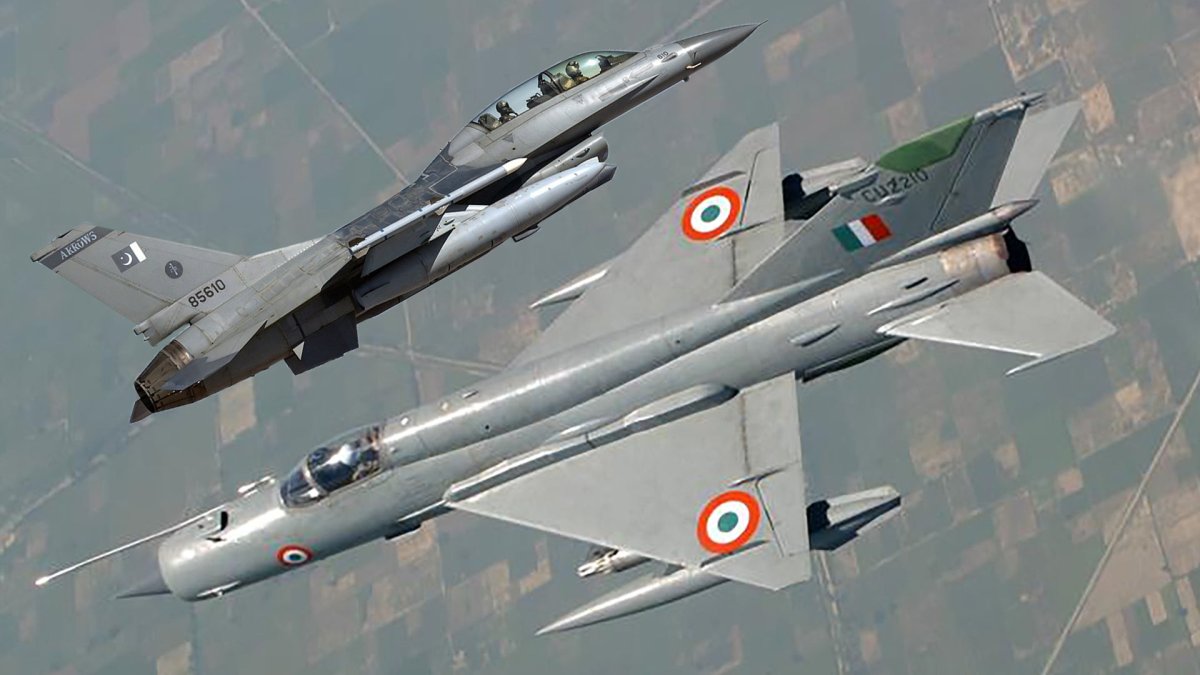
Enough With The Indian Mig-21 Bison Versus Pakistani F-16 Viper Bullshit够了,别再扯什么印度米格-21“野牛”和巴基斯坦F-16“蝰蛇”的扯淡事了!
The amount of garbage commentary and skewed analysis on the whole shoot down has been unbelievable. Here's the reality, like it or not.
Updated Dec 1, 2019 6:46 AM EST
I have never seen such a large and diverse mess of misinformation spouted and parroted with wild abandon about a military skirmish than what has come out of the short spate of Pakistani-Indian air battles that occurred in late February. But one aspect of those operations, in particular, has been so ridiculously mischaracterized by the media, so-called analysts, and the public in general, that the majority of narratives surrounding it have to be called out for what they are— total
During a Pakistani Air Force counterstrike operation on February 27th, one that came in response to India’s air raid into their territory on February 26th, an Indian MiG-21 Bison was shot down and its pilot , Wing Commander Abhinandan Varthaman, captured. He was returned to India in remarkably good shape not long after. Claims that India shot down a Pakistani F-16 during that same incident quickly followed.
What has come as a result of all this has been a full-on information assault of laughably childish narratives that lack any understanding of modern air combat and appear to be largely driven by blind nationalism, political spin, or straight-up stupidity, not reality or fact.
India now officially claims that they shot down a Pakistani F-16 and that Wing Commander Varthaman was the one who did it just before he himself got shot down. I have to make clear that we have zero evidence that a Pakistani F-16 was lost in combat. None. That does not mean it didn’t happen, it just means that at this time we have no reason to believe it beyond taking India’s word for it.
MiG-21 Bison., Indian Air Force
The videos and images being passed around online that supposedly support the downed F-16 claim are pure misinformation made up of repackaged old media from past incidents or blatant mistruths peddled by “open source intelligence” social media congregators and nationalist pundit accounts supporting the Indian side of the long and sad standoff between the two nuclear-armed neighbors.
Maybe the most notorious piece of media being used to push the F-16 shoot down narrative is a set of pictures of aircraft wreckage showing what some claim is the outer casing of a GE-F110 turbofan engine. There are many issues with the photos to begin with— Bellingcat even did a big and totally unnecessary write up on it—but one needs to look no further than the simple fact that Pakistan has never operated a single F-16A/B/C/D with a General Electric engine. All of the country’s F-16s have run F100 series Pratt & Whitney engines since Pakistan first acquired the type decades ago.
Pakistani Block 52 F-16D. , USAF
So, case closed when it comes to one of the most prolific examples of the garbage mound of ‘evidence’ swirling around the incident. Once again, throngs of people, including major news outlets from around the globe, arguing about a subject they know nothing about.
But the question of if a seemingly archaic MiG-21 shot down a Pakistani F-16 really isn’t the issue here. The problem is that so many have said that such a loss would have been near impossible or a sign of some sort of super embarrassing blunder by an incompetent Pakistani Air Force, or even that the F-16’s value and capabilities as a modern combat aircraft should be discounted due to the purported loss. This is all absolute and total swill.
Modern air combat is not a Hollywood blockbuster movie or an arcade game folks! There are so many factors that go into every single air-to-air engagement—even those that occur in a relatively sterile vacuum for training—that acting as if the loss of a more modern and capable airframe to an older and less capable one is some sort of unheard of and damning evidence as to the latter’s relevance and effectiveness on the modern battlefield is absolutely inaccurate.
First off, the MiG-21 Bison that India flies, with well over 100 operational in its inventory, is not the ‘Fishbed’ of the Cold War era. The aircraft was updated with 4th generation fighter avionics and sensors in the late 1990s and early 2000s.
Indian MiG-21 Bison loaded with R-73 and R-77 missiles. , Aeroprints/Wikicommons
This upgrade included a glass cockpit, radar warning receiver, and a helmet mounted cueing system for firing the high off-boresight R-73 short-range air-to-air missile . Although it isn’t disclosed, it seems to include a data-link terminal, as well.
A Phazatron Kopyo (“Spear”) lightweight multi-mode radar was installed in the jet’s nosecone that also allowed it to employ the R-77 beyond-visual-range air-to-air missile. That upgraded radar may also have received certain tweaks that have improved its performance or it may have been replaced with an even more capable foreign radar set altogether. Other additions included a bubble canopy with far superior visibility compared to the MiG-21’s original smaller and more densely framed one. Expansive countermeasures dispensers were installed as well.
With the ability to carry smarter weapons, the Bison also received a very important piece of equipment from Israel, the bolt-on Elta-8222 self-protection electronic warfare pod. This was cutting edge tech in the early 2000s, but even today it is still amazingly formidable and is capable of wreaking absolute havoc on enemy radar systems—especially mechanically-scanned array fire control radars found on most 4th generation fighters.
All this adds up to a potent little package for not a lot of money and the MiG-21 already sports certain advantages like small radar and visual signatures from certain aspects, as well as the ability to make hard instantaneous turns and fast supersonic dashes. But when you pair the Bison package with creative tactics and networking, as well as a host of other aircraft and an experienced pilot, it becomes far more lethal than the sum of its parts.
You don’t have to take Tyler Rogoway’s word for this . The USAF found this out the hard way during one of the most beneficial learning moments in modern air combat training history. Cope India 2004 saw American F-15Cs paired off against the pointy-end of India’s wildly diverse Air Force. Although India’s Su-30Ks were close to the best thing Russia had to export at the time, and their French-built Mirage 2000s were certainly not to be discounted, the most surprising star of the exercise was the insidious little Bison.
Mirage 2000s, Su-30Ks, and F-15Cs during Cope India 2004., USAF
During the air combat training drills, Indian Air Force Su-30Ks would use their powerful radars to build-up situational awareness and then data-link their ‘picture’ to other aircraft in the airborne force, which seemed to include the upgraded MiG-21s. Either way, the Su-30 pilots could also use radio communications to inform the Bisons of threats and tactical opportunities. The Bison pilots, running with their radars off and emitting few to no electronic emissions that could alert the F-15 crews as to their whereabouts, would use this situational information to their advantage.
MiG-21 Bison pictured packing an Elta-8222 jamming pod., Unknown
With their Elta-8222 jamming pods fired up and wreaking havoc on the F-15C’s legendarily powerful AN/APG-63 radar, combined with their already small radar and visual signature, the Bisons would come screaming in out of nowhere to within visual range of the Eagles. They would proceed to shoot the F-15s in the face with their infrared-guided R-73 missiles before blasting by. And even if the Eagles noticed the Bisons at the last moment, the Bison pilots could negate the raw performance of the hulking F-15s by employing the ‘fire and forget’ R-73 nearly 90 degrees of the centerline of their noses using their helmet-mounted targeting system.
To put it metaphorically, the Bison wasn’t a cavalry soldier or a scout, it was a ninja.
Bisons in formation., Indian MoD
Overall, during that historic 2004 Cope India exercise, F-15 pilots found themselves having to react to rapidly changing tactics as the Indian airborne force constantly morphed their playbook in reaction to the Eagles’ moves and entering into visual fights just after picking up the Indian fighters that were already right on top of them on radar. By then the Indians were also locked on, as well.
It was a notoriously brutal, but highly beneficial learning experience for the Air Force. And yes, rules of engagement for the exercise were set purposely to fulfill certain training goals and push the Eagle force hard. This included limiting the F-15s from firing their simulated AIM-120 AMRAAMs in active mode radar homing mode and only engaging at 20 miles or less with those missiles in their degraded state.
The Eagles were also outnumbered—at times as much as three to one—but that wasn’t entirely uncommon for the F-15C/D force. The U.S. flying contingent was also made up of fleet pilots from an active squadron flying against a composite force of India’s most advanced aviators. But most of all, the Americans lacked their E-3 Sentry Airborne Warning And Control System (AWACS)—a staple of USAF air combat doctrine that traditionally enhanced the F-15’s situational awareness and survivability dramatically by acting as their high-powered eyes and ears on high.
F-15Cs and MiG-27s during Cope India 2004. Note that the far MiG-27 is also packing an Elta-8222 pod. , USAF
But still, the message was clear—future enemies may be far more tactically resourceful than previously realized, regardless of the quality of their equipment. The Pentagon had to react fast if it wanted to retain its air combat edge.
Realizing and facing the shortcomings of equipment and tactics through high-quality training and experimentation, and attempting to remediate those shortcomings as much as possible, is the hallmark of a great flying force, not a poor one.
The Joint Helmet Mounted Cueing System (JHMCS), which was already slated for the F-15C/D community, would soon find its way on many other American fighters as well. The push to get Active Electronic Scanned Array (AESA) radars that are far more capable than their mechanically scanned array predecessors—and especially more adept at spotting small radar cross-section targets moving fast in the ground clutter even in dense electronic warfare combat environments— was accelerated for the F-15C/D community.
F-15C seen fitted with AN/APG-63V3 AESA radar. , Raytheon
Other upgrades that are still in the works, including for the F-15 force, were spurred by the Cope India’s after-action findings. For instance, the F-15C/Ds infrared search and track system , which is just in the process of being procured now, would have helped greatly when it came to detecting the Bisons at beyond visual ranges regardless of the electronic warfare systems being employed against the Eagles. You can read all about this and IRSTs in general in this past feature of mine.
And what do you know? American aggressor aircraft were soon spotted packing Elta-8222 electronic warfare pods. In fact, Cope India 2004, and Cope India 2005 that produced similarly dismal results, were key factors in enhancing the way American aggressors did business, as well as some of the kit they had to help them replicate contemporary threats.
64th AGRS jet over the Nellis Test and Training Range packing a Elta-8222 jamming pods. The Israeli EW system showed up USAF aggressors in the aftermath of Cope India 2004/2005., USAF
In essence, thank goodness for the Bison and the tactics employed by the Indian Air Force during Cope India 2004/2005. It gave those in the USAF that were frustrated with the snail’s pace of key upgrade programs the evidence they needed to get prioritized funding.
As I have described in great detail before , the fact that U.S. fighters received an air-to-air dogfight missile with high-off boresight engagement capabilities—the AIM-9X—and a helmet mounted-sight/display with which to target it—decades after the Russians had fielded a similar capability, is still a bewildering and somewhat frightening fact to comprehend. In fact, the F-22, America’s supreme air-to-air weapon, still doesn’t have a helmet mounted sight/display system.
F-15C pilot wearing JHMCS., Tyler Rogoway/Author
So yes, the Bison can be a wily and capable threat when paired with other aerial assets, advanced electronic warfare, and a playbook of guileful and downright creative tactics.
This appears to be just how the aircraft was used during the shoot down in late February. According to reports, the Bison was in the air with Mirage 2000, Su-30MKIs, and maybe most important, the Embraer 145 based DRDO Airborne Early Warning and Control System. This aircraft is not only able to get a ‘God’s eye’ view of the battlespace, including spotting low-flying bogeys and detecting and geolocating the enemy’s radar and communications emissions, but it can share what it sees via data-link or voice direction with Indian fighters. In other words, those constantly morphing tactics and the unique employment of the Bison would have been only more potent over a decade and a half after Cope India 2004 via the help of the IAF’s new advanced airborne early warning and control aircraft.
IAF DRDO AEW&C aircraft., Venkat Mangudi/Wikicommons
So now that we have painted the big picture regarding the Bison, its capabilities, and how India has employed it in the past, it has to be made clear that we have very few hard facts about the engagement that brought the Bison down and supposedly did the same to the F-16.
What was the quality of both pilots’ situational awareness at the time? What was the electronic warfare environment like? Were communications flowing freely or were they degraded? What was the intelligence picture before the sorties even launched? What was the exact position of the Bison in relation to the fighter that shot it down and what was the experience level of the pilot onboard that aircraft?
Was the Bison flying at low-level, using the mountainous terrain to mask its radar signature? What was the opposing aircraft’s mission? Was it offensive or defense counter-air? Were the Pakistanis baiting the Indians knowing full well how they employ their fighter aircraft? What was the real-time intelligence picture on both sides? Did Pakistan have intelligence aircraft airborne and sharing info with its fighters? Who knew what was where and when? What weapons were available on both aircraft? What was the exact visibility conditions at the altitude in which the engagement occurred? Was everything working on both jets? What type of plane actually shot down the Bison? If it was an F-16, was it one of Pakistan’s plentiful upgraded F-16A/Bs or was it one of the handful of advanced Block 52 F-16C/Ds in their possession? Maybe most importantly, what were the rules of engagement and the general intent of both parties at the time of the engagement?
Pakistani F-16BM dropping GBU-10s., Asuspine/Wikicommons
And the list goes on and on. So, if you are looking for some definitive account of the engagement itself, you won’t find it here as it doesn’t exist at this time. Not even remotely close.
With all this in mind, is it possible that a MiG-21 Bison shot down a Pakistani F-16?
In fact, India’s claim that the Bison got off an R-73 shot just before being shot down fits exactly with what we know about the Bison’s sneaky tactics dating back to Cope India 2004.
Does this mean the Bison is superior or equal to the F-16? Or does this put into question the F-16’s capabilities? Absolutely not. Networking alone could have been the decisive factor, along with tactics, experience, and electronic warfare, and especially supporting airborne early warning and control aircraft capabilities.
This is not just true for the Bison. The Navy and Marines have 45 aggressor F-5N/Fs that are far less capable than the Bison, yet they fly against fleet pilots daily. We are talking about these old jets standing off against Super Hornets that are packed with AESA radars, Joint Helmet Mounted Cueing Systems, advanced data-links, and sometimes even benefitting from E-2D airborne early warning and control support.
These F-5N/Fs now have internal electronic warfare suites and other aircraft in their formations during large training drills, like contracted aggressors or Topgun/NAWDC F-16s and F/A-18s, pack advanced electronic warfare pods. But they lack a decent radar, helmet mounted sight and a missile to use it with, and don’t have a data-link for coordinated operations without the use of voice communications, among other deficiencies. Yet just like the Bison, these even less capable F-5s still rack up kills on the mighty Super Hornets. It happens far more often than most would believe.
A pair of F-5N aggressors depart in formation., Tyler Rogoway/Author
In fact, the Navy just selected a private contractor with F-5s upgraded to a similar, but even more advanced standard than the Bison as their ‘4th generation’ threat replication provider for NAS Fallon Nevada, the home of Topgun. Their competition was offering F-16s. Cost played a major part in the decision, which you can read all about here , but it underscores how sensors, avionics, tactics, and electronic warfare can be more important than the raw performance or age of the platform itself when it comes to modern air combat.
Obviously, this rule diminishes greatly when low-observability (stealth) is factored in for 5th generation fighter aircraft. But even with such advanced fighters, old and relatively low-performance aircraft with updated avionics can still pose a threat , especially when employing similarly surprising tactics as the Indians used and when operating as part of a large integrated air combat team that has strength in numbers.
In the end, the avalanche of recent direct comparisons of the MiG-21 Bison versus F-16 Viper and who would win in some fictional and largely irrelevant one versus one dogfight carry next to no relevance in regards to recent events, and in general, to a large degree. Anyone who pushes that type of childish analysis—usually paired with a sensationalized headline—as some sort of pathway toward a definitive conclusion on these matters should be viewed as an untrustworthy source.
In other words, read for entertainment value only.
MiG-21 Bison., Jyotirmoy895/wikicommons
The fact is, the side with the more capable sensor and networking architecture and most potent electronic warfare capabilities, as well as a creative tactics playbook and experience to leverage it, can have a far greater advantage regardless of ‘airframe versus airframe’ performance differentials.
Above all else, the loss of one aircraft, on either or both sides, in a highly complex battlespace, in a region boiling over with aggression and likely buried deep in ‘the fog of war,’ is not indicative of the quality of an entire nation’s air arm or its overall capabilities and the relevancy of its equipment in any tangible way. Both sides have very capable aviators and a mix of varyingly potent weapon systems at their disposal, each with their unique advantages and disadvantages.
So, to those who have been pushing totally unsubstantiated ‘takes,’ peddling fake evidence, spinning what little info is available for political or monetary gain, and/or making grand claims and conclusions backed by a weak knowledge base and childish assumptions about what happened in the skies near the Line of Control late last February, take your often nationalistic and deeply skewed narratives and stuff them up your tailpipes.
Contact the author: Tyler@thedrive.com
Comments couldn’t be loaded. Please refresh the page.
更新于美国东部时间2019年12月1日上午6:46
我从未见过如此之多、如此杂乱无章的虚假信息被肆意传播,尤其是在2月底巴基斯坦和印度之间短暂的空战之后。但其中某个方面尤其被媒体、所谓的分析人士以及公众严重歪曲,以至于围绕这一方面的大部分说法都必须被揭露其本质——彻头彻尾的谎言。
2月27日,巴基斯坦空军对印度2月26日对其领空的空袭做出回应,发动反击行动。在反击中,一架印度米格-21“野牛”战斗机被击落,飞行员阿比南丹·瓦尔塔曼中校被俘。不久后,他被安全送回印度。此次反击行动是为了报复印度2月26日对其领空的空袭。随后,又有报道称印度在同一事件中击落了一架巴基斯坦F-16战斗机。
这一切的结果是,铺天盖地的信息攻击充斥着可笑的幼稚叙事,这些叙事缺乏对现代空战的任何理解,似乎主要受盲目的民族主义、政治宣传或彻头彻尾的愚蠢所驱动,而不是现实或事实。
印度现在正式声称击落了一架巴基斯坦F-16战机,并称是瓦尔塔曼中校在被击落前完成了击落。我必须澄清,我们没有任何证据表明巴基斯坦的F-16战机在战斗中损失。一点也没有。但这并不意味着这件事没有发生,只是意味着目前除了印度的说法之外,我们没有其他理由相信此事。
印度空军 MiG-21 Bison.
网上流传的所谓支持F-16被击落说法的视频和图片,纯属虚假信息,是由过去事件的旧媒体重新包装而成,或是“开源情报”社交媒体聚集者和支持印度一方的民族主义评论员账号散布的公然谎言,而这两个拥有核武器的邻国之间长期而令人悲哀的对峙仍在继续。
或许最臭名昭著的、被用来佐证F-16被击落事件的媒体素材,是一组飞机残骸照片,照片中有人声称发现了GE-F110涡扇发动机的外壳。这些照片本身就存在诸多问题——Bellingcat甚至为此专门撰写了一篇冗长且完全没必要的文章——但只需看看一个简单的事实就足以说明问题:巴基斯坦从未拥有过任何一架配备通用电气发动机的F-16A/B/C/D型战机。自几十年前巴基斯坦首次购入F-16战机以来,该国所有F-16战机都一直使用普惠F100系列发动机。
巴基斯坦Block 52 F-16D战斗机,美国空军
所以,关于围绕这起事件的大量“证据”中最臭名昭著的例子之一,此事就此结案。再一次,包括来自世界各地的主要新闻媒体在内的大批民众,就他们一无所知的话题争论不休。
但问题的关键不在于一架看似老旧的米格-21是否击落了一架巴基斯坦的F-16。问题在于,许多人声称这样的损失几乎不可能发生,或者认为这是巴基斯坦空军极其无能的表现,甚至有人认为,由于这次所谓的损失,F-16作为现代战斗机的价值和性能应该被否定。这些说法完全是无稽之谈。
现代空战可不是好莱坞大片或街机游戏!每一次空战都涉及诸多因素——即使是在相对无菌的训练环境中进行的空战——因此,将一架更先进、性能更强的飞机被一架老旧、性能较弱的飞机击落视为前所未闻、足以证明后者在现代战场上无关紧要、效力低下的铁证,是完全错误的。
首先,印度现役的米格-21“野牛”战斗机(其库存超过100架)并非冷战时期的“鱼窝”。该机在20世纪90年代末和21世纪初进行了升级,配备了第四代战斗机的航电系统和传感器。
印度米格-21“野牛”战斗机挂载R-73和R-77导弹。(图片来源:Aeroprints/Wikicommons)
此次升级包括玻璃座舱、雷达告警接收器以及用于发射高离轴角R-73短程空空导弹的头盔瞄准系统。虽然未公开,但似乎还包括数据链终端。
该机机头锥内安装了一部Phazatron Kopyo(“矛”)轻型多模式雷达,使其能够使用R-77超视距空空导弹。这部升级后的雷达可能经过了一些改进,提升了性能,也可能被完全替换为性能更强大的外国雷达。其他改进包括:相比米格-21原有的较小且结构更密集的座舱盖,其视野范围显著提升;此外,还安装了大型对抗措施投放器。
除了能够携带更智能的武器外,“野牛”战斗机还从以色列获得了一项非常重要的装备——可外挂式Elta-8222自卫电子战吊舱。这项技术在21世纪初堪称尖端科技,即使在今天,它仍然威力惊人,能够对敌方雷达系统造成毁灭性打击,尤其是对大多数第四代战斗机上配备的机械扫描阵列火控雷达。
所有这些加起来,就构成了一个威力强大的小型组合,而且价格并不昂贵。米格-21本身就具备一些优势,例如在某些方面雷达和视觉特征较小,以及能够进行急转弯和高速超音速突进。但是,当把“野牛”套件与创造性的战术和网络配合,再加上其他飞机和经验丰富的飞行员时,它的杀伤力将远远超过各部分性能的总和。
你不必完全相信泰勒·罗格威的说法。美国空军在现代空战训练史上最有益的学习经历之一中,就深刻体会到了这一点。在2004年的“应对印度”演习中,美国的F-15C战机与印度空军种类繁多的顶级战机展开了较量。尽管印度的苏-30K战机几乎是当时俄罗斯出口的最佳战机,而他们法国制造的幻影2000战机也绝对不容小觑,但这次演习中最令人意想不到的明星却是那架阴险狡诈的“野牛”战机。
2004年“应对印度”军演期间,美国空军的幻影2000、苏-30K和F-15C战斗机亮相。
在空战训练演习中,印度空军的苏-30K战斗机将利用其强大的雷达获取态势感知信息,然后将这些信息以数据链的形式传递给空中部队的其他飞机,其中似乎包括升级后的米格-21战斗机。此外,苏-30飞行员还可以通过无线电通信向F-15“野牛”战斗机通报威胁和战术机会。“野牛”战斗机的飞行员在飞行过程中关闭雷达,并尽可能减少可能暴露自身位置的电子设备辐射,从而利用这些态势信息取得优势。
图片显示一架米格-21“野牛”战斗机挂载了Elta-8222干扰吊舱。(来源不明)
野牛战机配备的Elta-8222干扰吊舱启动后,会对F-15C威力强大的AN/APG-63雷达造成严重干扰。凭借其本身就很小的雷达和视觉特征,野牛战机能够从天而降,直逼鹰式战斗机的视线范围。它们会用红外制导的R-73导弹猛烈攻击F-15,然后呼啸而过。即使鹰式战斗机在最后一刻才发现野牛战机,野牛战机的飞行员也可以利用头盔瞄准系统,将R-73导弹以近90度角发射,从而抵消F-15庞大身躯的强大火力。
打个比方,野牛不是骑兵或侦察兵,而是一名忍者。
印度国防部
总的来说,在2004年那次具有历史意义的“应对印度”演习中,F-15飞行员发现自己必须应对快速变化的战术,因为印度空军不断调整作战计划以应对F-15的行动,并在雷达上发现已经近在咫尺的印度战斗机后立即与其展开目视空战。而此时,印度方面也已经锁定目标。
这次演习以残酷著称,但对空军而言却是一次极其宝贵的学习经历。没错,演习的交战规则是特意设定的,旨在达成特定的训练目标,并对F-15战机进行高强度训练。这些规则包括限制F-15战机使用模拟的AIM-120 AMRAAM导弹进行主动雷达制导,并且只能在20英里(约32公里)以内使用性能降低的导弹进行交战。
F-15C/D战机的数量也处于劣势——有时甚至只有对手的三分之一——但这对于F-15C/D部队来说并非罕见。美军的飞行分遣队由现役中队的舰队飞行员组成,而他们的对手则是印度最先进飞行员组成的混合部队。但最重要的是,美军缺少E-3“哨兵”空中预警与控制系统(AWACS)——这套美国空军空战理论的核心装备,历来能够显著提升F-15战机的态势感知能力和生存能力,如同其强大的高空耳目。
2004年“应对印度”联合军演期间的F-15C和米格-27战斗机。请注意,远处的米格-27还挂载了Elta-8222吊舱。(美国空军)
但即便如此,传递的信息依然明确——未来的敌人无论装备多么精良,其战术应变能力都可能远超之前的预期。五角大楼若想保持其空战优势,就必须迅速做出反应。
通过高质量的训练和试验,认识到装备和战术的不足,并尽可能地弥补这些不足,这是伟大飞行部队的标志,而不是糟糕飞行部队的标志。
联合头盔瞄准系统(JHMCS)原本就计划装备F-15C/D战斗机,很快也将应用于其他多种美国战斗机。F-15C/D战斗机也加快了有源电子扫描阵列(AESA)雷达的研发进程。AESA雷达的性能远超其机械扫描阵列雷达,尤其是在密集电子战环境下,能够更有效地探测地面杂波中快速移动的小雷达反射截面目标。
图中可见F-15C战斗机已安装AN/APG-63V3有源相控阵雷达。(雷神公司)
其他一些仍在进行中的升级项目,包括针对F-15战机的升级,都是受到“应对印度”演习后评估结果的推动。例如,目前正在采购中的F-15C/D红外搜索跟踪系统,如果配备在F-15上,无论敌方使用何种电子战系统,都能在超视距范围内探测到敌方的“野牛”无人机。您可以在我之前撰写的这篇文章中详细了解这项升级以及红外搜索跟踪系统的相关内容。
你猜怎么着?很快人们就发现美国假想敌飞机上挂载了Elta-8222电子战吊舱。事实上,2004年和2005年两次同样惨败的“应对印度”演习,不仅显著提升了美国假想敌的作战方式,也为他们配备了一些能够模拟当代威胁的装备。
第64空中地面支援中队(64th AGRS)的喷气式飞机飞越内利斯试验训练靶场,机上挂载着Elta-8222电子战吊舱。这套以色列电子战系统在2004/2005年“应对印度”演习之后,暴露了美国空军假想敌的行踪。
从本质上讲,我们应该感谢“野牛”战斗机以及印度空军在2004/2005年“应对印度”演习期间采取的策略。这为那些对关键升级项目进展缓慢感到沮丧的美国空军人员提供了他们所需的证据,从而争取到了优先拨款。
正如我之前详细描述过的,美国战斗机在苏联部署类似能力几十年后才获得具备高离轴角空战能力的空对空导弹——AIM-9X——以及与之配套的头盔瞄准显示器,这至今仍令人费解,甚至有些可怕。事实上,美国最强大的空对空武器F-22至今仍未配备头盔瞄准显示器系统。
F-15C飞行员身着JHMCS头盔。泰勒·罗戈威/作者
所以,没错,当野牛战机与其他空中力量、先进的电子战技术以及一套狡猾而富有创造性的战术配合使用时,它就能成为狡猾而强大的威胁。
这似乎正是该飞机在二月底被击落事件中的使用方式。据报道,当时“野牛”预警机与幻影2000、苏-30MKI战斗机以及或许最为重要的,基于巴西航空工业公司E145飞机的印度国防研究与发展组织(DRDO)机载预警与控制系统一同在空中飞行。这架飞机不仅能够获得战场“上帝视角”,包括发现低空飞行目标、探测并定位敌方雷达和通信信号,还能通过数据链或语音指令与印度战斗机共享所见信息。换句话说,在2004年“应对印度”演习之后的十五年里,借助印度空军新型先进机载预警与控制系统,这些不断演变的战术以及“野牛”预警机的独特运用将会更加有效。
IAF DRDO AEW&C 飞机。, Venkat Mangudi/Wikicommons
既然我们已经描绘了关于 Bison 战斗机、其性能以及印度过去如何使用它的大图景,那么必须明确指出,对于导致 Bison 战斗机被击落以及据称导致 F-16 战斗机被击落的交战,我们几乎没有任何确凿的事实。
当时两名飞行员的态势感知能力如何?电子战环境如何?通信是否畅通无阻?出击前掌握的情报情况如何?“野牛”战机相对于击落它的战斗机的确切位置在哪里?击落它的战斗机飞行员经验水平如何?
“野牛”战机是否低空飞行,利用山地地形掩盖其雷达信号?敌方战机的任务是什么?是进攻性空中打击还是防御性空中打击?巴基斯坦是否明知印度战机的作战方式,却故意引诱印度?双方当时掌握的实时情报情况如何?巴基斯坦是否派出侦察机与战机共享情报?双方谁掌握了目标位置和时间?双方战机都配备了哪些武器?交战时该高度的能见度如何?双方战机的装备是否都正常?击落“野牛”战机的究竟是什么型号的战机?如果是F-16,是巴基斯坦数量众多的升级版F-16A/B,还是他们拥有的少数几架先进的Block 52 F-16C/D?或许最重要的是,交战时的交战规则和双方的总体意图是什么?
巴基斯坦F-16BM战斗机投放GBU-10炸弹。(图片来源:Asuspine/Wikicommons)
这样的例子不胜枚举。所以,如果你想了解订婚本身的确切情况,这里恐怕找不到,因为目前还没有这样的确切记载。甚至连相关的记载都没有。
考虑到所有这些因素,米格-21“野牛”战斗机击落巴基斯坦F-16战斗机的可能性有多大?
事实上,印度方面声称“野牛”战机在被击落前发射了一枚 R-73 导弹,这与我们自 2004 年“应对印度”行动以来所了解到的“野牛”战机的狡猾战术完全吻合。
这是否意味着Bison战机优于或与F-16战机性能相当?或者这是否质疑了F-16战机的能力?绝对不是。网络技术本身就可能成为决定性因素,此外还有战术、经验、电子战能力,尤其是空中预警和控制飞机的支援能力。
这不仅仅适用于“野牛”战斗机。海军和海军陆战队拥有45架假想敌F-5N/F战斗机,其性能远逊于“野牛”战斗机,但它们每天都要与舰队飞行员进行对抗训练。我们说的是这些老旧的喷气式飞机,它们要对抗的是装备了AESA雷达、联合头盔瞄准系统、先进数据链,有时甚至还能获得E-2D空中预警和控制支持的“超级大黄蜂”战斗机。
这些F-5N/F战机现在都配备了内部电子战系统,在大型训练演习中,编队中的其他飞机,例如受雇的假想敌战机或Topgun/NAWDC的F-16和F/A-18战机,也都配备了先进的电子战吊舱。但它们缺乏像样的雷达、头盔瞄准具和与之配套的导弹,也没有数据链来进行协同作战,只能依靠语音通信,此外还有其他一些缺陷。然而,就像F-5“野牛”战机一样,这些性能更弱的F-5战机仍然能够击落强大的“超级大黄蜂”战机。这种情况发生的频率远超大多数人的想象。
两架F-5N假想敌战斗机编队起飞。(泰勒·罗戈韦/作者)
事实上,海军刚刚选定了一家私人承包商,为其位于内华达州法伦海军航空站(Topgun基地)的“第四代”威胁模拟提供商,该承包商提供的F-5战斗机升级到了与“野牛”(Bison)类似甚至更先进的标准。他们的竞争对手提供的是F-16战斗机。成本在决策中起到了重要作用,详情请点击此处阅读。但这凸显了在现代空战中,传感器、航空电子设备、战术和电子战能力的重要性,有时甚至超过了平台本身的性能或机龄。
显然,对于第五代战斗机而言,如果考虑到低可探测性(隐身)因素,这条规则的适用性会大大降低。但即便拥有如此先进的战斗机,老旧且性能相对较低的飞机,只要配备了升级的航电系统,仍然能够构成威胁,尤其是在采用类似印度军队那样出其不意的战术,以及作为一支数量庞大的联合空中作战部队的一部分进行作战时。
最终,近期铺天盖地的米格-21“野牛”与F-16“蝰蛇”的直接对比,以及关于谁会在虚构的、基本无关紧要的一对一空战中获胜的讨论,与近期发生的事件,乃至总体而言,都几乎没有任何关联。任何鼓吹这种幼稚的分析——通常还配以耸人听闻的标题——并将其作为得出最终结论的途径的人,都应该被视为不可信的信息来源。
换句话说,仅供娱乐。
MiG-21 Bison。,Jyotirmoy895/wikicommons
事实上,拥有更强大的传感器和网络架构、更强大的电子战能力,以及创造性的战术方案和运用这些能力的经验的一方,无论“机身对机身”的性能差异如何,都能获得更大的优势。
最重要的是,在高度复杂的战场环境中,在战火纷飞、局势动荡不安且深陷“战争迷雾”的地区,任何一方或双方损失一架飞机,都不能以任何实质性的方式反映一个国家空军的整体实力、作战能力或其装备的适用性。双方都拥有非常优秀的飞行员,并配备了各种威力不一的武器系统,每种系统都有其独特的优势和劣势。
所以,对于那些一直在散布毫无根据的“观点”,兜售伪造的证据,为了政治或金钱利益而歪曲仅有的少量信息,以及/或者基于薄弱的知识基础和幼稚的假设,对去年二月底控制线附近上空发生的事情做出夸张的断言和结论的人,请把你们那些经常带有民族主义色彩且严重歪曲事实的叙述塞进你们的排气管里吧。
联系作者:Tyler@thedrive.com
评论加载失败,请刷新页面。