The Army Acquired Its Own Hovercraft In The 1980s. It Didn’t Go Well.上世纪80年代,陆军购置了自己的气垫船。但结果并不理想。
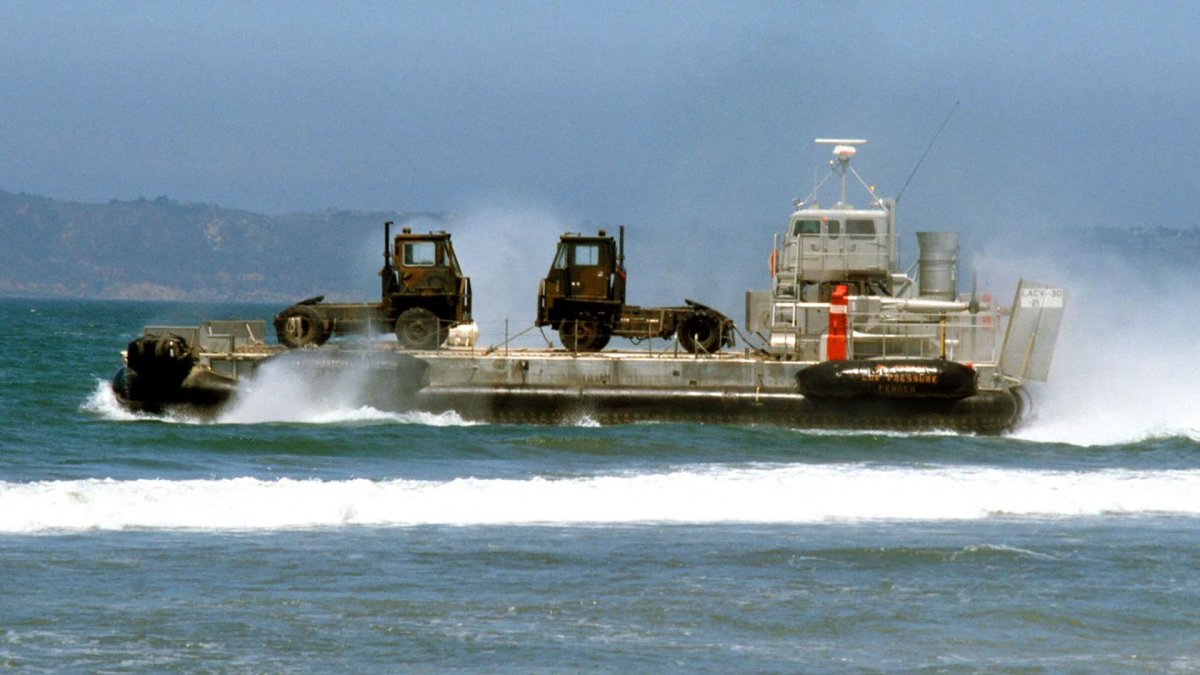
The Army bought LACV-30 hovercraft derived from a commercial model designed in Canada that ended up being ill-suited for hardy military tasks.
Updated Sep 23, 2021 6:23 PM EDT
An old joke says that foreign militaries find the U.S. armed services baffling, in part because the U.S. Navy has its own air force and its own army—and the Navy’s army (the Marine Corps) has its own air force. Not to be outdone, the U.S. Army has its own navy . Since at least World War II, the Army has maintained a fleet of boats and ships (numbering more than 100,000 vessels in 1945), ranging from small landing craft to fairly large logistics support vessels . It has dozens of larger vessels and hundreds of small boats today. From 1983 to 1994, the Army even operated more than two dozen hovercraft.
The LACV-30 (lighter, air cushion vehicle, 30-ton payload) was adapted in the 1970s from a commercial hovercraft built by Bell Aerospace Canada, the Bell Voyageur. Some 40 feet wide and 80 feet long, it had an empty weight of around 65,000 pounds, according to globalsecurity.org . The hovercraft ‘lighter’ — a name given to flat-bottomed craft that moves people and cargo from moored ships — was powered by a pair of Pratt & Whitney PT6T Twin-Pac gas turbines running on standard JP4 jet fuel. The craft could carry up to 30 tons of payload, including two 20-foot containers, pallets, and small vehicles — though, unlike the actual Navy’s landing craft, air cushion (LCAC) , it could not handle a main battle tank such as the 60-ton-plus M1A1 , or even the 50-some-ton M60s that were still in service as late as 1991.
The civilian Bell Voyageur, on which the LACV-30 was based., Bell Aerospace
A U.S. Army LACV-30 hovercraft beached during Exercise Gallant Eagle 86, a joint exercise in July 1986 held at Twentynine Palms and Camp Pendleton, California., National Archives
What the LACV-30 lacked in capacity it made up for in speed. Sources vary, but most put the cruise speed at between 50 and 60 mph, or 44 to 52 knots, while burning 260 gallons/hour. It had little in the way of self-defense capability, and its relatively small air cushion left it vulnerable to rough seas, limiting it to operations in sea state three — that is, in chop with waves heights of around three to four feet. On the other hand, its relatively small size and aluminum structure allowed it to be broken down for transport and reassembled when it reached its operating area.
Unfortunately, the program never really gained any momentum, despite spending around $140 million (in 1986 dollars) to acquire 26 of them. Bell Aerospace Canada’s Voyageur design underlies the LACV-30. By contrast, the JEFF A/B, which grew into the U.S. Navy’s landing craft, air cushion/LCAC design, was a U.S. Bell project run out of its operation in New Orleans, Louisiana. The two craft were developed more or less in parallel, but with little apparent cooperation between the Bell divisions.
According to a 1977 report from the then-General Accounting Office (GAO), LACV-30 operational testing was a bit of a mess. Instead of handing prototypes (based on the civilian Bell Voyageur craft) over to the Army’s operational testing and evaluation unit—the Armor and Engineer board—a subordinate unit of the Army Training and Doctrine Command (TRADOC), managed the process.
It seems the Armor and Engineer Board team made a hash of the testing. According to the GAO report, the Army decided not to test the LACV-30 in the sort of conditions that might have made it useful:
For example, Army officials said operational testing will not include tests of the vehicle’s capability to operate in plunging surf up to 8 feet high in winds up to 50 miles per hour in temperatures as low as minus 40 degrees Fahrenheit, or over vertical obstacles up to 3 feet high. GAO
For example, Army officials said operational testing will not include tests of the vehicle’s capability to operate in plunging surf up to 8 feet high in winds up to 50 miles per hour in temperatures as low as minus 40 degrees Fahrenheit, or over vertical obstacles up to 3 feet high.
For example, Army officials said operational testing will not include tests of the vehicle’s capability to operate
in plunging surf up to 8 feet high
in winds up to 50 miles per hour
in temperatures as low as minus 40 degrees Fahrenheit, or
over vertical obstacles up to 3 feet high.
A LACV-30 in action in 1986., US National Archives
In fairness, it’s worth noting that TRADOC said it expected the missing tests would be done during developmental testing, once initial units had been procured, and that, anyway, there was plenty of such data from the civilian version. But, as the GAO added: “It is doubtful that civilian experience with a version of the LACV-30 was obtained under the types of conditions encountered during military amphibious operations. Similarly, the skills of civilian operators and maintenance personnel may not have been comparable to those of their military counterparts.”
The Army eventually acknowledged that even its inadequate initial testing raised serious doubts about the vessels’ capability. Globalsecurity.org says the Army admitted “the LACV-30’s reliability, availability, and maintainability characteristics were inadequate” and it was likely unable to complete its designed two-hour shift “without a system or mission failure.”
Despite these problems, the Army stood up two operational units, the 8th and 331st Transportation Companies. According to a history of the 8th , training began at Fort Story (today, part of Joint Base Little Creek, Virginia) in 1983, before the 8th was activated as an air cushion transportation company in October 1984. The unit had been variously a ground transport, helicopter, and boat company off and on since World War II.
Cranes aboard the vehicle cargo ship USNS Altair (T-AKR 291) lower equipment to a LACV-30 lighter, air cushion vehicle, during Exercise Gallant Eagle 86., National Archives
The company’s LACV-30s participated in exercises throughout the late 1980s, even working with the 6th Marine Expeditionary Brigade at Camp Lejeune in June 1988, training for hostage rescue missions. But the maintenance issues with the lighters, combined with their operational limitations, ultimately were too, uh, deflating, and the Army pulled the plug on the 8th and 331st, as well as the LACV-30, all of which were decommissioned in 1994. The vehicles were sold to a company in Alaska, but environmental concerns — especially noise — ultimately made them impractical there. At least one decrepit example wound up for sale in Louisiana in recent years.
A broken-down LACV-30 was offered for sale on the internet a few years ago., Louisianasportsman.com
It’s probably no wonder, then, that when the Navy was looking for a hovercraft to call its own in the mid-1980s, it evaluated and then quickly discarded the LACV-30 in favor of Bell Textron’s much more capable LCAC . Part of the issue is that the Army couldn’t decide whether its hovercraft would be a true lighter (usually an unpowered barge) or a landing craft (a seagoing small transport) that can land on a contested beach. Both are used to move people and cargo from larger vessels, but seakeeping, speed, and — sometimes — self-defenses differentiate them. The LACV-30 compromised in too many ways, while the LCAC was designed with seakeeping and heavy lift in mind from the outset.
Today, even as the LCAC is being phased out, its latest evolution, Bell’s Ship-to-Shore Connector LCAC 100, has begun to join the fleet. Hovercraft continue to have their uses, but a poorly performing one that depends on nearly ideal conditions could be considered evidence by those who contend that it’s not always best to let an army have its own navy.
A landing craft, air cushion, launches from the amphibious dock landing ship USS Ashland (LSD-48)., U.S. Navy / MC3 Madysson Anne Ritter
Comments couldn’t be loaded. Please refresh the page.
更新于美国东部时间2021年9月23日下午6:23
有个老笑话说,外国军队觉得美国军队的运作令人费解,部分原因是美国海军有自己的空军和陆军——而海军的陆军(海军陆战队)又有自己的空军。美国陆军也不甘示弱,拥有自己的海军。至少从二战时期开始,陆军就拥有一支庞大的舰艇舰队(1945年舰艇数量超过10万艘),从小型登陆艇到相当大的后勤支援舰艇,应有尽有。如今,陆军拥有数十艘大型舰艇和数百艘小型舰艇。从1983年到1994年,陆军甚至还运营过二十多艘气垫船。
LACV-30(轻型气垫船,有效载荷30吨)是上世纪70年代由加拿大贝尔宇航公司(Bell Aerospace Canada)生产的商用气垫船“贝尔旅行者”(Bell Voyageur)改装而来。据globalsecurity.org网站报道,该船宽约40英尺,长约80英尺,空重约65,000磅。这种气垫船的“轻型”运输工具——通常指用于从系泊船舶运送人员和货物的平底运输工具——由两台普惠PT6T Twin-Pac燃气轮机提供动力,使用标准JP4航空煤油。该艇可运载高达 30 吨的有效载荷,包括两个 20 英尺的集装箱、托盘和小车辆——尽管与海军真正的气垫登陆艇 (LCAC) 不同,它无法运载 60 多吨重的 M1A1 主战坦克,甚至无法运载 1991 年仍在服役的 50 多吨重的 M60 主战坦克。
LACV-30 就是以民用贝尔 Voyageur 飞机为基础设计的。贝尔航空航天公司
1986年7月,在加利福尼亚州二十九棕榈镇和彭德尔顿营举行的“英勇雄鹰86”联合演习期间,一艘美国陆军LACV-30气垫船搁浅。(图片来源:美国国家档案馆)
LACV-30虽然运载能力不足,但速度极快。各方说法不一,但大多数资料显示其巡航速度在50至60英里/小时(44至52节)之间,油耗为260加仑/小时。它的自卫能力有限,相对较小的气垫使其容易受到恶劣海况的影响,因此只能在三级海况下作战——即浪高约3至4英尺的波浪中作战。另一方面,它相对较小的尺寸和铝制结构使其可以拆卸运输,并在到达作战区域后重新组装。
遗憾的是,尽管花费了约1.4亿美元(按1986年美元计算)采购了26架飞机,该项目始终未能真正取得进展。贝尔宇航加拿大公司设计的“旅行者”(Voyageur)是LACV-30的基础。相比之下,后来发展成为美国海军气垫登陆艇(LCAC)的JEFF A/B是美国贝尔公司位于路易斯安那州新奥尔良的工厂负责的项目。这两款飞机的研发几乎是并行进行的,但贝尔公司各部门之间似乎缺乏合作。
根据当时的美国总审计署 (GAO) 1977 年的一份报告,LACV-30 的作战测试一团糟。测试过程并非按照规定将原型机(基于民用贝尔 Voyageur 型飞机)移交给陆军的作战测试和评估单位——装甲与工程兵委员会,而是由陆军训练与条令司令部 (TRADOC) 的一个下属单位负责。
装甲与工程兵委员会的测试团队似乎搞砸了。根据美国政府问责局(GAO)的报告,陆军决定不在可能使其发挥作用的条件下测试LACV-30:
例如,陆军官员表示,作战测试将不包括在高达8英尺的巨浪中、风速高达每小时50英里、气温低至零下40华氏度的情况下行驶,或越过高达3英尺的垂直障碍物的能力测试。
例如,陆军官员表示,作战测试将不包括测试该车辆在高达 8 英尺的巨浪中、风速高达每小时 50 英里、气温低至零下 40 华氏度的情况下运行的能力,或越过高达 3 英尺的垂直障碍物的能力。
例如,陆军官员表示,作战测试将不包括对车辆运行能力的测试。
在高达8英尺的汹涌海浪中
风速可达每小时 50 英里
在低至零下40华氏度的温度下,或者
可越过高达 3 英尺的垂直障碍物。
1986年,一辆LACV-30装甲运兵车正在执行任务。(图片来源:美国国家档案馆)
平心而论,值得注意的是,美国陆军训练与条令司令部(TRADOC)表示,他们预计缺失的测试将在首批设备采购后的研发测试阶段完成,而且无论如何,民用版本已经积累了大量此类数据。但是,正如美国政府问责局(GAO)补充道:“民用版LACV-30的经验是否能在军事两栖作战的条件下获得,这一点令人怀疑。同样,民用操作人员和维护人员的技能可能也无法与军方同行相提并论。”
陆军最终承认,即使是最初不充分的测试也令人对该舰艇的性能产生了严重怀疑。Globalsecurity.org网站称,陆军承认“LACV-30的可靠性、可用性和可维护性不足”,并且很可能无法在“不发生系统或任务故障”的情况下完成其设计的两小时轮班。
尽管存在这些问题,陆军还是组建了两个作战单位:第8运输连和第331运输连。根据第8运输连的历史记载,该连于1983年在斯托里堡(现为弗吉尼亚州小溪联合基地的一部分)开始训练,并于1984年10月正式组建为气垫运输连。自二战以来,该连曾断断续续地担任过地面运输连、直升机连和船艇连等职务。
在“英勇雄鹰86”演习期间,美国海军“阿尔泰尔”号(USNS Altair,T-AKR 291)运输舰上的起重机将设备吊装到LACV-30轻型气垫登陆车上。(美国国家档案馆)
该公司生产的LACV-30轻型装甲车在20世纪80年代后期参与了各种演习,甚至在1988年6月还与驻扎在勒琼营的美国海军陆战队第6远征旅合作,进行人质救援任务训练。但这些轻型装甲车的维护问题以及其操作上的局限性最终令人失望,陆军终止了第8和第331轻型装甲车部队以及LACV-30的服役,所有这些车辆都在1994年退役。这些车辆被卖给了阿拉斯加的一家公司,但环境问题——尤其是噪音问题——最终使它们在阿拉斯加不再适用。近年来,至少有一辆破旧的LACV-30在路易斯安那州被出售。
几年前,一辆破损的LACV-30型卡车在网上出售。(Louisianasportsman.com)
因此,也就不难理解为什么海军在20世纪80年代中期寻求自主研发的气垫船时,会评估LACV-30后迅速放弃,转而选择贝尔泰克斯特朗公司性能更强大的LCAC。部分原因是陆军当时无法决定其气垫船究竟是真正的轻型运输船(通常是无动力驳船)还是能够在敌方海滩登陆的登陆艇(小型海上运输工具)。两者都用于从大型舰艇运送人员和货物,但适航性、速度以及——有时——自卫能力是它们之间的区别。LACV-30在很多方面都存在妥协,而LCAC从一开始就兼顾了适航性和重型运输能力。
如今,尽管LCAC气垫登陆艇正在逐步退役,但其最新改进型——贝尔公司的舰岸连接器LCAC 100——已开始加入舰队服役。气垫登陆艇仍有其用途,但性能不佳且依赖近乎理想条件的气垫登陆艇,或许能为那些认为陆军并非总是应该拥有海军的人提供佐证。
一艘气垫登陆艇从两栖船坞登陆舰“阿什兰”号(LSD-48)上发射升空。(美国海军/三级军士长马迪森·安妮·里特摄)
评论加载失败,请刷新页面。