This Is The Early Warning Radar Helicopter The Royal Navy Could Have Had这是英国皇家海军原本可能拥有的早期预警雷达直升机。
Her Majesty’s Navy turned down a Merlin equipped with an active electronically scanned radar for a far less cutting-edge solution.
新闻视频
Published Apr 1, 2021 6:28 PM EDT
The U.K. Royal Navy recently announced that the first Merlin Crowsnest carrier-based airborne early warning helicopter had been delivered to its home base, at Culdrose in Cornwall, ahead of a scheduled first operational cruise aboard the HMS Queen Elizabeth later this spring, bringing a powerful new surveillance capability to the fleet. But the Crowsnest concept could have been altogether very different, had the U.K. decided on a more advanced — and more costly — active electronically scanned array (AESA) radar setup.
With the primary task of long-range air, sea, and land surveillance, a radar helicopter, like Crowsnest, is a vital component of the U.K.’s resurgent carrier strike capability , providing a way to detect, identify, and track threats beyond an armada’s horizon, ensuring that it’s protected.
One of the first Crowsnest-equipped Merlin HM2 helicopters delivered to Royal Naval Air Station Culdrose recently., CROWN COPYRIGHT
The Royal Navy had gone for years without any carriers at all after the retirement of HMS Ark Royal , together with all of the country’s short takeoff and vertical landing (STOVL) Harrier GR9s , as a result of the 2010 Strategic Defense and Security Review. Now, a multi-billion-dollar project has reinstated what the U.K. Ministry of Defense describes as the Carrier Enabled Power Projection (CEPP) capability, and Crowsnest is central to this. As well as the two Queen Elizabeth class aircraft carriers themselves, and at least 48 F-35B Lightning Joint Strike Fighters , around $329 million is being spent on Crowsnest.
Delivery of the first aircraft to the operating unit means the Royal Navy is, once again, ready to take an airborne early warning (AEW) helicopter to sea. While the current Crowsnest will be an eagerly awaited and critical addition to the carrier strike group, it might not have been the best solution in terms of overall capability.
Overall, the path to get to this point has been a fairly tortuous one. It’s been an incredible 21 years since what was then known as the Future Organic Airborne Early Warning program was announced in the U.K. parliament. At that point, it was anticipated that the resulting capability could be in service by 2012.
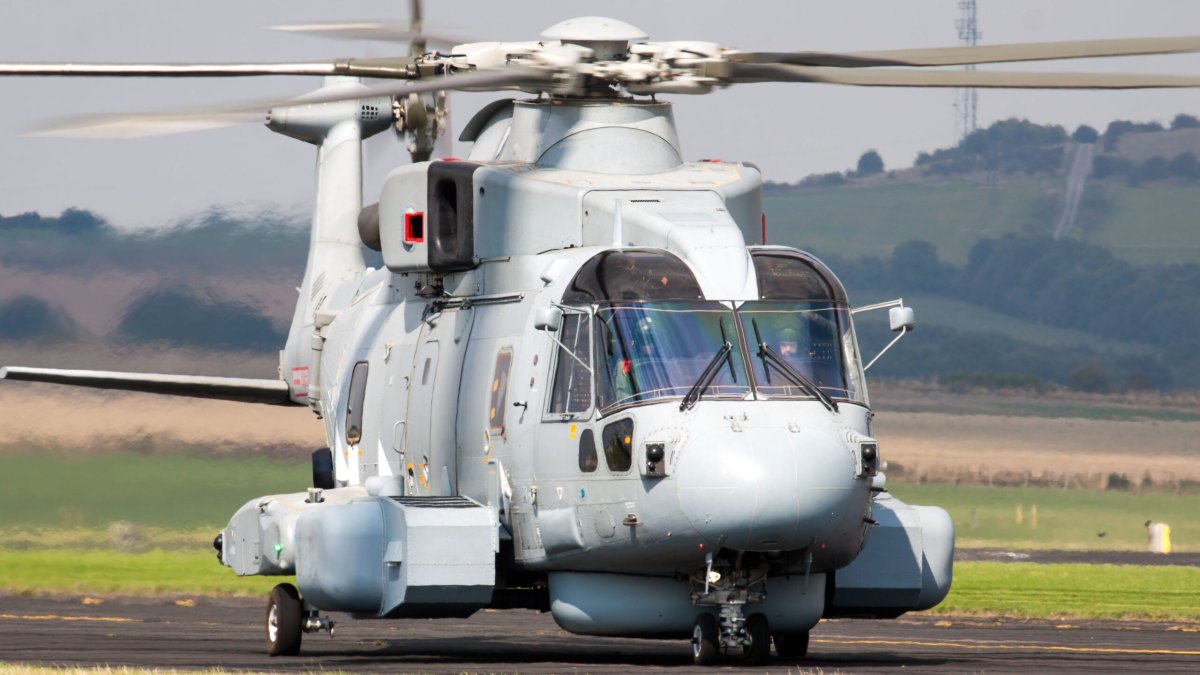
Before settling on the current Crowsnest solution, the U.K. had considered an active electronically scanned array (AESA) array which, as also seen in the photo at the top of this story, was installed in pods along the lower fuselage sides of the Merlin.
A Merlin testbed helicopter fitted with the Lockheed Martin Vigilance suite during trials back in 2014., Rick Ingham
Known as Vigilance, this was a Lockheed Martin offering and it incorporated technology derived from the Northrop Grumman AN/APG-81 used in the F-35 Joint Strike Fighter . At some point later on, Lockheed switched from the AN/APG-81-derived radar to the Israeli Elta EL/M-2052 radar, again contained within side-mounted pods. The same containers, which attached to the Merlin’s existing torpedo hardpoints, also carried identification friend or foe (IFF) and electronic support measures (ESM) equipment.
Either way, once equipped, this AEW Merlin would have benefited from all the advantages of an AESA radar , chiefly its ability to rapidly scan huge volumes of airspace compared to older radars that use a mechanically-steered dish. AESAs also offer increased detection and tracking ranges compared to similarly-sized mechanically-scanned designs. They have improved target discrimination and identification capabilities, especially when it comes to spotting low-flying targets with small radar cross-sections, such as cruise missiles or drones . Clearly, such a capability is hugely important when it comes to protecting a carrier group.
Lockheed Martin began testing the Vigilance system in late 2011 and flight trials were conducted using a Merlin test aircraft at MOD Boscombe Down , in southwest England, the U.K. military aircraft testing establishment. There are next to no details available of what this testing achieved, but it’s clear it was part of a so-called assessment phase to compare the different available options.
Thought was also been given to a bespoke AEW aircraft based on the V-22 Osprey tiltrotor , which would have offered greater endurance and a higher operating altitude than the Merlin. The V-22 has long been eyed as a potentially highly useful, if expensive, addition to the Royal Navy’s future carrier strike groups, also being able to provide carrier onboard delivery , aerial refueling , combat search and rescue , and other missions.
An artist’s impression of an AEW-equipped Royal Navy V-22 Osprey., ROYAL NAVY
Helicopter AEW platforms are, by their nature, limited by their operating altitude, which reduces their radar reach, and by their range, as well as being more fatiguing for their operators. All those drawbacks would have been addressed by the U.S. Navy’s E-2D Advanced Hawkeye , one other platform that was under consideration. However, this would only have been feasible if the U.K. had opted to equip its carriers with catapults for launching aircraft and arrester wires for recovering them. While a “cats and traps” configuration was briefly the plan, as you can read about here , the final choice fell on a STOVL carrier, tailored around the F-35B.
While the Osprey and Advanced Hawkeye were likely never realistic propositions, on cost grounds, the Ministry of Defense spent many years — and a reported $49 million — weighing up the options.
A U.S. Navy E-2D Advanced Hawkeye prepares to catch the wire aboard USS Gerald R. Ford underway in the Atlantic Ocean., U.S. Navy
In the background, meanwhile, defense firm Thales offered a less ambitious and cheaper adaptation of the existing Searchwater 2000 and Cerberus used in what was then the Royal Navy’s radar helicopter, the Sea King ASaC7 . This had first entered Royal Navy service in 1982 as an urgent response to the lack of AEW coverage during the Falklands War and the original Searchwater technology dated back to the latter half of the 1970s.
In April 2015, Lockheed Martin teamed up with Thales to pitch this offering as an alternative to Vigilance. The following month, the U.K. Ministry of Defense selected the Lockheed/Thales proposal . The decision had cost millions of pounds and years of development work, to end up with what was, essentially, the same equipment already in use, ported over to a helicopter that was also well established in service.
In November 2016, a contract was agreed with Lockheed Martin UK to provide and integrate 10 Crowsnest systems as roll-on/roll-off kits for the existing fleet of 30 Merlin HMA2 anti-submarine warfare helicopters, all of which are being adapted to accommodate the equipment. In the process, 200 jobs were secured across the United Kingdom, with Lockheed Martin, as well as sub-contractors Thales and Leonardo Helicopters.
A Royal Navy Merlin Crowsnest undergoes maintenance. , CROWN COPYRIGHT
Today’s Crowsnest system essentially utilizes the same Searchwater 2000 radar and Cerberus tactical sensor suite that were both used in the long-serving Sea King ASaC7, the last of which were retired in September 2018, after nearly 40 years of service. As in the Sea King, the mechanically scanned radar antenna is carried in an inflatable bag that pivots down from the side of the helicopter. The appearance of this installation led to the “Baggers” nickname for the helicopter and its operators, who, like the equipment, have also been passed from the Sea King ASaC7 to the Merlin Crowsnest.
Up to 600 contacts can be monitored by the Cerberus suite, including airborne threats as well as small, fast-moving targets over land and water. The ability to provide overland surveillance is something that was exploited by the Sea King ASaC7 over Afghanistan, in particular, where the aircraft were used successfully in support of NATO forces on the ground.
A Royal Navy Sea King ASaC7 helicopter operating in Afghanistan., CROWN COPYRIGHT
As a mechanically scanned system, the Searchwater 2000 not only falls short in terms of capabilities compared to an AESA equivalent but also has increased maintenance demands, with more moving parts compared to a conformal AESA system. A potential failure of the pivoting arm, for instance, would prevent the helicopter from undertaking its mission and the spinning dish also needs constant upkeep.
That said, some improvements have been made to the equipment for the new Crowsnest application and these reportedly address the human interface, target identification capability, and resilience against electronic jamming.
Above all, however, the Crowsnest system was chosen by the U.K. Ministry of Defense as it was judged the more affordable one, and one which should have presented a minimum risk. Selecting the same equipment as used in the Sea King ASaC7, even if it is “warmed over,” should also reduce the demands on training and logistics.
As it was, despite choosing what was considered the lower-risk solution, the Crowsnest program ended up delayed anyway. Originally anticipated to enter operational service in 2018, coinciding with the withdrawal of the Sea King ASaC7, it wasn’t until March 2019 that a Merlin HM2 fitted with Crowsnest took to the air for the first time.
A revised initial operating capability (IOC) date was then planned for December 2020, to align with the declaration of IOC for HMS Queen Elizabeth in the carrier strike role. This called for one carrier “fitted with the Crowsnest radar system, with supporting infrastructure, logistics, communications and surveillance in place.”
HMS Queen Elizabeth during its first major exercise in British waters last October., CROWN COPYRIGHT
However, a report last June from the U.K. Government’s National Audit Office, which scrutinizes public spending, noted that “the initial contracted capability will not be available until September 2021, 18 months later than planned.”
“The Department did not oversee its contract with Lockheed Martin effectively and, despite earlier problems on the project, neither was aware of the subcontractor’s lack of progress until it was too late to meet the target delivery date,” the report continued. “It subsequently concluded that the subcontractor working on the project, Thales, failed to meet its contractual commitments to develop the equipment and had not provided sufficient information on the project’s progress. The Department and its industry partners have since implemented a recovery plan and enhanced monitoring arrangements.”
Delays have continued, however, and a “full airborne radar capability” for Crowsnest is now not expected until May 2023.
Meanwhile, for the forthcoming Carrier Strike Group 21 (CSG21) deployment to the Mediterranean and the Indo-Pacific — the first operational cruise for HMS Queen Elizabeth — nine Merlin HM2s from 820 Naval Air Squadron (NAS) are expected to go onboard. Of these, three are likely to be equipped with the pre-IOC Crowsnest kits. Taking maintenance and training requirements into account, that leaves precious few airframes for anti-submarine warfare.
Once that first carrier deployment is complete, we may have a better idea of how well this ‘renewed’ iteration of the Crowsnest performs. It could well be that the Royal Navy has a worthy successor to the Sea King ASaC7 in the making, or it might even come to regret turning down the more advanced AESA solution from Lockheed Martin.
Contact the author: thomas@thedrive.com
Comments couldn’t be loaded. Please refresh the page.
发布于美国东部时间2021年4月1日下午6:28
英国皇家海军近日宣布,首架梅林“乌鸦巢”舰载预警直升机已交付至位于康沃尔郡库尔德罗斯的母港,并将于今年春季晚些时候随“伊丽莎白女王”号航母进行首次作战巡航,为舰队带来强大的新型监视能力。但如果英国当初选择更先进、成本也更高的有源相控阵雷达(AESA),那么“乌鸦巢”预警系统的设计理念可能会截然不同。
雷达直升机(如“乌鸦巢”)的主要任务是进行远程空中、海上和陆地监视,它是英国复兴的航母打击能力的重要组成部分,能够探测、识别和跟踪舰队视距之外的威胁,确保舰队的安全。
近日,首批配备“乌鸦巢”(Crowsnest)系统的梅林HM2直升机之一交付给库尔德罗斯皇家海军航空站。(版权所有)
自2010年《战略防务与安全评估》导致“皇家方舟”号航空母舰退役,以及英国所有短距起飞/垂直降落(STOVL)“鹞”式GR9战斗机退役后,英国皇家海军多年来一直没有航母。如今,一项耗资数十亿美元的项目重建了英国国防部所称的“航母赋能力量投射”(CEPP)能力,“乌鸦巢”航母系统是其中的核心。除了两艘“伊丽莎白女王”级航空母舰和至少48架F-35B“闪电”联合攻击战斗机外,“乌鸦巢”航母系统本身也耗资约3.29亿美元。
首架飞机交付作战部队意味着英国皇家海军再次做好了将空中预警(AEW)直升机部署到海上的准备。虽然现役的“乌鸦巢”直升机对于航母打击群来说是一项备受期待且至关重要的补充,但就整体能力而言,它可能并非最佳方案。
总的来说,走到今天这一步可谓相当曲折。自英国议会宣布当时名为“未来有机空中预警系统”(Future Organic Airborne Early Warning)的项目以来,已经过去了令人难以置信的21年。当时预计,该项目最终将在2012年投入使用。
在最终确定采用目前的 Crowsnest 解决方案之前,英国曾考虑过有源电子扫描阵列 (AESA) 阵列,正如本文顶部照片所示,该阵列安装在 Merlin 发动机机身下部两侧的吊舱中。
2014年,一架梅林测试直升机在试验期间安装了洛克希德·马丁公司的“警戒”系统。(图片来源:里克·英厄姆)
这款名为“警戒”(Vigilance)的雷达系统由洛克希德·马丁公司研发,其技术源自诺斯罗普·格鲁曼公司为F-35联合攻击战斗机开发的AN/APG-81雷达。后来,洛克希德·马丁公司将这款基于AN/APG-81的雷达更换为以色列埃尔塔公司生产的EL/M-2052雷达,两款雷达均安装在侧挂吊舱内。这些吊舱可连接到“梅林”导弹现有的鱼雷挂点,同时还携带敌我识别(IFF)和电子支援措施(ESM)设备。
无论如何,一旦装备了AESA雷达,这架预警机(梅林)就能受益于AESA雷达的所有优势,尤其是其相比使用机械旋转天线的旧式雷达,能够快速扫描大片空域。AESA雷达的探测和跟踪距离也比同等尺寸的机械扫描雷达更远。它们还具有更强的目标辨别和识别能力,尤其是在发现雷达反射截面积小的低空目标(例如巡航导弹或无人机)方面。显然,这种能力对于保护航母战斗群至关重要。
洛克希德·马丁公司于2011年末开始测试“警戒”(Vigilance)系统,并在位于英格兰西南部英国国防部博斯康比唐(Boscombe Down)的英国军用飞机测试基地,使用梅林(Merlin)测试飞机进行了飞行试验。关于此次测试的具体成果,目前几乎没有任何细节可查,但显然这是所谓的评估阶段的一部分,旨在比较不同的可用方案。
人们也曾考虑过基于V-22“鱼鹰”倾转旋翼机研制一款定制的预警机,该机比“梅林”发动机拥有更长的续航时间和更高的飞行高度。长期以来,V-22一直被视为英国皇家海军未来航母打击群中极具潜力(尽管造价昂贵)的补充机型,它还能执行舰载物资投送、空中加油、战斗搜救等任务。
艺术家绘制的配备预警系统的英国皇家海军V-22“鱼鹰”倾转旋翼机示意图。
直升机预警平台本身就存在局限性,例如作战高度限制了其雷达探测范围,航程也有限,而且操作人员更容易疲劳。美国海军的E-2D“先进鹰眼”预警机(当时英国考虑的另一个平台)本可以解决所有这些缺点。然而,这只有在英国选择为其航母配备弹射器和拦阻索的情况下才可行。虽然“弹射器+拦阻索”的配置方案曾一度被提上日程(详情请见此处),但最终英国还是选择了以F-35B战斗机为核心的短距起降(STOVL)航母。
虽然从成本角度来看,“鱼鹰”和“先进鹰眼”可能从来都不是现实的选择,但国防部还是花费了多年时间(据报道花费了 4900 万美元)来权衡各种方案。
一架美国海军E-2D“先进鹰眼”预警机准备在大西洋上航行的“杰拉尔德·R·福特”号航空母舰上捕获目标线。
与此同时,国防公司泰雷兹提出了一种不那么雄心勃勃且成本更低的方案,该方案基于现有的 Searchwater 2000 和 Cerberus 系统,并应用于当时英国皇家海军的雷达直升机 Sea King ASaC7。Sea King ASaC7 于 1982 年首次进入英国皇家海军服役,作为应对福克兰群岛战争期间预警覆盖不足的紧急措施,而 Searchwater 的原始技术可以追溯到 20 世纪 70 年代后期。
2015年4月,洛克希德·马丁公司与泰雷兹公司合作,提出以“警戒”(Vigilance)系统作为替代方案。次月,英国国防部选择了洛克希德/泰雷兹的方案。这项决定耗费了数百万英镑和数年的研发时间,最终得到的却只是将原本已在服役的设备移植到一款同样服役多年的直升机上而已。
2016年11月,英国洛克希德·马丁公司与英国政府签订合同,为其现有的30架梅林HMA2反潜直升机提供并集成10套“乌鸦巢”(Crowsnest)系统,这些系统将以滚装滚卸套件的形式安装到直升机上。所有直升机均需进行改装以适配该系统。此举为洛克希德·马丁公司及其分包商泰雷兹和莱昂纳多直升机公司在英国创造了200个就业岗位。
一架英国皇家海军梅林“瞭望台”直升机正在进行维护。,版权所有
如今的“乌鸦巢”系统基本上沿用了服役多年的“海王”ASaC7直升机所使用的“搜索水2000”雷达和“地狱犬”战术传感器套件。最后一架“海王”ASaC7直升机在服役近40年后,于2018年9月退役。与“海王”直升机一样,“乌鸦巢”的机械扫描雷达天线也装在一个可从直升机侧面向下旋转的充气袋中。这种装置的外观使得直升机及其操作人员获得了“充气袋”(Baggers)的绰号。与设备一样,这些操作人员也从“海王”ASaC7直升机转移到了“梅林”“乌鸦巢”直升机上。
Cerberus 系统最多可监控 600 个目标,包括空中威胁以及陆地和水面上的小型快速移动目标。海王 ASaC7 直升机在阿富汗战场上充分发挥了其陆地监视能力,成功支援了北约地面部队的作战行动。
一架在阿富汗执行任务的英国皇家海军海王ASaC7型直升机。(版权所有)
作为一套机械扫描系统,Searchwater 2000 不仅在性能上逊于同等规格的有源相控阵雷达 (AESA),而且由于其活动部件比保形 AESA 系统更多,维护需求也更高。例如,旋转臂一旦发生故障,就会导致直升机无法执行任务;此外,旋转天线也需要定期维护。
也就是说,新的 Crowsnest 应用的设备已经进行了一些改进,据报道,这些改进主要针对人机界面、目标识别能力以及抗电子干扰能力。
然而,英国国防部之所以选择“乌鸦巢”系统,最主要的原因是它被认为价格更实惠,风险也最小。即使是“翻新”的旧设备,选用与“海王”ASaC7直升机相同的装备,也能降低训练和后勤方面的需求。
尽管选择了风险较低的方案,但“乌鸦巢”项目最终还是被推迟了。该项目原计划于2018年投入使用,与“海王”ASaC7直升机的退役时间重合,但直到2019年3月,一架搭载“乌鸦巢”系统的梅林HM2直升机才首次升空。
随后,修订后的初始作战能力(IOC)日期计划于2020年12月实现,以与“伊丽莎白女王”号航母在航母打击任务中宣布具备初始作战能力的时间保持一致。这要求一艘航母“配备‘乌鸦巢’雷达系统,并具备相应的配套基础设施、后勤、通信和监视能力”。
去年十月,英国皇家海军“伊丽莎白女王”号航空母舰在英国水域进行了首次大型演习。(图片版权归英国皇家所有)
然而,英国政府国家审计署(负责审查公共支出)去年 6 月的一份报告指出,“最初签订的合同能力要到 2021 年 9 月才能提供,比计划晚了 18 个月。”
报告继续指出:“该部门未能有效监督与洛克希德·马丁公司的合同,尽管项目早期就存在问题,但双方均未察觉分包商进度滞后,直至为时已晚,无法按期交付。随后,报告得出结论,负责该项目的分包商泰雷兹公司未能履行其开发设备的合同义务,且未提供足够的项目进展信息。此后,该部门及其行业合作伙伴已实施补救计划并加强了监督机制。”
然而,延误仍在继续,克罗斯内斯特的“完整机载雷达能力”预计要到 2023 年 5 月才能实现。
与此同时,即将部署至地中海和印太地区的第21航母打击群(CSG21)——也是“伊丽莎白女王”号航母的首次作战巡航——预计将有来自海军航空兵第820中队的9架梅林HM2型直升机登舰。其中,三架可能配备初始作战能力(IOC)前的“乌鸦巢”(Crowsnest)反潜作战套件。考虑到维护和训练需求,剩余用于反潜作战的机队数量非常有限。
一旦首次航母部署完成,我们或许就能更清楚地了解这款“升级版”Crowsnest无人机的性能。皇家海军很可能正在打造一款足以取代Sea King ASaC7的优秀机型,但也可能会后悔当初拒绝洛克希德·马丁公司更先进的AESA解决方案。
联系作者:thomas@thedrive.com
评论加载失败,请刷新页面。