Congress lays groundwork for AUKUS export control reform国会为AUKUS出口管制改革奠定基础
The White House and Congress are pushing for U.S. export control reforms in order to implement AUKUS cooperation on hypersonics, AI and quantum technology.
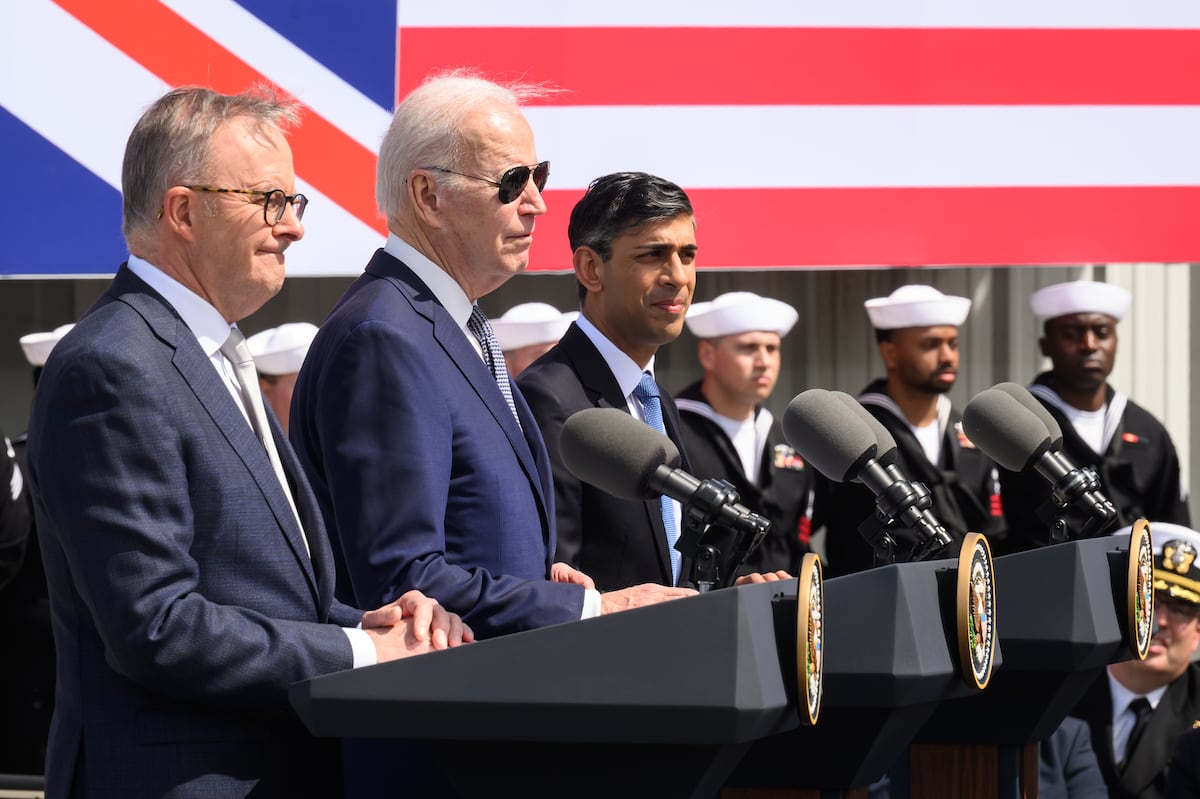
WASHINGTON — Congress on Wednesday took the first step in what is expected to be a lengthy effort to overhaul U.S. export control laws in order to expedite technology cooperation needed to implement a central pillar of the AUKUS trilateral agreement with Australia and the U.K.
The House passed a bill 393-4 directing the State Department and Pentagon to submit information on defense export licenses necessary to collaborate with the U.S. allies on hypersonic weapons, artificial intelligence and quantum technologies. These technologies form what is known as pillar two of the AUKUS agreement , which all three countries view as critical to filling capability gaps before Australia receives U.S. and U.K. nuclear-powered submarines over the next two decades under pillar one .
Rep. Joe Courtney of Connecticut, the top Democrat on the Armed Services seapower subcommittee, told Defense News that he pushed throughout the past year to “get a circuit-breaker type of mechanism” that would expedite technology sharing arrangements with Australia and the U.K. to alleviate private sector concerns about potential violations of the U.S. International Traffic in Arms Regulations regime, or ITAR.
“That is clearly something that the White House and AUKUS team have been focused on themselves,” Courtney said on March 14. “I personally believe it’s going to be a multi-year process for Congress to address this issue.”
While the State Department oversees ITAR, the Defense Department is responsible for technological security and disclosure policy decisions before ITAR comes into play. A senior administration official told Defense News on March 9 that the Pentagon already initiated a review of these export control policies.
“We are currently looking at a wide range of potential changes to ITAR and to other technology sharing restrictions that go under categories like technology, security and foreign disclosure,” said the official, speaking on condition of anonymity to discuss the non-public process. “We’ll be working with Congress, including the Appropriations, Armed Services and also Foreign Relations – which has authority over much of this – to get their support for reforms that we put forward.”
The the bill the House passed Wednesday, introduced by Foreign Affairs Committee Chairman Mike McCaul, R-Texas, seeks more granular information on export control regulations from the State Department and the Pentagon. It requires a joint report from each agency on how the current U.S. export control regime affects technology cooperation with Australia and the U.K. under AUKUS pillar two.
A State Department spokesperson told Defense News on the condition of anonymity to discuss diplomatic issues that the agency does “not anticipate any challenges in implementing AUKUS due to U.S. export control regulations, which exist to safeguard U.S. technologies and maintain the U.S. warfighter’s qualitative edge.” The spokesperson highlighted the State Department’s Open General License Pilot Program — a new ITAR exemption for Australia, the U.K. and Canada.
“Contrary to much recent commentary, export licenses for the U.K. and Australia move faster through our systems than for any other countries and our technology cooperation with those countries is both broad and deep,” said the State Department spokesperson. “We recognize the need to foster even more efficient and flexible export control systems in order to support operational readiness and interoperability of U.S. allies, and we continue to do that.”
Arthur Sidonos, Australia’s ambassador to the United States, voiced confidence in March in the ongoing work to accelerate export licenses to enable AUKUS technology sharing.
“That work is underway; it’s not finished, but compared with say six months ago, the work is getting done,” Sidonos said at the Center for Strategic and International Studies.
If the Senate passes the McCaul bill, the Biden administration will have to provide Congress with “an assessment of recommended improvements to export control laws and regulations of Australia, the United Kingdom and the United States that such countries should make to implement the AUKUS partnership.”
The report would include an “average and median time” it took the U.S. government to review arms exports applications and sales to Australia and the U.K. in 2021 and 2022. It also would include a list of the number of applications both countries have made for licenses to export defense articles and services in those years, and how many were approved and denied.
Additionally, it requires a list of “voluntary disclosures” between 2017 and 2022 that have resulted in ITAR violations while trying to export defense articles to either country.
Bryant Harris is the Congress reporter for Defense News. He has covered U.S. foreign policy, national security, international affairs and politics in Washington since 2014. He has also written for Foreign Policy, Al-Monitor, Al Jazeera English and IPS News.
华盛顿——周三,国会迈出了改革美国出口管制法律的第一步,预计这将是一项漫长的努力,旨在加快技术合作,以落实与澳大利亚和英国签署的AUKUS三边协议的核心支柱。
众议院以393票赞成、4票反对的表决结果通过了一项法案,指示国务院和五角大楼提交与美国盟友在超音速武器、人工智能和量子技术方面开展合作所需的国防出口许可证信息。这些技术构成了所谓的“澳美协议”第二支柱,三国均认为,在澳大利亚根据第一支柱在未来二十年内接收美国和英国的核动力潜艇之前,填补能力缺口至关重要。
康涅狄格州众议员乔·考特尼是众议院军事委员会海权小组委员会的首席民主党议员,他告诉《防务新闻》,在过去一年里,他一直在努力争取“建立一种类似断路器的机制”,以加快与澳大利亚和英国的技术共享安排,从而减轻私营部门对可能违反美国《国际武器贸易条例》(ITAR)的担忧。
“这显然是白宫和AUKUS团队一直关注的问题,”考特尼在3月14日表示。“我个人认为,国会解决这个问题将是一个需要数年时间的过程。”
虽然国务院负责监管《国际武器贸易条例》(ITAR),但国防部负责在ITAR生效前制定技术安全和信息披露政策。一位高级政府官员3月9日告诉《防务新闻》,五角大楼已经启动了对这些出口管制政策的审查。
这位官员在匿名的情况下表示:“我们目前正在研究对《国际武器贸易条例》(ITAR)以及其他技术共享限制(涵盖技术、安全和对外披露等类别)进行一系列潜在修改。我们将与国会合作,包括拨款委员会、军事委员会以及外交关系委员会(该委员会对其中许多事项拥有管辖权),以获得他们对我们提出的改革方案的支持。”
众议院周三通过的这项法案由众议院外交事务委员会主席、德克萨斯州共和党众议员迈克·麦考尔提出,旨在从国务院和五角大楼获取更详细的出口管制法规信息。该法案要求国务院和五角大楼提交一份联合报告,说明现行的美国出口管制制度如何影响美国与澳大利亚和英国在澳英合作协议第二支柱下的技术合作。
一位不愿透露姓名的美国国务院发言人向《防务新闻》透露,由于涉及外交问题,该机构“预计在实施AUKUS项目时不会因美国出口管制条例而遇到任何挑战,这些条例旨在保护美国技术并保持美国作战人员的质量优势。”这位发言人重点介绍了国务院的“开放通用许可证试点项目”(Open General License Pilot Program)——一项针对澳大利亚、英国和加拿大的新的《国际武器贸易条例》(ITAR)豁免。
美国国务院发言人表示:“与近期许多评论相反,英国和澳大利亚的出口许可证审批速度比其他任何国家都快,而且我们与这两个国家的技术合作既广泛又深入。我们认识到,为了支持美国盟友的作战准备和互操作性,需要建立更加高效灵活的出口管制体系,我们将继续努力。”
澳大利亚驻美国大使亚瑟·西多诺斯 (Arthur Sidonos) 在 3 月份表示,他对正在开展的加快出口许可证发放以实现 AUKUS 技术共享的工作充满信心。
“这项工作正在进行中;虽然还没有完成,但与六个月前相比,这项工作正在取得进展,”西多诺斯在战略与国际研究中心表示。
如果参议院通过麦考尔法案,拜登政府将不得不向国会提供“一份评估报告,其中建议对澳大利亚、英国和美国的出口管制法律法规进行改进,以落实澳美伙伴关系”。
该报告将包括美国政府在 2021 年和 2022 年审查对澳大利亚和英国的武器出口申请和销售所需的“平均时间和中位数时间”。报告还将列出这两个国家在这两年提交的国防物品和服务出口许可证申请数量,以及获得批准和被拒绝的申请数量。
此外,它还要求提供一份 2017 年至 2022 年间因试图向两国出口国防物品而导致违反 ITAR 的“自愿披露”清单。
布莱恩特·哈里斯是《防务新闻》的国会记者。自2014年以来,他一直在华盛顿报道美国外交政策、国家安全、国际事务和政治。他还曾为《外交政策》、《Al-Monitor》、《半岛电视台英语频道》和IPS新闻撰稿。