US vendors tussle over Norway’s maritime-surveillance drone business美国供应商为争夺挪威海上监视无人机业务而展开激烈竞争
Northrop Grumman and General Atomics are vying for a deal, as U.S. manufacturers fear losing prominence in Europe.
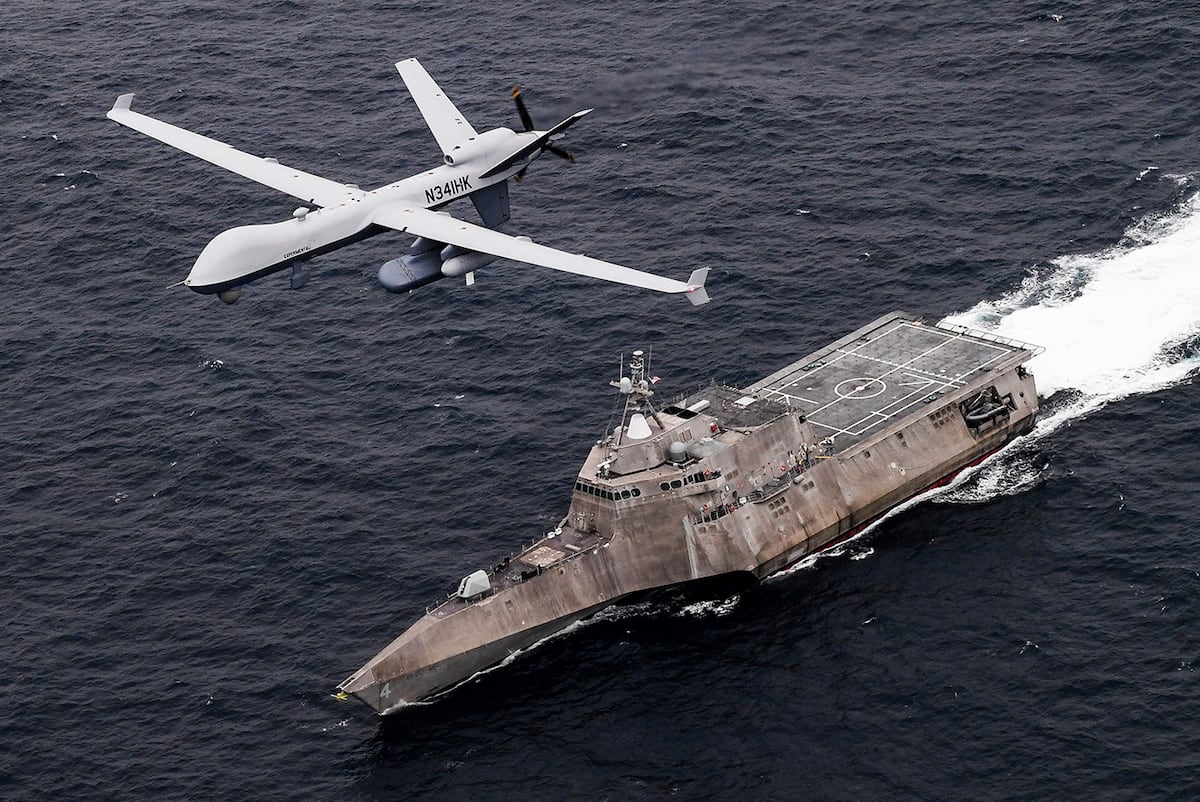
MILAN — Competition is heating up for Norway’s envisioned Arctic-capable, long-range maritime drones, as two American manufacturers have entered the race.
As part of the 2025-2036 Norwegian Defense Pledge, Oslo has committed to acquiring new unmanned aerial systems to be stationed at the Andøya Air Station, some 300 kilometers north of the Arctic Circle.
Earlier this year , it was revealed that the Norwegian Ministry of Defense contacted U.S.-based manufacturers including Northrop Grumman and General Atomics with a request for information.
A General Atomics spokesman told Defense News in March that the company had already responded to the solicitation pitching its MQ-9B SeaGuardian, while Northrop Grumman officials have said they are offering the MQ-4C Triton.
Meanwhile, a Norwegian defense official said the drone project remains at a concept stage.
“At this stage, Forsvarsmateriell (NDMA) is working closely with the Norwegian Air Force to support a concept selection study – because we are still defining requirements and evaluating operational needs, no flight tests have been scheduled and no final decision point has been set,” Brigadier General Jarle Nergård, director of NDMA Air Systems Division said.
Still, competition for the prospective business has drawn out direct comparisons among the American vendors.
Jane Bishop, vice president and general manager of global surveillance at Northrop Grumman, published an article on the company’s website on June 25 criticizing the MQ-9B.
She described the competitor drone as a “medium-altitude long-endurance (MALE) system capable of only about half the service ceiling” of Triton.
“The lower service ceiling has also led to increased risk, as losses have been seen over the past year with multiple MALE aircraft being shot down,” the article states.
It also noted that if Norway were to select the General Atomics’ drone, it would need to buy approximately “four times as many units as more capable HALE [the category of the Triton] aircraft.”
A spokesman for General Atomics said the company had no comment.
The survivability of both American drones has been challenged by some experts in the past. In her article, when mentioning losses, Bishop was likely referring to an incident where three U.S. drones were shot down in April by the Houthis in Yemen – which were Reaper unmanned aerial vehicles, not the SeaGuardian variant.
Northrop systems have not been immune either to adversaries acquiring more sophisticated counter-drone capabilities. In 2019, an Iranian surface-to-air missile shot down the U.S. Navy Broad Area Maritime Surveillance (or BAMS-D) drone, which was a predecessor to the MQ-4C Triton.
An important capability for Norway will be to have the chosen drone complement the country’s P-8A Poseidon maritime patrol fleet to assist them in monitoring large bodies of open water found across its territory.
Norway has acquired five P-8As, with the first units delivered in 2022, that have gradually replaced the Nordic country’s aging fleet of P-3 Orion and DA-20 Jet Falcon aircraft.
Both the SeaGuardian and the Triton can interface with the P-8, according to the manufacturers.
Previously, the U.S. partnered with Australia to jointly develop the Triton’s interoperability with the Australian P-8s, while the SeaGuardian also conducted an unmanned-manned teaming with the British Royal Air Force’s P-8 aircraft in 2021.
Norwegian officials have not disclosed the amount they will dedicate to the purchase of long-range maritime drones.
The government recently announced that it has invested approximately $620 million to support the maritime coalition, led by the United Kingdom, to develop and produce unmanned surface vessels in Ukraine using Kongsberg technology.
Elisabeth Gosselin-Malo was a Europe correspondent for Defense News. She covers a wide range of topics related to military procurement and international security, and specializes in reporting on the aviation sector. She is based in Milan, Italy.
米兰——挪威设想的能够在北极执行任务的远程海上无人机的竞争日趋激烈,因为两家美国制造商也加入了这场竞赛。
作为 2025-2036 年挪威国防承诺的一部分,奥斯陆承诺采购新的无人机系统,并部署在位于北极圈以北约 300 公里的安德亚空军基地。
今年早些时候,有消息透露,挪威国防部联系了包括诺斯罗普·格鲁曼公司和通用原子公司在内的美国制造商,请求提供相关信息。
通用原子公司的一位发言人在 3 月份告诉《防务新闻》,该公司已经响应了招标,推销其 MQ-9B 海卫士无人机,而诺斯罗普·格鲁曼公司的官员则表示,他们提供的是 MQ-4C 海神无人机。
与此同时,一位挪威国防官员表示,无人机项目仍处于概念阶段。
“目前,Forsvarsmateriell (NDMA) 正与挪威空军密切合作,支持概念选择研究——因为我们仍在确定需求和评估作战需求,所以尚未安排飞行测试,也尚未确定最终决策点,”NDMA 航空系统部门主管 Jarle Nergård 准将表示。
尽管如此,对这笔潜在业务的竞争还是引发了美国供应商之间的直接比较。
诺斯罗普·格鲁曼公司全球监控副总裁兼总经理简·毕晓普于 6 月 25 日在公司网站上发表了一篇文章,批评了 MQ-9B 无人机。
她将竞争对手的无人机描述为“中空长航时(MALE)系统,其飞行高度仅为 Triton 的一半左右”。
文章指出:“较低的飞行高度限制也导致了风险增加,过去一年中,多架中空长航时飞机被击落,造成了损失。”
报告还指出,如果挪威选择通用原子公司的无人机,则需要购买的数量大约是“性能更强的HALE(Triton)飞机的四倍”。
通用原子公司的一位发言人表示,该公司对此不予置评。
过去一些专家曾对美制无人机的生存能力提出质疑。毕晓普在文章中提到损失时,很可能指的是今年4月也门胡塞武装击落三架美制无人机的事件——这些无人机是“死神”(Reaper)无人机,而非“海上卫士”(SeaGuardian)无人机。
诺斯罗普公司的系统也未能幸免于对手获得更先进的反无人机能力。2019年,一枚伊朗地对空导弹击落了美国海军的广域海上监视无人机(BAMS-D),该无人机是MQ-4C“海神”无人机的前身。
对挪威来说,一项重要的能力是让选定的无人机与该国的 P-8A 海神海上巡逻机队互补,以协助他们监测其领土内的大片开放水域。
挪威已购入五架 P-8A 反潜巡逻机,首批飞机于 2022 年交付,这些飞机已逐步取代了该北欧国家老旧的 P-3 猎户座和 DA-20 喷气猎鹰飞机机队。
据制造商称,SeaGuardian 和 Triton 都可以与 P-8 连接。
此前,美国与澳大利亚合作,共同开发了 Triton 无人机与澳大利亚 P-8 反潜巡逻机的互操作性;同时,SeaGuardian 无人机也在 2021 年与英国皇家空军的 P-8 反潜巡逻机进行了无人-有人协同作战。
挪威官员尚未透露将拨出多少资金用于购买远程海上无人机。
政府最近宣布,已投资约 6.2 亿美元,支持由英国领导的海上联盟在乌克兰利用康斯伯格技术开发和生产无人水面舰艇。
伊丽莎白·戈斯林-马洛曾任《防务新闻》欧洲通讯员。她的报道涵盖军事采购和国际安全等广泛领域,尤其擅长航空领域的报道。她常驻意大利米兰。