European drone builders tinker with AI in navigation and targeting欧洲无人机制造商正在尝试将人工智能应用于导航和目标定位。
The mix of drones and AI is becoming more prevalent in new designs proposed by manufacturers.
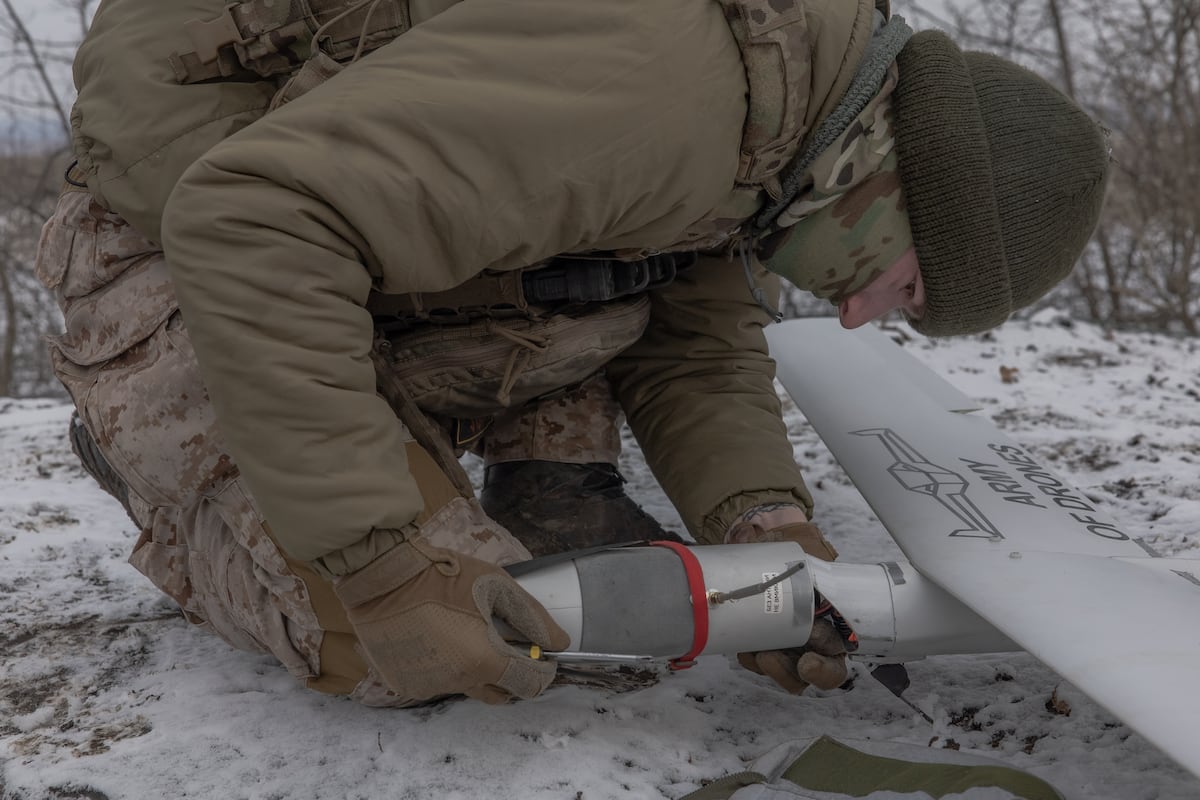
MILAN — Drawing from Ukraine’s battlefield successes, a growing number of European companies have begun fielding drones with artificial intelligence features.
An element of Ukraine’s recent “Spider Web” operation on June 1 – a covert drone attack carried out deep inside Russia – was largely overlooked: the supporting role played by AI.
According to the Center for Strategic and International studies, AI-driven tools were likely critical in training the software of explosive, first-person-view drones. These tools enabled the drones to spot threats, indicate possible strike points for each one, and guide them to targets if the connection with the operator went astray.
The mix of drones and AI is now becoming more prevalent in new designs proposed by manufacturers.
At a recent Drone Summit held in Estonia, a handful of Latvian drone companies showcased their current focus of AI-targeting capabilities. Among them, Origin Robotics recently launched an autonomous drone interceptor created to destroy adversarial unmanned aerial vehicles.
Dubbed “Blaze,” the craft was trained with the help of AI to differentiate between various aircraft types and other objects. Once the system locks onto a target, it takes off and dashes to intercept it by smashing its warhead into it.
Last month, Finnish company Patria announced it will lead a European industry consortium for the new joint Artificial Intelligence Warfare Adaptive Swarm Platform, or AI-WASP.
The program, which includes Finland, Sweden, Estonia, Italy, Greece and Spain, seeks to develop AI-controlled software for use on small to medium-sized unmanned and manned systems.
The project recently received €45 million ($53 million) in funding from the European Commission.
Another company making headway into this space is the Czech manufacturer LPP Holding, which said in May that it provided AI-guided drones to Ukrainian forces. The company’s MTS drones are equipped with AI-based visual navigation specifically designed for GPS-denied areas, per the company website.
While the European defense industry is progressively making greater use of AI in unmanned systems, experts say there remain challenges in its integration, especially when it comes to onboard information.
“The issue is data – what kind of information is used to train UAVs to fly to a certain location or strike specific targets?” said Samuel Bendett, an advisor at the Centre for Naval Analyses. In a targeting sequence, data resident on the drone – versus linked up through an external transmission – would be the sole basis for strike decisions, a challenge in rapidly changing battlefield conditions, he added.
A recent report by the U.S.-based Center for Strategic and International Studies found that Ukraine has opted to train small AI models on small datasets instead of creating large, broad templates.
“This approach enables fast and efficient onboard processing on the limited computing power of small and inexpensive chips, which can be quickly updated and retrained … these datasets can be collected through a company’s battlefield operations or open-source data from social media,” the report said.
Germany-based drone manufacturer Quantum Systems unveiled recently the Mosaic UXS, a software command-and-control platform for unmanned systems to unify capabilities across air, land and sea domains.
The company reports that it is capable of mission planning and execution with machine learning and can plan swarm operations in which each drone is tasked with completing an individual mission.
Ukrainian defense companies have focused on similar endeavors by developing standalone AI software and compact chips that can be fused on a wide range of platforms from FPV drones to turrets set up on unmanned ground vehicles.
Elisabeth Gosselin-Malo was a Europe correspondent for Defense News. She covers a wide range of topics related to military procurement and international security, and specializes in reporting on the aviation sector. She is based in Milan, Italy.
米兰——借鉴乌克兰战场上的成功经验,越来越多的欧洲公司开始部署具有人工智能功能的无人机。
乌克兰最近于 6 月 1 日发动的“蜘蛛网”行动(在俄罗斯境内深处进行的一次秘密无人机袭击)中,有一个要素被很大程度上忽视了:人工智能发挥的支持作用。
根据战略与国际研究中心的研究,人工智能驱动的工具在训练爆炸物第一人称视角无人机的软件方面可能发挥了关键作用。这些工具使无人机能够发现威胁,指出每个威胁的潜在打击点,并在与操作员的连接中断时引导它们飞向目标。
无人机与人工智能的结合在制造商提出的新设计中正变得越来越普遍。
在近期于爱沙尼亚举行的无人机峰会上,几家拉脱维亚无人机公司展示了他们目前在人工智能目标定位方面的研发重点。其中,Origin Robotics公司近期推出了一款自主无人机拦截器,旨在摧毁敌方无人机。
这架名为“烈焰”(Blaze)的飞行器借助人工智能进行训练,能够区分各种类型的飞机和其他物体。一旦系统锁定目标,它便会起飞并高速冲向目标进行拦截,用弹头将其摧毁。
上个月,芬兰公司 Patria 宣布将领导一个欧洲产业联盟,开发新的联合人工智能战争自适应集群平台(AI-WASP)。
该计划涵盖芬兰、瑞典、爱沙尼亚、意大利、希腊和西班牙,旨在开发用于中小型无人和有人系统的AI控制软件。
该项目最近获得了欧盟委员会提供的 4500 万欧元(5300 万美元)资金。
另一家在该领域取得进展的公司是捷克制造商LPP控股公司。该公司在5月份表示,已向乌克兰军队提供了人工智能导航无人机。据该公司网站介绍,其MTS无人机配备了基于人工智能的视觉导航系统,专为GPS信号受限区域设计。
尽管欧洲国防工业正在逐步加大人工智能在无人系统中的应用,但专家表示,人工智能的集成仍然存在挑战,尤其是在机载信息方面。
“问题的关键在于数据——究竟使用什么样的信息来训练无人机飞往特定地点或打击特定目标?”海军分析中心顾问塞缪尔·本德特说道。他补充说,在目标打击序列中,无人机上存储的数据(而非通过外部传输获取的数据)将是打击决策的唯一依据,这在瞬息万变的战场环境下是一项挑战。
美国战略与国际研究中心最近的一份报告发现,乌克兰选择在小型数据集上训练小型人工智能模型,而不是创建大型、广泛的模板。
报告称:“这种方法能够在小型廉价芯片有限的计算能力上实现快速高效的机载处理,并且可以快速更新和重新训练……这些数据集可以通过公司的战场行动或来自社交媒体的开源数据来收集。”
德国无人机制造商 Quantum Systems 近日推出了 Mosaic UXS,这是一个用于无人系统的软件指挥控制平台,旨在统一空中、陆地和海洋领域的作战能力。
该公司表示,它能够利用机器学习进行任务规划和执行,并可以规划集群行动,其中每架无人机都被赋予完成一项单独任务的任务。
乌克兰国防公司也致力于类似的研发工作,开发独立的AI软件和紧凑型芯片,这些软件和芯片可以融合到从FPV无人机到无人地面车辆炮塔等各种平台上。
伊丽莎白·戈斯林-马洛曾任《防务新闻》欧洲通讯员。她的报道涵盖军事采购和国际安全等广泛领域,尤其擅长航空领域的报道。她常驻意大利米兰。