Check Out This AC-130 Gunship Pilot Wearing A Scorpion Helmet Mounted Display看看这位AC-130炮艇机飞行员,他戴着蝎式头盔显示器
AC-130W pilots get a huge boost in situational awareness and more from the helmet mounted display that is usually found on fighters.
Updated Nov 27, 2020 6:35 PM EST
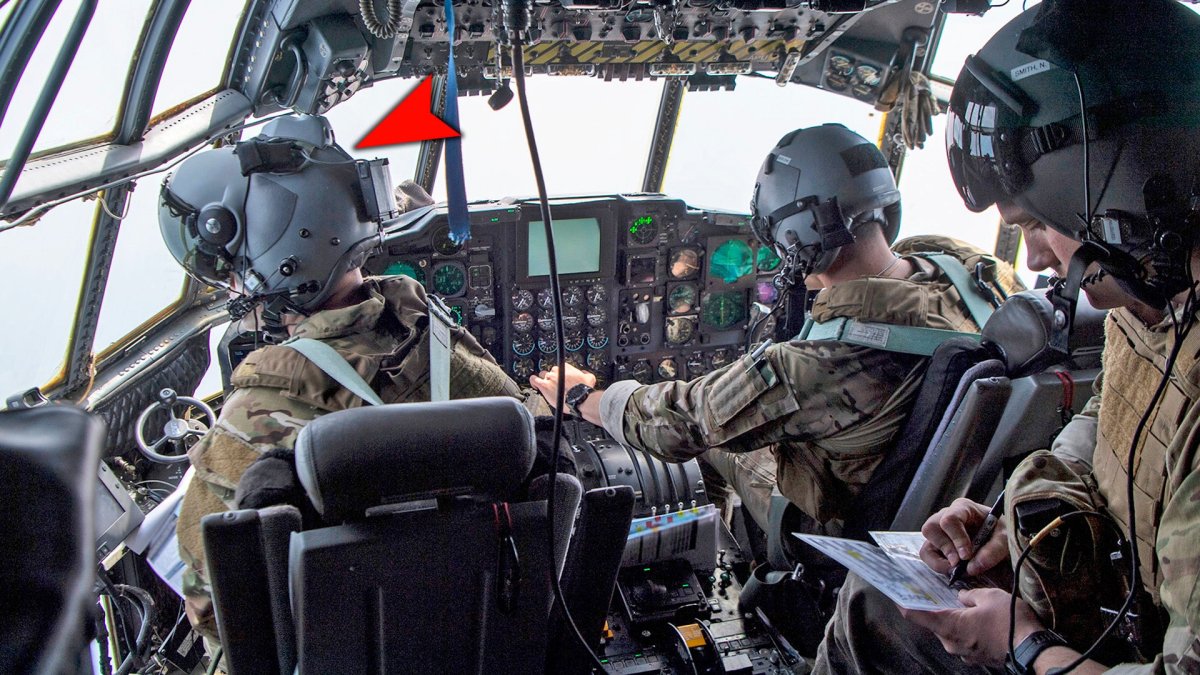
It’s known that pilots that fly the AC-130W Stinger II gunship wear the Scorpion Helmet Mounted Display , but we haven’t seen much imagery showing it in use. Now, thanks to photos released from exercise Gulf Sentry, which was held last week in the Persian Gulf off the coast of the United Arab Emirates, we have a great shot of a pilot of the gunship not just wearing Scorpion, but the improved variant of the helmet-mounted display, known as HObIT, or Hybrid Optical-based Inertial Tracker. HObIT more accurately tracks pilot head movements compared to the original version of the Scorpion.
The HObIT system is an upgrade for the Thales Visionix Scorpion helmet and it features a new monocle with updated symbology. The helmet also employs a new Inertial Measurement Unit (IMU) optical head tracker that works in tandem with a group of small circular stickers that are placed on the interior of the cockpit to seamlessly track the pilot’s head movements even if the helmet moves out of the optical tracking zone.
The Thales helmet has already been incorporated into a number of aircraft types for both air-to-air and air-to-ground applications, with the AC-130W fielding the system after the A-10C Thunderbolt II. It now has an increasing number of applications including the upgraded F-5ATs of contract aggressor company Tactical Air Support Inc., which you can read all about here . The War Zone also recently reported how the Scorpion helmet was tested by pilots flying the U.S. Air Force F-22 Raptor .
A close-up view of the AC-130W pilot wearing the Scorpion helmet., U.S. Air Force/SrA Duncan Bevan
Air Force Special Operations Command’s (AFSOC) AC-130Ws are converted C-130H transports, and their crews continue to use holographic rifle sights to provide a relatively simple way of lining up the gunship in a pylon turn against targets on the ground. You can read more about this arrangement of an off the shelf system for this unique application in this previous War Zone article . The addition of the Scorpion helmet will provide Stinger II pilots with an enhanced ability to more accurately target weapons and improve a pilot’s situational awareness. It displays full-color symbology in front of the pilot’s eye and is linked in with the aircraft’s sensors and data-links so that targets and other objects of interest, as well as primary flight data, are displayed in an augmented reality fashion all around the pilot. It’s a major advance for the USAF’s gunships, with Air Force Special Operations Command’s new AC-130J Ghostrider set to field the same system.
AC-130W sips gas from a KC-135E., USAF
Older AC-130s, such as the now-retired AC-130H and U models, had a sideways-looking Head-Up Display (HUD) for the pilot in order to help train the aircraft’s guns on a specific target area. This was in addition and/or in cooperation with the aircraft’s advanced sensors and computer systems. It was a case of having to fly the aircraft in a manner to enable the weapons to be employed — much like a 17th-century warship with a Broadside that featured a battery of cannons. As well as the aerial gunners in the cargo bay, the crew members in the cockpit could also fire some of those weapons themselves, if necessary.
An aerial gunner operates the AC-130W’s GAU-23/A 30mm cannon., U.S. Air Force/SrA Duncan Bevan
The AC-130W is armed with the GAU-23/A 30mm Bushmaster II cannon and a devastating 105mm Howitzer, but it can also call upon an array of smart weaponry to rain down all manner of lethal effects. This includes AGM-176 Griffin air-to-ground missiles and GBU-44 Viper Strike munitions that can be deployed via its rear ramp. The AC-130W can also fire AGM-114 Hellfire missiles and drop GBU-39/B Small Diameter Bombs. You can read more about the AC-130W’s range of armaments here .
An inflatable target is attacked by an AC-130W during the recent exercise., U.S. Air Force/SSgt Timothy Clegg
Exercise Gulf Sentry was held between the United States and the United Arab Emirates Joint Aviation Command (JAC) from Aug. 9-12 exercised the mission of Air Operations in support of Maritime Surface Warfare (AOMSW) in the Arabian Gulf . An AC-130W assigned to U.S. Special Operations Central Command (SOCCENT) worked alongside Joint Terminal Attack Controllers (JTACs) who were responsible for directing live fires at simulated targets. A media release said: “It gave Emirati and U.S. pilots a chance to hone strike capabilities together against surface targets such as maritime infrastructure and fast attack craft.”
An aerial gunner removes a casing from the 105mm Howitzer onboard an AC-130W Stinger II., U.S. Air Force/SrA Duncan Bevan
For the AC-130 crew, this exercise appears to have provided an excellent opportunity to exercise the AC-130W’s firepower in a maritime environment, and it wasn’t the first time it did so in recent months. The need to strike large numbers of small craft in the Arabian and Persian Gulfs is a burgeoning requirement for U.S. Central Command. This kind of air-sea training reflects the need to rehearse a vital Persian Gulf mission, underscored by the ongoing tensions with Iran in the Strait of Hormuz.
Equipped with a wide range of new tech weaponry, that can now be more quickly and effectively employed by the AC-130W crew, means the gunship continues to prove its worth. Blending the Scorpion helmet-mounted display with that impressive airborne arsenal makes the AC-130 an even deadlier attack platform that can unleash its killer blows faster and more accurately than ever before.
Contact the author: jamie@thedrive.com
Comments couldn’t be loaded. Please refresh the page.
更新于美国东部时间2020年11月27日下午6:35
众所周知,驾驶AC-130W“毒刺II”炮艇机的飞行员佩戴“蝎子”头盔显示器,但我们很少看到它实际使用时的图像。现在,得益于上周在阿联酋波斯湾举行的“海湾哨兵”演习中公布的照片,我们得以一窥这位炮艇机飞行员的身影:他不仅佩戴了“蝎子”头盔显示器,而且佩戴的是改进型的“蝎子”头盔显示器——HObIT,即混合光学惯性跟踪器。与初代“蝎子”相比,HObIT能够更精确地跟踪飞行员的头部运动。
HObIT系统是泰雷兹Visionix Scorpion头盔的升级版,它配备了带有更新符号的新型单片眼镜。该头盔还采用了一种新型惯性测量单元(IMU)光学头部追踪器,它与贴在驾驶舱内部的一组小型圆形贴纸协同工作,即使头盔移出光学追踪区域,也能无缝追踪飞行员的头部运动。
泰雷兹公司的这款头盔已被应用于多种机型,用于空对空和空对地作战。AC-130W在A-10C“雷电II”攻击机之后也装备了该系统。如今,它的应用范围越来越广,包括为假想敌公司战术空中支援公司(Tactical Air Support Inc.)升级的F-5AT战斗机,您可以在这里阅读相关报道。此外,《战区》(The War Zone)网站近期也报道了美国空军F-22“猛禽”战斗机飞行员对“蝎子”头盔的测试情况。
近距离拍摄的AC-130W飞行员佩戴“蝎子”头盔的照片。(美国空军/高级空军士兵邓肯·贝文摄)
美国空军特种作战司令部(AFSOC)的AC-130W是由C-130H运输机改装而来,其机组人员继续使用全息瞄准镜,以便在挂架转弯时相对轻松地瞄准地面目标。您可以在之前的《战区》文章中了解更多关于这种针对特定应用的现成系统的信息。加装“蝎子”头盔将使“毒刺II”导弹飞行员能够更精确地瞄准目标,并提高飞行员的态势感知能力。它在飞行员眼前显示全彩符号,并与飞机的传感器和数据链连接,使目标和其他感兴趣的物体以及主要飞行数据以增强现实的方式显示在飞行员周围。这对美国空军的武装直升机来说是一项重大进步,美国空军特种作战司令部的新型AC-130J“幽灵骑士”也将配备相同的系统。
美国空军的AC-130W从KC-135E加油机上吸取燃料。
较老的AC-130,例如现已退役的AC-130H和AC-130U型,都配备了侧视式抬头显示器(HUD),以便飞行员将机炮瞄准特定目标区域。这套系统与飞机的先进传感器和计算机系统配合使用。飞行员必须以特定的方式驾驶飞机才能使用武器——这很像17世纪配备舷侧炮的战舰。除了货舱内的机枪手外,必要时,驾驶舱内的机组人员也可以亲自操作部分武器。
一名空中炮手正在操作AC-130W的GAU-23/A型30毫米机炮。(美国空军高级空军士兵邓肯·贝文摄)
AC-130W 配备 GAU-23/A 30 毫米“大毒蛇 II”机炮和一门威力巨大的 105 毫米榴弹炮,此外,它还能调用一系列智能武器,造成各种致命打击。这些武器包括 AGM-176“狮鹫”空地导弹和 GBU-44“蝰蛇”打击炸弹,可通过其后部舱门投放。AC-130W 还能发射 AGM-114“地狱火”导弹并投掷 GBU-39/B 小直径炸弹。您可以在这里阅读更多关于 AC-130W 武器装备的信息。
在最近的一次演习中,一架AC-130W攻击机正在攻击一个充气目标。(美国空军/中士蒂莫西·克莱格摄)
8月9日至12日,美国和阿联酋联合航空司令部(JAC)举行了“海湾哨兵”联合演习,演练了在阿拉伯湾地区支援海上水面作战(AOMSW)的空中作战任务。一架隶属于美国中央特种作战司令部(SOCCENT)的AC-130W飞机与联合终端攻击控制员(JTAC)协同作战,后者负责引导实弹射击模拟目标。新闻稿称:“此次演习使阿联酋和美国的飞行员有机会共同磨练打击水面目标(例如海上基础设施和快速攻击艇)的能力。”
一名空中炮手正在AC-130W“毒刺II”攻击机上拆卸105毫米榴弹炮的炮壳。(美国空军/高级空军士兵邓肯·贝文摄)
对于AC-130机组人员来说,此次演习似乎提供了一个绝佳的机会,让他们能够在海上环境中检验AC-130W的火力,而这也不是近几个月来他们首次进行此类演习。打击阿拉伯湾和波斯湾大量小型舰艇的需求日益增长,这已成为美国中央司令部日益迫切的需求。这种空海联合训练体现了演练一项至关重要的波斯湾任务的必要性,而霍尔木兹海峡与伊朗持续不断的紧张局势更凸显了这一需求。
AC-130W 武装直升机配备了种类繁多的新型高科技武器,机组人员能够更快、更有效地使用这些武器,这意味着它持续展现着自身的价值。将“蝎子”头盔显示器与强大的机载武器库相结合,使 AC-130 成为更加致命的攻击平台,能够比以往任何时候都更快、更精准地发动致命打击。
联系作者:jamie@thedrive.com
评论加载失败,请刷新页面。