Retired Submariner Turned Gamer Gives Amazing Video Explainers On Sub Tactics And Tech一位退役潜艇兵转型成为游戏玩家,制作了一系列精彩的视频讲解潜艇战术和技术。
A former U.S. Navy sonar operator brings the ins and outs of undersea warfare to life via a whiteboard video series.
Updated Dec 1, 2019 7:10 AM EST
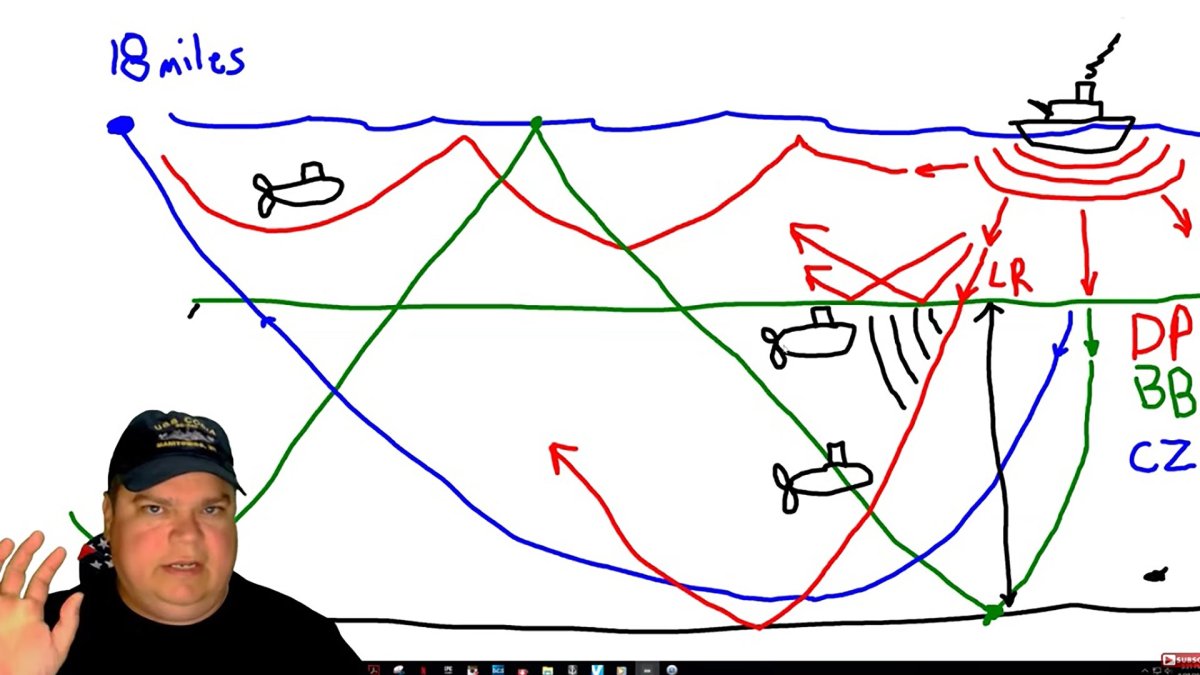
When it comes to conveying concepts even as fascinating but as complicated as how to use layer depth to evade enemy sonar, eyes can glaze over very quickly and attention spans can evaporate. Pretty much everything that has to do with the shadowy art of submarine warfare is either very complicated or ambiguous, but like anything else, a very good teacher can make a world of difference. One man, in particular—retired submariner Aaron ‘Jive Turkey’ Amick— is such a teacher and has deservingly found a dedicated audience in YouTube’s potent gaming community. Beyond his gaming commentary, he has pulled out his whiteboard for viewers and has proven that the world of undersea combat and submarines isn’t nearly as inaccessible as it seems.
Tackling subjects ranging from submarine to satellite communications to how high-tech steel leviathans of the deep deal with trash in a really down-to-earth and remarkably clear way has made his Youtube channel one of my favorites. Above all else, it provides a far more accessible explanation of the nuts and bolts of submarine warfare than pretty much anything I have seen in the past. On top of it, the primary game that Amick talks about, in addition to his explainer videos, relates right back to them and has captured my interest. The title is called Cold Waters and it looks like one impressive submarine combat simulator.
Just as we have down in the past when we have seen ex-military personnel hit YouTube to share their expertise and passion by way of video game tutorials and explanations, The War Zone reached out to the Hawaiian shirt-clad Jive Turkey to find out how he ended up creating such a unique channel, what his background is, and yes, how he got that nickname! But before we dive into that, here are a bunch of his must-watch videos:
Jive Turkey doesn’t just talk about tactics and combat systems—in addition to his eclectic gaming focused fair—he also gives fantastic explanations of how submarines function, how their command structures are organized, and more, many of which are prompted by reader mail.
So who is the man behind the Jive Turkey moniker and these awesome videos? We found out in what turned out to be a particularly awesome Q&A:
Clearly, you have a Navy background, can you give us an idea of what this background is?
I joined the U.S. Navy in 1990. I spent a year going to submarine and sonar schools. During that time, the Navy was adding a lot of technical schools to the training pipeline and top students were moved into the next school instead of given orders to a sea command. This allowed me to move up from A school (basic sonar) to C school (advanced sonar) to multiple Maintenance Specialist schools just by keeping my grades up. By the time I got to my first submarine, I had attended most sonar schools the Navy had to offer.
My first submarine was a 688 Los Angeles class fast attack boat out of New London Submarine Base in Connecticut, the USS Philadelphia . I remember checking onboard that morning, the crew was very busy. Everyone was bustling around, loading supplies and food. We were going underway for a deployment in just a few days. The senior enlisted man, the Chief of the Boat, sat me down outside sonar during my check-in process and told me I was very lucky. We are going on the most important mission in his 20+ year career.
I spent the next 4 months underwater collecting intelligence that was used for the Daily White House Briefing in the aftermath of the fall of the Soviet Union. I was hooked on spying. I loved it.
I extended that sea tour as long as possible and conducted many intelligence gathering and training missions in the North Atlantic. The Navy never acknowledged our exact mission locations for good reason.
After about five years of that, it was time to rotate to another command. There was a new sonar system that was being installed on subs and I took advantage of my rotation date to get back into the training pipeline. I spent half of 1996 in classroom learning the AN/BQQ-5E sonar system operation and maintenance. The last half of that year was spent learning submarine warfare tactics and current intelligence on every major sea power in the world. This was the most difficult and intense learning I have ever experienced. It’s a lot of memorization of hundreds of frequencies across dozens of platforms and weapons from over 30 countries. At night, we would take that knowledge and employ it in the Tactical Trainer—the most realistic submarine simulator ever built.
With five years at sea experience and one year of intense training, I went back to sea on the Ohio class nuclear ballistic missile submarine USS Maine out of Kings Bay Naval Base in Georgia. I did a full tour of hiding 24 D-5 Trident nuclear missiles in the Atlantic. There were a few occasions when Russia would send their Akulas down to look for us, but it’s a big ocean. We just avoided them.
After back-to-back sea duty tours, I thought I’d give shore duty a shot. I become an Instructor at King’s Bay Naval Base Trident Training Facility. I became a Master Training Specialist and taught in the tactical pipeline. I really enjoyed helping young sonarman become strong tactical advisors. Some of my students went to commands like the USS Jimmy Carter , which focus on Special Operations.
In 2003, we invaded Iraq again. This increased the demand on our base security that was supported by both the U.S. Navy and the Marine Corps. I volunteered to train with the Marines and assist in base security for a year. This was the most physically challenging time in my military career. By this time, I was over 30 years old and running obstacle courses and live fire exercises with Marines. It was great!
Eventually, the Navy wanted me back at sea, so I took another fast attack boat out of New London. On the USS Pittsburgh , I conducted missions in the North Atlantic and South Pacific. The fast-paced lifestyle of a submarine sailor hunting in the world’s oceans came to a halt when my sub went into an extended drydock period. It was getting to the end of my career at this point and I didn’t want to spend it in a drydock. I requested a transfer.
The Navy recognized my ability to teach and put me on a Training Tiger Team for the latest sonar system, the AN/BQQ-10. I rounded out 20 years of submarine service by going to multiple sea commands training their Weapons Department on employment of the new sonar tools in the BQQ-10 suite.
How did you go from the shadowy world of undersea intelligence gathering and submarine warfare to creating awesome YouTube videos about it?
After the Navy, I finished my degree in Computer Network Engineering and got a job contracting for IBM in central Florida.
In the evening, I would record PC video games like Civilization V and post them to YouTube as a hobby. I had a very small audience of about 100 subscribers who regularly checked in to see what kind of shenanigans I was doing to alter ‘world history.’ In January of 2017, I resigned my day job and decided to focus on my YouTube channel full time. I began making videos regularly. But, my channel did not grow for five months and I was faced with the realization that maybe YouTube and online entertainment was not going to be my next career.
Cold Waters was released in June of 2017 and I bought a copy. It’s a Cold War era submarine game centered around the American 688 fast attack submarine. I decided to record some Cold Waters gameplay while narrating real-world employment tactics. My first Cold Waters video ‘Greenland Sea Convoy Hunt’ got over 200K views.
Then, fellow YouTuber and Navy man ‘The Mighty Jingles’ found my channel while looking for Cold Waters tutorials and told his 700K subscribers to check out my channel. I went from 100 subscribers to over 20K in about three weeks in June of 2017. That’s when my YouTube career began.
Tell us a bit about Cold Waters. Is the game fairly realistic? What makes it special?
Cold Waters is a real-time naval combat submarine simulator. It has realistic physics, ship models, weapons capabilities and dynamic underwater acoustic environments. While contacts are automatically gained and faded, the player is required to classify them manually and maneuver their submarine for target motion analysis. Cold Waters uses player’s maneuvers to realistically improve a contact solution. The player then makes tactical decisions based on what limited information they have gleaned.
It’s the most realistic nuclear submarine simulator since the Jane’s Dangerous Waters PC game.
You do such a fantastic job explaining very complex technical concepts in an accessible way. Where do you think that talent came from?
Complex systems are difficult for me to memorize, so I break it down into general blocks. That simplification helps me remember how things work. It has an additional benefit of also ‘declassifying’ a lot of the topics I discuss. The exact process of how we do just about anything on a nuclear submarine is classified at various levels. Some mundane tasks still have a ‘confidential’ restriction. But, by using my generalized, block step method to convey these tasks, I not only ‘declassify’ them, but it also makes them easy to understand.
What are five things people misunderstand or don’t even know about submarine warfare?
1.) It’s boring. We search 24/7 diligently for weeks and months often without anything to show except our own wellbeing.
2.) Submariners do a lot of different jobs. I was a Sonarman by rate, but I was also responsible for a firefighting hose team, a dewatering team, weapons handling, equipment maintenance, sonar division personal requests, and providing division and weapons department training. It’s the most I have ever worked in my life.
3.) Submarine warfare is happening right now. There is a continuous effort by other nations to gain a tactical at sea advantage over our weapon platforms. The U.S. Navy works hard every day to prevent that.
4.) It’s slow. When a target comes within detection range, it often just fades in slowly from background noise over several minutes. The operators must be patient and always vigilant. A quiet watch can become the most important watch of your mission in an instant.
5.) It will change your perspective on the world. The most intense time in my life was hunting another human in a submarine. Man is the ultimate target because he’s clever and expects you. I have no interest in wildlife hunting now because I’ve hunted at a level that doesn’t begin to compare.
How did you get the nickname Jive Turkey?
I went to Public School here in the backwater swamp of central Florida in the 1970s. I was one of the only white boys on the school bus and the driver would yell, “sit your Jive Turkey ass down!” when he had been drinking. So, the other kids called me Jive Turkey and the name stuck.
How can our readers follow your work and what’s the best way for someone to get started in Cold Waters?
You can follow my work by subscribing to my YouTube channel and Twitch channel .
I would ask anyone who wants to support what I do to join my Patreon page as that is my primary source of income.
The best way to get started in Cold Waters is to watch my Tutorial playlist .
People can meet me at the November 10th, 2018 Anchors Away Anaheim event at the Esports Arena in Anaheim California. I’ll be doing a meet and greet and a celebrity World of Warships tournament. Tickets are available at Worldofwarships.com
Contact the author: Tyler@thedrive.com
Comments couldn’t be loaded. Please refresh the page.
更新于美国东部时间2019年12月1日上午7:10
即使是像如何利用潜艇深度规避敌方声呐这样引人入胜却又极其复杂的概念,在讲解时也容易让人感到枯燥乏味,注意力难以集中。潜艇作战这门神秘的艺术,几乎所有相关内容都极其复杂或晦涩难懂,但正如其他任何事物一样,一位优秀的老师能够起到至关重要的作用。其中一位——退役潜艇兵亚伦·“摇摆火鸡”·阿米克——就是这样一位老师,他在YouTube强大的游戏社区中赢得了众多忠实观众。除了游戏解说之外,他还经常拿出白板为观众讲解,证明水下作战和潜艇的世界远没有看起来那么遥不可及。
他以极其通俗易懂的方式讲解了从潜艇到卫星通信,再到深海高科技钢铁巨兽如何处理垃圾等各种主题,这使他的YouTube频道成为我最喜欢的频道之一。最重要的是,它对潜艇战的方方面面都提供了比我过去见过的几乎任何内容都更容易理解的解释。此外,Amick除了讲解视频之外,还提到了一款与这些内容密切相关的游戏,这款游戏也深深吸引了我。这款游戏名为《冷水》(Cold Waters),看起来是一款令人印象深刻的潜艇战斗模拟游戏。
就像我们过去看到一些退伍军人在 YouTube 上分享他们的专业知识和热情,制作游戏教程和讲解视频一样,《战区》栏目也联系到了身穿夏威夷衬衫的 Jive Turkey,想了解他是如何创建这样一个独特的频道的,他的背景是什么,以及他这个绰号的由来!但在我们深入探讨之前,先来看看他的一些必看视频:
Jive Turkey 不仅谈论战术和战斗系统——除了他那包罗万象的游戏展会之外——他还对潜艇的运作方式、指挥结构的组织方式等等进行了精彩的解释,其中许多解释都是由读者来信引发的。
那么,Jive Turkey 这个名字背后的男人,以及这些精彩视频的创作者究竟是谁呢?我们在一次非常精彩的问答环节中找到了答案:
显然您有海军背景,您能给我们介绍一下您的海军背景吗?
我于1990年加入美国海军。我花了一年时间在潜艇和声纳学校学习。那段时间,海军在训练体系中增设了许多技术学校,优秀学员会被直接送往更高一级的学校,而不是被分配到海上指挥部。这让我得以从A级学校(基础声纳)一路晋升到C级学校(高级声纳),并最终进入多个维修专家学校,而这一切仅仅依靠我保持优异的成绩。当我登上第一艘潜艇时,我已经完成了海军提供的大部分声纳学校课程。
我的第一艘潜艇是驻扎在康涅狄格州新伦敦潜艇基地的688型洛杉矶级快速攻击艇,名为“费城”号。我记得那天早上登艇时,船员们都非常忙碌。每个人都在忙着装载补给和食物。几天后我们就要出海部署了。艇长,也就是级别最高的士官,在登艇登记时把我叫到声呐舱外坐下,告诉我我非常幸运。我们将执行他二十多年军旅生涯中最重要的一次任务。
接下来的四个月,我一直在水下收集情报,这些情报被用于苏联解体后白宫的每日简报。我迷上了间谍活动,我热爱这份工作。
我尽可能延长了海上巡航时间,并在北大西洋执行了多次情报搜集和训练任务。海军出于某种原因从未公开我们确切的任务地点。
大约五年后,我轮换到另一个单位。当时潜艇上正在安装一种新型声呐系统,我利用轮换的机会重新投入训练。1996年上半年,我在教室里学习AN/BQQ-5E声呐系统的操作和维护。下半年,我则学习了潜艇作战战术以及世界各大海军强国的最新情报。这是我经历过的最艰苦、最密集的学习。我们需要记住来自30多个国家、数十种平台和武器的数百种频率。晚上,我们会把这些知识运用到战术训练器中——这是迄今为止建造的最逼真的潜艇模拟器。
凭借五年海上经验和一年的强化训练,我重返大海,登上俄亥俄级核动力弹道导弹潜艇“缅因”号,该潜艇驻扎在佐治亚州金斯湾海军基地。我完成了在大西洋隐藏24枚D-5“三叉戟”核导弹的完整任务。期间,俄罗斯曾几次派出“阿库拉”侦察机来搜寻我们,但海洋浩瀚无垠,我们总能巧妙避开。
在连续执行海上任务后,我决定尝试一下岸上工作。我成为了金斯湾海军基地三叉戟训练中心的教官。我晋升为高级训练专家,负责战术训练。我非常享受帮助年轻的声纳兵成长为优秀的战术顾问。我的一些学员后来去了像“吉米·卡特”号航空母舰这样专注于特种作战的舰艇服役。
2003年,我们再次入侵伊拉克。这增加了我们基地安保的需求,而美国海军和海军陆战队都承担了这项任务。我自愿加入海军陆战队训练,并协助基地安保工作一年。那是我军旅生涯中体能挑战最大的时期。那时我已经30多岁了,却仍然和海军陆战队员一起进行障碍训练和实弹射击演习。真是太棒了!
最终,海军希望我重返海上,于是我又从新伦敦调来了一艘快速攻击艇。在“匹兹堡”号潜艇上,我执行了北大西洋和南太平洋的任务。潜艇兵在世界各大洋上快节奏的航行生活,随着潜艇进入长期干船坞维修而戛然而止。那时我的军旅生涯已接近尾声,我不想在干船坞里度过余生,于是申请了调动。
海军认可了我的教学能力,并将我安排到最新声呐系统 AN/BQQ-10 的训练虎队中。在潜艇服役的 20 年里,我前往多个海上指挥部,培训他们的武器部门如何使用 BQQ-10 套件中的新型声呐工具。
你是如何从神秘的海底情报收集和潜艇战领域转型,制作出精彩的YouTube相关视频的?
退伍后,我完成了计算机网络工程专业的学位,并在佛罗里达州中部为 IBM 做合同工。
晚上,我会录制一些电脑游戏视频,比如《文明5》,然后上传到YouTube,这纯粹是我的爱好。我的频道只有大约100个订阅者,他们经常来看看我又在搞什么名堂来改变“世界历史”。2017年1月,我辞掉了白天的工作,决定全职投入到我的YouTube频道。我开始定期发布视频。但是,我的频道在五个月内没有任何增长,我不得不意识到,也许YouTube和网络娱乐并不适合我。
《冷水》(Cold Waters)于2017年6月发售,我买了一份。这是一款以冷战时期美国688型快速攻击潜艇为主角的潜艇游戏。我决定录制一些《冷水》的游戏视频,并配以现实世界中的作战策略解说。我的第一个《冷水》视频“格陵兰海护航行动”获得了超过20万的观看量。
后来,另一位YouTube博主、海军出身的“The Mighty Jingles”在搜索“Cold Waters”教程时发现了我的频道,并让他的70万订阅者去看看。2017年6月,我的订阅者在短短三周内就从100人飙升到2万多人。我的YouTube生涯就此开启。
请介绍一下《冷水》这款游戏。它的真实度如何?它的特别之处在哪里?
《冷水》是一款实时海战潜艇模拟游戏。它拥有逼真的物理引擎、舰船模型、武器性能和动态水下声学环境。虽然目标会自动被发现和消失,但玩家需要手动识别目标并操控潜艇进行目标运动分析。《冷水》会根据玩家的操作来真实地改进目标识别结果。玩家随后会根据收集到的有限信息做出战术决策。
这是自《简氏危险水域》PC游戏以来最逼真的核潜艇模拟器。
你非常擅长用通俗易懂的方式解释非常复杂的技术概念。你觉得你的这种天赋是从哪里来的?
复杂的系统对我来说很难记忆,所以我把它分解成几个通用模块。这种简化方法有助于我记住事物的运作方式。它还有一个额外的好处,那就是能让很多我讨论的话题变得“透明”。我们在核潜艇上几乎所有操作的具体流程都属于不同级别的机密。一些看似平凡的任务仍然受到“保密”限制。但是,通过运用我总结出的通用模块步骤方法来阐述这些任务,我不仅能让它们变得“透明”,还能让它们变得易于理解。
关于潜艇战,人们通常有哪些误解或根本不了解的五件事?
1)这很无聊。我们日夜不停地努力搜索,持续数周甚至数月,往往除了我们自身的健康状况之外,一无所获。
2)潜艇兵的工作种类繁多。我的军衔是声纳兵,但我还负责消防水带小组、排水小组、武器操作、设备维护、声纳部门的个人需求,以及为部门和武器部门提供培训。这是我一生中工作量最大的一次。
3)潜艇战正在发生。其他国家不断试图在海上获得针对我方武器平台的战术优势。美国海军每天都在努力阻止这种情况发生。
4)速度很慢。当目标进入探测范围时,它通常会在几分钟内慢慢从背景噪音中显现出来。操作员必须耐心并时刻保持警惕。一次看似平静的监视,可能瞬间成为任务中最关键的监视。
5)它会改变你对世界的看法。我人生中最刺激的经历是在潜艇里猎杀另一个人。人是终极目标,因为他们聪明,而且会预料到你的行动。我现在对野生动物狩猎毫无兴趣,因为我的狩猎经历远超于此。
你是怎么得到“摇摆火鸡”这个绰号的?
上世纪七十年代,我在佛罗里达中部这片偏僻沼泽地带的公立学校上学。我是校车上为数不多的白人男孩之一,司机喝醉后会冲着我大喊:“你这只醉醺醺的火鸡,给我坐下!”于是,其他孩子就叫我“醉醺醺的火鸡”,这个绰号就一直跟着我了。
读者如何才能关注您的作品?对于想要了解《冷水》这部作品的人来说,最好的入门方式是什么?
你可以订阅我的 YouTube 频道和 Twitch 频道来关注我的作品。
我恳请所有想要支持我的工作的人加入我的 Patreon 页面,因为这是我的主要收入来源。
想要开始玩《冷水》这款游戏,最好的方法是观看我的教程播放列表。
大家可以在2018年11月10日于加州阿纳海姆电子竞技馆举行的Anchors Away Anaheim活动上见到我。届时我将进行粉丝见面会,并举办一场名人版《战舰世界》锦标赛。门票可在Worldofwarships.com网站购买。
联系作者:Tyler@thedrive.com
评论加载失败,请刷新页面。