Navy Presents Revealing F-35 Helmet Display Videos And Flight Test Dangers海军公布F-35头盔展示视频及飞行测试危险性
Seminar by F-35 testers details tense nighttime carrier vertical landing that almost went wrong and the breaking off of a F-35B's refueling probe tip during tanker trials.
Updated Jul 5, 2020 7:09 PM EDT
A video from Flight Test Safety Committee’ s conference early last May offers a fascinating insight into the F-35 test program. A talk put on by NAVAIR and presented by the F-35 Government Flight Test Director, Lt. Col. D. Tom Fields, goes into detail about a couple of challenges the program has faced over the last 12 months, and it’s is presented in a totally frank and unafraid manner. The open tone of the address is downright refreshing considering the usual one-sided spin we get from the F-35 Program Office and its corporate partners.
In particular, two separate testing events are discussed during the talk:
The two specific tests the Colonel Fields discusses during his presentation., Screen Cap from seminar video
During the presentation, never seen before nighttime video recorded by the aircraft’s helmet mounted display (HMD) is shown. As we have discussed many times before , the F-35’s helmet uses footage from the aircraft’s Distributed Aperture System, as well as a camera mounted on the helmet itself , to seamlessly project a monochromatic picture of the environment around the pilot. In the videos we get a much better idea of what exactly the pilot sees at night while flying the F-35 and how they get to see it.
What the F-35B pilot sees in their HMD during bright nighttime deck and moon conditions. You can see the layover from the front facing fixed camera to the helmet’s camera as the pilot pans their head and the canopy bow becomes visible. Notice how the virtually HUD snaps over to the right as the pilot turns their head. , Gif from linked video
What the pilot sees in their HMD during dark nighttime deck and moon conditions., Gif from linked video
Not only does the Colonel’s presentation give a clear picture of just a few of the intricacies of integrating the F-35B with “Gator Navy” flattops , but a display malfunction nearly caused disaster during one of the nighttime shipboard landing tests. Fields makes it clear: “We got real lucky that night.”
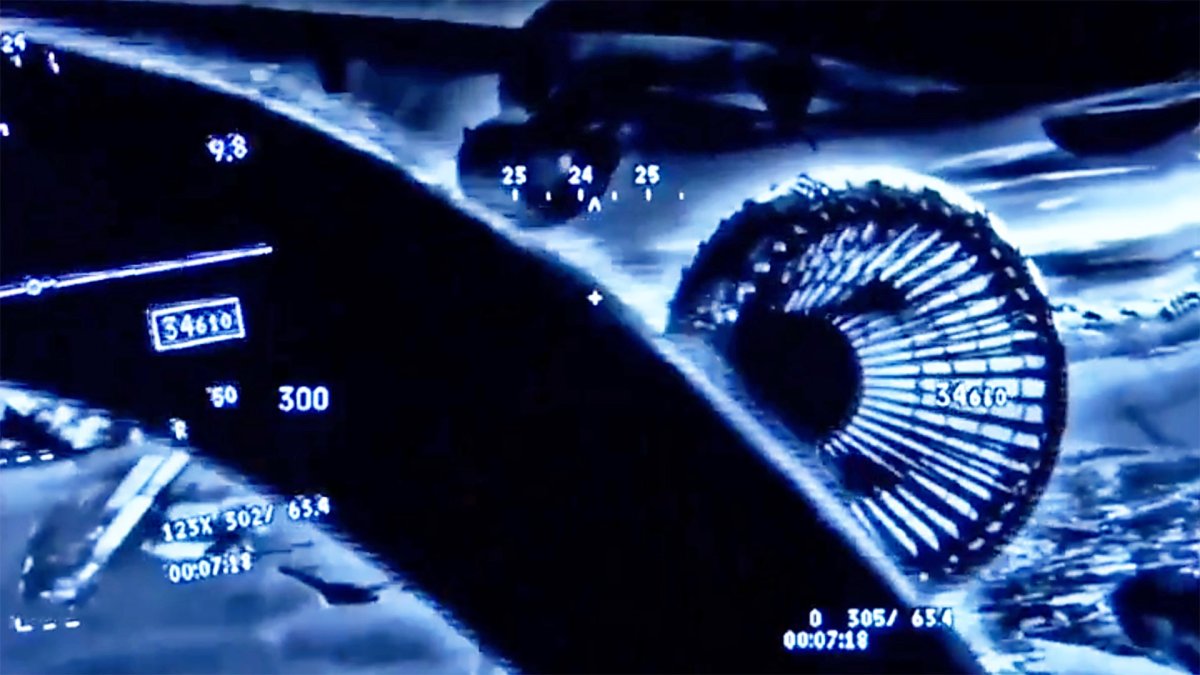
We also get to see a weapons laden F-35B struggle to refuel behind a KC-135R, and eventually its refueling probe’s tip gets snapped off in the tanker’s “iron maiden” receptacle basket. The test’s goal was to see if the F-35B could use its afterburner to go “higher, heavier, and slower” while refueling.
Normal tanking recorded by the HMD during daytime operations. The helmet camera sits inches above the pilot’s eyes and is not usually used during day operations. , Gif from linked video
The KC-135R’s “iron maiden” basket breaks away, snapping off the F-35C’s refueling probe during aerial refueling envelope tests., Gif from linked video
We also learn other interesting details from the presentation, like how the F-35’s canopy bow perfectly blocks the pilot’s line of sight with the refueling probe, so that the pilot has to move their head around to see it. We also get a full run down on the HMD’s virtual heads up display (HUD) symbology.
Beyond those and other F-35 specific details, the video is just stuffed full of interesting tidbits of information that pertains to modern flight testing and aircraft operating envelope expansion trials.
You can watch the video in its entirety by clicking this link.
After watching this video, it’s hard not feel that if the F-35 program would have just consistently published this type of information as the program advanced, for better or worse, it probably would have gone a long way to help—not hurt—the controversial aircraft’s plight.
One of the major criticisms of the F-35 program has been the fog surrounding its delayed development. Massive swathes of issues would periodically emerge through leaks, congressional hearings, and watchdog or pentagon test and evaluation reports. At the same time, straight answers from the aircraft’s manufacturer or the F-35 program office were seemingly few and far between. Instead, we got glitzy videos with idealized snippets of the jet in action and those involved with the program singing its praises, which seemed totally tone deaf, especially as the aircraft’s development was clearly headed towards the edge of the abyss.
Being proactive instead of reactive, and as open and straight with the public as possible, when it comes to developmental issues and challenges would be a far better, or at least a more appreciated strategy going forward for the F-35 and other big-ticket defense programs that will follow it.
A major hat tip to our friend Stephen Trimble, the big cheese over at one of our favorite sites, Flightglobal.com ‘s Americas bureau, for finding this video.
Contact the author: Tyler@thedrive.com
Comments couldn’t be loaded. Please refresh the page.
更新于美国东部时间2020年7月5日晚上7:09
一段来自去年五月初飞行测试安全委员会会议的视频,为我们深入了解F-35测试项目提供了绝佳视角。由海军航空系统司令部(NAVAIR)主办、F-35政府飞行测试主管D·汤姆·菲尔兹中校主讲的演讲,详细阐述了该项目在过去12个月中面临的一些挑战,其表达方式坦诚直率,毫不畏惧。考虑到F-35项目办公室及其企业合作伙伴通常片面的宣传,菲尔兹中校的这种开放态度着实令人耳目一新。
演讲中重点讨论了两项独立的测试活动:
菲尔兹上校在演讲中提到的两项具体测试。(研讨会视频截图)
在演示过程中,展示了此前从未公开过的由F-35头盔显示器(HMD)拍摄的夜间视频。正如我们之前多次讨论过的,F-35的头盔显示器利用飞机分布式孔径系统(DAS)以及头盔自身安装的摄像头拍摄的画面,无缝地将飞行员周围环境的单色图像投射到屏幕上。通过这些视频,我们可以更清晰地了解飞行员在夜间驾驶F-35时究竟看到了什么,以及他们是如何获得这些景象的。
在明亮的夜空和月光条件下,F-35B 飞行员通过头盔显示器 (HMD) 看到的画面。可以看到,当飞行员转动头部,座舱盖前端显露出来时,画面会从前方固定摄像头切换到头盔摄像头。注意,当飞行员转动头部时,虚拟 HUD 会迅速向右移动。(GIF 来自相关视频)
飞行员在夜间漆黑的甲板和月光条件下,通过头盔显示器(HMD)看到的景象。(GIF 动图来自相关视频)
上校的演讲不仅清晰地展现了F-35B与“鳄鱼海军”航母整合的诸多复杂细节,而且还提到,在一次夜间舰载着舰测试中,一次显示故障几乎酿成灾难。菲尔兹明确表示:“那天晚上我们真是太幸运了。”
我们还看到一架满载武器的F-35B战机在KC-135R加油机后方艰难地进行空中加油,最终其加油探管的尖端在加油机的“铁处女”式受油篮中折断。此次测试的目的是检验F-35B能否在空中加油时利用加力燃烧室实现“更高、更重、更慢”的飞行速度。
白天作战期间,头盔显示器(HMD)记录到正常的加油情况。头盔摄像头位于飞行员眼睛上方几英寸处,通常在白天作战期间不使用。(GIF 来自相关视频)
KC-135R的“铁处女”吊篮脱落,在空中加油测试中折断了F-35C的加油探管。(GIF来自相关视频)
我们还从演示中了解到其他一些有趣的细节,例如F-35的座舱盖弧形设计如何完美地遮挡飞行员的视线,使其无法看到空中加油探管,飞行员必须转动头部才能看到它。此外,我们还全面了解了头戴式显示器(HMD)的虚拟抬头显示(HUD)符号体系。
除了这些以及其他 F-35 的具体细节之外,该视频还包含大量与现代飞行测试和飞机操作包线扩展试验相关的有趣信息。
点击此链接即可观看完整视频。
看完这段视频后,人们不禁会想,如果 F-35 项目能够随着项目的推进持续公布这类信息,无论好坏,都可能对这款备受争议的飞机的困境起到很大的帮助作用,而不是造成损害。
F-35项目的主要诟病之一在于其研发进度迟缓,笼罩在迷雾之中。大量问题会不时通过泄密、国会听证会以及监督机构或五角大楼的测试评估报告浮出水面。与此同时,来自飞机制造商或F-35项目办公室的直接回应却寥寥无几。取而代之的是,我们看到的是一些华丽的视频,其中穿插着战机理想化的飞行片段,以及项目相关人员对战机的赞誉之词。这些言论显得格格不入,尤其是在战机研发明显濒临失败的情况下。
对于 F-35 和其他后续的大型国防项目而言,在发展问题和挑战方面,采取积极主动而非被动应对,并尽可能对公众保持公开透明的态度,将是一种更好的策略,或者至少是一种更受赞赏的策略。
特别感谢我们的朋友 Stephen Trimble,他是我们最喜欢的网站之一 Flightglobal.com 美洲分部的负责人,是他找到了这段视频。
联系作者:Tyler@thedrive.com
评论加载失败,请刷新页面。