Sweden goes back to the drawing board for a next-gen warplane瑞典重新开始设计下一代战机
In the global push to reimagine air power, Stockholm is taking a breather to figure out its path.
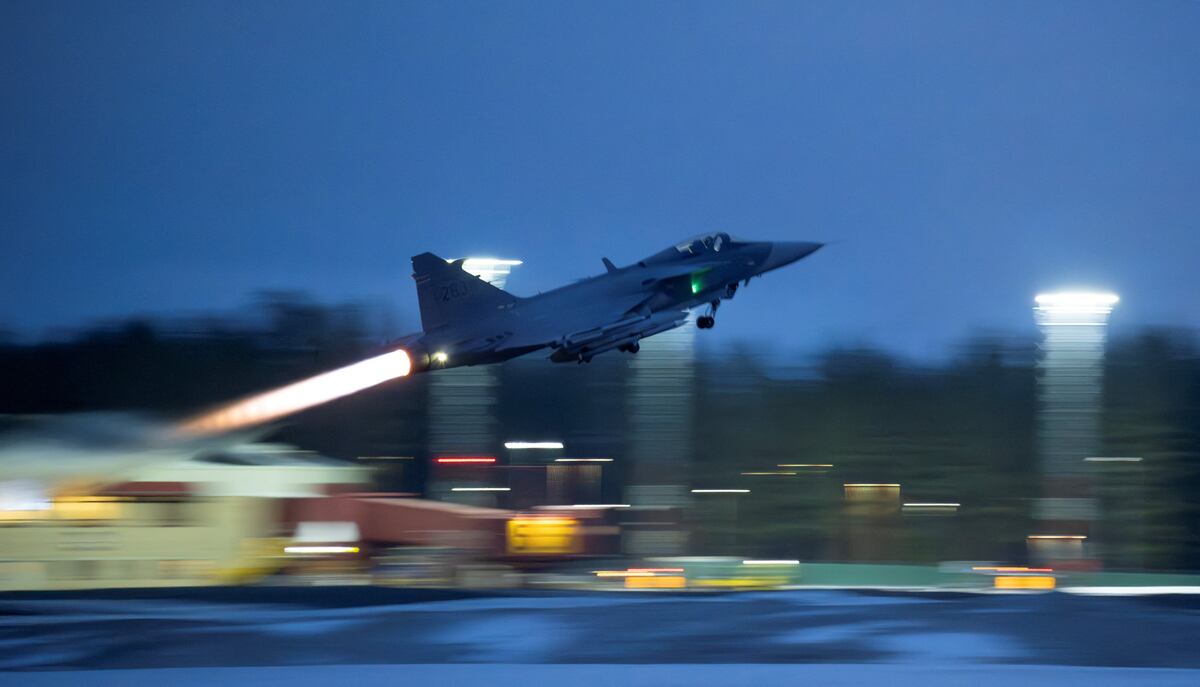
MILAN — Amid a rush within NATO to rally around next-generation combat aircraft, new alliance member Sweden is taking a pause to assess what’s next for its lineage as a warplane-producing country.
The Nordic state in 2022 suspended its flirtation with one of Europe’s two marquee airpower efforts, the Global Combat Air Programme, an initiative led by the U.K., Italy and Japan that seeks to deliver a sixth-generation fighter capability by 2035.
Fast forward to today, and Sweden’s industrial champion Saab is freshly under contract with the Ministry of Defense’s equipment branch, dubbed FMV, to conduct “conceptual studies” on future fighter systems — military jargon for starting at square one.
Saab has managed to secure a share of the global warplane market with the Gripen family of aircraft. The decades-long work has spawned an industrial ecosystem in aerospace engineering that political leaders hope to bring to bear in the NATO alliance.
Next-generation air power concepts on both sides of the Atlantic envision a move away from traditional fighter jets steered by humans as the central pillar of future air forces. Instead, nations are fine-tuning ideas for a networked hodgepodge of flying objects at various altitudes that can be synchronized at the push of a button to overwhelm enemy forces.
A key factor in those considerations is forging a multinational industrial base that can make it happen. For Europeans, that means consolidating workshare around critical aviation technologies while trying to preserve enough national know-how as a hedge against crises to come, an issue certain to be on the minds of decision-makers in Stockholm.
“It has been a successful story so far [for Sweden’s jet-manufacturing chain] and we are looking forward to the future,” Maj. Gen. Jonas Wikman, chief of the Swedish Air Force, told Defense News. He referred to the newly contracted warplane studies as a “journey to figure out what the next steps are for us.”
“What the concept studies are allowing us to do is to have the freedom to decide what suits us best and the freedom to invest in capabilities that make sense to us,” Wikman said.
Yet another program?
Sweden’s decision to take a pause to determine its own requirements has brought about a guessing game across the defense industry regarding what the country’s next move might be.
Will Stockholm try to rejoin GCAP through Saab in the future? Could it team up with the rival program, the Future Combat Air System led by France, Germany and Spain? Or will it opt to build and develop its own fighter with other partners? Might it simply acquire an existing fighter when the time comes?
“Nothing has been decided yet and won’t be decided until at the very least the beginning of the next decade,” Wikman said. “No matter the direction we opt to go in, Swedish industry will always be involved.”
In the mix of options, the emergence of yet another fighter program in Europe is unlikely because of the enormous investment involved, Douglas Barrie, a senior fellow for military aerospace at the London-based International Institute for Strategic Studies, told Defense News.
“Saab and the FMV are looking at all possible options, but I wouldn’t put the emergence of a third European crewed combat aircraft project particularly high in terms of outcomes,” he said. Instead, Stockholm could seek to tack onto a collaboration in an effort to spread the research and development costs, he added.
Affordability is a major challenge to programs like FCAS and GCAP, with high-tech ambitions driving the life-cycle costs into the tens of billions of dollars or more.
To put the amounts required into perspective, as of last year, the U.K. pledged to spend around $2.5 billion on GCAP’s initial research and observation stage alone, an amount equivalent to roughly one-fourth of Sweden’s planned 2024 defense budget.
Whichever path leaders in Stockholm decide to take, there is such a thing as a uniquely Swedish approach to combat airplanes that officials will likely want to retain, according to Justin Bronk, a senior research fellow at the London-based RUSI think tank.
“Sweden is likely to stick to its traditional areas of design and technology strength in the combat air design space during any next-gen program,” he said. Its features include “designing comparatively small, and therefore, efficient aerodynamic airframes; electronic warfare suites; rapid software iteration; and ease of maintenance.”
Considering the Gripen fighter will be the backbone of the Swedish Air Force for decades to come, with plans to operate the latest variant, the Gripen E, until 2060, some of its design tenets are expected to bleed into any future Swedish fighter ideas.
“The easy upgradability, robustness allowing for disperse operations from highways, and flight hour costs – these are all characteristics that are a great foundation for a starting point when looking into the next fighter system,” Peter Nilsson, head of Saab’s business unit for advanced programs, told Defense News.
Sweden’s national emergency plans dictate fighter aircraft must be able to use roads as makeshift runways in the event of a crisis.
At a media briefing during the Singapore Airshow in February, Saab’s chief marketing officer, Mikael Franzén, said due to the current threat level in Sweden, the country would operate the Gripen C/D variant for longer than anticipated.
“The C/D versions are to be retired between 2035 and 2040, or beyond, so that the Air Force does not have a dip in readiness and retains full capability during this re-armament period,” Franzén told reporters.
There are now more than 21 operational Gripen E models globally, including test models, and 35 aircraft in production, according to the company.
Franzén also said the Swedish company had improved every system in older C/D models under the Gripen E program, including an upgraded electronic warfare suite and the ability to carry three times more armaments.
When it comes to a future fighter system, Sweden does not plan to go it alone.
“We have a long heritage of international collaboration and will continue working in that way — the Gripen is truly an international fighter, but built in Sweden,” said Saab’s Nilsson. “We’ll continue working with partners from other countries.”
At this point, the studies under contract with the defense ministry are meant to illuminate the trade space in which Swedish leaders will make decisions later on. Focus areas include technology analysis, partnership opportunities, logistics and industrial implications, as well as digital and physical testing of capabilities, according Nilsson
Some high-tech areas of interest Saab plans to explore are a mix “between manned and unmanned systems as well as disruptive technologies,” he said.
A unique aspect of Saab’s vision of fighter jets is the company’s specialization on counter-stealth technology , which is the discipline of detecting aerial objects designed to be concealed from radar.
At an air warfare conference organized in March by the RUSI think tank, Jonas Grönberg, Saab’s director of strategy for fighter aircraft, said that given the fast-paced development of software and hardware systems for signals processing, stealth fighters are bound to increasingly be more discoverable by radars.
“Some military trends we’re seeing influence electronic warfare are radar threats regaining importance and the re-emergence of surveillance radars at low-frequency bands,” he added.
Some older radars function at much lower frequency ranges, which means their wavelengths are considerably longer and capable of effectively spotting most stealth aircraft.
An unmanned companion
Sweden, like other countries, is considering the addition of a drone to accompany Gripen fighters even before plans for a next-gen fighter are hatched. The idea is conceptually known among air forces as “loyal wingman,” a reference to an unmanned helper which pilots can task mid-flight to attack targets, collect intelligence or act as a decoy.
In 2022, Saab’s concept for a supersonic loyal wingman broke cover as part of an academic paper presented by a company employee at the International Council of the Aeronautical Sciences in Stockholm.
While little is known regarding the status of the technology today, the document states it was initially developed under Saab’s participation in the U.K.-led program now known as GCAP. The wingman was designed for combat with a low radar signature profile, to fly at high speeds and to conduct long-range air-to-air battles.
Saab, for its part, is readying its workforce for the pivotal next-gen study. For one, the company has equipped the unit tasked with the project to have “full fighter system capability,” and hiring is underway to beef up the engineer ranks, Nilsson said.
Elisabeth Gosselin-Malo was a Europe correspondent for Defense News. She covers a wide range of topics related to military procurement and international security, and specializes in reporting on the aviation sector. She is based in Milan, Italy.
米兰——在北约各国竞相研发下一代战斗机之际,新加入北约的瑞典却停下来评估其作为战机生产国的未来走向。
2022 年,这个北欧国家暂停了与欧洲两大空中力量计划之一——全球作战空中计划的合作。该计划由英国、意大利和日本领导,旨在到 2035 年交付第六代战斗机能力。
时至今日,瑞典工业巨头萨博公司刚刚与国防部装备部门(简称 FMV)签订了一份合同,对未来的战斗机系统进行“概念研究”——这是军事术语,意味着从零开始。
萨博公司凭借“鹰狮”系列战机成功占据了全球战机市场的一席之地。数十年的努力催生了一个航空航天工程领域的产业生态系统,各国领导人希望将其运用到北约联盟中。
大西洋两岸的下一代空中力量概念都设想,未来空军的核心支柱将不再是传统的由人操控的战斗机。相反,各国正在完善各种飞行器组成的网络化作战系统,这些飞行器可以部署在不同的高度,只需按下按钮即可同步行动,从而压制敌军。
这些考量的关键在于构建一个能够实现这一目标的跨国产业基础。对欧洲人而言,这意味着在关键航空技术领域整合工作,同时努力保留足够的国家技术诀窍,以应对未来的危机——这无疑是斯德哥尔摩决策者们关注的焦点。
瑞典空军司令约纳斯·维克曼少将告诉《防务新闻》:“到目前为止,瑞典的喷气式飞机制造产业链发展得非常成功,我们对未来充满期待。”他将新近签订的战机研究合同称为“探索我们下一步发展方向的旅程”。
维克曼说:“概念研究让我们能够自由地决定什么最适合我们,并自由地投资于对我们来说有意义的能力。”
又一个项目?
瑞典决定暂停国防采购以确定自身需求,这让整个国防工业界对该国的下一步行动充满了猜测。
斯德哥尔摩未来会尝试通过萨博公司重新加入全球战斗机应用计划(GCAP)吗?它会与法国、德国和西班牙主导的“未来作战空中系统”(FCA)项目合作吗?还是会选择与其他合作伙伴共同研发自己的战斗机?或者,它会在时机成熟时直接购买现成的战斗机?
维克曼表示:“目前一切都还没有定论,至少要到下一个十年初才能做出决定。无论我们选择哪个方向,瑞典工业界都将始终参与其中。”
伦敦国际战略研究所军事航空航天高级研究员道格拉斯·巴里告诉《防务新闻》,在各种选择中,欧洲不太可能出现另一个战斗机项目,因为这涉及到巨额投资。
“萨博和瑞典联邦国防军正在考虑所有可能的方案,但我认为第三个欧洲有人驾驶战斗机项目的成功几率并不高,”他说道。他还补充说,斯德哥尔摩方面可能会寻求与其他项目合作,以分摊研发成本。
可负担性是 FCAS 和 GCAP 等项目面临的主要挑战,高科技雄心壮志将生命周期成本推高至数百亿美元甚至更多。
为了更直观地了解所需的金额,截至去年,英国承诺仅在 GCAP 的初始研究和观察阶段就投入约 25 亿美元,这笔金额相当于瑞典 2024 年国防预算计划的大约四分之一。
据伦敦皇家联合军种研究所 (RUSI) 高级研究员贾斯汀·布朗克 (Justin Bronk) 称,无论斯德哥尔摩的领导人决定采取哪条道路,瑞典在战斗机方面都有一种独特的方法,官员们可能都希望保留这种方法。
他说:“在任何下一代战斗机项目中,瑞典都可能继续发挥其在战斗机设计领域的传统优势,包括设计相对较小、因此空气动力学性能更佳的机身;电子战系统;快速的软件迭代;以及易于维护。”
考虑到“鹰狮”战斗机将在未来几十年成为瑞典空军的主力战机,并且计划使用最新型号“鹰狮E”战斗机服役至2060年,预计其一些设计理念将渗透到瑞典未来的战斗机设计中。
萨博先进项目业务部门负责人彼得·尼尔森告诉《防务新闻》:“易于升级、坚固耐用,可从高速公路进行分散作战,以及飞行小时成本——这些都是在研究下一代战斗机系统时很好的起点。”
瑞典国家应急计划规定,在危机情况下,战斗机必须能够利用公路作为临时跑道。
2 月新加坡航展期间,萨博首席营销官米凯尔·弗兰岑在一次媒体简报会上表示,由于瑞典目前的威胁级别,该国将比预期更长时间地使用鹰狮 C/D 型战斗机。
弗兰岑告诉记者:“C/D 型战机将在 2035 年至 2040 年或更晚的时候退役,这样空军的战备能力就不会下降,并在重新武装期间保持全部作战能力。”
据该公司称,目前全球共有超过 21 架正在运营的鹰狮 E 型战斗机(包括测试机型),另有 35 架飞机正在生产中。
弗兰岑还表示,这家瑞典公司在鹰狮E计划下改进了老款C/D型战斗机的每一个系统,包括升级的电子战套件和携带三倍于旧款的武器的能力。
在未来的战斗机系统方面,瑞典并不打算单打独斗。
萨博公司的尼尔森表示:“我们有着悠久的国际合作传统,并将继续以这种方式开展工作——鹰狮战斗机是一款真正的国际战斗机,但它是在瑞典制造的。我们将继续与其他国家的合作伙伴携手合作。”
据尼尔森称,目前与国防部签订合同开展的研究旨在阐明瑞典领导人未来决策所处的贸易环境。研究重点领域包括技术分析、合作机会、物流和产业影响,以及能力的数字化和物理测试。
萨博表示,他计划探索的一些高科技领域是“有人系统和无人系统以及颠覆性技术的结合”。
萨博战斗机理念的一个独特之处在于该公司专注于反隐形技术,即探测旨在躲避雷达探测的空中目标。
在皇家联合军种研究所 (RUSI) 智库于 3 月组织的一次空战会议上,萨博战斗机战略总监 Jonas Grönberg 表示,鉴于信号处理软件和硬件系统的快速发展,隐形战斗机势必会越来越容易被雷达发现。
他补充说:“我们看到一些影响电子战的军事趋势是雷达威胁重新变得重要,以及低频段监视雷达的重新出现。”
一些老式雷达的工作频率范围要低得多,这意味着它们的波长要长得多,能够有效地发现大多数隐形飞机。
无人伴侣
与其他国家一样,瑞典也在考虑为“鹰狮”战斗机配备无人机,即便下一代战斗机的计划尚未出台。这种设想在空军中被称为“忠诚僚机”,指的是飞行员可以在飞行途中操控的无人辅助飞行器,它可以执行攻击目标、收集情报或充当诱饵等任务。
2022 年,萨博公司的一名员工在斯德哥尔摩举行的国际航空科学理事会上发表的一篇学术论文中,公开了其超音速忠诚僚机的概念。
虽然目前人们对这项技术的现状知之甚少,但该文件指出,它最初是在萨博参与的英国主导的全球协同作战能力提升计划(GCAP)中开发的。这款僚机被设计用于作战,具有低雷达反射截面积、高速飞行能力以及远程空战能力。
萨博公司方面正在为这项至关重要的下一代战斗机研究项目做好人员准备。尼尔森表示,公司已为负责该项目的部门配备了“完整的战斗机系统能力”,并且正在招聘工程师以扩充队伍。
伊丽莎白·戈斯林-马洛曾任《防务新闻》欧洲通讯员。她的报道涵盖军事采购和国际安全等广泛领域,尤其擅长航空领域的报道。她常驻意大利米兰。