With Chinese warships anchoring in Cambodia, the US needs to respond中国军舰停泊在柬埔寨,美国需要做出回应。
Opinion: It’s past time for Washington to jettison its ad hoc, absent-minded approach toward Beijing’s basing pursuits, opinion writers argue.
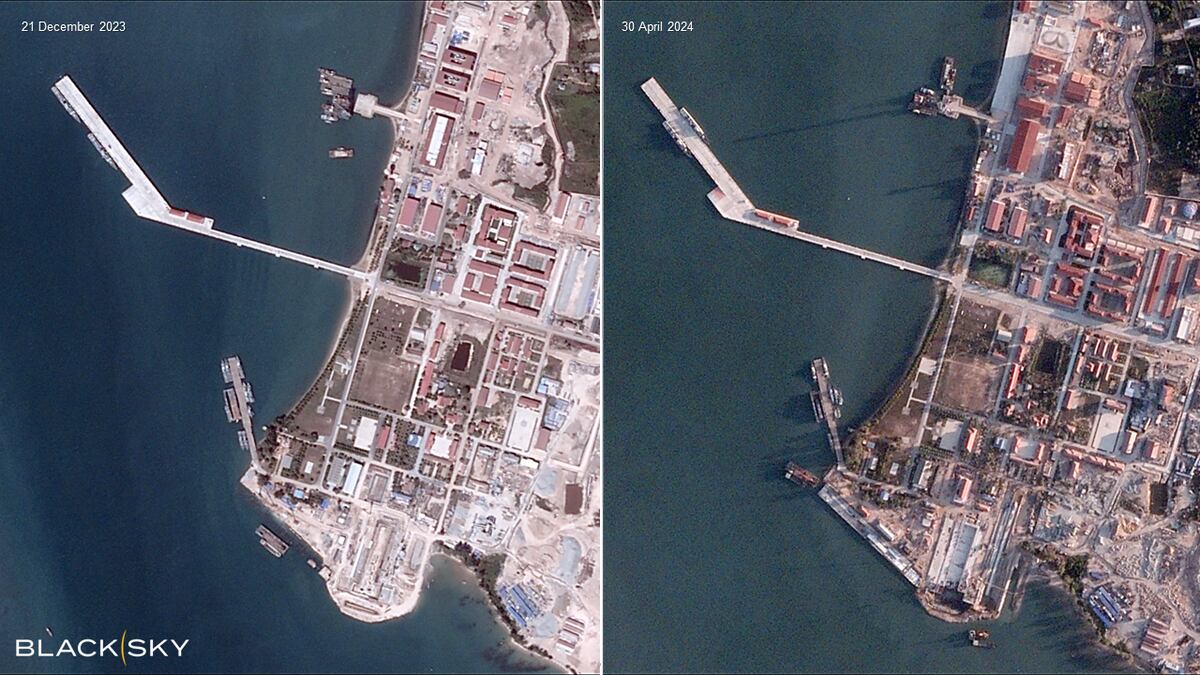
The recent mooring of Chinese warships at Cambodia’s Ream Naval Base marked the unofficial inauguration of China’s first overseas naval post in the Indo-Pacific region and only its second overall. These latest deployments, which demand a robust American government response, signal how China plans to leverage its expanding global military footprint to thwart U.S. forces from intervening in a Taiwan crisis .
For years, Chinese and Cambodian officials insisted that refurbishments at Ream Naval Base — a deep-water facility located along the coast of the Gulf of Thailand — were never intended to accommodate Chinese military vessels. But those denials evaporated when Chinese corvettes docked at Ream Naval Base, which now boasts a near-replica of the 363-meter-long pier installed at China’s only other overseas naval base in Djibouti.
Both piers are large enough to berth any ship in China’s fast-growing naval force, including its new, approximately 300-meter-long Type 003 Fujian aircraft carrier, which will undergo sea trials this year. Meanwhile, the U.S. Navy’s fleet is almost half the size it was 40 years ago.
Cambodian Defence Minister Tea Banh, left, and China's Ambassador to Cambodia Wang Wentian, center, take part in a groundbreaking ceremony at the Ream Naval Base in Preah Sihanouk province on June 8, 2022. (Pann Bony/AFP via Getty Images)
Yet, Ream Naval Base and Djibouti represent only two nodes in Beijing’s broader overseas basing strategy. Earlier this year, the U.S. intelligence community warned Congress that China is pursuing other naval bases and expanded military access in Burma, Cuba, Equatorial Guinea, Pakistan, Seychelles, Sri Lanka, Tanzania and the United Arab Emirates. Gaining a foothold in any of these locations, many of which are situated near sensitive U.S. military sites, would provide China’s People’s Liberation Army with a vantage point to monitor and control vital maritime routes.
From left, a satellite image shows a naval base in Djibouti with Chinese military presence, and a near-replica pier in Cambodia's Ream Naval Base that China uses. (Courtesy of BlackSky)
In Cambodia’s case, that includes the Strait of Malacca, through which 30% of the world’s trade flows .
While China remains intent on rivaling U.S. dominance, Beijing is not seeking to mirror America’s expansive and expensive global military presence . Instead, China’s aim is to neutralize the American network’s effectiveness.
Satellite image shows Cambodia's Ream Naval Base, the left in June 2022 and the other in July 2023. (Courtesy of BlackSky)
More specifically, China’s little-understood forward edge defense doctrine centers around deploying military assets abroad where China’s adversaries — principally the U.S. — are strongest, such as the Middle East. In certain cases, China is eyeing new naval outposts adjacent to brick-and-mortar U.S. bases; elsewhere, its focused on establishing a presence near maritime choke points frequented by American military vessels.
By pre-positioning its military in this manner, Chinese strategists assess Beijing stands a reasonable chance of striking American military facilities and other high-value targets — and even during a war over Taiwan — thereby complicating Washington’s ability to dispatch these and other forces to China’s periphery.
Similarly, in projecting power from farther flung locales, such as West Africa, China could gravely complicate Washington’s ability to rapidly deploy U.S. military assets stationed along America’s Eastern Seaboard to the fight in Asia.
So far, Cambodia has incurred no costs whatsoever for its decision to host Chinese forces. In other instances, diplomatic interventions designed to counter China’s basing strategy have fallen short. For example, U.S. warnings to the United Arab Emirates in 2021 led to a brief halt in China’s covert base building there, yet construction quietly resumed two years later. The White House dispatched a different high-level delegation to Equatorial Guinea, also in 2021, only to discover later that nearby Gabon had already agreed to host Chinese forces on its soil.
It’s past time for Washington to jettison its ad hoc, absent-minded approach toward Beijing’s basing pursuits. Through enhanced oversight and better coordination, Congress can and should lead the way to ensure policies are in place to anticipate and thwart China’s moves in countries where the U.S. government assesses Beijing is seeking new or expanded military access agreements.
For starters, the Defense Department should immediately appoint a senior official to synchronize internal strategy and resourcing on this matter. The White House should similarly appointment someone to lead the interagency’s response and planning. At present, no single official or office within the Defense Department or White House has that responsibility.
Beyond routine oversight, lawmakers should consider ordering a comprehensive assessment from the Defense Department to scrutinize how new Chinese military installations might shift the global power balance and complicate U.S. force posture in key regions. Such an assessment could also spur Congress to consider granting new or expanded authorities to executive branch agencies and the intelligence community to counter China’s military moves, just as it did during the Cold War to thwart the Soviet Union’s push for overseas basing primacy.
Last, Congress should also dispatch delegations to countries with current or potential Chinese basing sites, not only to reinforce diplomatic ties but to offer tangible support that could dissuade them from hosting a Chinese military facility.
Barring swift U.S. action, the Chinese warships now anchored in Cambodia may soon set course for new Chinese outposts. Should such deployments unfold, it could mark a strategic encirclement that leaves Taiwan — and U.S. interests in the Indo-Pacific — vulnerable.
Rep. Rob Wittman, R-Va., is the vice chair of the House Armed Services Committee. Craig Singleton, a former U.S. diplomat, is a senior China fellow at the Foundation for Defense of Democracies think tank.
近期中国军舰停靠柬埔寨云壤海军基地,标志着中国在印太地区首个海外海军基地(也是其在全球的第二个海外基地)的非正式启用。此次部署需要美国政府做出强有力的回应,也表明中国计划如何利用其不断扩大的全球军事影响力来阻止美国干预台湾危机。
多年来,中国和柬埔寨官员一直坚称,位于泰国湾沿岸的深水基地——云壤海军基地的翻新工程并非旨在停泊中国军舰。但随着中国护卫舰停靠云壤海军基地,这些否认不攻自破。如今,云壤海军基地拥有一个几乎与中国在吉布提的另一个海外海军基地——云壤海军基地——的363米长码头一模一样的码头。
这两个码头都足够大,可以停泊中国快速发展的海军中的任何舰艇,包括其新型的、长约300米的003型福建号航空母舰,该舰将于今年进行海试。与此同时,美国海军的舰队规模几乎只有40年前的一半。
2022年6月8日,柬埔寨国防部长狄班(左)和中国驻柬埔寨大使王文田(中)在西哈努克省云壤海军基地参加奠基仪式。(Pann Bony/AFP via Getty Images)
然而,里姆海军基地和吉布提仅仅是北京更广泛的海外军事基地战略中的两个节点。今年早些时候,美国情报界警告国会,中国正在缅甸、古巴、赤道几内亚、巴基斯坦、塞舌尔、斯里兰卡、坦桑尼亚和阿拉伯联合酋长国寻求建立其他海军基地并扩大军事准入。在这些地区(其中许多都靠近美国敏感的军事设施)获得立足点,将使中国人民解放军能够监控和控制重要的海上航线。
从左至右,卫星图像分别显示了吉布提境内有中国军队驻扎的海军基地,以及中国在柬埔寨云壤海军基地使用的几乎完全相同的码头。(图片由BlackSky提供)
以柬埔寨为例,这包括马六甲海峡,全球 30% 的贸易都要经过这里。
尽管中国仍致力于与美国抗衡,但北京并不寻求效仿美国庞大而昂贵的全球军事存在。相反,中国的目标是削弱美国军事网络的效力。
卫星图像显示了柬埔寨云壤海军基地,左图为2022年6月拍摄,右图为2023年7月拍摄。(图片由BlackSky提供)
更具体地说,中国鲜为人知的前沿防御战略的核心在于向其对手(主要是美国)实力最强的地区,例如中东,部署军事力量。在某些情况下,中国正着眼于在美军实体军事基地附近建立新的海军前哨;而在另一些情况下,中国则专注于在美军舰艇频繁出入的海上咽喉要道附近建立存在。
中国战略家认为,通过这种方式预先部署军队,北京有相当大的机会打击美国军事设施和其他高价值目标——即使是在台湾战争期间——从而使华盛顿向中国周边地区派遣这些部队和其他部队的能力变得复杂。
同样,中国从西非等更远的地方投射力量,可能会严重阻碍华盛顿迅速将驻扎在美国东海岸的美国军事力量部署到亚洲战场。
迄今为止,柬埔寨并未因其接纳中国军队的决定而付出任何代价。在其他一些案例中,旨在遏制中国驻军战略的外交干预却收效甚微。例如,美国在2021年向阿联酋发出警告,导致中国在阿联酋的秘密基地建设短暂停止,但两年后,建设工作又悄然恢复。白宫同样在2021年派遣了另一个高级代表团前往赤道几内亚,但后来发现邻国加蓬已经同意在其境内接纳中国军队。
华盛顿早就应该摒弃其对北京寻求军事基地这一问题的临时性、漫不经心的态度。通过加强监督和协调,国会可以而且应该发挥带头作用,确保制定相关政策,以预先防范并阻止中国在美方政府评估认为北京正在寻求建立或扩大军事准入协议的国家中的行动。
首先,国防部应立即任命一位高级官员,负责协调内部战略和资源调配。白宫也应任命一位负责人,领导跨部门的应对和规划工作。目前,国防部或白宫内没有任何官员或部门承担这项职责。
除了例行监督之外,立法者还应考虑责成国防部进行全面评估,以审查中国新建军事设施可能如何改变全球力量平衡,并使美国在关键地区的军事部署复杂化。此类评估还可以促使国会考虑赋予行政部门机构和情报机构新的或更大的权力,以应对中国的军事行动,正如冷战时期国会为阻止苏联寻求海外军事基地主导地位而采取的行动一样。
最后,国会还应派遣代表团前往目前或可能拥有中国军事基地的国家,不仅是为了加强外交关系,也是为了提供切实的支持,以劝阻这些国家不要接纳中国军事设施。
若美国不迅速采取行动,目前停泊在柬埔寨的中国军舰可能很快就会驶往新的中国前哨基地。一旦此类部署发生,可能标志着中国对台湾——以及美国在印太地区的利益——形成战略包围,使其面临风险。
弗吉尼亚州共和党众议员罗伯·威特曼是众议院军事委员会副主席。克雷格·辛格尔顿曾任美国外交官,现任保卫民主基金会智库高级中国研究员。