Ukraine war inspires weapons that crack battle tanks at weakest point乌克兰战争催生了能击穿坦克最薄弱环节的武器。
Arms manufacturers are tuning their lineups to the immediate experience of the brutal, close-range fighting in Ukraine.
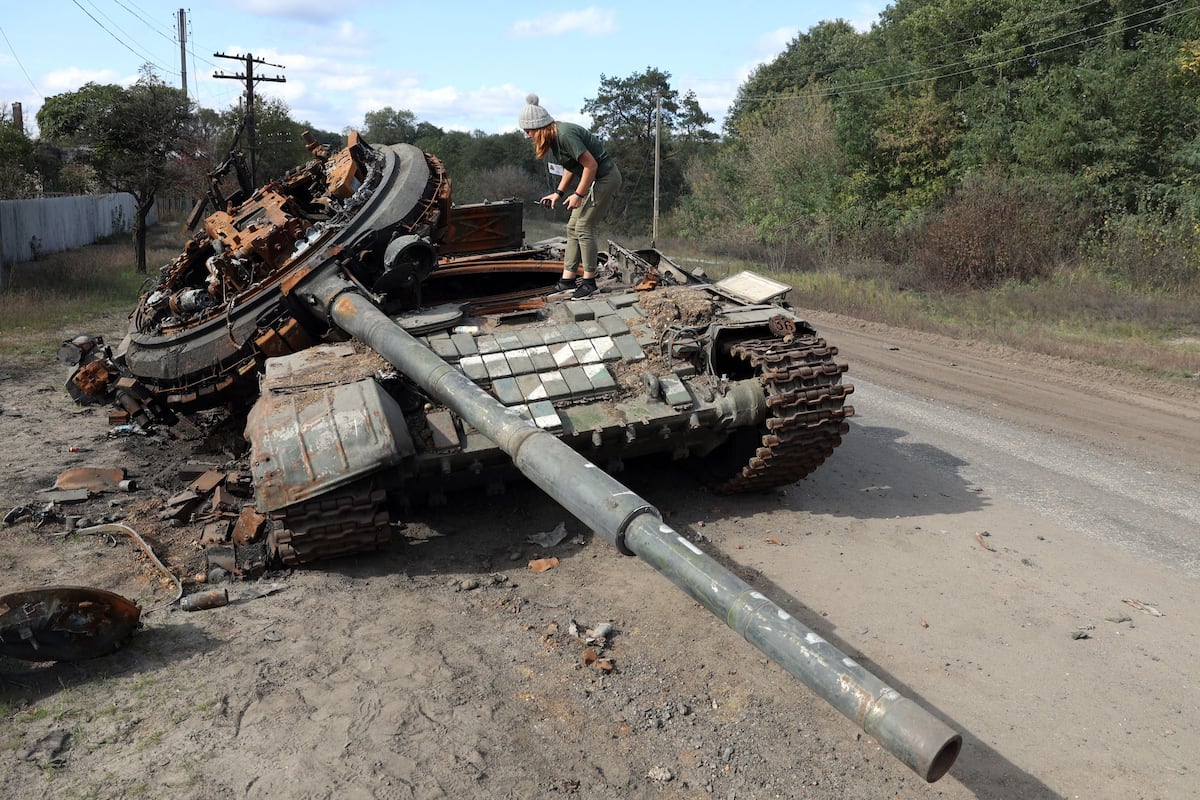
LONDON — Western companies are developing weapons aimed at cracking battle tanks from the top, their weakest point, or that can rain down thousands of metal fragments on dug-in infantry from falling drones.
The novelties come as arms manufacturers tune their lineups to the immediate experience of the brutal, close-range fighting in Ukraine, a trend on display at the DSEI defense trade show held last week in London.
Germany’s Rheinmetall, for example, is reviving a Cold War concept of bouncing mines in its proposed Area Defence Weapon. The system, which resembles a small beer keg sitting on radial stabilizers, uses a combination of sensors to verify that a tank is passing by only to launch itself into the air and drill a 155-millimeter artillery munition into the vehicle’s topside on the way down.
The company said the weapon, ready for use in a few years, could be used in combination with traditional anti-tank mines, where the ADW munition goes after mine-clearing vehicles to keep adversaries’ armored columns from advancing through mined areas.
The re-emergence of mine warfare brings to mind the situation on the frontlines of Ukraine’s defense against Russia, described in a recent Washington Post report as the world’s most mine-contaminated piece of land.
Rheinmetall, for its part, doesn’t refer to the Area Defence Weapon as a mine because the units can be turned off remotely or be programmed to let friendly forces through, with a human operator involved in the process of arming the system.
“Battlefield barriers, and anti-tank mines in particular, have been taken out of commission by NATO forces almost completely since the end of the Cold War,” a company representative explained. “The re-building of that capability is currently the subject of analyses and concepts.”
Meanwhile, Finnish company Insta is throwing its Steel Eagle shrapnel-throwing drone into the ring for meeting a Ukrainian need for killing large numbers of foot soldiers on the open battlefield with fewer scarce munitions fired as they repel Russian invaders and take back territory.
The quadcopter drone carries a fragmentation charge, which notably started its developmental life as a bouncy mine à la ADW, over infantry positions, shredding fighters with 3,000 projectiles so forceful they even penetrate thin armor, according to the company.
Steel Eagle can spray an area as large as a third of a soccer pitch with enough fragments that every square meter will get an average of one-and-a-half projectiles. The drone can also programmed to fall down to a low altitude right before exploding for a denser spray, Tuure Lehtoranta, a vice president at Insta’s defense unit, told Defense News.
Ukrainian officials have been pleading with Western allies for controversial cluster munitions that deal a similar effect, with the United States agreeing this summer to deliver some of the Pentagon’s old stocks.
According to videos circulated on social media, frontline troops have used drones to drop grenades on Russian soldiers, an effect that Lehtoranta said is too “pointed” for the kind of mass punch envisioned by Ukrainian commanders.
The company says its primary target is equipping its home forces of Finland with the Steel Eagle capability.
“There is interest not limited to Finland,” the executive said.
Sebastian Sprenger is associate editor for Europe at Defense News, reporting on the state of the defense market in the region, and on U.S.-Europe cooperation and multi-national investments in defense and global security. Previously he served as managing editor for Defense News. He is based in Cologne, Germany.
伦敦——西方公司正在研发旨在从坦克顶部(其最薄弱的部位)击穿坦克的武器,或者从坠落的无人机上向掩体中的步兵投掷数千块金属碎片。
这些新式武器的出现,正值武器制造商根据乌克兰残酷的近距离战斗的直接经验调整其产品线之际。这一趋势在上周于伦敦举行的DSEI防务贸易展上得到了体现。
例如,德国莱茵金属公司正在其提出的区域防御武器系统中复兴冷战时期的一种跳雷概念。该系统外形酷似一个架在径向稳定器上的小型啤酒桶,它利用多种传感器来探测是否有坦克经过,一旦发现目标,便会跃入空中,并在下落过程中将一枚155毫米炮弹射入坦克顶部。
该公司表示,这种武器将在几年内准备就绪,可以与传统的反坦克地雷结合使用,ADW弹药用于攻击扫雷车辆,以阻止敌方装甲纵队通过雷区。
地雷战的再次出现,让人想起乌克兰在抵御俄罗斯入侵的前线局势。最近《华盛顿邮报》的一篇报道称,那里是世界上地雷污染最严重的地区。
莱茵金属公司则不把区域防御武器称为地雷,因为这些装置可以远程关闭,或者被编程为允许友军通过,而启动该系统的过程则需要人工操作员的参与。
“自冷战结束以来,北约部队几乎完全停止使用战场障碍物,特别是反坦克地雷,”该公司一位代表解释说。“重建这项能力目前正处于分析和概念研究阶段。”
与此同时,芬兰公司 Insta 推出了其“钢铁雄鹰”弹片投掷无人机,以满足乌克兰在开阔战场上用更少的稀缺弹药消灭大量步兵的需求,从而击退俄罗斯入侵者并夺回领土。
据该公司称,这款四旋翼无人机携带破片炸药,其最初的研发方向是类似ADW的弹跳地雷,用于攻击步兵阵地,发射3000枚威力巨大的弹丸,甚至可以穿透薄装甲,从而撕碎敌军。
钢铁雄鹰无人机可以喷射相当于三分之一足球场大小的区域,其碎片数量之多,平均每平方米都能被1.5枚弹丸覆盖。Insta公司防务部门副总裁图雷·莱赫托兰塔告诉《防务新闻》,该无人机还可以被编程在爆炸前低空坠落,以实现更密集的喷射。
乌克兰官员一直恳求西方盟友提供具有类似效果的有争议的集束弹药,而美国今年夏天同意交付五角大楼的一些旧库存。
根据社交媒体上流传的视频显示,前线部队使用无人机向俄罗斯士兵投掷手榴弹,莱赫托兰塔表示,这种效果对于乌克兰指挥官设想的大规模打击来说过于“尖锐”。
该公司表示,其主要目标是为芬兰本土部队配备“钢铁雄鹰”导弹系统。
“这方面的兴趣不仅限于芬兰,”这位高管表示。
塞巴斯蒂安·斯普伦格是《防务新闻》欧洲版副主编,负责报道该地区的防务市场状况,以及美欧在防务和全球安全领域的合作和多国投资。此前,他曾担任《防务新闻》执行主编。他现居德国科隆。