Skunk Works’ Factory Of The Future Will Use Roaming Robots To Rapidly Assemble Top Secret Aircraft臭鼬工厂的未来工厂将使用漫游机器人快速组装绝密飞机
Skunk Works' knack for innovation enters the "digital" age with a factory able to spit out advanced aircraft faster and cheaper than ever before.
新闻视频
By Joseph Trevithick
Published Aug 13, 2021 1:28 PM EDT
Lockheed Martin’s famous Skunk Works advanced projects division has opened a new cutting-edge manufacturing facility at its campus in Palmdale, California, which is part of the U.S. Air Force’s Plant 42 . The company says that the technologies it will employ in this new “factory of the future,” blandly named Building 648, will help it drastically speed up and otherwise improve how it designs and produces advanced aerospace vehicles, including stealth fighters and drones, hypersonic missiles, and more. Beyond that, however, this factory is the centerpiece of a larger transformation going on within Skunk Works that could potentially revolutionize the development and production of even very advanced aerospace concepts, industrial capabilities that could be increasingly essential for the U.S. military to maintain its competitive edge.
The War Zone was among a select group of outlets given an opportunity to visit Skunk Works and attend the ribbon-cutting ceremony for the 215,000-square foot Building 648, which Lockheed Martin representatives have described as an “intelligent, flexible, advanced manufacturing facility,” on Aug. 10, 2021, as well as tour other relevant portions of the overall facility at Palmdale. The factory is the “cornerstone” of approximately $400 million worth of investments the company has made to help expand its capabilities and capacity at what is formally known as Plant 10 in recent years, which has already led directly to the creation of 1,500 new jobs since 2018.
A view of Building 648’s lobby., Lockheed Martin
“While what we’re doing hasn’t changed, how we’re doing it has changed,” Jeff Babione, Vice President and General Manager of Skunk Works, to the reporters who traveled to Palmdale to get a briefing ahead of the ribbon-cutting ceremony. “So, for some time, Lockheed Martin, at the corporate level, and across the entire enterprise, has been focused on transforming virtually everything we do in the business, from writing requirements, to writing contracts, to designing and developing those technologies, to manufacturing technologies, to sustaining those technologies in the field. This is our digital transformation.”
Building 648 is a prime reflection of these new processes and how Lockheed Martin plans to implement them inside and outside of Skunk Works. Though the factory’s shop floor was largely empty during the ribbon-cutting event, that is, in itself, a key aspect of Lockheed Martin’s plans for the high-tech facility.
Over the years, Skunk Works has had to expend significant time and resources to simply set up workspaces for new programs within buildings across its campus in Palmdale. One Lockheed Martin executive quipped that the local companies who provide the chain-link fences that segregate the different areas within the various hangars at Plant 10 can expect reliable work given how often those spaces have to be reconfigured. Beyond just building those alcoves, new, dedicated tooling also often has to be procured and then moved into place, especially when it comes to manufacturing prototypes or carrying out limited production runs of certain designs.
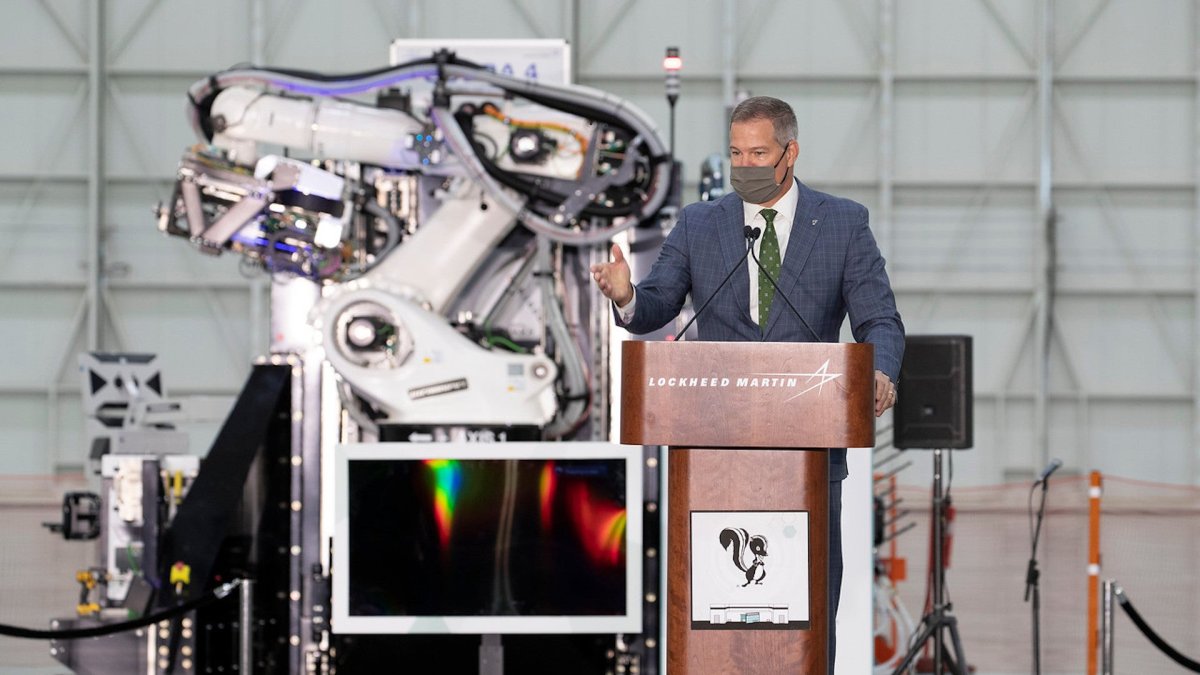
Lockheed Martin’s goal with Building 648 is to do away with a significant amount of the initial setup through increased automation, particularly with the employment of large, advanced robots from Electroimpact . Right now, the company has four such robots, known as Combined Operation: Bolting and Robotic AutoDrill systems, or COBRAs . These are, in their present configurations, capable of drilling and countersinking holes in various materials, including composites and titanium, as well as bolting and fastening structures together. These machines, one of which is seen in the background of the photo at the top of this story, could gain additional functionality as time goes on, as well. Building 648 itself also has very advanced climate controls, able to keep the interior temperature within plus or minus two degrees of a specific setting, regardless of the conditions outside, to support work using various, often environmentally sensitive materials. These materials often have to be fitted or even fused together, so controlling their expansion during manufacturing is key.
Skunk Works has already used these robots and demonstrated some of their advanced capabilities on the X-59A Quiet Supersonic Transport testbed, or QueSST. This experimental aircraft is under development for NASA as part of a project to explore ways to mitigate the shockwave and associated noise from sonic booms.
One of Lockheed Martin’s COBRA robots works on the wing of the X-59A., Lockheed Martin
A company representative told The War Zone that the Electroimpact robots had drilled more than 7,519 holes in structures for the X-59A, at a rate of one hole every 21 seconds, and that only 23 of those needed to be redrilled. Improperly drilled holes can easily lead to delays and cost increases, especially when it comes to the production of stealthy aircraft, where these kinds of mistakes can impact the radar-absorbing and deflecting qualities of the design. This level of accuracy in machining also helps ensure uniformity in parts, including spares, which is important for sustaining systems as time goes on. Altogether, this is a major step up from building advanced aircraft largely by hand, as Skunk Work has done for decades.
In addition to simply being able to quickly and accurately drill and fasten structures for advanced aircraft, the robots are capable of being programmed to perform this work autonomously, with a human operator present mainly to provide an additional margin of safety. The robots are mobile, which means they can go to where the work is, rather than the other way around.
More importantly, that latter capability means that a single robot, using pre-programmed instructions, will be able to move relatively rapidly from one task to another, regardless of whether that involves drilling holes in something like the X-59A or bolting together parts for an advanced manned or unmanned aircraft. In turn, the hope is that this will significantly reduce the need for project-specific tooling, as well as make it easier to reconfigure spaces within Building 648, or any similar facility, when shifting from work on one program to another, giving the entire enterprise a very modular feel. There will be nothing, not even basic furniture, permanently nailed down on the floor of this new factory.
The work that will go on in Building 648 will also leverage advances in both augmented reality (AR) and virtual reality (VR), combined with advances in digital engineering, to further improve the manufacturing processes. What this means in practice is that personnel on the shop floor, as well as engineers elsewhere, will be able to check that physical parts being built or assembled look and behave structurally the way they were expected to when compared with digital models. If problems arise, or there is a desire to change certain things, individuals could use AR or VR to immediately begin exploring potential fixes or alterations without necessarily have to assemble or disassemble entire components first.
AR and VR also allow the functioning of an entire system to be explored, and tweaked if necessary, without needing to have a complete physical article fully constructed. This means, for example, that engineers and technicians can check to make sure that access panels, and what’s behind them, are accessible to workers that will service the aircraft. Assembly of components of specific products can leverage AR, giving workers a far better context of how the operations should occur, which should increase manufacturing speed, streamline training, and enhance quality control.
All of the technologies that Skunk Works plans to employ within Building 648 itself are, however, just one part of a much bigger picture. This is the over-arching “digital transformation” that Vice President and General Manager Babione spoke to ahead of the ribbon-cutting.
It might seem innocuous, but building 648 will have wi-fi inside, despite being approved to work on projects at some of the highest levels of classification with the U.S. government, two things that are typically incongruous and something Babione said was a first for a Department of Defense contractor. Some 85 percent of everything that goes on at Skunk Works is classified. So, what that means is that data can be more readily and flexibly sent to and from the shop floor and engineering spaces elsewhere within Plant 10 without the need for physical links. This is necessary to enable Skunk Works’ vision of mobile robots moving seamlessly from one project to another across the factory and how reconfigurable the facility will be, as a whole.
One Lockheed Martin representative stressed that the individuals involved in the various aspects of the design and manufacturing processes were not necessarily doing different types of work compared to what they had done in the past, but that the process is more vertical now than horizontal. What the means in practice is that, instead of different teams completing their portions of a project and then passing them off to the next group in a sequential process, they are now working more in parallel and are more actively coordinating along the way.
This broader concept has been enabled in no small part through the development of digital modeling and engineering toolset called StarDrive . This builds on Skunk Works’ already long-established reputation as a pioneer in advanced and rapid prototyping capabilities, including high-fidelity modeling.
Various elements of the StarDrive team have already been demonstrating what the toolkit, combined with advanced manufacturing capabilities now expected to be exploited to the fullest in Building 648, can do through various modeling and digitally-enabled manufacturing efforts. The X-59A program, one of Skunk Works’ few unclassified programs, has provided a useful springboard for StarDrive to test out its advanced processes.
One demonstration effort conducted under StarDrive, known as Polaris, used the entire digital toolkit to produce a 1:1 copy of a section of the X-59A that included metal and composite components. In addition to demonstrating how all of this is work to produce a real, physical product, Polaris also showed how Lockheed Martin will be able to bring third-party suppliers right in at the beginning of the process.
A picture of the X-59A under construction earlier this year. Polaris produced a 1:1 copy of a section of this aircraft spanning from around the area immediately behind the cockpit to the space in front of where the engine is mounted on top of the fuselage., Lockheed Martin
Portions of the Polaris structure were built off-site by Spirit AeroSystems using digital design data provided by Skunk Works. In existing manufacturing processes, subcontractors typically send components to places like Skunk Works’ Plant 10, where they are then prepped for assembly, including the drilling of various holes, and then painstakingly fitted together.
Using the StarDrive tools, Spirit was able to have its segments more or less ready to go before shipping them, greatly reducing assembly time. As an example, the pinning of the composite structures to the metal frame on Polaris, a process that Skunk Works representatives said involved fastening some 1,500 individual pins and that would typically take hours, was completed within approximately 30 minutes.
Renee Pasman, the Director of Integrated Systems at Skunk Works, described the ultimate aim here as being to make the process akin to assembling extremely “high-quality Ikea furniture,” except that the final product doesn’t “wobble” at all.
The name Polaris, the formal moniker for what is commonly referred to as the North Star, was specifically chosen to reflect its nature as a “pathfinder” program for future Skunk Works programs. The StarDrive team is already working on a separate initiative, dubbed Speed Racer , which will serve as a different kind of end-to-end demonstration of the process, taking a digital design and turning it into a flying prototype.
A rendering of Speed Racer as seen in a Lockheed Martin video about StarDrive., Lockheed Martin capture
The Speed Racer vehicle itself, which was first publicly disclosed in 2020 and that you can read more about here , is a small missile-like drone. During the events at Palmdale, Skunk Works disclosed that the name, which is an acronym, stands for Small Penetrating Expendable Decoy Radically Affordable Compact Extended Range, and that there is an as-yet-undisclosed customer for this air vehicle. It’s not clear if that entity is presently planning on acquiring Speed Racers simply for research and development purposes or has an eye toward eventually employing them operationally in some way.
Skunk Works also provided some basic details on other StarDrive subprojects, including Sirius, which was focused on the “model-based systems engineering” of a notional tailless delta-wing fighter jet-type aircraft, and Charlie, a similar effort in some respects to Polaris, but that produced a smaller and less complex physical component.
The digital toolset is also be used in work related to the modernization of the F-16 Viper fighter jet design. Earlier this year, the Air Force announced that it had hired Wichita State University’s National Institute of Aviation Research (NIAR) to create a very high-fidelity 1:1 digital model, or “digital twin,” of an F-16 to help support such efforts. Lockheed Martin’s StarDrive team has also been involved in that project.
“Using a proven platform like the F-16 to advance digital twin data models allows our team to demonstrate a further reduction in lifecycle cost for sustainability while also introducing additional capability through digital thread continuity,” Aaron Martin, the StarDrive Program Manager at Skunk Works, said in a statement in June. “This project is indicative of how Lockheed Martin’s technology investments will allow us to make even faster progress on future programs.”
StarDrive, together with the capabilities that Skunk Works plans to put into use in Building 648, are all intended to allow engineerings and technicians to get their various jobs done faster, more efficiently, and more effectively, even when dealing with very high-tech design concepts and materials. This, in turn, is expected to dramatically reduce the time it takes to develop those designs and build them, as well as the costs of doing so.
While these benefits would be good in any context, they will be especially valuable if they can be employed effectively with regards to advanced aerospace projects, especially on military programs, such as future manned and unmanned stealth aircraft. Historically, those kinds of development programs have been extremely costly and time-consuming , often creating new problems down the road as demands emerge to integrate new, more up-to-date technology into those designs.
A prime example of this is the F-35 Joint Strike Fighter program, which began at Skunk Works, and has faced significant development and production hurdles throughout its history already and is now facing worrisome growth in operational and sustainment costs . “We’re in a situation that bears some resemblance to one that I had earlier on, around Lot 4 or so, when there were a lot of design issues on a plane that hadn’t been resolved, and we were in the process of buying airplanes that were going to need extensive modifications,” Frank Kendall, who was just recently confirmed as Secretary of the Air Force, told Air Force Magazine about the Block 4 upgrade package for the Joint Strike Fighter in a recent interview.
The Air Force, among other F-35 operators, see those improvements, which you can read more about here , as critical to the F-35’s viability in future high-end conflicts. However, it is unclear when they will find themselves integrated into the bulk of operational Joint Strike Fighter fleets.
In recent years, the Air Force, in particular, has similarly been talking about wanting to find ways to upend traditional development cycles for advanced air vehicles, and achieve efficiencies similar to those seen in the commercial automotive and aviation industries. In 2019, Will Roper, then the Assistant Secretary of the Air Force for Acquisition, Technology, and Logistics, first described the basic outline of one potential new, rapid, iterative design concept, called the Digital Century Series , which would rely heavily on digital engineering techniques and focus on small production runs. A facility like Skunk Works’ Building 648 could make this ambitious idea more plausible.
U.S. military officials have also made it increasingly clear publicly in recent months that they feel traditional development processes are too slow to keep pace, capability-wise, with potential adversaries, especially near-peer opponents, such as China. “What I don’t know, and what we’re working with our great partners, is if our nation will have the courage and the focus to field this capability before someone like the Chinese fields it and uses it against us,” Air Force General Mark Kelly, head of Air Combat Command, said earlier this year , referring to his services Next Generation Air Dominance (NGAD) program. NGAD is a multi-prong advanced development effort that has produced at least one flying demonstrator design already.
Artwork the US Air Force has released in relation to the NGAD program., USAF
With all this in mind, it’s perhaps not surprising that the main StarDrive workspace at Skunk Works, also known as Area M, has a large version of the iconic skunk logo that visitors are encouraged to sign and included a signature with “NGAD SML,” printed underneath. It was not readily possible to determine who this individual was from their signature, but SML here likely meant “Subject Matter Lead.” There is, of course, also the possibility, that this refers to the U.S. Navy’s NGAD effort , which is similar, but separate from the Air Force program of the same name. Lockheed Martin’s new developmental and manufacturing processes would, of course, be of interest to both of those services, along with other branches of the U.S. military, as well as foreign allies that have close enough relations with the U.S. government to potentially take advantage of them.
Of course, it remains to be seen whether or not Lockheed Martin’s plans for Building 648, or the rest of its company-wide digital transformation, will fully come to fruition. Though significant portions of the overall concept have already been demonstrated, it is still an ambitious undertaking and the company will need to prove that it can be scaled up, even on a modest level.
As already noted, Building 648 is just one part of a large expansion of facilities to handle almost exclusively classified work in Palmdale. This includes plans to build an expanded solar farm at Plant 10 that will be 10 times the size of the current one, which is already very large, and will allow the new factory to operate “off the grid.”
Other work at Palmdale includes the expansion of Building 638 to include an 8,000-square-foot hangar with the “capability to operate aircraft of varying thrust levels,” allowing engine testing to be conducted entirely inside the structure “to ensure external parties cannot see” what’s going on, according to a poster at the ribbon-cutting ceremony. The construction of thousands of additional square feet of storage space for classified articles was completed at Plant 10’s Building 645 and at Lockheed Martin’s Helendale Radar Cross Section Range , also in California just to the east Skunk Works’ main campus, earlier this year, as well. Work is expected to be finished on expanding Building 645, described only as a “secure classified intelligent facility,” in November.
In addition, Skunk Works’ also has workforces now at Lockheed Martin’s manufacturing facilities in Fort Worth in Texas, home of the main F-35 production line , and in Marietta in Georgia. However, the company stressed that, at least for now, Building 648 at Palmdale will be a unique facility in terms of its capabilities.
Lockheed Martin, as a whole, plans to spend around $2 billion over the next five years just in support of its digital transformation. So, all told, the company clearly sees these initiatives as potentially game-changing on a broad scale.
If the results meet the expectations, this could very well help revolutionize advanced aerospace development and manufacturing in the United States—which is what Skunk Works, at its very core, has always been about. This, in turn, could help offer the Pentagon, as a whole, a critical avenue to support its own digital transformation , which it clearly sees as a strategic necessity.
Contact the author: joe@thedrive.com
Comments couldn’t be loaded. Please refresh the page.
作者:约瑟夫·特雷维西克
发布于美国东部时间2021年8月13日下午1:28
洛克希德·马丁公司著名的“臭鼬工厂”(Skunk Works)先进项目部门在其位于加利福尼亚州帕姆代尔的园区内开设了一座全新的尖端制造工厂,该园区隶属于美国空军42号工厂。该公司表示,这座被命名为“648号楼”的全新“未来工厂”将采用先进技术,大幅提升其设计和生产先进航空航天飞行器(包括隐形战斗机和无人机、高超音速导弹等)的能力。不仅如此,这座工厂还是“臭鼬工厂”正在进行的一项更大规模转型的核心,这项转型有望彻底改变包括尖端航空航天概念在内的各种先进技术的研发和生产方式,而这些工业能力对于美国军方保持其竞争优势至关重要。
《战区》(The War Zone)是少数几家获准参观“臭鼬工厂”(Skunk Works)的媒体之一,并于2021年8月10日参加了占地21.5万平方英尺的648号楼的剪彩仪式。洛克希德·马丁公司代表称该楼为“智能、灵活、先进的制造工厂”。《战区》还参观了位于帕姆代尔的整个工厂的其他相关部分。该工厂是洛克希德·马丁公司近年来投资约4亿美元用于扩大其在原10号工厂(Plant 10)的能力和产能的“基石”,自2018年以来,这些投资已直接创造了1500个新的就业岗位。
洛克希德·马丁公司648号楼大厅一景
“虽然我们做的事情没有改变,但做事的方式改变了,”臭鼬工厂副总裁兼总经理杰夫·巴比昂在剪彩仪式前向前往帕姆代尔参加简报会的记者们说道。“因此,一段时间以来,洛克希德·马丁公司在公司层面以及整个企业范围内,一直致力于转变我们业务的几乎所有环节,从编写需求、撰写合同,到设计和开发这些技术,再到制造这些技术,以及在现场维护这些技术。这就是我们的数字化转型。”
648号楼充分体现了这些新流程,以及洛克希德·马丁公司计划如何在臭鼬工厂内外实施这些流程。尽管在剪彩仪式期间,工厂车间基本空无一人,但这本身正是洛克希德·马丁公司对这座高科技工厂规划的关键所在。
多年来,臭鼬工厂不得不耗费大量时间和资源,仅仅是为了在位于帕姆代尔园区各栋建筑内为新项目搭建工作空间。一位洛克希德·马丁公司的高管打趣道,鉴于10号工厂各个机库内不同区域需要频繁重新配置,那些提供链式围栏的当地公司肯定能接到不少活儿。除了搭建这些隔间之外,通常还需要采购新的专用工具,然后将其搬运到位,尤其是在制造原型或进行特定设计的限量生产时。
洛克希德·马丁公司在648号楼项目上的目标是通过提高自动化程度,特别是采用Electroimpact公司的大型先进机器人,来大幅简化初始设置工作。目前,该公司拥有四台这样的机器人,名为“组合操作:螺栓连接和机器人自动钻孔系统”(COBRA)。这些机器人目前的配置能够对包括复合材料和钛在内的各种材料进行钻孔和沉头处理,以及将结构件螺栓连接和紧固在一起。这些机器(本文顶部照片背景中可以看到一台)未来还可能获得更多功能。648号楼本身也配备了非常先进的气候控制系统,能够将内部温度保持在设定值的正负两度范围内,不受外部环境条件的影响,从而支持使用各种材料(通常是对环境敏感的材料)的作业。这些材料通常需要进行装配甚至熔合,因此控制它们在制造过程中的膨胀至关重要。
臭鼬工厂已经使用这些机器人,并在X-59A静音超音速运输机(QueSST)试验平台上展示了它们的一些先进功能。这架实验飞机是NASA正在研发的项目的一部分,旨在探索如何减轻音爆产生的冲击波和相关噪音。
洛克希德·马丁公司的一款眼镜蛇(COBRA)机器人正在X-59A战斗机的机翼上工作。
一位公司代表告诉《战区》杂志,Electroimpact公司的机器人已为X-59A飞机的结构钻了超过7519个孔,平均每21秒钻一个孔,其中只有23个孔需要重钻。钻孔不合格很容易导致延误和成本增加,尤其是在隐形飞机的生产过程中,这类错误会影响飞机的雷达吸收和偏转性能。这种加工精度还有助于确保零件(包括备件)的一致性,这对于系统的长期维护至关重要。总而言之,这与臭鼬实验室几十年来主要依靠手工制造先进飞机相比,是一项重大进步。
除了能够快速精准地为先进飞机钻孔和紧固结构外,这些机器人还可以被编程自主完成这项工作,操作员在场主要是为了提供额外的安全保障。这些机器人具有移动性,这意味着它们可以主动前往工作地点,而不是反过来。
更重要的是,后一项能力意味着,单个机器人只需遵循预先设定的指令,就能相对快速地完成各项任务,无论是在X-59A之类的物体上钻孔,还是为先进的有人或无人驾驶飞机组装零件。反过来,这有望显著减少对特定项目工具的需求,并使648号楼或任何类似设施内的空间布局更加灵活,方便在不同项目间切换,从而使整个企业具有高度模块化的特性。在这座新工厂里,任何东西,甚至包括基本的家具,都不会被永久固定在地板上。
648号楼的建设工作将充分利用增强现实(AR)和虚拟现实(VR)技术的最新进展,并结合数字工程技术,进一步改进制造流程。这意味着,车间人员以及其他工程师都可以通过数字模型,检查正在制造或组装的实物部件的外观和结构是否符合预期。如果出现问题或需要进行某些更改,相关人员可以立即使用AR或VR技术来探索潜在的解决方案或改进措施,而无需事先组装或拆卸整个组件。
AR 和 VR 技术还允许人们探索整个系统的运行情况,并在必要时进行调整,而无需完全构建实体产品。例如,这意味着工程师和技术人员可以检查检修面板及其后面的部件是否便于飞机维修人员操作。特定产品的组件组装可以利用 AR 技术,使工人更好地了解操作流程,从而提高生产速度、简化培训并加强质量控制。
然而,臭鼬工厂计划在648号楼内应用的所有技术,仅仅是更大蓝图中的一部分。这正是副总裁兼总经理巴比昂在剪彩仪式前所谈到的总体“数字化转型”。
看似无关紧要,但648号楼内部将配备Wi-Fi,尽管该楼获准参与美国政府最高级别的机密项目——这两件事通常看似矛盾,巴比昂表示,这对于国防部承包商而言尚属首次。臭鼬工厂约85%的工作都属于机密。这意味着,无需物理连接,数据即可在10号工厂内车间和工程空间之间更便捷、更灵活地传输。这对于实现臭鼬工厂的愿景至关重要:移动机器人能够在工厂内无缝地从一个项目点移动到另一个项目点,并实现整个工厂的灵活重构。
洛克希德·马丁公司的一位代表强调,参与设计和制造流程各个环节的人员,其工作内容与以往相比并无本质区别,只是流程更加垂直化而非水平化。具体而言,这意味着以往各个团队按顺序完成项目部分后再移交给下一个团队,而现在他们更多地并行工作,并在过程中进行更积极的协调。
这一更广泛的概念的实现,在很大程度上得益于名为 StarDrive 的数字建模和工程工具集的开发。这建立在 Skunk Works 在先进快速原型制作能力(包括高保真建模)方面早已确立的先驱地位之上。
StarDrive团队的各个成员已经通过各种建模和数字化制造实践,展示了该工具包与先进制造能力相结合的潜力,而这些先进制造能力预计将在648号楼得到充分利用。X-59A项目是臭鼬工厂为数不多的非机密项目之一,它为StarDrive测试其先进工艺提供了一个有益的跳板。
在StarDrive项目下开展的一项名为“北极星”(Polaris)的演示项目中,洛克希德·马丁公司利用全套数字化工具包,制作了X-59A飞机某一部分的1:1复制品,其中包括金属和复合材料部件。除了展示如何利用这些技术最终生产出一个真实的实体产品外,“北极星”项目还展示了洛克希德·马丁公司如何在流程初期就引入第三方供应商。
这是今年早些时候X-59A的建造照片。北极星公司制作了该飞机一部分的1:1复制品,复制范围从驾驶舱后方一直延伸到机身顶部发动机安装位置前方。洛克希德·马丁公司
北极星火箭的部分结构由Spirit AeroSystems公司利用臭鼬工厂提供的数字设计数据在异地建造。在现有的制造流程中,分包商通常会将部件运送到像臭鼬工厂10号工厂这样的地方,在那里进行组装前的准备工作,包括钻各种孔,然后进行精细的装配。
借助 StarDrive 工具,Spirit 公司能够在发货前基本完成各个部件的组装,从而大大缩短了组装时间。例如,在 Polaris 飞船上,将复合材料结构固定到金属框架上的过程,据 Skunk Works 的代表称,通常需要固定大约 1500 个销钉,耗时数小时,而现在只需大约 30 分钟即可完成。
Skunk Works 集成系统总监 Renee Pasman 将最终目标描述为使整个过程类似于组装极其“高质量的宜家家具”,只不过最终产品完全不会“摇晃”。
“北极星”(Polaris)这个名字,是其正式名称,通常指北极星,特意选用这个名字来体现它作为未来臭鼬工厂项目的“探路者”计划的性质。StarDrive团队已经在进行一项名为“极速赛车手”(Speed Racer)的独立项目,该项目将以另一种方式完整展示整个流程,即从数字设计到飞行原型机的转化。
这是洛克希德·马丁公司关于星际驱动(StarDrive)的视频中出现的《极速赛车手》(Speed Racer)的渲染图。
这款名为“极速赛车”(Speed Racer)的飞行器于2020年首次公开亮相,您可以在这里了解更多信息。它是一款小型导弹状无人机。在帕姆代尔的活动中,臭鼬工厂透露,“极速赛车”是一个缩写,代表“小型穿透型消耗性诱饵”(Small Penetrating Expendable Decoy Radically Affordable Compact Extended Range),并且这款飞行器已经有了一位尚未公开的客户。目前尚不清楚该客户购买“极速赛车”的目的是仅仅用于研发,还是最终将其投入实际作战使用。
Skunk Works 还提供了其他 StarDrive 子项目的一些基本细节,包括 Sirius(专注于概念性无尾三角翼战斗机的“基于模型的系统工程”)和 Charlie(在某些方面与 Polaris 类似,但产生了一个更小、更不复杂的物理组件)。
这套数字化工具集还将用于F-16“蝰蛇”战斗机现代化改造的相关工作。今年早些时候,美国空军宣布已聘请威奇托州立大学国家航空研究所(NIAR)创建F-16战斗机的高精度1:1数字模型,即“数字孪生”,以支持相关工作。洛克希德·马丁公司的StarDrive团队也参与了该项目。
“利用F-16这样成熟的平台来推进数字孪生数据模型,使我们的团队能够进一步降低生命周期成本,从而提高可持续性,同时通过数字线程连续性引入更多功能,”臭鼬工厂StarDrive项目经理Aaron Martin在6月份的一份声明中表示。“该项目表明,洛克希德·马丁公司的技术投资将如何使我们能够在未来的项目中取得更快进展。”
StarDrive系统以及臭鼬工厂计划在648号楼投入使用的其他技术,旨在帮助工程师和技术人员更快、更高效、更有效地完成各项工作,即使是面对高科技设计理念和材料也不例外。这有望大幅缩短设计和建造所需的时间,并降低相关成本。
这些优势在任何情况下都有益,但如果能有效应用于先进航空航天项目,特别是军事项目(例如未来的有人和无人隐形飞机),它们将尤为宝贵。历史上,这类研发项目耗资巨大且耗时漫长,而且随着后续需要将更新、更先进的技术集成到这些设计中,往往会产生新的问题。
F-35联合攻击战斗机项目就是一个典型的例子。该项目始于臭鼬工厂,在其发展历程中已遭遇诸多研发和生产难题,如今又面临着令人担忧的运营和维护成本增长。“我们现在的情况与我之前在第四批次左右遇到的情况有些相似,当时飞机存在许多尚未解决的设计问题,而我们正在采购的飞机需要进行大量的改装,”刚刚被任命为空军部长的弗兰克·肯德尔在最近接受《空军杂志》采访时谈到联合攻击战斗机的第四批次升级包时说道。
空军以及其他F-35用户都认为这些改进(详情请点击此处)对于F-35在未来高端冲突中的生存能力至关重要。然而,目前尚不清楚这些改进何时才能整合到联合攻击战斗机(JSF)的大多数作战机队中。
近年来,美国空军尤其一直在探讨如何打破先进飞行器传统的研发周期,并实现与商用汽车和航空业类似的效率。2019年,时任空军负责采购、技术和后勤的助理部长威尔·罗珀首次提出了一个潜在的新型快速迭代设计理念的基本框架,即“数字世纪系列”。该系列将大量运用数字工程技术,并专注于小批量生产。像臭鼬工厂648号楼这样的设施或许能让这一雄心勃勃的想法更易于实现。
近几个月来,美国军方官员也越来越公开地表示,他们认为传统的研发流程速度太慢,无法在能力方面跟上潜在对手,尤其是像中国这样的近乎势均力敌的对手。空军作战司令部司令马克·凯利上将今年早些时候在谈到空军的下一代空中优势(NGAD)项目时表示:“我不知道,而我们正在与伟大的伙伴们共同努力的是,我们国家是否有勇气和决心在像中国这样的国家部署并用它来对付我们之前,先部署这种能力。” NGAD是一项多管齐下的先进研发项目,目前已至少研制出一种飞行验证机设计。
美国空军发布的与下一代空中防御系统(NGAD)项目相关的艺术作品。
考虑到以上种种,位于臭鼬工厂(Skunk Works)的StarDrive主工作区(也称M区)内醒目地展示着一个大型的标志性臭鼬徽标,并鼓励访客签名,其中一位访客的签名下方还印有“NGAD SML”字样,这或许并不令人意外。虽然无法从签名中直接确定签名者的身份,但这里的“SML”很可能代表“主题负责人”(Subject Matter Lead)。当然,也有可能指的是美国海军的NGAD项目,该项目与空军的同名项目类似,但又有所区别。洛克希德·马丁公司的新研发和制造工艺无疑会引起美国海军、空军以及其他军种,乃至与美国政府关系密切、可能从中获益的外国盟友的兴趣。
当然,洛克希德·马丁公司648号楼的计划,乃至其全公司范围内的数字化转型计划能否最终实现,还有待观察。尽管整体概念的很大一部分已经得到验证,但这仍然是一项雄心勃勃的计划,公司需要证明即使规模不大,该计划也能推广实施。
如前所述,648号楼只是帕姆代尔大型设施扩建项目的一部分,该项目旨在处理几乎全部机密工作。其中包括在10号工厂建造一座规模更大的太阳能发电厂,其规模将是现有发电厂的10倍(现有发电厂的规模已经非常庞大),这将使新工厂能够“脱离电网”运行。
帕姆代尔的其他工程包括扩建638号楼,增设一个8000平方英尺的机库,该机库“能够运行不同推力级别的飞机”,从而使发动机测试能够在机库内部完全进行,“以确保外部人员无法看到”测试过程。这是剪彩仪式上发布的海报内容。今年早些时候,位于加州、紧邻臭鼬工厂主园区东侧的洛克希德·马丁公司海伦代尔雷达横截面靶场(位于10号工厂645号楼)也完成了数千平方英尺的机密物品存储空间建设。645号楼的扩建工程预计将于11月完工,该楼被描述为“安全的机密智能设施”。
此外,臭鼬工厂目前还在洛克希德·马丁公司位于德克萨斯州沃斯堡(F-35主生产线所在地)和佐治亚州玛丽埃塔的制造工厂设有员工。不过,该公司强调,至少就目前而言,位于帕姆代尔的648号厂房在能力方面将是一个独一无二的设施。
洛克希德·马丁公司计划在未来五年内投入约20亿美元用于数字化转型。总而言之,该公司显然认为这些举措有可能在更广泛的范围内产生变革性影响。
如果结果符合预期,这将极有可能彻底改变美国先进航空航天领域的研发和制造——而这正是臭鼬工厂的核心使命所在。反过来,这或许能为五角大楼提供一条至关重要的途径,以支持其自身的数字化转型,而五角大楼显然将数字化转型视为一项战略要务。
联系作者:joe@thedrive.com
评论加载失败,请刷新页面。