New Evidence China Is Building A Massive Mothership For Drone Submarines新证据表明中国正在建造一艘巨型无人潜艇母舰
Recent satellite imagery shows a host of highly specialized features on the ship that's under construction, as well as a large cradle sitting beside it.
By Joseph Trevithick
Published Sep 24, 2026 5:10 PM EDT
Satellite image ©2026 Vantor
For the past six months or so, a curious-looking vessel with a very boxy superstructure has been taking shape at a shipyard in the Chinese city of Shanghai. A new satellite image lends credence to an earlier assessment that this is a mothership to support China’s growing fleets of ever-larger submersible drones , though it could also have other roles.
TWZ obtained the image of the ship in question, which was taken on September 10, from Vantor . Since then, it has also received an overall coat of gray paint, pointing to future service with the People’s Liberation Army Navy (PLAN). It is some 669 feet (204 meters) long and around 98 feet (30 meters) at its widest. In terms of basic length and width, the vessel being built now is very roughly comparable to China’s Type 071 amphibious warfare ship . However, it appears to be much taller overall than the Type 071.
The full September 10, 2026, image of the ship in question. Satellite image ©2026 Vantor
Another more recent view of the ship showing its new gray paint job. Chinese internet via X
The new ship has been under construction at the Hudong-Zhonghua Shipyard on Changxing Island in Shanghai since at least April. This yard produces a variety of naval vessels, including surface combatants and amphibious assault ships, as well as commercial designs.
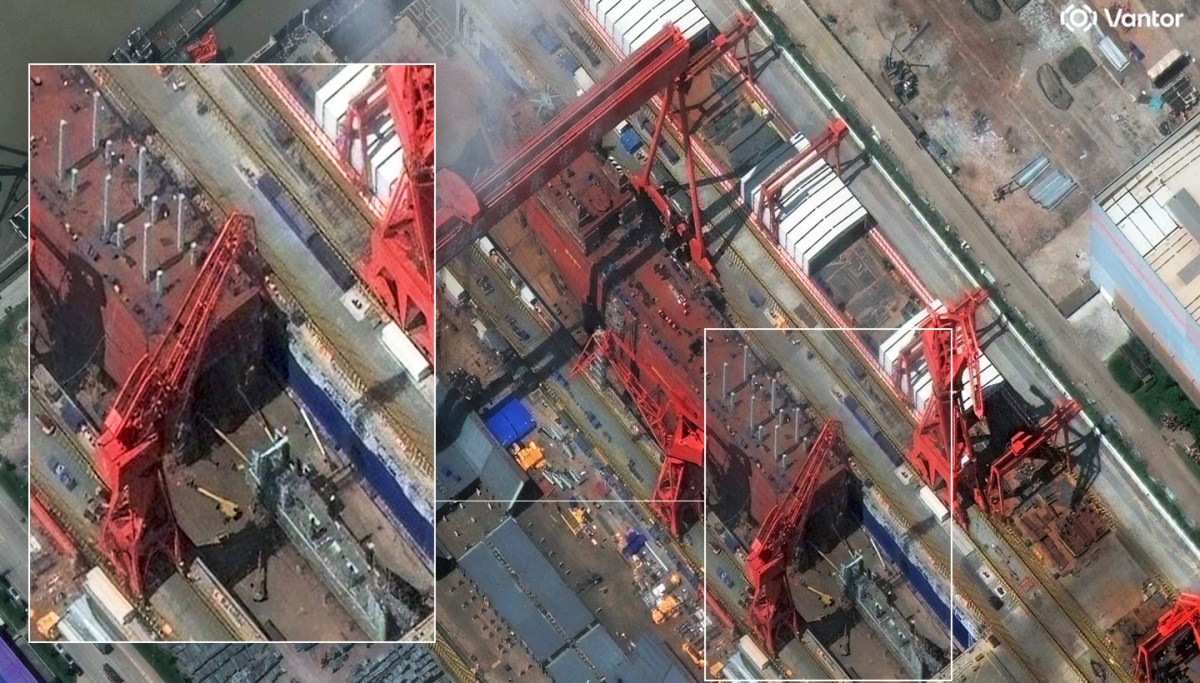
The September 10 image, which shows the ship from the stern, is interesting for a number of reasons. It notably confirms that the design not only has a well deck, but that it is sized around what looks to be a large cradle-like platform visible in the shot. The very roughly 164-feet (50-meter) long rectangular platform has an arch-shaped structure at one end and two teardrop-shaped ones at the other, as well as six pillars, three on each side, in between. The teardrop-shaped structures, in particular, point to the platform being at least a semi-submersible, as they would help with stability and otherwise guide the flow of water while being pulled along.
A closer look at the stern end of the ship, showing the opening for the well deck and the cradle-like platform. Satellite image ©2026 Vantor
An even closer look at the platform. Satellite image ©2026 Vantor
An earlier satellite image of the ship under construction taken on August 24, 2026, which also shows the cradle-like platform being built. Satellite image ©2026 Vantor
The satellite image also clearly shows six large struts extending from the top of the stern end of the superstructure, each one which is paired with a shorter strut, for a total of 12. Earlier this month, independent naval analyst H.I. Sutton, who tracks undersea warfare developments in particular, posited that these struts could be used to lower a platform or some other similar structure below the hull of the ship. He also assessed that they could be used as part of a larger system capable of moving payloads between decks internally. This would help account for the configuration of the core superstructure, especially how high it is all the way from the front to the back. Overall, signs point to the inside of the superstructure being largely hangars and other open work spaces, allowing for multiple large UUVs to be carried and supported. Individual UUVs would be launched and recovered, one at a time, via the cradle.
A closer look at the struts protruding from the top of the ship. Satellite image ©2026 Vantor
In making his assessment, Sutton drew specific attention to a previously shown rendering of a proposed Chinese scientific research vessel with a roughly similar strut-based system at the stern for deploying submersibles and other large payloads. However, on that design, the system was entirely exposed rather than contained with an extended superstructure.
The rendering of the proposed scientific research vessel with a system for deploying payloads at the stern that features four struts. Chinese internet via H.I. Sutton
The platform seen immediately behind the ship being built at the Hudong-Zhonghua Shipyard aligns with Sutton’s assessment about the purpose of the struts. At the same time, launches and recoveries could also be conducted in a more traditional manner via the well deck. The design of the cradle-like platform would seem to suggest the latter option is at least part of the plan.
The general idea of launching and recovering payloads through the bottom of the hull of a ship , including through moon pools , is hardly new. As another point here, Russia is known to have highly specialized mothership submarines that can carry crewed midget submarines and large uncrewed submersibles attached underneath their hulls, and that are also capable of launching ultra-long-range nuclear-powered and nuclear-armed torpedoes . The idea of deploying and retrieving large UUVs via well decks using cradle-like systems is something being explored by other navies globally, including in the United States . All that being said, a large specialized ship built for the purpose of launching and recovering very large underwater vehicles in an operational capacity is unique.
The image from September 10, as well as other recent views of the ship, highlight other features that are now taking shape. This includes a large opening on the starboard side, which could be for launching and/or recovering lifeboats or other watercraft, or moving payloads to and from the pier while docked, as well as a multi-pronged mast on top of the bridge. An additional part of the ship’s superstructure extends behind the bridge area, and there is what looks to be a hangar inside. There is no attached helipad present now, but one could well be added later on somewhere on top of the superstructure. Many naval auxiliaries , as well as commercial ships designed for offshore support and other specialized tasks , have open helipads on raised frames attached to different parts of the superstructures.
A closer look at the area of the superstructure around the bridge, showing the multi-pronged mast on top and what looks to be the opening to a hangar. Satellite image ©2026 Vantor
Though there is growing clarity about the ship’s design, many questions do remain about the full breadth of its intended purpose. In Sutton’s view, the PLAN has a need, just in general, for a dedicated mothership to support its growing uncrewed underwater vehicle (UUV) fleets . The PLAN is pursuing various tiers of UUVs to perform a host of different missions, including intelligence, surveillance, and reconnaissance (ISR), as well as mine-laying, special operations support, and even launching direct attacks on enemy vessels. Larger and larger UUV designs have been steadily emerging in China , which could require more specialized launch and recovery options to be feasibly employed operationally, especially from other vessels at sea. Deployment and retrieval at sea could, in turn, support very long duration missions far from China’s own shores.
“With smaller UUVs, even up to 20 meters like the AJX-002 and HSU-100 paraded in Beijing last year, they are road mobile. Truck mounted cranes should be sufficient for getting them in and out of the water making operations much simpler. With these latest, much larger XXLUUVs [extra-extra large uncrewed underwater vehicles] however, China will start to need dedicated port facilities,” Sutton wrote previously on his website . “Until now China has been using floating docks to house the two XXLUUV prototypes being tested on Hainan . One of these docks was purpose built while the other may have been taken up from general use.”
A Chinese AJX-002 UUV, or a mockup thereof, seen ahead of a major military parade in Beijing in 2025. Chinese internet via X
China's naval unmanned systems. Consisting of (in order), AI enabled unmanned submersible (HSU-100), used for detection and attack. Unmanned patrol boat. Unmanned mine-laying/attack submersible (AJX-002), this was previously mistaken for a nuclear powered torpedo. Because the… pic.twitter.com/Mlj55XLNBH — Zhao DaShuai 东北进修🇨🇳 (@zhao_dashuai) September 3, 2025
China's naval unmanned systems. Consisting of (in order), AI enabled unmanned submersible (HSU-100), used for detection and attack. Unmanned patrol boat. Unmanned mine-laying/attack submersible (AJX-002), this was previously mistaken for a nuclear powered torpedo. Because the… pic.twitter.com/Mlj55XLNBH
“This arrangement also has a significant drawback: each floating dock can only carry a single XXLUUV,” Sutton added. “Or if more than one, then they both need to be placed in the water at the same time. Because the whole dock floods, there cannot be one undergoing maintenance while another is being launched or recovered.”
A mothership vessel able to discreetly deploy and recover large uncrewed and crewed submersibles and other large payloads underwater could be tasked with more specialized missions, including cutting cables , retrieving objects from the seabed , and other kinds of undersea espionage. There is overlap here with more benign roles, such as submarine rescue, salvage, and even deep-sea scientific research. There is also the matter of servicing an expanding array of Chinese underwater infrastructure , including sensor and communications networks . As something of a corollary, Russia’s spy ship Yantar is officially described as an oceanic research vessel. In China, the line between military and non-military assets and capabilities, including ships, is often very blurry, to begin with, as TWZ regularly highlights. This dichotomy was observed right at the Hudong-Zhonghua Shipyard around the end of last year after pictures of a commercial cargo ship being used to showcase a new family of containerized weapons, sensors , and other systems went viral online.
It is also worth pointing out that the boxy and largely enclosed design of the ship now being built at Hudong-Zhonghua Shipyard will inherently make it difficult to observe any activities onboard. This will have the additional knock-on effect of helping keep any payloads, as well as the crew, shielded from the elements. This could be valuable for operations in harsher locales, including waters in and around the Arctic, an ever-more strategic part of the world where China is working to be more engaged .
We also do not know if the apparent mothership vessel is intended to be a one-off or part of a larger class. It could be a stepping stone to broader plans or be part of an already extensive fleet of bespoke naval auxiliaries , as well as unique ostensibly commercial vessels , in service in China today. The PLAN’s aforementioned UUV ambitions will bring along significant test and evaluation requirements, as well as the need to support actual future operations.
If nothing else, evidence is only growing that the new ship under construction at the Hudong-Zhonghua Shipyard is intended to serve, at least in part, as a mothership for large submersible drones.
Contact the author: joe@twz.com
Comments couldn’t be loaded. Please refresh the page.
作者:约瑟夫·特雷维西克
发布于美国东部时间2026年9月24日下午5:10
卫星图像 ©2026 Vantor
过去六个月左右,一艘外形奇特、上层建筑呈方正形状的船只在中国上海的一家造船厂逐渐成形。一张新的卫星图像证实了早前的评估,即这是一艘母舰,用于支援中国日益壮大的、规模越来越大的水下无人潜航器舰队,尽管它也可能承担其他用途。
TWZ从Vantor处获得了这艘舰艇的照片,照片拍摄于9月10日。此后,该舰艇被涂上了灰色油漆,表明其未来将加入中国人民解放军海军服役。该舰长约204米(669英尺),最宽处约30米(98英尺)。就基本长度和宽度而言,这艘正在建造的舰艇与中国的071型两栖攻击舰大致相当。然而,它的整体高度似乎比071型要高得多。
2026年9月10日拍摄的涉事船舶完整图像。卫星图像©2026 Vantor
另一张近期拍摄的照片显示了这艘船新涂的灰色油漆。图片来自中国互联网,经由X。
这艘新舰至少从四月份起就在上海长兴岛沪东中华造船厂建造。该船厂生产各种海军舰艇,包括水面作战舰艇和两栖攻击舰,以及商用舰艇。
9月10日拍摄的这张照片从船尾方向展示了这艘船,其引人注目之处颇多。尤其值得一提的是,它证实了该船的设计不仅包含坞舱,而且其尺寸似乎围绕着照片中可见的大型摇篮状平台而定。这个长约50米(164英尺)的矩形平台一端呈拱形结构,另一端则有两个泪滴状结构,中间还有六根立柱,两侧各三根。特别是泪滴状结构,表明该平台至少是半潜式的,因为它们有助于保持平台的稳定性,并在拖曳过程中引导水流。
近距离观察船尾,可以看到坞舱开口和摇篮状平台。卫星图像 ©2026 Vantor
更近距离地观察该平台。卫星图像 ©2026 Vantor
2026年8月24日拍摄的早期卫星图像显示了正在建造中的船舶,图中也显示了正在建造的摇篮状平台。卫星图像©2026 Vantor
卫星图像清晰地显示,从上层建筑尾端顶部延伸出六根大型支柱,每根支柱都与一根较短的支柱配对,总共十二根。本月初,专门追踪水下作战发展的独立海军分析师HI Sutton提出,这些支柱可用于将平台或其他类似结构降至船体下方。他还评估认为,这些支柱可以作为更大系统的一部分,用于在甲板之间进行有效载荷的内部运输。这有助于解释核心上层建筑的结构,特别是其从前到后的高度。总体而言,种种迹象表明,上层建筑内部主要为机库和其他开放式工作空间,可用于搭载和支撑多个大型无人水下航行器(UUV)。单个UUV将通过吊架逐一进行发射和回收。
近距离观察从船顶伸出的支柱。卫星图像 ©2026 Vantor
萨顿在评估过程中特别提到了之前展示的一张中国科考船设计图,该船船尾也采用了类似的支柱式系统,用于部署潜水器和其他大型有效载荷。然而,该设计中的系统完全暴露在外,而非像本文所述那样被延伸的上层建筑所包裹。
图中所示为拟建科学考察船的效果图,船尾配备有效载荷部署系统,该系统由四根支柱支撑。图片来自中国互联网,经由HI Sutton发布。
在沪东中华造船厂建造的船舶后方所见的平台,与萨顿对支柱用途的评估相符。同时,也可以通过坞舱以更传统的方式进行下水和回收作业。摇篮式平台的设计似乎表明,后一种方案至少是计划的一部分。
通过舰体底部(包括月池)投放和回收有效载荷的总体思路并非新鲜事。此外,众所周知,俄罗斯拥有高度专业化的母舰潜艇,其舰体下方可搭载载人袖珍潜艇和大型无人潜航器,并且能够发射超远程核动力鱼雷。利用摇篮式系统通过坞舱投放和回收大型无人潜航器(UUV)的思路,是包括美国在内的世界各国海军正在探索的方向。尽管如此,专门建造用于作战投放和回收超大型水下航行器的大型专业舰艇仍然独一无二。
9月10日拍摄的照片以及其他近期拍摄的舰艇照片,突显了该舰艇正在逐渐成型的其他特征。其中包括右舷的一个大型开口,该开口可能用于救生艇或其他水上交通工具的投放和回收,或在停靠码头时用于有效载荷的装卸;此外,舰桥顶部还安装了一根多叉桅杆。舰艇上层建筑的另一部分延伸至舰桥区域后方,内部似乎有一个机库。目前舰艇上没有直升机停机坪,但未来很可能在上层建筑的某个位置加装。许多海军辅助舰艇以及设计用于海上支援和其他特殊任务的商船,都在上层建筑的不同位置设有架设在凸起框架上的开放式直升机停机坪。
近距离观察桥梁周围的上部结构区域,可以看到顶部的多叉桅杆以及疑似通往机库的开口。卫星图像 ©2026 Vantor
尽管人们对该舰的设计越来越了解,但其全部预期用途仍存在诸多疑问。萨顿认为,中国人民解放军海军(PLAN)总体上需要一艘专用母舰来支持其不断壮大的无人水下航行器(UUV)舰队。中国人民解放军海军正在研发不同级别的无人水下航行器,以执行包括情报、监视和侦察(ISR)、布雷、特种作战支援,甚至直接攻击敌方舰艇在内的各种任务。中国不断涌现出尺寸越来越大的无人水下航行器,这可能需要更专业的投放和回收方案才能切实可行地投入作战,尤其是在海上从其他舰艇投放和回收的情况下。海上投放和回收反过来又可以支持远离中国海岸的超长航时任务。
“对于较小的无人水下航行器(UUV),即使是像去年在北京展出的AJX-002和HSU-100这样长度不超过20米的型号,它们都是公路机动的。车载起重机足以将它们吊入水中和吊出水面,大大简化了操作。然而,对于这些最新的、尺寸更大的超大型无人水下航行器(XXLUUV),中国将需要专门的港口设施,”萨顿此前在他的网站上写道。“到目前为止,中国一直使用浮动船坞来停泊在海南岛测试的两艘超大型无人水下航行器原型船。其中一个船坞是专门建造的,而另一个可能是从其他用途中征用的。”
一架中国AJX-002无人水下航行器(UUV)或其模型,在2025年北京大型阅兵式前夕亮相。图片来自中国互联网(经由X)。
中国海军无人系统。包括(按顺序):人工智能无人潜水器(HSU-100),用于探测和攻击;无人巡逻艇;无人布雷/攻击潜水器(AJX-002),该潜水器此前曾被误认为是核动力鱼雷。因为…… pic.twitter.com/Mlj55XLNBH — 赵大帅 东北进修🇨🇳 (@zhao_dashuai) September 3, 2025
中国海军无人系统。包括(按顺序):人工智能无人潜水器(HSU-100),用于探测和攻击;无人巡逻艇;无人布雷/攻击潜水器(AJX-002),该潜水器此前曾被误认为是核动力鱼雷。因为…… pic.twitter.com/Mlj55XLNBH
萨顿补充道:“这种安排也有一个明显的缺点:每个浮动码头只能搭载一艘超大型无人水下航行器(XXLUUV)。如果需要搭载多艘,则必须同时下水。因为整个码头都会被水淹没,所以无法做到一艘进行维护的同时,另一艘进行下水或回收。”
一艘能够隐蔽地部署和回收大型无人或载人潜水器以及其他大型水下有效载荷的母舰,可以被赋予更专业的任务,包括切断电缆、从海底打捞物体以及其他类型的水下间谍活动。这与一些更为温和的任务有所重叠,例如潜艇救援、打捞,甚至深海科学研究。此外,它还负责维护不断扩展的中国水下基础设施,包括传感器和通信网络。俄罗斯的间谍船“琥珀”号也被官方描述为一艘海洋研究船,这在某种程度上也是一种佐证。在中国,军事和非军事资产及能力(包括舰船)之间的界限往往非常模糊,正如TWZ经常强调的那样。这种二元性在去年年底就曾在沪东中华造船厂出现过,当时一艘商用货船被用来展示一系列新型集装箱式武器、传感器和其他系统,相关照片在网上疯传。
值得一提的是,沪东中华造船厂目前正在建造的这艘舰艇采用方正封闭的设计,其内部结构本身就使得外界难以观察舰上活动。这也有助于保护有效载荷和船员免受恶劣天气的影响。这对于在环境更为恶劣的地区执行任务至关重要,例如北极及其周边海域。北极地区战略地位日益重要,中国正努力加强在该地区的参与。
我们也不清楚这艘疑似母舰的舰艇是计划建造的单艘舰艇,还是更大规模舰艇系列的一部分。它可能是更广泛计划的垫脚石,也可能是目前中国海军已服役的庞大定制化海军辅助舰艇以及一些外观独特的商用舰艇的一部分。中国人民解放军海军上述的无人水下航行器(UUV)计划将带来大量的测试和评估需求,以及支持未来实际作战行动的必要性。
即便没有其他证据,越来越多的证据表明,沪东中华造船厂正在建造的新船至少部分是为了作为大型潜水无人机的母船而建造的。
联系作者:joe@twz.com
评论加载失败,请刷新页面。