Here’s Our Best Look Yet At Russia’s Secretive Space Cannon, The Only Gun Ever Fired In Space这是我们迄今为止对俄罗斯神秘太空炮的最佳观察,它是唯一一门在太空发射过的火炮。
Based on a design that was intended to protect bombers, the R-23M cannon had an unusual and closely guard design, to begin with.
新闻视频
By Joseph Trevithick
Updated Feb 16, 2021 6:53 PM EST
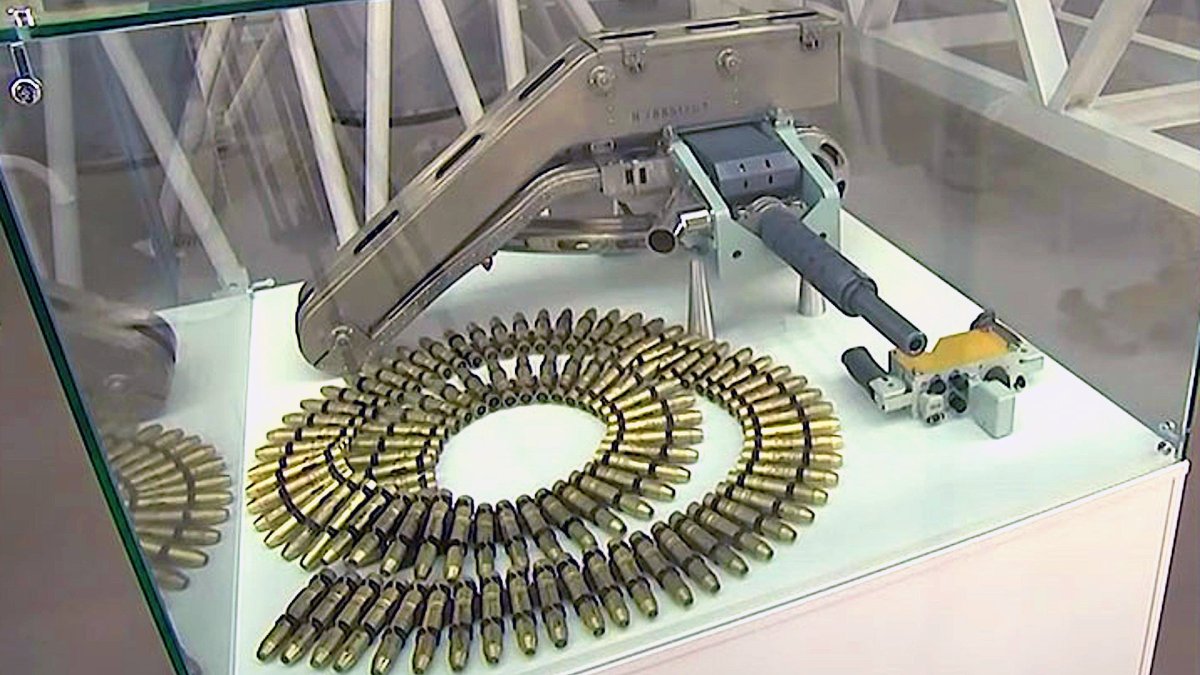
More than four decades after the Soviet Union’s 23mm R-23M automatic cannon became the first and only gun to have actually been fired in space , at least that we know about, a new picture of this secretive weapon has emerged. The image offers the clearest look to date of the entire Shchit-1 self-defense system that armed the Almaz OPS-2 military space station, which orbited the Earth for around eight months between 1974 and 1975.
Russian author Anatoly Zak, who also runs the website RussianSpaceWeb.com, spotted the Shchit-1 system in images the Russian Ministry of Defense released of Defense Minister Sergei Shoigu’s visit to NPO Mashinostroyenia earlier in 2021. NPO Mashinostroyenia, originally known simply as OKB-52, is a design bureau best known for the development of missiles , rockets, and spacecraft, including work on the Almaz military space program during the Cold War.
A screengrab from a TV Zvezda program that aired in 2015, showing the Shchit-1 self-defense system. Prior to this year, this was the most detailed look at the system and the R-23M cannon publicly available., TV Zvezda capture
For years, the R-23M and the Almaz program were both wrapped in multiple layers of secrecy for various reasons. The fact that the OPS-2 space station was armed at all did not emerge until after the fall of the Soviet Union in 1991. There was only one available picture of the R-23M prior to 2015, and not a very good one , which may have only reflected a prototype design and did not show the complete Shchit-1 system. In 2015, a special aired on TV Zvezda , the official television channel of the Russian Ministry of Defense, which included the first real look, seen above, of the entire space-based configuration .
Development of the standard terrestrial R-23, designed primarily as self-defense weapons for bombers, began in the 1950s and was treated as a highly sensitive project. The brainchild of Aron Rikhter at KB Tochmash , a design bureau then headed up by Aleksandr Nudelman, the idea had been to craft a more compact gun that would be easier to fit inside an aircraft and particularly well-suited for turreted applications. Rikhter had worked directly with Nudelman on the earlier, unrelated 23mm NR-23 , as well as the larger 30mm NR-30 , both of which saw widespread use on Soviet aircraft.
The Soviet Il-28 bomber had two NR-23 cannons mounted in the tail, as seen here., Varga Attila via Wikimedia
The R-23 is a so-called revolver cannon, which, as its name indicates, feeds ammunition into the firing position by way of a number of revolver-like cylinders. This feed mechanism, which is similar in some very broad respects to Gatling-type designs , allows for a higher rate of fire than can be achieved with more conventional single-barrel guns.
However, Rikhter’s gun, unlike most other revolver cannons, feeds ammunition from the magazine backward into the cylinders, rather than from the rear or the side. This places the feed mechanism in the center of the gun, helping to shorten its overall length.
On top of that, the R-23 uses unique 23x260mm cartridges that have a so-called telescoped configuration. This means that the projectile is nestled completely inside the cartridge case, rather than sticking out of the front. The general concept behind ammunition of this type is to shorten the overall length of the round, and, by extension, the weapon that fires it, without any significant loss of performance over a gun firing a similar traditional round.
The Tupolev Tu-22 Blinder bomber was the first aircraft to be designed to carry the R-23, with one of the guns to be mounted in a remote-controlled, radar-directed turret in the tail. Delays in the development of the cannon meant that the first Blinders entered service years before their tail guns were ready.
The Tu-22’s tail gun, a turreted R-23 cannon., Alex Beltyukov via Wikimedia
In the end, the Tu-22 was the only aircraft to be armed with the R-23. This helped keep the very existence of the gun largely secret until the first Blinders were exported to Iraq and Libya in the 1970s. An actual example did not reportedly fall into Western hands until one was recovered from the wreckage of a Libyan Tu-22 that French forces had shot down over Chad in 1987. That conflict between Chad and Libya, in general, was an intelligence bonanza for the West.
It’s not clear whether or not the development of the R-23M for space-based applications contributed to the secrecy surrounding the weapon or if it was chosen because it was so closely guarded to start with. Its compact nature no doubt helped make it an obvious choice for attaching to a spacecraft, where weight and physical space are always at a premium.
Based on the still limited information that has emerged to date, the Shchit-1 self-defense system consisted of a single R-23M cannon in a rigid mount with a magazine mounted on top of the center portion of the gun. What modifications may have been made to the weapon itself to ensure it would function properly in zero gravity are unclear.
“From the dawn of the Space Age, the secrecy-obsessed Soviet military was terrified by the prospect of American spacecraft approaching and inspecting Soviet military satellites—which, according to the Kremlin’s propaganda, were not even supposed to exist,” Anatoly Zak wrote in a piece on the R-23M for Popular Mechanics in 2015. “This wasn’t crazy. The fear of attack on spacecraft was real, with both sides of the Iron Curtain developing anti-satellite weapons. It seemed perfectly logical in the 1960s that military and piloted spacecraft would need self-defense weapons.”
The Almaz military space stations, work on which first began in the early 1960s, were intended to be armed from the beginning. Before shifting to the R-23M, Zak says that KB Tochmash had been working on a compact 14.5mm weapon for space-based use.
The Almaz stations were expected to be multi-purpose military platforms in space. The plan was for the first types to be configured primarily for intelligence, surveillance, and reconnaissance missions with cameras and other sensors. Delays with the development of the sensor package held up the entire program. In 1971, the Soviet Union launched a civilian space station, Salyut , that incorporated some of the design work developed under the Almaz program, together with components from the venerable Soyuz spacecraft .
A line drawing of the core Almaz space station design., NASA
The Salyut program ultimately provided a cover for the Almaz space stations. Of the seven Salyut space stations launched between 1971 and 1991, three were actually military types.
The first Almaz station, referred to publicly as Salyut-2 and also known as OPS-1, was launched in 1973. However, an accident on board shortly after launch forced the Soviets to abandon it before an actual crew could be sent up to join it.
OPS-2, also called Salyut-3, followed in 1974. This station, armed with the R-23M, successfully reached orbit on June 25 of that year, but a two-man crew did not arrive until July. They remained there for 15 days, during which they tested the onboard telescopic Agat-1 Earth-observation camera, which is said to have been able to produce imagery of the ground with a resolution of better than three meters .
A second crew failed to reach the station later in 1974 after their Soyuz spacecraft suffered a malfunction. The third mission to OPS-2 was subsequently canceled and it operated in an unmanned mode until it deorbited on January 24, 1975. In September 1974, personnel on the ground remotely ejected a pod with film from the Agat-1 camera, which subsequently returned to Earth and was recovered.
A display depicting an Almaz space station., Pulux11 via Wikimedia
The test of the R-23M cannon occurred on the station’s very last day in orbit. Without any way to fully simulate on the ground how firing the gun would impact OPS-2, the plan had always been to test it in orbit without anyone on board. The shock and recoil not only had the potential to damage the station but, in the vacuum of space, those forces raised the possibility that shooting the weapon could send it flying in a dangerously unpredictable fashion.
“The outpost [OPS-2] ignited its jet thrusters simultaneously with firing the cannon to counteract the weapon’s powerful recoil,” Anatoly Zak explained in the story for Popular Mechanics back in 2015. “According to various sources, the cannon fired from one to three blasts [bursts], reportedly firing around 20 shells in all. They burned up in the atmosphere, too.”
Exactly what happened during the test remains classified to this day. The next Almaz space station, known as OPS-3 and Salyut-5, had no weaponry on board, at least that we know of. Plans for an OPS-4 station included a new Shchit-2 self-defense system that was reportedly designed to fire missile-like interceptors , but no pictures of that weapon are known to exist publicly.
The Soviets did also develop specialized self-defense guns for cosmonauts, such as the TP-82 seen in the video below, but these were intended to be used on Earth, not in space. You can read more about them in this past War Zone piece .
How effective the Shchit-1 system would ever have been had it seen more widespread use is certainly debatable. The fixed mounting meant that the entire space station had to be rotated to aim it, which would reportedly have been done using a simple optical sight.
In the years since the test of the R-23M in space, the prospect of attacks on satellites and other spacecraft certainly hasn’t gone away, nor has an interest in weapons that could be used in orbit for defensive or offensive purposes. Last year, the head of U.S. Space Force, the U.S. military’s newest branch, publicly accused Russia of having tested an on-orbit projectile-based anti-satellite weapon. It’s interesting to note that what little we know about the Shchit-2 system would seem to fit this general description.
At the same time, Russia has also been testing relatively small inspector satellites, which have the ability to get very close to other objects in space. This could allow them to function as orbital spies, as well as “ killer satellites ,” using various means of attack to damage, disable, or destroy a target, including by simply smashing into it.
An infographic from the U.S. Defense Intelligence Agency showing various means by which one satellite could attack another in space., DIA
These kinds of threats have prompted discussion in other countries, including the United States and France, about the development of potential countermeasures, if they don’t exist already in the classified realm . The French military, specifically, says it is now working on space-based “guardian satellites” that will be armed with lasers , though it’s unclear if they will be powerful enough to physically damage or destroy an incoming threat or will just be designed as dazzlers to blind or confuse enemy sensor and seeker systems.
The story of the R-23M certainly highlights just how complex and sensitive the matter of developing even the most basic weapons for space-based applications remains, a full 46 years after the Soviets conducted the one known test of an automatic cannon in orbit.
Contact the author: joe@thedrive.com
Comments couldn’t be loaded. Please refresh the page.
作者:约瑟夫·特雷维西克
更新于美国东部时间2021年2月16日下午6:53。
在苏联23毫米R-23M自动炮成为迄今为止唯一一门在太空实际发射过的火炮(至少据我们所知)四十多年后,这门神秘武器的全新照片浮出水面。这张照片清晰地展现了“Shchit-1”自卫系统的全貌,该系统曾装备于1974年至1975年间绕地球运行约八个月的“金刚石OPS-2”军事空间站。
俄罗斯作家阿纳托利·扎克(Anatoly Zak)同时也是网站RussianSpaceWeb.com的运营者,他在俄罗斯国防部发布的国防部长谢尔盖·绍伊古于2021年初访问机械制造科研生产联合体(NPO Mashinostroyenia)的照片中发现了“Shchit-1”系统。机械制造科研生产联合体(NPO Mashinostroyenia),原名OKB-52,是一家以研发导弹、火箭和航天器而闻名的设计局,曾参与冷战时期的“金刚石”(Almaz)军事航天计划。
这是一张来自2015年德国红星电视台(TV Zvezda)节目的截图,展示了“Shchit-1”自卫系统。在此之前,这是公众所能获得的关于该系统和R-23M型火炮最详细的介绍。
多年来,R-23M导弹和金刚石火箭计划都因各种原因被层层保密。直到1991年苏联解体后,OPS-2空间站配备武器的事实才为人所知。2015年之前,R-23M导弹只有一张公开照片,而且质量很差,可能只反映了原型设计,并未展现完整的“Shchit-1”系统。2015年,俄罗斯国防部官方电视台“星辰电视台”(TV Zvezda)播出了一档特别节目,首次完整展示了R-23M的太空系统配置(如上图所示)。
标准型陆基R-23机炮的研发始于20世纪50年代,主要设计用于轰炸机的自卫,该项目被视为高度机密。R-23机炮是阿隆·里赫特在托赫马什设计局(KB Tochmash,当时由亚历山大·努德尔曼领导)的创意,其设计理念是制造一种更紧凑的机炮,以便更易于安装在飞机上,尤其适合炮塔式应用。里赫特曾与努德尔曼直接合作研发过早期的23毫米NR-23机炮以及更大的30毫米NR-30机炮,这两款机炮均在苏联飞机上得到广泛应用。
如图所示,苏联伊尔-28轰炸机的尾部装有两门NR-23机炮。(图片来自Wikimedia,Varga Attila)
R-23 是一种所谓的转轮炮,顾名思义,它通过多个类似转轮的弹巢将弹药送入射击位置。这种供弹机构在某些方面与加特林机枪的设计类似,使其射速比传统的单管火炮更高。
然而,与大多数其他转轮炮不同,里赫特的枪弹不是从后部或侧面供弹,而是从弹匣向后输送到弹膛。这使得供弹机构位于枪身中央,有助于缩短其整体长度。
此外,R-23 使用独特的 23×260 毫米弹药,这种弹药采用所谓的伸缩式结构。这意味着弹头完全位于弹壳内部,而不是像传统弹药那样从前端伸出。这种弹药的设计理念在于缩短弹药的整体长度,进而缩短发射该弹药的武器长度,同时又不显著降低其性能,使其与发射类似传统弹药的枪支相比并无明显差异。
图波列夫Tu-22“盲人”轰炸机是第一款设计搭载R-23机炮的飞机,其中一门机炮将安装在尾部一个遥控雷达制导炮塔内。由于机炮研发延误,首批“盲人”轰炸机在尾部机炮准备就绪前数年就已投入使用。
图-22的尾炮,一门炮塔式R-23机炮。(图片来自Wikimedia,Alex Beltyukov摄)
最终,图-22是唯一一款装备R-23反潜炮的飞机。这使得该炮的存在在很大程度上被保密,直到20世纪70年代首批“盲点”反潜炮出口到伊拉克和利比亚。据报道,直到1987年法国军队在乍得上空击落一架利比亚图-22轰炸机后,西方才首次获得实物。乍得和利比亚之间的冲突,总体而言,对西方来说是一次情报盛宴。
目前尚不清楚R-23M导弹的研发是否因其天基应用而导致其高度保密,或者它本身就因其严密的保密性而被选中。毫无疑问,其紧凑的特性使其成为航天器的理想选择,因为在航天器上,重量和物理空间始终是至关重要的。
根据目前已知的有限信息,Shchit-1自卫系统由一门R-23M型火炮组成,该火炮安装在一个刚性炮架上,弹匣则位于火炮中部上方。至于为了确保其在零重力环境下也能正常工作,该武器本身可能进行了哪些改进,目前尚不清楚。
阿纳托利·扎克在2015年为《大众机械》杂志撰写的一篇关于R-23M的文章中写道:“从太空时代伊始,痴迷于保密的苏联军方就对美国航天器接近并检查苏联军用卫星的前景感到恐惧——根据克里姆林宫的宣传,这些卫星甚至不应该存在。这并非杞人忧天。对航天器遭受攻击的恐惧是真实存在的,铁幕两侧都在研发反卫星武器。在20世纪60年代,军用和载人航天器需要自卫武器似乎是完全合乎逻辑的。”
阿尔马兹军用空间站的建造工作始于20世纪60年代初,从一开始就计划配备武器。扎克表示,在转向R-23M之前,托赫马什设计局(KB Tochmash)一直在研发一种用于太空的紧凑型14.5毫米武器。
“金刚石”空间站原本被设想为多用途的太空军事平台。最初的计划是,首批空间站将主要用于情报、监视和侦察任务,配备摄像头和其他传感器。传感器组件的研发延误导致整个项目停滞不前。1971年,苏联发射了民用空间站“礼炮”号,该空间站融合了“金刚石”计划的部分设计成果,以及来自久经考验的“联盟”号飞船的部件。
美国国家航空航天局(NASA)的金刚石(Almaz)空间站核心结构设计线图。
礼炮计划最终为金刚石空间站提供了掩护。在1971年至1991年间发射的七个礼炮空间站中,有三个实际上是军用型的。
第一个金刚石号空间站,公开名称为礼炮-2号,也称为OPS-1,于1973年发射升空。然而,发射后不久发生的一起事故迫使苏联在派遣真正的宇航员上去之前就放弃了它。
OPS-2,又称礼炮-3号,于1974年发射升空。该空间站搭载R-23M火箭,于当年6月25日成功入轨,但两名宇航员直到7月才抵达。他们在空间站停留了15天,期间测试了机载的阿加特-1地球观测望远镜相机,据说该相机能够拍摄分辨率优于3米的地面图像。
1974年晚些时候,第二批宇航员乘坐的联盟号飞船发生故障,未能抵达空间站。随后,第三次OPS-2任务被取消,飞船以无人模式运行,直至1975年1月24日脱离轨道。1974年9月,地面人员远程释放了装有阿加特-1相机胶片的吊舱,该吊舱随后返回地球并被回收。
描绘 Almaz 空间站的显示屏。, Pulux11 来自 Wikimedia
R-23M型舰炮的测试是在空间站轨道运行的最后一天进行的。由于地面上无法完全模拟发射舰炮对OPS-2系统的影响,因此原计划是在无人在轨的情况下进行测试。冲击和后坐力不仅可能损坏空间站,而且在真空的太空环境中,这些力还可能导致舰炮以极其危险且不可预测的方式飞出去。
阿纳托利·扎克在2015年《大众机械》杂志的报道中解释道:“前哨站(OPS-2)在发射火炮的同时点燃了喷气推进器,以抵消武器强大的后坐力。据各种消息来源称,火炮发射了一到三次炮击,据说总共发射了大约20枚炮弹。这些炮弹也在大气层中燃烧殆尽。”
测试期间究竟发生了什么,至今仍属机密。下一座金刚石空间站,即OPS-3和礼炮-5,据我们所知,并未搭载任何武器。OPS-4空间站的计划中包含一种新型的“Shchit-2”自卫系统,据报道该系统旨在发射类似导弹的拦截器,但目前尚未有任何该武器的图片公开。
苏联也确实为宇航员研发过专用的自卫枪支,例如下方视频中出现的TP-82,但这些枪支是设计用于地球上的,而非太空。您可以在之前的“战区”文章中了解更多相关信息。
如果Shchit-1系统得到更广泛的应用,其有效性究竟如何,这一点无疑值得商榷。由于其固定安装方式,每次瞄准时都必须旋转整个空间站,而据报道,这一操作原本是通过一个简单的光学瞄准器完成的。
自R-23M导弹在太空进行测试以来,针对卫星和其他航天器的攻击威胁并未消失,人们对可在轨道上用于防御或进攻的武器的兴趣也丝毫未减。去年,美国太空军(美国军方最新成立的军种)司令公开指责俄罗斯测试了一种在轨弹基反卫星武器。值得注意的是,我们目前对“Shchit-2”系统的了解似乎与上述描述相符。
与此同时,俄罗斯也在测试相对较小的侦察卫星,这些卫星能够非常接近太空中的其他物体。这可能使它们能够充当轨道间谍,以及“杀手卫星”,利用各种攻击手段(包括直接撞击)来破坏、瘫痪或摧毁目标。
美国国防情报局制作的一张信息图,展示了卫星之间在太空中相互攻击的各种方式。
这类威胁已引发包括美国和法国在内的其他国家讨论,探讨开发潜在的应对措施(如果相关技术尚未存在于机密领域)。法国军方表示,他们正在研发配备激光武器的天基“守护卫星”,但目前尚不清楚这些激光武器的威力是否足以对来袭目标造成物理损伤或摧毁,还是仅仅用于干扰或迷惑敌方传感器和导引系统。
R-23M 的故事无疑凸显了即使是最基本的太空武器研发也是多么复杂和敏感的问题,尽管苏联在轨道上进行了唯一一次已知的自动炮试验已经过去了整整 46 年。
联系作者:joe@thedrive.com
评论加载失败,请刷新页面。