Estonia raids combat-vehicle funds to buy more drones, air defenses爱沙尼亚挪用作战车辆资金购买更多无人机和防空装备
The defense minister said the decision was based on lessons learned from Russia's invasion of Ukraine.
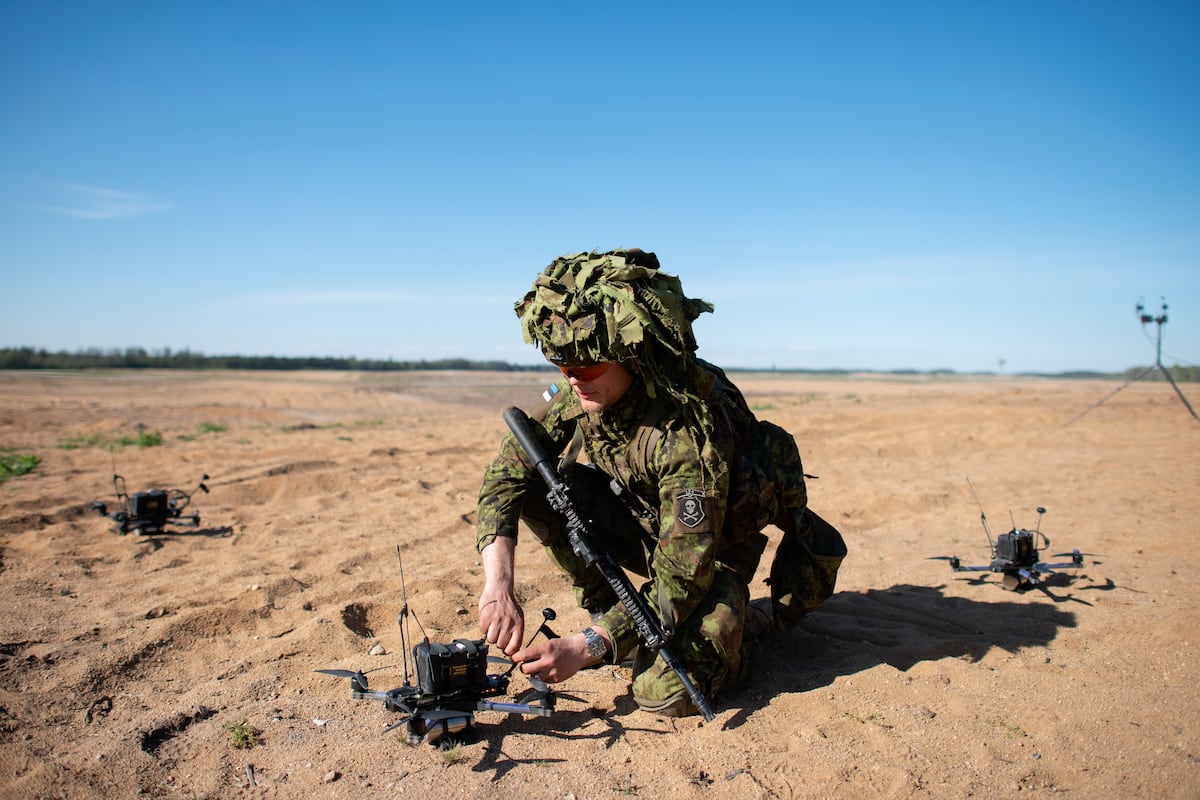
WARSAW, Poland — Estonia’s government has decided to put on hold its planned acquisition of new infantry fighting vehicles.
The Baltic nation will instead direct the funds toward drones, counter-drone measures and air-defense systems , while squeezing more service life out of the country’s existing fleet of second-hand CV90 vehicles.
Estonian Defense Minister Hanno Pevkur announced the move, which pauses a €500 million ($590 million) acquisition, last week, saying it was based on lessons drawn from Russia’s invasion of Ukraine. Tallinn will “extend the service life of the existing CV90 vehicles by at least 10 years,” Pevkur was quoted in a statement issued by the government.
The move is in contrast with actions by the other two Baltic States, Latvia and Lithuania, which have made decisions to buy new CV90 and Ascod vehicles, respectively.
“We have decided that, at present, it is more rational to modernize the existing infantry fighting vehicles rather than replace them. Modernization will ensure the sustained preservation of capability and the efficient use of resources,” Andri Maimets, spokesman for the Estonian Centre for Defence Investments (ECDI), the country’s military procurement agency, told Defense News.
Under the modernization plan, the vehicles are to be fitted with new electronics, and their weapon and targeting systems will be upgraded, Maimets said.
Estonia secured 44 used CV90s from the Netherlands that were delivered in 2019, and sourced additional 37 hulls of vehicles made by BAE Systems Hägglunds for Norway, subsequently rebuilding them into support vehicles.
Raimond Kaljulaid, an Estonian lawmaker who represents the opposition Social Democratic Party on the parliament’s National Defence Committee, told Defense News the decision should be viewed in the context of Estonia’s rising military expenditure.
“Estonia spends over 5% of its GDP on defense, and this is real spending on our military which is above NATO’s 3.5 percent target to meet the capability targets,” Kaljulaid said. “This means that, if we want to invest more in counter-drone technologies or combat drones, the money must come from the existing budget,” he added. “If our threat assessment and priorities change, we need to adapt our spending accordingly.”
The lawmaker said the National Defence Committee will “keep a close eye on the adapted approach to make sure that everything is done the right away to ensure national security.”
As Tallinn advances plans to select a foreign supplier for the planned domestic ramp-up of 155 mm artillery ammunition production, Kaljulaid also said that projects to attract international defense industry players to Estonia must be accelerated.
“The past five-six years have brought remarkable success to the development of Estonia’s defense industry, with unmanned technologies as one of the prime examples. At the same time, we must make efforts to ensure that Estonia continues to be competitive with regards to other countries in the region,” he said.
Jaroslaw Adamowski is the Poland correspondent for Defense News.
波兰华沙——爱沙尼亚政府决定暂停采购新型步兵战车的计划。
这个波罗的海国家将把资金用于无人机、反无人机措施和防空系统,同时尽可能延长该国现有二手 CV90 车辆的使用寿命。
爱沙尼亚国防部长汉诺·佩夫库尔上周宣布暂停一项价值5亿欧元(约合5.9亿美元)的采购计划,称此举是基于从俄罗斯入侵乌克兰事件中吸取的教训。佩夫库尔在政府发布的一份声明中表示,塔林方面将“把现有CV90装甲车的服役寿命至少延长10年”。
此举与另外两个波罗的海国家拉脱维亚和立陶宛的行动形成鲜明对比,这两个国家分别决定购买新的 CV90 和 Ascod 车辆。
爱沙尼亚国防投资中心(ECDI,该国军事采购机构)发言人安德里·迈梅茨告诉《防务新闻》:“我们认为,目前对现有步兵战车进行现代化改造比更换它们更为合理。现代化改造将确保作战能力的持续保持和资源的有效利用。”
迈梅茨表示,根据现代化计划,这些车辆将安装新的电子设备,其武器和瞄准系统也将得到升级。
爱沙尼亚从荷兰获得了 44 辆二手 CV90 装甲车,这些车辆于 2019 年交付。此外,爱沙尼亚还从 BAE Systems Hägglunds 公司为挪威采购了 37 个车辆车体,随后将其改装成支援车辆。
代表反对党社会民主党在议会国防委员会任职的爱沙尼亚议员雷蒙德·卡柳莱德告诉《防务新闻》,应该从爱沙尼亚不断增长的军费开支的角度来看待这一决定。
卡柳莱德表示:“爱沙尼亚国防开支占国内生产总值(GDP)的5%以上,这是实实在在的军费开支,高于北约为达到能力目标而设定的3.5%的目标。” 他补充道:“这意味着,如果我们想加大对反无人机技术或作战无人机的投资,资金必须来自现有预算。如果我们的威胁评估和优先事项发生变化,我们也需要相应地调整支出。”
该议员表示,国防委员会将“密切关注调整后的方法,以确保一切都按正确的方式进行,从而保障国家安全”。
随着塔林推进为计划中的国内155毫米火炮弹药增产项目选择外国供应商的计划,卡柳莱德还表示,必须加快吸引国际国防工业企业来爱沙尼亚的项目。
“过去五六年,爱沙尼亚国防工业取得了显著成就,无人技术便是其中的佼佼者。与此同时,我们必须努力确保爱沙尼亚在与该地区其他国家的竞争中继续保持优势,”他说道。
Jaroslaw Adamowski 是《防务新闻》驻波兰记者。