Chasing Soviet Missiles In The Cobra Ball From A Desolate Rock In The Aleutian Islands在阿留申群岛一座荒凉的岩石上,驾驶眼镜蛇球追逐苏联导弹
During the Cold War, RC-135 Cobra Ball missile test tracking jet crews sat alert at one of the most remote and inhospitable places on earth.
新闻视频
Updated Dec 16, 2020 12:30 PM EST
The horn went off at 0330. Groggy, the pilot pulled on his flying suit, stuffed his feet into his boots, and headed down the stairs to Hangar 6. He was not alone.
As he clambered up the stairs through the jet’s gaping cargo door, he saw the alert mission crew getting settled into their seats. In the cockpit, he passed the two navigators already at work. The Nav 1 was spinning up the LN-20 stellar-inertial doppler system as the Nav 2 was prepping the SATCOM and her mission materials.
He slid into the left seat just as the copilot arrived. Both put on their headsets while strapping in.
“Pilot? Ground. Air stairs clear, ready to back.”
“Roger, brakes released.”
The copilot keyed the radio. “Six weather.” Transmitting in the blind, ground control broadcast the current weather conditions.
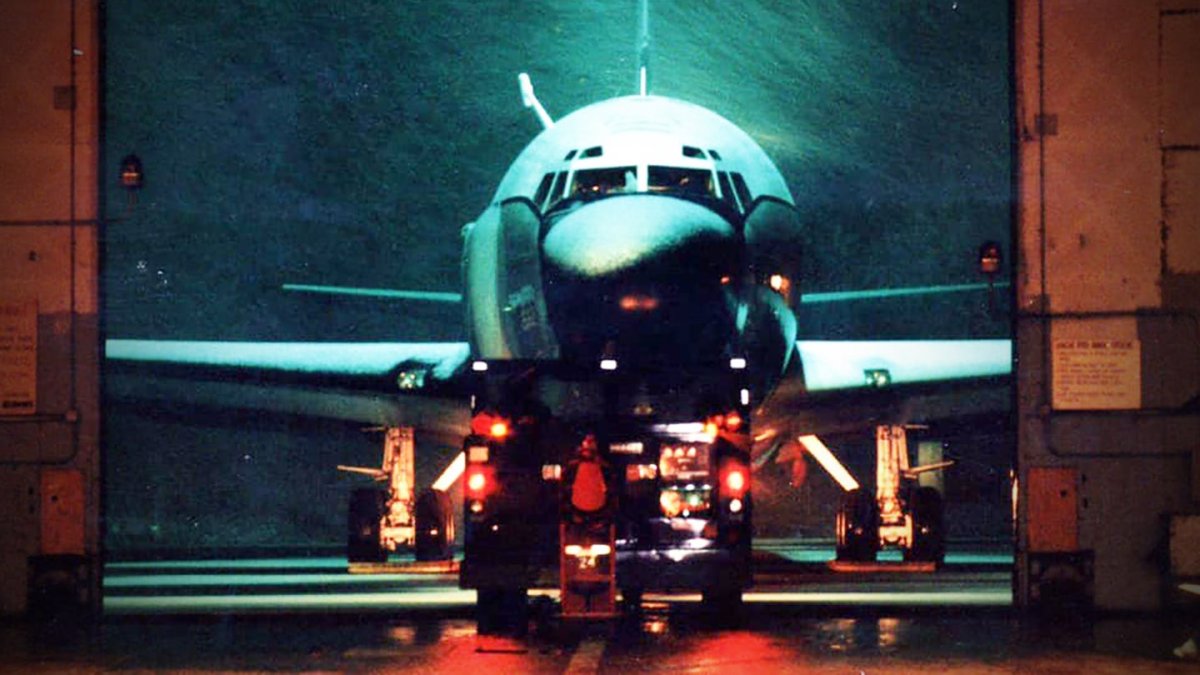
Now pushed outside of the huge hangar, the pilot began the engine start.
An earlier RC-135 outside one of the hangars at Shemya., USAF
“Turning three.” The number three engine quickly came to life, followed by four, one, and then two. The crew entry chute closed and the airplane blinked as the copilot switched to internal power while the ground crew disconnected the ground power cart.
The jet moved onto the runway, turning left. Illuminated by the taxi lights, the pilot could barely see the edge of the runway in the fog and blowing snow. As the end of the runway disappeared under the nose, the pilot turned the airplane around sharply to align it with the centerline of Runway 28. The copilot turned off the taxi lights and the jet came to a stop. Flaps set, takeoff data reviewed, Before Takeoff Checklist complete. The pilot nodded in the dim red glow of the cockpit and the copilot switched on the landing light. Throttles set, all four engines steady, brakes released. Slowly, 285,000 pounds of airplane, crew, and jet fuel accelerated to 165 knots before rotating and disappearing into the frigid darkness.
The Cobra Ball was airborne.
Shemya Air Force Base, Alaska—better known as The Rock—sits on a remote island at the tip of the Aleutian Chain close to what was then the USSR. This location would allow the Cobra Ball and its crew to be in position less than an hour after notification to gather re-entry intelligence on Soviet ballistic missile warheads careening through the atmosphere during their terminal stage of flight.
Shemya is one of the most remote installations on earth, situated right at Russia’s back doorstep., Google Maps
The duty crew was ready to launch in less than 15 minutes, which occasionally gave them only 15 minutes for a “turn short” and collection of intelligence data once on the scene, that is if there was insufficient warning time from the Defense Special Missile and Astronautics Center ( DEFSMAC ), part of the National Security Agency. DEFSMAC determined that a Soviet launch was imminent. Normally, crews had a minimum of 30 to 45 minutes to be on station prior to collection. In many cases, however, the mission was a bust as the Soviets elected not to launch or the indicators at DEFSMAC were ambiguous.
Image of Shemya taken on December 2nd, 2020. , PHOTO © 2020 PLANET LABS INC. ALL RIGHTS RESERVED. REPRINTED BY PERMISSION.
The windswept island is scattered with buildings old and new, but the two biggest features are the massive COBRA DANE radar on a bluff on the northwest of the island and the main ramp at the Air Force Base. While many of the large hangars that once dotted the area around the airstrip have finally been demolished, the main hangars are now modern, having been totally rebuilt in 2016 following damage done by a major storm. , PHOTO © 2019 PLANET LABS INC. ALL RIGHTS RESERVED. REPRINTED BY PERMISSION.
The Rock was cold, grey, and blustery, buffeted by wind, snow, rain, and fog. Two crews lived in rooms in the second story of the hangar and cooked their own meals in a common kitchen. Each crew deployed for two weeks at a time, with one-week overlap for continuity.
There was comparatively little to do on The Rock, which had one cable TV channel that showed old VHS movies and the Alaska Weather Report. Crews could visit the small base exchange, known as “Macy’s,” for a pizza, work out in the gym in the hangar, jog the length of the 10,006-foot runway, or tour the island.
When the weather was bad, the jet was back at Eielson Air Force Base on the Alaskan mainland, there was no tasking, or after a mission, crews were rewarded with a “Beer Light” to raise their spirits. A cold beer or two sometimes led to hijinks like riding the rotating beacon on the top of Hangar 3 or the ritual skinny dip in the frigid Northern Pacific Ocean followed immediately by similar immersion in the Bering Sea.
In 1959, the United States began collecting telemetry intelligence (TELINT) of Soviet ballistic missile launches. These initially involved EB-47E(TT) Tell Twos operating from Incirlik Air Base in Turkey and flying over the Black Sea and Iran. In addition, spooky U.S. Navy aircraft operated from bases in Pakistan, but were soon evicted. Despite their successes in collecting boost-phase TELINT, all of these planes lacked any optical capability. Moreover, they only tracked the missile booster and not any re-entry vehicles (warheads).
To mitigate this shortcoming, in 1960, the U.S. modified a four-month-old Boeing KC-135A, serial number 59-1491, with only 142 total hours into a configuration nicknamed Nancy Rae to collect measurement and signature intelligence (MASINT). On December 31st, 1961, the airplane and crew arrived at Shemya AFB. Over time, the airplane was redesignated as JKC-135A and later RC-135S, and the program name changed to Wanda Belle, then to Rivet Ball, and finally to Cobra Ball.
The Nancy Rae KC-135A, serial number 59-1491., Stephen Miller
The sole Lisa Ann RC-135E, serial number 62-4137, later renamed Rivet Amber, joined the Rivet Ball in 1966. This new airplane carried a massive Hughes radar to track incoming re-entry vehicles, which were then filmed by a ballistic streak camera similar to the one on the Rivet Ball.
The Lisa Ann RC-135E, serial number 62-4137, with its huge radar embedded in the fuselage between the wing root and the cockpit. , King Hawes
Tragedy struck on January 13th, 1969 when the Rivet Ball slid off the runway at Shemya AFB, breaking its spine, but with no loss of life or equipment. Months later, on June 5th, 1969, the Rivet Amber aircraft disappeared over the Bering Sea with the loss of all 19 crewmen onboard.
The remains of 59-1491, by then designated as an RC-135S Rivet Ball, on January 13th, 1969., King Hawes
To make up for the loss of those aircraft, two former testbed C-135Bs, serial numbers 61-2663 and 61-2664, were hastily converted into RC-135S platforms, entering service in 1969 and 1972, respectively. On the Ides of March 1981, 61-2664 struck the approach lights of Runway 10 during landing at Shemya AFB, killing six of its crew.
While in the hospital recovering from an assassination attempt, President Ronald Reagan subsequently approved the emergency conversion of another C-135B, serial number 61-2662, into the fourth Cobra Ball, attesting to the critical national importance placed on these airplanes and their mission.
In 1989, as part of the Strategic Defense Initiative, the lone RC-135X Cobra Eye, serial number 62-4128, arrived at Shemya AFB. The Cobra Eye flew missions on behalf of the U.S. Army and U.S. Ballistic Missile Defense agencies. With the end of the Cold War, it was eventually reconfigured into an RC-135S, one of three that are still in service, at the time of writing, with the 55th Wing at Offutt Air Force Base in Nebraska.
RC-135S 61-2663 cobra ball I outside Hangar 7 at Shemya., Author’s Photo
The most distinctive feature of the Cobra Ball is its black starboard wing and engines. This was initially done to reduce glare on the mission optics, although with newer equipment this became less important, if not altogether unnecessary. Beginning with the conversion of 62-4128, the Cobra Balls have been configured with bilateral digital sensors allowing collection from either side of the aircraft. The black wing has been retained both out of a sense of tradition and as a clear indicator that the airplane is a National Technical Means of verification asset.
RC-135S with its iconic black wing. Note that this aircraft was still in the earlier configuration in which only one side of the aircraft could collect data. , USAF
After nearly four hours of tediously drilling holes in the night sky 40 nautical miles off the east coast of the Soviet Union’s Kamchatka Peninsula, the Cobra Ball headed off to air refuel from the strip alert KC-135A on temporary duty with the Alaskan Tanker Task Force at Eielson Air Force Base, also the home base for the Strategic Air Command (SAC) Cobra Ball crews assigned to the 24th Strategic Reconnaissance Squadron, part of the 6th Strategic Reconnaissance Wing, and crews assigned to the 6985th Security Squadron, part of Electronic Security Command, then the Air Force’s component of the Central Security Service . The “Ball” returned to its orbit area just before sunrise. It looked to be another “Tuna Patrol,” with no collection.
Suddenly the Tactical Coordinator came over the intercom, “X-Ray! X-Ray! X-Ray! Crew, we have a launch from Plesetsk of an SS-18 Mod 5 . Re-entry objects are the bus and up to 10 warheads, including decoys and other junk. ETA 28 minutes.”
The pilot switched off the autopilot altitude hold and began a slow climb to flight level 350. Now fat with gas from the tanker, it would take a big chunk of the next half-hour to climb as high as possible to reduce atmospheric interference with the Real Time Optical System (RTOS) and Multiple Object Discriminator System (MODS) that visually tracked whatever survived re-entry.
The Navs quickly calculated how to position the jet so it would be at the top of its orbit (the northernmost point) exactly two minutes prior to re-entry. At the time, the Cobra Ball had its optical sensors only on the right side of its fuselage, so they needed to head south to view the re-entry at the Kura Test Range to the west. Flight parameters were critical: zero degrees deviation on heading, less than two knots of airspeed and two degrees of bank, with less than a 50-foot variance in altitude. Knowing exactly where the Cobra Ball was in three-dimensional space relative to the re-entry revealed considerable details about the objects it tracked.
Some 30 seconds after turn-down, both the copilot and the Photo Technician keyed their interphones.
“Gaslight! Gaslight! Gaslight!” The first object became visible, leaving a fiery streak in the Western sky. Each object left a similar long streak from the upper atmosphere, downward to the impact area on Kamchatka, which they struck in the pre-dawn darkness. In the back end of the jet, cameras whirred and telemetry tapes filled up. The copilot used a grease pencil on his side window to trace the re-entry pattern of all the objects which would be transcribed to the mission report for further analysis by the scientists of the Foreign Technology Division at Wright-Patterson Air Force Base in Ohio.
In less than a minute it was over.
Each crewmember sat hunched over their stations, filling out forms, copying key data, and summarizing the performance of the equipment.
There was only one “window” today, meaning there would be no further launches. It would soon be time to go home.
Returning To Base Can Be The Hardest Part
Landing at The Rock has always been a challenge.
When it was originally built during World War II to support B-24s and P-38s, there were two perpendicular runways to deal with the strong crosswinds that buffeted Shemya, located at the confluence of the Northern Pacific Ocean and the Bering Sea. Now there was just one, and the crosswinds were wicked.
B-24s at Shemya during World War II., USAAF
Storms could last for days with gale-force winds, rain, sleet, snow, and dense fog, often all at once. The hangar doors could only be opened if the winds were less than 50 knots, so more than a few sorties were canceled for bad winds alone. In minutes, the weather at Shemya could change as the front moved through, leaving the island bathed in balmy 40° sunlight and calm winds. Back home at Eielson AFB, it could be -40° with dense ice fog.
At the beginning of Nancy Rae operations, the flight crews were all highly experienced Majors or Lieutenant Colonels from Air Force Systems Command. When SAC took over the mission, this level of expertise continued, but, by 1965, copilots with two or three years of experience were assigned to the right seat.
An incident in 1966 restricted the copilot upgrade process, reaffirming the need for well-seasoned ‘135 pilots in the left seat. Eventually, these new upgrade limits were relaxed given the assumption that experienced Shemya-qualified copilots could safely transition to become experienced Shemya-qualified aircraft commanders. The crash of RC-135S 61-2664 at Shemya AFB in 1981 by one such pilot permanently ended copilot upgrades.
RC-135S 61-2663 passes the memorial to 61-2664 at Shemya., Paul Jeanes photo
Subsequently, SAC required each Cobra Ball aircraft commander to have a minimum of 2,500 hours of total time, be qualified as an instructor pilot, and complete a rigorous check-out procedure in order to land at Shemya AFB. This applied to all SAC aircraft, including transient KC-135s. Cobra Ball copilots typically upgraded to aircraft commander en route to their next assignment. With the cessation of operations from The Rock, the unit moved to Offutt AFB in 1995 as part of “Cobra Thaw” and this requirement went away.
Recovering On The Rock
As the Ball approached 130 nautical miles from Shemya AFB, the Nav 2 updated the weather via the SATCOM. Runway 28 in use, winds two-three-zero at 25 gusting 30 knots, ceiling 800-feet and visibility one nautical mile with intermittent snow. Not bad, and certainly within the limit of 25 knots direct crosswind. The Cobra Ball could not begin its descent to Shemya AFB if the landing conditions were out of limits, and would instead orbit until it reached the minimum fuel level required to divert back to Eielson AFB.
“We’re golden,” said the pilot, “Before Descent Checklist.” The copilot prepared the landing data, the Navs completed their charts and paperwork, and the back-end crew finished shutting down their equipment. Passing 10,000-feet, the copilot called the checklist complete.
“Shemya, Blind 55 , request vectors to the ILS, Runway 28.”
“Roger, Blind 55 , turn left heading zero-four-zero and descend to 2,500.”
“Zero-four-zero, 2,500, Blind 55 .”
As the Ball slowed below 220 KIAS (knots indicated airspeed) the pilot called for flaps 20° and the Before Landing Checklist. The Detachment Commander—Cobra 01—updated the winds and runway conditions. They were still within limits.
“ Blind 55 , turn left three-zero-zero and join the localizer.”
“Three-zero-zero, Blind 55 .”
Presently the ILS localizer “came off the wall” and the pilot banked left to intercept the inbound course. With the winds this morning it would not be an airliner landing.
“Flaps 30°, gear down.” The copilot moved the flap lever and extended the gear.
“Three green, good pressure. Before Landing Checklist complete.”
Although it was now daylight, the pilots could see nothing but white in the solid overcast. In the back it was already a bumpy ride; a blindfolded roller coaster ride.
“Flaps 40°. Gear, flaps, fuel panel set for landing, safety checks complete.”
“ Blind 55 is gear down, full stop.”
“Roger Blind 55 , cleared to land.”
“Cleared to land, Blind 55 .”
The Ball broke out of the clouds above the grey water of the Pacific Ocean, but there was nothing ahead of the nose. The copilot looked out his side window and saw the runway cocked off some 45° to the right.
“Runway in sight. Love this weathervaning.”
“Flaps 50°,” said the pilot, “Crew, continue to land.”
The airplane passed over the cove at the approach end of Runway 28. No wind shear this time.
Runway 28 at Shemya AFB., Author’s Photo
The pilot lowered the left wing and pushed in a boot-full of right rudder to align with the runway. Some 2,000 feet down the runway the airplane landed hard, intentionally dissipating lift and momentum. Up went the speed brakes—putting even more weight on the landing gear—and the pilot pulled the thrust reverser levers into the armed position. Four lights on the instrument panel turned bright orange.
“All four! All four!” called the Nav 1. The roar of the thrust reversers signaled the back-end crew that the landing was indeed a full-stop.
After 7.1 hours, Mission S032 was over. A successful “take,” an uneventful landing, and a green Beer Light.
Shemya’s Cobra Ball Legacy
Over the years, details like these of the Cobra Ball’s mission have evolved as the airplane changed, new equipment and personnel were added, and mission requirements shifted. In 1988, the Cobra Ball deployed to Kadena Air Base on the Japanese island of Okinawa to monitor a launch by the People’s Republic of China. Following the 1995 termination of operations from Shemya AFB, the RC-135S fleet was re-engined and upgraded. The three jets and their crews have since monitored missile launches by Russia, China, India, Pakistan, Iran, Syria, and North Korea.
Modern Cobra Ball still wearing the black wing scheme., USAF
The legacy of the Cobra Ball mission lies in its ongoing efforts to understand foreign ballistic missile development and the resulting diplomatic processes to limit their threat to the United States and its allies. As one of America’s National Technical Means of verification, the value of the Cobra Ball and its crews remains unequaled.
Robert S Hopkins, III, flew the RC-135S and RC-135X as a copilot from 1987-1990. In 1989, he was part of the crew that flew the first operational reconnaissance mission of the RC-135X, for which they became the first RC-135 crew to receive the General Jerome F “Jerry” O’Malley Award for the best reconnaissance crew in the Air Force. Hopkins has written extensively about the Cobra Ball and other RC-135 operations.
Contact the editor: Tyler@thedrive.com
Comments couldn’t be loaded. Please refresh the page.
更新于美国东部时间2020年12月16日下午12:30。
凌晨 3 点 30 分,喇叭响了。飞行员睡眼惺忪地穿上飞行服,把脚塞进靴子里,然后走下楼梯前往 6 号机库。他不是一个人。
他爬上舷梯,穿过喷气式飞机敞开的货舱门,看到警觉的任务机组人员正在各自就座。在驾驶舱里,他经过两位已经开始工作的导航员。导航员1正在启动LN-20恒星惯性多普勒系统,而导航员2则在准备卫星通信设备和任务物资。
他刚滑进左侧驾驶座,副驾驶也正好到了。两人一边系安全带一边戴上耳机。
“飞行员?地面。舷梯已清空,准备返回。”
“收到,刹车已松开。”
副驾驶按下无线电键。“六号气象站。”地面控制中心在盲区内播报了当前的天气状况。
飞行员被推出巨大的机库后,开始启动发动机。
一架早期的RC-135侦察机停放在谢米亚空军基地的一个机库外。(美国空军)
“三号发动机启动。”三号发动机迅速启动,随后是四号、一号,最后是二号。机组人员降落伞关闭,飞机指示灯闪烁,副驾驶切换到内部电源,地勤人员则断开了地面电源车。
喷气式飞机驶入跑道,向左转弯。在滑行灯的照射下,飞行员在雾气和漫天飞雪中几乎看不清跑道的边缘。当跑道尽头消失在机头下方时,飞行员迅速调转机头,使飞机与28号跑道的中心线对齐。副驾驶关闭了滑行灯,飞机停了下来。襟翼放下,起飞数据已检查完毕,起飞前检查清单已完成。飞行员在昏暗的红色驾驶舱灯光下点了点头,副驾驶打开了着陆灯。油门推杆到位,四台发动机运转稳定,刹车松开。这架重达28.5万磅的飞机,载着机组人员和航空燃油,缓缓加速到165节,然后旋转,消失在寒冷的夜色中。
眼镜蛇球升空了。
位于阿拉斯加的谢米亚空军基地——俗称“岩石”——坐落在阿留申群岛顶端一座偏远岛屿上,靠近当时的苏联领土。这一位置使得“眼镜蛇球”侦察机及其机组人员能够在接到通知后不到一小时内抵达指定位置,收集苏联弹道导弹弹头在飞行末段穿越大气层时的再入情报。
谢米亚是地球上最偏远的设施之一,位于俄罗斯的后院边缘。(谷歌地图)
值班人员在不到15分钟内即可做好发射准备,这意味着他们有时只有15分钟的时间进行“紧急转向”并收集情报数据,尤其是在国家安全局下属的国防特种导弹与航天中心(DEFSMAC)预警时间不足的情况下。DEFSMAC判断苏联即将发射导弹。通常情况下,值班人员至少有30到45分钟的时间在现场待命并收集情报。然而,在许多情况下,由于苏联选择不发射导弹或DEFSMAC的指示含糊不清,任务最终失败。
Shemya 的照片拍摄于 2020 年 12 月 2 日。照片版权 © 2020 PLANET LABS INC. 保留所有权利。经许可转载。
这座饱受风吹雨打的小岛上散落着新旧建筑,但最引人注目的两处地标分别是位于岛屿西北部悬崖上的巨型“眼镜蛇丹”雷达站和空军基地的主停机坪。虽然曾经遍布跑道周围的许多大型机库最终已被拆除,但主机库如今已焕然一新,它们在2016年因一场大风暴的破坏而彻底重建。照片© 2019 PLANET LABS INC. 保留所有权利。经许可转载。
“岩石”号机库寒冷、阴沉、狂风呼啸,时而刮风,时而下雪,时而下雨,时而又雾气弥漫。两支机组人员住在机库二楼的房间里,共用一个厨房自己做饭。每支机组人员每次部署两周,中间有一周的交接期,以确保任务的连续性。
在“岩石”岛上,娱乐活动相对较少,只有一个有线电视频道,播放老式VHS电影和阿拉斯加天气预报。机组人员可以去被称为“梅西百货”的小型基地商店买披萨,在机库的健身房锻炼,沿着10006英尺长的跑道慢跑,或者游览岛屿。
天气恶劣时,喷气式飞机就返回阿拉斯加大陆的艾尔森空军基地,没有任务安排;或者任务结束后,机组人员会得到一瓶“淡啤酒”来提振精神。一两瓶冰镇啤酒有时会引发一些恶作剧,比如骑在3号机库顶部的旋转信标上,或者在冰冷的北太平洋里进行一次例行的裸泳,然后紧接着又跳进白令海里进行同样的浸泡。
1959年,美国开始收集苏联弹道导弹发射的遥测情报(TELINT)。最初,美国使用EB-47E(TT)“侦察机二号”(Tell Two)从土耳其因吉尔利克空军基地起飞,飞越黑海和伊朗上空。此外,美国海军也曾使用一些神秘的飞机从巴基斯坦的基地起飞,但很快就被驱逐。尽管这些飞机在收集助推段遥测情报方面取得了一些成功,但它们都缺乏光学探测能力。而且,它们只能追踪导弹助推器,而无法追踪任何再入飞行器(弹头)。
为了弥补这一不足,1960年,美国对一架仅服役四个月、序列号为59-1491、总飞行时间仅142小时的波音KC-135A进行了改装,并将其命名为“南希·雷”(Nancy Rae),用于收集测量和特征情报(MASINT)。1961年12月31日,这架飞机和机组人员抵达谢米亚空军基地。随着时间的推移,这架飞机先后被重新命名为JKC-135A和RC-135S,项目名称也几经变更,从“旺达·贝尔”(Wanda Belle)到“铆钉球”(Rivet Ball),最终定名为“眼镜蛇球”(Cobra Ball)。
南希·雷KC-135A,序列号59-1491,斯蒂芬·米勒
唯一的 Lisa Ann RC-135E,序列号 62-4137,后来更名为 Rivet Amber,于 1966 年加入 Rivet Ball。这架新飞机搭载了一台巨大的休斯雷达,用于跟踪来袭的再入飞行器,然后由类似于 Rivet Ball 上的弹道条纹相机进行拍摄。
丽莎·安RC-135E型飞机,序列号62-4137,其巨大的雷达嵌入机身,位于机翼根部和驾驶舱之间。金·霍斯
1969年1月13日,悲剧发生。“铆钉球”号飞机在谢米亚空军基地滑出跑道,机身断裂,所幸无人伤亡,设备也未受损。数月后,1969年6月5日,“铆钉琥珀”号飞机在白令海上空失踪,机上19名机组人员全部遇难。
1969年1月13日,编号为59-1491的残骸,当时已被命名为RC-135S铆钉球。金·霍斯
为了弥补这些飞机的损失,两架原先的C-135B试验机,序列号分别为61-2663和61-2664,被紧急改装成RC-135S平台,分别于1969年和1972年投入使用。1981年3月15日,61-2664号飞机在谢米亚空军基地降落时撞上了10号跑道的进近灯,导致机上六名机组人员遇难。
在医院接受暗杀未遂后的康复治疗期间,罗纳德·里根总统随后批准将另一架 C-135B(序列号 61-2662)紧急改装成第四架“眼镜蛇球”运输机,这证明了国家对这些飞机及其任务的重视程度。
1989年,作为战略防御计划的一部分,唯一一架RC-135X“眼镜蛇之眼”侦察机(序列号62-4128)抵达谢米亚空军基地。这架“眼镜蛇之眼”侦察机曾为美国陆军和美国弹道导弹防御机构执行任务。冷战结束后,它最终被改装成RC-135S侦察机,截至撰写本文时,仍有三架RC-135S在内布拉斯加州奥弗特空军基地的第55联队服役。
RC-135S 61-2663“眼镜蛇”I型飞机停在谢米亚空军基地7号机库外。(作者照片)
眼镜蛇球最显著的特征是其黑色的右翼和发动机。最初这样做是为了减少任务光学设备的眩光,但随着新设备的出现,这种做法的重要性降低,甚至完全没有必要。从62-4128号机的改装开始,眼镜蛇球都配备了双边数字传感器,可以从飞机两侧采集数据。保留黑色机翼既是出于传统,也是为了清晰地表明该飞机是国家技术验证手段资产。
RC-135S 拥有标志性的黑色机翼。请注意,这架飞机仍处于早期配置阶段,只能采集一侧机翼的数据。(美国空军)
在苏联堪察加半岛东海岸40海里外的夜空中进行了近四个小时的漫长盘旋后,“眼镜蛇球”无人机飞往艾尔森空军基地,从临时驻守在阿拉斯加加油特遣队的KC-135A加油机上进行空中加油。艾尔森空军基地也是战略空军司令部(SAC)“眼镜蛇球”无人机机组的驻地,这些机组隶属于第6战略侦察联队第24战略侦察中队和电子安全司令部(当时是空军中央安全局的组成部分)第6985安全中队。“球”在日出前返回了预定轨道区域。看起来又是一次“金枪鱼巡逻”,没有收获任何猎物。
战术协调员突然通过对讲机喊道:“X射线!X射线!X射线!机组人员,普列谢茨克发射了一枚SS-18 Mod 5型导弹。再入目标包括导弹本体和最多10枚弹头,其中可能包含诱饵和其他杂物。预计28分钟后到达。”
飞行员关闭了自动驾驶仪的高度保持功能,开始缓慢爬升至 350 飞行高度层。现在飞机已经从加油机那里补充了足够的燃料,接下来的半个小时里,飞机需要尽可能爬升到更高的高度,以减少大气对实时光学系统 (RTOS) 和多目标识别系统 (MODS) 的干扰,这两个系统通过视觉跟踪任何在重返大气层后幸存下来的物体。
导航员迅速计算出如何调整喷气式飞机的位置,使其在重返大气层前两分钟正好到达轨道顶点(最北点)。当时,“眼镜蛇球”的光学传感器仅位于机身右侧,因此需要向南飞行,才能观测到位于西部的库拉试验场的重返大气层过程。飞行参数至关重要:航向偏差为零度,空速小于两节,倾斜角小于两度,高度偏差小于50英尺。精确掌握“眼镜蛇球”相对于重返大气层的三维空间位置,可以揭示其追踪目标的诸多细节信息。
飞机降舱约 30 秒后,副驾驶和摄影技术员都按下了机内通话键。
“煤气灯!煤气灯!煤气灯!”第一个物体出现在视野中,在西方的天空留下一道火光。每个物体都留下类似的长长的轨迹,从高层大气向下坠落到堪察加半岛的撞击区,它们在黎明前的黑暗中撞击了那里。在喷气式飞机的后部,摄像机嗡嗡作响,遥测磁带很快就满了。副驾驶用油性笔在侧窗上描绘出所有物体的再入轨迹,这些轨迹将被记录到任务报告中,供位于俄亥俄州赖特-帕特森空军基地的外国技术部门的科学家们进一步分析。
不到一分钟就结束了。
每个船员都弓着背坐在各自的岗位上,填写表格,抄录关键数据,并总结设备的性能。
今天只有一个“窗口期”,这意味着不会再有其他发射任务了。很快就到了回家的时间。
返回基地可能是最难的部分
在巨石强森降落一直都是一项挑战。
谢米亚机场最初建于二战期间,是为了支持B-24和P-38轰炸机起降。当时,由于位于北太平洋和白令海交汇处的谢米亚经常受到强劲的侧风侵袭,机场设有两条垂直跑道。如今,跑道只剩下一条,侧风却异常凶猛。
二战期间,美国陆军航空队B-24轰炸机在谢米亚岛附近。
暴风雨可能持续数日,伴有狂风、暴雨、雨夹雪、暴雪和浓雾,而且往往多种天气同时出现。只有当风速低于50节时,机库大门才能打开,因此,仅因风力恶劣,就有不少飞行任务被取消。谢米亚岛的天气瞬息万变,锋面过境后,岛上可能沐浴在温暖的40摄氏度阳光下,微风习习。而艾尔森空军基地的气温则可能骤降至零下40摄氏度,并伴有浓厚的冰雾。
在“南希·雷”号行动初期,机组人员全部是来自空军系统司令部的经验丰富的少校或中校。战略空军司令部接管任务后,这种专业水平得以延续,但到了1965年,副驾驶的位置被安排给了拥有两到三年飞行经验的飞行员。
1966年的一起事故限制了副驾驶的晋升进程,再次强调了左座需要经验丰富的RC-135飞行员。最终,鉴于人们认为经验丰富的谢米亚空军基地合格副驾驶可以安全过渡到经验丰富的谢米亚空军基地合格机长,这些新的晋升限制有所放宽。1981年,一名这样的飞行员在谢米亚空军基地驾驶RC-135S 61-2664坠毁,这起事故彻底终止了副驾驶的晋升进程。
RC-135S 61-2663 号飞机经过谢米亚的 61-2664 号飞机纪念碑。(保罗·吉恩斯摄)
随后,战略空军司令部(SAC)要求每架“眼镜蛇球”行动的飞机机长必须拥有至少2500小时的总飞行时间,具备教官飞行员资格,并完成严格的考核程序,才能在谢米亚空军基地降落。这项规定适用于所有SAC飞机,包括临时驻扎的KC-135加油机。“眼镜蛇球”行动的副驾驶通常会在前往下一个任务的途中晋升为飞机机长。随着“岩石”基地(谢米亚空军基地)行动的结束,该部队于1995年作为“眼镜蛇解冻”计划的一部分迁至奥弗特空军基地,这项要求也随之取消。
在岩石上恢复
当“眼镜蛇球”飞机距离谢米亚空军基地130海里时,导航员2号通过卫星通信系统更新了天气信息。28号跑道正在使用中,风速25节,阵风30节,云底高度800英尺,能见度1海里,间歇性降雪。天气状况尚可,完全在25节的侧风限制范围内。如果着陆条件超出限制,“眼镜蛇球”飞机将无法开始下降降落谢米亚空军基地,而是会在空中盘旋,直到燃料达到返回艾尔森空军基地所需的最低水平。
“一切就绪,”飞行员说道,“下降前检查清单已完成。”副驾驶准备好了着陆数据,导航员完成了航图和文书工作,后勤人员也关闭了所有设备。飞机越过10000英尺后,副驾驶宣布检查清单完成。
“Shemya,盲区55,请求引导至ILS,28号跑道。”
“罗杰,盲道 55,左转,方向 040,下降到 2500 英尺。”
“零四零,2500,盲注55。”
当“球”号飞机速度降至220节指示空速以下时,飞行员要求放下20度襟翼并执行着陆前检查单。分遣队指挥官——“眼镜蛇01”——更新了风向和跑道状况。这些条件仍在允许范围内。
“盲道 55,左转 300,加入定位器。”
“三零零,盲人55号。”
目前,ILS航向信标“脱离了正轨”,飞行员向左倾斜机身以截获进场航线。鉴于今天早晨的风向,这架飞机无法进行客机着陆。
“襟翼30度,起落架放下。”副驾驶拉动襟翼杆,放下起落架。
“三个绿灯,压力良好。着陆前检查清单已完成。”
虽然天色已亮,但飞行员们在厚厚的云层中只能看到一片白色。机舱后部已经颠簸不已,就像蒙着眼睛坐过山车一样。
“襟翼40度。起落架、襟翼、燃油面板已设置好着陆状态,安全检查完成。”
“盲降55档,即减速,结束。”
“Roger Blind 55,获准着陆。”
“允许着陆,盲区55。”
“球”号冲破太平洋灰色海面上的云层,但机头前方空无一物。副驾驶向侧窗望去,发现跑道向右倾斜了大约45度。
“跑道在眼前。真喜欢这个风向标。”
“襟翼50度,”飞行员说,“机组人员,继续着陆。”
飞机飞越了28号跑道进近端的海湾。这次没有风切变。
谢米亚空军基地28号跑道,作者摄
飞行员降低左翼,并猛踩右舵,使飞机对准跑道。飞机滑行约2000英尺后重重着陆,有意消耗升力和动量。减速板收起——使起落架承受更大的重量——飞行员将反推杆拉至待命位置。仪表盘上的四个指示灯变为明亮的橙色。
“四个!四个!”导航员1号喊道。反推装置的轰鸣声向后方机组人员发出信号,表明着陆确实已经完全停止。
经过7.1小时,S032任务结束。一次成功的“发射”,一次顺利的着陆,以及一个绿色的啤酒指示灯。
谢米娅的眼镜蛇球遗产
多年来,随着飞机型号的改进、新设备和人员的加入以及任务需求的转变,“眼镜蛇球”侦察机的任务细节也随之演变。1988年,“眼镜蛇球”侦察机部署至日本冲绳岛嘉手纳空军基地,监视中华人民共和国的导弹发射。1995年谢米亚空军基地停止运行后,RC-135S机队进行了发动机更换和升级。此后,这三架飞机及其机组人员曾监视过俄罗斯、中国、印度、巴基斯坦、伊朗、叙利亚和朝鲜的导弹发射。
现代眼镜蛇球仍然保留着黑色机翼涂装,美国空军
“眼镜蛇球”任务的遗产在于其持续不断地努力了解外国弹道导弹的发展情况,以及由此产生的旨在限制其对美国及其盟友构成威胁的外交进程。作为美国国家技术核查手段之一,“眼镜蛇球”及其机组人员的价值至今仍无可比拟。
罗伯特·S·霍普金斯三世于1987年至1990年间担任RC-135S和RC-135X的副驾驶。1989年,他所在的机组执行了RC-135X的首次作战侦察任务,并因此成为首批荣获杰罗姆·F·“杰里”·奥马利将军奖(空军最佳侦察机组奖)的RC-135机组。霍普金斯曾撰写大量关于“眼镜蛇舞会”及其他RC-135作战行动的文章。
联系编辑:Tyler@thedrive.com
评论加载失败,请刷新页面。