Here’s How An EC-135 Crew Pulled Off One Of The Most Jaw-Dropping Air Show Takeoffs Ever以下是EC-135机组人员如何完成史上最令人瞠目结舌的飞行表演起飞之一
With the Cold War ending, one EC-135 airborne command post crew carefully planned to go out on top at their home air show.
新闻视频
Updated Nov 27, 2020 6:28 PM EST
For years the RAF Mildenhall Air Fête was one of the highlights of the British air show season. Its reputation for bringing unusual, exotic, and far-flung visitors made it a “must-see” event for guests and flight crews alike. The Air Force’s EC-135H SILK PURSE definitely fit the bill of unique aircraft participants.
The 10th Airborne Command and Control Squadron (ACCS), based at RAF Mildenhall from 1970 to 1991, operated five Boeing EC-135H SILK PURSE airborne command posts in support of the U.S. Commander-in-Chief, Europe (USCINCEUR), the head of U.S. European Command. These would launch in time of crisis to provide an aerial backup to ground-based command centers, and operated much like the BLUE EAGLE EC-135Js for the Pacific, the SCOPE LIGHT EC-135Ps for the Atlantic, and the EC-135Cs (including the vaunted LOOKING GLASS for Strategic Air Command) in the continental US.
Traditionally, the 10th ACCS EC-135s made rather docile appearances at the Air Fête, usually flying in formation with U.K.-based fighters to demonstrate their air refueling capability. After one such display with F-111s , an image was altered to show one of the Aardvarks as a secret “Aurora” type airplane caught by an intrepid oil rig photographer over the North Sea, causing no end of wild speculation.
With the anticipated disbandment of the 10th ACCS in late 1991 due to the “peace dividend” associated with the end of the Cold War, coupled with the extensive corrosion of the SILK PURSE fleet due to the salty damp air both in the United Kingdom and Lajes Field, the Azores, where the EC-135Hs sat ground alert, the unit planned for its final flight at the 1991 Air Fête. The aircraft commander for the flight was Major “Mad Jack” Elliott. He had previously flown the LOOKING GLASS EC-135Cs at Offutt Air Force Base, Nebraska, the many different EC-135s at Ellsworth Air Force Base, South Dakota, and the COBRA BALL RC-135S at Eielson Air Force Base, Alaska. Elliott was on one of the flights that witnessed the “Dome of Light” while flying out of Alaska. You can read all about these mysterious phenomena in this past War Zone feature .
While stationed in Alaska, “Mad Jack” led the RC-135 Combat Tactics Team (along with the author), and took part in many spirited discussions about the performance of the TF33-equipped ‘135s. Part of this involved planning for an RC-135S takeoff in a high-threat condition, as the COBRA BALL was not equipped with the HAVE SIREN counter infrared system found on the RIVET JOINT RC-135V/W and COMBAT SENT RC-135U fleets. This meant an aggressive takeoff and climb would be used to reduce vulnerability to shoulder-fired surface-to-air missiles , such as the SA-7 . In truth, there was little need for this at Eielson AFB, and zero need at the COBRA BALL’s forward operating location at Shemya AFB in the Aleutian Islands.
Beginning in 1988, the RC-135S deployed to Kadena Air Base, Okinawa , with anticipated movements to other locations that were less secure than Alaska. As a result, these “hangar flying” debates were far more significant than mere “what if” exercises, and the general consensus was to climb at 3-engine speed plus 50 Knots-Indicated Air Speed (KIAS), irrespective of nose-up angle.
6th Strategic Reconnaissance Wing Tactics patch. , Author’s collection
When the KC-135A first became operational, its low-thrust J57 engines barely provided sufficient thrust, even with water injection (thrust was 11,200 pounds ‘dry,’ 12,925 pounds ‘wet’), during its maximum fuel load takeoff for nuclear war. Consequently, the pitch picture at takeoff was a mere 8.5 or 9 degrees nose up, allowing the airplane to accelerate while providing a very minimal margin of error. With TF33 turbofans, thrust increased to 16,050 pounds (and 20,000 pounds for the F108 high-bypass turbofans on the KC-135R/T ). For decades, SAC operating procedures were clear: follow the 8.5 or 9 degree climb profiles or die.
On 16th November 1988, KC-135R 62-3554 Cherokee Rose set 16 time-to-climb records up to just under 50,000 feet. Its F108 engines were fully uprated to 24,000 pounds of thrust. The airplane was airborne in an amazing five seconds , accelerated to 325 KIAS, then raised the nose to 27 degrees and maintained 0.78 Mach until reaching the desired altitude. Clearly, in the right conditions, the KC-135 was capable of more than its stodgy 8.5 or 9 degree rotation.
KC-135R 62-3554 ‘Cherokee Rose’ used in the record-setting flights., Bruce Radebaugh
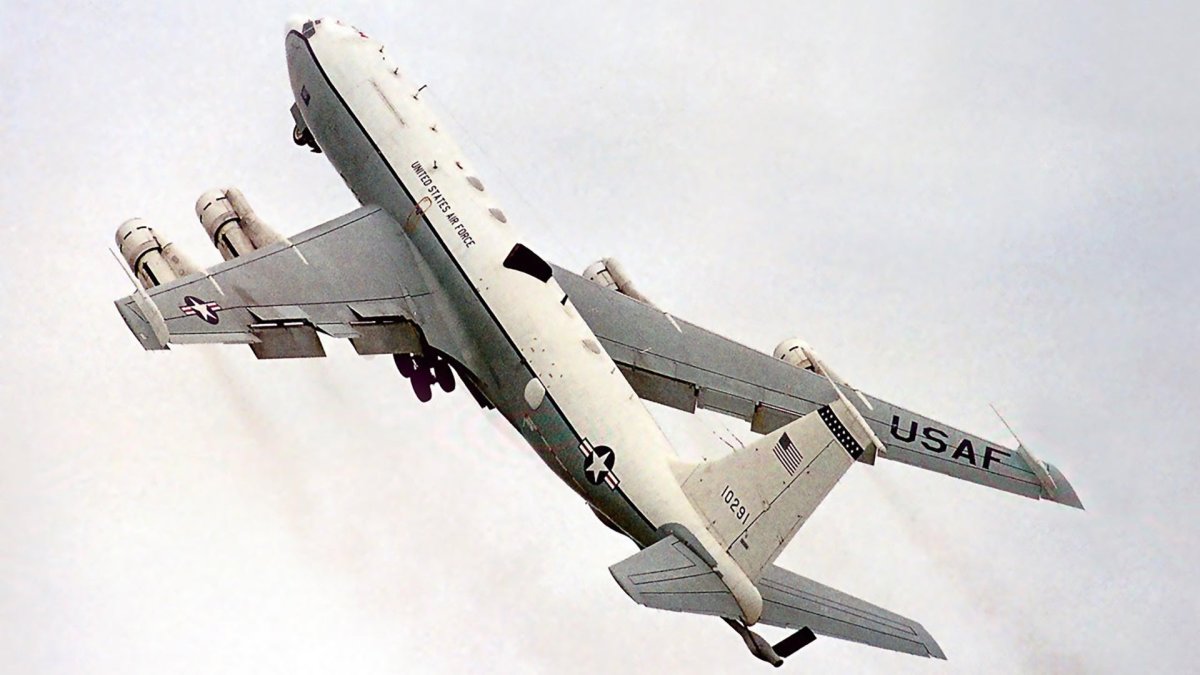
With these thoughts in mind, “Mad Jack” and crew carefully planned their “takeoff to remember.” EC-135H 61-0291, named Anglian Lion, was chosen for the flight. Given that the airplane would carry only a minimal fuel load for the display, it was nearly 100,000 pounds lighter than its maximum takeoff weight, substantially improving its performance. Moreover, the crew planned to delay rotation from the calculated point on the runway to increase the airplane’s speed at takeoff. Tire placard speed—the maximum speed the tires can tolerate on the ground—is 198 KIAS, so the actual rotation point was carefully calculated to be less than this speed and with sufficient runway remaining to ensure becoming airborne safely. The aircraft would rotate to whatever nose-up attitude would allow the airplane to climb to approximately 1,500 ft before leveling off with a safety margin of 3-engine climb speed plus 50 KIAS in case of an engine failure after decision speed.
The actual takeoff went as planned, although the steep angle led to decreased airflow through the engines, causing a noticeable compressor stall on the #4 engine. The crew chief, who was in the boom pod during takeoff, thought the airplane “went vertical!” The 7th Air Division commander, Brigadier General Kenneth L. Hagemann, who was unaware of the carefully planned start of the show, joked “there goes my career.”
In any event, the takeoff certainly impressed the crowd!
“Mad Jack” is center, kneeling; Kyle is center, standing in front of the entry door pressure plate., Andrew Kyle
In today’s far more conservative Air Force, surely there are critics who would say this was unsafe for a big airplane like the EC-135, while citing the Thunderhawks KC-135 crash and the loss of the B-52 at Fairchild. Those are accidents from unrelated causes and are better left for another post. In the case of the Anglian Lion , however, this definitely non-standard takeoff was carefully calculated using official takeoff data and was well within the jet’s operational limits.
Flame it if you will, but as the legendary “Tex” Johnston—who rolled the Boeing 367-80 , twice, might say, “it was a helluva performance!”
Robert S Hopkins, III, is an independent scholar and aviation historian. Previously he was a US Air Force pilot and flew 17 different variants of EC-, KC-, and RC-135s. He has appeared on a variety of aviation programs on the BBC, Smithsonian, Discovery, NRK (Norway), and the History Channel. Hopkins earned a PhD in History from the University of Virginia and has published multiple books on the history of strategic airpower and aerial reconnaissance.
Comments couldn’t be loaded. Please refresh the page.
更新于美国东部时间2020年11月27日下午6:28。
多年来,米尔登霍尔皇家空军航空节一直是英国航展季的亮点之一。它以吸引来自世界各地、不同寻常的飞机而闻名,是宾客和飞行员都“不容错过”的盛会。空军的EC-135H“丝绸钱包”运输机无疑符合参展飞机的独特标准。
驻扎在米尔登霍尔皇家空军基地(RAF Mildenhall)的第10空中指挥控制中队(ACCS)于1970年至1991年间运营五架波音EC-135H“丝绸钱包”(SILK PURSE)空中指挥所,为美国驻欧洲总司令(USCINCEUR,即美国欧洲司令部司令)提供支持。这些指挥所会在危机时刻起飞,为地面指挥中心提供空中支援。其运作方式与太平洋地区的“蓝鹰”(BLUE EAGLE)EC-135J、大西洋地区的“瞄准镜”(SCOPE LIGHT)EC-135P以及美国本土的EC-135C(包括为战略空军司令部服务的著名的“镜子”(LOOKING GLASS))类似。
按照惯例,第10空中加油中队(ACCS 10)的EC-135飞机在航空节上表现得相当低调,通常与驻扎在英国的战斗机编队飞行,展示其空中加油能力。然而,在一次与F-111战斗机的编队飞行表演之后,一张照片被篡改,照片中一架EC-135被伪装成一架秘密的“极光”(Aurora)型飞机,由一位勇敢的石油钻井平台摄影师在北海上空拍摄到,这引发了无尽的猜测。
由于冷战结束带来的“和平红利”,预计第10空中指挥控制中队将于1991年底解散。加之英国和亚速尔群岛拉杰斯机场(EC-135H飞机常驻地面警戒区)潮湿的空气导致“丝绸钱包”(SILK PURSE)机队严重腐蚀,该中队计划在1991年航空节上进行最后一次飞行。此次飞行的机长是“疯子杰克”艾略特少校。他此前曾在内布拉斯加州奥弗特空军基地驾驶过“镜子”(LOOKING GLASS)EC-135C,在南达科他州埃尔斯沃思空军基地驾驶过多种不同的EC-135,并在阿拉斯加州艾尔森空军基地驾驶过“眼镜蛇球”(COBRA BALL)RC-135S。艾略特曾乘坐飞机从阿拉斯加起飞,亲眼目睹了“光穹”(Dome of Light)的奇观。你可以在之前的《战区》专题报道中了解到所有这些神秘现象。
在阿拉斯加驻扎期间,“疯子杰克”(Mad Jack)领导了RC-135战斗战术小组(与作者共同领导),并参与了许多关于配备TF33战术系统的RC-135性能的热烈讨论。其中一项内容是制定在高度威胁环境下RC-135S起飞的计划,因为“眼镜蛇球”(COBRA BALL)并未配备“铆钉联合”(RIVET JOINT)RC-135V/W和“战斗哨兵”(COMBAT SENT)RC-135U机队所配备的“有警报器”(HAVE SIREN)反红外系统。这意味着需要采用激进的起飞和爬升策略,以降低被肩扛式地对空导弹(例如SA-7)攻击的风险。事实上,在艾尔森空军基地(Eielson AFB)几乎没有这种必要,而在“眼镜蛇球”位于阿留申群岛谢米亚空军基地(Shemya AFB)的前沿作战地点,则完全没有必要。
自1988年起,RC-135S部署至冲绳嘉手纳空军基地,并计划调往其他比阿拉斯加更不安全的地点。因此,这些“机库飞行”的讨论远比简单的“假设”演练意义重大,最终达成的共识是,无论机头仰角如何,都应以三发转速加上50节指示空速(KIAS)爬升。
第6战略侦察联队战术臂章。作者收藏
KC-135A 最初投入使用时,其低推力的 J57 发动机即使在注水的情况下,在核战争最大燃油起飞时也难以提供足够的推力(干推力为 11,200 磅,注水后为 12,925 磅)。因此,起飞时的俯仰角仅为 8.5 或 9 度,这使得飞机在加速的同时,容错率极低。换装 TF33 涡扇发动机后,推力提升至 16,050 磅(KC-135R/T 上的 F108 高涵道比涡扇发动机则达到 20,000 磅)。几十年来,战略空军司令部的操作规程非常明确:要么严格按照 8.5 或 9 度的爬升角飞行,要么就坠毁。
1988年11月16日,KC-135R加油机62-3554“切诺基玫瑰”号创造了16项爬升时间纪录,高度接近50,000英尺。其F108发动机推力已完全升级至24,000磅。这架飞机仅用了惊人的5秒便成功起飞,加速至325节指示空速,然后将机头抬升至27度,并保持0.78马赫的速度直至达到预定高度。显然,在合适的条件下,KC-135的爬升能力远不止其略显笨拙的8.5或9度。
KC-135R 62-3554“切诺基玫瑰”号,曾用于创造飞行纪录。——布鲁斯·拉德博
考虑到这些因素,“疯子杰克”和他的机组人员精心策划了这次“令人难忘的起飞”。他们选择了编号为61-0291、名为“安格利亚雄狮”的EC-135H飞机执行此次飞行任务。由于飞机仅携带少量燃油用于表演,其重量比最大起飞重量轻了近10万磅,从而显著提升了性能。此外,机组人员还计划延迟在跑道上预定的起飞点进行抬轮,以提高飞机的起飞速度。轮胎标牌速度——即轮胎在地面上能够承受的最大速度——为198节指示空速(KIAS),因此,实际抬轮点经过仔细计算,确保速度低于此值,并且剩余跑道长度足以保证安全起飞。飞机将抬轮至合适的机头上仰姿态,使其爬升至约1500英尺,然后平飞。在达到决断速度后,飞机将保持三发爬升速度加上50节指示空速的安全裕度,以应对单发失效的情况。
实际起飞按计划进行,但陡峭的起飞角度导致发动机气流减少,造成4号发动机出现明显的压气机失速。起飞时身处吊杆舱内的机组长以为飞机“垂直上升了!”第七航空师师长肯尼斯·L·哈格曼准将对精心策划的起飞过程毫不知情,他开玩笑说:“我的职业生涯完了。”
总之,这次起飞确实给观众留下了深刻的印象!
“疯子杰克”跪在中间;凯尔站在入口门压力板前,也在中间。安德鲁·凯尔
在如今更为保守的空军中,肯定会有批评人士指出,对于像EC-135这样的大型飞机来说,这样的起飞方式并不安全,并会援引雷鹰KC-135的坠毁事故以及B-52在费尔柴尔德空军基地的坠毁事件。但这些事故的原因各不相同,最好留待以后再讨论。然而,就“安格利亚雄狮”号而言,这种非标准的起飞方式是经过仔细计算,并使用了官方起飞数据,完全在飞机的操作限制范围内。
你可以尽情批评,但正如传奇人物“德克萨斯”约翰斯顿(他曾两次驾驶波音367-80翻滚)可能会说的那样,“这是一场精彩绝伦的表演!”
罗伯特·S·霍普金斯三世是一位独立学者和航空史学家。他曾是美国空军飞行员,驾驶过17种不同型号的EC-135、KC-135和RC-135飞机。他曾多次出现在BBC、史密森尼频道、探索频道、挪威广播公司(NRK)和历史频道等多个航空节目中。霍普金斯拥有弗吉尼亚大学历史学博士学位,并出版过多部关于战略空军力量和空中侦察史的著作。
评论加载失败,请刷新页面。