US missile system will remain in Philippines despite China’s alarm尽管中国发出警告,美国导弹系统仍将留在菲律宾。
The U.S. Army transported the Typhon missile system to the northern Philippines as part of combat exercises in April with Philippine troops.
MANILA, Philippines — American and Filipino security officials have agreed to keep a U.S. mid-range missile system in the northern Philippines indefinitely to boost deterrence despite China’s expressions of alarm , two Philippine officials said Wednesday.
The U.S. Army transported the Typhon missile system, a land-based weapon that can fire the Standard Missile-6 and the Tomahawk Land Attack Missile, to the northern Philippines as part of combat exercises in April with Philippine troops and to test its deployability aboard a U.S. Air Force aircraft.
Tomahawk missiles can travel over 1,000 miles, which places China within their target range. Officials are considering keeping the missile system in the northern Philippines up to April next year, when U.S. and Philippine forces are scheduled to hold their annual Balikatan — Tagalog for “shoulder-to-shoulder” — large-scale combat exercises, he said.
The two officials spoke to The Associated Press on condition of anonymity because they were not authorized to discuss the sensitive U.S. missile deployment publicly. There was no immediate comment from U.S. officials.
Chinese diplomats have repeatedly conveyed their alarm to the Philippine government, warning that the deployment of the missile system could destabilize the region.
A Philippine army spokesperson said earlier that the system was scheduled to be removed from the country by the end of this month. Philippine Defense Secretary Gilberto Teodoro Jr. refused to confirm or deny the extension.
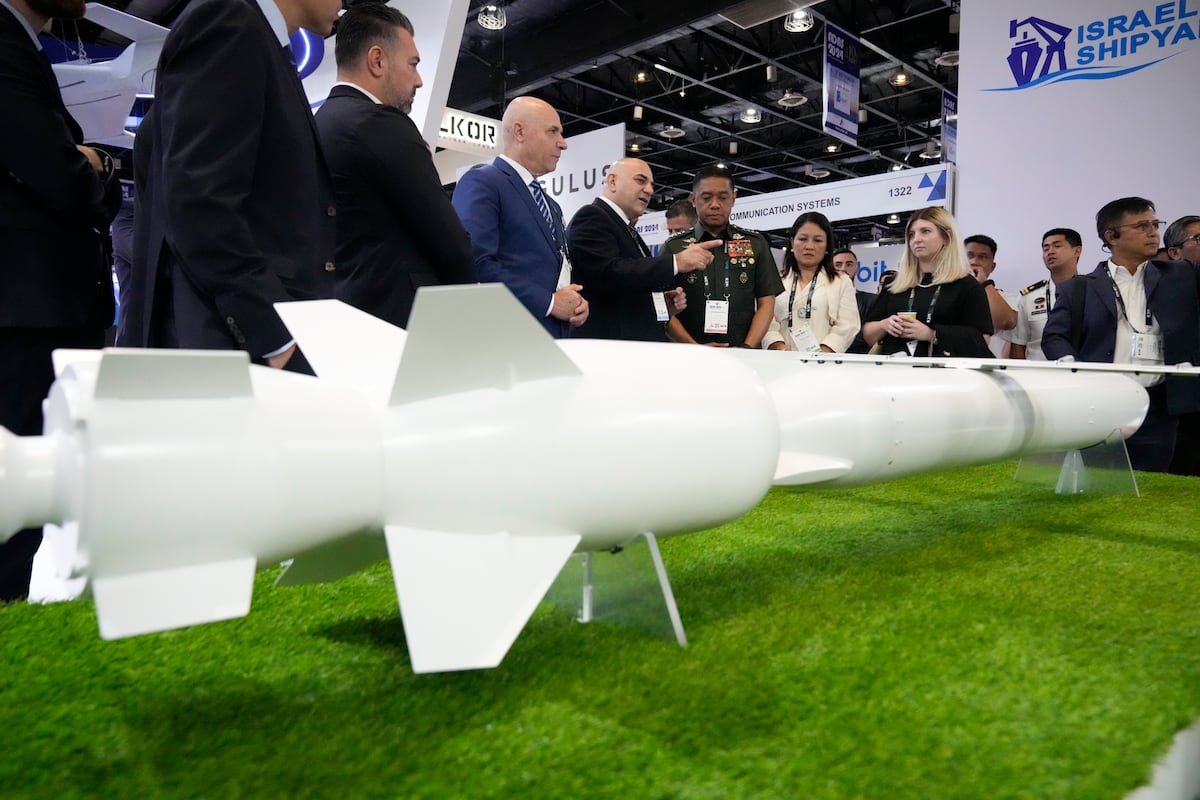
But Teodoro rejected China’s demands as interference in the Philippines’ internal affairs, speaking to reporters Tuesday on the sidelines of an Asian defense industry exhibition in Manila.
“China is saying that they are alarmed but that is interference into our internal affairs. They are using reverse psychology in order to deter us from building up our defensive capabilities,” Teodoro said.
“Before they start talking, why don’t they lead by example? Destroy their nuclear arsenal, remove all their ballistic missile capabilities, get out of the West Philippines Sea and get out of Mischief Reef,” Teodoro said. “I mean, don’t throw stones when you live in a glass house.”
Teodoro used the Philippine name for the disputed South China Sea and for a contested reef off the western Philippines that Chinese forces seized in 1995 and is now one of seven missile-protected island bases China maintains in the disputed waters.
Philippine military chief Gen. Romeo Brawner Jr. said he has asked U.S. military officials to keep the missile system in the Philippines, but declined to say what was their response.
“If I were given the choice, I would like to have the Typhon here in the Philippines forever because we need it for our defense,” Brawner told reporters.
Last month, Philippine Foreign Secretary Enrique Manalo said his Chinese counterpart Wang Yi expressed China’s “very dramatic” concern over the U.S. mid-range missile deployment to the Philippines during their recent talks in Laos on the sidelines of the Association of Southeast Asian Nations meetings with Asian and Western countries.
Manalo said Wang warned the presence of the U.S. missile system could be “destabilizing,” but he said that he disagreed. “They’re not destabilizing” and the missile system was only in the Philippines temporarily, Manalo said he told Wang.
Although the missile system was transported to the Philippines for joint combat exercises in April, it was not fired during the joint drills by the longtime treaty allies, according to Philippine and U.S. military officials.
China has strongly opposed increased U.S. military deployments to the region, including to the Philippines, saying they could endanger regional stability and peace.
The U.S. and the Philippines have repeatedly condemned China’s increasingly assertive actions to fortify its territorial claims in the South China Sea, where hostilities have flared since last year with repeated clashes between Chinese and Philippine coast guard forces and accompanying vessels.
Aside from China and the Philippines, Vietnam, Malaysia, Brunei and Taiwan also have overlapping claims in the busy waterway, a key global and security route which is also believed to be sitting atop vast undersea deposits of gas and oil.
Associated Press journalist Aaron Favila contributed to this report.
菲律宾马尼拉——两名菲律宾官员周三表示,尽管中国对此表示担忧,但美国和菲律宾安全官员已同意无限期地在菲律宾北部保留一套美国中程导弹系统,以加强威慑。
今年 4 月,美国陆军将“台风”导弹系统(一种陆基武器,可发射“标准-6”导弹和“战斧”陆攻导弹)运往菲律宾北部,作为与菲律宾军队进行作战演习的一部分,并测试其在美国空军飞机上的部署能力。
战斧导弹射程超过1000英里,这意味着中国在其射程之内。他表示,官员们正在考虑将导弹系统保留在菲律宾北部,直至明年4月,届时美菲军队将举行一年一度的“肩并肩”(Balikatan)大规模联合军事演习。
这两位官员因未获授权公开讨论美国敏感的导弹部署事宜,故在匿名的情况下接受了美联社的采访。美国官员尚未对此置评。
中国外交官多次向菲律宾政府表达了他们的担忧,警告称导弹系统的部署可能会破坏该地区的稳定。
菲律宾军方发言人此前表示,该系统计划于本月底前从该国撤出。菲律宾国防部长吉尔伯托·特奥多罗拒绝证实或否认延期一事。
但特奥多罗周二在马尼拉举行的亚洲国防工业展览会间隙对记者表示,中国的要求是对菲律宾内政的干涉,他对此予以驳斥。
特奥多罗说:“中国声称他们感到震惊,但这干涉了我们的内政。他们正在使用反向心理战术,以阻止我们增强防御能力。”
“在他们开始空谈之前,为什么不先以身作则呢?销毁他们的核武库,移除所有弹道导弹能力,撤出西菲律宾海,撤出美济礁,”特奥多罗说。“我的意思是,自己住在玻璃房子里,就别扔石头。”
特奥多罗使用了菲律宾语名称来指代有争议的南海以及菲律宾西部附近一个有争议的礁石。中国军队于 1995 年占领了该礁石,现在它是中国在争议水域维护的七个导弹防御岛屿基地之一。
菲律宾军方首脑罗密欧·布劳纳将军表示,他已要求美国军方官员将导弹系统留在菲律宾,但他拒绝透露美方的回应。
“如果让我选择,我希望‘台风’永远留在菲律宾,因为我们需要它来进行防御,”布劳纳告诉记者。
上个月,菲律宾外交部长恩里克·马纳洛表示,在最近于老挝举行的东南亚国家联盟亚洲和西方国家会议期间,中国外长王毅与菲律宾举行会谈,王毅对美国向菲律宾部署中程导弹表示了中国“非常严重”的关切。
马纳洛说,王毅曾警告说,美国导弹系统的存在可能会“破坏稳定”,但他表示不同意。“它们不会破坏稳定”,而且导弹系统只是暂时部署在菲律宾,马纳洛说他这样告诉王毅。
据菲律宾和美国军方官员称,虽然该导弹系统于 4 月运往菲律宾参加联合作战演习,但在长期条约盟友的联合演习中并未发射。
中国强烈反对美国向该地区(包括菲律宾)增派军事力量,称这可能会危及地区稳定与和平。
美国和菲律宾多次谴责中国在南海采取日益强硬的行动来巩固其领土主张。自去年以来,南海局势持续恶化,中国和菲律宾海警部队及随行船只之间屡次发生冲突。
除了中国和菲律宾之外,越南、马来西亚、文莱和台湾也对这条繁忙的水道拥有重叠的主权声索。这条水道是重要的全球安全通道,据信其下方蕴藏着丰富的海底天然气和石油资源。
美联社记者亚伦·法维拉对本报道亦有贡献。