Ukraine’s fire-dropping drones can find, shock Russian troops: experts专家称,乌克兰的投弹无人机能够发现并震慑俄罗斯军队。
The high-temperatures of the blend can damage or destroy caches of equipment and ammunition in a single sortie.
MILAN — The Ukrainian military has begun utilizing first-person-view drones with a thermite spray capability over forested areas where Russian troops and equipment are hiding, a tactic that experts say can be a legitimate weapon of war, but only under strict circumstances.
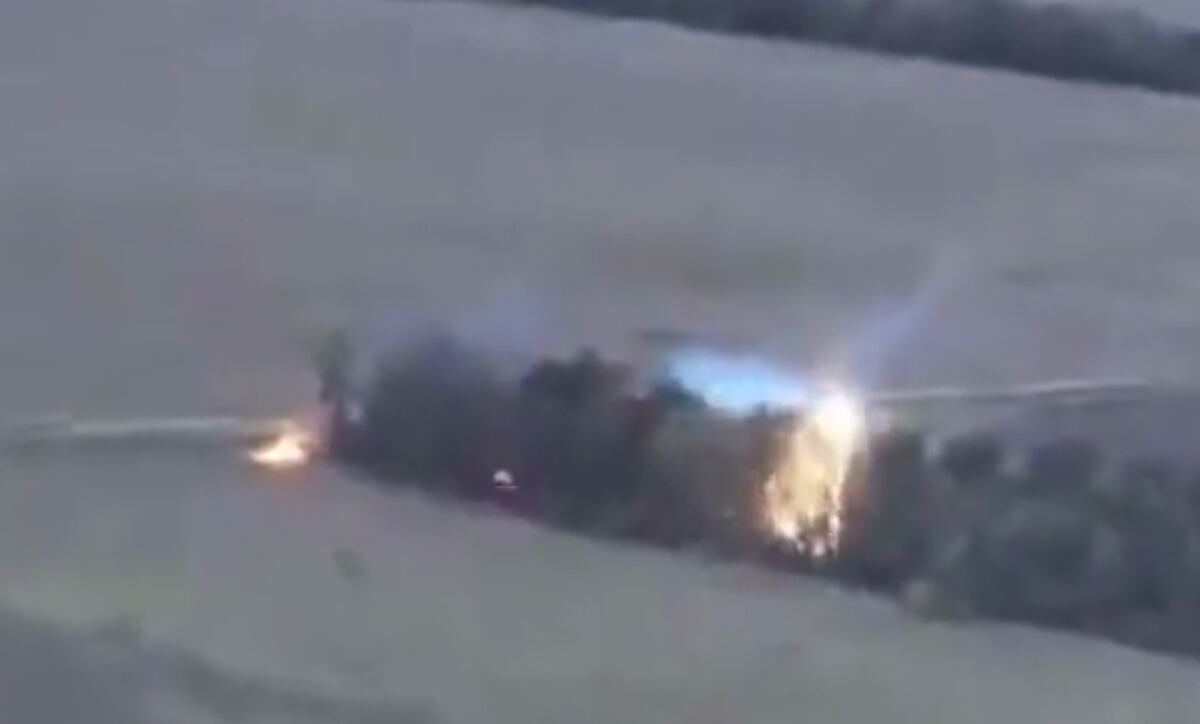
On Sept. 2, footage emerged online showing what appeared to be a Ukrainian low-cost first-person-view drone, or FPV, carrying an incendiary burning mixture that it sprayed along a dense line of trees where Russian troops were suspected.
It was later reported by Ukrainian media outlet Militarnyi that the Ukrainian Mountain Infantry had received thermite munitions – which include a powdered mix of aluminum and iron oxide capable of burning at temperatures exceeding 2,200 degrees Celsius – that were mounted on drones and dropped on Russian positions.
Experts believe that the use of such weapons is two-fold, acting as both a cheap way to expose enemy locations and to cause fear among the invading troops.
“The primary use of these thermite FPV drones is as a defoliant to remove the tree and foliage cover that Russian troops and vehicles are using for concealment in tree lines; and secondarily likely intended as a psychological weapon due to the nature of the effects thermite would produce in contact with skin,” Justin Bronk, senior research fellow at the London-based Royal United Services Institute, said.
In addition, the high-temperatures of the blend can damage or destroy caches of equipment and ammunition in a single sortie, Federico Borsari, resident fellow at the U.S. Center for European Policy Analysis, noted.
“They can be employed for specific purposes for which explosive effects are not ideal, and be useful to burn abandoned vehicles, for instance, saving explosive warheads for missions requiring kinetic effects,” he said.
The two experts said FPVs are suitable drone variants to deliver the burning mixture at slow speed because of their low cost and precise maneuverability.
As incendiary weapons have become more common in the war, analysts have been flagging concerns over harm to civilians. For example, in 2023, Russia reportedly used thermite bombs in eastern Ukraine over residential neighborhoods, according to a video on social media that was picked up by the Youtube channel of The Telegraph newspaper.
Dangers in using thermite include the possibility of causing out-of-control fires that risk burning down civilian infrastructure and non-military targets.
The use of thermite munitions is not banned per say, but neither is it straightforward, experts say.
“It would be legitimate and legal to use them as defoliants to remove cover, and this holds unless they would a) hit civilians or b) there was a significant risk the subsequent fire would endanger civilians – contrast this with Russian use of thermite last year in an indiscriminate manner,” Matthew Savill, director of military science at RUSI, wrote in an email to Defense News.
Under the Geneva Conventions, deliberately targeting civilian areas with incendiary weapons constitutes a war crime, yet Moscow has paid little consideration to adhering to international norms during the course of the war.
Russian forces have used other fire-inducing weapons such as the 9M22S incendiary cluster rocket, used for the 122mm caliber Grad rocket artillery system, Bronk said.
Savill notes that throughout the war, Ukraine has largely been able to contrast its adherence to international conflict laws against Russian behavior, an important appearance he presumes Kyiv will strive to maintain.
“I would expect that however they choose to use thermite, they would want to keep that distinction,” he said.
Elisabeth Gosselin-Malo was a Europe correspondent for Defense News. She covers a wide range of topics related to military procurement and international security, and specializes in reporting on the aviation sector. She is based in Milan, Italy.
米兰——乌克兰军方已开始在俄罗斯军队和装备藏匿的森林地区使用具备铝热剂喷洒能力的第一人称视角无人机,专家表示,这种战术可以成为合法的战争武器,但只能在严格的情况下使用。
9 月 2 日,网上出现了一段视频,显示一架疑似乌克兰低成本第一人称视角无人机(FPV)携带燃烧混合物,并沿着疑似俄罗斯军队所在的茂密树林喷洒。
乌克兰媒体 Militarnyi 后来报道称,乌克兰山地步兵收到了铝热剂弹药——其中包括铝和氧化铁的粉末混合物,能够在超过 2200 摄氏度的温度下燃烧——这些弹药被安装在无人机上,并投放到俄罗斯阵地。
专家认为,使用此类武器有两个目的,既可以廉价地暴露敌方位置,又可以恐吓入侵部队。
“这些铝热剂FPV无人机的主要用途是作为落叶剂,清除俄罗斯军队和车辆在树林中用于掩护的树木和树叶;其次,由于铝热剂与皮肤接触会产生的影响,它们很可能被用作心理武器,”总部位于伦敦的皇家联合军种研究所高级研究员贾斯汀·布朗克说。
此外,美国欧洲政策分析中心常驻研究员费德里科·博尔萨里指出,这种混合物的高温可能会在一次出击中损坏或摧毁大量的装备和弹药。
他说:“它们可以用于一些不适合爆炸效果的特定用途,例如焚烧废弃车辆,从而将爆炸弹头用于需要动能效果的任务。”
两位专家表示,FPV无人机由于成本低、机动性强,是适合以低速输送燃烧混合物的无人机类型。
随着燃烧武器在战争中日益普遍,分析人士纷纷指出其对平民造成的伤害令人担忧。例如,据《每日电讯报》YouTube频道转载的一段社交媒体视频显示,俄罗斯据称于2023年在乌克兰东部居民区使用了铝热剂炸弹。
使用铝热剂的危险包括可能引发失控的火灾,从而烧毁民用基础设施和非军事目标。
专家表示,铝热剂弹药的使用本身并没有被禁止,但也不是一帆风顺的。
“使用它们作为落叶剂清除掩体是合法合理的,除非它们会 a) 击中平民,或者 b) 随后的火灾有重大风险危及平民——这与俄罗斯去年不分青红皂白地使用铝热剂形成了鲜明对比,”皇家联合军种研究所 (RUSI) 军事科学主任马修·萨维尔在给《防务新闻》的电子邮件中写道。
根据日内瓦公约,蓄意使用燃烧武器袭击平民区构成战争罪,但莫斯科在战争期间很少考虑遵守国际准则。
布朗克说,俄罗斯军队还使用过其他引发火灾的武器,例如用于 122 毫米口径“冰雹”火箭炮系统的 9M22S 燃烧集束火箭。
萨维尔指出,在整个战争期间,乌克兰在很大程度上能够将自身对国际冲突法的遵守与俄罗斯的行为进行对比,他认为基辅将努力维持这一重要的形象。
“我预计,无论他们选择如何使用铝热剂,他们都会希望保持这种区别,”他说。
伊丽莎白·戈斯林-马洛曾任《防务新闻》欧洲通讯员。她的报道涵盖军事采购和国际安全等广泛领域,尤其擅长航空领域的报道。她常驻意大利米兰。