Russia’s Jet-Powered Shahed Drones Are Quickly Evolving As Ukraine Scrambles To Blunt Their Damage俄罗斯的喷气式“沙赫德”无人机正在迅速发展,乌克兰正竭力削弱其破坏力。
The Geran-4 one-way attack drone uses speed and altitude to evade low-cost interceptors Ukraine depends heavily upon.
Published Sep 29, 2026 3:50 PM EDT
Over the summer, Russia intensified its use of jet-powered one-way attack drones. Flying faster and higher than the propeller-driven Shahed-136 s (or Geran-2s as Russia calls their copies) that have been terrorizing Ukraine for years, these weapons are far harder to intercept. We predicted this would happen over three years ago when Iran first introduced its jet-powered Shahed-238, which itself was an adaptation of the Shahed-136. Initial variants of Russia’s copy of that drone, called the Geran-3, first appeared over the skies of Ukraine in early 2024 . By mid-2025 they were becoming a real problem . Since then, the latest higher-performance variant of this weapon, the Geran-4, has added great strain to Ukraine’s dwindling air defense resources and is the source of increasing levels of destruction across the country.
The Geran-4 appeared last May, according to the Ukrainian Defense Intelligence Directorate (GUR). Unlike the Geran-3, which largely used a modified Shahed-136 airframe, the new drone has one purpose-built for higher-speed flight because “the structural strength [of the older model] was insufficient for high-speed flights, and even less so for maneuvering under high G-loads,” GUR noted.
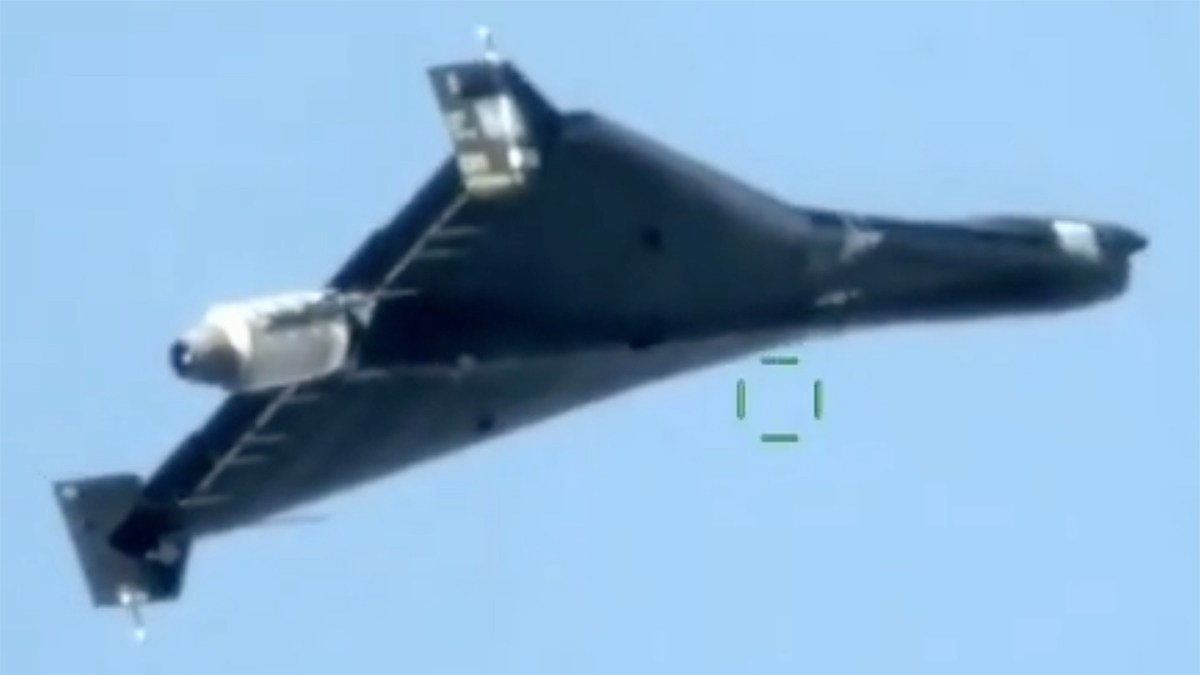
A Geran 4 attempting to be intercepted by a Ukrainian drone. (Via X) (GUR)
The Geran-4’s new airframe features a blended air intake and overall “improved aerodynamic efficiency, a reinforced structure, and a turbojet engine with increased thrust,” GUR stated. “The wings are now permanently integrated into the center wing section. To reduce air resistance, the number of technological hatches on the fuselage has been minimized.”
In an overnight attack across Ukraine that lasted until Monday, “Russia launched 165 drones overnight, 79 of them jet-powered, the Air Force reported . Air defenses downed or suppressed 112, and hits were recorded at 14 locations. You can see the aftermath of one of those attacks in the following video.
We’re under constant attack🚨🚨🚨Unfortunately, just a few minutes ago, a jet-powered Shahed drone hit a residential building 💔. #Odesa Burn in hell, ruzzians🤬 pic.twitter.com/EXTWM1yVIN — Antoninaodesa NAFO (@antoninaodesssa) September 28, 2026
We’re under constant attack🚨🚨🚨Unfortunately, just a few minutes ago, a jet-powered Shahed drone hit a residential building 💔. #Odesa Burn in hell, ruzzians🤬 pic.twitter.com/EXTWM1yVIN
Recently, Radio Free Europe/Radio Liberty (RFE/RL) got its hands on one of these weapons. Its report offers the best view yet of what makes these drones so dangerous.
The Geran-4 is “a new, faster version of the attack drone that is proving harder for Ukrainian air defenses to intercept,” the report states. “We were given a rare opportunity to literally take this surviving drone apart and find out what makes it so much faster, more maneuverable, and more accurate.”
“The first part we uncover is the turbojet engine. It is one of the Geran-4’s most significant upgrades, allowing the drone to fly at altitudes of up to eight kilometers,” the report explained. “That’s twice as high as the older propeller-powered drones. According to specialists, drones equipped with this type of engine have already flown from Russia-occupied Crimea to Lutsk in northwestern Ukraine, a distance of more than 700 kilometers.”
RFE/RL takes apart a Russian Geran-4 drone to uncover what makes the jet-powered unmanned aerial vehicle (UAV) faster, harder to intercept, and capable of operating deep inside Ukraine — from its turbojet engine and advanced camera to foreign-made communications and navigation… pic.twitter.com/WGNdlpS9w1 — Radio Free Europe/Radio Liberty (@RFERL) September 25, 2026
RFE/RL takes apart a Russian Geran-4 drone to uncover what makes the jet-powered unmanned aerial vehicle (UAV) faster, harder to intercept, and capable of operating deep inside Ukraine — from its turbojet engine and advanced camera to foreign-made communications and navigation… pic.twitter.com/WGNdlpS9w1
“This engine allows it to fly at speeds of up to 450 to 500 kilometers per hour over Ukrainian territory. Sometimes even faster,” RFE / RL proffered. “It flies fast and high, which is why it is still difficult to intercept.”
As the camera pans down over the engine, the reporters noted that while it is made in China, “we have investigated cases where these engines were assembled in Russia using Chinese components.”
The next component examined was the drone’s camera.
“It has several modes: daylight, night vision, and infrared,” the report stated. “The camera offers 10-times optical zoom and up to 32-times digital zoom, allowing the drone operator to view terrain from an altitude of eight kilometers.”
“If there is a relay station and it is connected to the network, an operator sitting in an automated workstation somewhere in Bryansk, Oryol, or Crimea can control the drone and guide it to its target,” RFE/RL stated.
“Once the drone is inside Ukraine, regular cellular SIM cards can help keep it connected,” the report continued. “We also found two GSM modems inside this drone. Using SIM cards, they can transmit the Geran-4’s location over mobile networks, allowing the operator to track it in real time.”
Back in 2024, we explained how Shaheds fitted with 4G modems and SIM cards from Ukrainian telecom firms, combined with a camera installed on the drone and the ability to use wireless networks, could be one of a number of avenues that would transform the Shahed into a relatively long-range reconnaissance and strike asset capable of beyond-line-of-sight real-time operations. This could help plug what at the time was a glaring gap in the Russian arsenal, although the stability of its connectivity is still unknown and providing man-in-the-loop guidances in real-time for strikes may be beyond the capabilities of this configuration, at least consistently.
Regardless, most of these drones do not have cameras or modems, they fly to a specific set of coordinates and dive on a target before detonating.
The following images offered a glimpse into that system.
👀 Inside Russian Shahed: power bank and a SIM card of a Ukrainian operator pic.twitter.com/D5LGBMJfIv — MAKS 26 🇺🇦👀 (@Maks_NAFO_FELLA) November 29, 2023
👀 Inside Russian Shahed: power bank and a SIM card of a Ukrainian operator pic.twitter.com/D5LGBMJfIv
Drone specialists who have investigated the remains of these weapons told the outlet that they had found SIM cards “from Ukraine, Russia, Belarus, and even some European Union countries. And the deeper we go inside the drone, the more foreign-made components we find.”
The RFE team also found a Chinese mesh modem the Russians use to help guide the drone.
“It’s responsible, among other things, for radio and video communications. Essentially, this device allows the drone operator to see the video feed from the Geran-4 almost in real time,” RFE/RL stated. “The modem has a range of up to 300 kilometers and can also act as a signal relay. That means several drones flying near each other can relay and strengthen the signal, making it possible to control them over much greater distances.”
The discovery of the Chinese mesh modem illustrates something we reported earlier this year : “For some time now, Russia has been working on a man-in-the-loop (MITL) control capability for the Shahed/Geran, a feature that was confirmed when they started to appear with cameras and cellular modems, something TWZ explored in detail at the time. These developments allow the drone to be connected to an operator. Standard Shaheds fly autonomous routes to pre-planned targets on autopilot with no man-in-the-loop control. They are ‘fire and forget’ weapons. “
“ Meanwhile, the range at which MITL can be achieved has been steadily increased. At first, the drones were adapted to exploit patchy cellular networks to provide additional connectivity when available. More recently, Shaheds have been flying with antennas allowing for direct line-of-sight control close to the front lines. This allows them to hit targets dynamically like an FPV drone, while packing a much heavier punch and being able to loiter for long periods of time. You can read all about this development here . Now, the datalink range is being extended using airborne signal relays , possibly creating a mesh network with multiple line-of-sight links.”
درون”Geran-4“ توقف محرك الـMicro-turbojet قبل الانقضاض على الهدف، وتتَّخذ وضعية الانزلاق البطيء، ربّما لتوفير الوقود او لدقة افضل اثناء البحث بالعدسة البصرية. ايضاً يظهر بوضوح هوائيات الارسال Mesh Antennas اثنان مثبَّتان على الذَّيل، أحدهما موجّه الى الاعلى والاخر الى الاسفل. pic.twitter.com/cQIyHhvbmm — TACTIX ™ (@Tactixtm) September 27, 2026
درون”Geran-4“ توقف محرك الـMicro-turbojet قبل الانقضاض على الهدف، وتتَّخذ وضعية الانزلاق البطيء، ربّما لتوفير الوقود او لدقة افضل اثناء البحث بالعدسة البصرية. ايضاً يظهر بوضوح هوائيات الارسال Mesh Antennas اثنان مثبَّتان على الذَّيل، أحدهما موجّه الى الاعلى والاخر الى الاسفل. pic.twitter.com/cQIyHhvbmm
Finally, the Ukrainian journalists found something else we have long reported on . Like many other Russian weapons, the Geran-4 even contains components made in America.
“Despite international sanctions, a significant portion of its components are still coming from abroad, highlighting gaps in global export control enforcement,” RFE/RL showcased. “We just opened up the drone’s onboard computer, and these circuit boards contain components made by a U.S. company. The markings on this component are partly worn off, but you can still see the manufacturer, Texas Instruments.”
“According to the specialists, what is actually Russian-made here is mainly the drone’s body and its assembly. This particular drone was manufactured and assembled at Alabuga, a major Russian drone production site . According to Ukraine’s military intelligence, Russia is now producing around 3,000 Geran-4 and Geran-5 drones a month at Alabuga and other facilities across Russia.”
Satellite images of the site first emerged in 2023, which you can see below.
Satellite images of the factory producing Iranian kamikaze drones Shahed-136 in Yelabuga, Tatarstan. #russia #Ukraine pic.twitter.com/07HBMwcGCs — Dr. Khaled Alfaiomi (@Alfaiomi) November 15, 2023
Satellite images of the factory producing Iranian kamikaze drones Shahed-136 in Yelabuga, Tatarstan. #russia #Ukraine pic.twitter.com/07HBMwcGCs
As if the Geran-4 drones were not challenging enough for Ukraine, Russian Geran-5 jet-powered drones are equipped with “a DSMAC (Digital Sensor Module for Autonomous Navigation) module for navigation using reference images of the Earth’s surface, similar to the X-101 missile,” the Ukrainian technology monitoring channel Polkovnyk GSh reported on Telegram . DSMAC allows for a weapon to navigate without any external help from global positioning satellites. The Tomahawk also uses this system. You can read all about it and how AI embedded in Shahed models will be the next leap in true autonomy far beyond the front lines, even for hunting and killing targets of opportunity, in our special feature linked here.
In addition, Russia has installed mesh repeaters on these weapons for radio signals so that video of the attacks can be “recorded (and immediately transmitted),” presidential adviser on defense technology Serhii Beskrestnov, known as Flash, said on Telegram .
The Russian military is now capable of acquiring real-time, high-quality BDA of its strikes with Geran-type OWA-UAVs/cruise missiles in downtown Kyiv. In the footage below, we can see the moment of a Russian strike with Geran-5 cruise missile on the "Inkom" business center… pic.twitter.com/mPx4Kf9tmH — Status-6 (@Archer83Able) September 27, 2026
The Russian military is now capable of acquiring real-time, high-quality BDA of its strikes with Geran-type OWA-UAVs/cruise missiles in downtown Kyiv. In the footage below, we can see the moment of a Russian strike with Geran-5 cruise missile on the "Inkom" business center… pic.twitter.com/mPx4Kf9tmH
Though these jet-powered drones are causing major problems for Ukraine, the country is finding a way to combat them.
One way is by using Ukrainian Air Force F-16 Vipers to shoot them down, which you can see in the following video.
The moment a Russian jet-powered "Shahed" drone is shot down by an F-16 fighter jet using its M61 Vulcan cannon. pic.twitter.com/gU72HJTXUa — WarTranslated (@wartranslated) September 23, 2026
The moment a Russian jet-powered "Shahed" drone is shot down by an F-16 fighter jet using its M61 Vulcan cannon. pic.twitter.com/gU72HJTXUa
The Russian jet-powered drones were largely outrunning the drone interceptors Ukraine began using with great success against the piston-driven Shaheds. Those interceptors were not only saving lives, but they were also saving money because they cost a tiny fraction of far more expensive, higher-end munitions like the PAC-3 MSE fired by the Patriot system or the AIM-120 Advanced Medium-Range Air-to-Air Missile variants fired from the National Advanced Surface-to-Air Missile System ( NASAMS ) air defense launchers.
Seeking a more efficient and effective defense, Ukraine adapted by fielding higher-performing interceptor drones that are purpose-built to take on the jet-powered Russian munitions. Still, the engagement window for hitting the Russian drones is small, and these are more expensive to build. However, they will remain far less costly and faster to acquire than surface-to-air missiles.
In his speech earlier this week at the U.N. General Assembly, President Volodymyr Zelensky claimed that “our soldiers have already successfully tested four new jet-powered interceptor drones against Russian jet-powered Shaheds. So we are scaling up production.”
It is unclear exactly which interceptors the Ukrainian president was talking about; however, other types designed to take on Russian jet-powered Gerans have become public. One of them is the Sting S, a variant of the bullet-shaped Sting interceptor drone made by the Ukrainian Wild Hornets drone company.
On Sept. 19, the company posted a video on X claiming that “a crew from the 1020th Anti-Aircraft Missile Regiment took down a Russian Geran-5 using the new STING S. This drone is faster and carries a larger explosive payload than other Geran variants.”
TWZ cannot independently verify these claims.
STING S takes down a Geran-5 jet-powered drone-missile ❗️💥 The crew from the 1020th Anti-Aircraft Missile Regiment took down a Russian Geran-5 using the new STING S. This drone is faster and carries a larger explosive payload than other Geran variants. Big thanks to the… pic.twitter.com/Eg0rQgd1tL — Wild Hornets (@wilendhornets) September 19, 2026
STING S takes down a Geran-5 jet-powered drone-missile ❗️💥 The crew from the 1020th Anti-Aircraft Missile Regiment took down a Russian Geran-5 using the new STING S. This drone is faster and carries a larger explosive payload than other Geran variants. Big thanks to the… pic.twitter.com/Eg0rQgd1tL
When we asked for more details, Wild Hornets told “that the tests are going well. About a dozen enemy ‘Geran-4′ jet-powered strike UAVs have already been shot down, as well as several ‘Geran-5’ models, just in the last few days. We should note that at this stage we are talking about only the first results of combat testing within a few select units.”
The Sting S “is a high-speed quadcopter-type interceptor,” the Wild Hornets spokesperson added. “When choosing this model, we took into account that the solution should be inexpensive, easy to use, and quickly scalable.”
“Furthermore, most of the targets during combat testing have been destroyed using ‘Hornet Vision Ctrl’ remote control technology,” the spokesman stated. Wild Hornets claims the system provides low-latency image transmission, long-range communication, and resistance to electronic warfare.
100 remote interceptions in 100 seconds: Hornet Vision CTRL in action 🔥 Since deployment, Ukraine’s Defense Forces have remotely destroyed 1,000+ enemy targets using the system. All thanks to the skill of crews taking down enemy drones with STING interceptors every day 🫡 pic.twitter.com/9sUthdjsvF — Wild Hornets (@wilendhornets) September 3, 2026
100 remote interceptions in 100 seconds: Hornet Vision CTRL in action 🔥 Since deployment, Ukraine’s Defense Forces have remotely destroyed 1,000+ enemy targets using the system. All thanks to the skill of crews taking down enemy drones with STING interceptors every day 🫡 pic.twitter.com/9sUthdjsvF
“We expect this will allow us to rapidly scale up the deployment of the new interceptor once mass production begins,” the spokesperson noted.
As we have frequently noted , Russia and Ukraine continuously create new weapons and ways to defeat them. The jet-powered Russian drones, and Ukraine’s newest interceptors designed to destroy them, are the latest examples of a seemingly endless weapons evolution cycle in this war.
Contact the author: howard@twz.com
Comments couldn’t be loaded. Please refresh the page.
发布于美国东部时间2026年9月29日下午3:50
今年夏天,俄罗斯加大了喷气式单向攻击无人机的使用力度。这些无人机的飞行速度和高度都超过了多年来一直肆虐乌克兰的螺旋桨式“沙赫德-136”(俄罗斯称之为“格兰-2”)无人机,因此更难拦截。早在三年前伊朗首次推出喷气式“沙赫德-238”(该机本身就是“沙赫德-136”的改进型)时,我们就预测到了这种情况。俄罗斯仿制的“沙赫德-238”无人机的早期型号“格兰-3”于2024年初首次出现在乌克兰上空。到2025年中期,它们已经成为一个棘手的问题。此后,该武器的最新高性能改进型“格兰-4”给乌克兰日益减少的防空资源带来了巨大压力,并造成了该国范围内日益严重的破坏。
据乌克兰国防情报局(GUR)称,Geran-4无人机于去年5月亮相。与主要采用改进型Shahed-136机身的Geran-3不同,新型无人机采用了专为高速飞行而设计的机身,因为“(老款机型的)结构强度不足以支撑高速飞行,更无法承受高过载机动,”GUR指出。
一架Geran 4型无人机试图被乌克兰无人机拦截。(图片来自X)(GUR)
格朗-4型飞机的新型机身采用了融合式进气道,整体“空气动力效率更高,机身结构更加坚固,并配备了推力更大的涡轮喷气发动机”,格朗-4公司表示。“机翼现在永久集成到中央翼段中。为了降低空气阻力,机身上的技术舱门数量已降至最低。”
据美国空军报告,俄罗斯在乌克兰发动了持续到周一的夜间袭击,共出动165架无人机,其中79架为喷气式无人机。防空系统击落或压制了112架无人机,并在14个地点造成损失。您可以在以下视频中看到其中一次袭击的后果。
我们正遭受持续不断的攻击🚨🚨🚨不幸的是,就在几分钟前,一架喷气式动力沙赫德无人机撞上了一栋居民楼💔。#敖德萨 下地狱吧,鲁扎人🤬 pic.twitter.com/EXTWM1yVIN — Antoninaodesa NAFO (@antoninaodesssa) September 28, 2026
我们正遭受持续不断的攻击🚨🚨🚨不幸的是,就在几分钟前,一架喷气式动力沙赫德无人机撞上了一栋居民楼💔。#敖德萨 下地狱吧,鲁扎人🤬 pic.twitter.com/EXTWM1yVIN
近日,自由欧洲电台/自由电台(RFE/RL)获得了一架此类武器。其报道对这类无人机的危险性提供了迄今为止最全面的解读。
报告指出,Geran-4是“一种新型的、速度更快的攻击无人机,乌克兰防空系统更难拦截它”。“我们有幸获得了一次难得的机会,可以对这架幸存的无人机进行彻底拆解,以探究它速度更快、机动性更强、精度更高的原因。”
报告解释说:“我们发现的第一部分是涡轮喷气发动机。这是Geran-4无人机最重要的升级之一,使无人机能够飞行至高达8公里的高度。这比老式螺旋桨动力无人机的飞行高度高出两倍。据专家称,配备这种发动机的无人机已经从俄罗斯占领的克里米亚飞往乌克兰西北部的卢茨克,距离超过700公里。”
自由欧洲电台/自由电台拆解了一架俄罗斯“格朗-4”无人机,揭示了这款喷气式无人机为何速度更快、更难拦截,并能在乌克兰境内纵深作战——从其涡轮喷气发动机和先进摄像头到外国制造的通信和导航系统…… pic.twitter.com/WGNdlpS9w1 — 自由欧洲电台/自由电台 (@RFERL) 2026年9月25日
自由欧洲电台/自由电台拆解了一架俄罗斯“格朗-4”无人机,揭示了这款喷气式无人机为何速度更快、更难拦截,并能在乌克兰境内纵深作战——从其涡轮喷气发动机和先进摄像头到外国制造的通信和导航系统…… pic.twitter.com/WGNdlpS9w1
“这种发动机使它能够在乌克兰领空以高达每小时450至500公里的速度飞行,有时甚至更快,”自由欧洲电台/自由电台报道说。“它飞行速度快、高度高,因此仍然难以拦截。”
当镜头向下扫过发动机时,记者们指出,虽然它是中国制造的,“但我们调查过一些案例,这些发动机是在俄罗斯使用中国零部件组装的。”
接下来检查的部件是无人机的摄像头。
报告指出:“它有多种模式:日光模式、夜视模式和红外模式。该摄像头提供10倍光学变焦和高达32倍的数字变焦,使无人机操作员能够从8公里高空观察地形。”
“如果有一个中继站并且它连接到网络,那么坐在布良斯克、奥廖尔或克里米亚某个地方的自动化工作站中的操作员就可以控制无人机并引导它到达目标,”自由欧洲电台/自由电台表示。
报告继续指出:“一旦无人机进入乌克兰境内,普通的手机SIM卡就能帮助它保持网络连接。我们还在这架无人机内部发现了两个GSM调制解调器。它们可以利用SIM卡,通过移动网络传输Geran-4的位置信息,使操作员能够实时追踪它。”
早在2024年,我们就曾解释过,为“沙赫德”(Shahed)无人机配备乌克兰电信公司的4G调制解调器和SIM卡,并加装摄像头和无线网络,可能是将其改造为相对远程侦察和打击工具的多种途径之一,使其能够进行超视距实时作战。这或许有助于弥补当时俄罗斯武器库中一个明显的短板,尽管其网络连接的稳定性尚不明确,而且这种配置可能难以持续地为打击行动提供实时的人机回路引导。
尽管如此,这些无人机大多没有摄像头或调制解调器,它们会飞到一组特定的坐标,然后俯冲攻击目标并引爆。
以下图片展示了该系统的内部结构。
👀 俄罗斯 Shahed 内部:移动电源和乌克兰运营商的 SIM 卡 pic.twitter.com/D5LGBMJfIv — MAKS 26 🇺🇦👀 (@Maks_NAFO_FELLA) 2023年11月29日
👀 俄罗斯 Shahed 手机内部:移动电源和一张乌克兰运营商的 SIM 卡 pic.twitter.com/D5LGBMJfIv
调查过这些武器残骸的无人机专家告诉媒体,他们发现了来自乌克兰、俄罗斯、白俄罗斯,甚至一些欧盟国家的SIM卡。“我们越深入无人机内部,发现的外国制造的部件就越多。”
自由欧洲电台团队还发现了俄罗斯人用来帮助引导无人机的中国产网状调制解调器。
“它负责无线电和视频通信等功能。基本上,这台设备可以让无人机操作员几乎实时地看到来自Geran-4的视频画面,”自由欧洲电台/自由电台(RFE/RL)表示。“该调制解调器的有效范围可达300公里,还可以作为信号中继。这意味着多架无人机在附近飞行时可以中继并增强信号,从而实现更远距离的控制。”
中国网状调制解调器的发现印证了我们今年早些时候报道的内容:“一段时间以来,俄罗斯一直在为‘沙赫德’/‘格朗’无人机研发人机联动(MITL)控制能力。当这些无人机开始配备摄像头和蜂窝调制解调器时,这一功能得到了证实,TWZ当时对此进行了详细报道。这些发展使得无人机能够与操作员连接。标准的‘沙赫德’无人机依靠自动驾驶仪自主飞行,飞往预先设定的目标,无需人机联动控制。它们是‘发射后不管’的武器。”
与此同时,多目标信息传输(MITL)的有效范围也在稳步提升。最初,无人机经过改造,能够利用信号覆盖不均的蜂窝网络,在可用时提供额外的连接。最近,沙赫德无人机配备了天线,可以在前线附近进行直接视距控制。这使得它们能够像第一人称视角(FPV)无人机一样动态打击目标,同时拥有更强大的火力,并能长时间盘旋。您可以在这里阅读有关此项发展的全部内容。现在,数据链路的有效范围正在通过机载信号中继进行扩展,有可能构建一个包含多个视距链路的网状网络。
”Geran-4“ 微型涡轮喷气发动机”网状天线 网状天线 网状天线 网状天线 网状天线 网状天线亲爱的,亲爱的。 pic.twitter.com/cQIyHhvbmm — TACTIX ™ (@Tactixtm) 2026 年 9 月 27 日
”Geran-4“ 微型涡轮喷气发动机”网状天线 网状天线 网状天线 网状天线 网状天线 网状天线亲爱的,亲爱的。 pic.twitter.com/cQIyHhvbmm
最后,乌克兰记者还发现了我们长期报道过的另一件事。和许多其他俄罗斯武器一样,“格朗-4”导弹甚至包含美国制造的零部件。
“尽管受到国际制裁,这架无人机的很大一部分零部件仍然来自国外,凸显了全球出口管制执法方面的漏洞,”自由欧洲电台/自由电台报道称。“我们刚刚拆开了无人机的机载电脑,这些电路板上的零部件是由一家美国公司生产的。虽然零部件上的标记部分磨损,但仍然可以看到制造商——德州仪器。”
据专家称,这架无人机的机身和组装部分主要是俄罗斯制造的。这架无人机是在俄罗斯主要的无人机生产基地阿拉布加制造和组装的。据乌克兰军事情报部门称,俄罗斯目前在阿拉布加和俄罗斯境内的其他工厂每月生产约3000架“格朗-4”和“格朗-5”无人机。
该地点的卫星图像最早于 2023 年出现,您可以在下方看到。
位于鞑靼斯坦叶拉布加的生产伊朗神风特攻队无人机 Shahed-136 的工厂的卫星图像。 # Russia #Ukraine pic.twitter.com/07HBMwcGCs — Khaled Alfaiomi 博士 (@Alfaiomi) 2023 年 11 月 15 日
位于鞑靼斯坦叶拉布加的生产伊朗神风特攻队无人机 Shahed-136 的工厂的卫星图像。 #俄罗斯#乌克兰 pic.twitter.com/07HBMwcGCs
据乌克兰科技监测频道Polkovnyk GSh在Telegram上报道,俄罗斯的Geran-4无人机已经给乌克兰带来了不小的挑战,而Geran-5喷气式无人机则配备了“DSMAC(数字传感器模块,用于自主导航)模块,该模块利用地球表面参考图像进行导航,类似于X-101导弹”。DSMAC使武器无需全球定位卫星的外部辅助即可自主导航。战斧导弹也使用了该系统。您可以在我们这篇专题报道中了解更多详情,以及嵌入Shahed无人机的AI技术将如何实现真正的自主飞行,其应用范围将远远超出前线,甚至可以用于猎杀临时目标。点击此处链接即可阅读我们的专题报道。
此外,俄罗斯还在这些武器上安装了用于无线电信号的网状中继器,以便“记录(并立即传输)袭击的视频”,俄罗斯总统国防技术顾问谢尔盖·别斯克列斯特诺夫(网名“闪电”)在 Telegram 上表示。
俄罗斯军方现在能够实时获取其在基辅市中心使用“格朗”系列无人作战无人机/巡航导弹进行打击的高质量弹道数据分析(BDA)。以下视频展示了俄罗斯使用“格朗-5”巡航导弹打击“因科姆”商业中心的瞬间…… pic.twitter.com/mPx4Kf9tmH — Status-6 (@Archer83Able) September 27, 2026
俄罗斯军方现在能够实时获取其在基辅市中心使用“格朗”型无人作战无人机/巡航导弹进行打击的高质量弹道数据。以下视频展示了俄罗斯使用“格朗-5”巡航导弹打击“因科姆”商业中心的瞬间…… pic.twitter.com/mPx4Kf9tmH
虽然这些喷气式无人机给乌克兰造成了重大问题,但该国正在寻找应对之策。
一种方法是使用乌克兰空军的 F-16 蝰蛇战斗机将它们击落,您可以在下面的视频中看到。
一架俄罗斯喷气式“沙赫德”无人机被F-16战斗机用其M61火神炮击落的瞬间。 pic.twitter.com/gU72HJTXUa — WarTranslated (@wartranslated) September 23, 2026
俄罗斯喷气式“沙赫德”无人机被F-16战斗机用M61火神炮击落的瞬间。 pic.twitter.com/gU72HJTXUa
俄罗斯的喷气式无人机在很大程度上领先于乌克兰开始使用的无人机拦截器,而乌克兰此前已成功地用这些拦截器对付活塞式“沙赫德”无人机。这些拦截器不仅挽救了生命,还节省了资金,因为它们的成本仅为价格昂贵得多的高端弹药的一小部分,例如“爱国者”系统发射的PAC-3 MSE导弹或国家先进地对空导弹系统(NASAMS)防空发射器发射的AIM-120先进中程空对空导弹。
为了寻求更高效的防御手段,乌克兰部署了性能更优异的拦截无人机,这些无人机专为对抗俄罗斯喷气式导弹而设计。尽管如此,拦截俄罗斯无人机的窗口期仍然很短,而且制造成本更高。但是,与地对空导弹相比,它们的采购成本和速度仍然要低得多。
本周早些时候,泽连斯基总统在联合国大会上发表讲话称,“我们的士兵已经成功测试了四架新型喷气式拦截无人机,对抗俄罗斯的喷气式‘沙赫德’无人机。因此,我们正在扩大生产规模。”
目前尚不清楚乌克兰总统具体指的是哪种拦截机;不过,其他一些旨在对抗俄罗斯喷气式“格朗”无人机的型号已经公开。其中之一是“毒刺S”,它是乌克兰“野黄蜂”无人机公司生产的子弹形“毒刺”拦截无人机的改进型。
9 月 19 日,该公司在 X 上发布了一段视频,声称“第 1020 防空导弹团的一个小组使用新型 STING S 击落了一架俄罗斯 Geran-5 无人机。这款无人机比其他 Geran 型号速度更快,携带的爆炸载荷更大。”
TWZ无法独立核实这些说法。
STING S 击落一枚 Geran-5 喷气式无人导弹!💥 第1020防空导弹团的机组人员使用新型 STING S 无人机击落了一枚俄罗斯 Geran-5 导弹。这款无人机比其他 Geran 系列导弹速度更快,携带的爆炸载荷也更大。非常感谢…… pic.twitter.com/Eg0rQgd1tL — Wild Hornets (@wilendhornets) September 19, 2026
STING S 击落一枚 Geran-5 喷气式无人导弹!💥 第1020防空导弹团的机组人员使用新型 STING S 无人机击落了一枚俄罗斯 Geran-5 导弹。这款无人机比其他 Geran 系列导弹速度更快,携带的爆炸载荷也更大。非常感谢…… pic.twitter.com/Eg0rQgd1tL
当我们询问更多细节时,“野黄蜂”表示:“测试进展顺利。仅在过去几天,就已经击落了大约十几架敌方‘格朗-4’喷气式攻击无人机和几架‘格朗-5’型无人机。需要指出的是,目前我们谈论的只是少数精选部队进行的初步实战测试结果。”
“Sting S是一款高速四旋翼拦截器,”野黄蜂队发言人补充道。“在选择这款机型时,我们考虑到了解决方案应该价格低廉、易于使用且能够快速扩展。”
发言人表示:“此外,在实战测试中,大部分目标都是使用‘大黄蜂视觉控制’远程控制技术摧毁的。”野黄蜂公司声称,该系统可提供低延迟图像传输、远程通信以及抗电子战能力。
100 秒内完成 100 次远程拦截:Hornet Vision CTRL 系统实战演示 🔥 自部署以来,乌克兰国防军已使用该系统远程摧毁了 1000 多个敌方目标。这都要归功于每天驾驶 STING 拦截器击落敌方无人机的机组人员的精湛技艺 🫡 pic.twitter.com/9sUthdjsvF — Wild Hornets (@wilendhornets) September 3, 2026
100秒内完成100次远程拦截:Hornet Vision CTRL系统实战演示🔥 自部署以来,乌克兰国防军已利用该系统远程摧毁了1000多个敌方目标。这都要归功于每天驾驶STING拦截器击落敌方无人机的机组人员的精湛技艺🫡 pic.twitter.com/9sUthdjsvF
发言人指出:“我们预计,一旦开始大规模生产,这将使我们能够迅速扩大新型拦截器的部署规模。”
正如我们多次指出的,俄罗斯和乌克兰不断研发新型武器及其应对手段。俄罗斯的喷气式无人机和乌克兰最新研发的用于摧毁它们的拦截器,正是这场战争中武器不断演进的最新例证。
联系作者:howard@twz.com
评论加载失败,请刷新页面。