Smart pendant that can alert visually impaired commuters when bus arrives under development一种能够提醒视障乘客公交车到站的智能吊坠正在研发中。
A wearable pendant and app help visually impaired commuters identify and board buses independently using real-time audio alerts and computer vision technology. Read more at straitstimes.com.
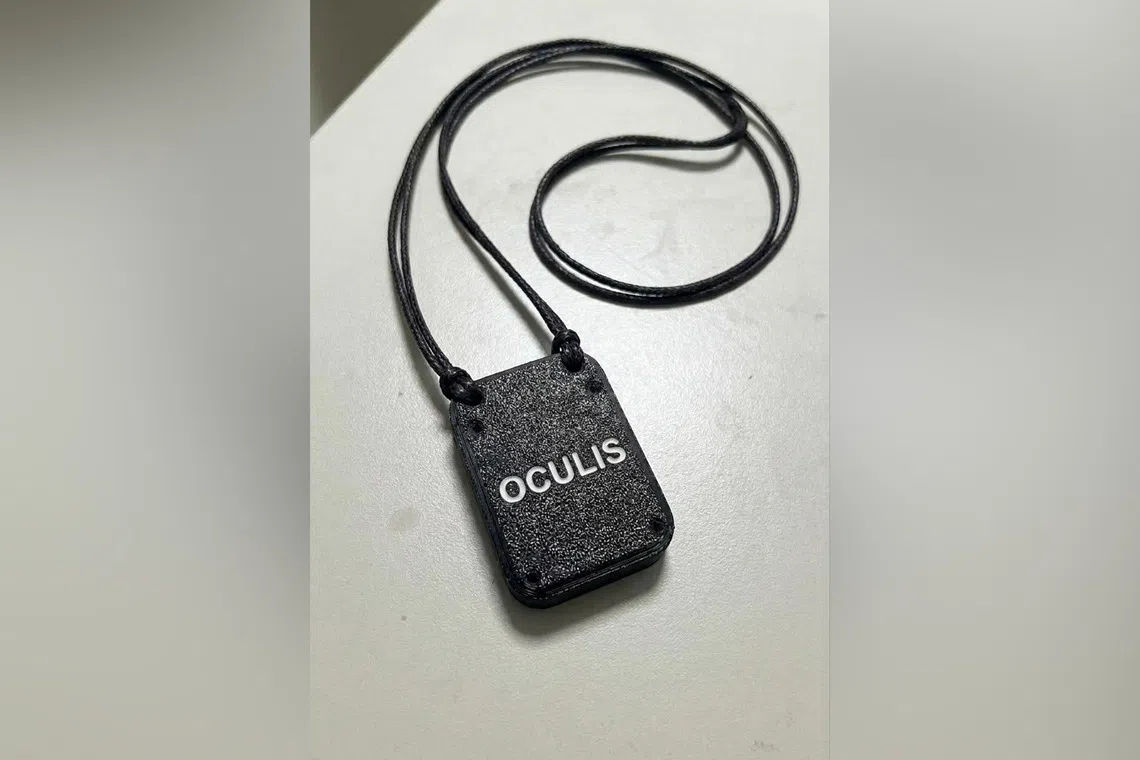
The wearable pendant will come with specialised cameras and sensors that will help visually impaired users better navigate the bus system.
Published Sep 05, 2026, 07:00 AM
Updated Sep 05, 2026, 07:00 AM
A team from NTU is developing a smart pendant to help visually impaired commuters identify and get audio alerts for arriving buses, improving on their existing Oculis iPhone app.
The pendant will use cameras and sensors for hands-free navigation.
The device aims to enhance travel independence but an expert stresses it should complement, not replace, accessible public transport infrastructure and services.
SINGAPORE – Visually impaired commuters could soon be able to use a necklace pendant that can identify and read out bus numbers could make it easier for them to travel by bus.
National Technological University (NTU) u ndergraduate Lee Kiah Hong , 22 , and three of his friends are working on a prototype model of the pendant that will build on an iPhone application called Oculis that they developed.
The iPhone app uses computer vision to identify the bus number, then a voice reads it out loud, which comes in especially handy for visually impaired commuters who are travelling alone.
Lee and his friends – full-time national servicemen Ryan Yeo , 21 , Sriram Jeyakumar , 21 , and Chia Wee Leong , 22 – decided to improve on the iPhone app and create a pendant that can be worn on a necklace.
It will come with specialised cameras and sensors that will help visually impaired users better navigate the bus system.
The team met while studying applied artificial intelligence and analytics at Singapore Polytechnic.
They started developing the iPhone Oculis app in July 2025 as part of an accelerator scheme for the Build for Good initiative under Open Government Products – an independent unit of the Government Technology Agency or GovTech.
They received $ 20,000 in funds and mentoring sessions and successfully carried out tests with members of the visually impaired community, while tracking data and gathering feedback.
The Oculis tech tool taps into real-time bus arrival timings provided by the Land Transport Authority (LTA). When the bus they are waiting for is one minute away, the app gives users an alert.
An audio alert provides instructions and phone vibrations – called haptics – guide users on how best to position the phone in the right direction towards the bus.
When their bus arrives, users will get a voice confirmation.
Lee said the team got feedback from more than 40 visually impaired users over more than 200 navigation trips, and found that many of them preferred a hands-free option because they needed one hand to hold a cane.
The iPhone app uses computer vision to identify the bus number, then a voice reads it out loud, which comes in especially handy for visually impaired commuters who are travelling alone. ST PHOTO: GIN TAY
Several of them preferred to keep one free hand, in case they took a tumble and needed to cushion their fall with a free hand, he added.
Also, the iPhone rolling shutter camera could not detect and identify bus numbers on the screen displays of older buses quickly and accurately, and ended up showing a “pulsing” image on-screen.
Lee and his team are now in the research and development stage for the wearable pendant, and are still in the midst of making sure it is safe to use as well as user-friendly before running tests with visually impaired users.
Lee said the team is open to experimenting with how the new device looks, and are developing prototypes in both the form of spectacles and necklaces.
The team is also mulling over how the audio announcement will be delivered if the device is the pendant, with options such as a loudspeaker or bluetooth connection to earpieces under consideration.
Lee said each wearable device is estimated to cost between $30 and $40 if the team manages to buy materials in bulk, and is able to secure a mass production deal.
Lee got the idea for the Oculis app when his uncle lost much of his vision after developing glaucoma in 2021. The uncle felt he needed to reply on others when taking the bus alone, especially when he was at the bus stop and wanted to know if his bus had arrived.
Even going to a nearby market caused him anxiety.
University student Lee Kiah Hong showing the app he and his friends designed for visually impaired people to identify bus services. ST PHOTO: GIN TAY
University student Lee Kiah Hong showing the app he and his friends designed for visually impaired people to identify bus services.
Lee said he hoped the app can help his uncle, who is in his mid-forties, feel more confident when travelling on his own, especially during peak hours when other passengers are in a rush and help is hard to come by.
The team, he added, is working on the project while juggling other commitments, so no firm timeline has been set to produce the devices.
This will be among the first such accessibility-focused tech devices in the transportation field in Singapore, if they go into production.
Assistant Professor Victor Zhuang, who teaches disability communication at NTU , said it is exciting how artificial intelligence, computer vision and wearable technologies are increasing able to translate previously inaccessible information into modes like speech or vibration.
However, it is important that accessibility does not become the responsibility of physically disabled commuter, who will be required to buy, charge, wear and maintain a special device just to use public transport, he added.
He said: “Apps and wearables should complement accessible infrastructure, information systems, announcements, wayfinding, and trained staff rather than replace them.”
Zhuang added that it is important to get people with disabilities involved not only as testers or users, but also in deciding which problems can be solved by technology, and how these solutions are designed.
A navigation app called Waymap-SG that uses audio step-by-step audio instructions to guide users through transport locations is now available for use at 17 bus interchanges and MRT stations.
Users can be prompted to take photos of their surroundings, and a visual positioning system will determine their starting location.
The app will then guide them along accessible routes, for example, by avoiding stairs if needed, with clear prompts at key points, such as turns, escalators, lifts and exits.
Esther Loi is a journalist at The Straits Times, where she covers transport issues.
这款可穿戴吊坠将配备专用摄像头和传感器,以帮助视障用户更好地乘坐公交系统。
发布于 2026 年 9 月 5 日上午 7:00
更新于2026年9月5日上午7:00
南洋理工大学的一个团队正在开发一款智能吊坠,以帮助视障通勤者识别公交车并接收到站的语音警报,从而改进他们现有的 Oculis iPhone 应用。
该吊坠将利用摄像头和传感器实现免提导航。
该设备旨在增强出行独立性,但一位专家强调,它应该作为公共交通基础设施和服务的补充,而不是取代它们。
新加坡——视力障碍的通勤者很快就能使用一种可以识别和读出公交车号码的项链吊坠,这将使他们乘坐公交车出行更加方便。
22岁的新加坡国立科技大学(NTU)本科生李嘉鸿和他的三个朋友正在开发一款吊坠原型模型,该吊坠将基于他们开发的名为Oculis的iPhone应用程序。
这款 iPhone 应用利用计算机视觉技术识别公交车号码,然后通过语音朗读出来,这对于独自出行的视障通勤者来说尤其方便。
李和他的朋友们——21岁的全职国民服役人员杨瑞安、21岁的斯里拉姆·杰亚库玛尔和22岁的谢伟良——决定改进iPhone应用程序,并创建一个可以佩戴在项链上的吊坠。
它将配备专用摄像头和传感器,以帮助视障用户更好地乘坐公交系统。
该团队在新加坡理工学院学习应用人工智能和分析时相识。
他们于 2025 年 7 月开始开发 iPhone Oculis 应用,这是“建设美好未来”倡议加速器计划的一部分,该计划隶属于开放政府产品部(政府技术局或 GovTech 的一个独立部门)。
他们获得了 2 万美元的资金和指导课程,并成功地对视障人士进行了测试,同时跟踪数据并收集反馈。
Oculis 的这款技术工具利用陆路交通管理局 (LTA) 提供的实时巴士到站时间信息。当用户等待的巴士还有一分钟到达时,该应用程序会发出提醒。
语音提示会提供指导,手机振动(称为触觉反馈)会引导用户如何将手机正确对准公交车。
当公交车到达时,乘客会收到语音确认。
李表示,该团队在 200 多次导航过程中,从 40 多名视障用户那里获得了反馈,发现他们中的许多人更喜欢免提选项,因为他们需要一只手来握住拐杖。
这款iPhone应用程序利用计算机视觉技术识别公交车号码,然后通过语音朗读出来,这对于独自出行的视障人士来说尤其方便。(海峡时报照片:金泰)
他还补充说,他们中的一些人喜欢空出一只手,以防摔倒时需要用空着的手缓冲冲击。
此外,iPhone 的卷帘快门相机无法快速准确地检测和识别老式公交车屏幕显示屏上的公交车号,最终在屏幕上显示“闪烁”的图像。
李和他的团队目前正处于可穿戴吊坠的研发阶段,他们仍在努力确保吊坠使用安全且易于使用,然后再对视障用户进行测试。
李表示,团队对新设备的外观持开放态度,正在开发眼镜和项链两种形式的原型。
团队还在考虑,如果设备是吊坠,音频通知将如何发出,目前正在考虑使用扬声器或通过蓝牙连接到耳机等方案。
李表示,如果团队能够批量购买材料并达成大规模生产协议,预计每个可穿戴设备的成本在 30 美元到 40 美元之间。
李的叔叔在 2021 年患上青光眼后视力严重下降,这激发了他开发 Oculis 应用的想法。叔叔觉得独自乘公交车时需要依靠别人,尤其是在公交车站等车时,想知道公交车是否已经到站。
就连去附近的集市都会让他感到焦虑。
大学生李嘉鸿展示他和朋友为视障人士设计的应用程序,该程序用于识别公交线路。(海峡时报摄影:金泰)
大学生李嘉鸿展示了他和朋友们为视障人士设计的应用程序,该程序用于识别公交服务。
李先生表示,他希望这款应用程序能够帮助他四十多岁的叔叔在独自旅行时更有信心,尤其是在高峰时段,其他乘客都很着急,很难获得帮助。
他补充说,团队在忙于其他事务的同时还在进行这个项目,因此还没有确定设备的确切生产时间表。
如果投入生产,这将是新加坡交通领域首批此类以无障碍出行为重点的技术设备之一。
在南洋理工大学教授残疾人沟通的助理教授庄维克多表示,人工智能、计算机视觉和可穿戴技术越来越能够将以前无法获取的信息转化为语音或振动等模式,这令人兴奋。
但他补充说,重要的是,无障碍设施不应成为身体残疾的通勤者的责任,他们将被要求购买、充电、佩戴和维护特殊设备才能使用公共交通工具。
他说:“应用程序和可穿戴设备应该作为无障碍基础设施、信息系统、公告、寻路和训练有素的工作人员的补充,而不是取代它们。”
庄补充说,让残疾人参与其中非常重要,不仅要让他们担任测试员或用户,还要让他们参与决定哪些问题可以通过技术解决,以及如何设计这些解决方案。
一款名为 Waymap-SG 的导航应用程序现已在 17 个巴士转换站和地铁站投入使用,该应用程序使用语音分步指导用户前往交通地点。
系统会提示用户拍摄周围环境的照片,然后通过视觉定位系统确定他们的起始位置。
然后,该应用程序将引导他们沿着无障碍路线行进,例如,在需要时避开楼梯,并在关键点(如转弯处、自动扶梯、电梯和出口)提供清晰的提示。
埃丝特·罗伊是《海峡时报》的记者,主要报道交通运输问题。