At this decades-old Chinatown antiques shop, a father and son cast old objects in a new light在这家位于唐人街、已有数十年历史的古董店里,一对父子以全新的视角审视旧物。
PK and Jacob Cheong are the father-and-son duo behind East Inspirations, an antiques and lifestyle shop in Chinatown known for transforming imperfect antiques and unexpected vintage objects – from biscuit moulds to an old iron – into table lamps.
新闻视频
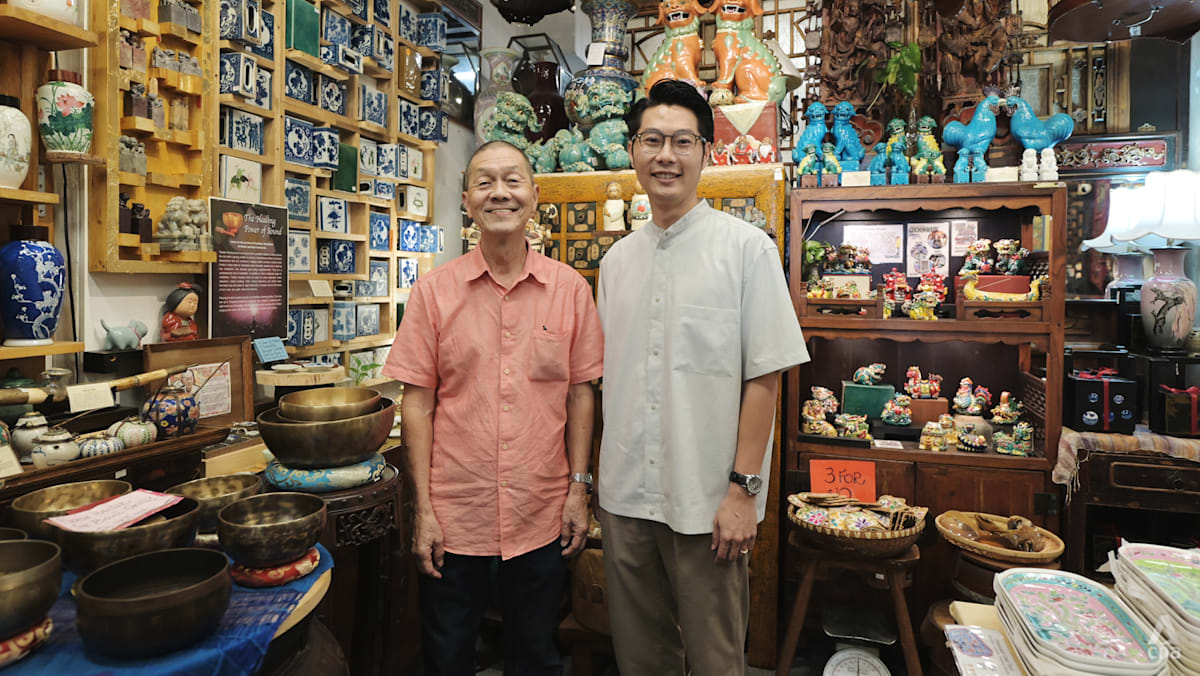
PK and Jacob Cheong are the father-and-son duo behind East Inspirations, an antiques and lifestyle shop in Chinatown known for transforming imperfect antiques and unexpected vintage objects – from biscuit moulds to an old iron – into table lamps.
Father-and-son duo PK and Jacob Cheong run antiques and lifestyle shop East Inspirations in Chinatown. (Photo: CNA/Joyee Koo)
This audio is generated by an AI tool.
What do you do with a treasured object that is damaged or no longer in use? Some might leave it as it is; others might simply throw it away. But for 72-year-old Cheong Poh Kwai (or PK as he prefers to be called), it's an opportunity to give that object a second life – and, quite literally, a new light.
That philosophy is at the heart of East Inspirations, the antiques and lifestyle shop he opened in 1993. Today, he runs it with his 37-year-old son Jacob, who joined the family business about 10 years ago.
East Inspirations is located at 256 South Bridge Road, in Chinatown. (Photo: CNA/Joyee Koo)
The shop is filled with an eclectic mix of antique, vintage and contemporary objects reflecting Chinese and Southeast Asian cultures. (Photo: CNA/Joyee Koo)
It is hard to miss East Inspirations’ shophouse along South Bridge Road. Framed by a traditional-style signboard, its shopfront is packed with an eclectic mix of Chinese porcelain, antique furniture, decorative objects, teaware and vintage household items. Given its location in the busy tourist district of Chinatown, the shop also carries a range of Peranakan- and Singapore-inspired souvenirs.
PK Cheong can often be found at the back of the shophouse, sipping tea, coming up with new designs or flipping through a book about antiques. (Photo: CNA/Joyee Koo)
Right at the back of the shophouse is a space where Jacob hosts tea appreciation sessions for interested guests. (Photo: CNA/Joyee Koo)
Towards the rear of the shophouse are two intimate spaces. One is PK’s personal corner, where he drinks tea with old friends and dreams up new designs and business ideas. It is also where he keeps some of his most cherished pieces, which he said he would probably never sell. The other is Jacob’s tearoom, lined with his collection of teaware and an assortment of tea leaves. Here, visitors can join him for tea appreciation sessions, a recent addition he introduced to the family business.
And among the sea of objects, the table lamps stand out. Conceptualised by PK, these one-of-a-kind designs incorporate everything from repurposed antique porcelain to unexpected objects.
PK incorporated biscuit moulds once used by his mother into the base of this table lamp. (Photo: CNA/Joyee Koo)
PK gives damaged and forgotten objects new life by turning them into one-of-a-kind table lamps. (Photo: CNA/Joyee Koo)
A table lamp featuring a vintage iron as its base. (Photo: CNA/Joyee Koo)
A table lamp featuring a combination of abacuses as its base. (Photo: CNA/Joyee Koo)
One of his favourite creations incorporates two biscuit moulds once used by his mother. One features a fish representing the Chinese phrase "nian nian you yu" (“may you have abundance every year”), while the other bears a lotus symbolising many children and grandchildren. For PK, giving these objects a new function also allows their stories to live on.
“The first aim is to give it another life, and the second is to pass the tradition on,” he said.
IT STARTED WITH LAMPSHADES
PK’s lamp-making journey began with the skills he acquired in his first job.
Before starting his own business in the 1980s, PK worked as a machinist in a factory that also made lamps. (Photo: PK Cheong)
After completing National Service, he worked as a machinist at a factory that specialised in table lamps in the 1970s. PK was initially responsible for producing the lamps’ steel components, but gradually learnt how the different bases and lampshades were designed and made. At the time, the factory used newly made porcelain for its lamp bases.
In 1981, PK started his own business with his wife and a few friends, making their own lamps. (Photo: PK Cheong)
In 1981, after getting married, PK started a company producing table lamps with his wife and several friends. He focused on designing the lamp bases and lampshades, while his wife specialised in making the shades by hand.
It was during a work trip to China that same year that he first encountered antiques on such a large scale.
“We visited this warehouse, and I saw so many antiques,” he recalled. “I was shocked. At that moment, my heart was a little moved. They were so beautiful.”
Struck by their beauty and artistry, PK began to wonder why old porcelain pieces could not be used as lamp bases instead of creating new ones. But the encounter also sparked a deeper interest in antiques. He began studying and examining them on his own, visiting dealers and asking questions. One purchase soon led to another, and his collection gradually grew.
A GROWING ANTIQUES COLLECTION
Some of the antiques he coveted would cost as much as S$1,000 and he often asked sellers if he could pay in instalments.
PK first discovered his interest in antiques during a business trip to China. (Photo: PK Cheong)
“The antiques I bought couldn’t see the light of day,” he joked. “I hid them under the bed because my wife would scold me. We didn’t have much money, but I was still buying antiques.”
But what attracted him was not so much their monetary value, but the artistry and meaning behind the painted imagery.
“If you don’t understand or appreciate Chinese culture, you generally won’t be drawn to antiques,” he said. “Someone who loves Chinese culture will want to delve deeper, understand it and study it.”
PK Cheong with his collection of antiques at home. (Photo: CNA/Joyee Koo)
PK Cheong’s collection of antiques at home. (Photo: CNA/Joyee Koo)
PK has never counted how many pieces he has amassed over the decades. Apart from those displayed in the shophouse, his home is also filled with his treasures. Among the oldest are pieces dating to the Tang and Song dynasties.
“A vase isn’t merely an object. It contains stories and characters,” he said. “When friends visit your home and see the beautiful vase, they will ask what is painted on it.”
PK Cheong’s morning ritual includes sipping tea on his balcony while appreciating his antique collection.
His collection is not merely for display, but also a source of comfort. Every morning, he enjoys a cup of tea on his balcony, surrounded by his penjing – another passion of his, comprising miniature landscapes of carefully shaped trees, rocks and water that are also home to his small fish – and takes out one of his antiques to admire.
“When I’m troubled or facing a problem I can’t resolve, I spend time appreciating them,” he shared. “They help me forget my worries for a while.”
OLD OBJECTS, NEW LIGHT
In 1985, one of his friends brought in a batch of damaged porcelain from Guangzhou. Instead of seeing the pieces as waste, he saw an opportunity to give them a practical purpose while preserving the culture and stories they carried. “Why not turn these broken porcelain pieces into something functional, while also passing on the culture?” he said.
PK Cheong saw an opportunity to give damaged antiques a second life. (Photo: PK Cheong)
Drawing on the technical skills he had gained as a machinist, PK developed his own process for transforming the fragile pieces into lamps, which were subsequently sold.
The project marked the beginning of an approach that continues to shape his work: giving damaged or disused objects a new function rather than discarding them because of their imperfections.
One of PK Cheong’s table lamp designs, featuring a damaged vase as its base. (Photo: CNA/Joyee Koo)
In the early 1990s, as China’s manufacturing sector grew, Singapore’s labour-intensive handicraft industry became increasingly difficult to sustain. PK decided to pivot towards retail and began looking for a shop in 1993.
His first retail space was at the former Handicraft Centre in Chinatown Point before moving into its current shophouse in 1997.
Although the business no longer makes its lampshades in-house, they are still designed by PK and produced by a supplier in China. The shop also continues to accept requests to transform customers’ objects into lamps, including more unusual items.
"Technically, anything can be made into a lamp – even a piece of stone.” PK said.
The lamps are assembled at the company’s warehouse, where PK brings together the repurposed bases, electrical fittings and shades. Prices vary depending on the complexity of the design and the amount of work required.
One of PK’s favourite designs features a bamboo-shaped ventilation block that once formed part of a balcony. (Photo: CNA/Joyee Koo)
One of his favourite designs uses a bamboo-shaped ventilation block that was once part of a balcony. He came across more than 200 of these in Guangzhou, where a house was being demolished and decided to buy the entire lot.
“I already had the idea of turning it into a lamp as a way of preserving that nostalgia,” he said. “The colour is also beautiful, and bamboo has an auspicious meaning – rising higher with each step – so it also makes a good gift.”
“The first rule of the house was not to play ball games,” Jacob recalled with a chuckle.
Jacob and his two siblings grew up in a home filled with valuable objects and watched his father build his antique collection over the years.
“Our parents taught us how to handle and live with them, rather than, ‘Don’t touch them,’” he said. “It was more like: How do you live with them in a good way? So then we learnt to appreciate them as well.”
PK’s son, Jacob, joined the family business 10 years ago. (Photo: CNA/Joyee Koo)
Joining the family business was not something Jacob had always envisioned. He studied business finance and business administration before taking his first job at a bank. When a corporate career did not work out for him, he joined East Inspirations around 2016.
“In a way, my father gave me a lifeline through the business, and I also gave him a lifeline, because joining extends that business,” Jacob said. “He can continue doing what he likes, and I also get to spend a lot of time with him.”
Today, he oversees more of the company’s social media, marketing and online presence. He also introduced structured tea appreciation sessions, building on his father’s long-time practice of serving tea to friends and customers while discussing antiques.
Jacob also conducts tea appreciation sessions at the shophouse. (Photo: CNA/Joyee Koo)
His appreciation for antiques and Chinese culture deepened after he joined the company, began sourcing pieces himself and came to understand the effort his father had put into building his collection.
“Because my siblings and I grew up surrounded by his collection, we didn’t really appreciate it back then,” Jacob said. “When I stepped into the business, started purchasing pieces and saw what other people had and what was available in the market, I realised that his collection was really quite something.”
Many of the antiques in the shop come from PK’s past collection, local collectors or overseas sellers they find through online bidding and auctions. Father and son also travel together to discover new pieces and draw inspiration for the business.
View this post on Instagram
They regularly visit Jingdezhen, a Chinese city renowned for its porcelain, where they source new, handmade pieces. These trips have given Jacob a greater appreciation of his father’s knowledge and eye for antiques.
“That’s when my dad’s taste comes into play,” Jacob said. “He knows whether a piece is emulating something from the past or is something totally new.”
Their tastes do not always align, but Jacob considers that an advantage.
“It’s good that we both have slightly different tastes because it makes the place a little more different,” he said. “Otherwise, it would be very boring. It adds to the variety of pieces that we have in the shop.”
KEEPING THE LIGHT ON
While demand for vase lamps may have declined, PK continues to sit in his cosy corner of the shophouse, sipping tea and imagining new designs for old and damaged objects.
PK continues to dream up new designs from his cosy corner of the shophouse. (Photo: CNA/Joyee Koo)
“It’s quite rare now. It used to be more common, perhaps because many people no longer use vases,” PK said. “Another reason is the supply from China. People can buy them more cheaply online.”
Still, familiar faces from the shop’s early years continue to return.
“My old customers still come back. Some have been with us since the 1990s,” he said. “They tell us, ‘We bought something from you back in 1997.’ Some of them also bring other customers to us.”
Beyond allowing PK to continue doing what he loves, the business has also given father and son the opportunity to work together, with Jacob helping to carry his father’s life’s work into the next generation.
“I’m very happy. What more could you ask for when you have a child like this?” he said. “I didn’t force him to join – he came willingly, and that makes me even happier.”
A single handpicked story that we think you shouldn't miss. Just one a day.
PK 和 Jacob Cheong 是 East Inspirations 的父子二人组,这是一家位于唐人街的古董和生活方式商店,以将不完美的古董和意想不到的复古物品(从饼干模具到旧熨斗)改造成台灯而闻名。
父子二人PK和Jacob Cheong在唐人街经营着一家名为“East Inspirations”的古董及生活方式商店。(图片:CNA/Joyee Koo)
这段音频由人工智能工具生成。
如何处理一件损坏或不再使用的珍贵物品?有些人可能会保持原样;有些人可能会直接扔掉。但对于72岁的张宝贵(他更喜欢别人叫他PK)来说,这是一个赋予物品第二次生命——以及真正意义上的“重见天日”的机会。
这种理念是他于 1993 年创立的古董和生活方式商店 East Inspirations 的核心。如今,他与 37 岁的儿子 Jacob 一起经营这家商店,Jacob 大约 10 年前加入了家族企业。
East Inspirations位于唐人街南桥路256号。(图片:CNA/Joyee Koo)
这家商店里摆满了琳琅满目的古董、复古和现代物品,反映了中国和东南亚的文化。(图片:CNA/Joyee Koo)
位于桥南路的“东方灵感”店屋十分醒目。店面以传统风格的招牌为衬托,琳琅满目的中国瓷器、古董家具、装饰品、茶具和复古家居用品,令人目不暇接。由于地处繁华的唐人街旅游区,这家店还出售一系列娘惹和新加坡特色纪念品。
人们经常可以看到PK Cheong在店屋后面,一边喝茶,一边构思新的设计,或者翻阅古董书籍。(图片:CNA/Joyee Koo)
在店屋的后方,有一处空间,雅各布会在那里为感兴趣的客人举办品茶会。(图片:CNA/Joyee Koo)
店屋后部有两个私密空间。一个是PK的私人角落,他会在这里与老朋友品茶,构思新的设计和商业理念。这里也存放着他最珍爱的几件物品,他说这些东西他可能永远不会卖掉。另一个是Jacob的茶室,里面摆满了他的茶具收藏和各种茶叶。在这里,游客可以和他一起品茶,这是他最近为家族生意新增的一项活动。
在琳琅满目的物品中,台灯格外引人注目。这些独一无二的设计出自PK之手,融合了从回收利用的古董瓷器到意想不到的物件等各种元素。
PK将他母亲曾经用过的饼干模具融入到这盏台灯的底座中。(图片:CNA/Joyee Koo)
PK 将破损或被遗忘的物品改造成独一无二的台灯,赋予它们新的生命。(图片:CNA/Joyee Koo)
一款以复古铁艺为底座的台灯。(图片:CNA/Joyee Koo)
一款以算盘为底座的台灯。(图片:CNA/Joyee Koo)
他最喜欢的作品之一,是用他母亲曾经用过的两个饼干模具制作而成。一个模具上画着一条鱼,寓意“年年有余”,另一个模具上画着一朵莲花,象征着子孙满堂。对PK来说,赋予这些物件新的功能,也让它们的故事得以延续。
他说:“第一个目标是赋予它新的生命,第二个目标是传承这一传统。”
一切始于灯罩
PK的灯具制作之旅始于他在第一份工作中获得的技能。
在20世纪80年代创办自己的公司之前,PK曾在一家也生产灯具的工厂当过机械师。(照片:PK Cheong)
服完兵役后,他在上世纪70年代到一家专门生产台灯的工厂做机械师。PK最初负责生产灯具的钢制部件,但逐渐学会了如何设计和制作不同的灯座和灯罩。当时,工厂的灯座使用的是新生产的瓷器。
1981年,PK和妻子以及几个朋友一起创办了自己的公司,开始制作灯具。(照片:PK Cheong)
1981年,PK结婚后,与妻子和几个朋友一起创办了一家生产台灯的公司。他专注于设计灯座和灯罩,而他的妻子则专门负责手工制作灯罩。
同年,他因公出差去中国,第一次大规模地接触到了古董。
“我们参观了这个仓库,我看到了好多古董,”他回忆道。“我当时震惊了。那一刻,我有点感动。它们太漂亮了。”
PK被这些瓷器的精美和工艺所深深吸引,开始思考为什么不直接利用旧瓷器制作灯座,而要重新制作新的灯座。这次邂逅也激发了他对古董更深厚的兴趣。他开始独自研究和鉴赏古董,拜访古董商,四处请教。一次购买之后,他的收藏便接踵而至。
不断增长的古董收藏
他心仪的一些古董价值高达 1000 新元,他经常问卖家是否可以分期付款。
PK是在一次去中国的商务旅行中第一次发现了自己对古董的兴趣。(照片:PK Cheong)
“我买的那些古董都没见过天日,”他开玩笑说。“我把它们藏在床底下,因为我老婆会骂我。我们家并不富裕,但我还是继续买古董。”
但吸引他的并非这些画作的金钱价值,而是画作背后的艺术性和意义。
“如果你不了解或不欣赏中国文化,你通常不会被古董吸引,”他说。“热爱中国文化的人会想要深入了解、理解和研究它。”
PK Cheong在家中展示他的古董收藏。(图片:CNA/Joyee Koo)
PK Cheong在家中收藏的古董。(图片:CNA/Joyee Koo)
PK从未统计过自己几十年来究竟收藏了多少件藏品。除了店屋里陈列的那些,他的家中也摆满了他的珍藏。其中一些年代最久远的藏品可以追溯到唐宋时期。
“花瓶不仅仅是一件物品,它承载着故事和人物,”他说。“当朋友来你家做客,看到漂亮的花瓶时,他们会问上面画的是什么。”
PK Cheong的晨间习惯是在阳台上一边品茶一边欣赏他的古董收藏。
他的收藏不仅是为了展示,更是一种慰藉。每天清晨,他都会在阳台上品茶,周围环绕着他的盆景——这是他的另一大爱好,盆景由精心雕琢的树木、岩石和水景组成,也是他养的小鱼的家园——然后他会拿出一件古董来欣赏。
“当我遇到烦恼或无法解决的问题时,我会花时间去欣赏它们,”他分享道。“它们能让我暂时忘记烦恼。”
旧物新光
1985年,他的一位朋友从广州带回了一批破损的瓷器。他并没有把这些碎片视为废品,而是看到了赋予它们实用价值的机会,同时也保留了它们所承载的文化和故事。“为什么不把这些碎瓷片变成实用的东西,同时又能传承文化呢?”他说道。
PK Cheong 看到了让破损古董重获新生的机会。(照片:PK Cheong)
PK 利用他作为机械师所掌握的技术技能,开发出一种将易碎部件改造成灯具的工艺,随后将这些灯具出售。
该项目标志着一种持续影响他作品的方法的开始:赋予损坏或废弃的物品新的功能,而不是因为它们的缺陷而丢弃它们。
这是PK Cheong设计的一款台灯,底座是一个破损的花瓶。(图片:CNA/Joyee Koo)
上世纪90年代初,随着中国制造业的发展,新加坡劳动密集型的手工艺产业越来越难以维持。PK决定转型零售业,并于1993年开始寻找店面。
他的第一家零售店位于牛车水坊的前手工艺品中心,之后于 1997 年搬到了现在的店屋。
虽然这家店不再自行生产灯罩,但灯罩的设计仍然出自PK之手,并由中国的供应商负责生产。此外,这家店也继续接受顾客的定制订单,将顾客的物品(包括一些比较特殊的物品)改造成灯具。
“从技术上讲,任何东西都可以做成灯——甚至一块石头。”PK说道。
这些灯具在公司仓库组装,PK公司将回收利用的灯座、电气配件和灯罩集中到一起。价格根据设计的复杂程度和所需工时而有所不同。
PK最喜欢的设计之一是用竹子形状的通风砖,它原本是阳台的一部分。(图片:CNA/Joyee Koo)
他最喜欢的设计之一是用竹子形状的通风砖,这种通风砖原本是阳台的一部分。他在广州一栋正在拆迁的房子里发现了200多个这样的通风砖,于是决定把它们全部买下来。
“我早就想把它做成一盏灯,以此来保留那份怀旧之情,”他说。“它的颜色也很漂亮,而且竹子寓意吉祥——每一步都向上攀登——所以它也是一份不错的礼物。”
“家里的第一条规矩就是不准玩球类游戏,”雅各布笑着回忆道。
雅各布和他的两个兄弟姐妹在一个摆满了珍贵物品的家中长大,亲眼目睹了父亲多年来不断积累古董收藏。
他说:“我们的父母教我们如何与它们相处,而不是‘别碰它们’。他们更常说的是:如何才能与它们和谐共处?这样我们也学会了欣赏它们。”
PK的儿子Jacob十年前加入了家族企业。(图片:CNA/Joyee Koo)
加入家族企业并非雅各布一直以来的设想。他曾学习商业金融和工商管理,之后在一家银行找到了第一份工作。由于企业生涯并不顺利,他于2016年左右加入了East Inspirations公司。
“从某种意义上说,父亲通过他的事业给了我一条出路,我也给了他一条出路,因为我的加入也拓展了这项事业,”雅各布说。“他可以继续做他喜欢的事,而我也能有很多时间陪伴他。”
如今,他负责公司更多的社交媒体、市场营销和线上运营工作。他还引入了系统化的品茶活动,延续了他父亲多年来一边品茶一边与朋友和顾客探讨古董的传统。
Jacob还在店屋里举办品茶活动。(图片:CNA/Joyee Koo)
加入公司后,他对古董和中国文化的欣赏日益加深,开始亲自搜寻藏品,并逐渐理解了父亲为建立收藏所付出的努力。
“因为我和我的兄弟姐妹从小就生活在他的藏品之中,所以我们当时并没有真正意识到它的价值,”雅各布说。“当我开始涉足这个行业,开始购买藏品,并看到其他人拥有什么以及市场上有哪些藏品时,我才意识到他的藏品确实非常了不起。”
店内许多古董都来自PK过去的收藏、当地收藏家的藏品,或是他们通过网络竞拍和拍卖找到的海外卖家。父子俩还会一起旅行,寻找新的古董,为店铺汲取灵感。
在 Instagram 上查看此帖子
他们经常去景德镇——这座以瓷器闻名的中国城市——寻找新的手工瓷器。这些旅行让雅各布更加欣赏父亲的古董知识和鉴赏力。
“这时我父亲的品味就派上用场了,”雅各布说。“他知道一件作品是在模仿过去的作品,还是完全创新的作品。”
他们的喜好并不总是一致,但雅各布认为这是一个优势。
“我们俩品味略有不同是件好事,这样店里的商品种类就更丰富了,”他说。“不然的话,店里就太单调了。这也增加了我们店里商品的种类。”
保持灯光开启
虽然对花瓶灯的需求可能有所下降,但PK仍然坐在他店屋里舒适的角落里,一边喝茶,一边构思着如何为旧的、破损的物品设计新的灯具。
PK继续在他舒适的店屋角落里构思新的设计。(图片:CNA/Joyee Koo)
“现在这种情况非常罕见。以前比较常见,可能是因为很多人不再使用花瓶了,”PK说。“另一个原因是来自中国的供应。人们可以在网上更便宜地买到它们。”
不过,这家店早期的一些老面孔仍然会回来。
“我的老顾客仍然会回来。有些顾客从上世纪90年代就开始光顾我们了,”他说。“他们会告诉我们,‘我们1997年就在你们这里买过东西了。’他们中的一些人还会给我们带来其他顾客。”
除了让 PK 继续做他喜欢的事情之外,这项事业也让父子俩有机会一起工作,雅各布帮助将他父亲毕生的事业传承给下一代。
“我非常高兴。有这样的孩子,还能奢求什么呢?”他说道。“我没有强迫他参加——他是自愿来的,这让我更加高兴。”
每天一篇,我们精心挑选一篇您不容错过的精彩故事。