F-22 Now Has AIM-9X But Still No Helmet Mounted Display To Use With ItF-22现在配备了AIM-9X导弹,但仍然没有与之配套的头盔显示器。
The Raptor will never reach its full potential without a helmet mounted display, something that was promised with the jet nearly 30 years ago.
新闻视频
Updated Jul 3, 2020 4:13 AM EDT
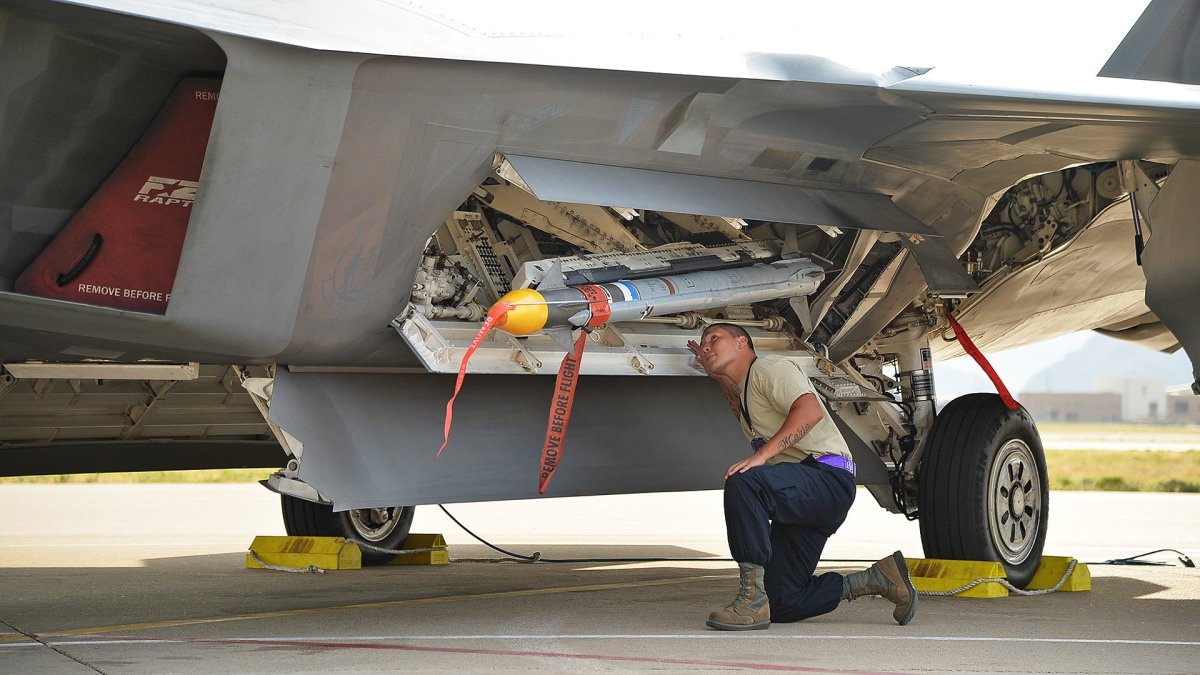
The USAF is quick to tout that the F-22 Raptor fleet has been finally upgraded to use the AIM-9X Sidewinder—a long awaited move that will allow the most advanced air superiority fighter in the world to ditch the relatively ancient AIM-9M version of the iconic short-range air-to-air missile. But even with this new capability, F-22 pilots still lack a helmet mounted display (HMD) to take advantage of the missile’s high-off boresight (HOBS) abilities, and there doesn’t seem to be much talk about fixing this long standing deficiency in the near term.
You can read all about the F-22’s short-range missile and helmet mounted display fiasco here.
The AIM-9X Sidewinder, Raytheon
There is no doubt that adding basic AIM-9X capability to the F-22 is a significant upgrade over what the AIM-9M had to offer. Some F-22s have had the ability to carry the missiles for about a year or so, but the software to deeply integrate with the jet and give the pilot the proper symbology to easily employ it was only installed with the Increment 3.2B software that is now being made available to the Raptor fleet.
The AIM-9X Block I has bit longer range, it’s faster, has a wider field of view, much higher maneuverability and a far better imaging infrared seeker that is very tough to fool with existing countermeasures than its Cold War era AIM-9M predecessor. The missile can even be used against ground targets in a pinch if the jet has the right software. Defensetech.org recently spoke to an experienced Raptor pilot with the 95th Fighter Squadron about this new arrow in the F-22’s quiver:
“With the AIM-9M ‘Mike’ we kind of went out there going, ‘We have six missiles’… With AIM-9X, we step out the door going, ‘We got eight missiles on the jet.’ It’s literally that big of a difference… Night and day different… It brings us on par with most of the other infrared missiles around the world.” He also added that the AIM-9X gives Raptor pilots the ability “shoot a lot further with better tracking capability out of the seeker.”
Chief Master Sergeant Chuck Jenkins, a wing Weapons Manager based at Elmendorf AFB in Alaska also commented about the F-22’s new missile in a USAF article, stating :
“This has been in the inventory for the Air Force and Navy for some years; it’s nothing new to the military. But to put it on the Ferrari of aircraft—the F-22, the most advanced aircraft we have—it gives the pilots more maneuverability, larger range, and it’s a much faster missile.”
But now that the Raptor finally has widespread AIM-9X capability, it seems that the USAF is still putting off giving Raptor pilots the “point and shoot” ability that goes along with this new missile, not to mention the enhanced situational awareness that a Helmet Mounted Display provides. In essence, the missile’s most important feature, its ability to engage targets even over a pilot’s shoulder, still cannot be unlocked by the Raptor, even after both the AIM-9X and F-22 have been operational (although separately) for well over a decade and other far less technologically complex fighters, like the F-15C/D and F-16C/D have had such a capability for just as long a time.
Instead, the Raptor will wait for its next round of upgrades around 2019, which will allow it to field the AIM-9X block II. This second iteration of the AIM-9X is already operational and features lock-on-after-launch capability. This will allow Raptor pilots to engage a target without locking the AIM-9X’s gimbaled seeker onto that target before firing. The missile is equipped with a data-link and upgraded autopilot that receives information from the launch aircraft as to where the target is located in space and time so that it can fly-out toward it once it has left the jet’s launch rail. In some cases, the missile can make a nearly 180 degree turns to engage targets behind the aircraft, and then lock onto them once headed in that opposite direction.
F-22 launching an AIM-9X during testing., USAF
In the F-22’s case, this means the AIM-9X Block II will not have to be shoved out into the airstream so that the pilot can obtain a hard lock before letting the missile fly. Instead the Raptor’s side weapons bay doors can remain closed until the command to launch is given—and in doing so the F-22 can remain stealthy longer during the weapons engagement portion of a dogfight.
But once again, for close-in dogfighting, instead of relying on a pilot to point his eyes at the target through a HMD in order to engage said target, the AIM-9X Block II will rely on the F-22’s sensors—primarily its APG-77 AESA radar—that has roughly a 120 degree frontal field of view —to provide cueing and telemetry to the missile’s data-link. This is called “helmetless high off bore-sight” (HHOBS) capability. It may be possible to leverage information from the jet’s ALR-94 electronic support measures suite, and from third party sensor sources, such as other F-22s and even AWACs aircraft when employing the AIM-9X Block II in lock-on after launch mode, although at close range this is doubtful.
But once again, the Raptor will not take advantage of the missile’s full engagement envelope without giving its pilot a HMD. Not just that, but the F-22 lacks a spherical infrared sensor system like the F-35 Distributed Aperture System that could potentially provide directional cueing for the AIM-9X Block II even without the F-35 pilot’s highly advanced Helmet Mounted Display being pointed at the target.
For the HMD lacking F-22, where the AIM-9X Block II will really shine is in its ability to reach out and kill targets at intermediate ranges—much farther than its predecessor due to a new rocket motor design and lock on after launch capability. In essence, a pilot can lock up a target on their radar farther than the AIM-9X’s seeker can see, and let the missile fly. It will be guided via data-link towards the enemy until AIM-9X’s seeker head acquires the target itself and makes its terminal attack run. This gives F-22 pilots, who are highly limited by the missiles they carry internally, the ability to engage at near or beyond visual range distances with all of their eight missiles, instead of just their six AIM-120 AMRAAMs.
Hughes Missile Systems
Although these advances are welcomed, it is easy to find it relatively absurd that the most advanced air-to-air fighter ever built still won’t have the same high-off boresight missile capability as a 40 year old F-15 even after receiving continuos upgrades since it was declared operational some 12 years ago.
The Joint Helmet Mounted Cueing System (JHMCS) used by American F-15, F-16, F/A-18s and a few other US combat aircraft is not an option for the Raptor because its magnetic tracking concept is incompatible with the stealthy cockpit features of the F-22. Still, other HMDs exist, some with arguably better features and adaptability than JHMCS. As of 2015, the USAF was supposed to be working towards fielding a version of the highly capable Thales Scorpion HMD for Raptor pilots. Although the system was given an abbreviated test with Raptors assigned to Nellis AFB in 2014, and the pilots really liked it, official testing was supposed to begin this year with entry into service scheduled for around 2020. Yet not much has been heard about this plan in the last two years, and there has been other talk that a new helmet may be tested instead sometime in the future.
On numerous occasions, F-22 pilots have said they do not want a version of the F-35’s helmet . It brings some very unique capabilities to the F-35 , which was literally designed around it, but supposedly it has been deemed too heavy and has a forward center of gravity that will make straining under high Gs less than optimal for hard maneuvering Raptor pilots. The Scorpion HMD visor fits to the Raptor’s pilot’s existing helmet, and uses a “monocle” in front of one eye to display high-definition color imagery. Not just that but a version of it is already deployed on the A-10 and some F-16s, and it is easily adaptable to night vision goggles.
It’s frustrating to think that a solution to the F-22’s HMD woes exists, and it’s an off-the-shelf one at that, but the USAF will not move forward with procuring it for the Raptor community. After spending roughly $70 billion on the F-22 program, you would think that giving it a basic capability that was shortsightedly slashed in the 1990s as a desperate cost saving measure would be an absurdly logical move. Especially considering the total force relies so heavily on the small fleet of Raptors for air supremacy today.
In the end the already outstanding F-22 will never be all that it can be without this glaringly obvious and overdue upgrade. Until then, the world’s most deadly air-to-air fighter will still have one wing tied behind its back, and it does so at the direction of the USAF brass and its army of bean counters.
Contact the author: Tyler@thedrive.com
Comments couldn’t be loaded. Please refresh the page.
更新于美国东部时间2020年7月3日凌晨4:13
美国空军迅速宣称,F-22“猛禽”战斗机机队终于升级,可以使用AIM-9X“响尾蛇”导弹——这一期待已久的升级将使世界上最先进的空中优势战斗机能够抛弃相对老旧的AIM-9M型短程空空导弹。然而,即便拥有了这项新能力,F-22飞行员仍然缺少头盔显示器(HMD)来充分利用该导弹的高离轴(HOBS)射击能力,而且似乎近期内并没有太多解决这一长期缺陷的计划。
您可以点击此处阅读有关 F-22 短程导弹和头盔显示器故障的全部内容。
AIM-9X响尾蛇导弹,雷神公司
毫无疑问,为F-22增加AIM-9X基本能力是对AIM-9M的重大升级。部分F-22战机已具备携带该导弹的能力约一年左右,但用于与战机深度集成并为飞行员提供便捷操作所需符号的软件,直到3.2B版本软件才得以安装,而该版本软件目前正向猛禽机队推广。
AIM-9X Block I 的射程更远,速度更快,视野更广,机动性更强,而且其成像红外导引头性能远胜于冷战时期的 AIM-9M 前身,难以被现有的对抗措施干扰。如果战机配备了合适的软件,该导弹甚至可以在紧急情况下用于攻击地面目标。Defensetech.org 最近采访了第 95 战斗机中队的一位经验丰富的 F-22 猛禽战斗机飞行员,谈到了 F-22 的这一新武器:
“以前用AIM-9M‘迈克’导弹的时候,我们出击的时候只能说,‘我们有六枚导弹’……而用AIM-9X导弹的时候,我们出击的时候就可以说,‘我们飞机上带了八枚导弹’。这差别真的太大了……简直是天壤之别……它让我们与世界上大多数其他红外制导导弹的性能持平。”他还补充说,AIM-9X导弹让猛禽战斗机的飞行员能够“发射更远的距离,并且拥有更好的目标跟踪能力”。
驻阿拉斯加埃尔门多夫空军基地的联队武器管理员、首席军士长查克·詹金斯也在美国空军的一篇文章中评论了F-22的新型导弹,他表示:
“这种导弹已经在空军和海军的装备清单里存放多年了;对军方来说并不新鲜。但是把它装在飞机中的法拉利——F-22,我们最先进的飞机上——它能给飞行员带来更大的机动性、更远的射程,而且导弹的速度也快得多。”
但现在猛禽战机终于具备了全面装备AIM-9X导弹的能力,美国空军似乎仍然迟迟不肯让猛禽飞行员拥有与这种新型导弹配套的“即指即射”能力,更不用说头盔显示器带来的增强态势感知能力了。本质上,该导弹最重要的特性——即使越过飞行员的视线也能攻击目标——在猛禽战机上仍然无法实现。尽管AIM-9X导弹和F-22战机(虽然是独立服役)已经服役超过十年,而其他技术复杂度远低于猛禽的战斗机,例如F-15C/D和F-16C/D,也早已具备这种能力。
猛禽战机将等到2019年左右进行下一轮升级,届时将能够装备AIM-9X Block II型导弹。这款第二代AIM-9X导弹已经投入使用,并具备发射后锁定能力。这意味着猛禽战机飞行员无需在发射前锁定目标,即可直接攻击目标。该导弹配备了数据链和升级版自动驾驶仪,能够接收来自发射飞机的时空位置信息,从而在离开飞机发射架后自动飞向目标。在某些情况下,导弹甚至可以进行近180度转弯,攻击飞机后方的目标,并在飞向相反方向时锁定目标。
美国空军F-22战斗机在测试中发射AIM-9X导弹。
对于F-22而言,这意味着AIM-9X Block II导弹无需像以往那样被推入气流中,以便飞行员在发射前锁定目标。猛禽战机的侧面武器舱门可以保持关闭状态,直到接到发射指令——如此一来,F-22在近距离空战的武器交战阶段就能保持更长时间的隐身状态。
但是,在近距离空战中,AIM-9X Block II 导弹并非依赖飞行员通过头盔显示器(HMD)瞄准目标,而是依靠 F-22 战机的传感器——主要是其 APG-77 有源相控阵雷达(AESA),该雷达拥有约 120 度的正面视场——为导弹的数据链提供瞄准和遥测数据。这被称为“无头盔高离轴瞄准”(HHOBS)能力。在发射后锁定模式下使用 AIM-9X Block II 导弹时,或许可以利用战机的 ALR-94 电子支援措施套件以及第三方传感器(例如其他 F-22 战机甚至预警机)提供的信息,尽管在近距离作战中这种可能性不大。
但猛禽战机若不为飞行员配备头盔显示器(HMD),便无法充分发挥导弹的全部作战效能。不仅如此,F-22 还缺少像 F-35 分布式孔径系统(DAS)那样的球形红外传感器系统,即使 F-35 飞行员的先进头盔显示器未对准目标,DAS 也能为 AIM-9X Block II 导弹提供方向指示。
对于缺少F-22的头盔显示器(HMD)而言,AIM-9X Block II的真正优势在于其在中程打击目标的能力——由于采用了新的火箭发动机设计和发射后锁定功能,其射程远超前代产品。简而言之,飞行员可以在雷达上锁定一个超出AIM-9X导引头探测范围的目标,然后让导弹飞行。导弹将通过数据链进行制导,直至AIM-9X的导引头自行锁定目标并完成末端攻击。这使得F-22飞行员——由于其内部携带的导弹数量有限——能够使用全部八枚导弹(而不仅仅是六枚AIM-120 AMRAAM)在近视或超视距范围内进行打击。
休斯导弹系统
尽管这些进步值得欢迎,但很容易让人觉得有点荒谬,有史以来最先进的空对空战斗机,即使在 12 年前宣布服役以来不断进行升级,仍然不具备与 40 年前的 F-15 相同的高离轴导弹能力。
美国F-15、F-16、F/A-18等少数美军战斗机使用的联合头盔瞄准系统(JHMCS)并不适用于F-22猛禽战斗机,因为其磁跟踪原理与F-22的隐身座舱设计不兼容。不过,市面上还有其他头盔显示器(HMD),其中一些在性能和适应性方面可能优于JHMCS。截至2015年,美国空军原本计划为猛禽战斗机飞行员配备高性能的泰雷兹蝎式头盔显示器(Thales Scorpion HMD)。尽管该系统于2014年在内利斯空军基地的猛禽战斗机上进行了简短测试,飞行员对其评价很高,但正式测试原计划于今年开始,并于2020年左右投入使用。然而,过去两年里,关于该计划的消息寥寥无几,甚至有传言称,未来可能会测试一种新型头盔。
F-22飞行员曾多次表示不希望使用F-35的头盔。F-35的头盔虽然能带来一些独特的性能(其设计初衷就是围绕这款头盔),但据称它过于沉重,重心靠前,在高过载下会使猛禽战斗机飞行员难以承受,影响其高机动性。蝎式HMD头盔显示器可适配猛禽战斗机飞行员现有的头盔,并采用单片镜片来显示高清彩色图像。不仅如此,A-10攻击机和部分F-16战斗机也已配备了类似的头盔显示器,并且它还可以轻松适配夜视镜。
令人沮丧的是,F-22的头盔显示器(HMD)问题明明有现成的解决方案,但美国空军却不愿为猛禽战机采购。F-22项目耗资约700亿美元,按理说,为其配备一项在上世纪90年代因急于节省成本而被短视地削减的基本能力,应该是理所当然的。尤其考虑到如今整个空军对这支规模不大的猛禽战机机队在空中优势方面有着如此巨大的依赖。
最终,如果没有这项显而易见且姗姗来迟的升级,原本就已十分出色的F-22永远无法发挥其全部潜力。在此之前,这款世界上最致命的空对空战斗机仍将受限于自身性能,而这一切都是美国空军高层及其庞大的财务团队的授意。
联系作者:Tyler@thedrive.com
评论加载失败,请刷新页面。