Poland picks Kongsberg-PGZ consortium to build anti-drone ‘wall’波兰选择康斯伯格-PGZ财团建造反无人机“墙”
The purchase comes in response to incursions by Russian drones that Moscow has perpetrated against Poland alongside Russia’s ongoing invasion of Ukraine.
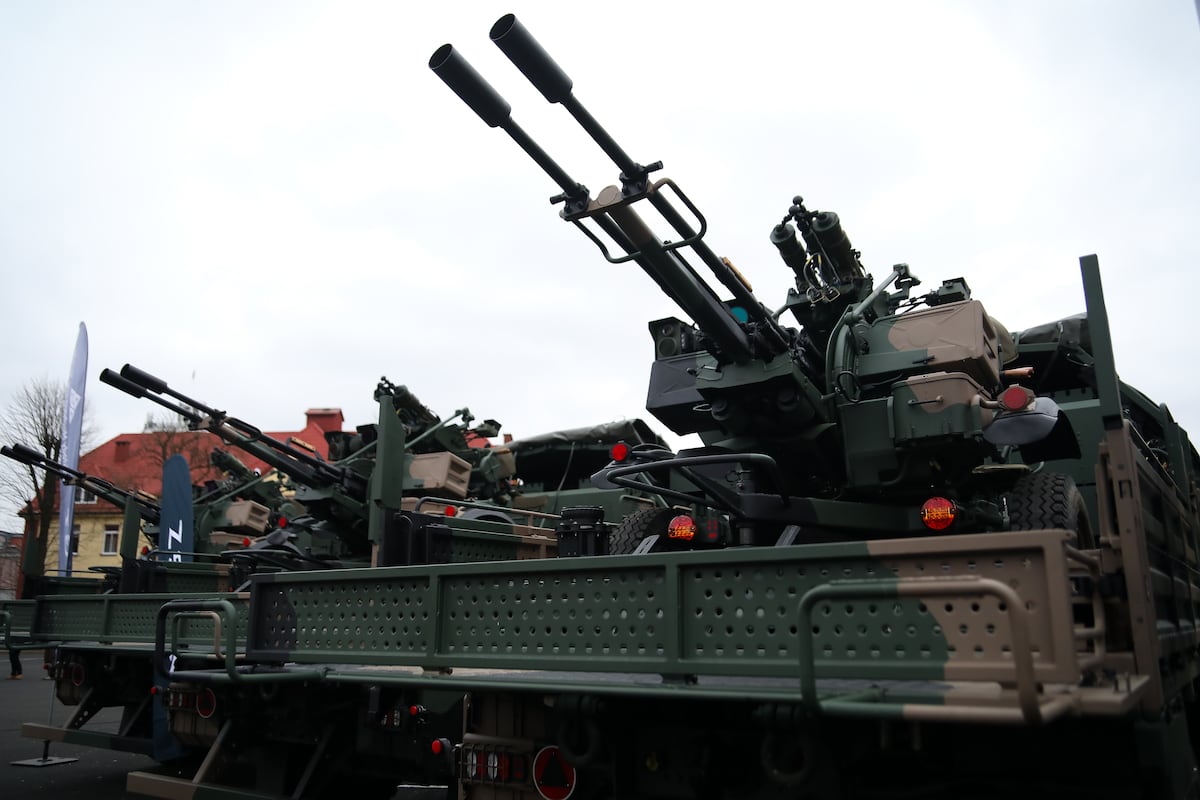
WARSAW, Poland — Poland’s Ministry of National Defence has signed a deal with a consortium comprising Norway’s Kongsberg Defence & Aerospace and Polish state-run defense group PGZ to acquire counter-unmanned aerial systems (CUAS) that will protect the country’s airspace.
The purchase comes in response to incursions by Russian drones that Moscow has perpetrated against Poland alongside Russia’s ongoing invasion of Ukraine.
Signed on Jan. 30 in the presence of Polish Prime Minister Donald Tusk and Władysław Kosiniak-Kamysz, who is deputy prime minister and defense minister, the deal paves the way for the development of the San anti-drone system whose value is estimated at around PLN 15 billion ($4.2 billion). Deliveries of the first components of the system are scheduled to begin in 2026.
“We are talking about 18 anti-drone batteries, 52 firing platoons, 18 command platoons, 703 vehicles, of which around 400 are based on the Jelcz [military truck platform] and 300 are based on the Legwan [light reconnaissance vehicle]. All of this means that we will be able to react in an extremely effective way against the threats that originate from the east,” Kosiniak-Kamysz said during the official signing ceremony.
In his remarks, the deputy prime minister referred to last September’s violations of Polish airspace by Russian unmanned aerial vehicles (UAVs). The drone threats had triggered action by the Polish and allied air forces which included scrambling F-35 fighter jets to shoot the the drones down.
“The night of September 9-10, 2025, when our airspace was violated, when Russian unmanned aerial vehicles first appeared over NATO territory, was a turning point,” Kosiniak-Kamysz said. “It was a moment when we all wondered what else could be done. Research on this equipment took many months: integration, combining all the elements into one well-functioning system.”
He described the San suite, named after a river in eastern Poland, as a “vast and multi-threaded system, created by both [PGZ] … and its partners: APS from Gdynia and Kongsberg from Norway.”
The value of Kongsberg’s share of the deal is around NOK 16 billion ($1.66 billion). In a statement, the Norwegian company said the batteries that are to be supplied to Poland’s military will comprise a wide range of effectors, including 35mm, 30mm and 12.7mm guns, as well as missiles, interceptor drones and other solutions. The system is based on Kongsberg’s Protector family of weapons, including the Medium Caliber Turret (MCT30) and the Remote Weapon Station, the producer said in a statement.
The acquisition “confirms Poland’s position as a regional hub for counter-drone innovation and strengthens Kongsberg’s positions as one of Europe’s leading providers of anti-drone solutions,” said Eirik Lie, the president of Kongsberg Defence & Aerospace.
Tusk said Kongsberg’s participation in the consortium indicates the Polish government “not only appreciates the competencies of our Norwegian partners, but also considers it an element of the new security architecture that Poland has initiated.”
The prime minister said that, in the aftermath of Russia’s attack against Ukraine, Poland seeks to strengthen its military cooperation with the Baltic States and Scandinavian countries. He also pointed to Poland’s selection of the A26 Blekinge submarine, a design offered by Sweden’s Saab, in November 2025 as “a practical expression of this new security architecture.”
PGZ said in a statement the majority of the components of the San system, with a share of around 60%, is to be supplied by companies that are part of the Polish group.
“Deliveries of the entire system are expected to be completed 24 months following the signing of the contract,” PGZ said.
The SAN program represents a key initiative to boost Poland’s air-defense capabilities. The Polish ministry has also ordered Common Anti-air Modular Missiles , or CAMM, as well as iLaunchers from European consortium MBDA. The weapons are part of the nation’s Narew short-range air defense system developed by PGZ. The ministry has also purchased Pilica+ very-short-range air defense batteries from the Polish defense industry.
The Narew and Pilica+ systems will complement the two Patriot Configuration 3+ batteries Poland purchased in 2018 under the Wisła mid-range air defense program, and the second phase of the program announced in May 2022 under which the country seeks a further six batteries of the system made by Raytheon.
Kosiniak-Kamysz said that, in total, Warsaw intends to spend around PLN 250 billion on bolstering its air defense capabilities which could make the effort the largest acquisition program for the Polish military in history.
“We are building another layer of the air defense system. We have the Wisła, we have the Narew, we have the Pilica, and we are now adding the San,” he said.
For 2026, the Polish government has earmarked a defense budget of some PLN 200.1 billion, up from PLN 186.6 billion a year earlier. This means the country’s military expenditure could capture more than 4.8% of Poland’s gross domestic product (GDP).
A large portion of the money for new military acquisitions, including the San program, is to be sourced from roughly €44 billion ($51 billion) in low-cost loans that Poland was awarded under the European Union’s Security Action For Europe (SAFE) scheme.
Jaroslaw Adamowski is the Poland correspondent for Defense News.
波兰华沙——波兰国防部与由挪威康斯伯格防务与航空航天公司和波兰国有国防集团PGZ组成的财团签署了一项协议,采购反无人机系统(CUAS),以保护该国的领空。
此次购买是为了回应俄罗斯无人机对波兰的入侵,以及俄罗斯持续入侵乌克兰的行为。
该协议于1月30日在波兰总理唐纳德·图斯克和副总理兼国防部长瓦迪斯瓦夫·科西尼亚克-卡梅什的见证下签署,为价值约150亿波兰兹罗提(约合42亿美元)的“圣”(San)反无人机系统的研发铺平了道路。该系统的首批组件计划于2026年开始交付。
科西尼亚克-卡米什在正式签约仪式上表示:“我们指的是18个反无人机连、52个射击排、18个指挥排、703辆车辆,其中约400辆基于Jelcz(军用卡车平台),300辆基于Legwan(轻型侦察车)。所有这些都意味着,我们将能够以极其有效的方式应对来自东方的威胁。”
副总理在讲话中提到了去年9月俄罗斯无人机侵犯波兰领空的事件。无人机威胁引发了波兰及其盟国空军的行动,其中包括紧急出动F-35战斗机击落无人机。
“2025年9月9日至10日夜间,我们的领空遭到侵犯,俄罗斯无人机首次出现在北约领空,这是一个转折点,”科西尼亚克-卡梅什说。“那一刻,我们都在思考还能做些什么。对这套设备的研发耗时数月:整合、将所有部件组合成一个运转良好的系统。”
他将以波兰东部一条河流命名的 San 套件描述为“一个庞大的多线程系统,由 [PGZ] 及其合作伙伴:来自格丁尼亚的 APS 和来自挪威的 Kongsberg 共同创建”。
康斯伯格公司在这笔交易中价值约160亿挪威克朗(16.6亿美元)。这家挪威公司在一份声明中表示,将提供给波兰军方的这套系统将包含多种武器,包括35毫米、30毫米和12.7毫米口径的火炮,以及导弹、拦截无人机和其他解决方案。康斯伯格公司在声明中称,该系统基于其“保护者”(Protector)系列武器,包括中口径炮塔(MCT30)和遥控武器站。
康斯伯格防务与航空航天公司总裁埃里克·利表示,此次收购“巩固了波兰作为反无人机创新区域中心的地位,并加强了康斯伯格作为欧洲领先的反无人机解决方案供应商之一的地位”。
图斯克表示,康士伯参与该财团表明波兰政府“不仅赞赏我们挪威合作伙伴的能力,而且还将其视为波兰发起的新安全架构的一个组成部分”。
波兰总理表示,在俄罗斯袭击乌克兰之后,波兰寻求加强与波罗的海国家和北欧国家的军事合作。他还指出,波兰于2025年11月选择了瑞典萨博公司设计的A26“布莱金厄”级潜艇,称其为“这一新型安全架构的实际体现”。
PGZ 在一份声明中表示,San 系统的大部分组件(约占 60%)将由波兰集团旗下的公司供应。
PGZ表示:“整个系统的交付预计将在合同签署后24个月内完成。”
SAN项目是提升波兰防空能力的一项关键举措。波兰国防部还向欧洲MBDA集团订购了通用防空模块化导弹(CAMM)和iLauncher发射器。这些武器是波兰PGZ公司研发的“纳雷夫”(Narew)短程防空系统的一部分。此外,波兰国防部还从波兰国防工业采购了“皮利卡+”(Pilica+)超短程防空导弹系统。
Narew 和 Pilica+ 系统将补充波兰在 2018 年根据“维斯瓦”中程防空计划购买的两套“爱国者”3+ 型导弹系统,以及 2022 年 5 月宣布的该计划的第二阶段,根据该阶段,波兰将寻求再购买六套由雷神公司制造的该系统。
科西尼亚克-卡米什表示,华沙计划总共花费约 2500 亿兹罗提来加强其防空能力,这可能使这项计划成为波兰军方历史上规模最大的采购计划。
“我们正在构建防空系统的另一层防御体系。我们已经有了维斯瓦导弹系统、纳雷夫导弹系统和皮利察导弹系统,现在又增加了桑导弹系统,”他说。
波兰政府已为2026年拨出约2001亿兹罗提的国防预算,高于前一年的1866亿兹罗提。这意味着该国的军事开支可能占到波兰国内生产总值(GDP)的4.8%以上。
包括 San 计划在内的新军事采购资金的大部分将来自波兰根据欧盟“欧洲安全行动”(SAFE)计划获得的约 440 亿欧元(510 亿美元)的低成本贷款。
Jaroslaw Adamowski 是《防务新闻》驻波兰记者。