S. Korea picks L3Harris tech package for new early-warning aircraft韩国选择L3Harris的技术方案用于新型预警机
A contract for the program, which has a budget of $2.2 billion, is expected to be signed around November.
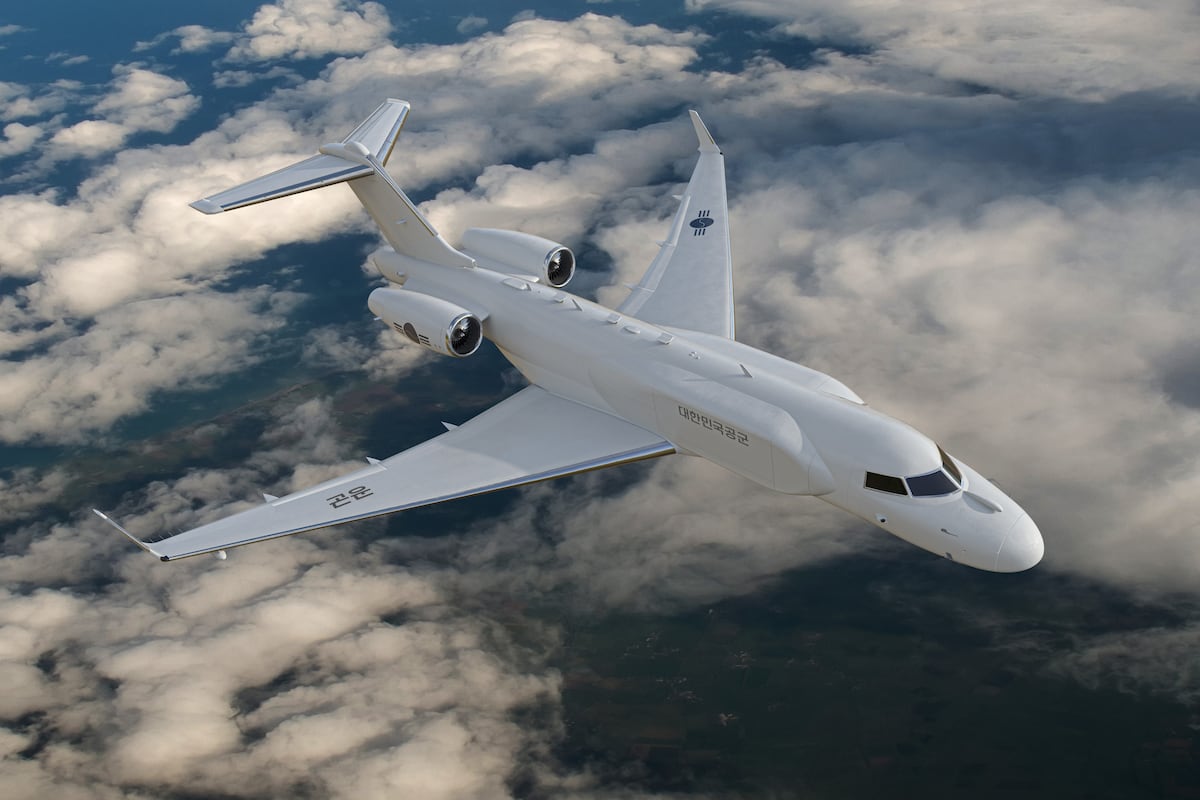
CHRISTCHURCH, New Zealand — South Korea’s next-generation airborne early warning and control – or AEW&C – aircraft will be based on Bombardier’s Global 6500 airframe, with L3Harris Technologies acting as lead integrator.
The formal announcement of the selection came on Sep. 30, and an L3Harris Technologies spokesperson subsequently confirmed to Defense News that the Defense Acquisition Program Administration (DAPA) had selected the company’s Phoenix AEW&C platform.
A contract is expected to be signed around November.
“This project is expected to enhance the Republic of Korea Armed Forces’ ability to maintain continuous and comprehensive air surveillance and control capabilities in response to growing aerial threats,” the L3Harris spokesperson said.
A budget of KRW3.1 trillion ($2.2 billion) has been allocated, and the project for the Republic of Korea Air Force (ROKAF) should be completed by 2032.
L3Harris Technologies declined to share details about its Phoenix AEW platform, but a representative told Defense News last year that an initial two aircraft would be modified in Texas before having radars integrated in Israel. The radar in question is Elta’s ELW-2085. Offering 360° coverage, the ELW-2085 has previously been integrated onto Israeli and Italian Gulfstream G550 AEW aircraft.
Korean Air would then lead work on the two remaining aircraft in-country and also perform sustainment.
The company spokesperson said in 2024: “Through L3Harris’ agreements with Korean Air, LIG Nex1 and Ace Antenna, and ongoing discussions with additional Korean partners, the team intends that the aircraft and mission system equipment will be fully supported in Korea.”
The Phoenix beat two other competitors: Boeing’s E-7A and Saab’s GlobalEye. The ROKAF already operates four E-737 Peace Eye AEW aircraft delivered in 2011-12, but it elected not to buy the similar E-7A that the U.S. Air Force itself has snubbed in recent times.
Notably, Saab’s offer was predicated on the same Global 6500 airframe, but using the Swedish company’s Erieye-ER radar. Saab’s local partner was Korea Aerospace Industries.
In the end, L3Harris scored better in terms of operational suitability, operating costs and cooperation with local defense companies, according to DAPA. The company claims it can achieve operational availability rates exceeding 95%.
While Saab’s offer scored better in terms of contract conditions and acquisition costs, DAPA said L3Harris’ aggregate score was the highest overall.
Gordon Arthur is an Asia correspondent for Defense News. After a 20-year stint working in Hong Kong, he now resides in New Zealand. He has attended military exercises and defense exhibitions in about 20 countries around the Asia-Pacific region.
新西兰基督城——韩国下一代空中预警与控制(AEW&C)飞机将以庞巴迪环球6500飞机为基础,L3Harris Technologies担任首席集成商。
9 月 30 日正式宣布了这一选择,随后 L3Harris Technologies 的一位发言人向《防务新闻》证实,国防采办计划管理局 (DAPA) 选择了该公司的 Phoenix AEW&C 平台。
预计合同将于11月左右签署。
L3Harris公司发言人表示:“该项目有望增强韩国武装部队应对日益增长的空中威胁,维持持续全面的空中监视和控制能力。”
已拨款 3.1 万亿韩元(22 亿美元)用于该项目,韩国空军(ROKAF)的该项目应于 2032 年完成。
L3Harris Technologies公司拒绝透露其“凤凰”(Phoenix)预警机平台的具体细节,但一位代表去年告诉《防务新闻》,首批两架飞机将在德克萨斯州进行改装,之后再将雷达集成到以色列。该雷达为埃尔塔公司(Elta)的ELW-2085型。ELW-2085型雷达可提供360°全方位覆盖,此前已集成到以色列和意大利的湾流G550预警机上。
随后,大韩航空将主导国内剩余两架飞机的维修工作,并负责后续维护。
该公司发言人在 2024 年表示:“通过 L3Harris 与大韩航空、LIG Nex1 和 Ace Antenna 达成的协议,以及与更多韩国合作伙伴的持续磋商,团队计划在韩国全面支持飞机和任务系统设备。”
“凤凰”预警机击败了另外两个竞争对手:波音公司的E-7A和萨博公司的“环球之眼”。韩国空军目前已装备四架于2011-2012年交付的E-737“和平之眼”预警机,但它并未选择购买与之类似的E-7A,而美国空军近年来也对E-7A不屑一顾。
值得注意的是,萨博的报价基于Global 6500机身,但采用的是该公司自主研发的Erieye-ER雷达。萨博在韩国的合作伙伴是韩国航空航天工业公司(KAI)。
根据德国国防采办计划署(DAPA)的评估,L3Harris最终在作战适用性、运营成本以及与当地国防企业的合作方面得分更高。该公司声称其作战可用率可超过95%。
虽然萨博的报价在合同条件和采购成本方面得分更高,但DAPA表示,L3Harris的综合得分最高。
戈登·阿瑟是《防务新闻》的亚洲特派记者。在香港工作20年后,他现居新西兰。他曾到访亚太地区约20个国家,参加过军事演习和防务展览。