European arms industry growth to beat 10% a year, Redburn forecasts雷德伯恩预测,欧洲军火工业年增长率将超过10%。
Rising military budgets already led to a “material jump” in order backlog that is yet to be fully reflected in financial results and profit outlooks.
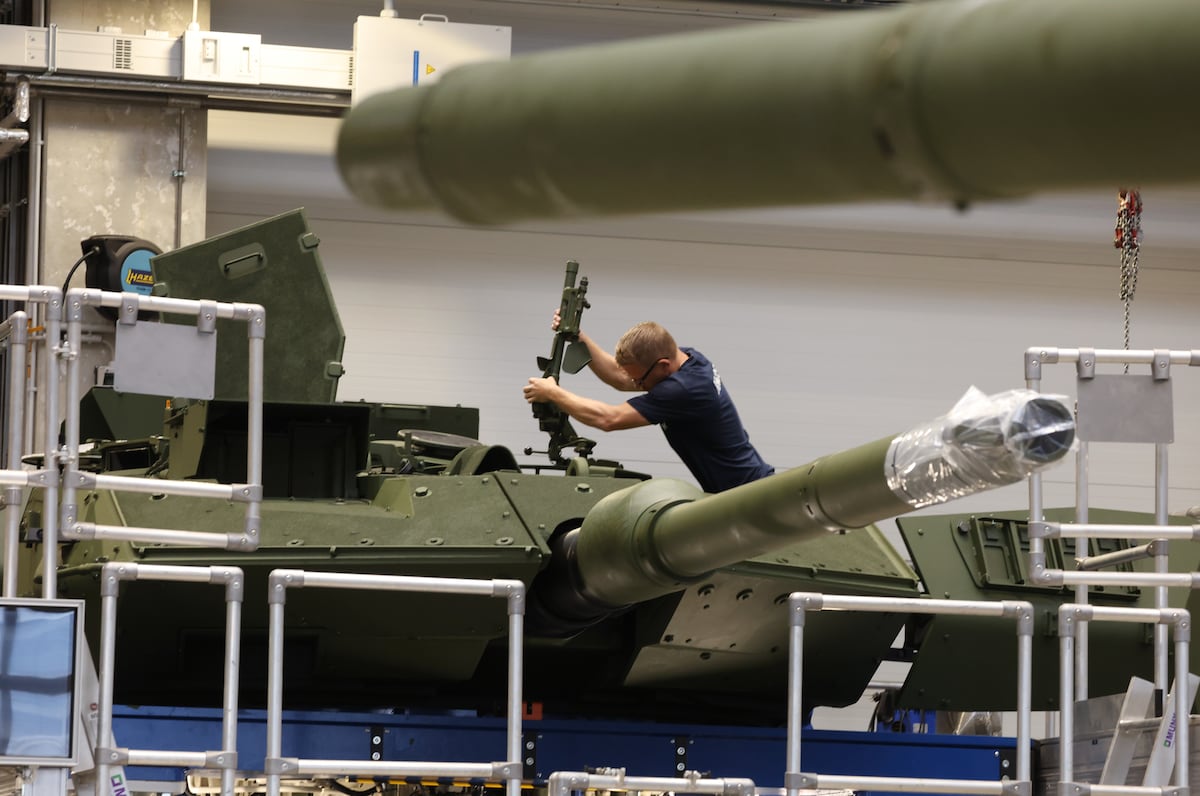
PARIS — European defense companies may grow their revenue from European customers by an average 10.5% to 11.5% a year for the next decade, as most countries commit to NATO’s 2035 spending targets, financial research firm Rothschild & Co. Redburn said.
The fastest growth will continue to be in countries that have underspent historically, such as Germany, or in parts of Europe “uncomfortably close” to the perceived threat from Russia, analysts Olivier Brochet and Joe Orchard wrote in an Oct. 2 report.
Rising military budgets already led to a “material jump” in order backlog that is yet to be fully reflected in financial results and profit outlooks of the continent’s defense industry, the analysts said. European Union countries lifted defense spending by 19% to a record €343 billion ($400 billion) in 2024, with spending set to rise to €381 billion this year, according to the European Defence Agency.
“The European defense industry’s backlog should continue to expand at a faster rate than it is consumed for years,” Brochet and Orchard wrote.
Based on Europe spending 3.5% of GDP on defense in 2035, with 35% to 40% of the budget spent on equipment, European defense equipment spending would be around 1.2% to 1.4% of GDP, more than double today’s levels, the report said.
As it rearms, Europe will “materially outgrow” the United States, which is planning to keep defense procurement steady at about 1% of GDP, according to Brochet and Orchard.
European defense companies on average filled about 34% of their backlog every year between 2013 and 2021, with that number falling to 30% in 2024 due to the acceleration in order intake. The number is expected to return to its historic levels as production capacity increases, the analysts said.
That would then see the industry’s European revenue at least tripling by 2035, Brochet and Orchard wrote, or a compound annual growth rate of 10.5% to 11.5%.
Based on a sample of 11 large Western European defense companies between 2013 and 2024, defense procurement takes about a year to translate into order intake, suggesting the “sharp increase” in defense budgets in 2024 and 2025 could materialize into industry orders in 2025-2026, according to the Redburn analysts.
The backlog for the sample set of companies increased to an average 3.9 years of sales in 2023-24 from three years in the period from 2013 to 2021, they said.
For Europe’s defense industry, the home continent on average accounted for around 65% of 2024 sales, with Naval Group and Rheinmetall getting a larger share from Europe, and BAE Systems on the lower end.
Firms exposed to geographies with the biggest spending increases and those active in air defense and land armament are growing revenue faster than peers, led by the German land-armament defense industry, according to the report.
“Local players disproportionately benefit from the strength in defense spending, as countries aim at reinvesting what is effectively their taxpayer money into their domestic economies,” Brochet and Orchard wrote, adding that has been particularly visible in Germany and Eastern Europe.
Combined sales for six Germany companies – Rheinmetall, KNDS, Hensoldt, TKMS, Diehl and Renk – climbed 16% a year in the 2020-24 period. For six Eastern European companies – PGZ, CSG, Colt CZ, VMZ, Romarm and WB Group – compound average growth rate was 33% over the period, though that included some material mergers and acquisitions activity.
Very active joint venture and M&A strategies will allow “the nimblest of companies in the sector” to capture an even larger share of the growing procurement budget, Brochet and Orchard said.
They said Rheinmetall and Leonardo have been the most visible examples of the joint venture strategy, compared to Thales and BAE Systems that have captured growth through their existing presence in local markets.
The U.S. industry has also used the joint venture strategy in Europe, with Anduril partnering with Rheinmetall and Kratos with Airbus in combat drones, and Lockheed Martin with Rheinmetall and RTX with MBDA in air-defense missiles, according to Brochet and Orchard.
European defense investment will be focused on areas including air defense, the most critically needed capability for Europe, as well as ground defense equipment such as tanks and artillery. Other priority areas will be deep strike, air dominance, aerial drones and counter-drone technology, naval, and space.
Drone innovation is still “very far” from a maturity state, while anti-drone warfare capabilities have become as important as the drones themselves, the analysts said. The countermeasure loop observed in Ukraine is no more than three months, meaning counters are deployed within three months of the appearance of a new system, they said.
“That means that until the Russian threat starts crystallizing, European governments might be reluctant to place large orders for the production of drones that they would then store, with high risk that they could become obsolete in a matter of months.”
Funding of any public good such as defense comes from either borrowing or taxes, and the funding challenge is “particularly acute” for France, the United Kingdom, Italy and Spain due to high levels of public debt, the Redburn analysts said.
Brochet and Orchard noted that public support for rearmament in Europe can’t be taken for granted, especially when it implies trading social security for defense security, when there is no perception of imminent danger.
“It could trigger a massive and potentially radical rejection of the rearmament drive in European countries, especially if they are distant from the European border,” they said. “Future elections in Europe are likely to test the resolve of the voting populations, with a risk of backtracking on the plan should regime change ensue.”
Another risk for European defense companies is pricing pressure should Russia’s war in Ukraine eventually end, the analysts said. At that point, they expect a wave of battle-proven products to enter the international market, with especially drones and ammunition potentially being offered with low prices and short production times.
Western suppliers are deploying defensive strategies such as setting up joint ventures with Ukrainian Defense Industry, according to Brochet and Orchard.
Diversified groups such as Thales and BAE not specialized in ammunition and drones may best resist the post-conflict pressure, the analysts. They also noted Rheinmetall’s diversification efforts outside its core businesses, including deals in missiles, satellites and naval shipbuilding .
Rudy Ruitenberg is a Europe correspondent for Defense News. He started his career at Bloomberg News and has experience reporting on technology, commodity markets and politics.
巴黎——金融研究公司罗斯柴尔德·雷德伯恩表示,未来十年,随着大多数国家承诺实现北约2035年的支出目标,欧洲国防公司来自欧洲客户的收入平均每年可能会增长10.5%至11.5%。
分析师奥利维尔·布罗谢和乔·奥查德在 10 月 2 日的一份报告中写道,增长最快的仍将是历史上支出不足的国家,例如德国,或者欧洲一些被认为与俄罗斯威胁“过于接近”的地区。
分析人士表示,不断增长的军费预算已经导致订单积压“大幅增加”,但这一影响尚未完全反映在欧洲大陆国防工业的财务业绩和盈利预期中。据欧洲防务局的数据,欧盟国家计划在2024年将国防开支提高19%,达到创纪录的3430亿欧元(4000亿美元),而今年的开支预计将增至3810亿欧元。
布罗切特和奥查德写道:“未来几年,欧洲国防工业的积压订单增长速度应该会超过其消耗速度。”
报告称,假设欧洲在 2035 年将 GDP 的 3.5% 用于国防,其中 35% 至 40% 的预算用于装备,那么欧洲国防装备支出将占 GDP 的 1.2% 至 1.4% 左右,是目前水平的两倍多。
据布罗切特和奥查德称,随着欧洲重新武装,其国防规模将“大幅超过”美国,而美国计划将国防采购额稳定在GDP的1%左右。
2013年至2021年间,欧洲国防企业平均每年完成约34%的积压订单,但由于订单量加速增长,预计2024年这一比例将降至30%。分析师表示,随着产能的提升,预计这一比例将恢复到历史水平。
Brochet 和 Orchard 写道,到 2035 年,该行业的欧洲收入将至少增长两倍,复合年增长率将达到 10.5% 至 11.5%。
根据 2013 年至 2024 年间 11 家西欧大型国防公司的样本,国防采购大约需要一年时间才能转化为订单,Redburn 分析师表示,这意味着 2024 年和 2025 年国防预算的“大幅增长”可能会在 2025-2026 年转化为行业订单。
他们表示,样本公司积压订单量从 2013 年至 2021 年期间的 3 年增加到 2023-24 年期间的平均 3.9 年销售额。
对于欧洲国防工业而言,本土市场平均占 2024 年销售额的 65% 左右,其中海军集团和莱茵金属公司从欧洲获得的份额较大,而 BAE 系统公司获得的份额较小。
报告显示,在支出增长幅度最大的地区以及活跃于防空和陆地武器领域的公司,其收入增长速度比同行更快,其中以德国陆地武器国防工业为首。
布罗切特和奥查德写道:“国防开支的增长使地方企业获得了不成比例的收益,因为各国都希望将实际上是纳税人的钱重新投入到国内经济中。”他们还补充说,这种情况在德国和东欧尤为明显。
2020年至2024年期间,德国六家公司——莱茵金属、KNDS、亨索尔特、TKMS、迪尔和伦克——的合并销售额年均增长16%。同期,东欧六家公司——PGZ、CSG、Colt CZ、VMZ、Romarm和WB集团——的复合年均增长率为33%,但其中包含了一些重要的并购活动。
Brochet 和 Orchard 表示,非常积极的合资和并购战略将使“该行业中最灵活的公司”能够获得不断增长的采购预算中更大的份额。
他们表示,与泰雷兹和英国航空航天系统公司通过其在当地市场的现有地位实现增长相比,莱茵金属和莱昂纳多是合资战略最明显的例证。
据 Brochet 和 Orchard 称,美国工业界也在欧洲采用了合资企业战略,例如 Anduril 与莱茵金属公司合作开发战斗无人机,Kratos 与空客公司合作开发战斗无人机,洛克希德·马丁公司与莱茵金属公司合作开发防空导弹,RTX 与 MBDA 公司合作开发防空导弹。
欧洲国防投资将重点关注防空领域(这是欧洲最迫切需要的能力)以及地面防御装备,例如坦克和火炮。其他优先领域包括纵深打击、空中优势、无人机和反无人机技术、海军和太空。
分析人士指出,无人机技术创新距离成熟仍“遥遥无期”,而反无人机作战能力的重要性已与无人机本身不相上下。他们表示,在乌克兰观察到的反制措施周期不超过三个月,这意味着反制措施会在新系统出现后的三个月内部署到位。
“这意味着,在俄罗斯的威胁开始显现之前,欧洲各国政府可能不愿意大量订购无人机,然后将它们储存起来,而这些无人机很可能在几个月内就过时。”
Redburn 分析师表示,国防等任何公共产品的资金来源要么是借贷,要么是税收,而由于公共债务水平高企,法国、英国、意大利和西班牙面临的资金挑战“尤为严峻”。
布罗切特和奥查德指出,欧洲公众对重新武装的支持不能想当然,尤其是在没有迫在眉睫的危险的情况下,重新武装意味着用社会保障换取国防安全。
他们表示:“这可能会在欧洲国家引发大规模、甚至可能是激进的反军备竞赛,尤其是在那些远离欧洲边界的国家。未来的欧洲选举可能会考验选民的决心,如果政权更迭,该计划可能会出现倒退。”
分析人士指出,欧洲国防企业面临的另一大风险是,如果俄罗斯在乌克兰的战争最终结束,价格压力将会增加。他们预计,届时将有大量经过实战检验的产品涌入国际市场,尤其是无人机和弹药,这些产品的价格可能会很低,生产周期也会很短。
布罗切特和奥查德表示,西方供应商正在采取防御性策略,例如与乌克兰国防工业建立合资企业。
分析人士指出,像泰雷兹和BAE系统公司这样并非专门从事弹药和无人机业务的多元化集团,或许最能抵御冲突后的压力。他们还注意到莱茵金属公司在其核心业务之外的多元化努力,包括导弹、卫星和海军造船等领域的交易。
鲁迪·鲁伊滕贝格是《防务新闻》的欧洲记者。他的职业生涯始于彭博新闻社,拥有报道科技、大宗商品市场和政治方面的经验。