The Plan For Making Aging USMC F/A-18 Hornets Deadlier Than Ever For A Final Decade Of Service让老旧的美国海军陆战队F/A-18“大黄蜂”战斗机在最后十年服役期间比以往任何时候都更具杀伤力的计划
Major upgrades and a smart fleet management plan will give the Marines the most potent Hornets ever during the twilight of the type's service.
新闻视频
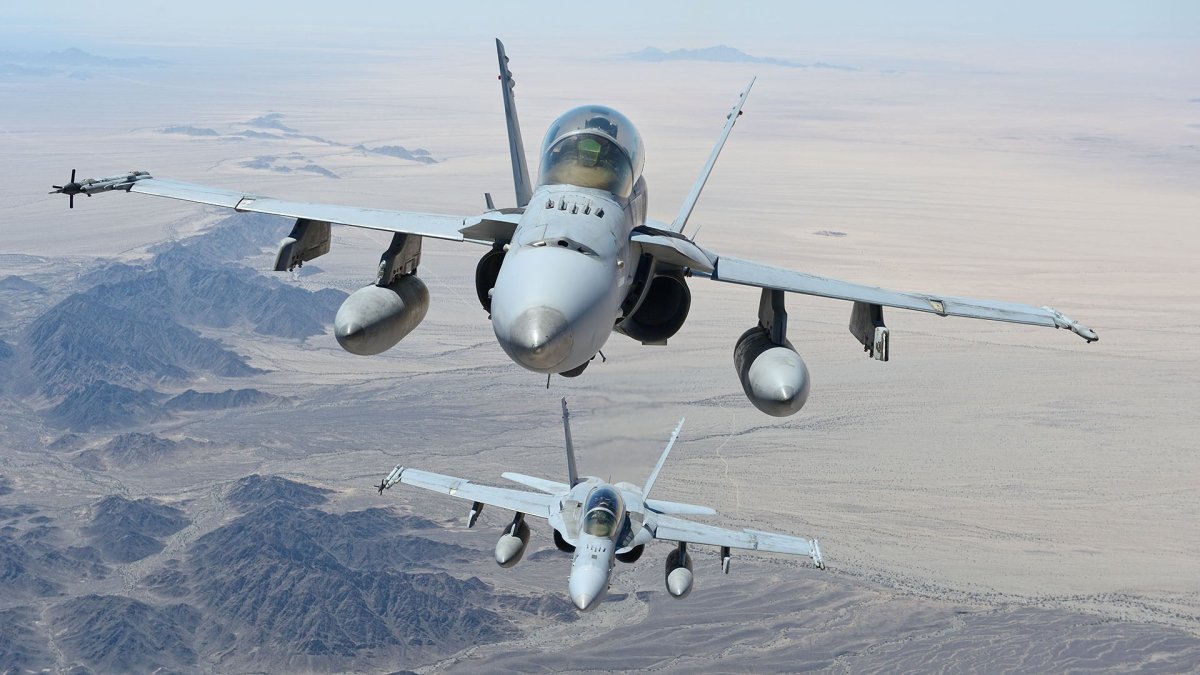
Updated Nov 27, 2020 6:24 PM EST
The U.S. Marine Corps is moving towards a streamlined fleet of Lockheed Martin F-35B and C-model Lightning IIs for all of its tactical aircraft (TACAIR) needs post-2030. While USMC leadership juggles the exact planning over the number of the stealthy fighters it will need to meet future requirements, both the McDonnell Douglas AV-8B Harrier II and F/A-18A-D Hornet fleets will continue to provide Close Air Support (CAS) for Marines on the ground and air cover above the battlefield. Under current plans, the Harrier II will bow out in Fiscal Year 2028, followed by the Hornet in 2030.
The aging Marine Corps Hornet fleet is composed of a range of 1980s-era F/A-18A-D models, all of which have undergone various upgrades. Now, in order to bridge the decade-long gap between now and the type’s retirement, a select batch of approximately 84 Hornets has been earmarked to make it through to the planned “sundown” despite their advanced years via a series of upgrades, the likes of which the Hornet has never seen.
With the Hornet considered to be the USMC’s most potent air-to-air and air-to-ground “legacy” fighter aircraft, the so-called “best-in-breed” are now receiving High Flight Hour (HFH) inspections during depot-level maintenance that will see them out to 10,000 flight hours. Concurrently, they are being equipped with new technology that will enable them to bridge the gap to the Marine Lightning fleet of 2030-onwards.
Known unofficially as “Classic” Hornets, these first-generation F/A-18s were ultimately superseded by the larger F/A-18E/F Super Hornet in U.S. Navy service. The original A-D models have now all been retired from the front line Navy fleet. Some of these aircraft have been redirected into the USMC to help prop up the fleet as the Marines’ eye a planned “sunset” of 2030 for the Hornet.
The U.S. Marine Corps aims to operate up to seven active-duty Hornet squadrons with the latest upgrades., Jamie Hunter
The F/A-18A-D Program Management Agency (PMA) is actively engaged in future plans for the fleet, which includes managing multiple readiness initiatives, planning an aggressive strike/store plan, and implementing re-engineered end of life Planned Maintenance Inspection (PMI) events. Twice yearly reviews are held to identify the most suitable aircraft that will ensure the Marines keep a credible fleet of Hornets on the flight line now and into the future.
U.S. Marine Corps leadership has laid out the broad ambition for its Hornet strike fighter fleet in its annual Aviation Plans of recent years. Central to this is a series of upgrades that will ultimately realize up to seven squadrons-worth of best condition Hornets, all of which will receive a new Active Electronically Scanned Array (AESA) radar in the form of the Raytheon AN/APG-79(v)4 .
This radar is based on the AN/APG-79(v)1 radar that equips Block 2/3 F/A-18E/F Super Hornets and EA-18G Growlers. Ambitions for an AESA radar for the Classic Hornet have been in train for a decade, as have numerous other plans. In conjunction with a new advanced self-protection system and a suite of modern precision-guided weapons, the Hornet is being made as lethal as possible in order for it to meet high-end missions over the coming decade.
Speaking to The War Zone , former Hornet Weapons Systems Officer (WSO) Lt Col Michael “Sock” Pavis is the F/A-18A-D Capabilities Lead and F/A-18A-D Air Vehicle Lead for the PMA-265 Hornet Program Office at Naval Air Station Patuxent River in Maryland. “The Marine Corps Aviation Plan is the foundation of the plan for U.S Marine Corps F/A-18A-Ds. That’s a “sundown” of 2030 and supporting the transition to F-35. During that transition, the Hornet is the Marine Corps aircraft that has the greatest variety of both air-to-air and air-to-surface weapons. So. we need to support that, and the National Defense Strategy, to ensure we are lethal, survivable, and ready.”
The U.S. Marine Corps transition plan to the F-35., USMC
“Keeping that in mind, we are looking at transitioning all our A-D squadrons to be composite squadrons , each with seven F/A-18Cs and five F/A-18Ds. [We will use] the most valuable fleet, [one that gives us] the most capability for the lowest cost of ownership. The F/A-18 was initially designed for 6,000 flight hours, and is now extended to 8,000 hours. Following a High Flight Hour [HFH] inspection, we’re able to fly those F/A-18s to 10,000 hours. That HFH inspection is expensive and time consuming, and [involves] a lot of time where those aircraft are not able to be used because they’re in the depot. The ones that have completed the HFH inspection and are compatible with capability upgrades like the AN/APG-79(v)4 radar, the AN/ALQ-214(v)5 and AN/ALR-67 electronic warfare suites — those aircraft are the most valuable as they provide the most available flying time with the least expensive depot costs. So, we are able to have our best flyers out there for the longest period of time for the lowest cost. We have a most valuable fleet mindset to reduce cost of ownership and keep the highest capability possible.”
The new composite squadron plan means that the seven remaining active-duty Marine Corps Hornet squadrons will be able to support all F/A-18 mission sets. “It’s partially a manpower solution, in that we have Hornet WSOs that we have created, but we are finishing that training of new WSOs in the next few years. The career field will remain throughout the life of the Hornet as they are still valuable and they add a mission set, particularly in the Forward Air Controller (Airborne) capability and Tactical Air Control mission that only those two-seat crews can do,” Pavis explains. “By spreading those throughout the fleet, you get better usage of our WSOs throughout the squadrons. It’s a mission and a logistic solution by going to composite squadrons — it’s not driven by hours remaining on aircraft or airframes specifically.”
Selecting the “best-in-breed”
The USMC’s Hornet squadrons have struggled over recent years with readiness — having sufficient available airframes to meet commanders’ requirements. According to the 2018 Marine Aviation Plan : “The USMC fleet currently has eleven active squadrons and one reserve squadron. In recent years there has been an aircraft inventory shortage due to In Service Repairs (ISR) and depot maintenance backlog. HQMC has reset the force by temporarily reducing squadron flightline entitlement (FLE) to 10 aircraft to preserve future combat readiness while meeting today’s current operational requirements. As inventory continues to recover we will return to a community FLE of 12 with deploying squadrons beginning in 3rd quarter of FY17.”
A pilot conducts pre-flight checks on a Hornet as MCAS Miramar., Jamie Hunter
Naval Air Systems Command has conducted an exhaustive study of the overall Hornet fleet with the aid of a predictive flight hour tool to assess which of the aircraft will provide the best availability and lowest overall support cost through to 2030. “In that analysis we also looked at which aircraft are compatible with accepting our capability upgrades that we need,” Pavis explains. “That creates best-of-breed. Getting us the most flight hours for the least amount of depot cost. There’s a cut-off line at a certain production Lot [build] number, above that Lot number they’re able to accept those upgrades, below it they can’t. [That’s] Lot 15 and above F/A-18Cs and Lot 14 and above Ds. That was the initial neck down, then we look at what’s available, what’s valuable, and what’s going to give us the most hours.”
“When we’re assessing aircraft, we are looking at the overall number of hours it’s flown and also the fatigue life expended.” One of the most influential fatigue factors relates to the wing root, which, if in need of replacement, drives a time consuming and expensive structural upgrade known as Center Barrel Replacement Plus (CBR+).
According to the 2019 Marine Aviation Plan : “The F/A-18 Service Life Management Program (SLMP) consists of the Center Barrel Replacement Plus (CBR+) and High Flight Hour (HFH) inspection programs.The CBR+ has extended the service life of numerous Lot 17 and below aircraft and the HFH inspection has extended the life of the F/A-18A-D aircraft beyond 8,000 hours. In parallel with HFH and CBR+ maintenance, the Service Life Extension Program (SLEP) incorporates a combination of inspections, repairs and a number of Engineering Change Proposals to extend additional F/A-18A/C/D to 10,000 Flight Hours. The Naval Aviation Enterprise has re-engineered the post-8,000 hour end of life maintenance plan.”
According to Pavis: “We went through our fatigue life, looked at our hours, the ability to accept the capability upgrades and looked at what needs CBR and not, and we were able to drastically reduce the number of forecast CBRs we have left to the order of less than five more planned future CBR inductions. By doing that we will have aircraft and can fly them the way we need to with only a small mitigation for fatigue life to make sure they keep their 10,000 hours.”
“The analogy we have been using is “the pig is passing through the python.” We have an immense number of aircraft in depot level maintenance right now getting that 8,000 HFH inspection. We’ve inducted a bunch and we’re delivering them as fast as we can, but our work in progress number right now is the highest it’s going to be. Those are the ones that are going to take us to 2030, because they have 2,000 hours left on them. There’s another inspection at 9,000 hours but it’s minor.”
Composite Hornet squadrons will allow the USMC to retain the WSO career field until the final retirement of the Hornet., Jamie Hunter
In addition to the active squadrons, a single Reserve unit at Naval Air Station/Joint Reserve Base Fort Worth, Texas, also flies the Hornet. VMFA-112 “Cowboys” is transitioning from older F/A-18A+ aircraft to low-hour Lot 10 and 11 F/A-18Cs, which are being upgraded by Boeing to C+ configuration. This project originally included 30 Hornets but was later reduced to 19. “We have delivered seven Hornets from of our C+ program, and have 12 left to deliver to support VMFA-112 through its “sundown,” explains Pavis.
The F/A-18C+ upgrade provides the F/A-18C+ with Multifunctional Information Distribution System-Low Volume Terminal (MIDS-LVT) digital communications, the Naval Aircrew Common Ejection Seat (NACES), Joint Helmet-Mounted Cueing System (JHMCS), Tactical Aircraft Moving Map Capabilities (TAMMAC) and new full-color cockpit displays. The F/A-18C+ is also compatible with the latest AN/AAQ-28 Litening Gen4 targeting pod.
A host of individual upgrade projects over recent years have been wrapped into a succession of software “drops” known as Operational Flight Programs, or OFPs. These have included Link-16 data link functionality, the Gen4 Litening pod, and required radar navigation upgrades to meet modern air traffic control regulations.
Currently being retrofitted across the selected fleet of Hornets is a suite of electronic warfare enhancements. “We are outfitting aircraft with the ALE-67(v)3 Radar Warning Receiver [RWR], plus replacing the ALQ-165 ASPJ [Airborne Self-Protection Jammer] with the ALQ-214(v)5, and those efforts are ongoing,” says CDR Bisher “Binger” Mufti, the Radar/Future Electronic Warfare Lead in PMA-265.
Additional approved and funded programs coming down the pipe include an Automatic Ground Collision Avoidance System ( Auto-GCAS ), which Pavis says will be added “as soon as possible.” So-called NAVWAR upgrades are funded as a new start in FY2022, for incorporation in FY2023-2024 and will be added to enable the assurance of GPS and timing, according to Pavis. This relates to jamming-resistant GPS systems that are applicable in certain operational scenarios, which you can read more about here in this previous War Zone piece .
Weapons upgrades have included the addition of the AIM-9X Block II , AIM-120D Advanced Medium-Range Air-to-Air Missile (AMRAAM) and the AGR-20A Advanced Precision Kill Weapon System (APKWS), which is a Hydra 70 unguided rocket with a laser guidance kit to turn them into precision-guided munitions. Combining the new weapons with a new Active Electronically Scanned Array (AESA) radar unlocks a whole new level of capability for the Hornet.
AESA technology not only offers significant improvements in combat capability, but also greater reliability due to the reduction in the number of moving parts. The operational improvements include enhanced detection and tracking ranges, target discrimination and identification, the ability to spot low-flying reduced radar cross-section targets like cruise missiles, as well as the capability to rapidly scan huge volumes of airspace as AESA radars do not rely on a mechanically steered radar dish to do so.
An obsolescence and capability upgrade to replace the existing AN/APG-73 system in the Hornet has been a long-term ambition for the Marine Corps. Raytheon initially performed a fit check in 2010 with what was known then as the APG-79(VX), also known as the Raytheon Advanced Combat Radar (RACR). However, plans did not firm up until the 2018 Marine Aviation Plan.
Raytheon engineers fit-check an APG-79(v)4 on a Hornet., Raytheon
Candidate radars also included Northrop Grumman’s Scalable Agile Beam Radar (SABR), with the company undertaking a Hornet fit check in 2018. On January 15, 2019, Raytheon announced that the U.S. Marine Corps had awarded it a contract for the AN/APG-79(v)4 that could ultimately lead to the retrofit of seven squadrons worth of F/A-18C/Ds — the current budget includes 75 total radars for the Marines. Naval Air Systems Command awarded Raytheon a contract worth $30.2-million that covered the first nine production-standard sets for delivery from December 2021. Notably, Canada has also selected the same radar for the upgrade of its CF-18 Hornets, which you can read about here .
This radar’s lineage in the Super Hornet’s AN/APG-79 was a major consideration when selecting the optimum candidate for a cost-effective retrofit. “The AN/APG-79(v)4 is designed to be compatible with the software that already exists in the Hornet and runs the current AN/APG-73,” says Lt Col Pavis. The commonality with the APG-79(v)1 in the Super Hornet and Growler also helps to minimise cost when it comes to future software development for the new Hornet radar. “What we really get with the AESA is supply chain streamlining,” adds CDR Mufti. “APG-79(v)1 is in our Super Hornets and the (v)4 shares about 90 percent commonality with that. This is the best way to ensure the radar is supportable and sustainable until sundown.”
“The [initial] nine radars was the first procurement and designed to get the ball rolling,” Mufti adds. This was in addition to a previous contract for test sets to be delivered in order to commence Hornet integration work at Naval Air Warfare Station China Lake, California. This includes a RACR test radar and four Engineering Development Model (EDM) radars that will arrive at China Lake over the coming year. One of these is just an antenna, which will be used for test work. Pavis says hardware installations of the set itself can either be made in the depot during scheduled inspections or in the field at operational units, whichever is deemed to be the most efficient. The Hornet’s new OFP 29C+ mission software is currently in development to support the initial introduction of the new radar.
The USMC is hoping to fund more Hornet upgrades including new cockpit displays., Jamie Hunter
Looking further ahead, there are still some unfunded upgrades that Pavis says the Marines still require for the Hornet. This includes the improved AN/ALR-67(v)5 RWR. “We also have obsolescence and maintainability issues with our cockpit displays; the left and right digital display indicators [DDIs] and our Cockpit Video Recording System [CVRS],” he says, adding that incremental upgrades on the roadmap are in various states of funding and planning.
Overall, this coherent set of plans will provide for what will arguably be the most potent set of original Hornets on the planet. As F-35 fielding plans have slipped to the right, the ability for the F/A-18 to adapt through life extensions and capability insertions has provided the USMC with an extremely useful back-up option.
Despite all the new enhancements, the Marine Corps has no plans to change the designation of its Hornets. Moreover, Pavis is keen to point out that the various unofficial monikers that have been used in recent times for the F/A-18A-D fleet simply aren’t recognized within U.S. Navy and Marine Corps circles. “It is the F/A-18A-D Hornet. No “Legacy,” no “Legendary,” no “Classic,” we are the Hornet,” he asserts.
Contact the editor: Tyler@thedrive.com
Comments couldn’t be loaded. Please refresh the page.
更新于美国东部时间2020年11月27日下午6:24。
美国海军陆战队正朝着精简机队方向发展,计划在2030年后全部采用洛克希德·马丁公司的F-35B和C型“闪电II”战斗机来满足其战术飞机(TACAIR)需求。尽管海军陆战队领导层仍在权衡未来所需隐形战斗机的具体数量,但麦克唐纳·道格拉斯公司的AV-8B“鹞”式II和F/A-18A-D“大黄蜂”机队将继续为地面海军陆战队员提供近距离空中支援(CAS),并为战场上空提供空中掩护。根据目前的计划,“鹞”式II将于2028财年退役,“大黄蜂”将于2030年退役。
海军陆战队老旧的F/A-18“大黄蜂”战斗机机队由一系列上世纪80年代生产的F/A-18A-D型组成,这些飞机都经历过不同程度的升级。如今,为了弥补该机型退役前长达十年的空档期,一批约84架“大黄蜂”战斗机被选中进行升级改造,使其能够服役到预定的“日落”日期。这些升级改造规模空前,远超“大黄蜂”战斗机的服役年限。
由于“大黄蜂”战斗机被认为是美国海军陆战队最强大的空对空和空对地“传统”战斗机,这些所谓的“同类最佳”战机目前正在基地级维护期间接受高飞行小时(HFH)检查,以确保其飞行时间达到10,000小时。与此同时,它们正在配备新技术,以使其能够顺利过渡到2030年及以后的“闪电”战斗机机队。
这些非正式地被称为“经典”F/A-18“大黄蜂”的第一代战机,最终被美国海军服役的更大型号F/A-18E/F“超级大黄蜂”所取代。最初的AD型战机现已全部从海军一线部队退役。其中一些飞机已被转交给美国海军陆战队,以帮助维持其机队实力,因为海军陆战队计划在2030年之前逐步淘汰“大黄蜂”战机。
美国海军陆战队计划部署多达七个现役“大黄蜂”战斗机中队,并采用最新的升级方案。——杰米·亨特
F/A-18A-D项目管理机构(PMA)积极参与该机队的未来发展规划,包括管理多项战备计划、制定积极的打击/挂载计划以及实施重新设计的退役计划维护检查(PMI)。每年两次的审查旨在确定最合适的机型,以确保海军陆战队现在和将来都能保持一支可靠的“大黄蜂”机队在役。
美国海军陆战队领导层在近几年的年度航空计划中阐述了其“大黄蜂”攻击战斗机机队的宏伟目标。该计划的核心是一系列升级,最终将使多达七个中队的“大黄蜂”战斗机达到最佳状态,所有这些战斗机都将配备新型有源电子扫描阵列(AESA)雷达,即雷神公司生产的AN/APG-79(v)4型雷达。
这款雷达基于装备于Block 2/3型F/A-18E/F“超级大黄蜂”和EA-18G“咆哮者”电子战飞机的AN/APG-79(v)1雷达。为经典型“大黄蜂”配备有源相控阵雷达的计划已酝酿十年之久,其他诸多计划亦是如此。配合新型先进自卫系统和一系列现代化精确制导武器,“大黄蜂”正被打造得尽可能强大,以应对未来十年的高端任务。
前“大黄蜂”武器系统官(WSO)迈克尔·“索克”·帕维斯中校现任马里兰州帕图克森特河海军航空站PMA-265“大黄蜂”项目办公室的F/A-18A-D能力负责人和F/A-18A-D飞行器负责人。他接受《战区》采访时表示:“海军陆战队航空计划是美国海军陆战队F/A-18A-D计划的基础。该计划的目标是到2030年‘退役’,并支持向F-35的过渡。在这一过渡期间,‘大黄蜂’是海军陆战队拥有最丰富空对空和空对地武器的飞机。因此,我们需要支持该计划以及国家国防战略,以确保我们拥有致命的杀伤力、生存能力和战备状态。”
美国海军陆战队向F-35过渡的计划。
“考虑到这一点,我们正在考虑将所有防空中队转型为混合中队,每个中队配备7架F/A-18C和5架F/A-18D。[我们将使用]最有价值的机队,[以]最低的拥有成本提供最强大的作战能力。F/A-18最初的设计飞行时间为6000小时,现在已延长至8000小时。经过高飞行小时(HFH)检查后,我们可以将这些F/A-18的飞行时间延长至10000小时。高飞行小时检查既昂贵又耗时,而且[需要]大量时间让飞机停放在维修站,无法使用。那些已经完成高飞行小时检查并兼容AN/APG-79(v)4雷达、AN/ALQ-214(v)5和AN/ALR-67电子战套件等能力升级的飞机,这些飞机最有价值,因为它们能以最低的维修成本提供最长的飞行时间。因此,我们能够以最低的成本,让最优秀的飞行员在最长的时间内保持飞行状态。我们秉持着打造最有价值机队的理念,旨在降低拥有成本,同时保持尽可能高的性能。
新的混合中队计划意味着现役的七个海军陆战队“大黄蜂”战斗机中队将能够支持所有F/A-18任务。“这部分是人力解决方案,因为我们已经组建了‘大黄蜂’武器系统操作员(WSO)队伍,但我们正在未来几年内完成新WSO的培训。WSO这一职业领域将在‘大黄蜂’的整个服役周期内持续存在,因为他们仍然很有价值,而且他们能够执行一系列任务,尤其是在前线空中管制(空中)能力和战术空中管制任务方面,这些任务只有双座机组才能完成,”帕维斯解释道。“通过将这些WSO分配到整个机队,我们可以更好地利用各个中队的WSO资源。组建混合中队是一种任务和后勤解决方案——它并非仅仅基于飞机或机体的剩余飞行小时数。”
选择“同类最佳”
近年来,美国海军陆战队的“大黄蜂”战斗机中队在战备方面一直面临挑战,即缺乏足够的飞机来满足指挥官的需求。根据2018年海军陆战队航空计划:“美国海军陆战队目前拥有11个现役中队和1个预备役中队。近年来,由于在役维修(ISR)和基地维护积压,飞机库存一直短缺。海军陆战队总部已调整部队配置,暂时将各中队的飞行线配额(FLE)减少至10架飞机,以在满足当前作战需求的同时,确保未来的战备能力。随着库存的逐步恢复,我们将恢复到12架的飞行线配额,并于2017财年第三季度开始部署中队。”
一名飞行员在米拉马尔海军陆战队航空站对一架“大黄蜂”战斗机进行飞行前检查。(杰米·亨特摄)
海军航空系统司令部借助飞行小时预测工具,对整个“大黄蜂”机队进行了详尽的研究,以评估哪些飞机在2030年之前能够提供最佳的可用性和最低的总体支持成本。“在分析中,我们还研究了哪些飞机可以兼容我们所需的性能升级,”帕维斯解释说。“这造就了最佳机型,让我们能够以最低的维修成本获得最多的飞行小时。生产批次(批次号)是划分标准,高于该批次号的飞机可以进行升级,低于该批次号的则不行。[例如]第15批次及以上的F/A-18C和第14批次及以上的F/A-18D。这是初步筛选,然后我们考察哪些飞机可用、哪些飞机有价值,以及哪些飞机能够为我们提供最多的飞行小时。”
“我们在评估飞机时,会考虑飞机的总飞行小时数以及疲劳寿命。” 其中一个影响最大的疲劳因素与机翼根部有关,如果需要更换,则需要进行耗时且昂贵的结构升级,称为中心筒更换加强版 (CBR+)。
根据2019年海军陆战队航空计划:“F/A-18使用寿命管理计划(SLMP)包括中心筒更换加强版(CBR+)和高飞行小时(HFH)检查计划。CBR+延长了许多第17批次及之后生产的飞机的使用寿命,而HFH检查则将F/A-18A-D飞机的使用寿命延长至8000小时以上。与HFH和CBR+维护并行,使用寿命延长计划(SLEP)结合了检查、维修和多项工程变更提案,旨在将更多F/A-18A/C/D的飞行小时数延长至10000小时。海军航空企业已重新设计了8000小时后的报废维护计划。”
帕维斯表示:“我们评估了飞机的疲劳寿命,查看了飞行小时数,评估了飞机接受能力升级的可行性,并分析了哪些飞机需要进行耐久性升级(CBR),哪些不需要。最终,我们大幅减少了预计需要进行的耐久性升级数量,未来计划引进的耐久性升级数量将减少到不到五架。通过这种方式,我们将拥有足够的飞机,并能按照我们的需求进行飞行,只需采取少量措施来缓解疲劳寿命问题,以确保飞机能够达到10000小时的飞行小时数。”
我们一直用“猪过蟒蛇”来打比方。目前有大量飞机正在进行大修,进行8000小时的HFH(高频飞行小时)检查。我们已经接收了一批,并正在以最快的速度交付,但目前在建项目的数量已经达到最高水平。这些飞机将陪伴我们到2030年,因为它们还有2000小时的剩余寿命。9000小时时还有一次检查,但那次检查比较简单。
混合编队“大黄蜂”中队将使美国海军陆战队能够保留武器系统操作员(WSO)这一职业领域,直至“大黄蜂”最终退役。——杰米·亨特
除了现役中队外,位于德克萨斯州沃斯堡海军航空站/联合后备基地的一个预备役部队也装备了F/A-18“大黄蜂”战斗机。VMFA-112“牛仔”中队正在从老旧的F/A-18A+战机过渡到低飞行小时数的10批次和11批次F/A-18C战机,这些战机正在由波音公司升级至C+配置。该项目最初计划订购30架“大黄蜂”战机,但后来减少到19架。“我们已经交付了C+项目中的7架‘大黄蜂’战机,还有12架需要交付,以支持VMFA-112中队完成其‘退役’阶段,”帕维斯解释道。
F/A-18C+升级为F/A-18C+配备了多功能信息分发系统低容量终端(MIDS-LVT)数字通信系统、海军通用弹射座椅(NACES)、联合头盔瞄准系统(JHMCS)、战术飞机移动地图能力(TAMMAC)以及全新的全彩座舱显示器。F/A-18C+还兼容最新的AN/AAQ-28“闪电”第四代瞄准吊舱。
近年来,一系列独立的升级项目被整合到一系列被称为“运行飞行计划”(OFP)的软件“更新”中。这些项目包括Link-16数据链功能、第四代Litening吊舱,以及为满足现代空中交通管制条例而进行的必要雷达导航升级。
目前正在对部分“大黄蜂”战机进行电子战升级改造。“我们正在为飞机配备ALE-67(v)3雷达告警接收机(RWR),并将ALQ-165机载自卫干扰机(ASPJ)更换为ALQ-214(v)5,这些工作正在进行中,”PMA-265中队雷达/未来电子战负责人比舍尔·“宾格”·穆夫提中校说道。
其他已获批准并正在筹备的项目包括自动地面防撞系统(Auto-GCAS),帕维斯表示该系统将“尽快”投入使用。所谓的导航战系统(NAVWAR)升级项目已于2022财年启动,计划在2023-2024财年完成,帕维斯称,升级后的系统将确保GPS和授时功能的可靠性。这涉及到适用于特定作战场景的抗干扰GPS系统,您可以在之前的“战区”文章中了解更多信息。
武器升级包括加装AIM-9X Block II导弹、AIM-120D先进中程空空导弹(AMRAAM)以及AGR-20A先进精确杀伤武器系统(APKWS)。APKWS是在Hydra 70无制导火箭的基础上加装激光制导套件,使其具备精确制导能力。这些新武器与新型有源相控阵雷达(AESA)的结合,使“大黄蜂”战斗机的作战能力提升到了一个全新的水平。
AESA技术不仅显著提升了作战能力,而且由于减少了活动部件的数量,可靠性也更高。其作战性能的提升包括:探测和跟踪距离的扩大、目标区分和识别能力的增强、对低空飞行、雷达反射截面积小的目标(例如巡航导弹)的探测能力,以及由于AESA雷达无需机械旋转的雷达天线,因此能够快速扫描大片空域。
海军陆战队长期以来一直希望对“大黄蜂”战斗机上现有的AN/APG-73系统进行升级改造,以解决其性能老化问题。雷神公司最初于2010年对当时被称为APG-79(VX)(也称为雷神先进作战雷达,RACR)的系统进行了适配性测试。然而,直到2018年海军陆战队航空计划中,相关计划才最终确定。
雷神公司工程师正在对一架“大黄蜂”战斗机上的APG-79(v)4进行适配性检查。
候选雷达还包括诺斯罗普·格鲁曼公司的可扩展敏捷波束雷达(SABR),该公司于2018年对F/A-18“大黄蜂”战斗机进行了适配性测试。2019年1月15日,雷神公司宣布美国海军陆战队已授予其AN/APG-79(v)4雷达合同,该雷达最终可能用于改装七个中队的F/A-18C/D战斗机——目前的预算包括为海军陆战队采购共计75部雷达。海军航空系统司令部授予雷神公司一份价值3020万美元的合同,涵盖首批九套生产标准雷达,将于2021年12月开始交付。值得注意的是,加拿大也选择了同一款雷达用于其CF-18“大黄蜂”战斗机的升级,您可以在这里阅读相关信息。
这款雷达源自超级大黄蜂的AN/APG-79雷达,这是选择最具成本效益的升级方案时的一个重要考量因素。“AN/APG-79(v)4的设计与大黄蜂现有的软件兼容,并运行着现有的AN/APG-73雷达,”帕维斯中校说道。它与超级大黄蜂和咆哮者无人机上使用的APG-79(v)1雷达的通用性也有助于最大限度地降低未来为新型大黄蜂雷达开发软件的成本。“我们采用AESA雷达的真正优势在于简化了供应链,”穆夫提指挥官补充道。“我们的超级大黄蜂战机上使用的是APG-79(v)1雷达,而(v)4雷达与其有大约90%的通用性。这是确保雷达能够持续运行到日落的最佳方式。”
穆夫提补充道:“首批采购的九部雷达是第一批产品,旨在启动整个项目。”此前,海军航空作战中心(位于加利福尼亚州中国湖)已签订合同,采购测试设备,以便在该基地启动“大黄蜂”战斗机的集成工作。这批设备包括一部RACR测试雷达和四部工程开发模型(EDM)雷达,它们将在未来一年内抵达中国湖。其中一部仅为天线,将用于测试工作。帕维斯表示,雷达设备的硬件安装既可以在基地定期检查期间进行,也可以在作战部队现场进行,具体取决于哪种方式效率最高。“大黄蜂”战斗机的新型OFP 29C+任务软件目前正在开发中,以支持新雷达的首次投入使用。
美国海军陆战队希望为“大黄蜂”战斗机提供更多升级资金,包括新的座舱显示器。——杰米·亨特
展望未来,帕维斯表示,海军陆战队仍需为“大黄蜂”战机进行一些尚未获得资金支持的升级。这其中包括改进型的AN/ALR-67(v)5雷达告警接收机(RWR)。他说道:“我们的座舱显示器也存在老化和维护方面的问题,例如左右数字显示指示器(DDI)和座舱视频录制系统(CVRS)。”他还补充说,路线图上的各项升级目前处于不同的资金筹措和规划阶段。
总体而言,这套协调一致的计划将打造出堪称全球最强大的F/A-18“大黄蜂”战斗机。随着F-35部署计划的推迟,F/A-18通过延寿和能力升级实现的适应能力,为美国海军陆战队提供了一个极其有用的备用方案。
尽管进行了诸多改进,海军陆战队仍无意更改其“大黄蜂”战机的正式名称。此外,帕维斯强调,近年来美国海军和海军陆战队内部并未认可F/A-18A-D机队使用的各种非官方名称。“它就是F/A-18A-D‘大黄蜂’。没有‘传承’、没有‘传奇’、没有‘经典’,我们就是‘大黄蜂’。”他断言道。
联系编辑:Tyler@thedrive.com
评论加载失败,请刷新页面。