Macron sends $438 billion military budget plan to French parliament马克龙向法国议会提交了一份4380亿美元的军费预算计划。
Gradual increases would see the 2030 annual defense budget top €60 billion, almost double from 2017.
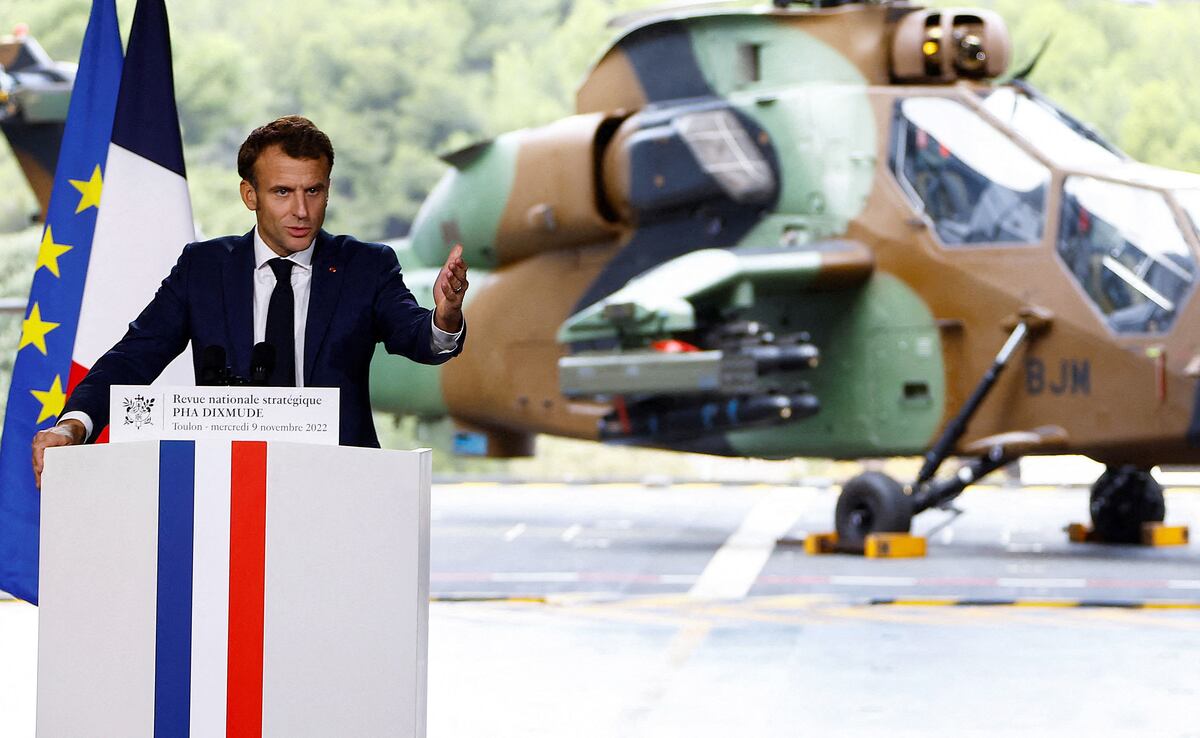
STUTTGART, Germany — France’s government is pouring hundreds of billions of euros into shoring up its military apparatus via its newest military programming law, which, if enacted, would support new capability efforts and ongoing programs through the end of the decade.
Officials unveiled the proposed 2024-2030 military programming law (LPM) on April 4, ahead of presenting it to France’s legislative bodies. The five-year programming law has been in development since spring 2022, and was honed during top-level meetings with French President Emmanuel Macron, Prime Minister Elisabeth Borne, and Defense Minister Sebastien Lecornu, said Army Col. Yann Latil, director of the ministry’s strategic capability cell, during an April 3 media briefing.
In January, Macron first announced that the LPM would include €400 billion ($435 billion) in investments, and cover a total of €413 ($450) billion in military needs. The investments are intended to target several areas of focus, to include a need for additional munitions and weaponry in the wake of Russia’s attack on Ukraine and a return to high intensity conflict on the European continent. Officials also cited increasing tensions in the Indo-Pacific region, and the increasingly speedy pace of technology innovation as incentives for the priorities set in this programming law.
The ministry plans to request an additional €1.5 billion be added to the 2023 annual defense budget, bringing it from €43.9 billion to about €45.4 billion. The annual budgets would then increase year over year by at least €3 billion through 2030, said François Bolard, the ministry’s budget adviser.
Specifically, the budget will increase by €3.1 billion in the 2024 budget; by €3 billion in 2025, 2026, and 2027, and by €4.3 billion in 2028, 2029, and 2030, he told reporters. By 2030, France’s annual defense budget is expected to top €60 billion; nearly double the amount allocated in 2017 of €32 billion, he added.
Over the course of the next five years, the French military is both continuing ongoing capability reboots and launching new initiatives.
The development of the nation’s next-generation aircraft carrier, dubbed PANG for the French porte-avion nouvelle generation , will kick into high gear, with plans to put the Naval Group-built carrier to sea in 2036-2037, and begin trials in 2037-2038, officials said. Also in the maritime domain, France is scheduled to receive 15 new frigates by 2030, including three new FDI models meant for defense and intervention.
France’s air force will see the entry of the MBDA-developed, renovated medium range air-to-surface (ASMPA-R) missile during this budget cycle, as well as the development of its expected successor, the fourth-generation nuclear air-to-ground (ASN4G) hypersonic cruise missile that will succeed it. ArianeGroup is on contract to develop and manufacture the new missile.
Paris will continue its timeline to achieve an “all Rafale” air fleet by 2035, and expects to procure 32 new fighter jets from contractor Dassault Aviation within the LPM, which will be delivered between 2030 and 2032, officials said. The Future Combat Air System (FCAS) next-generation fighter and weapon program in development by France, Spain, and Germany, should see its first fighter demonstrator come to fruition under this LPM, in 2027.
The French military will also continue to modernize its land forces via the mammoth “Scorpion” overhaul program of its ground vehicles and associated equipment. Studies on the design for the Franco-German Main Ground Combat System (MGCS) next-generation tank will continue in the time period, officials said.
In the space domain, France plans to launch a new orbital space surveillance project, using nanosatellites to patrol Geostationary Orbit (GEO), identify potential on-orbit threats to national assets, and if necessary, disable the threat with an on-board laser
In partnership with the national space center CNES, the Air and Space Force intends to launch a demonstrator nanosatellite in 2023 under the “Yoda” project, with the system in development by contractor Hemeria. By 2030, a mature capability dubbed “Egide” would take on the “patrolling satellite” mission, the officials said.
The on-orbit laser is being developed under the “FLAMHE” project moniker. France is also anticipating developing a ground-to-space laser system dubbed BLOOMLASE, with both capabilities to be operational by the end of the decade.
While undersea warfare has become a major topic in France since former Defense Minister Florence Parly released the first undersea strategy in early 2022, ministry officials could not provide a fixed funding number for investments in the domain. They said only that it would be in the “hundreds of millions” of euros, and include investments in underwater drones that can reach 6,000 meters of depth, other types of undersea and subsea remotely operated vehicles, and upgrades to anti-mine vessels.
A report issued Monday by the French Ministry of Defense detailed the following planned investments:
€5 billion for intelligence and counterintelligence efforts;
€13 billion for overseas capabilities and initiatives;
€5 billion for “drones,” to include unmanned systems and remotely operated munitions, as well as development on the Eurodrone medium-altitude, long-endurance UAV in development by Airbus for France, Spain, Germany, and Spain.
€5 billion for surface-to-air defense capabilities;
€16 billion for munitions, including the modernization of long-range anti-ship missiles, as well as F321 heavy torpedoes and new surface-to-air and air-to-air interceptors (MBDA’s Aster-MICA and METEOR families, respectively);
€49 billion for maintenance and conditional operations, a 49% increase over the previous LPM;
€10 billion for innovative technology investments, to include directed energy technology, swarming drones, and robotic capabilities;
€6 billion for the space domain;
€4 billion for cyber defense.
The €400 billion investments outlined in this programming law do not include any military support France might provide to Ukraine in the future, officials told reporters. “The Ukraine support is something that could evolve in time, and the president wanted to guarantee the evolution of this support could never impact our own capability buildup,” Bolard said. The bulk of France’s support to Ukraine would come via the European Union’s off-book European Peace Facility (EPF) funding mechanism, but officials did not share how much funding has been allocated to aid to Ukraine to date.
The French administration hopes the LPM will be voted on by Congress before the July 14th holiday, Bolard said.
Vivienne Machi is a reporter based in Stuttgart, Germany, contributing to Defense News' European coverage. She previously reported for National Defense Magazine, Defense Daily, Via Satellite, Foreign Policy and the Dayton Daily News. She was named the Defence Media Awards' best young defense journalist in 2020.
德国斯图加特——法国政府正通过最新的军事规划法投入数千亿欧元来加强其军事力量。如果该法案获得通过,将支持新的能力建设和正在进行的项目,直至本十年末。
4月4日,官员们公布了拟议的2024-2030年军事规划法(LPM),随后将其提交给法国立法机构。国防部战略能力部门主任、陆军上校扬·拉蒂尔在4月3日的新闻发布会上表示,这项为期五年的规划法自2022年春季以来一直在制定中,并在与法国总统埃马纽埃尔·马克龙、总理伊丽莎白·博尔内和国防部长塞巴斯蒂安·勒科尔努举行的高级别会议上进行了完善。
今年1月,马克龙首次宣布,《国防政策手册》(LPM)将包含4000亿欧元(约合4350亿美元)的投资,涵盖总计4130亿欧元(约合4500亿美元)的军事需求。这些投资旨在重点关注多个领域,包括应对俄罗斯入侵乌克兰后对额外弹药和武器的需求,以及应对欧洲大陆再次爆发的高强度冲突。官员们还指出,印太地区日益紧张的局势以及技术创新日新月异的发展,也是促成该规划法案中各项优先事项的原因。
国防部计划申请在2023年度国防预算中增加15亿欧元,使其从439亿欧元增至约454亿欧元。国防部预算顾问弗朗索瓦·博拉尔表示,此后,到2030年,年度预算将逐年至少增加30亿欧元。
他告诉记者,具体而言,2024年预算将增加31亿欧元;2025年、2026年和2027年将分别增加30亿欧元;2028年、2029年和2030年将分别增加43亿欧元。他还补充说,到2030年,法国的年度国防预算预计将超过600亿欧元,几乎是2017年320亿欧元预算的两倍。
在接下来的五年里,法国军方既将继续进行现有能力的重启,也将继续推出新的举措。
法国下一代航空母舰(法语简称PANG,即“新一代航母”)的研发工作将加速推进,计划于2036-2037年由法国海军集团建造的这艘航母下水,并于2037-2038年开始试航。官员们表示,在海上领域,法国计划到2030年接收15艘新型护卫舰,其中包括三艘用于防御和干预的新型FDI型护卫舰。
在本预算周期内,法国空军将迎来由MBDA公司研发的改进型中程空地导弹(ASMPA-R)的列装,同时还将研发其预期的后续型号——第四代核空地高超音速巡航导弹(ASN4G)。阿丽亚娜集团已获得合同,负责研发和生产这款新型导弹。
巴黎方面表示,将继续推进其在2035年前实现“全部装备阵风战斗机”的目标,并计划根据采购计划(LPM)从达索航空公司采购32架新型战斗机,这些飞机将于2030年至2032年间交付。此外,由法国、西班牙和德国联合研发的未来作战空中系统(FCAS)下一代战斗机和武器项目,预计将于2027年根据该采购计划完成首架战斗机验证机的研制。
法国军方还将继续通过规模庞大的“蝎子”地面车辆及相关装备升级计划,推进陆军现代化。官员们表示,在此期间,法德联合研制的下一代主战坦克系统(MGCS)的设计研究也将继续进行。
在太空领域,法国计划启动一项新的轨道空间监视项目,利用纳米卫星巡逻地球同步轨道(GEO),识别对国家资产构成潜在威胁的在轨目标,并在必要时使用星载激光器消除威胁。
法国空军和航天部队计划与法国国家空间研究中心(CNES)合作,于2023年发射一颗名为“尤达”(Yoda)的纳米卫星演示样机,该系统由承包商Hemeria公司开发。官员们表示,到2030年,一项名为“埃吉德”(Egide)的成熟计划将承担“巡逻卫星”的任务。
该在轨激光器正在“FLAMHE”项目下研发。法国还计划研发名为“BLOOMLASE”的地空激光系统,这两项技术都将于本十年末投入使用。
自前国防部长弗洛朗丝·帕利于2022年初发布首份水下作战战略以来,水下作战已成为法国关注的焦点。然而,国防部官员却无法提供该领域投资的具体金额。他们仅表示,投资额将达“数亿欧元”,其中包括投资研发可下潜至6000米深度的水下无人机、其他类型的水下遥控航行器以及升级反水雷舰艇。
法国国防部周一发布的一份报告详细列出了以下投资计划:
50亿欧元用于情报和反情报工作;
130亿欧元用于海外能力建设和相关举措;
50亿欧元用于“无人机”,包括无人系统和遥控弹药,以及空客公司为法国、西班牙、德国和西班牙开发的欧洲无人机(Eurodrone)中空长航时无人机的研发。
50亿欧元用于地对空防御能力;
160亿欧元用于军需品,包括远程反舰导弹的现代化改造,以及F321重型鱼雷和新型地对空和空对空拦截器(分别是MBDA的Aster-MICA和METEOR系列);
维护和条件性运营费用为 490 亿欧元,比上一年度 LPM 增长 49%;
100亿欧元用于创新技术投资,包括定向能技术、集群无人机和机器人技术;
太空领域投入60亿欧元;
40亿欧元用于网络安全防御。
官员告诉记者,这项规划法案中概述的4000亿欧元投资不包括法国未来可能向乌克兰提供的任何军事支持。“对乌克兰的支持可能会随着时间推移而变化,总统希望确保这种支持的演变绝不会影响我们自身的军事能力建设,”博拉尔说。法国对乌克兰的大部分支持将通过欧盟的“欧洲和平基金”(EPF)这一非正式融资机制提供,但官员们没有透露迄今为止已拨付给乌克兰的援助资金数额。
博拉尔表示,法国政府希望国会能在7月14日假期前对《人民政治行动纲领》(LPM)进行投票表决。
薇薇安·马奇是驻德国斯图加特的一名记者,主要负责《防务新闻》的欧洲报道。她此前曾为《国家防务杂志》、《防务日报》、《卫星通讯》、《外交政策》和《代顿每日新闻》撰稿。2020年,她荣获防务媒体奖最佳青年防务记者称号。