Giving practitioners academic scaffolding: RSIS leaders reflect as think-tank turns 30为实践者提供学术框架:RSIS 领导者在智库成立 30 周年之际进行反思
RSIS marks 30 years supporting Singapore policy-making with research on disinformation, counterterrorism, social cohesion, and emerging security threats. Read more at straitstimes.com.
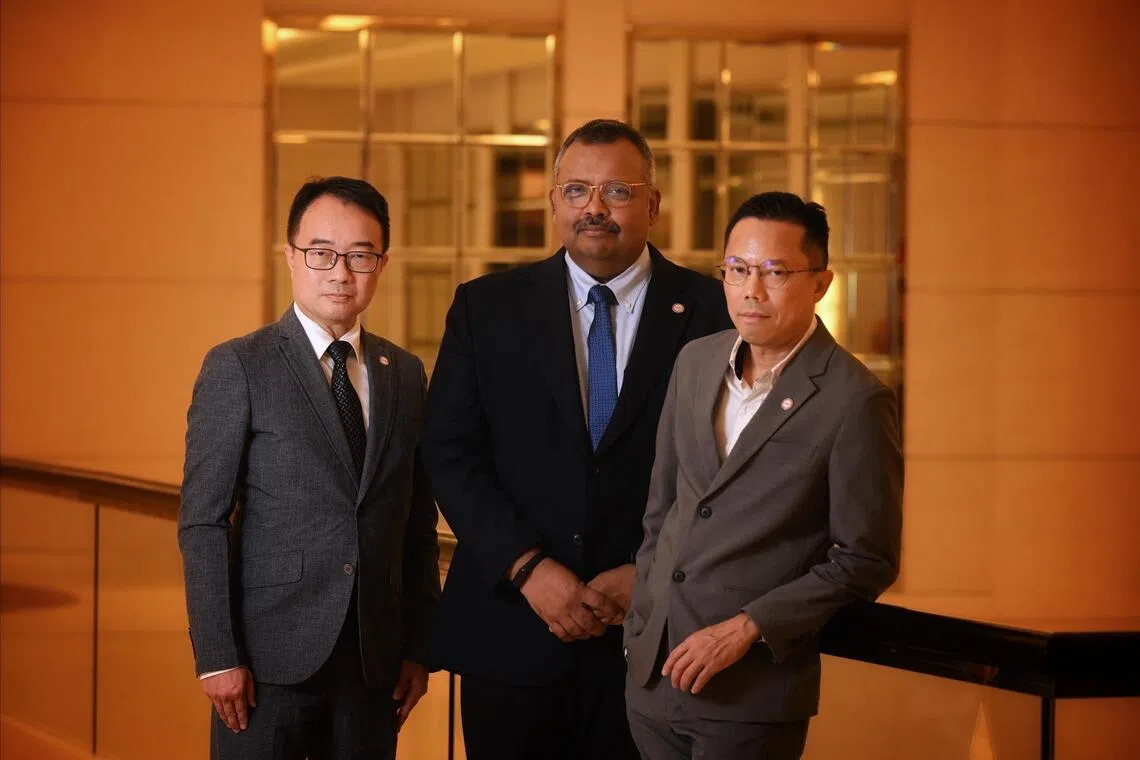
(From left) Benjamin Ang, head of the S. Rajaratnam School of International Studies’ Centre of Excellence for National Security; Kumar Ramakrishna, dean of RSIS; and Leong Chan-Hoong, head of RSIS’ Social Cohesion Research Programme.
ST PHOTO: CHONG JUN LIANG
Published Oct 05, 2026, 05:00 AM
Updated Oct 05, 2026, 05:00 AM
SINGAPORE – In the wake of the 2016 United States presidential election , when the power of state-backed, algorithmically amplified disinformation campaigns started to become apparent, S. Rajaratnam School of International Studies (RSIS) researchers saw this as an understudied area.
The school convened its first workshop on the topic the following year , bringing together global experts from fields including sociology, psychology, communications and military strategy.
Their conversations highlighted the need for a multi-pronged approach to combat disinformation as countries, including the US, grappled with ways to deal with the new threat.
When Singapore decided it needed a new law to tackle online falsehoods, RSIS researchers were called upon to contribute to the select committee process, which eventually led to the Protection from Online Falsehoods and Manipulation Act that came into effect in October 2019.
As RSIS commemorates its 30th anniversary in 2026, three leaders from the school shared with The Straits Times its role in supporting policymaking over the years and providing practitioners with intellectual grounding in geopolitics.
Benjamin Ang, head of RSIS’ Centre of Excellence for National Security, said that while individuals were focused on different aspects of disinformation at the time, RSIS researchers believed that the issue was significant and required them to piece the full picture together.
“That’s why we constantly run workshops where we bring together experts from around the world, from different angles – many of whom have never heard of one another before on these issues like disinformation, foreign interference and cybersecurity,” Ang said.
“We get the most complete picture that we can give, and we invite policymakers to this.”
RSIS began as the Institute of Defence and Strategic Studies in 1996, and has since grown into a think-tank and graduate school that studies a broad range of strategic and security issues.
Kumar Ramakrishna, who took over as RSIS dean in 2023, said the institution helps the authorities anticipate developments “to prevent them from being blindsided”.
“The Government has their own agencies and internal analytical capabilities, but RSIS’ role is to support that effort,” he said, adding that its research is intended for practitioners in government rather than academics.
Intellectual scaffolding to counter terrorism
One of RSIS’ contributions to Singapore’s security in its early years was supporting the Religious Rehabilitation Group (RRG) in its efforts to rehabilitate detained Jemaah Islamiyah (JI) operatives in the early 2000s.
The Government had sought assistance from Muslim religious leaders to engage the detainees, said Kumar, who was previously the head of RSIS’ International Centre for Political Violence and Terrorism Research.
Although the religious leaders understood, through their own religious training, how extremist ideology deviated from Islam, Kumar said they also needed to learn how the ideology came about.
This includes the origins of JI, which he said has been mistakenly attributed to being a creation of Al-Qaeda.
Instead, its origins can be traced to Darul Islam, a group from Indonesia formed in 1942. In the 1980s, its members had travelled to Afghanistan to fight against the Soviets, and became influenced by global jihadist figures and their vision of a global caliphate.
JI was established in 1993 with the aim of creating a pan-South-east Asian caliphate.
To understand the geopolitics behind extremist movements, some of the religious scholars involved in the RRG attended postgraduate training at RSIS.
Kumar said that while knowledge of the religious doctrine was important, it was insufficient on its own in addressing the root causes of extremism during the rehabilitation process.
The RSIS training had given the Muslim scholars “a very good holistic understanding of the big picture of extremist Islam at that time”, he said.
With the evolution of extremism over the years through self-radicalisation and the influence of far-right ideas, Kumar said the institution continues to provide the RRG with a platform to study this threat.
Today, there are RSIS academics who are part of the RRG and are involved in rehabilitating detainees alongside case officers and psychologists.
Several Ministry of Home Affairs officers also receive training from RSIS, gaining the “intellectual scaffolding” and wider academic grounding, Kumar said.
“Not just in counter-terrorism but also in geopolitics, which I think is very important for them to develop a broader and holistic view of international trends which impact the evolution of transnational terrorism,” he added.
From policy review to horizon scanning
Ang said one of RSIS’ significant roles is reviewing policies and policy decisions, and creating awareness of their impacts among the public and international partners.
He cited an analysis done in 2024 after the authorities blocked 10 fake websites linked to foreign actors.
The sites mimicked typical news portals and were said to be potential avenues for conducting disinformation campaigns against Singapore.
“We had done a deep dive into these websites – where they came from, what they were doing – and were able to compare them with other global disinformation tactics and explain it in a way that everybody could understand,” Ang noted.
Such analysis of policy also involves having a broader conception of security in Singapore, which includes knowledge of potential areas of vulnerability that can be exploited.
Leong Chan-Hoong, the head of RSIS’ Social Cohesion Research Programme, has studied social integration within housing estates using 10 years of data from Singapore’s Ethnic Integration Policy.
Areas such as Bishan and Toa Payoh were found to have a larger proportion of Chinese, while Malay home buyers have pivoted to places like Marsiling and Pasir Ris, with Indians observed to be more dispersed across estates.
One finding was that neighbourhoods with a higher concentration of permanent residents and ethnic minorities reported lower social trust.
His research also found that having a shared space like a community club can meaningfully bring diverse communities together, although the effect diminished with distance and fell off beyond about 120m.
One of the proposals put forward by Leong in 2018 for better social mixing was to relocate “good schools away from the popular places”, which some people thought was a controversial idea back then.
However, Anglo-Chinese School (Primary) announced in 2023 that it would move from Barker Road to Tengah in 2030 as part of a major effort to provide greater accessibility for as many pupils as possible.
Leong said he would not know whether his research had contributed to that decision.
“But it doesn’t matter. The fact is that these are the things that we do to understand social cohesion and how we can foster the mindshare of living together,” he said.
Looking ahead to emerging threats
One area that RSIS is studying is the intersection between artificial intelligence and other emerging areas such as space and quantum technology, said Ang.
One example is the use of AI to process data from satellite imagery. RSIS is examining various aspects, including issues of governance and what other countries are doing on this front.
“We propose options based on what we see around the world, and our analysis is based on how we think it applies to Singapore,” said Ang.
During a lecture in September commemorating RSIS’ 30th anniversary, Defence Minister Chan Chun Sing said that interpreting ongoing change was a necessary but insufficient competency for the organisation. It needed to go beyond interpreting current events and “ponder the improbable” – the foundational motto of RSIS.
It is this horizon-scanning role that Kumar describes as being “a canary in a coal mine”.
One growing concern in the extremism space is the trend of offenders carrying out violence without an ideological reason.
Recent cases in the region include a November 2025 school bombing in Indonesia orchestrated by a teenager who had far-right inscriptions on his toy gun, but showed little understanding of the ideology.
Understanding this new trend may require a different approach in dealing with radicalised individuals, noted Kumar.
“Maybe we should just look at how to build youth resilience against any kind of extremist ideas, including nihilistic ideas – the idea that violence is good,” he said.
AI/artificial intelligence
(从左至右)拉惹勒南国际研究院国家安全卓越中心主任 Benjamin Ang;拉惹勒南国际研究院院长 Kumar Ramakrishna;以及拉惹勒南国际研究院社会凝聚力研究项目负责人 Leong Chan-Hoong。
《海峡时报》照片:梁崇俊
发布于 2026 年 10 月 5 日上午 5:00
更新于2026年10月5日上午5:00
新加坡——在 2016 年美国总统大选之后,当国家支持、算法放大的虚假信息宣传活动的力量开始显现时,拉惹勒南国际研究院 (RSIS) 的研究人员认为这是一个研究不足的领域。
第二年,该校召开了第一次关于该主题的研讨会,汇集了来自社会学、心理学、传播学和军事战略等领域的全球专家。
他们的对话凸显了采取多管齐下的方法打击虚假信息的必要性,包括美国在内的各国都在努力寻找应对这一新威胁的方法。
当新加坡决定需要一部新法律来打击网络虚假信息时,RSIS 的研究人员被邀请参与专门委员会的程序,最终促成了《防止网络虚假信息和操纵法》的出台,该法于 2019 年 10 月生效。
2026 年,RSIS 将迎来成立 30 周年。当天,该校三位领导人向《海峡时报》介绍了 RSIS 多年来在支持政策制定和为从业人员提供地缘政治理论基础方面所发挥的作用。
RSIS国家安全卓越中心负责人Benjamin Ang表示,虽然当时人们关注的是虚假信息的不同方面,但RSIS的研究人员认为这个问题意义重大,需要他们拼凑出完整的图景。
“这就是为什么我们不断举办研讨会,将来自世界各地、不同领域的专家聚集在一起——其中许多人以前从未听说过彼此,比如虚假信息、外国干涉和网络安全等问题,”Ang说。
“我们力求提供最全面的信息,并邀请政策制定者参与其中。”
RSIS 前身是成立于 1996 年的国防与战略研究所,此后发展成为一家智库和研究生院,研究范围广泛的战略和安全问题。
2023 年接任 RSIS 院长的 Kumar Ramakrishna 表示,该机构帮助当局预测事态发展,“以防止他们措手不及”。
“政府有自己的机构和内部分析能力,但RSIS的作用是支持这项工作,”他说道,并补充说,其研究对象是政府从业人员,而不是学术界人士。
反恐的理论框架
RSIS 在新加坡成立初期对新加坡安全的贡献之一是支持宗教康复小组 (RRG) 在 2000 年代初期对被拘留的伊斯兰祈祷团 (JI) 成员进行改造。
库马尔说,政府曾寻求穆斯林宗教领袖的帮助,以便与被拘留者进行沟通。库马尔此前是拉合尔国际研究院(RSIS)国际政治暴力和恐怖主义研究中心的主任。
库马尔表示,虽然宗教领袖们通过自身的宗教训练了解了极端主义意识形态是如何偏离伊斯兰教的,但他们也需要了解这种意识形态是如何产生的。
这其中包括伊斯兰祈祷团的起源,他表示,伊斯兰祈祷团一直被错误地归咎于基地组织。
相反,它的起源可以追溯到 1942 年在印度尼西亚成立的达鲁伊斯兰组织。在 20 世纪 80 年代,该组织的成员前往阿富汗与苏联作战,并受到全球圣战人物及其建立全球哈里发国的愿景的影响。
伊斯兰大会党成立于1993年,其目标是建立一个泛东南亚哈里发国。
为了解极端主义运动背后的地缘政治,一些参与 RRG 的宗教学者在 RSIS 接受了研究生培训。
库马尔表示,虽然了解宗教教义很重要,但这本身不足以在康复过程中解决极端主义的根源问题。
他说,RSIS的培训让穆斯林学者“对当时极端伊斯兰主义的大局有了非常好的整体了解”。
库马尔表示,随着极端主义多年来通过自我激进化和极右思想的影响而不断演变,该机构将继续为RRG提供研究这一威胁的平台。
如今,RSIS 的一些学者加入了 RRG,与个案官员和心理学家一起参与被拘留者的改造工作。
库马尔表示,内政部的几名官员也从拉贾斯坦邦国际研究院 (RSIS) 接受培训,从而获得“知识框架”和更广泛的学术基础。
“不仅在反恐方面,而且在地缘政治方面,我认为这对他们来说非常重要,有助于他们更全面、更深入地了解影响跨国恐怖主义演变的国际趋势,”他补充道。
从政策审查到前瞻性研究
Ang表示,RSIS的重要职责之一是审查政策和政策决定,并提高公众和国际合作伙伴对这些政策影响的认识。
他引用了2024年进行的一项分析,当时当局封锁了10个与外国势力有关的虚假网站。
这些网站模仿了典型的新闻门户网站,据称是针对新加坡开展虚假信息宣传活动的潜在途径。
“我们对这些网站进行了深入研究——它们的来源、它们的用途——并能够将它们与其他全球虚假信息策略进行比较,并以每个人都能理解的方式进行解释,”Ang 指出。
对政策的这种分析还涉及对新加坡安全问题的更广泛理解,包括了解可能被利用的潜在脆弱领域。
拉森国际研究院社会凝聚力研究项目负责人梁灿雄利用新加坡种族融合政策10年的数据,研究了住宅区内的社会融合情况。
调查发现,碧山和大巴窑等地区的华人比例较高,而马来购房者则转向马西岭和巴西立等地,印度人则较为分散地分布在各个住宅区。
一项研究发现,常住居民和少数族裔人口较为集中的社区,社会信任度较低。
他的研究还发现,拥有像社区俱乐部这样的共享空间可以有效地将不同的社区聚集在一起,尽管这种效果会随着距离的增加而减弱,并在超过大约 120 米后消失。
梁先生在 2018 年提出的促进社会融合的方案之一是将“优质学校从热门地区迁走”,这在当时被一些人认为是一个有争议的想法。
然而,英华小学于 2023 年宣布,为了尽可能多地为学生提供更便利的入学途径,学校将于 2030 年从巴克路搬迁至登加。
梁表示,他无法得知自己的研究是否对这一决定有所贡献。
“但这并不重要。事实上,我们做这些事情是为了了解社会凝聚力,以及如何培养共同生活的意识,”他说。
展望未来,应对新出现的威胁
Ang表示,RSIS正在研究的领域之一是人工智能与其他新兴领域(如太空和量子技术)的交叉领域。
例如,人工智能可用于处理卫星图像数据。拉脱维亚国际研究中心(RSIS)正在研究各个方面,包括治理问题以及其他国家在这方面的做法。
“我们根据在世界各地看到的情况提出方案,我们的分析则基于我们认为这些方案如何适用于新加坡,”Ang说道。
在9月为纪念拉脱维亚国际学院成立30周年而举办的讲座上,国防部长陈振声表示,解读持续变化是该机构的必要能力,但还不够。它需要超越对时事的解读,去“思考那些看似不可能的事情”——这正是拉脱维亚国际学院的立校格言。
库马尔将这种具有前瞻性的角色比作“煤矿里的金丝雀”。
极端主义领域日益令人担忧的一个趋势是,犯罪分子在没有意识形态原因的情况下实施暴力行为。
该地区最近的案例包括 2025 年 11 月发生在印度尼西亚的一起校园爆炸案,该案由一名青少年策划,他的玩具枪上有极右翼的字样,但他对这种意识形态却知之甚少。
库马尔指出,要理解这一新趋势,可能需要用不同的方法来应对激进分子。
他说:“或许我们应该思考如何增强青年抵御各种极端主义思想的能力,包括虚无主义思想——即暴力是好事这种想法。”
人工智能