Hunker down, or plug in: SPH Media chairman on AI and why journalists can’t be replaced是坚守岗位,还是拥抱科技:新加坡报业控股媒体主席谈人工智能以及为何记者不可替代
SPH Media embraces AI to enhance journalism, partnering with Google for AI training and expanding multilingual content to reach wider audiences. Read more at straitstimes.com.
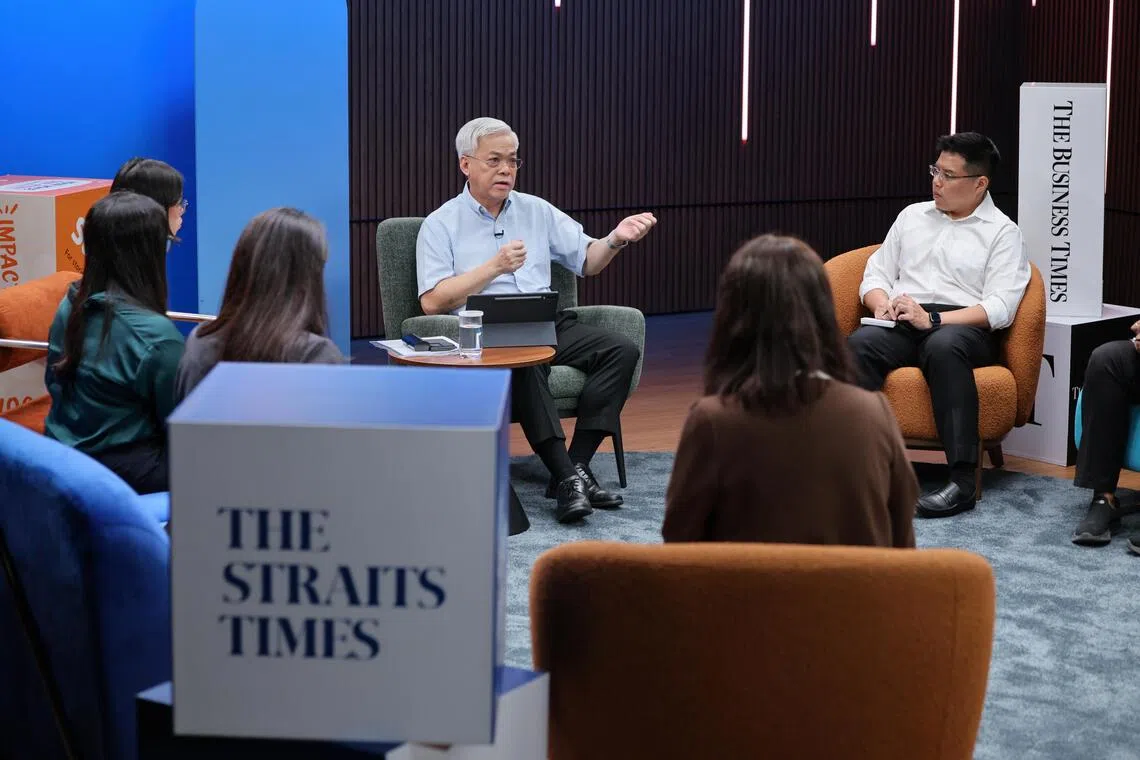
SPH Media executive chairman Chan Yeng Kit (centre) in an interview with the news organisation’s journalists on Sept 17.
PHOTO: LIANHE ZAOBAO
Published Oct 05, 2026, 05:00 AM
Updated Oct 05, 2026, 05:00 AM
SPH Media chooses to integrate with AI platforms, like Google, to ensure its news remains relevant and accessible while enhancing journalism with AI tools for verification and translation.
AI cannot replace human reporters due to the need for empathy, original content creation, and editorial judgement, which remain essential in journalism.
SPH Media focuses on adapting to AI changes by diversifying products and maintaining a strong mission-driven journalism culture to secure its future relevance and impact.
SINGAPORE – With artificial intelligence reshaping the media industry , SPH Media executive chairman Chan Yeng Kit said the company has two choices.
The first is to hunker down and protect what it has, and try to push back against any AI force that threatens its business.
The second is to become an indispensable part of whatever new AI platform that catches on, even as it defends what matters at the core for a news company.
SPH has chosen the second path, with the goal of having its voice wherever people seek news and information, including from AI sources, said Chan.
In an interview with SPH Media journalists, Chan said it was important for the media organisation to be plugged in, given the risk of being cut out of how people consume news altogether.
“What I worry about is, at a more strategic level, a total disintermediation of particular parts of the business value chain that we have,” he said.
To this end, SPH Media has signed a number of agreements, including a collaboration with Google in April .
The partnership with the search giant will provide SPH journalists with training in generative AI verification for investigative research and facilitate responsible AI use in its newsrooms.
At the same time, the collaboration will ensure that SPH’s content reaches wider audiences promptly through stronger integration with Google’s distribution channels.
Chan said the media organisation is working with other partners as well but did not elaborate further, citing non-disclosure agreements.
“Any time someone asks for news and information from an AI source, we want our voice to be there,” he said.
AI also presents an opportunity for SPH Media to do a lot more with what it already has to reach bigger audiences without much incremental costs, said Chan. For instance, the media organisation is using AI translation in the push for its titles to become more multilingual.
The eventual goal is to have an English edition of Chinese daily Lianhe Zaobao with proper copy-editing and enough attention to the fidelity of translation, and to do likewise for Berita Harian and Tamil Murasu.
“Now, the AI translation engine can do 98 per cent of the work. You just have a copy editor at the end,” he said, contrasting this with the past, when such work would have depended entirely on human translators.
What AI cannot do is generate original content, which is why reporters are still needed.
“It will be a while before robots are empathetic enough (to) go and interview an auntie, and get the auntie to pour out all her stories to you,” he said.
Another aspect of the news that requires humans is editorial judgment and insights, said Chan. “Maybe one of these days, AI would be good enough. But for now, I think these are core for us.”
For SPH Media, the key is to master these basics so that it can adapt no matter how the media landscape changes. Another part of its strategy is to have a stable of products, and not be a one-trick pony, added Chan.
No news company in the world – big or small – has figured out what the exact impact of AI will be on the industry, but Chan said he does not see the current wave of AI development as a passing fad.
“If it turns out to be hype and you go in there, so be it,” he said. “But if it turns out to be important, then how can we be part of it – plugged in, that we are indispensable?”
Chan expressed optimism about the company’s future prospects, citing the common sense of mission he has observed in his informal lunches with reporters and editors.
While SPH Media “does not pay like the fintech companies or the AI companies or the big banks”, people choose to stay because they think the work they do is meaningful, he said.
“The sense of mission and the sense of wanting to do good journalism is always there,” he said. “It’s what drives them.”
Chin Soo Fang is senior correspondent at The Straits Times, covering a wide range of topics including community, politics, social issues, consumer, culture and heritage.
AI/artificial intelligence
新加坡报业控股媒体执行主席陈永杰(中)于9月17日接受该新闻机构记者采访。
图片来源:联合早报
发布于 2026 年 10 月 5 日上午 5:00
更新于2026年10月5日上午5:00
SPH Media 选择与 Google 等人工智能平台集成,以确保其新闻保持相关性和可访问性,同时利用人工智能工具进行验证和翻译,从而增强新闻报道。
人工智能无法取代人类记者,因为同理心、原创内容创作和编辑判断等能力在新闻业中仍然至关重要。
SPH Media 致力于通过产品多元化和保持以使命为导向的新闻文化来适应人工智能的变化,以确保其未来的相关性和影响力。
新加坡——随着人工智能重塑媒体行业,新加坡报业控股媒体执行主席陈永杰表示,公司面临两种选择。
首先,要坚守阵地,保护现有资源,并努力反击任何威胁其业务的人工智能力量。
第二点是成为任何流行起来的新人工智能平台不可或缺的一部分,同时捍卫新闻公司的核心价值。
陈先生表示,新加坡报业控股选择了第二条道路,目标是让其在人们寻求新闻和信息的任何地方都能发出声音,包括来自人工智能来源的信息。
陈在接受新加坡报业控股媒体记者采访时表示,鉴于媒体机构有可能完全脱离人们获取新闻的方式,因此与时俱进对媒体机构来说至关重要。
“我担心的是,从更战略的层面来说,我们现有的商业价值链中的某些环节会完全脱离中介化,”他说。
为此,SPH Media 签署了多项协议,包括 4 月份与 Google 的合作。
与这家搜索巨头的合作将为新加坡报业控股(SPH)的记者提供生成式人工智能验证方面的培训,以用于调查研究,并促进新闻编辑室负责任地使用人工智能。
与此同时,此次合作将通过与谷歌分发渠道更紧密的整合,确保新加坡报业控股的内容能够迅速触达更广泛的受众。
陈表示,该媒体机构也在与其他合作伙伴合作,但以保密协议为由,未作进一步说明。
他说:“任何时候,只要有人向人工智能来源寻求新闻和信息,我们都希望我们的声音能够被听到。”
陈先生表示,人工智能也为新加坡报业控股媒体(SPH Media)提供了一个契机,使其能够以更低的成本,利用现有资源触达更广泛的受众。例如,该媒体机构正在利用人工智能翻译技术,推动旗下刊物实现多语种化。
最终目标是制作英文版的《联合早报》,并进行适当的文字编辑,充分注意翻译的准确性;同时,也制作英文版的《每日新闻》和《泰米尔语日报》。
“现在,人工智能翻译引擎可以完成 98% 的工作。最后只需要一个文字编辑,”他说道,并将此与过去完全依赖人工翻译的情况进行了对比。
人工智能无法生成的是原创内容,所以记者仍然是必需的。
他说:“机器人要足够有同理心,能够去采访一位阿姨,并让阿姨向你倾诉她所有的故事,还需要一段时间。”
陈女士表示,新闻工作中另一个需要人工参与的方面是编辑判断和洞察力。“也许有一天,人工智能就足够好了。但就目前而言,我认为这些对我们来说至关重要。”
对于新加坡报业控股媒体集团(SPH Media)而言,关键在于掌握这些基本要素,以便无论媒体格局如何变化都能适应。陈先生补充说,其战略的另一部分是拥有稳定的产品线,而不是只会一种策略。
世界上没有任何一家新闻公司——无论大小——能够确切地预测人工智能将对新闻行业产生怎样的影响,但陈表示,他不认为当前的人工智能发展浪潮只是一时的风潮。
“如果结果证明这只是炒作,而你却参与其中,那就这样吧,”他说。“但如果结果证明这很重要,那么我们如何才能参与其中——融入其中,成为不可或缺的一部分呢?”
陈先生对公司的未来前景表示乐观,并指出他在与记者和编辑的非正式午餐中观察到了公司上下对使命的共同理解。
他说,虽然新加坡报业控股媒体公司“不像金融科技公司、人工智能公司或大型银行那样支付高薪”,但人们选择留下来,因为他们认为自己所做的工作很有意义。
他说:“他们的使命感和做好新闻工作的愿望始终都在。这就是他们的动力所在。”
Chin Soo Fang 是《海峡时报》的资深记者,报道范围广泛,包括社区、政治、社会问题、消费者、文化和遗产等话题。
人工智能