Watch This C-130 Run For Its Life At Low Level From A Mock Enemy Missile Crew观看这架C-130运输机在模拟敌方导弹发射阵地的掩护下低空逃生。
Realistic threats on the ground are an important if often underappreciated aspect of the Air Force's Red Flag air combat exercises.
新闻视频
By Joseph Trevithick
Published Dec 31, 2021 2:20 PM EST
When talking about Red Flag , the U.S. Air Force’s premier large-scale air combat exercise series , the focus is generally on air-to-air engagements . However, simulated ground-based anti-aircraft threats are also key to replicating as realistic an experience for pilots as possible. A video on YouTube has recently come to our attention that offers a rare look at this aspect of a Red Flag exercise from the perspective of personnel playing the role of enemy air defenders trying to shoot down British C-130 Hercules transport aircraft .
It is not clear when the video, which was posted in September of this year, was actually shot. Red Flag exercises have been conducted regularly since 1975 and take place over the sprawling Nevada Test and Training Range (NTTR) adjacent to Nellis Air Force Base outside of Las Vegas, Nevada. YouTube user Tim Gosling who put it on online describes it as “Highlights from a fun time out round Las Vegas 30 plus years ago, dodging pretend SAMs and not going into Area 51.” This would date the video to the early 1990s.
“Live ammunition is used for air-to-ground sorties, there is a ‘Red Air’ contingent to simulate enemy fighters and representative hostile surface-to-air missile radar systems,” the description adds. “RED FLAG has long been an international event and has been highly useful to the RAF, including this case the C-130s from RAF Lyneham flying simulated behind-the-lines air drop missions. And of course there were also the attractions of Las Vegas.”
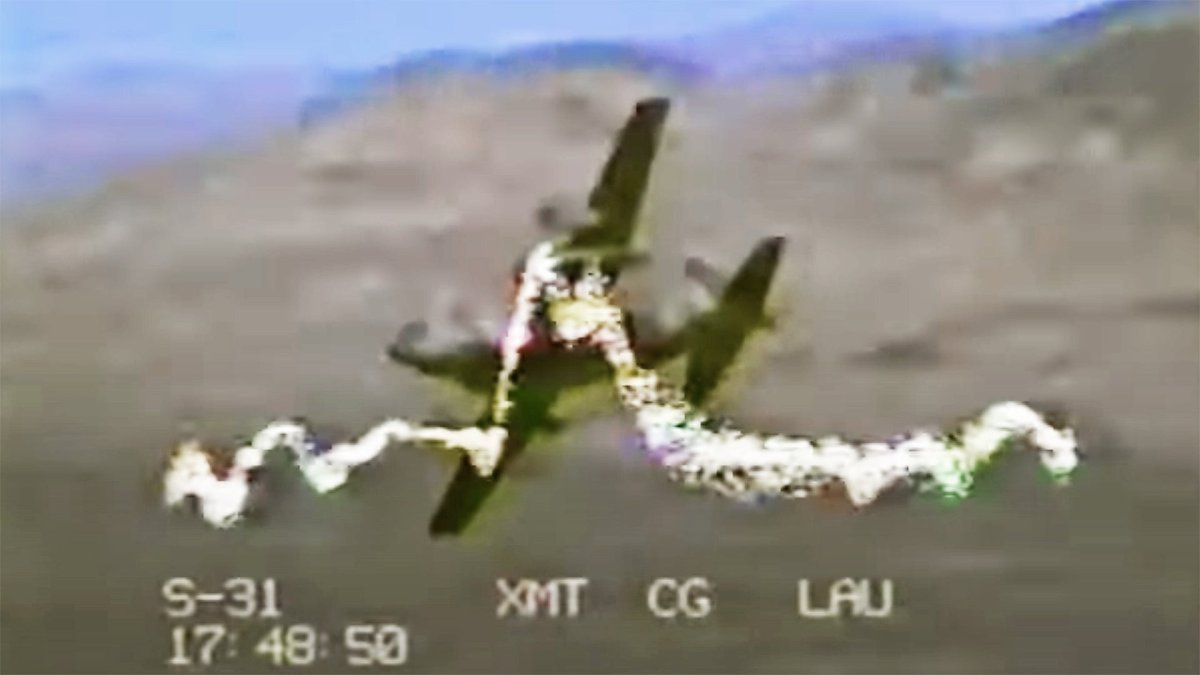
The video is a montage of clips taken from two different perspectives, the view from an optical tracking system and from what appears to be the inside of a radar control van. This kind of footage could be helpful for debriefing aircraft crews after an exercise, as well as a general instructional aid.
An example of the footage from the optical tracking system that is seen in the video., YouTube capture
An example of one of the clips in the video that appears to have been shot inside a radar van., YouTube capture
It’s unclear what threat system or systems we are seeing replicated here. However, the radar van clips show side-by-side vertical displays that are similar to those associated with engagement and fire control radars used in a wide variety of Soviet-era surface-to-air missile systems dating all the way back to the S-75 Dvina , also known as the SA-2 Guideline, its NATO reporting name.
The video below is from a highly detailed computer simulation of the user interface for an SA-2E surface-to-air missile system showing typical side-by-side radar displays found on various Soviet-era systems.
The optical tracking system feed has a range scope indicator overlaid on top of it, along with other data, which is also similar to fire control components found on Soviet-era surface-to-air missile systems. The range scope indicator is a wave that peaks as a target approaches and the associated radar locks on or attempts to lock on.
It is very possible that what we are seeing here are systems that are not just designed to replicate those kinds of Soviet-era threats, but are actually the real deal. The U.S. military has captured and otherwise acquired various pieces of foreign materiel over the years, including surface-to-air missile systems and associated radars . Though these assets are too low-density to be used on a wide-scale basis, they are still often employed in training exercises to provide enhanced realism alongside full-scale surrogates and other simulated threats . All of these simulated hostile elements on the ground are integrated into the larger opposing force plan, which includes “Red Air” aggressor aircraft , as well.
It is very possible that the optical tracking system seen in this video could be one associated with a Soviet 9K33 Osa mobile surface-to-air missile system, which the U.S. Air Force has at least one example of available for use as a training aid. The Osa, also known by the NATO reporting name SA-8 Gecko, is a low-altitude, short-range air defense system that uses command-guided missiles and is known to have an optical tracking system as a backup to its onboard radars. This would all fit very much with the low-level engagement scenario seen in the footage.
An SA-8 surface-to-air missile system on a trailer ahead of a US Air Force training exercise in 2017., USAF
Inside the SA-8., USAF
The SA-8’s user interface , as depicted in the computer simulation seen in the video below, includes a range scope indicator, but does not feature the side-by-side displays seen in parts of the video, but that footage could easily be from within a separate radar van. The Air Force has a number of stand-alone Soviet-era radar systems that are available for use during Red Flag.
Regardless of the specific system in use, the footage shows various attempts to lock onto and engage C-130s flying at very low altitude, offering a good look at a number of tactics, techniques, and procedures that pilots can use to evade enemy surface-to-air missiles. There is some pretty impressive maneuvering to be seen from the Hercules crews.
Sound bytes from the personnel acting as the faux hostile air defense forces underscore the challenges they can face, as well.
“And I just lost him on ground clutter,” one individual says at one point in the video, highlighting the difficulty many radars have in separating aircraft from the terrain at low levels. “We locked on ground clutter again.”
“Yeah, I just locked up and I’m going to launch right now,” that same person continues. “I just lost him. … I think he gave me chaff there.”
Chaff refers to various materials that an aircraft can release to blind or confuse enemy radars. When the concept was first invented during World War II, strips of aluminum were used for this purpose. More modern chaff consists of bundles of metal-coated glass or plastic fibers.
US Navy RR-144, at top, and RR-129 chaff countermeasures, as well as loose chaff, at right. These are examples of more modern metal-coated fiber-type chaff., USN
“He’s chaffing. And just went below terrain and chaffed me. Broke me with chaff and then went terrain masking,” another person is heard saying in the video, showing how chaff could be used together with the benefits of ground clutter, as well as just hiding behind terrain features like mountains, to evade enemy air defenses. “That’s going to be a miss due to chaff.”
That same individual mentions at one point that they’re launching a “Smokey Sam.” Developed by the Navy in the 1980s, the Smokey Sam , also known as the GTR-18A, is a cheap paper and styrofoam rocket that is simply designed to create a visual signature similar to a real surface-to-air missile launch to provide added realism during training. This gives pilots something to actually look for when practicing scanning for and spotting incoming attacks. This unguided rocket’s construction means that it is extremely unlikely to be dangerous in any way to aircraft flying overhead, even if it actually impacts one.
Now, of course, enemy air defense capabilities, as well as friendly countermeasures systems, have continued to evolve and improve in the decades since these video clips were shot. At the same time, a not-insignificant amount of what is seen, on both the part of the air defenders and the pilots attempting to evade them, remains relevant today.
Large numbers of older Soviet-era surface-to-air missile systems, as well as improved variants and derivatives , remain in service around the world and are threats that would need to be taken into consideration during U.S. military responses to many potential crises, even in lower-threat environments . In addition, Short-range air defense (SHORAD) systems, including both man-portable and vehicle-based types , are experiencing something of a renaissance globally and more modern types are proliferating ever-more widely a result, including to non-state actors .
Chaff and terrain masking remain important tools for friendly pilots, especially those behind the controls of slower, non-stealthy platforms, such as C-130s. Air Force special operations units operating MC-130 variants and other specialized aircraft , in particular, train to conduct very low-level flights at night in order to help avoid detection and potential threats when inserting or extracting forces from denied or otherwise sensitive areas.
All told, this video is a very interesting behind-the-scenes look at an often underappreciated aspect of Air Force Red Flag exercises as seen from the equally unusual perspective of individuals filling the role of enemy surface-to-air missile system operators.
Contact the author: joe@thedrive.com
Comments couldn’t be loaded. Please refresh the page.
作者:约瑟夫·特雷维西克
发布于美国东部时间2021年12月31日下午2:20。
谈到美国空军最重要的大规模空战演习“红旗”时,人们通常关注的是空对空作战。然而,模拟地面防空威胁对于尽可能真实地模拟实战环境也至关重要。我们最近注意到YouTube上的一段视频,它罕见地从扮演敌方防空部队人员的角度展现了“红旗”演习中这一方面的场景,他们试图击落英国的C-130“大力神”运输机。
这段视频发布于今年9月,但其拍摄时间尚不明确。自1975年以来,红旗军演定期举行,演习地点位于内华达州拉斯维加斯郊外内利斯空军基地旁的广阔的内华达试验训练靶场(NTTR)。上传该视频的YouTube用户Tim Gosling将其描述为“30多年前在拉斯维加斯附近度过的一段美好时光的精彩片段,躲避模拟地空导弹,并且没有进入51区”。由此推断,该视频的拍摄时间应在20世纪90年代初。
“空对地攻击演练使用实弹,还有一支‘红军’部队模拟敌方战斗机和具有代表性的敌方地对空导弹雷达系统,”描述补充道。“‘红旗’军演长期以来都是一项国际盛事,对英国皇家空军来说意义非凡,包括此次来自莱纳姆皇家空军基地的C-130运输机执行的模拟敌后空投任务。当然,拉斯维加斯的魅力也不容忽视。”
这段视频是由两个不同视角拍摄的片段剪辑而成:一个是光学跟踪系统的视角,另一个似乎是从雷达控制车内部拍摄的。这类影像资料可用于演习后对机组人员进行情况汇报,也可作为一般的教学辅助材料。
视频中展示的光学跟踪系统画面示例,来自 YouTube 截图
视频中的一个片段似乎是在测速车内拍摄的。(YouTube截图)
目前尚不清楚这里出现的是哪种或哪些威胁系统。然而,雷达车上的视频片段显示,并排的垂直显示屏与苏联时期各种地对空导弹系统(最早可追溯到S-75“德维纳”导弹,也称SA-2“指南针”导弹,这是其北约代号)所使用的交战雷达和火控雷达的显示屏类似。
下面的视频来自 SA-2E 地对空导弹系统用户界面的高度详细的计算机模拟,显示了苏联时代各种系统中常见的典型并排雷达显示器。
光学跟踪系统画面上叠加了测距指示器和其他数据,这与苏联时期地对空导弹系统的火控组件类似。测距指示器是一个波形,当目标接近且相关雷达锁定或尝试锁定目标时,波形峰值会达到最大值。
我们现在看到的很可能并非仅仅是用来复制苏联时代威胁的系统,而是实实在在的同类系统。多年来,美军缴获或以其他方式获得了各种外国装备,包括地对空导弹系统和相关雷达。虽然这些装备密度太低,无法大规模使用,但它们仍然经常用于训练演习,以增强演习的真实性,并与全尺寸的替代目标和其他模拟威胁相结合。所有这些地面模拟敌方要素都被整合到更大的假想敌部队计划中,该计划也包括“红方”假想敌飞机。
视频中出现的光学跟踪系统很可能与苏联9K33“奥萨”(Osa)移动式地对空导弹系统相关,美国空军至少拥有一套该系统,可用于训练。“奥萨”系统,北约代号SA-8“壁虎”(Gecko),是一种低空短程防空系统,使用指令制导导弹,并配备光学跟踪系统作为机载雷达的备用系统。这与视频中显示的低空交战场景非常吻合。
2017年,美国空军一次训练演习前,一辆拖车上装载着SA-8地对空导弹系统。(美国空军)
SA-8内部,美国空军
如下方视频中的计算机模拟所示,SA-8的用户界面包含一个测距范围指示器,但没有视频中出现的并排显示功能,不过视频中的画面很可能来自另一辆雷达车。空军拥有多套独立的苏联时代雷达系统,可在“红旗”军演期间使用。
无论具体使用的是哪种系统,这段录像都展现了多种锁定并攻击低空飞行的C-130运输机的尝试,让我们得以一窥飞行员用来规避敌方地对空导弹的多种战术、技巧和程序。大力神运输机机组人员的机动飞行技术也相当出色。
扮演假想敌防空部队的人员的录音片段也凸显了他们可能面临的挑战。
“我刚才因为地面杂波失去了他的目标,”视频中有人这样说道,这凸显了许多雷达在低空飞行时难以将飞机与地形区分开来的问题。“我们又锁定在地面杂波上了。”
“是啊,我刚锁定目标,现在就要启动了,”那个人继续说道。“我刚跟他断了联系……我觉得他刚才给了我一些无关紧要的信息。”
箔条是指飞机释放的各种材料,用于干扰或迷惑敌方雷达。二战期间,人们首次发明了箔条,当时使用的是铝条。而现代的箔条则由金属涂层的玻璃纤维或塑料纤维束组成。
图中上方为美国海军RR-144型和RR-129型箔条干扰弹,右侧为散落的箔条。这些都是较新的金属涂层纤维型箔条的例子。
“他放了干扰弹。他躲到地形下面,用干扰弹干扰我。用干扰弹扰乱我的视线,然后利用地形掩护,”视频中可以听到另一个人这样说道,这表明干扰弹可以与地面杂波结合使用,也可以躲在山脉等地形后面,以规避敌方防空系统。“因为有干扰弹,这次肯定打不中。”
同一个人曾提到他们正在发射“烟雾山姆”(Smokey Sam)。“烟雾山姆”(Smokey Sam),又称GTR-18A,是美国海军在20世纪80年代研制的一种廉价纸质泡沫火箭,其设计目的很简单,就是为了在训练中模拟真实地空导弹发射的视觉特征。这样,飞行员在练习扫描和发现来袭目标时,就能有实际的目标可供观察。这种无制导火箭的结构意味着,即使它真的击中了上空飞行的飞机,也极不可能对飞机造成任何危险。
当然,自这些视频片段拍摄以来的几十年里,敌方防空能力以及我方反制系统都在不断发展和改进。与此同时,视频中展现的防空力量和试图规避防空系统的飞行员的许多行为,在今天仍然具有一定的现实意义。
大量苏联时期遗留下来的地对空导弹系统及其改进型和衍生型仍在世界各地服役,即使在威胁较低的环境下,美国在应对许多潜在危机时也必须将这些威胁纳入考量。此外,包括便携式和车载式在内的短程防空(SHORAD)系统在全球范围内正经历着某种程度的复兴,更现代化的型号也因此得到越来越广泛的应用,甚至包括非国家行为体所拥有的。
对于友军飞行员来说,箔条和地形掩蔽仍然是重要的工具,尤其是那些驾驶速度较慢、非隐身平台(例如 C-130)的飞行员。空军特种作战部队,特别是那些操作 MC-130 系列飞机和其他专用飞机的部队,会进行夜间超低空飞行训练,以便在从敌占区或其他敏感区域部署或撤离部队时,避免被发现和潜在威胁。
总而言之,这段视频非常有趣地展现了空军“红旗”演习中一个经常被低估的方面,它是从扮演敌方地对空导弹系统操作员的个人的独特视角出发的。
联系作者:joe@thedrive.com
评论加载失败,请刷新页面。