How a Small-Town Girl Ended Up in the Cockpit of an A-10 Warthog一个小镇女孩是如何坐进A-10疣猪攻击机的?
And in her spare time she rides horses.
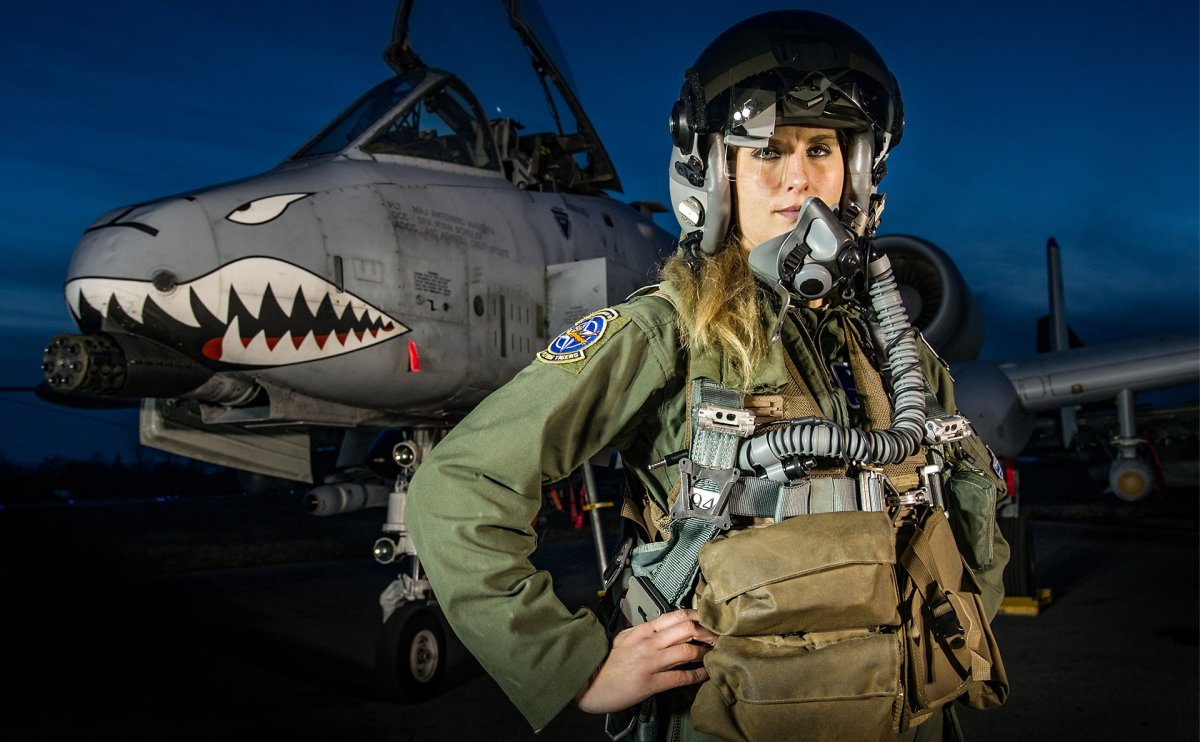
By Frank Crebas , Rich Cooper and Tyler Rogoway
Updated Jul 2, 2020 2:58 PM EDT
Kayla Bowers loves riding horses and target shooting. That fits nicely with her day job, where she tames the Air Force’s thoroughbred close air support jet, the A-10 Warthog, and executes aerial target practice using the aircraft’s legendarily massive and hideously powerful GAU-8 30mm Avenger cannon .
Lieutenant Bowers is better known by her peers in the 74th Fighter Squadron, “The Flying Tigers,” by her callsign, “Banzai.” Being a female fighter pilot is still a rare experience these days, and being one that flies the rugged A-10 Warthog is rarer still: today, only around five women fly the jet, according to Lieutenant Bowers.
Frank Crebas & Rich Cooper
In what is arguably the most masculine flying machine on the planet, Banzai found her true calling early on. She grew up in the tiny town of Pinckney, Michigan, pop. 2,500. The drive to fly for the military came to her while she was in high school.
“I was looking into the military as a possible career field,” Banzai says. “It really intrigued me that I could go into something that could offer such a challenge and adventure on a day-to-day basis. I looked into the types of things that would be the most challenging and adventurous I could do as a woman in the military, and got interested in flying.”
“I started researching the different aircraft,” she continues, “and when I learned about what an incredible platform the A-10 is, and looked at its combat search and rescue (CSAR) mission—it intrigued me. I also heard stories about it from high school friends who had enlisted in the Marine Corps and the Army. They had already deployed and told me stories of the A-10 saving their lives. It just really spoke to me that I could potentially do something like that, and make such a difference in somebody’s life. It’s not glamorous. Really, it’s just a very rugged aircraft that has a lot of capabilities. It’s just really incredible.”
She enrolled in ROTC (Reserve Officer Training Corps) after graduating high school and started college in 2008. After completing flight training years later, she ended up exactly where she wanted to be: in the A-10’s cockpit, surrounded by a “bathtub” of titanium armor. Along the way, she was pranked by her instructors.
“They played a trick on me on assignment night, which is not very nice,” she says of the evening when aircraft assignments are handed out. “When I first got up, they pretended like I had received a first assignment instructor pilot slot, and they kind of sent me back and let me think that that was what my future was. In the end, I found out I had really gotten the A-10. It was a roller coaster of emotion day, that’s for sure.”
It took a while to move from flying the slick T-38C Talon trainer to strapping into her dream jet. But when the time finally came, it was eye opening.
“You obviously have a lot of academics before your first flight and various other training events on the ground,” she says. “Actually flying the A-10 for the first time felt awesome. After six years of just loving that aircraft and wanting the A-10 so bad, the first time I flew in it, I remember thinking it wasn’t even real life. I just could not believe it. You go out and you fly some instrument approaches and you fly advanced handling characteristics, maneuvers, as well as some formation, like close formation fingertip, route, all of that.”
And what about firing the A-10’s notorious gun?
“I grew up shooting, so it kind of fits that now I shoot one of the biggest guns around. Shooting in the air is a rush, but it’s still a rush shooting on the ground too. I like doing that.”
Banzai has been assigned to Flying Tigers since December of 2014. Her first assignment at a frontline squadron has been an incredibly positive experience according to the young lieutenant that is still mastering the ins and outs of the mighty Warthog.
“When I got into the 74th, I remember thinking, Wow, there is not a single person I don’t like in this squadron . I really feel like I fit in and the guys don’t treat me any different just because I’m a girl. As long as you show up and you do your job and you don’t do things to stick out as a female, nobody is going to think anything of it.” Banzai continues, “These guys are my family, for sure. It’s really cool to share experiences and little inside jokes and things like that. Everyone has each other’s backs.”
This high level of camaraderie has come in handy during the squadron’s six month deployment to Eastern Europe as part of Operation Atlantic Resolve .
It was on this historic deployment at Graf Ignatievo Air Base, Bulgaria that we met up with Banzai, who had been flying missions with Bulgarian Air Force’s Su-25 Frogfoots, the A-10s Soviet-designed counterpart, and Mi-24 Hind attack helicopters.
Banzai and her Bulgarian Su-25 pilot counterpart., Frank Crebas & Rich Cooper
“Back home in Valdosta, Georgia, I just bought a small farm. I have two horses. My husband is in the military as well. He’s in the Army, so we’re used to being separated. It’s maybe a little bit easier on me than most people who live with their spouse on a daily basis because we’re a little bit more used to the separation. But it’s still hard. Having the same people around you makes it a lot easier. You have so much fun and you’re always laughing and having a good time and making memories.”
The young Hog Driver is racking up the memories on deployment, including working with some unusual assets in unfamiliar places. For instance, her last mission over the Bulgarian bombing ranges.
“We had the Rustics out there [callsign for Forward Air Controllers that direct aerial attacks from the ground], and we had a Mi-24 Hind attack helicopter and then two A-10s, so we were working coordinated attacks on the range. It was the first time the Bulgarians have done this. It’s definitely the first time I’ve been able to work coordinated attacks with a Hind.”
“Starting off, we worked on timing and deconfliction. The type of attack—the game plan—was a sectored sequential timing based off a time over target (TOT). So the way it would work was that we both held deconflicted in our airspace east and west of the target. Since the ceilings [the space between the ground and the cloud deck] were pretty low, we were holding about fifteen hundred feet AGL [above ground level], and the helicopters were holding at right around three hundred feet AGL.”
“We were still laterally deconflicted east and west from the target, and so then we would set a TOT for a hog or boar flight, that was us, and a TOT for the Hinds. We would then ingress into the target area first and do our weapons delivery, egress, and then the Hinds would be in shortly after us to do their weapons delivery and egress as well. It was a target rich environment for sure, something that as a two ship of A-10s there were still additional targets that could be hit, so the Hinds were of good use.”
“They also have different ordnance. They were carrying different ordnance than we were, so they were using rockets, and we were using bombs and guns. Different weaponeering considerations as well. They bring a further option to the fight. It went off pretty much without a hitch. Definitely once we got to the second and third attacks it was flowing pretty smoothly.”
It is amazing hearing someone go from talking about their love of horses to describing employing one of the world’s most deadly weapon systems in science-like detail, but that is the nature of any true fighter pilot. Still, it’s not all about flying. Breaking down each mission into learning points is what makes good pilots great.
“After the mission we’ll sit down with the forward air controllers and with my flight lead and we’ll discuss our portion of the scenario. I’m not sure if the Bulgarians are planning on meeting us here or not, but we’ll probably do an over the phone debrief or maybe debrief tomorrow after we gather all the data and information from the sortie.”
“I learned that each platform has different tactics, techniques, and procedures, and they operate a little bit differently. We are really used to working coordinated attacks with other A-10s. Every platform has something different that they bring to different tactical scenarios or tactical problems that are presented. So for me the biggest thing was learning the timing references of working helicopters into a coordinated attack. They don’t move quite as fast as an A-10, so you have to think differently about what TOTs you would use for them separate from, you know, what you might give an A-10.”
“We’ve been focusing a lot on combat search and rescue (CSAR). When we first got here that was our main emphasis item. We’ve been doing a lot of integration with the Cougars (CSAR helicopters) and the MiGs in an air-to-air arena. This was probably the first time we had the opportunity to look into some other training opportunities.”
“The more you fly, the more your habit patterns solidify, so it’s easier to fall back on them. When you get more task-saturated, it’s easier to fall back on those already set habit patterns. Still, every single time I fly there’s always something to be thinking forward to, and you’re always trying to stay ten steps ahead of the jet.”
“Just getting your general close air support cadence and flow down is something that comes with more experience, and the more scenarios you see and the more problems you’re presented with, the more your toolkit expands. As you either make a mistake or see how somebody else handled something, you can take those experiences and say, Oh, yeah. I remember that time that I was presented with that problem, and this is what worked. Then in the future you can use that.”
“I think in every Hog pilot’s life there’s a significant desire to go out and do what you’ve been trained for, and feel like you know your job. You’re paying back what you owe after all the effort and money that’s been invested in you.”
“It’s challenging every single day. There’s never anything that you fully expect each time that you fly, and just knowing that the capability that you bring and the asset that you are to the Air Force is really rewarding. Knowing that if you were to forward deploy to a location that the people on the ground can sleep safer at night knowing that you’re there.”
With the A-10’s highly controversial retirement on the horizon , there’s a good chance Banzai and her fellow Hog pilots will find themselves in a tactical jet like the F-35 Joint Strike Fighter, which couldn’t be more different from the rough and tumble, down and dirty, stick-and-rudder A-10.
“That’s a bridge that I’ll cross when I get there. I think that is what it’s looking like, that most A-10 pilots will likely get sent to it (the F-35). But right now I don’t want to think about flying anything besides the A-10. I can’t even imagine flying anything else. I mean obviously whatever I’m called to do after the A-10 I would be happy to do. Bottom line is that you’re still flying really incredible aircraft.”
As for being in the tiny cadre of active female A-10 pilots, Banzai has had the chance to fly with one of her lady Hog pilot counterparts.
“She’s deployed with us but part of the 75th Fighter Squadron, her callsign is Sparkles. I have flown with her. It was pretty cool. We call it “unmanned flight” or an “unmanned formation.” We have a good time.”
Here is a bonus gallery of Frank Crebas & Rich Cooper’s amazing images of Banzai and the A-10 in Bulgaria:
A special thanks to Frank Crebas of Bluelife Aviation & Rich Cooper of the Centre of Aviation Photography for providing the amazing images you saw in this article and for executing the interview with Banzai in Bulgaria. Make sure to check out their websites linked above at to follow them on Facebook here and here .
Contact the editor Tyler@thedrive.com
Comments couldn’t be loaded. Please refresh the page.
作者:弗兰克·克雷巴斯、里奇·库珀和泰勒·罗戈韦
更新于美国东部时间2020年7月2日下午2:58
凯拉·鲍尔斯喜欢骑马和射击。这与她的日常工作非常契合,她的工作是驯服空军的纯种近距离空中支援喷气式飞机A-10“疣猪”,并使用该飞机传奇般巨大且威力惊人的GAU-8 30毫米“复仇者”机炮进行空中射击练习。
鲍尔斯中尉在第74战斗机中队“飞虎队”的战友中更广为人知的称呼是她的呼号“万岁”。如今,成为一名女战斗机飞行员仍然十分罕见,而驾驶坚固耐用的A-10“疣猪”攻击机的女飞行员则更为罕见:据鲍尔斯中尉说,目前只有大约五名女性驾驶这种喷气式飞机。
弗兰克·克雷巴斯和里奇·库珀
在堪称地球上最具阳刚之气的飞行器——战斗机上,班扎伊很早就找到了自己的真正使命。她成长于密歇根州人口仅有2500人的小镇平克尼。高中时期,她便萌生了为军队效力的飞行员梦想。
“我当时正在考虑参军作为可能的职业方向,”班扎伊说。“能从事一份每天都充满挑战和冒险的工作,真的让我很感兴趣。我研究了作为一名女性在军队中能从事哪些最具挑战性和冒险性的工作,然后就对飞行产生了兴趣。”
“我开始研究各种不同的飞机,”她继续说道,“当我了解到A-10是一款多么出色的平台,以及它的战斗搜救(CSAR)任务时,我被深深吸引了。我还从一些高中朋友那里听到过关于A-10的故事,他们加入了海军陆战队和陆军。他们已经部署到海外,并告诉我A-10是如何拯救他们的生命的。这让我深受触动,我意识到自己或许也能做类似的事情,为他人的人生带来如此巨大的改变。这并不光鲜亮丽。实际上,它只是一架非常坚固耐用、功能强大的飞机。它真的非常了不起。”
高中毕业后,她加入了预备役军官训练团(ROTC),并于2008年进入大学。几年后完成飞行训练,她最终如愿以偿:坐进了A-10攻击机的驾驶舱,被厚厚的钛合金装甲包裹着。在此过程中,她还被教官们捉弄过。
“分配任务那天晚上他们耍了我一下,这可不太好,”她回忆起分配任务的那天晚上时说道。“我刚起床的时候,他们假装我被分配到了第一任教官飞行员的岗位,然后把我打发回去,让我以为这就是我的未来。结果,我发现自己其实被分配到了A-10。那天真是情绪起伏不定,真是如此。”
从驾驶性能卓越的T-38C“鹰爪”教练机过渡到驾驶她梦寐以求的喷气式飞机,这中间经历了一段漫长的过程。但当那一刻最终到来时,她大开眼界。
“显然,在第一次飞行之前,你需要完成大量的理论学习,以及各种地面训练,”她说。“第一次驾驶A-10的感觉真是太棒了。六年来我一直很喜欢这架飞机,非常渴望拥有A-10,所以当我第一次驾驶它的时候,我记得我感觉这一切都像在做梦。我简直不敢相信。你会进行一些仪表进近训练,练习一些高级操控特性、机动动作,以及一些编队飞行,比如近距离编队飞行、指尖编队飞行等等。”
那么,A-10 战机那门臭名昭著的机炮又该如何发射呢?
“我从小就玩射击,所以现在能用上威力最大的枪之一,也算是顺理成章的事。朝天射击很刺激,但朝地射击也很刺激。我喜欢这种感觉。”
自 2014 年 12 月以来,班扎伊一直被分配到飞虎队。这位年轻的少尉仍在努力掌握强大的疣猪战机的各种操作,她表示,在前线中队的首次任务是一次非常积极的经历。
“我刚加入第74中队的时候,就觉得,哇,这个中队里没有一个我不喜欢的人。我感觉自己融入得很好,大家并没有因为我是女生就区别对待我。只要你按时到岗,做好自己的工作,不做任何引人注目的事情,就不会有人在意。” 班扎伊继续说道,“这些家伙就像我的家人一样。能和他们分享经历、开一些只有我们懂的玩笑什么的,感觉真的很棒。每个人都互相支持。”
在“大西洋决心行动”期间,该中队在东欧进行了为期六个月的部署,这种高度的战友情谊发挥了重要作用。
正是在保加利亚格拉夫·伊格纳季耶沃空军基地的这次历史性部署中,我们遇到了班扎伊,他当时正在驾驶保加利亚空军的苏-25“蛙足”战斗机、苏联设计的A-10攻击机以及米-24“雌鹿”攻击直升机执行任务。
Banzai 和她的保加利亚 Su-25 飞行员搭档,弗兰克·克雷巴斯和里奇·库珀
“回到家乡佐治亚州瓦尔多斯塔后,我刚买了个小农场。我养了两匹马。我丈夫也是军人,他在陆军服役,所以我们已经习惯了异地恋。也许比起大多数每天都和配偶住在一起的人,我的情况会好一些,因为我们更习惯这种分离。但即便如此,仍然很艰难。身边有熟悉的人陪伴会轻松很多。大家在一起会非常开心,总是充满欢声笑语,享受美好时光,创造美好的回忆。”
这位年轻的“猪”式战斗机驾驶员在部署期间积累了丰富的经验,包括在陌生的环境中操作一些不寻常的装备。例如,她最近一次执行的任务是在保加利亚的轰炸靶场上空。
“我们派出了地面前线空中管制员(Rustics,指从地面指挥空中攻击的前线空中管制员),还有一架米-24雌鹿攻击直升机和两架A-10攻击机,所以我们在靶场上进行协同攻击演练。这是保加利亚人第一次进行这样的演练。这绝对是我第一次有机会驾驶雌鹿直升机进行协同攻击演练。”
“一开始,我们着重研究时机把握和冲突规避。攻击方式——或者说作战计划——是基于目标上空时间(TOT)的扇形顺序攻击。具体操作是,我们在目标东西两侧的空域内保持冲突规避。由于云底高度(地面与云层之间的空间)很低,我们保持在离地约1500英尺的高度,而直升机则保持在离地约300英尺的高度。”
“我们当时在目标东西两侧都保持着横向的冲突规避,所以我们会为我们自己的A-10攻击机(也就是野猪或野猪飞行队)设定一个飞行时间目标(TOT),然后再为雌鹿直升机设定一个飞行时间目标。我们会先进入目标区域进行武器投放和撤离,然后雌鹿直升机会在我们之后不久进入,进行它们的武器投放和撤离。那确实是一个目标密集的区域,即使我们只有两架A-10攻击机,仍然会有额外的目标可以攻击,所以雌鹿直升机发挥了很大的作用。”
“他们的弹药也和我们不一样。他们携带的弹药和我们不同,他们用的是火箭弹,而我们用的是炸弹和枪炮。武器装备的选择也不同。他们为战斗增添了更多选择。整个过程几乎毫无波折。尤其是在第二轮和第三轮攻击之后,一切都进行得非常顺利。”
听人从谈论对马匹的热爱,到用科学般的细节描述如何使用世界上最致命的武器系统之一,这确实令人惊叹,但这正是任何一位真正战斗机飞行员的特质。然而,飞行并非一切。将每一次任务分解成学习要点,才是优秀飞行员成为卓越飞行员的关键所在。
“任务结束后,我们会和前线空中管制员以及我的飞行队长坐下来,讨论我们负责的那部分任务。我不确定保加利亚方面是否计划在这里和我们会合,但我们可能会进行电话汇报,或者在明天收集完本次飞行任务的所有数据和信息后进行汇报。”
“我了解到,每个平台都有不同的战术、技术和程序,它们的运作方式也略有不同。我们非常习惯于与其他A-10攻击机进行协同攻击。每个平台都有其独特之处,可以应对不同的战术场景或战术问题。因此,对我来说,最重要的是学习如何将直升机融入协同攻击的时机把握。它们的移动速度不如A-10快,所以你必须根据A-10的作战训练计划(TOT)来考虑如何更好地运用这些计划。”
“我们一直非常重视战斗搜救(CSAR)。刚到这里的时候,这是我们的主要工作重点。我们一直在与美洲狮(CSAR直升机)和米格战机进行空对空联合训练。这可能是我们第一次有机会探索其他训练机会。”
“飞行次数越多,你的习惯模式就越牢固,也就越容易依赖这些习惯。当任务越来越多时,就更容易依赖那些已经形成的习惯模式。尽管如此,每次飞行我都会思考一些未来的事情,而且你总是要比飞机领先十步。”
“掌握近距离空中支援的基本节奏和流程需要更多经验,你遇到的场景越多,遇到的问题越多,你的应对技巧就越丰富。当你犯错或者看到别人如何处理类似情况时,你可以把这些经验记下来,然后说:‘哦,对,我记得当时遇到过这个问题,当时我是这么做的。’以后就可以用上了。”
“我认为,每个阿卡姆轰炸机飞行员都渴望出去执行自己接受过训练的任务,并觉得自己胜任这份工作。毕竟,这是在回报之前投入在你身上的所有努力和金钱。”
“每天都充满挑战。每次飞行都无法完全预料会发生什么,但知道自己所具备的能力以及自己对空军的重要性,真的非常有成就感。知道如果被前沿部署到某个地方,那里的人们晚上可以更安心地睡觉,因为他们知道你在那里。”
随着 A-10 备受争议的退役即将到来,Banzai 和她的“野猪”战机飞行员同伴们很有可能会驾驶像 F-35 联合攻击战斗机这样的战术喷气式飞机,这与粗犷豪放、简单粗暴、依靠操纵杆和方向舵的 A-10 截然不同。
“那是以后的事了,到时候再说。我觉得现在的情况是,大多数A-10飞行员很可能会被调去驾驶F-35。但现在我不想考虑驾驶A-10以外的任何飞机。我甚至无法想象驾驶其他飞机。我的意思是,当然,在A-10之后,无论被派去做什么,我都乐意接受。最重要的是,你仍然在驾驶非常出色的飞机。”
至于作为现役女 A-10 飞行员中的少数人之一,班扎伊曾有机会与她的一位女 A-10 飞行员同行一起飞行。
“她和我们一起部署,隶属于第75战斗机中队,她的呼号是‘闪闪’。我和她一起飞过。感觉很棒。我们称之为‘无人飞行’或‘无人编队’。我们玩得很开心。”
以下是弗兰克·克雷巴斯和里奇·库珀拍摄的关于万岁号战机和A-10战机在保加利亚的精彩照片集锦:
特别感谢 Bluelife Aviation 的 Frank Crebas 和航空摄影中心的 Rich Cooper,感谢他们提供本文中精彩的图片,并促成了在保加利亚对 Banzai 的采访。请务必访问上方链接的网站,并在 Facebook 上关注他们(链接在此和此处)。
联系编辑:Tyler@thedrive.com
评论加载失败,请刷新页面。