US confirms first combat use of LUCAS one-way attack drone in Iran strikes美国证实首次在对伊朗的打击行动中使用卢卡斯单向攻击无人机
The Low-cost Unmanned Combat Attack System, or LUCAS drone, is a one-way attack drone reverse-engineered after the Iranian Shahed-136.
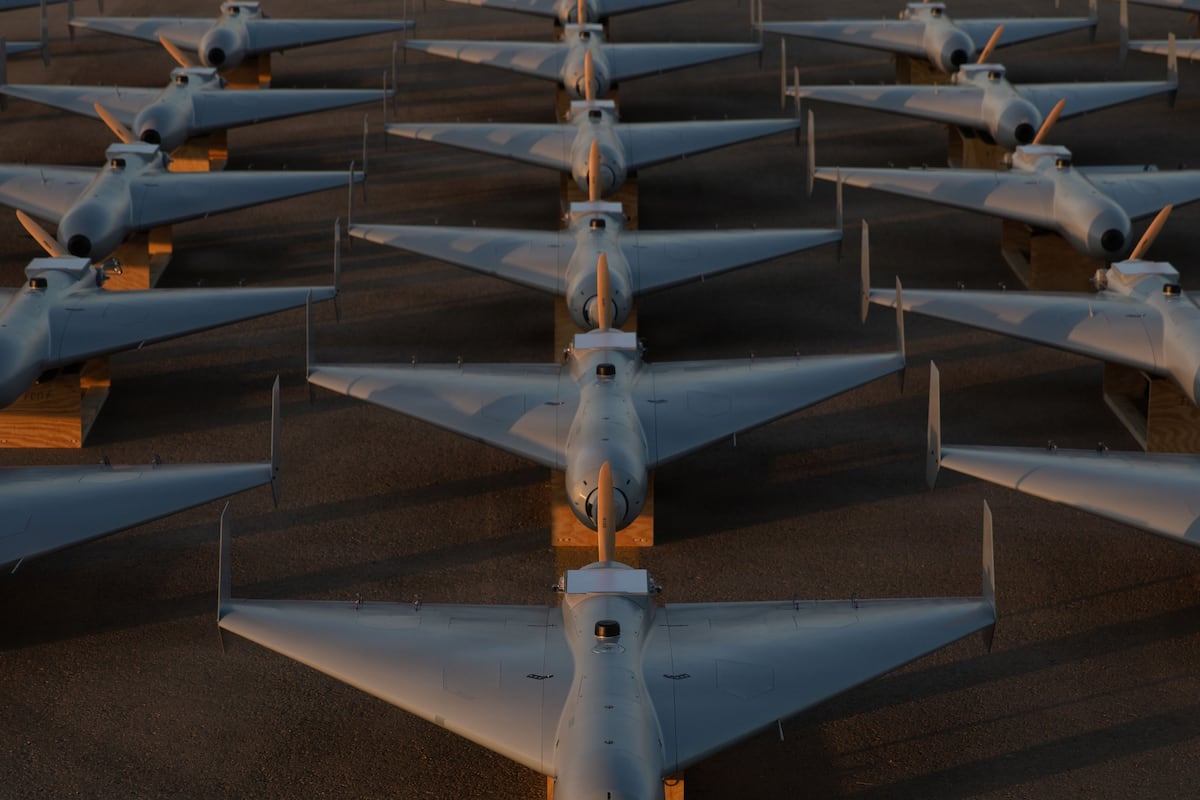
U.S. Central Command officials have confirmed that airstrikes launched on Iran on Saturday involved the first combat use of the U.S. military’s new autonomous kamikaze drone.
The Low-cost Unmanned Combat Attack System, or LUCAS drone, was launched as part of Operation Epic Fury , which targeted Islamic Revolutionary Guard Corps command and control facilities, Iranian air defense capabilities, missile and drone launch sites and military airfields, CENTCOM officials announced.
“The president ordered bold action, and our brave soldiers, sailors, airmen, Marines, guardians, and Coast Guardsmen are answering the call,” Adm. Brad Cooper, commander of CENTCOM, said in the release .
The LUCAS platform is a one-way attack drone reverse-engineered after the Iranian Shahed-136 .
Built by the Arizona-based SpektreWorks , the drone, which can be launched via catapults, rocket-assisted takeoff and mobile ground systems, is a spinoff of the company’s FLM 136 target model, one designed for counter-drone training while simulating Iran’s Shahed variant.
The FLM 136 model carries a range capability of around 500 miles, with a maximum payload of 40 pounds, or “roughly twice the explosive yield of a hellfire missile,” according to Alex Hollings, host of Sandboxx News’ FirePower .
With a maximum takeoff weight of 180 pounds, the FLM 136 is significantly lighter than the Iranian Shahed. The platforms are also immensely more cost-effective — and scalable — compared to the more advanced munitions in the U.S. arsenal, carrying a price tag of around $35,000 per unit.
The U.S. Navy’s use of costly interceptors in recent years against Shaheds fired by Houthis into the Red Sea has prompted increased scrutiny of the cost trade-offs of such exchanges.
Iran’s stockpile of unmanned Shahed drones is immense, with the Islamic Republic reportedly producing 10,000 per month. Contrast the $35,000 average cost of an Iranian Shahed drone with an estimated $4 million price tag of a land-fired PAC-3 interceptor, and the cost exchange, if engaged, is 114-1 in favor of Iran.
And while the LUCAS drone is a strike munition, its deployment marks a considerable shift toward a cost-effective philosophy that could soon see cheaply-made interceptor drones, such as those being used to great effect in Ukraine, fielded by U.S. forces.
Soaring casualties in Ukraine, as well as lopsided military spending by Russia, have forced Kyiv to rethink its battlefield approach.
As of February, Ukrainian commanders say strike drones now account for 60% to 70% of all hits on Russian targets. Similarly, cost-friendly interceptor drones, some of which run as little as $1,000 each, experienced a 70% success rate in downing Iranian-made Shaheds in February.
The U.S.-made LUCAS drone, meanwhile, was successfully launched from a ship for the first time in December , with personnel aboard the Independence-class littoral combat ship USS Santa Barbara carrying out an exercise in the Arabian Gulf, the Defense Department previously announced.
Those troops make up the newly formed Task Force Scorpion Strike squadron, a first-of-its-kind one-way-attack drone squadron led by U.S. Special Operations Command-Central personnel.
“This new task force sets the conditions for using innovation as a deterrent,” Cooper said in a December release . “Equipping our skilled warfighters faster with cutting-edge drone capabilities showcases U.S. military innovation and strength, which deters bad actors.”
The establishment of the task force in December followed a directive months earlier by Defense Secretary Pete Hegseth, “Unleashing U.S. Military Drone Dominance,” to accelerate acquisition and fielding of affordable autonomous systems throughout the military services.
“To simulate the modern battlefield, senior officers must overcome the bureaucracy’s instinctive risk-aversion on everything from budgeting to weaponizing and training,” Hegseth wrote in the July memo . “Next year I expect to see this capability integrated into all relevant combat training, including force-on-force drone wars.”
The Navy’s operations in U.S. Central Command comprise around 2.5 million square miles of ocean and include the Arabian Gulf, Gulf of Oman, Red Sea and parts of the Indian Ocean.
J.D. Simkins is Editor-in-Chief of Military Times and Defense News, and a Marine Corps veteran of the Iraq War.
美国中央司令部官员证实,周六对伊朗发动的空袭中,美军首次在实战中使用了新型自主神风特攻无人机。
美国中央司令部官员宣布,低成本无人作战攻击系统(LUCAS)无人机作为“史诗狂怒行动”的一部分投入使用,该行动的目标是伊朗伊斯兰革命卫队的指挥控制设施、伊朗防空能力、导弹和无人机发射场以及军用机场。
“总统下令采取大胆行动,我们勇敢的陆军、海军、空军、海军陆战队、国民警卫队和海岸警卫队队员正在响应号召,”中央司令部司令布拉德·库珀海军上将在新闻稿中说。
LUCAS平台是一款单向攻击无人机,它是仿照伊朗Shahed-136无人机逆向工程而来的。
这款无人机由位于亚利桑那州的 SpektreWorks 公司制造,可通过弹射器、火箭助推起飞和移动地面系统发射,是该公司 FLM 136 目标型号的衍生产品,该型号旨在模拟伊朗的 Shahed 变种无人机,用于反无人机训练。
据 Sandboxx News 的 FirePower 节目主持人 Alex Hollings 称,FLM 136 型号的射程约为 500 英里,最大有效载荷为 40 磅,或者“大约是地狱火导弹爆炸当量的两倍”。
FLM 136的最大起飞重量为180磅,比伊朗的“沙赫德”导弹轻得多。与美国武库中更先进的弹药相比,该平台也更具成本效益,且更易于扩展,单价约为35,000美元。
近年来,美国海军使用昂贵的拦截器对付胡塞武装向红海发射的沙赫德导弹,这引发了人们对这种行动的成本权衡的更多关注。
伊朗拥有数量庞大的“沙赫德”无人机,据报道,伊朗每月产量高达1万架。相比之下,一架伊朗“沙赫德”无人机的平均成本为3.5万美元,而陆基PAC-3拦截机的估价约为400万美元。如果双方交战,伊朗的成本优势高达114比1。
虽然 LUCAS 无人机是一种打击弹药,但它的部署标志着美军在成本效益理念上发生了重大转变,这种理念可能很快就会使美军部署廉价的拦截无人机,例如在乌克兰取得巨大成效的那些无人机。
乌克兰境内不断攀升的伤亡人数,以及俄罗斯不平衡的军费开支,迫使基辅重新思考其战场策略。
截至2月份,乌克兰指挥官表示,攻击型无人机目前占所有对俄目标打击的60%至70%。同样,一些成本低廉的拦截型无人机(单价低至1000美元)在2月份击落伊朗制造的“沙赫德”无人机的成功率也达到了70%。
与此同时,美国国防部此前宣布,美国制造的 LUCAS 无人机于 12 月首次从舰船上成功发射,当时“独立”级濒海战斗舰“圣巴巴拉”号上的人员正在阿拉伯湾进行演习。
这些部队组成了新成立的“蝎子打击”特遣队中队,这是一支史无前例的单向攻击无人机中队,由美国特种作战司令部中央司令部人员领导。
库珀在12月发布的一份声明中表示:“这个新成立的特别工作组为利用创新作为威慑手段创造了条件。更快地为我们训练有素的作战人员配备尖端无人机能力,展现了美国军事创新和实力,这可以威慑不法分子。”
12 月成立的特别工作组,是继国防部长皮特·赫格塞斯几个月前发布“释放美国军事无人机优势”指令之后成立的,该指令旨在加快在各军种中采购和部署价格合理的自主系统。
“为了模拟现代战场,高级军官必须克服官僚机构在从预算到武器装备和训练等各个方面本能的风险规避心理,”赫格塞斯在7月份的备忘录中写道。“我希望明年能看到这种能力融入所有相关的作战训练,包括实兵对抗无人机战争。”
美国海军在中央司令部的行动范围涵盖约 250 万平方英里的海洋,包括阿拉伯湾、阿曼湾、红海和印度洋的部分地区。
JD Simkins 是《军事时报》和《防务新闻》的总编辑,也是参加过伊拉克战争的海军陆战队老兵。