US Air Force flight to Antarctica turns back after Russian hazardous space activity warning美国空军一架飞往南极的航班在收到俄罗斯危险太空活动警告后返航
A U.S. Air Force C-17A Globemaster III taking off from Christchurch, New Zealand, returned after receiving a “potentially hazardous” space activity notice.
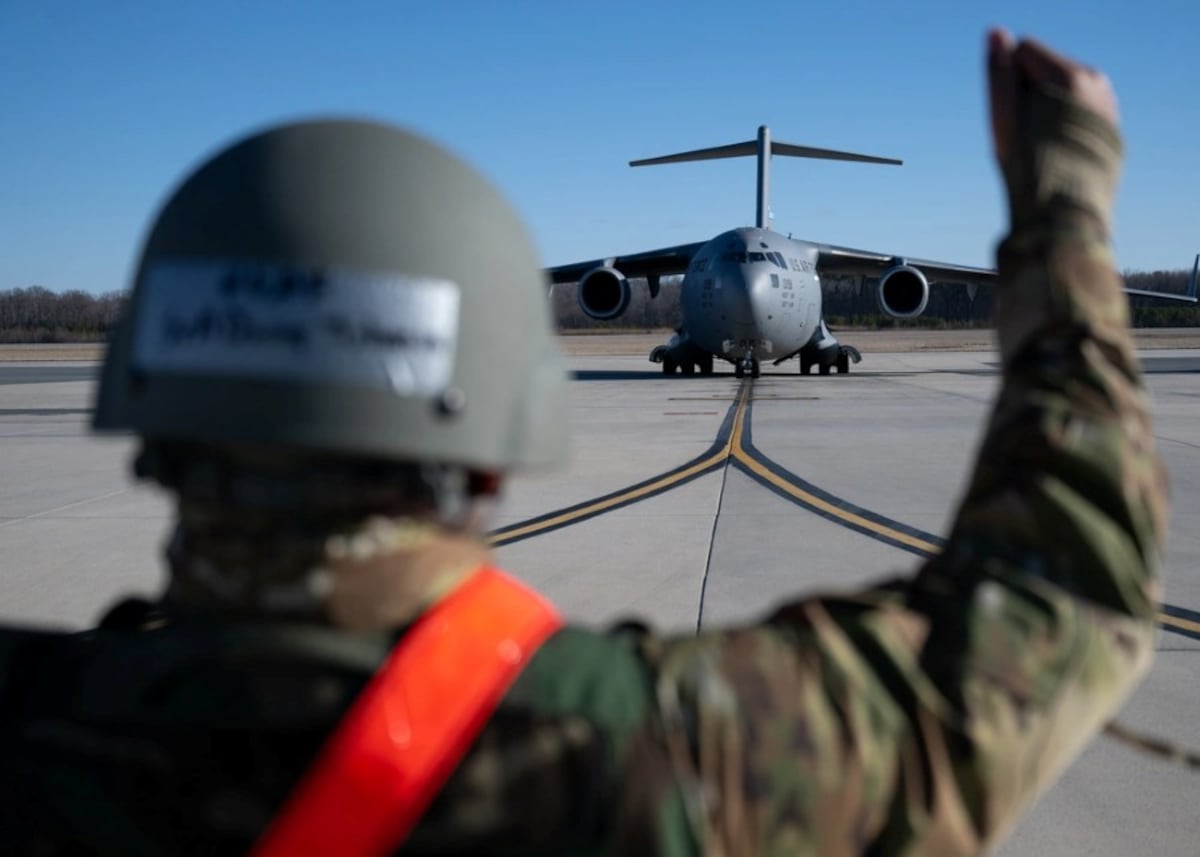
A U.S. Air Force flight enroute to Antarctica turned around to New Zealand after being notified of “potentially hazardous” space activity this week.
New Zealand’s Civil Aviation Authority was aware the flight from Christchurch pivoted following the agency’s issue of a Notice to Airmen, or NOTAM, to the aircraft, a CAA spokesperson told Military Times.
The Russian Air Traffic Management Corporation notified the CAA of the space activity, the spokesperson said, causing the authority to issue the NOTAM to the U.S. Air Force flight.
In a follow-up statement, the spokesperson said that the CAA was made aware by the Russian air traffic agency of a planned missile launch and associated potential hazard to international airspace within New Zealand’s Oceanic Flight Information Region.
“As a result, we put in place a danger area and issued a NOTAM to alert aircraft operators to the potential hazard,” the spokesperson said. “This does not prevent aircraft from flying through the area, operators make their decisions based on the information available.”
NOTAMs alert aircraft operators of potential hazards to allow them to make operational decisions around flight planning.
“Much of our Oceanic FIR is over international waters, where we have limited control over activities,” the spokesperson said, referring to the roughly 30 million square kilometers of international waters that spans across the South Pacific Ocean, Southern Ocean and Tasman Sea.
“It is normal practice for Airspace Authorities and Air Traffic Service Providers, provided with such hazard notifications to issue NOTAMs,” the spokesperson continued.
Flight-tracking data from Flightradar24 shows a U.S. Air Force C-17A Globemaster III took off from Christchurch International Airport, New Zealand, on Tuesday at 9 a.m. local time, with the call sign ICE28.
The site shows the aircraft landed around 11:30 a.m. back at Christchurch.
The flight was a routine resupply mission scheduled for this time of year, a U.S. Pacific Air Forces spokesperson told Military Times.
“Christchurch is the gateway to Antarctica,” the PACAF spokesperson said. “Both the United States Air Force and New Zealand Defense Force conduct operations and logistical support out of Christchurch in support of our Antarctic science programs.”
The turnaround happened during the U.S. Air Force’s annual Winter Fly-in period, or WinFly, which usually occurs toward the end of August and delivers teams, equipment and cargo to McMurdo Station and Scott Base, both in Antarctica, ahead of its research season.
The PACAF spokesperson declined to comment on whether this flight was in direct support of the WinFly, but a 2012 Air Force release details that a C-17 delivered over 300 passengers and 230,000 pounds of cargo that year to Antarctica.
“Using Christchurch International Airport, New Zealand as the base of operations, the mission of WinFly is to deliver advance teams and cargo to the remote research center in preparation for the main season of Operation Deep Freeze,” the release reads.
Operation Deep Freeze provides support to the U.S. Antarctic Program, managed by the National Science Foundation, that allows for continuous scientific research in the region.
Boeing’s C-17 Globemaster III is a cargo aircraft capable of fast delivery of troops and loads to main operating bases or forward bases in deployment areas. The aircraft can also complete tactical airlift and airdrop missions as well as aeromedical evacuations.
Cristina Stassis is a reporter covering stories surrounding the defense industry, national security, military/veteran affairs and more. She previously worked as an editorial fellow for Defense News in 2024 where she assisted the newsroom in breaking news across Sightline Media Group.
本周,一架飞往南极的美国空军飞机在接到有关“潜在危险”太空活动的通知后,返航新西兰。
新西兰民航局发言人告诉《军事时报》,该局已注意到从基督城起飞的航班在向该飞机发出飞行员通告(NOTAM)后改变了航线。
发言人表示,俄罗斯空中交通管理公司已将该太空活动通知了民航局,导致民航局向美国空军航班发布了航行通告。
发言人随后发表声明称,民航局已从俄罗斯空中交通管制机构获悉,计划在新西兰海洋飞行情报区内进行导弹发射,这可能对国际空域构成潜在危险。
发言人表示:“因此,我们划定了危险区域,并发布了航行通告,提醒航空运营商注意潜在危险。但这并不阻止飞机飞越该区域,运营商会根据现有信息做出决定。”
航行通告(NOTAM)提醒飞机运营者注意潜在危险,以便他们能够就飞行计划做出操作决策。
发言人表示:“我们的大部分海洋远征情报区位于国际水域,我们对那里的活动控制有限。”他指的是横跨南太平洋、南大洋和塔斯曼海的约 3000 万平方公里的国际水域。
发言人继续说道:“对于收到此类危险通知的空域管理机构和空中交通服务提供商来说,发布航行通告是正常做法。”
Flightradar24 的航班跟踪数据显示,一架美国空军 C-17A 环球霸王 III 运输机于周二上午 9 点(当地时间)从新西兰基督城国际机场起飞,呼号为 ICE28。
网站显示,飞机于上午 11:30 左右降落在基督城。
美国太平洋空军发言人告诉《军事时报》,这次飞行是每年这个时候安排的例行补给任务。
“基督城是通往南极的门户,”太平洋空军发言人说。“美国空军和新西兰国防军都从基督城开展行动和后勤保障,以支持我们的南极科学项目。”
这一转机发生在美军一年一度的冬季飞行集结期(WinFly),该集结通常在 8 月底进行,目的是在南极洲的麦克默多站和斯科特基地开始科研季之前,向这两个基地运送团队、设备和货物。
太平洋空军发言人拒绝评论此次飞行是否直接支持 WinFly,但美国空军 2012 年发布的一份新闻稿详细说明,当年一架 C-17 向南极洲运送了 300 多名乘客和 230,000 磅货物。
新闻稿中写道:“WinFly 以新西兰基督城国际机场为运营基地,其任务是将先遣队和货物运送到偏远的研究中心,为‘深冻行动’的主要季节做准备。”
“深冻行动”为美国南极计划提供支持,该计划由国家科学基金会管理,旨在使该地区的科学研究得以持续进行。
波音公司的C-17“环球霸王III”运输机是一款能够快速向部署区域的主要作战基地或前沿基地运送部队和物资的货运飞机。该飞机还可以执行战术空运和空投任务,以及航空医疗后送任务。
克里斯蒂娜·斯塔西斯是一位记者,主要报道国防工业、国家安全、军事/退伍军人事务等领域的新闻。她曾于2024年在《防务新闻》担任编辑助理,协助Sightline媒体集团旗下新闻编辑室处理突发新闻。