Ukraine Disrupts Russia’s Donetsk Offensive乌克兰打断俄罗斯在顿涅茨克的攻势
Ukrainian success has fundamentally unhinged the Russian campaign to complete the seizure of Donetsk Oblast.
Ukrainian forces have defeated the 2026 Russian campaign to seize Donetsk Oblast. Russian forces intended to conduct a deep encirclement of the entire Fortress Belt from the Lyman direction in the north and the Dobropillya direction in the southwest, linking up near Barvinkove, Kharkiv Oblast. This wide encirclement would have largely completed the seizure of unoccupied Donetsk Oblast. The Ukrainian counteroffensive known as Operation Vivaldi in the Lyman direction has completely disrupted this Russian plan by inflicting an operational defeat on the northern Russian pincer. This Ukrainian success has thus fundamentally unhinged the Russian campaign to complete the seizure of Donetsk, and will force the Russian military to reconstitute and likely fundamentally rethink its approach to accomplish its goals in this area. There is therefore no basis to assess that Russian forces will be able to take the rest of Donetsk Oblast in any short period of time, as Russian President Vladimir Putin continues to claim, or even to forecast that Russian forces will ever be able to complete their seizure of this region by force.
Russian forces have been engaged in a multi-pronged campaign intended to seize the Fortress Belt, attempting to complete the seizure of Kostyantynivka; envelop Kramatorsk from the southwest via Dobropillya and from the northeast via Lyman; and conduct frontal assaults against Slovyansk and Kramatorsk from the east. Ukrainian counterattacks in the Lyman direction will force the Russian military command to abandon its original campaign design of a wide encirclement of the Fortress Belt for a considerable period of time. Ukraine’s Operation Vivaldi in the Lyman direction has collapsed the Russian salient north and northwest of Lyman that was intended to be the base of the northern pincer of the Russian encirclement. Ukrainian counterattacks have both denied Russian forces the opportunity to conduct a wide encirclement of the Fortress Belt from the north and blocked Russian plans for enveloping Slovyansk itself from the northeast. Russian forces have made limited but significant gains in and around Kostyantynivka and east of Slovyansk but are struggling to maintain momentum in these areas and elsewhere on the frontline. Recent reporting indicates that Operation Vivaldi is already having effects on Russian operations in the neighboring Slovyansk direction.[1] Operation Vivaldi has fundamentally disrupted the current Russian campaign for Donetsk Oblast, but the long-term implications remain unclear at this time as details of the operation continue to emerge.
Ukrainian forces have also taken numerous steps to reinforce the Fortress Belt and better defend against Russian attacks, which will likely inhibit Russian offensive operations against the Fortress Belt beyond the Lyman direction. Ukraine restructured and realigned its military command arrangements in and around Donetsk Oblast in early September 2026, orienting areas of responsibility (AoR) to best defend the Fortress Belt and optimize command and control (C2).[2] The Ukrainian military command replaced the Eastern Group of Forces (GoF) with the newly formed Azov and Center GoFs: the Center GoF’s AoR runs from the Lyman direction to the Kramatorsk-Kostyantynivka area in the Fortress Belt, and the Azov GoF’s AoR covers the Dobropillya tactical area to the south.[3] Reorganized and reinforced Ukrainian units and formations are conducting tactical counterattacks east of Slovyansk that are disrupting Russian efforts to conduct a direct offensive against the city and could also undermine Russian efforts to press on Kramatorsk from the east.[4]
Ukrainian counterattacks will likely force the Russian military command to rethink its wider plans to use Russian activity in the Lyman and Dobropillya directions to conduct a wide encirclement of the Fortress Belt and all of Donetsk Oblast. Russian forces will not be able to seize the Fortress Belt according to their original plan, but Russian forces continue prioritizing attacks aimed at encircling the Fortress Belt from the southwest even though the Lyman effort has failed.[5] The Russian Ministry of Defense (MoD) continues attempts to falsely assert control over recently liberated settlements, refusing to accept the battlefield realities at least in public.[6] The continued false assertion of Russian control suggests that the Russian military command has neither yet internalized the loss of the Lyman salient nor adjusted its campaign design to reflect the loss of both the salient and the operational initiative in the area. The Russian military command has two combined arms armies (CAA) operating in the Lyman direction and north of Lyman, both of which are likely very degraded from Ukraine’s months-long counterattack and not in any condition to attempt any renewed offensive. The Russian military command will likely either have to give up on its plans for a northern pincer or redeploy significant manpower from other sectors to defend against Ukrainian counterattacks. Such a redeployment would very likely create cascading operational and strategic effects on other Russian offensives against the Fortress Belt. Dobropillya remains critical for any Russian prospects against the Fortress Belt outside of costly frontal assaults, and the Russian military command continues to prioritize efforts toward Dobropillya in an attempt to cut Ukrainian ground lines of communication (GLOCs) to the Fortress Belt from the west and will likely continue to do so even if it eventually gives up on the idea of linking advances from this direction with a northern pincer.
It is unclear how (or when) the Russian military command will adapt its campaign design in light of the collapse of the northern pincer, but the experience of previous Russian efforts will very likely shape any future Russian campaign. The Russian military command tried to seize Slovyansk directly from the east in the initial 2022 invasion, but failed. It then sought to envelop Slovyansk from Izyum, Kharkiv Oblast (northwest of Slovyansk) after the failure of its initial attempts to seize the city. Russian forces got to within six kilometers of the outskirts of Slovyansk at the time but never reached the city itself. The Russian campaign was designed to close in on the northern flank of the Fortress Belt from three sides, likely in the hopes of forcing a Ukrainian withdrawal first to the south towards Kramatorsk, then northwestward towards Barvinkove in combination with other Russian efforts. This effort also failed, and Russian hopes for seizing Slovyansk in 2022 ended with the successful Ukrainian Kharkiv counteroffensive in the fall of that year, which pushed Russian forces roughly 48 kilometers from Izyum and roughly 38 kilometers from Slovyansk. Russian forces took four years to reconstitute their strength enough to launch a new major campaign in the Slovyansk direction in 2026. The failure of the Russian campaign in 2022 and the time it took for Russian forces to renew efforts against Slovyansk are critical factors in considering the long-term implications of Operation Vivaldi. Operation Vivaldi has not inflicted Russian defeat on the same scale as the 2022 Kharkiv counteroffensive, but Russian forces will still require significant time to recover and reconstitute forces before being able to renew ground operations at the previous scale. Operation Vivaldi has thus destroyed two supporting Russian efforts: one that supported the deep encirclement of the Fortress Belt and one that supported a direct assault on Slovyansk from the northeast. Russian forces will have to reconstitute and regain positions they have just lost before they can try to seize or encircle Slovyansk again.
The collapse of the northern pincer makes Russian efforts toward Dobropillya even more critical for Russian prospects against the Fortress Belt. Russian offensives around Dobropillya are still aimed at conducting a wide encirclement of the Fortress Belt, cutting key Ukrainian ground lines of communication (GLOCs), and covering the western flank of the Kramatorsk push. The failure of the Dobropillya effort would constrain Russian forces to conducting direct frontal assaults against newly reinforced Ukrainian positions in the fortress belt cities themselves. The Russian military command thus continues to redouble its efforts to seize Dobropillya and then exploit that seizure with a drive to the north despite the extremely high losses its forces are taking for minimal gains in this direction.
The Russian military command’s campaign design rests on the delusional premise that it will be able to restore operational maneuver on the battlefield . The Russian rate of advance precludes a rapid envelopment of the Fortress Belt from Dobropillya, even if Russian forces manage to seize the town. Russian forces would need to advance north from Dobropillya to have an operational level impact on Ukrainian defenses in the Fortress Belt area considering the defeat of the Russian northern pincer. An operation to isolate the Fortress Belt relying exclusively on a drive north from the Dobropillya area would require enormous manpower and resources and take many months if not years to complete. If Ukrainian forces can either hold Dobropillya or force Russian attacks to culminate after seizing that settlement, then Russian prospects for taking the Fortress Belt cities at all become extremely dim.
The situation around the Fortress Belt remains dynamic and Russian forces will likely adapt to Ukrainian counterattacks over time, but Ukrainian forces appear to have halted the Russian effort for the time being. The collapse of the Russian effort on the northern flank does not end the immediate Russian threat to Kostyantynivka, however. The Russian campaign for Kostyantynivka has been more successful than Russian efforts in the Lyman-Slovyansk direction, and Russian forces have made significant tactical gains in the town. Russian forces have been struggling to quickly complete the seizure of the town, however, despite their own claims of seizure, which will likely impede their ability to conduct their planned campaign for Druzhkivka. Russian forces first infiltrated into Kostyantynivka in October 2025 and started making significant tactical gains in the town in June 2026 but have still not been able to seize the town after a year of fighting. Ukrainian forces continue to hold positions in northwestern Kostyantynivka, and continued Ukrainian presence in the town gives more time for Ukraine to build up and solidify defensive lines behind Kostyantynivka. The Russian military command is planning its campaign for Druzhkivka on the false premise that Russian forces control Kostyantynivka, which will create problems for Russian forces on the ground. More limited reporting indicates that Ukrainian forces may also be conducting limited counterattacks southwest of Druzhkivka and north of Kostyantynivka, which could further inhibit Russian attempts to reach Druzhkivka.[7]
Continued Russian failure to deprioritize secondary efforts outside the Fortress Belt hinders Russian forces’ efforts to complete the seizure of Donetsk Oblast. The Russian military command has not restructured its operational command structures to optimize for the offensive against the Fortress Belt as Ukrainian forces have done. The Russian military and political leadership has consistently demanded constant advances across the entire theater, stretching command structures far beyond the Fortress Belt and limiting the effectiveness of Russian operations. Elements of three Russian groupings of forces are operating against the Fortress Belt. The Russian Western Grouping of Forces’ (GoF) AoR spans from Kupyansk through Lyman, the Southern GoF’s AoR runs from Slovyansk to the area south of Druzhkivka, and the Central GoF’s AoR reaches from Dobropillya to Novopavlivka. The Western and Central GoFs are thus overextended and are responsible for significant offensive operations outside the Fortress Belt effort, specifically in the Kupyansk and Novopavlivka directions. The overextension of the Western and Central GoFs reduces their ability to effectively allocate resources to priority sectors and contributes to command and control (C2) inefficiencies that are hindering Russian forces’ ability to advance anywhere.
The pervasive culture of lying within the Russian military is also both indicative of the Kremlin’s actual tactical and operational objectives and an important factor degrading Russian battlefield awareness and impeding operational planning. Senior Russian military and political leadership regularly make blatantly false claims of Russian advances on the frontline, likely drawn from lower-echelon reports that exaggerate the progress on the ground toward real tactical and operational objectives. Senior Russian officials’ claims, for example that Russian forces have seized half of Oleksiievo-Druzhkivka and are fighting one kilometer east of Kramatorsk, indicate that the Russian military command intends to assault Druzhkivka and Kramatorsk head-on. The Senior Russian military and political leadership’s understanding of the true nature of the frontlines is severely distorted by the Russian military’s systematic lying.[8] This culture of lying will inhibit Russian forces’ ability to respond to Ukraine’s Operation Vivaldi, as the Russian military leadership has a completely false understanding of where the frontline is. Putin notably claimed on September 2 that Russian forces had seized Svyatohirsk (14 kilometers northwest of Lyman), despite Ukrainian counterattacks that have pushed the frontline to over 20 kilometers east of the settlement.[9] Ukrainian forces, in fact, capitalized on this culture of lying to maintain operational security (OPSEC) and the element of surprise over Russian forces to advance during Operation Vivaldi.[10] This fundamental Russian misunderstanding of the battlefield reality prevents Russian commanders from being able to address and respond to Ukrainian counterattacks in a timely manner. It also creates operational risks for Russian forces because they cannot call for strikes on locations they claim to control and because units in adjacent sectors may plan operations based on this inaccurate battlefield picture.
Ukrainian successes in the Lyman direction and Ukrainian efforts to stabilize the defense of the rest of the Fortress Belt area have placed the Russian military command in a difficult position. The Kremlin will be faced with hard choices in the coming months as Ukrainian forces continue to counterattack and contest the operational initiative in Donetsk Oblast. The situation across the Fortress Belt remains dynamic, and Russian commanders are reportedly pressing Putin for a massive mobilization likely aimed at restoring their ability to seize and hold the initiative. It remains unclear how such a mobilization, if Putin actually orders it, will change the theater dynamics in the face of Ukraine’s current advantages in both tactical and operational drone operations and drone-infantry integration. Ukraine has proven its ability to contest the operational initiative and disrupt Russian offensive plans on numerous occasions throughout 2026 and will likely continue to do so in the coming months. Russian forces may continue to make slow creeping advances in the Fortress Belt but will fail to meet Putin’s newly revised deadline of seizing all of Donetsk Oblast by Spring 2027, if they can seize it at all.
Russian forces intensified offensive operations intended to seize the Ukrainian Fortress Belt – Ukraine’s main defensive line in Donetsk Oblast — in Spring 2026, after conducting a series of mechanized assaults in the Lyman and Kostyantynivka directions.[11] Russian forces have not yet taken any Fortress Belt city but have made significant tactical gains in Kostyantynivka. Ukrainian defensive operations, including recent counteroffensive operations north of Lyman, will likely force the Russian military command to abandon its original campaign design of a wide encirclement of the Fortress Belt. The Russian military command is currently attempting to complete the seizure of Kostyantynivka; envelop Kramatorsk from the southwest via Dobropillya and from the northeast via Lyman; and conduct frontal assaults against Slovyansk and Kramatorsk from the east. Ukraine’s ongoing Operation Vivaldi has operationally defeated the Russian northern pincer in the Lyman direction, delaying Russia’s offensive against Slovyansk — the Russian objective after the seizure of Lyman itself.[12] Russian forces continue prioritizing attacks aimed at advancing frontally on the Fortress Belt from the south and encircling the Fortress Belt from the southwest over efforts to advance on the cities from the east, even though the Lyman effort has failed.[13] Russian forces are employing sustained pressure, drone-enabled interdiction, and infiltration tactics to advance, as they have been unable to restore operational maneuver to the battlefield. Russian forces have adapted and primed themselves for positional warfare, making slow and grinding, yet consistent, gains across the theater. It is unclear, even so, if they will be able to continue to make significant progress toward their aim of completing the seizure of Donetsk Oblast on the battlefield.
Russia has long held the operation objective of seizing Ukraine’s Fortress Belt, which is critical for Russian forces to complete the seizure of Donbas — Putin’s self-defined objective since late Spring 2022, following the Russian failure to take Kyiv City. The Fortress Belt is comprised of the four large settlements of Slovyansk, Kramatorsk, Druzhkivka, and Kostyantynivka with a combined pre-war population of over 380,000, with many smaller suburbs and satellite settlements in their vicinity. The Fortress Belt is an old Soviet industrial center, connected by the H-20 Highway and a railroad belt that act as arteries connecting the four cities. The Fortress Belt’s importance lies not only in its significance as the last remaining heavily populated area in Donbas that Russian forces have yet to occupy, but also in its key position defending the vast open plains of the right (east) bank of the Dnipro River basin.[14]
Slovyansk and Kramatorsk form the northern half of the Fortress Belt and have served as a significant logistics hub for defending Ukrainian forces in Donetsk Oblast since before the full-scale invasion in February 2022. Kramatorsk currently serves as Donetsk Oblast’s provisional administrative center (as Russian forces occupy the regional center of Donetsk City) and is a major industrial center. Druzhkivka, Oleksiievo-Druzhkivka, and Kostyantynivka form the southern half of the Fortress Belt. Lyman, which sits north of the Siverskyi Donets River north of Slovyansk, has served as Ukraine’s northern outpost of the Fortress Belt since late 2022.
Russian forces have tried and failed to seize the Fortress Belt several times since 2014. Ukrainian forces first retook the Fortress Belt cities from pro-Russian proxy forces who attacked and seized Slovyansk, Kramatorsk, Druzhkivka, and Kostyantynivka in April 2014.[15] Ukrainian forces dramatically built up the defenses of the Fortress Belt between 2014 and 2022. Russian forces tried to seize the Fortress Belt directly in Spring 2022 but were repulsed. They then attempted to attack the Fortress Belt from Izyum (northwest of Slovyansk) in March and April 2022 after advancing into eastern Kharkiv Oblast following their failures to seize the Fortress Belt directly from the east and west.[16] Ukrainian forces stopped the Russian effort to outflank Slovyansk via Izyum and then launched their own counteroffensive in Kharkiv that drove Russian forces out of Kharkiv Oblast and away from Slovyansk in Fall 2022.[17] Russian forces have subsequently conducted several campaigns in Donetsk Oblast in preparation for the current campaign against the Fortress Belt, including the campaigns for Soledar that culminated in January 2023, Bakhmut in May 2023, Chasiv Yar and Toretsk in August 2025, Siversk in December 2025, and Pokrovsk in January 2026, and the ongoing (and failing) campaign for Lyman.[18]
Putin has stuck to his priority goal of seizing all of Donetsk and Luhansk oblasts despite these continuous failures. Putin identified the complete seizure of Donetsk and Luhansk oblasts as a priority goal of Russia’s invasion of Ukraine in February 2022, and Russian officials have reiterated this objective over the past four years.[19] Russian forces seized 630.37 square kilometers in Donetsk Oblast between October 1, 2025, and October 1, 2026. Russian forces must seize an additional 5,382 square kilometers, including the Fortress Belt cities, in order to take the remainder of Donetsk Oblast. Putin has given Russian forces at least 15 separate deadlines since 2022 to seize the entirety of Donbas, and Russian forces have failed to meet any of them.[20] Putin has reportedly extended the deadline for Russian forces to seize the whole of Donetsk Oblast from the end of 2026 to Spring 2027 — a deadline that Russian forces will still not be able to meet.[21] Russian forces would have to advance at a rate of over 45 square kilometers per day to reach Putin’s deadline — a pace that Russian forces have not achieved since 2022. Russian offensive operations spanning from Lyman to Dobropillya are currently all aimed at seizing the remainder of Donetsk Oblast. Russian forces have advanced at an average rate of .06 kilometers per day in the Slovyansk direction in the last six months and .43 kilometers per day in the Kostyantynivka-Druzhkivka tactical area. Russian forces intensified localized assaults near Lyman and Kostyantynivka in May of 2026. It remains unclear if the Russian military command is willing or able to allocate the manpower necessary to make operationally significant advances in the area. It is also unclear if even additional manpower can overcome Ukrainian defenses.
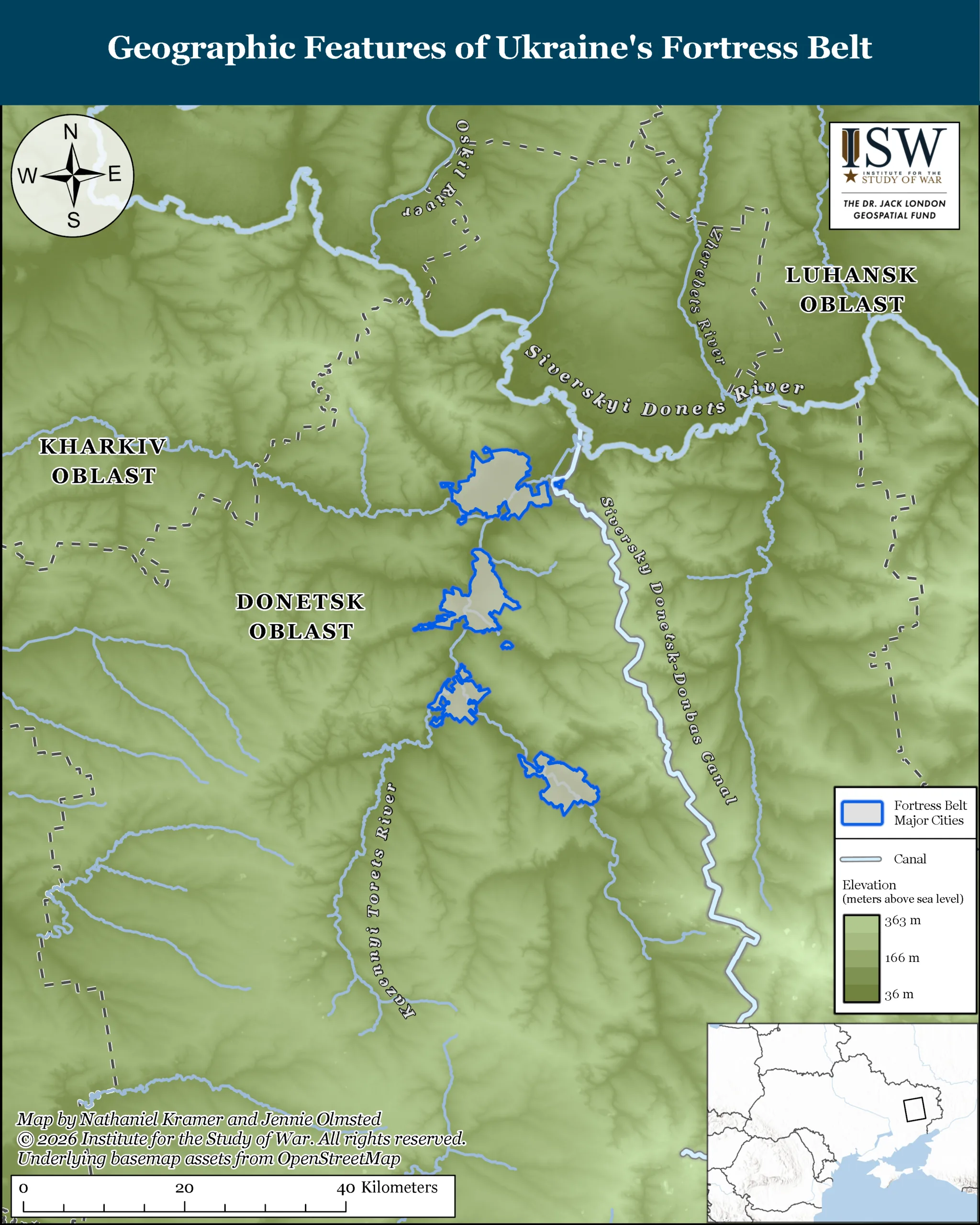
Geographic Features of the Fortress Belt that Hinder Russian Operations Against It
The terrain of the Fortress Belt is shaped by three waterways: the Siverskyi Donets River, the Kazennyi Torets River, and the Siverskyi Donets-Donbas Canal. The Siverskyi Donets River runs west northwest-east southeast, from Vovchansk, Kharkiv Oblast, to just north of Luhansk City, Luhansk Oblast, eventually feeding into the Don River in Russia. It splits Lyman from Slovyansk, running about 70 meters wide between the two settlements. The Kazennyi Torets is a far less significant body of water that runs south-north, feeding into the Siverskyi Donets east of Raihorodok (northeast of Slovyansk), and connects Slovyansk, Kramatorsk, and Druzhkivka. The river is fed by streams near Hrodivka and Myrnohrad, and the Kryvyi Torets River, which runs through Kostyantynivka. Both the Kazennyi Torets and Kryvyi Torets rivers are around 50 meters wide and run through the spine of the Fortress Belt operational area. The third significant body of water is the Siverskyi Donets – Donbas Canal, which splits off from the Siverskyi Donets near Raihorodok and flows south to Makiivka (north of Donetsk City). The topography of the Fortress Belt is largely flat, though incised throughout by the drainage basins of the rivers and streams and embossed by the banks of the Siverskyi Donets River and Canal. West of the Siverskyi Donets-Donbas Canal, many of these valleys run east-west towards the Kazennyi Torets River, while in the area around Siversk these valleys run southwest-northeast towards the Siverskyi Donets River near the Serebryanka Forest. Settlements such as Zakitne, Riznykivka, Vasyukivka, Nykyforivka, and Pryvillya (all east of Slovyansk) sit along those southwest-northeast running valleys. Settlements such as Nykonorivka, Vasyutynske, Fedorivka, and Virolyubivka sit along the east-west valleys running towards Slovyansk and Kramatorsk. A third significant stream of settlements sits along the valley of the Kazennyi Torets River south of Druzhkivka, including Sofiivka, Krasnyi Kut, and Raiske. The right (southern) bank of the Siverskyi Donets River, running from Kryva Luka to Zakitne, and the plateau that stretches south to the Kalenyky-Riznykivka-Svyato-Pokrovske line are the steepest area between Lyman and Dobropillya. Large wooded areas, as well as the Serebryanka forest north of Siversk, line the banks of the Siverskyi Donets, though Ukrainian defenders have leveled large sections of the forests near Lyman in order to deprive Russian attackers of the natural cover they provide. Most of the rest of the land is taken up by farmland, divided up by hedgerows and windbreaks, and dotted by smaller forested areas. A large stretch of quarries runs from Hruzke (northeast of Dobropillya) to Staroraiske (west of Druzhkivka). These water features, ravines, and the settlements along them dissect the terrain of the Fortress Belt and create many opportunities for Ukrainian defenders. Ukrainian forces have constructed fortifications to take advantage of these terrain features since 2014, which is one of the factors that makes the Fortress Belt so imposing an obstacle to Russian advances.
Russia’s campaign against Ukraine’s Fortress Belt consists of a broad encirclement effort and concurrent direct assaults on the urban belt itself, but Ukrainian defenses and poor synchronization among Russian lines of effort have significantly degraded the campaign’s prospects for success. The Russian campaign for Ukraine’s Fortress Belt is broken into two distinct primary elements: a deep encirclement of the entire Fortress Belt from the north and southwest and direct assaults on Slovyansk, Kramatorsk, and Druzhkivka from the east and Kostyantynivka and Druzhkivka from the south. The Russian Central Grouping of Forces (GoF), comprised of elements of three combined arms armies (CAAs) on the southern flank of the Fortress Belt, has been trying to seize Dobropillya and advance from the Pokrovsk-Dobropillya sector northward to the area west of Druzhkivka and Kramatorsk, while the Russian Western GoF, comprised of three CAAs advancing on the northern flank of the Fortress Belt, have been attempting to seize Lyman, cross the Siverskyi Donets River, and advance west-southwest to the area northwest-west of Slovyansk. The Russian military command intended for these two prongs to link up around Barvinkove in Kharkiv Oblast, thereby encircling the entire Fortress Belt and the Ukrainian forces defending the cities. That encirclement would also have effectively seized the remainder of Donetsk Oblast behind the Fortress Belt cities, largely completing the Kremlin’s objective of seizing Donbas. Ukrainian forces have eliminated the Russian salient north of Lyman in recent months, however, and effectively stopped Russian efforts to seize Lyman itself, disrupting this two-pronged encirclement effort.
The Russian Southern GoF, comprised of elements of four CAAs, is engaged in the campaign to take the Fortress Belt itself, advancing from Kostyantynivka toward Druzhkivka and subsequently Kramatorsk, while simultaneously conducting a frontal assault on Slovyansk and Kramatorsk from the east. The Russian military command likely intended for such Russian offensives to be a supporting effort of the wider encirclement in alignment with operational art practices that make sense in maneuver warfare but not in positional warfare. Russian forces have executed these two efforts in a disjointed and poorly coordinated way, however, in part because the Russian campaign design was never suitable for the positional warfare that characterizes the current state of the conflict.
Russian forces have developed a campaign to seize the Fortress Belt that could prove effective in seizing the Belt over an extended period of time absent an effective Ukrainian defense; however, a dogged Ukrainian defensive force has proven capable of taking advantage of severe defects in the Russian operational design and tactical methods to defend the strategic string of settlements. A brilliantly conducted Ukrainian counterattack, Operation Vivaldi, has, in fact, completely disrupted Russian efforts on the northern flank of the Fortress Belt. A Russian campaign to seize the entire Fortress Belt, and subsequently all of Donetsk Oblast, would likely take years at the current Russian rate of advance and result in massive casualties that Russian forces may not be able to sustain even with large-scale mobilization. The defeat of Russian efforts in the Lyman-Slovyansk direction, in fact, calls seriously into question whether Russian forces can take the Fortress Belt at all.
Russian Tactics and Methods for Advance
Russian forces have been seeking to isolate and seize the Fortress Belt through sustained pressure, drone-enabled interdiction, and infiltration rather than deep operational penetrations or frontal assaults, but this approach has not been successful because of the size of the Fortress Belt area and adapting Ukrainian defenses. Russian forces developed an initial plan to seize the Fortress Belt that utilized a double envelopment of the Fortress Belt from the north via Izyum, and from the south via Pokrovsk. This campaign plan required Russian forces to conduct rapid mechanized maneuver warfare of the sort envisioned in Soviet Deep Battle doctrine, which Russian forces have repeatedly shown themselves unable to conduct during the current conflict. Russian forces have not conducted offensive operations that have led to immediate operational-level benefits or set operational-level conditions for subsequent operations since Spring 2022, nor did those campaigns deliver strategic success.[22] The failure of Russian efforts throughout 2022 and 2023 led the Russian military command to adopt and disseminate a doctrinal method for advances across the theater starting in 2024 aimed at leveraging smaller creeping partial envelopments of territory to force Ukrainian withdrawals, instead of attempting rapid, deep operational-level penetrations.[23] Russian forces demonstrated such operational patterns during the seizures of Avdiivka in February 2024, Vuhledar in October 2024, and in the approaches to Pokrovsk in January 2026.[24] This method, despite producing over the course of 2025 the largest Russian gains since 2022, has failed to produce mutually supporting campaigns throughout the theater, as the rate of the Russian advance rarely developed faster than Ukrainian forces’ ability to redeploy reserves.
The Russian military command added a new element to this doctrinal method in Spring 2025, introducing a concerted months-long battlefield air interdiction (BAI) campaign utilizing fiber-optic drones and fixed-wing Shahed-type drones to degrade Ukrainian ground lines of communication (GLOCs) in the immediate and near rear, enable Russian infiltration missions, and subsequently undermine Ukraine’s ability to sustain tactical defenses.[25] A BAI campaign has long been part of first Soviet and then Russian military doctrine, yet Russia’s failure to gain air superiority over Ukraine in the initial phase of the war dramatically limited Russia’s conventional air interdiction capabilities. Russia’s drone-enabled BAI campaigns during Summer 2025 enabled Russian tactical successes in the Pokrovsk and Hulyaipole directions in Fall 2025.[26] The Russian military command likely seeks to use a prolonged BAI campaign to set conditions to allow Russian forces to successfully conduct frontal assaults against larger operationally significant towns, as Russian forces were able to do in Hulyaipole.[27] Russian forces, having struggled to complete their encirclement of Pokrovsk, deployed the elite Rubikon Center for Advanced Unmanned Technologies to interdict Ukrainian GLOCs.[28] The BAI efforts in that campaign indicated that Russian military command may have been experimenting with different tactics in an attempt to avoid a drawn-out bloody urban battle. In the end, the Russians took six months to seize the town in bloody urban combat after first advancing into it.
Russian infiltrations in Winter 2026 towards Svyatohirsk (northwest of Lyman) and in Summer 2026 towards Raiske (south of Druzhkivka) and Zolotyi Kolodyaz (between Kramatorsk and Dobropillya), moreover, indicated that Russian commanders intended to physically interdict crucial Ukrainian GLOCs supplying the entire Fortress Belt.[29] Those efforts have failed in the north and have thus far been unsuccessful in severing key Ukrainian GLOCs in the south.
The Russian military command first began utilizing infiltration tactics alongside the deployment of Rubikon elements in Winter and early Spring 2025 during Russian clearing operations in Kursk Oblast. Russian servicemembers allegedly crawled up to 16 kilometers through pipelines in some areas of Kursk Oblast in order to infiltrate behind Ukrainian lines.[30] The effectiveness of this tactic at counteracting the increasing efficacy of Ukrainian artillery and drone capabilities in Kursk led the Russian military command to implement this tactic across the theater. Russian servicemembers continued infiltrating through pipelines in urban environments such as Kupyansk but have also infiltrated along the extensive system of windbreaks that make up Ukraine’s farmlands.[31] Russian forces also began using unarmored civilian vehicles, mainly motorcycles and all-terrain vehicles (ATVs), throughout the theater throughout late 2024 and 2025 in an attempt to restore a degree of maneuver to the battlefield.[32] Russian forces have been unable to determine how to reintroduce mechanized maneuver to the battlefield, as Ukrainian forces regularly detect and destroy concentrations of Russian armored vehicles before they can reach the line of contact.[33] The Russian military command has subsequently spent the last two years disseminating positional warfare tactics and operational concepts for slow, infantry-led assaults and grinding marginal advances instead of focusing on restoring maneuver warfare.[34] Russian forces recently attempted mechanized assaults in the Velykyi Burluk and Dobropillya salients. These assaults failed to break through to even the forward edge of the Russian battle area, much less break through Ukrainian defenses, though that was likely not their intent. Russian servicemembers have conducted extensive infiltration missions in both areas following these mechanized assaults, suggesting that Russian military commanders intend for mechanized assaults to insert servicemembers as near the frontline as possible for future infiltration areas.[35]
Russian infiltration tactics can produce relatively rapid tactical gains against thinly held Ukrainian lines, but Ukrainian adaptations and Russia’s failure to consolidate infiltrations have limited their lasting effects. Russian forces, in the most dramatic example, rapidly infiltrated up to 17.44 kilometers behind Ukrainian lines east and northeast of Dobropillya in a matter of days in August 2025 — the first rapid movement on the battlefield since Ukraine’s 2024 Kursk incursion.[36] Russian infiltrators hid along windbreaks and positioned themselves in basements behind Ukrainian lines. These infiltrators operated in small groups of individuals or sometimes alone, and unlike previous Russian attempts to make small, creeping gains, the Russian military command instead instructed these infiltrators to probe an often thinly-manned Ukrainian frontline for gaps that larger formations could exploit. These tactics were initially successful in areas like Dobropillya and Hulyaipole, where infiltrators broke through weak points in Ukrainian defensive lines to make relatively rapid advances. Russian forces in the Dobropillya penetration did not take the time to consolidate positions, however, and infiltrated too deep without being able to move up logistics and other forces to consolidate the penetration, and Ukrainian forces subsequently cleared almost all of the territory the Russians had infiltrated into by September 2025.[37] Although Russian forces seized Hulyaipole, Russian forces’ failure to subsequently capitalize on the tactical success of seizing that settlement demonstrates the limited operational effectiveness of infiltration tactics.
Russian units at the tactical level have leaned into infiltration and saturation fires tactics in recent months, spending large amounts of manpower in exchange for minimal but continually grinding territorial gains intended to exhaust Ukrainian lines rather than break or envelop them. Russian forces have prioritized extended saturation of fires on Ukrainian defenses in the Fortress Belt using both glide bombs and artillery.[38] These fire missions are likely intended to destroy Ukrainian defensive positions in windbreaks and urban environments, suppress drone operators, and prepare the urban landscape for combat operations. Ukrainian military sources have reported on the increasing effectiveness of Russian glide bomb and artillery strikes against Ukrainian drone operators, as the Russian military command looks for ways to overcome Ukraine’s natural defensive advantage and its advantage in unmanned systems.[39] Russian forces extensively used indirect fire to level the urban battlefields of Pokrovsk and Kupyansk. Russian saturation fires against urban areas are likely intended both to destroy Ukrainian defensive positions and to facilitate the movement of Russian servicemembers infiltrating into those areas. Russian forces have concentrated airstrikes in Summer 2026 in the Dobropillya and Hulyaipole directions and conducted relatively fewer in the area from Slovyansk to Kostyantynivka.[40] They have increased their airstrikes against Fortress Belt cities, especially Kramatorsk, Slovyansk, and Izyum, since Winter 2026, however.[41]
Russian forces have continued to demonstrate effectiveness at interdicting Ukrainian logistics within the kill zone, a tactic that has enabled them to besiege Ukrainian-held settlements without conducting extensive frontal assaults or needing to engage in longer operational envelopments. Russian forces are actively conducting concerted air interdiction strikes within the kill zone (at least 10-15 km on either side of the line of contact and sometimes considerably deeper), including strikes against Ukrainian mechanized vehicles, unmanned ground vehicles (UGVs), and aerial resupply drones. Russian forces first displayed this tactic during the Kursk Offensive and have since implemented it in the campaigns for Pokrovsk, Kupyansk, Siversk, Vovchansk, and Hulyaipole, and in the ongoing campaigns for Kostyantynivka and Lyman. These tactical strikes operate in a different sphere from operational BAI attacks, which are mainly conducted in coordination with Russian Aerospace forces (VKS), Unmanned Systems Forces (USF), or by fire assets at the brigade and higher level. Current Russian tactical strikes, in contrast, often involve small and relatively inexpensive quad- and hex-copter drones striking isolated Ukrainian resupply and rotation missions that often use UGVs or infantry mobility vehicles (IMVs) such as the American MaxxPro, within the kill zone. The nature of these strike vehicles enables frontline tactical Russian units to launch their own tactical interdiction and support efforts in coordination with infiltration missions, without having to coordinate with or rely on resources from higher headquarters. Russian forces’ integration of tactical air interdiction efforts enables Russian drone operators to more directly prepare the battlespace in areas where Russian forward units are attempting to infiltrate. Drone innovation on both sides has expanded the kill zone (an area in the near rear of elevated drone strike risk) throughout 2025, which has led to increased difficulties for both Russian and Ukrainian forces in rotating personnel and getting materiel to frontline positions.[42] Recent Ukrainian military reporting indicates that some Russian servicemembers have to travel 20-30 kilometers on foot to frontline positions in the Kostyantynivka direction, for example.[43] Ukrainian logistics have also experienced problems resupplying sparse frontline positions and rotating exhausted troops out.[44]
This tactical air interdiction (TAI) effort is intended to generate more immediate effects on the battlefield, specifically to disrupt Ukrainian logistics in frontline settlements. This effort is separate from the doctrinal idea of operational air interdiction campaigns, which are intended to “divert, disrupt, delay, or destroy the enemy’s military potential before being brought to bear effectively against friendly forces” (AFDP 3-03).[45] These tactical strike efforts are not intended to disrupt Ukrainian combat capabilities at the corps level, but rather to disrupt Ukrainian forces’ ability to operate within the limited tactical environments in which Russian forces are trying to advance.[46] Russian forces’ development of such tactics enables them to isolate Ukrainian-held settlements without having to fight through fortified Ukrainian positions along the flanks of the tactical areas and conduct drawn-out and costly envelopments. The Russian military and defense industry have continued to innovate in the drone space. Innovations in unmanned systems, including through the adoption of fiber-optics for strike, mothership, and sleeper drones (and the subsequent expansion of their ranges), enabled Russian forces to target Ukrainian logistics in the near rear beginning in 2025, thinning and stretching Ukrainian defensive lines. Russian forces have continued to adapt to Ukrainian counter-drone technology such as electronic warfare (EW) jamming by utilizing frequency hopping and spread spectrum (FHSS) transmitters and receivers to bypass jammed frequencies. Ukrainian forces have responded by significantly expanding their tactical drone interception capabilities.[47]
The Russian Campaign for Slovyansk
The Russian military command intended to drive on Slovyansk from Izyum (Kharkiv Oblast, northwest of Slovyansk) in 2022 after initial attempts to seize the city directly from the east had failed. The Russian military command had intended to have Russian formations in southeastern Kharkiv Oblast and southwestern Luhansk Oblast drive southwestward and establish bridgeheads on the right (west) bank of the Oskil River in order to exert pressure on the Ukrainian operational rear west of Slovyansk. Russian formations of the Western GoF were given the task of seizing Lyman, an important Ukrainian stronghold on the left (northern) bank of the Siverskyi Donets River northeast of Slovyansk. Russian formations from the so-called Luhansk People’s Republic Army Corps (LNR AC) advanced on Slovyansk from the east, along the opposing right (southern) bank of the Siverskyi Donets River from Severodonetsk. The Russian campaign was designed to close in on the northern flank of the Fortress Belt from three sides, likely in the hopes of forcing a Ukrainian withdrawal first to the south towards Kramatorsk, then northwestward towards Barvinkove in combination with other Russian efforts.[48] This effort also failed and ended with the successful Ukrainian Kharkiv counteroffensive in Fall 2022. The Russian military command deprioritized the area after the Kharkiv counteroffensive but maintained more limited and consistent pressure in the Lyman direction, before resuming intensified operations against the town in Winter 2025-2026.[49] The Russian military command’s current campaign design intended to have Russian forces seize Lyman to reach Slovyansk from the northeast while advancing northwest of Lyman to conduct a wide encirclement of the Fortress Belt. The Russian military command likely intended for Russian forces operating east of Slovyansk to act as a supporting effort, benefiting from the encirclement to avoid having to fight prepared Ukrainian defenders in frontal assaults through the city.
Russian forces launched the campaign to seize Slovyansk in December 2025 following the seizure of Siversk (east of Slovyansk). Russian forces seized Siversk (28 kilometers east of Slovyansk) as of December 2025 after a 41-month campaign for the town.[50] Russian forces have advanced roughly 14 kilometers and infiltrated roughly 20 kilometers west of Siversk, primarily through open fields, over the last nine months. Russian forces resumed offensive operations in the Lyman direction in early 2024 and intensified this effort in March 2026 during a series of mechanized assaults, which marked the start of Russia’s Spring-Summer 2026 offensive.[51] Russian forces reached Lyman in November 2025 and began infiltration attempts into the town, but have since failed to make any tactical gains within the town (and have subsequently been repulsed). Russian forces deprioritized offensive operations toward Lyman in Fall 2025, in favor of offensive operations in the Kupyansk direction and other priority sectors of the frontline, before resuming intensified efforts against the town in early Spring 2026.
Russian forces have been trying to advance towards Slovyansk with elements of at least four combined arms armies in 2026. The Western GoF has focused the 25th CAA, large portions of the 20th CAA, and elements of the 1 st Guards Tank Army (GTA) (a CAA with a hereditary Soviet label) towards seizing Lyman. The 25th CAA, the main force assaulting Lyman, is comprised of two maneuver (one motorized rifle and one tank) brigades and four maneuver regiments, some of which are subordinate to a division headquarters, though portions of its 11th Tank Brigade are also operating in the Lyptsi direction in northern Kharkiv Oblast. The 20th CAA, responsible for the assaults on Borova and the northern flank of the Lyman assault, has nine maneuver regiments divided between two divisions. The 1st GTA has been preoccupied with assaulting Kupyansk for over a year, with a brigade and 12 maneuver regiments subordinated to it, though one of those regiments was deployed to the Lyptsi direction alongside the 11th Tank Brigade. The 3rd CAA (formerly 2nd Luhansk People’s Republic [LNR] AC, Southern Military District [SMD]) of the Southern GoF operates across from the 25th CAA on the right (southern) bank of the Siverskyi Donets River. It is driving on Slovyansk westwards via the southern bank of the Siverskyi Donets and northwestwards via the E-40 Highway with six maneuver brigades and one maneuver regiment, though some of its forces have been directed to assault Kramatorsk.
The Russian campaign for Lyman had been moving more slowly than the campaign for Kostyantynivka before its recent defeat, and Russian forces appear to have shifted priorities to attacks from east of Slovyansk. The Russian military command’s plan to conduct a wide encirclement of the Fortress Belt through Lyman would also have facilitated the envelopment of Slovyansk to accompany direct assaults from the east. Russian forces prioritized offensive operations against Slovyansk from the northeast through Lyman at the beginning of their Spring-Summer 2026 offensive but have failed in this direction.[52] Elements of the Russian Western GoF attempted to outflank Slovyansk from the northeast through Lyman, but strong Ukrainian defenses combined with difficult terrain and water features, including the Siverskyi Donets River that flows north and northeast of Slovyansk and surrounding canals, stopped Russian advances from the northeast. Ukrainian forces are also actively counterattacking around Lyman, increasingly reversing the Russian gains and effectively stopping this Russian effort.[53] Ukrainian forces cleared Russian infiltrators from settlements northwest of Lyman, including Svyatohirsk in August 2026.[54] Continued Ukrainian control of Lyman and the area north of Slovyansk along the E-40 highway complicates Russian attempts to reach Slovyansk, as the area provides critical logistics to Ukrainian forces in Slovyansk. The Russian military command reportedly set a deadline for Russian forces operating in the Lyman direction to reach Slovyansk from the northeast by May or June 2026, but Russian advances are currently at least 17 kilometers from the outskirts of Slovyansk.[55] Russian forces have been attacking the outskirts of Lyman since around November 2025 and infiltrated into the town several times since January 2026 but have not been able to consolidate positions in the town.[56] Ukrainian forces have cleared Russian infiltrators from the town numerous times, are counterattacking southeast of Lyman, and Ukrainian defensive lines appear to be holding at the time of publication.
Ukrainian counteroffensive operations north of Lyman have thwarted the always-unrealistic Russian campaign plan to encircle the entire Fortress Belt from the north and south. Ukrainian 3rd Army Corps commander Andrei Biletskyi reported on September 17, 20, and 28 that Ukrainian forces cleared 176 square kilometers of territory in a Russian salient north of Lyman during the first three phases of Operation Vivaldi.[57] ISW assesses that Ukrainian operations north of Lyman are more successful than official Ukrainian reporting, as commentary from Russian milbloggers has indicated.[58] Ukrainian forces launched a series of assaults into the salient from the north along the Ridkodub-Nove-Novomykhailivka line and from the south along the Yarova-Drobysheve-Stavky line. These Ukrainian counterattacks have effectively neutered Russian forces’ ability to conduct a wide encirclement of the Fortress Belt from the north and also Russian hopes of enveloping Slovyansk itself from the northeast.
The Russian Southern GoF have been prioritizing efforts to secure favorable positions east and southeast of Slovyansk in preparation for frontal assaults towards Slovyansk and the rest of the Fortress Belt, either oblivious to the collapse of Russian efforts north of the Siverskyi Donets River or to compensate for that failure. Russian forces operating east of Slovyansk are currently prioritizing attacks on the southern bank of the Siverskyi Donets River and from Rai-Oleksandrivka toward Mykolaivka in an attempt to seize local tactical heights and create more favorable conditions for an offensive against Slovyansk that bypasses difficult terrain and tough Ukrainian defenses in Lyman.[59] Russian forces likely view Mykolaivka as a primary tactical objective because its potential seizure would facilitate Russian assaults westward towards Slovyansk, bypassing difficult canalizing terrain features. Mykolaivka itself would be highly defensible from Ukrainian counterattacks, with the Siverskyi Donets River to the north, the Siverskyi Donets-Donbas Canal’s reservoirs to the east, and the Siverskyi Donets-Donbas Canal itself to the south, and could act as an obvious defensive line protecting Russian supply lines and artillery positions further east. Russian forces are thus conducting a dual tactical effort to connect elements operating near Kryva Luka (northeast of Mykolaivka) and Rai-Oleksandrivka to launch an assault against the settlement simultaneously from dominant terrain to the east and south.
The defeat of the Western GoF’s efforts toward Lyman has forced the Southern GoF to assume a greater share of the offensive effort against Slovyansk. Ukrainian forces also appear to be pressing forward south of the Southern GoF’s drive on Mykolaivka, an effort that, combined with the defeat of Russian forces north of the Siverskyi Donets River, could unhinge the Russian drive from the east toward Slovyansk entirely. The Western GoF’s setbacks in the Lyman direction will also likely inhibit Russian activities near Kupyansk if the 1st GTA is forced to divert units southward to support the beleaguered 20th and 25th CAAs. Ukrainian forces have been sustaining pressure on Western GoF forces in the Kupyansk direction, which may seriously complicate Russian efforts to reallocate resources from that area.[60]
Russia’s Campaign for Kostyantynivka and Druzhkivka
The Russian campaign for Kostyantynivka has been considerably more successful than Russian efforts in the Lyman-Slovyansk direction, with Russian forces holding a considerable portion of the settlement. But Ukrainian forces appear to be stabilizing the situation within and near the settlement at the end of September 2026. Russian forces intend for the campaign for Kostyantynivka to facilitate future offensives against the Fortress Belt from the south and southwest. The Russian military command likely intended to conduct a double envelopment of Kostyantynivka from Chasiv Yar (northeast of Kostyantynivka) and Toretsk (southeast of Kostyantynivka), attacking simultaneously on both flanks to surround Kostyantynivka and force Ukrainian forces to withdraw from the city. Russian forces began this campaign for Kostyantynivka, designed along standard Russian campaign lines, in August 2025 after Russian forces seized Toretsk and the majority of Chasiv Yar. Russian forces likely view Kostyantynivka as the gateway of the Fortress Belt, as the southernmost settlement and the only one not defended by either another buffer city or a major water feature. They likely expect that seizing the settlement will enable future advances in the Fortress Belt. Subsequent pushes towards Druzhkivka from the Oleksandro-Kalynove and Poltava areas would then permit simultaneous assaults on Druzhkivka from the southeast and south in the type of mutually supporting campaign Russian forces have been unable to conduct even at the CAA level.
The Russian military command allocated elements of two CAAs and one AC to advance on Kostyantynivka. The Russian Southern GoF has concentrated elements of the 18th CAA (SMD), particularly its 70th Motorized Rifle Division, to advance north and northeast of Kostyantynivka around the Chasiv Yar area, and the 3rd CAA (SMD)’s 4th Motorized Rifle Brigade to advance directly on Kostyantynivka. The 3rd AC has been primarily attacking Kostyantynivka from the east and southeast from the Stupochky and Predtechyne areas. The 8th CAA (SMD) has long been responsible for the southern flank of the Russian advance on the Fortress Belt, participating in battles for Avdiivka and Toretsk, and now seems primarily responsible for the 25 km stretch of frontline between the right (eastern) bank of the Kazennyi Torets River from Shakhove (southwest of Druzhkivka) to Kostyantynivka. The Russian military command has concentrated considerable personnel and resources for the effort to seize Kostyantynivka and Druzhkivka and appears to be providing these formations with replenishments at a high rate.[61]
Russian forces began the campaign for Kostyantynivka in Summer 2025 following the seizure of Toretsk. Russian forces seized Toretsk as of August 2025 after a 14-month campaign and have since advanced roughly 17 kilometers toward Kostyantynivka.[62] Russian forces began setting conditions for a frontal attack on Kostyantynivka in late Summer and early Fall 2025, employing a combination of a prolonged BAI campaign, tactical interdiction efforts, infiltration missions, and mass small group assaults to advance.[63] Russian forces then began intensified efforts to seize Kostyantynivka in Winter 2026.[64] Russian forces seized the majority of Chasiv Yar as of August 2025 after a 26-month campaign, but Ukrainian counterattacks in March 2026 have since contested Russian control of the town and its environs.[65] Russian forces’ failure to complete the seizure of Chasiv Yar in August 2025 blocked what would likely have been the most direct route for subsequent offensive operations against the Fortress Belt, as the settlement is within at least 20 km of Kramatorsk, Druzhkivka, and Kostyantynivka. The Russian military command has instead had to prioritize advancing directly on Kostyantynivka from the southern axis, along the T-0516 Highway from Torets to Kostyantynivka, the H-20 Highway from Oleksandro-Kalynove to Kostyantynivka, and upstream of the Kazennyi Torets to Druzhkivka. Russian forces deprioritized Kostyantynivka in Fall 2025 in favor of completing the seizure of Pokrovsk but maintained air interdiction efforts and resumed intensified offensive operations in late Winter and early Spring 2026 as part of their Spring-Summer 2026 offensive against the Fortress Belt.[66] The February 2026 blocking of Russian use of Starlink and Ukrainian counterattacks in southern Ukraine in Winter 2026 temporarily weakened Russia’s ability to achieve these BAI effects, but Russian forces have begun to adapt and overcome these setbacks, potentially assisting future Russian advances in priority areas.
The Russian campaign for Kostyantynivka consists of two subordinate efforts: seizing Kostyantynivka and driving on Oleksiievo-Druzhkivka and bypassing Oleksiievo-Druzhkivka to directly reach Druzhkivka from the southwest and east. Russian forces are making tactical gains within Kostyantynivka and may complete the seizure of the city, though the timing and operational implications of the seizure remain unclear at this time. ISW has observed evidence to assess that Russian forces have advanced within 37.88 percent of Kostyantynivka itself as of October 6, 2026. Ukrainian forces continue to hold positions in northern and northwestern Kostyantynivka but reportedly withdrew their main body elements from southeastern Kostyantynivka to the eastern bank of the Kryvyi Torets River in late August 2026.[67] Russian forces deprioritized attacks on Kostyantynivka’s flanks as they concentrated efforts on seizing Kostyantynivka itself, likely due to the open terrain outside the city and extensive Ukrainian drone usage in the area, which makes it harder for Russian forces to infiltrate. Russian forces have only conducted limited infiltration missions southwest of Druzhkivka along the Kazennyi Torets River near Torske, Krasnyi Kut, and Pryiut, and Ukrainian defenses appear to be holding in the area. Russian efforts have intensified following their claims of having seized Kostyantynivka in June 2026. Russian forces are now reportedly launching between 1,500 and 2,000 FPV drones against Druzhkivka and the two logistics routes that lead into the city daily, priming the battlespace for a continued assault to make their premature claims true. Russian forces are seemingly attempting to continue infiltrations from Kostyantynivka directly to Oleksiievo-Druzhkivka without consolidating positions in northern Kostyantynivka or leveling the frontline south of Oleksiievo-Druzhkivka. This effort leaves the Russian southern flank open to potential Ukrainian counterattacks and risks leaving Russian forces unable to supply their forwardmost positions, however.
If Russian forces are unable to quickly complete the seizure of Kostyantynivka, their own claims of seizure will likely impede their ability to conduct their planned campaign for Druzhkivka. Putin claimed that Russian forces had seized Kostyantynivka as of July 3, 2026, and the Kremlin is likely under the false impression that Russian forces have control of Kostyantynivka. The longer that Ukrainian forces continue to contest the settlement in the northwestern neighborhoods, the more time Ukrainian defensive lines behind Kostyantynivka have to solidify under the Ukrainian military command in the area, which was late August 2026 and has reportedly been receiving reinforcements since then.[68] Russian units in the area will either be forced to devote more resources towards seizing a city they have already claimed, or else risk leaving a dangerous Ukrainian stronghold in the midst of their lines, akin to the role Chasiv Yar has played in the battle for Kostyantynivka.
The Russian secondary effort against Kramatorsk is primarily in the conditions-setting phase. Russian forces are conducting frontal assaults from the east while also still attempting to complete an envelopment of the Fortress Belt from the Dobropillya area to cut key GLOCs and cover the western flank of the Kramatorsk push. Russian forces have also intensified their BAI campaign against Kramatorsk, frequently striking bridges, river crossings, highways, locomotives, and all transport vehicles along Ukrainian GLOCS.[69] Russian forces have been heavily striking Slovyansk, Kramatorsk, and its environs in recent months to degrade Ukrainian logistics and defenses ahead of dedicated ground operations, using a combination of drones, missiles, and glide bombs.[70] Russian forces have been consistently striking the bridges over the Kazennyi Torets in these cities, aiming to isolate forward Ukrainian positions from receiving supplies.[71] The Russian military command reportedly provided Russian troops with 1,000 Molniya fixed-wing loitering munitions in July 2026 and issued orders to intensify strikes against Ukrainian logistics in and near Kramatorsk.[72] Russian forces are more heavily relying on glide bomb strikes, likely aiming to penetrate and destroy hardened Ukrainian targets, such as bridges and strongpoints.[73] Russian glide bomb strikes are currently enabling infantry advances in and near Kostyantynivka, as the strikes turn portions of the city into rubble that Russian infiltrators can exploit for cover and concealment, and Russian forces are likely applying lessons learned from Kostyantynivka in preparations for offensives against Slovyansk and Kramatorsk.[74]
It is currently unclear whether Russian forces aim to assault Kramatorsk directly, as recent Russian activity in the area of Malynivka-Vasyutynske-Fedorivka may suggest. Russian forces may instead be aiming to create a buffer zone to bring up tube artillery within range of Kramatorsk. The lack of significant Russian forces assaulting Kramatorsk is an indicator that Russian forces will likely hold off on a direct assault on the city until they have control of its flanks. The 3rd CAA currently has deployed two of its six maneuver brigades to assault Kramatorsk, though elements of the 70th MRD are in the Chasiv Yar area and could potentially reinforce the 3rd CAA if Russian command deems the forces assaulting Druzhkivka from the south and southeast are sufficient.
The Russian military command has continued to attempt a deep operational encirclement of Ukrainian forces in the Fortress Belt even amidst the failure of the northeastern prong of that encirclement, devoting large amounts of manpower and time to seize Pokrovsk and Dobropillya in order to drive on the Fortress Belt from the southwest. Russian forces seized Pokrovsk in January 2026, following an 18-month campaign to seize the settlement, but failed to quickly capitalize on that tactical success to break through the Ukrainian Novyi Donbas Line of fortifications north of Pokrovsk.[75] The 90th Tank Division (41st CAA, Central Military District [CMD]) reinforced the 51st CAA’s (formerly 1st Donetsk People’s Republic [DNR] AC, SMD) assault on Dobropillya and along the Kazennyi Torets River towards Druzhkivka in Summer 2026, indicating a renewed Russian focus on seizing Dobropillya in order to facilitate future operations against the Fortress Belt.[76] Russian forces have been attacking toward Dobropillya since completing the seizure of Pokrovsk in January 2026, but the Russian military command first prioritized offensives toward Kostyantynivka over those toward Dobropillya. The Russian units currently fighting toward Dobropillya have been engaged in combat since April 2025 and were significantly degraded following the culmination of the Pokrovsk campaign.
The Russian military command delusionally continues to believe that it will be able to restore operational maneuver on the battlefield, allocating significant resources to the Dobropillya area. Russian forces attacking toward Dobropillya are part of a broader Russian effort intended to form the southern part of the wide encirclement of the Fortress Belt together with Russian offensive operations north of Slovyansk. Russian forces have recently intensified combat operations towards Dobropillya, likely in the hopes of reviving their deep operational encirclement of the Fortress Belt from the southwest, instead of reallocating resources to attack toward Druzhkivka, which would likely produce more tangible successes. Russian forces have continued attempts to infiltrate into the settlements surrounding Dobropillya, including Hannivka, Svitle, Kucheriv Yar, Chernihivka, Vodyanske, Matyasheve, and Novomykolaivka.[77] Ukrainian military observer Kostyantyn Mashovets recently reported that Russian forces are attempting to first seize one of the settlements directly surrounding Dobropillya to accumulate infantry before subsequently launching a concerted attack against Dobropillya itself, rather than attempting an immediate infiltration into the approaches to Dobropillya.[78] Russian forces have been intensifying first-person view (FPV) and Molniya drone strikes and accumulating reserves around Pokrovsk (south of Dobropillya) in preparation for resuming intensified assault operations toward Dobropillya.[79] Russian forces are also transferring armor and drone support assets to the Dobropillya direction for future mechanized assaults in Fall 2026, with reportedly around 1,200 drone crews from Russia’s elite Rubikon Center for Advanced Unmanned Systems — about one-third of Rubikon’s total force — operating in the Dobropillya direction.[80] The Russian rate of advance precludes a rapid envelopment of the Fortress Belt from Dobropillya, even if Russian forces manage to seize the town and breach the Ukrainian defensive line in the area.[81]
The Russian MoD nonetheless baselessly claimed in late September 2026 a Russian encirclement of Dobropillya and that the complete seizure of the strongly fortified settlement of Dobropillya will threaten key Ukrainian supply lines running from Dnipropetrovsk Oblast towards the Fortress Belt. [82] The Russian MoD made the claim as reports continue to emerge about Operation Vivaldi, and the MoD is likely attempting to divert attention from the recent Ukrainian successes.
Russian forces appear to be conducting a more limited push toward Kramatorsk from the east. Recent Russian infiltration missions east of Kramatorsk near Vasyutynske, Tykhonivka, and Malynivka indicate that Russian forces may be attempting to conduct a frontal assault against Kramatorsk from the east.[83] Russian activity around Holubivka, Tykhonivka, Malynivka, Yurkivka, and Vasyutynske (all east of Kramatorsk) was largely limited until the second half of August 2026.[84] Russian activity east of Kramatorsk likely began as opportunistic infiltrations, but the Russian military command may attempt to turn this initial tactical opportunism into a greater concerted effort. Russian offensive tempo toward Kramatorsk remains very limited, with Ukrainian General Staff reports indicating that Russian forces attacked once per day on average during September 2026.[85] Russian forces’ tactical air interdiction (TAI) efforts against Kramatorsk and its environs over the last several months likely supported Russian infiltrators’ ability to break through Ukrainian defensive lines. Conducting a full-frontal assault against Kramatorsk would very likely require Russian forces to advance on a consistent broad front or risk leaving the flanks exposed, however. The positional nature of the current battlefield in Ukraine in 2026 does not allow for rapid maneuver through breaches of the type typified by World War II campaigns such as the German invasion of France or the Battle of Kursk. The salients that breakthroughs of defensive lines create are extremely vulnerable in positional warfare where logistics are even slower than the normal rate of advance. Russian salients around Dobropillya and north of Lyman have both proven vulnerable to counterattack, while even Ukraine’s natural salient in northeastern Kharkiv Oblast is under heavy pressure from Russian forces at the time of publication. The Russian military command’s plan, therefore, to swing from Dobropillya to the western outskirts of Kramatorsk would involve creating a salient twice as deep as the 2025 Dobropillya salient and would leave Russian forces very susceptible to Ukrainian counterattacks — always assuming that Russian forces are capable of breaking through Ukrainian defenses around Dobropillya, which remains unclear.
The organization of Russian forces conducting the outer encirclement and those conducting a frontal assault against Kramatorsk could inhibit Russian success. Russian forces operating east of Kramatorsk are under the Southern GoF, while those attacking toward Dobropillya are operating under the Central GoF. Russian forces have historically struggled with interoperability and command and control (C2) when disparate formations converge on a single operational objective, which may hinder dedicated offensive efforts against Kramatorsk.[86]
Russian forces currently appear to be prioritizing attacks aimed at advancing frontally on the Fortress Belt from the south and encircling the Fortress Belt from the southwest over efforts to advance on the Fortress Belt from the east. Ukrainian General Staff offensive intensity data since August 1, 2026, indicates that Russian forces supporting the effort to seize the Fortress Belt have maintained the highest offensive tempo toward Kostyantynivka and Dobropillya, averaging 20 and 34 attacks per day, respectively.[87] Russian forces averaged 14 attacks per day in the Slovyansk direction in August 2026 but have slowed their offensive tempo in September 2026 to an average of five attacks per day. Ukrainian forces recently eliminated the Russian salient north of Lyman, effectively disrupting the Russian military command’s unrealistic plans to conduct a wide encirclement of the Fortress Belt in Donetsk Oblast from the north near Lyman and the southwest near Dobropillya.[88] The Russian military command has likely not yet internalized recent Ukrainian counterattacks around Lyman and the subsequent collapse of its pincer effort from the north, so the Russian Central GoF continues a high offensive tempo to encircle the Fortress Belt from the southwest. The Russian military command may also decide to continue efforts from the northwest, as recent Russian Ministry of Defense claims suggest, even after realizing that the Lyman effort has failed in order to try to cut Ukrainian ground lines of communication (GLOCs) to the Fortress Belt from the south and west.[89] The Russian Southern GoF has slowed its offensive tempo toward Slovyansk from the east for the moment, potentially to regroup, as Russian offensive operations east of Slovyansk were likely intended to synergize with the Russian Western GoF’s efforts against Slovyansk from the northeast. Ukrainian operations in the Yampil direction will likely also complicate Southern GoF operations toward Slovyansk, as we have seen.
Russia’s Prospects for the Seizure of Kostyantynivka
Russian forces may complete the seizure of Kostyantynivka, which would be a significant operational and informational accomplishment if they can exploit it. Kostyantynivka acts as a southern gateway to the Fortress Belt and an important railway hub, which would give Russian forces a launching point for offensives toward Druzhkivka and further on to Kramatorsk. Russia’s seizure of the city would also require Ukrainian forces to commit a significant portion of manpower and materiel to the defense of the remaining Fortress Belt cities and the relatively less fortified areas of western Donetsk Oblast. The Kremlin has already falsely claimed the seizure of Kostyantynivka and positioned the seizure as a critical achievement in Russia achieving its war objectives and the key to future Russian battlefield successes.[90] The Kremlin and Russian information space will likely continue to use claims (or the reality) of the seizure of Kostyantynivka to push their cognitive warfare effort to allege that the seizure will imminently lead to the fall of the remainder of Donetsk Oblast and that Ukrainian frontlines are collapsing.
It is unclear whether Russian forces would be able to exploit the seizure of Kostyantynivka to make further operational gains, however. Russian forces have had varying success in building on the seizure of certain operationally significant towns — Pokrovsk, Hulyaipole, and Siversk — for a variety of reasons, all of which will be relevant to Russia’s ability to capitalize on the seizure of Kostyantynivka. Russian forces have struggled to advance towards Dobropillya following the fall of Pokrovsk, mostly due to stout Ukrainian defenses and the exhaustion of Russian forces in their campaign to seize Pokrovsk.[91] The 5th and 35th CAAs (both of the Eastern Military District [EMD]) seemed poised to achieve an operational breakthrough towards Orikhiv following the seizure of Hulyaipole around the same time as the fall of Pokrovsk. This potential breakthrough faltered, however, as Ukrainian forces conducted a successful defense of the left (west) bank of the Haichur River and conducted counterattacks at the seam of the 5th and 36th CAAs towards Uspenivka (north of Hulyaipole), pulling Russian reserves north rather than west.[92] Russian gains west of Siversk have been the most significant of any sector in 2026, as the 3rd CAA has taken advantage of sparse Ukrainian defenses and a breakdown in Ukrainian command.[93] Ukrainian forces under their new command structure and with reinforcements appear to be stabilizing the situation, at least for now, however.
The situation facing Russian forces in Kostyantynivka contains parallels with each of the above scenarios. Russian forces have expended large numbers of personnel from two combined arms armies and an army corps in the ongoing campaign for the city and face stiff Ukrainian defensive lines around Druzhkivka, and the recent reorganization of Ukrainian forces in the Fortress Belt likely closes a potential seam in Ukrainian corps that Russian forces may have attempted to exploit.[94] Russian forces may instead use infiltration tactics to embed small infantry groups inside the densely connected urban environment of the Fortress Belt. Russian forces have demonstrated the ability to persist in urban environments once they have infiltrated initial units into a settlement. The dense urban network of the Fortress Belt can provide ample infiltration areas for Russian small groups to move from settlement to settlement. ISW observed unconfirmed reports in August 2026 that Russian servicemembers infiltrated into Druzhkivka, suggesting that small numbers of Russian infiltrators may be able to bypass remaining Ukrainian defenses in Kostyantynivka and Oleksiievo-Druzhkivka.[95]
Russian forces will need to prioritize seizing significant tactical objectives to speed up their pace of advance on the Fortress Belt. Seizing the Fortress Belt will require Russian forces to make tactically significant gains at an operationally significant tempo in order to disrupt Ukraine’s natural defensive advantage. Sustaining this tempo will additionally require Russian forces to prioritize manpower replenishment in Kostyantynivka, potentially at the expense of gains along other sectors of the front. The Western GoF will need to seize Lyman and Svyatohirsk in order to protect river crossings over the Siverskyi Donets, while the Central GoF will need to push from Dobropillya, either after seizing or bypassing the settlement, and the 8th CAA (Southern GoF) will need to advance along the Kazennyi Torets River basin. Accomplishing all three of these objectives would cut off vital Ukrainian supply routes into the Fortress Belt and relieve pressure on the 3rd CAA advancing on the Fortress Belt from the east. The flanks of the Fortress Belt, as long as they hold, will continue to support the flow of Ukrainian personnel and materiel into the strategic settlement chain, however.
Ukraine’s Operation Vivaldi in the Lyman direction has fundamentally altered the shape of the current campaign for Donetsk, but it is too soon to forecast precisely in what way. The Ukrainian 3 rd Corps has defeated Russian efforts both to take and to bypass Lyman and eliminated the Russian salient north of Lyman at a minimum. Details of the operation continue to emerge, and Ukrainian forces may well have accomplished even more than that. Reorganized and reinforced Ukrainian units and formations also appear to be conducting tactical counterattacks east of Slovyansk that may well end the prospects for a continued Russian offensive directly on that city for the foreseeable future. The combined effects of these Ukrainian efforts will likely also undermine Russian efforts to press on Kramatorsk from the east, although it is too soon to fully evaluate the effects of those efforts in the Kramatorsk direction. The Russian military command is therefore confronting the possibility that its entire effort on the northern and eastern portions of the Fortress Belt has failed in a way that will require substantial time, resources, and effort to revise. The Russian command appears focused at the moment on stopping Ukrainian operations in the Lyman direction and has not likely yet begun to assess the implications of those operations for its efforts, still less to start thinking hard about how to redesign its campaign.
Russian forces will likely continue offensive operations toward Dobropillya, but they are unlikely to break through Ukrainian defenses and achieve operational effects in the foreseeable future. Russian forces could intensify offensive operations toward Dobropillya and attempt to conduct a wide envelopment of the Fortress Belt from the southwest, by advancing along the T-0514 Dobropillya-Kramatorsk highway. A rapid seizure of Dobropillya would cover the Kostyantynivka-Druzhkivka-Kramatorsk push from potential Ukrainian counterattacks and free substantial forces to commit to operations against Kramatorsk. Russian forces would first have to advance the 12 kilometers from Hryshyne (south of Dobropillya) and the nine kilometers from Nove Shakhove (east of Dobropillya) before beginning an assault on Dobropillya itself. Russian forces would also have to seize several smaller settlements south and southeast of Dobropillya. Russian forces remain extremely unlikely to conduct any such rapid operational maneuver given the nature of the kill zone and Russian forces’ persistent challenges with restoring maneuver to the battlefield. An operation to seize Dobropillya and then subsequently launch an offensive against Kramatorsk from the west would require significant manpower and resources and take many months if not years.
The collapse of the Russian effort on the northern flank of the Fortress Belt and the challenges facing the Russian pincer attempting to encircle the Fortress Belt via Dobropillya do not end the immediate Russian threat to the Kostyantynivka-Druzhkivka area, however. Russian forces will likely pursue three mutually supporting efforts by advancing on Druzhkivka from the southwest and from Kostyantynivka while simultaneously attacking toward Kramatorsk from the east. The Russian command continues efforts to complete the seizure of Kostyantynivka (even after having claimed it) while also launching attacks against Oleksiievo-Druzhkivka (just northwest of Kostyantynivka along the H-20) from Kostyantynivka and from Stepanivka (southwest of Kostyantynivka), as well as towards Druzhkivka from the Rusyn Yar-Sofiivka line along the Kazennyi Torets. ISW has observed evidence of Russian forces attempting to break through Ukrainian defensive lines in both areas. These assaults may leave the flanks southwest and northeast of Kostyantynivka open and susceptible to Ukrainian counterattacks, but Russian forces have intensified assaults along the Zolotyi Kolodyaz-Kucheriv Yar axis west of the Kazennyi Torets, likely in an attempt to protect the western flank of the Druzhkivka assault and the eastern flank of the Dobropillya assault. Russian forces should slowly shift pressure to advance toward Druzhkivka from the south and southwest around Rusyn Yar and Sofiivka, but may choose to attempt to directly advance along the H-20 to Druzhkivka for information purposes. Ukraine’s recent command restructure and deployment of the Azov Corps to this sector has further challenged Russian attempts to advance toward Druzhkivka from the south and southwest.[96]
Russian forces are currently 11 kilometers from Druzhkivka from the southwest; 15 kilometers from Druzhkivka from the south; and 10 kilometers from Druzhkivka from their current positions in Kostyantynivka. Russian forces would also likely have to cross the Kazennyi Torets River in several places and sufficiently supply troops on the west (right) bank in order to advance on an even front and maintain such a salient toward Druzhkivka from the southwest without leaving the flank east of Dobropillya open to Ukrainian counterattacks. If the units of the 150th Motorized Rifle Division (8th CAA) are too depleted to continue operations at pace along this axis, then the Russian military command could redirect elements of the 51st CAA (SMD), the primary force attacking toward Dobropillya from the east, to attack toward Druzhkivka to free up more combat power. The Russian military command would, however, have to leave enough units to maintain pressure toward Dobropillya so as to not open themselves up to Ukrainian counterattacks and suppress Ukrainian air interdiction efforts. Russian forces may attack west of Chasiv Yar through fields and small settlements toward Oleksiievo-Druzhkivka and Druzhkivka and attempt to physically interdict the H-20 Kostyantynivka-Kramatorsk highway, isolating Ukrainian forces south of the highway. If Russian forces choose to continue attacking toward Oleksiievo-Druzhkivka immediately after completing the seizure of Kostyantynivka without taking the time to level the frontline southwest of the city, they will leave their flanks vulnerable to Ukrainian counterattacks, however.
Russian forces may therefore attempt to simultaneously attack southwest of Druzhkivka along the Kazennyi Torets River and maintain pressure toward Druzhkivka from Kostyantynivka, forcing Ukrainian forces to withdraw from the area south of Druzhkivka to avoid encirclement. This movement would free up elements of the 3rd CAA operating north of Kostyantynivka near Chasiv Yar to concentrate efforts on advancing directly on Kramatorsk from the east (although their ability to do so will depend on the stability of their line to the north in the face of Ukrainian counterattacks). Russian forces will likely attempt to build upon recent infiltrations east of Kramatorsk and attempt to push as far to the outskirts of the city, as recent claims by the Chief of the Russian General Staff Valery Gerasimov demonstrated.[97] The claims from officials within Putin’s orbit are likely drawn from lower-echelon reports that exaggerate the progress on the ground towards real tactical and operational objectives. Gerasimov’s claims that Russian forces are fighting near an airfield a kilometer east of Kramatorsk and in Kurtivka, which is three kilometers east of Druzhkivka, and have seized half of Oleksiievo-Druzhkivka likely reveal the intent of the Russian commands to assault Kramatorsk and Druzhkivka head-on. This would likely be a multi-month undertaking, given the current Russian rate of advance, and would inflict high Russian casualties.
Russian forces are most likely to repeat the Pokrovsk scenario after seizing Kostyantynivka, rather than repeating Hulyaipole or Siversk. Ukrainian forces maintain strong defensive positions around Kostyantynivka that are close to Ukrainian GLOCs, unlike Siversk, and have exhausted assaulting Russian units, unlike in Hulyaipole, which will likely prohibit relatively rapid Russian advances in the area. Russian forces will have achieved a significant tactical achievement by seizing Kostyantynivka, but, as in Pokrovsk and even Hulyaipole, will likely fail to capitalize on that achievement. Ukrainian units holding the southern approaches to Druzhkivka are well-trained and well-equipped, while Russian command seems insistent on tying up a large number of troops and materiel to seize Dobropillya, a secondary effort in the campaign for the Fortress Belt.
Strategic Factors that Will Hinder Russian Offensives Against the Fortress Belt
Russian manpower issues will likely constrain Russian forces’ ability to make operationally significant gains in the Fortress Belt. Russia is increasingly suffering from recruiting and manpower challenges, including recruiting shortfalls relative to casualties, the commitment of reserves, increased signing bonuses, and expanded covert mobilization efforts.[98] Russian advances over the last several months have slowed despite higher casualties. Ukrainian General Staff reports indicate that Russian forces suffered 219,130 casualties, including killed in action (KIA) and wounded in action (WIA), between March and August 2026 — averaging around 627.88 casualties per square kilometer they seized or infiltrated.[99] Russian forces comparatively suffered 207,400 casualties during that same six-month period in 2025, averaging 88.37 casualties per kilometer taken.[100] Russian forces suffered seven times more casualties per kilometer seized or infiltrated between March and August 2026 than in the same period in 2025. Russia’s increasing casualty rate comes as Russian forces are recruiting fewer new servicemembers than losses on the battlefield for the first time.[101] Such a high casualty rate is unsustainable given Russia’s current recruitment rates and will likely degrade Russia’s ability to wage large assaults in the mid- to long-term.
Reports that Putin will order a large-scale mobilization this fall suggest that the Russian military command recognizes this challenge and seeks to address it head-on.[102] The Kremlin has set conditions for such a mobilization, but Putin has not yet ordered it as of this writing, and it is clear that he continues to be reluctant to do so.[103] Recent changes in Kremlin rhetoric, in fact, suggest that he may embrace an alternative to his original theory of victory (which was predicated on achieving his aims on the battlefield) focused instead on using long-range strikes to hammer Ukraine into submission this coming winter.[104] Russian forces will be very challenged to continue offensive operations in Donetsk over time without a new mobilization, and it is not entirely clear that even a large mobilization will change the equation dramatically. Ukrainian forces have been very successful in attriting Russian forces moving toward the front line and trying to reach initial assault positions, although it remains to be seen if they could scale up that attrition in the face of a dramatic increase in the overall number of Russian troops.
The Kremlin continues to deny the Russian military command the ability to commit the personnel required to the supposed priority effort of seizing Donetsk by deprioritizing other sectors of the frontline. Russian military and political leadership has defined success on the battlefield as constant advances across the entire theater, limiting the Russian military command’s ability to concentrate forces to seize the Fortress Belt in a timely manner. Russian forces are pursuing at least three operational-level efforts across the theater that are not mutually reinforcing but let Russian forces prioritize grinding, tactical gains on a single sector of their choice at a time. Putin’s theory of victory has rested on the premise that Russia can win a war of attrition by having Russian forces maintain the initiative and advance across the entire theater indefinitely, thereby outlasting both Ukraine’s ability to defend and Western support for Ukraine.[105] Putin and the Russian military command have viewed the retention of the theater-wide initiative as a strategic imperative in order to prevent Ukraine from committing manpower and materiel to defensive operations and to prevent Ukraine from accumulating the personnel and resources needed to contest the initiative.[106] The current pattern of operations allows Russian forces to shift the intensity of operations to different operational directions, allowing elements of units participating in less intensive efforts to rest and reconstitute, but it also prevents Russian forces from concentrating the forces needed to make operational breakthroughs in the current phase of the war. Russian forces will likely continue to struggle to maintain the Kremlin’s desired multi-pronged offensive operations in different operational directions due to the long-term materiel and manpower costs of such operations. Russian and Ukrainian source reporting indicates that Russian forces are accumulating personnel and drones to the Fortress Belt, but it is unclear if this will be sufficient for Russian forces to make operationally significant gains in the Fortress Belt over the next several months in the face of reorganized Ukrainian defenses. It is also unclear if Putin will let the Russian military deprioritize secondary efforts in favor of the push to finish the seizure of Donetsk even if he does embrace a new theory of victory.
Ukrainian counterattacks in other sectors of the front and its theater-wide intermediate-range strike campaign will challenge the Russian command’s ability to shift forces even if Putin permits a deprioritization of secondary efforts . Ukrainian forces launched a series of counterattacks in late 2025 and early 2026 that inhibited Russian advances at the onset of their Spring-Summer 2026 offensive and notably liberated more territory than Russian forces seized in April 2026.[107] Ukrainian forces began a series of counterattacks in the area of Kupyansk in mid-December 2025 that stabilized Ukrainian control over the town of Kupyansk and have largely been able to hold their gains since then despite Russian efforts to reverse them.[108] These efforts will complicate attempts by the Western GoF to deal with the evolving threat to its southern flank posed by Operation Vivaldi, as we have seen. Ukrainian forces conducted a series of counterattacks in the Oleksandrivka and Hulyaipole directions in late Winter and early Spring 2026, liberating over 400 square kilometers of territory.[109] Ukrainian forces conducted more limited counterattacks in western Zaporizhia Oblast in late April and early May 2026, retaking a few important settlements in the area.[110] These Ukrainian counterattacks created cascading operational and strategic effects against Russian forces early in the Spring-Summer 2026 offensive, by forcing Russia to choose between defending against Ukrainian counterattacks and allocating manpower and resources to priority sectors of the frontline, including the Fortress Belt.[111] The Russian military command, for example, had to redeploy elite airborne (VDV) and naval infantry units from Donetsk Oblast to southern Ukraine in early March 2026, forces that Russia had likely intended to use in attacks against the Fortress Belt.[112] Ukrainian forces have continued to make tactical gains in these areas despite Russian reinforcements after a brief slowdown in Ukrainian advances in the area in June 2026. These counterattacks will likely have an impact on Russian task organization in the Fortress Belt, though any impact on Russian forces in the Fortress Belt will likely come through a domino effect if Russia redeploys units from Pokrovsk southward to stabilize the situation, as they recently did with the 90th Tank Division, and plug holes in the lines with units from Kostyantynivka.[113] Ukrainian counterattacks north of Lyman will likely also force the Russian military command to reallocate resources from other sectors of the frontline to defending the area, which could further inhibit Russian offensives against other Fortress Belt cities.
Ukraine’s intensified intermediate-range strike campaign against Russian logistics, military equipment, and manpower since early 2026 has also degraded Russian forces’ ability to conduct offensive operations across the theater. Ukrainian forces have scaled this effort over the last several months, striking at least 35,688 Russian military assets (25,448 non-UAV) in May 2026, 40,401 (28,609 non-UAV) in June 2026, 42,146 (31,157 non-UAV) in July 2026, and 47,483 (35,049 non-UAV) in August 2026, according to data from Ukraine’s Unmanned Systems Forces. Ukrainian strikes have severely degraded Russia’s ability to use key GLOCs connecting Russia to occupied Crimea throughout occupied Ukraine, primarily the M-14 Rostov-Crimea highway and also partially along the E-40 Slovyansk-Bakhmut highway and the M-30 Luhansk City-Donetsk City highway.[114] This campaign targets operational-level Russian assets and is intended to inhibit Russia’s long-term ability to conduct offensive operations, as compared to Russia’s current TAI tactics, which are intended to have more immediate battlefield effects. Russian forces, therefore, might continue to make tactical gains in the Fortress Belt and other areas of the front, even as Ukrainian forces severely degrade the operational picture. Continued Ukrainian intermediate-range strikes will likely impose additional manpower requirements on Russian forces for air defenses, as Russian forces must now recruit for mobile fire groups — a requirement that competes with Russia’s need to recruit more personnel for frontline operations.[115] This intermediate strike campaign would also be key in attriting Russian reinforcements generated by a new mobilization before they can reach the front lines. Ukrainian forces have also achieved drone overmatch in certain frontline areas, which has contributed to stalling Russian advances, though ISW has observed reports that Russian forces are dramatically increasing the number of strike drones in the Fortress Belt.[116]
Russian forces remain unable to conduct the kind of rapid mechanized maneuver necessary to make advances to that magnitude with the kind of speed or surprise that could collapse Ukraine’s defenses in Donetsk Oblast. Russian forces may, however, possess the capability to slowly make Ukrainian frontline positions untenable and force Ukrainian forces to withdraw in specific priority areas. Ukrainian forces must rapidly address and adapt to Russian TAI efforts, and there are indications that they are doing so.[117] Both Russian and Ukrainian forces have been able to rapidly conceptualize, field, and implement near-continuous technological innovation and battlefield-adjusted tactics to optimize combat dynamics.[118] Russian forces are beginning to adapt and overcome certain challenges, including the February 2026 Starlink blocking, which inhibited Russian offensive operations in Spring 2026, the effects of which could start to mature in Fall 2026. Russian forces’ ability to overcome these challenges may enable a faster Russian rate of advance in the coming months if Ukraine is unable to counter these adaptations. Ukraine’s intermediate-range strike campaign will likely continue to mature in the coming weeks and months, the effects of which could negate ongoing Russian adaptations. Ukraine’s ability to field technological adaptations at scale ahead of Russian adaptations is crucial for Ukraine’s ability to offset Russia’s quantitative materiel advantages.[119]
Russian forces will likely continue to make slow, creeping advances in the Fortress Belt but will fail to meet Putin’s newly revised deadline of seizing all of Donetsk Oblast by Spring 2027. It remains a real possibility that Russian forces will be unable to seize the Fortress Belt at all.[120] The Russian rate of advance has continued to slow across the theater since 2025, when Russia’s rate of advance had already begun to slow.[121] Ukraine has proven that it can contest the tactical and operational initiative in several areas of the frontline and hinder Russian logistics in 2026, and Russia has struggled to counter these Ukrainian efforts.[122] Neither the trajectory nor any likely dynamics of the current conflict suggest that Russian forces will be able soon to accelerate their rate of advance dramatically — or possibly even to sustain it — as long as Western support for Ukraine continues at roughly current levels.
[1] https://understandingwar.org/research/russia-ukraine/russian-offensive-campaign-assessment-october-1-2026/ [2] https://understandingwar.org/research/russia-ukraine/russian-offensive-campaign-assessment-september-18-2026/ ; https://understandingwar.org/research/russia-ukraine/russian-offensive-campaign-assessment-august-26-2026/ [3] https://understandingwar.org/research/russia-ukraine/russian-offensive-campaign-assessment-september-1-2026/ ; https://understandingwar.org/research/russia-ukraine/russian-offensive-campaign-assessment-september-18-2026/ [4] https://understandingwar.org/research/russia-ukraine/russian-offensive-campaign-assessment-october-4-2026/ ; https://understandingwar.org/research/russia-ukraine/russian-offensive-campaign-assessment-september-30-2026/ ; https://understandingwar.org/research/russia-ukraine/russian-offensive-campaign-assessment-september-13-2026/ ; https://understandingwar.org/research/russia-ukraine/russian-offensive-campaign-assessment-september-26-2026/ ; https://understandingwar.org/research/russia-ukraine/russian-offensive-campaign-assessment-september-19-2026/ [5] https://understandingwar.org/research/russia-ukraine/russian-offensive-campaign-assessment-september-15-2026/ ; https://understandingwar.org/research/russia-ukraine/russian-offensive-campaign-assessment-september-13-2026/ [6] https://understandingwar.org/research/russia-ukraine/russian-offensive-campaign-assessment-september-29-2026/ [7] https://understandingwar.org/research/russia-ukraine/russian-offensive-campaign-assessment-september-28-2026/ ; https://understandingwar.org/research/russia-ukraine/russian-offensive-campaign-assessment-september-24-2026/ [8] https://understandingwar.org/research/russia-ukraine/russian-offensive-campaign-assessment-september-6-2026/ ; https://understandingwar.org/research/russia-ukraine/russian-offensive-campaign-assessment-september-8-2026/ [9] https://understandingwar.org/research/russia-ukraine/russian-offensive-campaign-assessment-september-2-2026/ [10] https://understandingwar.org/research/russia-ukraine/russian-offensive-campaign-assessment-september-25-2026/ [11] https://understandingwar.org/research/russia-ukraine/russian-offensive-campaign-assessment-march-21-2026/ ; https://understandingwar.org/research/russia-ukraine/russian-offensive-campaign-assessment-march-20-2026/ [12] https://understandingwar.org/research/russia-ukraine/russian-offensive-campaign-assessment-september-17-2026/ ; https://understandingwar.org/research/russia-ukraine/russian-offensive-campaign-assessment-september-15-2026/ [13] https://understandingwar.org/research/russia-ukraine/russian-offensive-campaign-assessment-september-15-2026/; https://understandingwar.org/research/russia-ukraine/russian-offensive-campaign-assessment-september-13-2026/ [14] https://understandingwar.org/research/russia-ukraine/the-importance-of-ukraines-fortress-belt-geospatial-intelligence-terrain-analysis/ [15] https://understandingwar.org/research/russia-ukraine/russian-offensive-campaign-assessment-august-8-2025/ [16] https://understandingwar.org/research/russia-ukraine/russian-offensive-campaign-assessment_16-31/ ; https://understandingwar.org/research/russia-ukraine/russian-offensive-campaign-assessment_4-32/ [17] https://understandingwar.org/research/russia-ukraine/russian-offensive-campaign-assessment_88/ ; https://understandingwar.org/research/russia-ukraine/russian-offensive-campaign-assessment_11-27/ [18] https://understandingwar.org/research/russia-ukraine/russian-offensive-campaign-assessment_13-21/ ; https://understandingwar.org/backgrounder/russian-offensive-campaign-assessment-may-21-2023 ; https://understandingwar.org/research/russia-ukraine/russian-offensive-campaign-assessment-august-17-2025/ ; https://understandingwar.org/research/russia-ukraine/russian-offensive-campaign-assessment-december-21-2025/ ; https://understandingwar.org/research/russia-ukraine/russian-offensive-campaign-assessment-february-25-2026/ [19] https://understandingwar.org/research/russia-ukraine/the-ukrainian-defense-of-pokrovsk-has-compelled-russia-to-change-its-approach-in-eastern-ukraine-2/ ; https://understandingwar.org/research/russia-ukraine/russia-ukraine-warning-update-russia/ ; https://understandingwar.org/research/russia-ukraine/russian-offensive-campaign-assessment_30-19/ [20] https://understandingwar.org/research/russia-ukraine/russian-offensive-campaign-assessment-august-23-2026/; https://understandingwar.org/research/russia-ukraine/russian-offensive-campaign-assessment-june-30-2026/; https://understandingwar.org/research/russia-ukraine/russian-offensive-campaign-assessment-october-28-2025/ ; https://www.understandingwar.org/backgrounder/russian-offensive-campaign-assessment-may-9-2025 ; https://www.understandingwar.org/backgrounder/russian-offensive-campaign-assessment-april-14-2024 ; https://www.understandingwar.org/backgrounder/russian-offensive-campaign-assessment-april-1-2023 ; https://understandingwar.org/research/russia-ukraine/russian-offensive-campaign-assessment_25-24/ [21] https://understandingwar.org/research/russia-ukraine/russian-offensive-campaign-assessment-september-6-2026/ ; https://understandingwar.org/research/russia-ukraine/russian-offensive-campaign-assessment-august-29-2026/ [22] https://understandingwar.org/backgrounder/russian-offensive-campaign-assessment-march-5-2023 ; https://understandingwar.org/backgrounder/russian-offensive-campaign-assessment-march-4 ; https://understandingwar.org/backgrounder/russian-offensive-campaign-assessment-march-18-2023 ; https://understandingwar.org/backgrounder/kremlin%E2%80%99s-pyrrhic-victory-bakhmut-retrospective-battle-bakhmut [23] https://understandingwar.org/research/russia-ukraine/russian-offensive-campaign-assessment-july-5-2025/ ; https://understandingwar.org/research/russia-ukraine/russian-offensive-campaign-assessment-january-31-2025/ [24] https://understandingwar.org/research/russia-ukraine/russian-offensive-campaign-assessment_18-8/ ; https://understandingwar.org/research/russia-ukraine/russian-offensive-campaign-assessment-2/ ; https://understandingwar.org/research/russia-ukraine/russian-offensive-campaign-assessment-february-25-2026/ [25] https://understandingwar.org/research/russia-ukraine/russian-partial-battlefield-air-interdiction-enabled-recent-russian-advances-in-pokrovsk/ ; https://understandingwar.org/research/russia-ukraine/russias-quest-to-intensify-the-theater-wide-battlefield-air-interdiction-campaign-against-ukraines-logistics/ [26] https://understandingwar.org/research/russia-ukraine/russian-offensive-campaign-assessment-november-12-2025/ ; https://understandingwar.org/research/russia-ukraine/russian-offensive-campaign-assessment-november-1-2025/ ; https://understandingwar.org/research/russia-ukraine/russian-drone-innovations-are-likely-achieving-effects-of-battlefield-air-interdiction-in-ukraine/ ; https://understandingwar.org/research/russia-ukraine/russian-offensive-campaign-assessment-august-12-2025/ ; https://understandingwar.org/research/russia-ukraine/russian-offensive-campaign-assessment-september-15-2025/ ; https://understandingwar.org/research/russia-ukraine/russian-offensive-campaign-assessment-august-29-2025/ [27] https://understandingwar.org/research/russia-ukraine/russian-offensive-campaign-assessment-february-6-2026/ [28] https://understandingwar.org/research/russia-ukraine/russian-partial-battlefield-air-interdiction-enabled-recent-russian-advances-in-pokrovsk/ ; https://understandingwar.org/research/russia-ukraine/russian-offensive-campaign-assessment-september-9-2025/ [29] https://understandingwar.org/research/russia-ukraine/russian-offensive-campaign-assessment-january-10-2026/ ; https://t.me/gvZapad/17737 [30] An infiltration is “a form of maneuver in which an attacking force conducts undetected movement through or into an area occupied by enemy forces to occupy a position of advantage while exposing only small elements to enemy defensive fires.” (FM3-90). https://t.me/yurasumy/21679; https://www.facebook.com/share/p/1HeFPuWi8i/?mibextid=wwXIfr [31] https://understandingwar.org/research/russia-ukraine/russian-offensive-campaign-assessment-may-20-2026/; https://understandingwar.org/research/russia-ukraine/russian-offensive-campaign-assessment-august-6-2026/ [32] https://understandingwar.org/research/russia-ukraine/russian-offensive-campaign-assessment-february-5-2026/ ; https://understandingwar.org/research/russia-ukraine/russian-offensive-campaign-assessment-september-9-2025/ ; https://understandingwar.org/research/russia-ukraine/russian-force-generation-and-technological-adaptations-update-may-7-2025/ ; https://understandingwar.org/research/russia-ukraine/russian-offensive-campaign-assessment-june-24-2025/ ; https://understandingwar.org/research/russia-ukraine/russian-offensive-campaign-assessment-june-16-2025/ ; https://understandingwar.org/research/russia-ukraine/russian-offensive-campaign-assessment-may-13-2025/ ; https://understandingwar.org/research/russia-ukraine/russian-offensive-campaign-assessment-december-12-2024/ ; https://understandingwar.org/research/russia-ukraine/russian-offensive-campaign-assessment-december-7-2024/ ; https://understandingwar.org/research/russia-ukraine/russian-offensive-campaign-assessment_6-2/ ; https://understandingwar.org/research/russia-ukraine/russian-offensive-campaign-assessment_10-9/ [33] https://understandingwar.org/research/russia-ukraine/russian-offensive-campaign-assessment-june-16-2025/ ; https://understandingwar.org/backgrounder/russian-force-generation-and-technological-adaptations-update-may-7-2025 ; https://understandingwar.org/research/russia-ukraine/russian-offensive-campaign-assessment-january-4-2025/ [34] https://understandingwar.org/research/russia-ukraine/russian-offensive-campaign-assessment-december-27-2025/ ; https://understandingwar.org/research/russia-ukraine/russian-offensive-campaign-assessment-january-22-2026/ ; https://understandingwar.org/research/russia-ukraine/russian-offensive-campaign-assessment-february-23-2026/ ; https://understandingwar.org/research/russia-ukraine/russian-offensive-campaign-assessment-december-17-2025/ ; https://understandingwar.org/research/russia-ukraine/russian-offensive-campaign-assessment-november-30-2025/ https://understandingwar.org/research/russia-ukraine/russian-offensive-campaign-assessment-may-16-2025/ ; [35] https://understandingwar.org/research/russia-ukraine/russian-offensive-campaign-assessment-august-31-2026/ ; https://understandingwar.org/research/russia-ukraine/russian-offensive-campaign-assessment-august-31-2026/ [36] https://understandingwar.org/research/russia-ukraine/russian-offensive-campaign-assessment-august-12-2025/ ; https://understandingwar.org/research/russia-ukraine/russian-offensive-campaign-assessment-august-11-2025/ [37] https://understandingwar.org/research/russia-ukraine/russian-offensive-campaign-assessment-august-15-2025/ ; https://understandingwar.org/research/russia-ukraine/russian-offensive-campaign-assessment-august-16-2025/ [38] https://understandingwar.org/research/russia-ukraine/russian-offensive-campaign-assessment-september-11-2026/ ; https://understandingwar.org/research/russia-ukraine/russian-offensive-campaign-assessment-september-9-2026/ ; https://understandingwar.org/research/russia-ukraine/russian-offensive-campaign-assessment-august-2-2026/ ; https://understandingwar.org/research/russia-ukraine/russian-offensive-campaign-assessment-september-9-2026/ ; https://understandingwar.org/research/russia-ukraine/russian-offensive-campaign-assessment-september-10-2026/ ; https://understandingwar.org/research/russia-ukraine/russian-offensive-campaign-assessment-august-16-2026/ ; https://understandingwar.org/research/russia-ukraine/russian-offensive-campaign-assessment-august-12-2026/ [39] https://t.me/silukr/1030; https://t.me/silukr/1049; https://x.com/davinci_army/status/2077683658194858130 [40] https://x.com/clement_molin/status/2087938745089569081; https://x.com/clement_molin/status/2072664615448662148/photo/1 [41] https://understandingwar.org/research/russia-ukraine/russian-offensive-campaign-assessment-august-26-2026/ ; https://understandingwar.org/research/russia-ukraine/russian-offensive-campaign-assessment-august-3-2026/ ; https://understandingwar.org/research/russia-ukraine/russian-offensive-campaign-assessment-july-29-2026/ ; https://understandingwar.org/research/russia-ukraine/russian-offensive-campaign-assessment-march-29-2026/ ; https://understandingwar.org/research/russia-ukraine/russian-offensive-campaign-assessment-march-21-2026/ ; https://understandingwar.org/research/russia-ukraine/russian-offensive-campaign-assessment-february-4-2026/ ; [42] https://understandingwar.org/research/russia-ukraine/russian-offensive-campaign-assessment-november-4-2025/ ; https://understandingwar.org/research/russia-ukraine/russian-offensive-campaign-assessment-september-19-2025/ ; https://understandingwar.org/research/russia-ukraine/russian-offensive-campaign-assessment-december-3-2025/ ; https://understandingwar.org/research/russia-ukraine/russian-offensive-campaign-assessment-september-28-2025/ ; https://understandingwar.org/research/russia-ukraine/russian-offensive-campaign-assessment-september-4-2025/ ; https://understandingwar.org/research/russia-ukraine/russian-offensive-campaign-assessment-january-15-2025/ ; https://understandingwar.org/research/russia-ukraine/russian-offensive-campaign-assessment-november-7-2025/ ; https://understandingwar.org/research/russia-ukraine/russian-offensive-campaign-assessment-august-16-2025/ [43] https://understandingwar.org/research/russia-ukraine/russian-offensive-campaign-assessment-june-23-2026/ [44] https://understandingwar.org/research/russia-ukraine/russian-offensive-campaign-assessment-november-15-2025/ ; https://understandingwar.org/research/russia-ukraine/russian-offensive-campaign-assessment-december-3-2025/ ; https://understandingwar.org/research/russia-ukraine/russian-offensive-campaign-assessment-december-3-2025/ ; https://understandingwar.org/research/russia-ukraine/russian-offensive-campaign-assessment-november-26-2025/ ; https://understandingwar.org/research/russia-ukraine/russian-offensive-campaign-assessment-february-4-2026/ ; [45] https://www.militarydictionary.org/term/air-interdiction [46] https://understandingwar.org/research/russia-ukraine/russian-offensive-campaign-assessment-december-5-2025/; https://understandingwar.org/research/russia-ukraine/russian-offensive-campaign-assessment-november-19-2025/; https://understandingwar.org/research/russia-ukraine/russian-offensive-campaign-assessment-december-23-2025/ [47] https://understandingwar.org/research/russia-ukraine/russian-offensive-campaign-assessment-may-21-2026/ ; https://understandingwar.org/research/russia-ukraine/russian-offensive-campaign-assessment-january-20-2026/; https://understandingwar.org/research/russia-ukraine/russian-offensive-campaign-assessment-march-2-2026/ ; https://understandingwar.org/research/russia-ukraine/russian-offensive-campaign-assessment-august-21-2026/ ; https://understandingwar.org/research/russia-ukraine/russian-offensive-campaign-assessment-october-4-2026/ ; https://understandingwar.org/research/russia-ukraine/russian-offensive-campaign-assessment-november-14-2025/ [48] [49] https://understandingwar.org/research/russia-ukraine/russian-offensive-campaign-assessment_25-18/ ; https://understandingwar.org/research/russia-ukraine/russian-offensive-campaign-assessment_19-21/ ; https://understandingwar.org/research/russia-ukraine/russian-offensive-campaign-assessment_17-23/ [50] https://understandingwar.org/research/russia-ukraine/russian-offensive-campaign-assessment-december-21-2025/ [51] https://understandingwar.org/research/russia-ukraine/russian-offensive-campaign-assessment-march-21-2026/ ; https://understandingwar.org/backgrounder/russian-winter-spring-2024-offensive-operation-kharkiv-luhansk-axis [52] https://understandingwar.org/research/russia-ukraine/russian-offensive-campaign-assessment-june-10-2026/ [53] https://understandingwar.org/research/russia-ukraine/russian-offensive-campaign-assessment-september-1-2026/ [54] https://understandingwar.org/research/russia-ukraine/russian-offensive-campaign-assessment-august-31-2026/ [55] https://understandingwar.org/research/russia-ukraine/russian-offensive-campaign-assessment-february-2-2026/ [56] https://understandingwar.org/research/russia-ukraine/russian-offensive-campaign-assessment-february-6-2026/ ; https://understandingwar.org/research/russia-ukraine/russian-offensive-campaign-assessment-february-2-2026/; https://understandingwar.org/research/russia-ukraine/russian-offensive-campaign-assessment-november-25-2025/ ; https://understandingwar.org/research/russia-ukraine/russian-offensive-campaign-assessment-december-21-2025/ ; https://understandingwar.org/research/russia-ukraine/russian-offensive-campaign-assessment-january-26-2026/ ; https://understandingwar.org/research/russia-ukraine/russian-offensive-campaign-assessment-november-9-2025/ ; https://understandingwar.org/research/russia-ukraine/russian-offensive-campaign-assessment-december-3-2025/ ; [57] https://understandingwar.org/research/russia-ukraine/russian-offensive-campaign-assessment-september-17-2026/ ; https://understandingwar.org/research/russia-ukraine/russian-offensive-campaign-assessment-september-20-2026/ ; https://understandingwar.org/research/russia-ukraine/russian-offensive-campaign-assessment-september-28-2026/ [58] https://understandingwar.org/research/russia-ukraine/russian-offensive-campaign-assessment-september-15-2026/ [59] https://understandingwar.org/research/russia-ukraine/russian-offensive-campaign-assessment-august-26-2026/ ; https://understandingwar.org/research/russia-ukraine/russian-offensive-campaign-assessment-august-23-2026/ ; https://understandingwar.org/research/russia-ukraine/russian-offensive-campaign-assessment-july-18-2026/ [60] https://understandingwar.org/research/russia-ukraine/russian-offensive-campaign-assessment-february-24-2026/ ; https://understandingwar.org/research/russia-ukraine/russian-offensive-campaign-assessment-december-12-2025/ ; https://understandingwar.org/research/russia-ukraine/russian-offensive-campaign-assessment-december-24-2025/ ; https://understandingwar.org/research/russia-ukraine/russian-offensive-campaign-assessment-march-31-2026/ ; https://understandingwar.org/research/russia-ukraine/russian-offensive-campaign-assessment-february-2-2026/ ; https://understandingwar.org/research/russia-ukraine/russian-offensive-campaign-assessment-february-15-2026/ ; https://understandingwar.org/research/russia-ukraine/russian-offensive-campaign-assessment-september-15-2026/ ; https://understandingwar.org/research/russia-ukraine/russian-offensive-campaign-assessment-may-23-2026/ ; https://understandingwar.org/research/russia-ukraine/russian-offensive-campaign-assessment-june-10-2026/ [61] https://understandingwar.org/research/russia-ukraine/russian-offensive-campaign-assessment-september-12-2026/ ; https://understandingwar.org/research/russia-ukraine/russian-offensive-campaign-assessment-september-11-2026/ ; https://understandingwar.org/research/russia-ukraine/russian-offensive-campaign-assessment-september-8-2026/ [62] https://understandingwar.org/research/russia-ukraine/russian-offensive-campaign-assessment-august-1-2025/; https://understandingwar.org/research/russia-ukraine/russian-offensive-campaign-assessment-august-17-2025/ [63] https://understandingwar.org/research/russia-ukraine/russian-offensive-campaign-assessment-november-25-2025/ ; https://understandingwar.org/research/russia-ukraine/russian-offensive-campaign-assessment-november-18-2025/ ; https://understandingwar.org/research/russia-ukraine/russian-offensive-campaign-assessment-november-12-2025/; https://understandingwar.org/research/russia-ukraine/russian-partial-battlefield-air-interdiction-enabled-recent-russian-advances-in-pokrovsk/ ; https://understandingwar.org/research/russia-ukraine/russian-offensive-campaign-assessment-november-15-2025/ [64] https://understandingwar.org/research/russia-ukraine/russian-offensive-campaign-assessment-june-10-2026/ ; https://understandingwar.org/research/russia-ukraine/russian-offensive-campaign-assessment-december-31-2025/; https://understandingwar.org/research/russia-ukraine/russian-offensive-campaign-assessment-january-5-2026/; https://understandingwar.org/research/russia-ukraine/russian-offensive-campaign-assessment-january-19-2026/; https://understandingwar.org/research/russia-ukraine/russian-offensive-campaign-assessment-august-17-2025/; https://understandingwar.org/research/russia-ukraine/russian-offensive-campaign-assessment-july-31-2025/; https://understandingwar.org/research/russia-ukraine/russian-offensive-campaign-assessment-august-1-2025/; https://understandingwar.org/research/russia-ukraine/russian-offensive-campaign-assessment-august-7-2025/ [65] https://understandingwar.org/research/russia-ukraine/russian-offensive-campaign-assessment-march-21-2026/ [66] https://understandingwar.org/research/russia-ukraine/russian-offensive-campaign-assessment-november-25-2025/ ; https://understandingwar.org/research/russia-ukraine/russian-offensive-campaign-assessment-november-2-2025/ [67] https://understandingwar.org/research/russia-ukraine/russian-offensive-campaign-assessment-august-26-2026/ [68] https://understandingwar.org/research/russia-ukraine/russian-offensive-campaign-assessment-august-26-2026/ ; https://x.com/WarUnitObserver/status/2097397612634624218 ; https://understandingwar.org/research/russia-ukraine/russian-offensive-campaign-assessment-september-1-2026/ ; https://understandingwar.org/research/russia-ukraine/russian-offensive-campaign-assessment-september-11-2026/ ; [69] https://understandingwar.org/research/russia-ukraine/russian-offensive-campaign-assessment-august-3-2026/ ; https://understandingwar.org/research/russia-ukraine/russian-offensive-campaign-assessment-september-8-2026/ ; https://understandingwar.org/research/russia-ukraine/russian-offensive-campaign-assessment-september-15-2026/ ; https://understandingwar.org/research/russia-ukraine/russian-offensive-campaign-assessment-march-20-2026/ ; https://understandingwar.org/research/russia-ukraine/russian-offensive-campaign-assessment-february-27-2026/ [70] https://understandingwar.org/research/russia-ukraine/russian-offensive-campaign-assessment-january-26-2026/; https://understandingwar.org/research/russia-ukraine/russian-offensive-campaign-assessment-february-6-2026/; https://understandingwar.org/research/russia-ukraine/russian-offensive-campaign-assessment-february-4-2026/; https://understandingwar.org/research/russia-ukraine/russian-offensive-campaign-assessment-february-10-2026/; https://understandingwar.org/research/russia-ukraine/russian-offensive-campaign-assessment-march-21-2026/; https://understandingwar.org/research/russia-ukraine/russian-offensive-campaign-assessment-march-25-2026/; https://understandingwar.org/research/russia-ukraine/russian-offensive-campaign-assessment-april-7-2026/; https://understandingwar.org/research/russia-ukraine/russian-offensive-campaign-assessment-june-19-2026/; https://understandingwar.org/research/russia-ukraine/russian-offensive-campaign-assessment-july-10-2026/; https://understandingwar.org/research/russia-ukraine/russian-offensive-campaign-assessment-july-10-2026/; https://understandingwar.org/research/russia-ukraine/russian-offensive-campaign-assessment-july-12-2026/; https://understandingwar.org/research/russia-ukraine/russian-offensive-campaign-assessment-august-8-2026/; https://understandingwar.org/research/russia-ukraine/russian-offensive-campaign-assessment-august-12-2026/ ; https://understandingwar.org/research/russia-ukraine/russian-offensive-campaign-assessment-august-26-2026/ [71] https://understandingwar.org/research/russia-ukraine/russian-offensive-campaign-assessment-january-24-2026/ [72] https://understandingwar.org/research/russia-ukraine/russian-offensive-campaign-assessment-july-10-2026/; https://understandingwar.org/research/russia-ukraine/russias-quest-to-intensify-the-theater-wide-battlefield-air-interdiction-campaign-against-ukraines-logistics/; https://understandingwar.org/research/russia-ukraine/russian-offensive-campaign-assessment-august-2-2026/; https://www.facebook.com/andrei.pivovarsky/posts/pfbid0YMvNK1WXo21VmU93pGoypXBFejiWc5qi8UuYtGK9XmNvTWG3YTeXf9Zx1wh1VCrml; https://understandingwar.org/research/russia-ukraine/russian-offensive-campaign-assessment-june-26-2026/; https://x.com/RALee85/status/2084222416234889227?s=20 ; https://t.me/Brigada_VARYAG/14 [73] https://understandingwar.org/research/russia-ukraine/russian-partial-battlefield-air-interdiction-enabled-recent-russian-advances-in-pokrovsk/; https://understandingwar.org/research/russia-ukraine/russian-offensive-campaign-assessment-july-29-2026/; https://understandingwar.org/research/russia-ukraine/russias-quest-to-intensify-the-theater-wide-battlefield-air-interdiction-campaign-against-ukraines-logistics/; https://t.me/milinfolive/177024; https://understandingwar.org/research/russia-ukraine/russian-offensive-campaign-assessment-july-30-2026/; https://understandingwar.org/research/russia-ukraine/russian-offensive-campaign-assessment-july-22-2026/ ; https://understandingwar.org/research/russia-ukraine/russian-offensive-campaign-assessment-august-3-2026/ [74] https://understandingwar.org/research/russia-ukraine/russian-offensive-campaign-assessment-august-3-2026/ ; https://understandingwar.org/research/russia-ukraine/russian-offensive-campaign-assessment-july-29-2026/ ; https://understandingwar.org/research/russia-ukraine/russian-offensive-campaign-assessment-august-26-2026/ [75] https://understandingwar.org/research/russia-ukraine/russian-offensive-campaign-assessment-february-25-2026/ [76] https://understandingwar.org/research/russia-ukraine/russian-offensive-campaign-assessment-july-25-2026/ [77] https://understandingwar.org/research/russia-ukraine/russian-offensive-campaign-assessment-september-20-2026/ [78] https://understandingwar.org/research/russia-ukraine/russian-offensive-campaign-assessment-september-20-2026/ ; https://t.me/zvizdecmanhustu/3603 ; https://t.me/zvizdecmanhustu/3604 [79] https://understandingwar.org/research/russia-ukraine/russian-offensive-campaign-assessment-august-23-2026/ [80] https://understandingwar.org/research/russia-ukraine/russian-offensive-campaign-assessment-september-17-2026/ [81] https://understandingwar.org/research/russia-ukraine/russian-offensive-campaign-assessment-september-2-2026/ [82] https://understandingwar.org/research/russia-ukraine/russian-offensive-campaign-assessment-september-24-2026/ [83] https://understandingwar.org/research/russia-ukraine/russian-offensive-campaign-assessment-august-31-2026/ [84] https://t.me/GeneralStaffZSU/41994 ; https://t.me/GeneralStaffZSU/41991 ; https://t.me/GeneralStaffZSU/42058 ; https://t.me/GeneralStaffZSU/42061 ; https://t.me/GeneralStaffZSU/41966 ; https://t.me/GeneralStaffZSU/42052 [85] https://t.me/GeneralStaffZSU/42084; https://t.me/GeneralStaffZSU/42160 ; https://t.me/GeneralStaffZSU/42309 [Data taken from the Ukrainian General Staff’s daily 0800 SITREP between September 1, 2026, and September 21, 2026] [86] https://understandingwar.org/research/russia-ukraine/russian-offensive-campaign-assessment-november-24-2024/ ; https://understandingwar.org/backgrounder/russian-offensive-campaign-assessment-august-15-2024; https://understandingwar.org/backgrounder/russian-offensive-campaign-assessment-august-20-2024; https://understandingwar.org/backgrounder/russian-offensive-campaign-assessment-july-23-2024; https://understandingwar.org/backgrounder/russian-winter-spring-2024-offensive-operation-kharkiv-luhansk-axis [87] https://t.me/GeneralStaffZSU/41674 ; https://t.me/GeneralStaffZSU/41915 ; https://t.me/GeneralStaffZSU/42214 [Data taken from the Ukrainian General Staff’s daily 0800 SITREP between August 1, 2026, and September 20, 2026] [88] https://understandingwar.org/research/russia-ukraine/russian-offensive-campaign-assessment-september-12-2026/ [89] https://understandingwar.org/research/russia-ukraine/russian-offensive-campaign-assessment-september-19-2026/ [90] https://understandingwar.org/research/russia-ukraine/russian-offensive-campaign-assessment-july-4-2026/ ; https://understandingwar.org/research/russia-ukraine/russian-offensive-campaign-assessment-july-3-2026/ [91] https://understandingwar.org/research/russia-ukraine/russian-offensive-campaign-assessment-october-24-2025/ ; https://understandingwar.org/research/russia-ukraine/russian-offensive-campaign-assessment-october-29-2025/ ; https://understandingwar.org/research/russia-ukraine/russian-offensive-campaign-assessment_28-9/ ; https://understandingwar.org/research/russia-ukraine/the-ukrainian-defense-of-pokrovsk-has-compelled-russia-to-change-its-approach-in-eastern-ukraine-2/ ; https://understandingwar.org/research/russia-ukraine/russian-offensive-campaign-assessment-october-24-2025/ ; https://understandingwar.org/research/russia-ukraine/russia-has-failed-to-break-ukraine-2/ [92] https://understandingwar.org/research/russia-ukraine/russian-offensive-campaign-assessment-february-24-2026/ ; https://understandingwar.org/research/russia-ukraine/russian-offensive-campaign-assessment-february-15-2026/ ; https://understandingwar.org/research/russia-ukraine/russian-offensive-campaign-assessment-february-23-2026/ ; https://understandingwar.org/research/russia-ukraine/russian-offensive-campaign-assessment-may-20-2026/ ; https://understandingwar.org/research/russia-ukraine/russian-offensive-campaign-assessment-may-12-2026/ ; https://understandingwar.org/research/russia-ukraine/russian-offensive-campaign-assessment-march-26-2026/ ; https://understandingwar.org/research/russia-ukraine/russian-offensive-campaign-assessment-april-29-2026/; https://understandingwar.org/research/russia-ukraine/russian-offensive-campaign-assessment-may-9-2026/ [93] https://understandingwar.org/research/russia-ukraine/russian-offensive-campaign-assessment-december-21-2025/ [94] https://understandingwar.org/research/russia-ukraine/russian-offensive-campaign-assessment-september-1-2026/ ; https://understandingwar.org/research/russia-ukraine/russian-offensive-campaign-assessment-august-26-2026/ [95] https://t.me/DnevnikDesantnika/46845 ; https://t.me/NgP_raZVedka/26248 ; https://t.me/milinfolive/178210 ; https://t.me/RVvoenkor/121938 [96] https://understandingwar.org/research/russia-ukraine/russian-offensive-campaign-assessment-august-31-2026/ ; https://t.me/azov_media/8809l ; https://x.com/azov_media/status/2102670724221534292 ; https://understandingwar.org/research/russia-ukraine/russian-offensive-campaign-assessment-september-7-2026/ ; [97] https://understandingwar.org/research/russia-ukraine/russian-offensive-campaign-assessment-august-27-2026/ [98] https://understandingwar.org/research/russia-ukraine/russian-offensive-campaign-assessment-april-13-2026/ ; https://understandingwar.org/research/russia-ukraine/russian-offensive-campaign-assessment-april-10-2026/; https://understandingwar.org/research/russia-ukraine/russian-offensive-campaign-assessment-april-6-2026/; https://understandingwar.org/research/russia-ukraine/russian-offensive-campaign-assessment-march-31-2026/ ; https://understandingwar.org/research/russia-ukraine/russian-offensive-campaign-assessment-may-19-2026/ [99] https://t.me/GeneralStaffZSU/42077 ; https://t.me/GeneralStaffZSU/42069 ; https://t.me/GeneralStaffZSU/42061 [Total losses generated from the Ukrainian General Staff’s daily 0800 SITREP between March 1 and August 31, 2026] [100] https://www.facebook.com/GeneralStaff.ua/posts/pfbid031frKwcfzQKsFhG7kFj3hoVWG8FPvGbFatwKBLj8pEpH8CHiLWWGeHZCzPwjXpbzml ; https://www.facebook.com/GeneralStaff.ua/posts/pfbid0UtV8kroegr7bNrdEpKn1DujJS9BzEo1ppieX4FwwvYzUWSbVovJ52ED9EdPnjnLWl ; https://t.me/GeneralStaffZSU/28451 https://t.me/GeneralStaffZSU/21602 [Total losses generated from the Ukrainian General Staff’s daily 0800 SITREP between March 1 and August 31] [101] https://understandingwar.org/research/russia-ukraine/russian-offensive-campaign-assessment-february-27-2026/ ; https://understandingwar.org/research/russia-ukraine/russian-offensive-campaign-assessment-may-19-2026/ ; https://understandingwar.org/research/russia-ukraine/russian-offensive-campaign-assessment-april-13-2026/ [102] https://understandingwar.org/research/russia-ukraine/russian-offensive-campaign-assessment-september-27-2026/ ; https://understandingwar.org/research/russia-ukraine/russian-offensive-campaign-assessment-july-29-2026/ ; https://understandingwar.org/research/russia-ukraine/russian-offensive-campaign-assessment-august-31-2026/ ; https://understandingwar.org/research/russia-ukraine/russian-offensive-campaign-assessment-september-4-2026/ ; https://understandingwar.org/research/russia-ukraine/russian-offensive-campaign-assessment-september-10-2026/ ; https://understandingwar.org/research/russia-ukraine/russian-offensive-campaign-assessment-july-28-2026/ ; https://understandingwar.org/research/russia-ukraine/russian-offensive-campaign-assessment-september-12-2026/ ; https://understandingwar.org/research/russia-ukraine/russian-offensive-campaign-assessment-september-1-2026/ [103] https://understandingwar.org/research/russia-ukraine/russian-offensive-campaign-assessment-september-22-2026/ ; https://understandingwar.org/research/russia-ukraine/russian-offensive-campaign-assessment-september-18-2026/ ; https://understandingwar.org/research/russia-ukraine/russian-offensive-campaign-assessment-august-31-2026/; https://understandingwar.org/research/russia-ukraine/russian-offensive-campaign-assessment-july-22-2026/; https://understandingwar.org/research/russia-ukraine/russian-offensive-campaign-assessment-july-29-2026/ [104] https://understandingwar.org/research/russia-ukraine/russian-offensive-campaign-assessment-october-4-2026/ ; https://understandingwar.org/research/russia-ukraine/russian-offensive-campaign-assessment-september-30-2026/; https://understandingwar.org/research/russia-ukraine/russian-offensive-campaign-assessment-september-26-2026/; https://understandingwar.org/research/russia-ukraine/russian-offensive-campaign-assessment-september-27-2026/ ; https://understandingwar.org/research/russia-ukraine/russian-offensive-campaign-assessment-october-2-2026/ [105] https://understandingwar.org/research/russia-ukraine/russian-offensive-campaign-assessment-september-20-2025/ ; https://understandingwar.org/research/russia-ukraine/russian-offensive-campaign-assessment_7-6/ [106] https://understandingwar.org/research/russia-ukraine/russian-offensive-campaign-assessment_30-5/ ; [107] https://understandingwar.org/research/russia-ukraine/russian-offensive-campaign-assessment-may-12-2026/ ; https://understandingwar.org/research/russia-ukraine/russian-offensive-campaign-assessment-march-26-2026/ ; https://understandingwar.org/research/russia-ukraine/russian-offensive-campaign-assessment-april-29-2026/; https://understandingwar.org/research/russia-ukraine/russian-offensive-campaign-assessment-may-9-2026/ ; https://understandingwar.org/research/russia-ukraine/russian-offensive-campaign-assessment-may-20-2026/ [108] https://understandingwar.org/research/russia-ukraine/russian-offensive-campaign-assessment-may-20-2026/ [109] https://understandingwar.org/research/russia-ukraine/russian-offensive-campaign-assessment-march-26-2026/ ; https://understandingwar.org/research/russia-ukraine/russian-offensive-campaign-assessment-march-10-2026/ ; https://understandingwar.org/research/russia-ukraine/russian-offensive-campaign-assessment-march-3-2026/ [110] https://understandingwar.org/research/russia-ukraine/russian-offensive-campaign-assessment-may-12-2026/ [111] https://understandingwar.org/research/russia-ukraine/russian-offensive-campaign-assessment-may-13-2026/ ; https://understandingwar.org/research/russia-ukraine/russian-offensive-campaign-assessment-may-9-2026/; https://understandingwar.org/research/russia-ukraine/russian-offensive-campaign-assessment-march-26-2026/; https://understandingwar.org/research/russia-ukraine/russian-offensive-campaign-assessment-march-9-2026/; https://understandingwar.org/research/russia-ukraine/russian-offensive-campaign-assessment-april-10-2026/
[10] https://understandingwar.org/research/russia-ukraine/russian-offensive-campaign-assessment-april-19-2026/; https://understandingwar.org/research/russia-ukraine/russian-offensive-campaign-assessment-april-9-2026/; https://understandingwar.org/research/russia-ukraine/russian-offensive-campaign-assessment-april-8-2026/; https://understandingwar.org/research/russia-ukraine/russian-offensive-campaign-assessment-april-3-2026/; https://understandingwar.org/research/russia-ukraine/russian-offensive-campaign-assessment-april-1-2026/; https://understandingwar.org/research/russia-ukraine/russian-offensive-campaign-assessment-march-31-2026/; https://understandingwar.org/research/russia-ukraine/russian-offensive-campaign-assessment-february-24-2026/ [112] https://understandingwar.org/research/russia-ukraine/russian-offensive-campaign-assessment-march-22-2026/; https://understandingwar.org/research/russia-ukraine/russian-offensive-campaign-assessment-february-6-2026/; https://understandingwar.org/research/russia-ukraine/russian-offensive-campaign-assessment-december-27-2025/; https://understandingwar.org/research/russia-ukraine/russian-offensive-campaign-assessment-december-24-2025/; https://understandingwar.org/research/russia-ukraine/russian-offensive-campaign-assessment-december-18-2025/; https://understandingwar.org/research/russia-ukraine/russian-offensive-campaign-assessment-december-16-2025/; https://understandingwar.org/research/russia-ukraine/russian-offensive-campaign-assessment-december-15-2025/; https://understandingwar.org/research/russia-ukraine/russian-offensive-campaign-assessment-february-24-2026/; https://understandingwar.org/research/russia-ukraine/russian-offensive-campaign-assessment-february-20-2026/ ; https://understandingwar.org/research/russia-ukraine/russian-offensive-campaign-assessment-march-7-2026/ [113] https://understandingwar.org/research/russia-ukraine/russian-offensive-campaign-assessment-september-11-2026/ ; https://understandingwar.org/research/russia-ukraine/russian-offensive-campaign-assessment-august-10-2026/ ; https://t.me/zvizdecmanhustu/3540 [114] https://understandingwar.org/research/russia-ukraine/ukraines-intermediate-range-strike-campaign-and-new-mechanized-attacks-herald-the-start-of-a-new-phase-of-the-war/ ; https://understandingwar.org/research/russia-ukraine/russian-offensive-campaign-assessment-may-20-2026/ ; https://understandingwar.org/research/russia-ukraine/russian-offensive-campaign-assessment-may-31-2026/ ; https://understandingwar.org/research/russia-ukraine/russian-offensive-campaign-assessment-may-30-2026/ ; https://understandingwar.org/research/russia-ukraine/russian-offensive-campaign-assessment-may-29-2026/ ; https://understandingwar.org/research/russia-ukraine/russian-offensive-campaign-assessment-may-25-2026/ [115] https://understandingwar.org/research/russia-ukraine/russian-offensive-campaign-assessment-june-21-2026/ ; https://understandingwar.org/research/russia-ukraine/russian-offensive-campaign-assessment-june-20-2026/; https://understandingwar.org/research/russia-ukraine/russian-offensive-campaign-assessment-may-28-2026/; https://understandingwar.org/research/russia-ukraine/russian-offensive-campaign-assessment-may-12-2026/; https://understandingwar.org/research/russia-ukraine/russian-offensive-campaign-assessment-may-27-2026/ [116] https://x.com/kriegsforscherD/status/2090868622612672670 [117] https://understandingwar.org/research/russia-ukraine/russian-offensive-campaign-assessment-september-19-2026/ ; https://understandingwar.org/research/russia-ukraine/russian-offensive-campaign-assessment-september-17-2026/ ; https://understandingwar.org/research/russia-ukraine/russian-offensive-campaign-assessment-september-15-2026/ [118] https://understandingwar.org/research/russia-ukraine/russian-offensive-campaign-assessment-april-27-2025/ ; https://understandingwar.org/backgrounder/ukraine%E2%80%99s-kursk-incursion-six-month-assessment ; https://understandingwar.org/backgrounder/russian-offensive-campaign-assessment-march-24-2025 ; https://understandingwar.org/backgrounder/russian-offensive-campaign-assessment-april-9-2025 ; https://understandingwar.org/backgrounder/russian-offensive-campaign-assessment-march-21-2025 ; https://understandingwar.org/backgrounder/russian-offensive-campaign-assessment-february-10-2025 [119] https://understandingwar.org/research/russia-ukraine/russian-offensive-campaign-assessment-april-27-2025/ ; https://understandingwar.org/backgrounder/ukraine%E2%80%99s-kursk-incursion-six-month-assessment ; https://understandingwar.org/backgrounder/russian-offensive-campaign-assessment-march-24-2025 ; https://understandingwar.org/backgrounder/russian-offensive-campaign-assessment-april-9-2025 ; https://understandingwar.org/backgrounder/russian-offensive-campaign-assessment-march-21-2025 ; https://understandingwar.org/backgrounder/russian-offensive-campaign-assessment-february-10-2025 [120] https://understandingwar.org/research/russia-ukraine/russian-offensive-campaign-assessment-june-30-2026/ [121] https://understandingwar.org/research/russia-ukraine/russian-offensive-campaign-assessment-september-1-2026/; https://understandingwar.org/research/russia-ukraine/russian-offensive-campaign-assessment-august-1-2026/; https://understandingwar.org/research/russia-ukraine/russian-offensive-campaign-assessment-july-1-2026/ [122] https://understandingwar.org/research/russia-ukraine/ukraines-intermediate-range-strike-campaign-and-new-mechanized-attacks-herald-the-start-of-a-new-phase-of-the-war/; https://understandingwar.org/research/russia-ukraine/russian-offensive-campaign-assessment-may-12-2026/; https://understandingwar.org/research/russia-ukraine/russian-offensive-campaign-assessment-may-20-2026/; https://understandingwar.org/research/russia-ukraine/russian-offensive-campaign-assessment-august-12-2026/
乌克兰军队挫败了俄罗斯2026年夺取顿涅茨克州的军事行动。俄军原计划从北部的莱曼方向和西南部的多布罗皮利亚方向对整个要塞带进行纵深包围,并在哈尔科夫州巴尔文科韦附近汇合。这一大规模包围将基本完成对尚未被占领的顿涅茨克州的占领。乌克兰军队在莱曼方向发起的代号为“维瓦尔第行动”的反攻彻底破坏了俄军的这一计划,对俄军北部的钳形攻势造成了作战上的挫败。乌克兰的胜利从根本上动摇了俄军夺取顿涅茨克的军事行动,并将迫使俄军重组,并可能从根本上重新思考其在该地区实现目标的策略。因此,没有任何依据可以评估俄罗斯军队能否在短时间内占领顿涅茨克州的其余地区(正如俄罗斯总统弗拉基米尔·普京不断声称的那样),甚至无法预测俄罗斯军队是否能够通过武力完成对该地区的占领。
俄军发动了一场多管齐下的战役,旨在夺取“要塞带”,其目标是完成对科斯蒂扬尼夫卡的占领;从西南方向经由多布罗皮利亚、从东北方向经由莱曼包围克拉马托尔斯克;并从东部对斯拉维扬斯克和克拉马托尔斯克发起正面进攻。乌克兰在莱曼方向的反击将迫使俄军指挥部在相当长的一段时间内放弃其原先对“要塞带”进行全面包围的作战计划。乌克兰在莱曼方向发起的“维瓦尔第行动”已经瓦解了俄军在莱曼北部和西北部的突出部,该突出部原本是俄军包围圈北部钳形攻势的基地。乌克兰的反击不仅使俄军无法从北部对“要塞带”进行全面包围,也阻止了俄军从东北方向包围斯拉维扬斯克的计划。俄军在科斯蒂扬尼夫卡及其周边地区以及斯拉维扬斯克以东取得了有限但意义重大的进展,但在这些地区以及其他前线地区,俄军难以保持攻势。近期报道显示,“维瓦尔第行动”已对俄军在邻近的斯拉维扬斯克方向的军事行动产生影响。[1] “维瓦尔第行动”从根本上扰乱了俄军目前在顿涅茨克州的军事行动,但由于行动细节仍在不断披露,其长期影响目前尚不明朗。
乌克兰军队还采取了多项措施加强“要塞带”防御,以更好地抵御俄罗斯的进攻,这很可能抑制俄罗斯在莱曼方向以外对“要塞带”发起进攻。2026年9月初,乌克兰对其顿涅茨克州及其周边地区的军事指挥机构进行了重组和调整,重新划分了责任区,以更好地防御“要塞带”并优化指挥控制。[2] 乌克兰军方以新组建的“亚速”和“中央”两个“中央”部队取代了原有的“东部”部队:中央部队的责任区从莱曼方向延伸至“要塞带”内的克拉马托尔斯克-科斯佳蒂尼夫卡地区;亚速部队的责任区则覆盖了南部的杜布罗皮利亚战术区。[3]经过重组和加强的乌克兰部队和编队正在斯拉维扬斯克以东进行战术反击,这扰乱了俄罗斯对该市进行直接进攻的努力,也可能破坏俄罗斯从东部向克拉马托尔斯克推进的努力。[4]
乌克兰的反击很可能迫使俄军指挥部重新考虑其更广泛的计划,即利用在莱曼和多布罗皮利亚方向的俄军行动,对要塞带和整个顿涅茨克州进行全面包围。俄军无法按照原计划夺取要塞带,但即便莱曼方向的行动失败,俄军仍继续优先考虑从西南方向包围要塞带的进攻。[5] 俄罗斯国防部继续试图虚假地宣称对近期解放的定居点拥有控制权,至少在公开场合拒绝接受战场上的现实。[6] 俄军持续虚假地宣称控制权表明,俄军指挥部既没有真正认识到莱曼突出部的丧失,也没有调整其作战计划以反映该地区突出部和作战主动权的丧失。俄军指挥部在莱曼方向和莱曼以北部署了两支合成集团军,这两支集团军很可能因乌克兰长达数月的反击而实力大减,无力再次发起进攻。俄军指挥部很可能不得不放弃其北部钳形攻势计划,或者从其他战区调集大量兵力以抵御乌克兰的反击。这种兵力调动很可能对俄军针对“堡垒带”的其他攻势产生连锁的作战和战略影响。多布罗皮利亚对于俄军在不发动代价高昂的正面进攻的情况下打击“堡垒带”的前景至关重要,俄军指挥部将继续优先推进多布罗皮利亚的战事,试图切断乌克兰从西部通往“堡垒带”的地面交通线,即使最终放弃将该方向的推进与北部钳形攻势相结合的计划,俄军指挥部也可能继续这样做。
目前尚不清楚俄军指挥部将如何(或何时)根据北部钳形攻势的崩溃调整其作战计划,但俄军以往的经验很可能会影响其未来的任何军事行动。在2022年的首次入侵中,俄军指挥部曾试图从东部直接夺取斯拉维扬斯克,但以失败告终。在首次攻占失败后,俄军转而试图从哈尔科夫州伊久姆(位于斯拉维扬斯克西北部)包围该城。当时,俄军一度推进至距离斯拉维扬斯克郊区仅六公里处,但始终未能攻入该城。俄军此次作战计划旨在从三面包围乌克兰要塞带的北翼,其目的很可能是迫使乌克兰军队先向南撤退至克拉马托尔斯克,然后与其他俄军行动相结合,向西北撤退至巴尔文科夫。这次行动也以失败告终,俄罗斯在2022年夺取斯拉维扬斯克的希望随着同年秋季乌克兰哈尔科夫反攻的成功而破灭。乌克兰军队的反攻将俄军逼退至距离伊久姆约48公里、距离斯拉维扬斯克约38公里处。俄军花了四年时间才恢复实力,得以在2026年再次向斯拉维扬斯克方向发起大规模攻势。2022年俄军攻势的失败以及俄军恢复对斯拉维扬斯克攻势所需时间,是评估“维瓦尔第行动”长期影响的关键因素。“维瓦尔第行动”虽然没有像2022年哈尔科夫反攻那样给俄军造成如此惨重的失败,但俄军仍需相当长的时间恢复和重组,才能恢复到之前的地面作战规模。 “维瓦尔第行动”摧毁了俄军的两项支援行动:一项支援对要塞带的纵深包围,另一项支援从东北方向对斯拉维扬斯克发起的直接进攻。俄军必须重整旗鼓,夺回刚刚失去的阵地,才能再次尝试夺取或包围斯拉维扬斯克。
北部钳形攻势的崩溃使得俄军在多布罗皮利亚的攻势对于其对抗“要塞带”的前景而言更加关键。俄军在多布罗皮利亚附近的攻势仍然旨在对“要塞带”进行全面包围,切断乌克兰的关键地面交通线,并掩护克拉马托尔斯克攻势的西翼。如果多布罗皮利亚攻势失败,俄军将被迫直接正面进攻“要塞带”各城市中新近加强的乌克兰阵地。因此,尽管俄军在北线损失惨重且进展甚微,俄军指挥部仍继续加倍努力夺取多布罗皮利亚,并试图利用这一优势向北推进。
俄军指挥部的作战计划建立在一个妄想之上,即他们能够恢复战场上的作战机动能力。即便俄军成功攻占多布罗皮利亚,其推进速度也注定无法从该镇迅速包围整个要塞带。考虑到俄军北部钳形攻势的失败,俄军必须从多布罗皮利亚向北推进,才能对乌克兰在要塞带地区的防御造成实质性影响。如果仅仅依靠从多布罗皮利亚地区向北推进来孤立要塞带,则需要耗费大量的人力物力,并且可能要持续数月甚至数年才能完成。如果乌克兰军队能够守住多布罗皮利亚,或者迫使俄军在攻占该镇后才停止进攻,那么俄军夺取要塞带各城市的希望将变得极其渺茫。
堡垒带周边的局势依然瞬息万变,俄军可能会逐渐适应乌克兰的反击,但目前乌克兰军队似乎已经暂时遏制了俄军的攻势。然而,俄军在北翼的攻势受挫,并未消除其对科斯佳蒂尼夫卡的直接威胁。俄军在科斯佳蒂尼夫卡的攻势比在莱曼-斯拉维扬斯克方向的攻势更为成功,俄军在该镇取得了显著的战术进展。尽管俄军声称已经占领该镇,但他们仍难以迅速完成对科斯佳蒂尼夫卡的攻占,这很可能会阻碍他们实施原定的德鲁日基夫卡攻势。俄军于2025年10月首次渗透进入科斯佳蒂尼夫卡,并于2026年6月开始在该镇取得显著的战术进展,但经过一年的战斗,他们仍然未能攻占该镇。乌克兰军队继续在科斯蒂安蒂尼夫卡西北部占据阵地,其在该镇的持续存在为乌克兰争取了更多时间,以便在科斯蒂安蒂尼夫卡后方构筑和巩固防线。俄罗斯军方指挥部基于俄军控制科斯蒂安蒂尼夫卡的错误假设,制定了针对德鲁日基夫卡的作战计划,这将给俄军地面部队带来麻烦。另有报道称,乌克兰军队可能还在德鲁日基夫卡西南和科斯蒂安蒂尼夫卡北部进行有限的反击,这可能会进一步阻碍俄军抵达德鲁日基夫卡的企图。[7]
俄罗斯持续未能降低在“要塞带”以外地区开展次要行动的优先级,阻碍了俄军完成对顿涅茨克州的占领。与乌克兰军队不同,俄罗斯军方指挥部并未调整其作战指挥结构以优化针对“要塞带”的进攻。俄罗斯军政领导层一贯要求在整个战区持续推进,导致指挥结构远远超出“要塞带”范围,限制了俄军作战的有效性。目前,俄军三个兵力集群的部分兵力正在对“要塞带”展开作战。俄军西部兵力集群(GoF)的责任区从库皮扬斯克延伸至莱曼;南部兵力集群的责任区从斯拉维扬斯克延伸至德鲁日基夫卡以南地区;中部兵力集群的责任区从多布罗皮利亚延伸至新巴甫洛夫卡。因此,西部和中部作战部队的兵力过度分散,并承担着“要塞带”以外的重要进攻行动,尤其是在库皮扬斯克和新巴甫洛夫卡方向。西部和中部作战部队的兵力过度分散削弱了其有效调配资源至优先区域的能力,并导致指挥控制效率低下,阻碍了俄军在任何方向的推进。
俄罗斯军方普遍存在的谎言文化既反映了克里姆林宫真实的战术和作战目标,也是削弱俄军战场态势感知、阻碍作战计划的重要因素。俄罗斯高级军事和政治领导人经常公然谎称俄军在前线取得进展,这些说法很可能来自下级部队夸大实际战术和作战目标进展的报告。例如,俄罗斯高级官员声称俄军已占领奥列克谢耶沃-德鲁日基夫卡一半的地区,并在克拉马托尔斯克以东一公里处作战,这表明俄军指挥部意图正面进攻德鲁日基夫卡和克拉马托尔斯克。俄军系统性的谎言严重扭曲了俄罗斯高级军事和政治领导人对前线真实情况的认知。[8] 这种谎言文化将削弱俄军应对乌克兰“维瓦尔第行动”的能力,因为俄罗斯军方领导层对前线位置的理解完全错误。值得注意的是,普京在9月2日声称俄军已占领斯维亚托希尔斯克(位于莱曼西北14公里处),尽管乌克兰的反击已将战线推进至该定居点以东20多公里处。[9] 事实上,乌克兰军队正是利用俄军这种撒谎的习惯,在“维瓦尔第行动”中保持了行动安全(OPSEC)并出其不意地推进。[10] 俄军对战场现实的这种根本性误解,使得俄军指挥官无法及时应对乌克兰的反击。这也给俄军带来了作战风险,因为他们无法对声称控制的地点发起打击,而且邻近地区的部队可能会基于这种不准确的战场态势制定作战计划。
乌克兰在莱曼方向取得的胜利以及其为稳定“堡垒带”其他地区的防御所做的努力,使俄罗斯军方指挥部陷入了困境。未来几个月,随着乌克兰军队继续反击并争夺顿涅茨克州的作战主动权,克里姆林宫将面临艰难抉择。整个“堡垒带”的局势仍然瞬息万变,据报道,俄罗斯指挥官正在向普京施压,要求进行大规模动员,其目的可能是为了恢复并保持作战主动权。如果普京真的下令进行这样的动员,鉴于乌克兰目前在战术和作战无人机行动以及无人机与步兵协同作战方面的优势,这种动员将如何改变战区格局仍不明朗。乌克兰在2026年已多次证明其有能力争夺作战主动权并破坏俄罗斯的进攻计划,而且很可能在未来几个月继续这样做。俄罗斯军队可能会继续在要塞带缓慢推进,但即便能够占领顿涅茨克州,也无法实现普京最新修订的在 2027 年春季之前占领整个顿涅茨克州的最后期限。
2026年春季,俄军在莱曼和科斯蒂安蒂尼夫卡方向发动了一系列机械化进攻后,加大了攻势,旨在夺取乌克兰“要塞带”(乌克兰在顿涅茨克州的主要防线)。[11] 俄军尚未攻占“要塞带”内的任何城市,但在科斯蒂安蒂尼夫卡取得了重要的战术进展。乌克兰的防御行动,包括近期在莱曼以北的反攻行动,很可能迫使俄军放弃其最初对“要塞带”进行全面包围的作战计划。俄军目前正试图完成对科斯蒂安蒂尼夫卡的占领;从西南方向经由多布罗皮利亚包围克拉马托尔斯克,从东北方向经由莱曼包围克拉马托尔斯克;并从东部对斯拉维扬斯克和克拉马托尔斯克发起正面进攻。乌克兰正在进行的“维瓦尔第行动”已在作战层面上挫败了俄军在莱曼方向的北部钳形攻势,延缓了俄军对斯拉维扬斯克的进攻——这是俄军在占领莱曼后的主要目标。[12] 尽管莱曼战役失败,俄军仍继续优先从南部正面进攻要塞带,并从西南方向包围要塞带,而非从东部进攻城市。[13] 由于无法恢复战场上的作战机动能力,俄军正采取持续施压、无人机辅助的封锁和渗透战术推进。俄军已调整战术并做好了阵地战准备,在整个战区缓慢而稳步地取得进展。即便如此,他们能否继续取得重大进展,最终在战场上占领顿涅茨克州,目前仍不明朗。
俄罗斯长期以来一直将夺取乌克兰的“堡垒带”作为作战目标,这对于俄军完成顿巴斯地区的占领至关重要——自2022年春末俄军攻占基辅失败后,普京便将此作为其既定目标。“堡垒带”由斯拉维扬斯克、克拉马托尔斯克、德鲁日基夫卡和科斯蒂扬蒂尼夫卡四个大型定居点组成,战前总人口超过38万,周边还有许多较小的郊区和卫星城。“堡垒带”曾是苏联时期的工业中心,H-20公路和一条铁路带如同动脉般连接着这四个城市。“堡垒带”的重要性不仅在于它是顿巴斯地区俄军尚未占领的最后一块人口稠密地区,还在于它占据着守卫第聂伯河右岸(东岸)广阔平原的关键位置。[14]
斯拉维扬斯克和克拉马托尔斯克构成了“要塞带”的北半部分,自2022年2月全面入侵之前,它们一直是乌克兰在顿涅茨克州防御部队的重要后勤枢纽。克拉马托尔斯克目前是顿涅茨克州的临时行政中心(因为俄军占领了顿涅茨克市),也是一个重要的工业中心。德鲁日基夫卡、奥列克谢耶沃-德鲁日基夫卡和科斯蒂扬蒂尼夫卡构成了“要塞带”的南半部分。莱曼位于斯拉维扬斯克以北,西顿涅茨河北岸,自2022年底以来一直是乌克兰在“要塞带”北部的据点。
自2014年以来,俄军多次试图夺取要塞带均告失败。乌克兰军队于2014年4月从亲俄代理部队手中夺回了要塞带上的城市,这些代理部队袭击并占领了斯拉维扬斯克、克拉马托尔斯克、德鲁日基夫卡和科斯蒂扬蒂尼夫卡。[15] 2014年至2022年间,乌克兰军队大幅加强了要塞带的防御工事。俄军于2022年春季试图直接夺取要塞带,但遭到击退。在东西两侧直接夺取要塞带失败后,俄军于2022年3月和4月从伊久姆(位于斯拉维扬斯克西北部)进攻要塞带,此前他们已推进至哈尔科夫州东部。[16]乌克兰军队阻止了俄罗斯军队经由伊久姆迂回包抄斯拉维扬斯克的企图,随后在哈尔科夫发动反攻,于 2022 年秋季将俄罗斯军队赶出哈尔科夫州,并远离斯拉维扬斯克。[17] 随后,俄罗斯军队在顿涅茨克州进行了多次战役,为目前针对要塞带的战役做准备,其中包括 2023 年 1 月结束的索列达尔战役、2023 年 5 月结束的巴赫穆特战役、2025 年 8 月结束的恰西夫亚尔和托列茨克战役、2025 年 12 月结束的锡韦尔斯克战役、2026 年 1 月结束的波克罗夫斯克战役,以及正在进行(但失败的)莱曼战役。[18]
尽管屡遭挫败,普京仍坚持其夺取顿涅茨克州和卢甘斯克州全部领土的首要目标。普京在2022年2月将完全夺取顿涅茨克州和卢甘斯克州列为俄罗斯入侵乌克兰的首要目标,过去四年里,俄罗斯官员也多次重申这一目标。[19] 2025年10月1日至2026年10月1日期间,俄军在顿涅茨克州占领了630.37平方公里的土地。为了夺取顿涅茨克州的剩余领土,俄军还必须占领包括“堡垒带”城市在内的另外5382平方公里土地。自2022年以来,普京至少为俄军设定了15个不同的最后期限,要求其夺取整个顿巴斯地区,但俄军均未能按期完成。[20]据报道,普京已将俄军占领顿涅茨克州全境的最后期限从2026年底延长至2027年春季——但俄军仍无法实现这一目标。[21] 俄军若要达到普京设定的最后期限,必须以每天推进超过45平方公里的速度前进——而自2022年以来,俄军从未达到过这样的速度。目前,从莱曼到多布罗皮利亚的俄军进攻行动均旨在占领顿涅茨克州的剩余地区。过去六个月,俄军在斯拉维扬斯克方向的平均推进速度为每天0.06公里,在科斯蒂扬尼夫卡-德鲁日基夫卡战术区域的平均推进速度为每天0.43公里。2026年5月,俄军加强了在莱曼和科斯蒂扬尼夫卡附近的局部进攻。目前尚不清楚俄军指挥部是否愿意或能够调配必要的人力,在该地区取得具有重大作战意义的进展。目前还不清楚,即使增加人手,是否能够突破乌克兰的防御。
阻碍俄军对该地区作战的要塞带地理特征
堡垒带的地形由三条水道塑造:西顿涅茨河、卡泽尼托列茨河和西顿涅茨-顿巴斯运河。西顿涅茨河自哈尔科夫州沃夫昌斯克向西北偏东、东南偏西方向流淌,直至卢甘斯克州卢甘斯克市以北,最终汇入俄罗斯境内的顿河。它将莱曼和斯拉维扬斯克分隔开来,河面在两地之间宽约70米。卡泽尼托列茨河水量远小于西顿涅茨河,呈南北走向,在赖霍罗多克(斯拉维扬斯克东北部)以东汇入西顿涅茨河,连接斯拉维扬斯克、克拉马托尔斯克和德鲁日基夫卡。该河由赫罗迪夫卡和米尔诺赫拉德附近的溪流以及流经科斯蒂扬尼夫卡的克里维托列茨河汇聚而成。卡泽尼托列茨河和克里维托列茨河的宽度均约为50米,贯穿要塞带作战区域的核心地带。第三条重要的水体是西顿涅茨-顿巴斯运河,它在赖霍罗多克附近从西顿涅茨河分流而出,向南流经马基伊夫卡(顿涅茨克市北部)。要塞带的地形总体平坦,但河流和溪流的流域纵横交错,西顿涅茨河和运河的河岸也使其地貌起伏。在西顿涅茨-顿巴斯运河以西,许多山谷呈东西走向,汇入卡泽尼托列茨河;而在锡韦尔斯克附近,这些山谷则呈西南-东北走向,在谢列布里扬卡森林附近汇入西顿涅茨河。扎基特涅、里兹尼基夫卡、瓦休基夫卡、尼基福里夫卡和普里维利亚(均位于斯拉维扬斯克以东)等聚落沿西南-东北走向的山谷分布。尼科诺里夫卡、瓦休廷斯克、费多里夫卡和维罗柳比夫卡等聚落则沿东西走向的山谷分布,通往斯拉维扬斯克和克拉马托尔斯克。第三大片聚落位于德鲁日基夫卡以南的卡泽尼托列茨河谷,包括索菲伊夫卡、克拉斯尼库特和赖斯克。从克里瓦卢卡到扎基特涅的西韦尔斯基顿涅茨河右岸(南岸)以及向南延伸至卡列尼基-里兹尼基夫卡-斯维亚托-波克罗夫斯克一线的高原是莱曼和多布罗皮利亚之间最陡峭的地区。大片林地,以及锡韦尔斯克以北的谢列布里扬卡森林,沿锡韦尔斯基顿涅茨河两岸绵延分布。不过,乌克兰守军已夷平莱曼附近的大片森林,以剥夺俄军进攻者利用森林提供的天然掩护。其余大部分土地为农田,农田间以树篱和防风林分隔,其间点缀着小片林地。从赫鲁兹克(多布罗皮利亚东北部)到斯塔罗赖斯克(德鲁日基夫卡西部),绵延着一大片采石场。这些水系、沟壑以及沿岸的居民点,将要塞带的地形分割开来,为乌克兰守军创造了诸多机会。自2014年以来,乌克兰军队一直在修建防御工事,以利用这些地形特征,这也是要塞带对俄军推进构成如此巨大阻碍的原因之一。
俄罗斯针对乌克兰要塞带的军事行动包括大规模包围和对要塞带城市本身的同步直接进攻,但乌克兰的防御工事以及俄军各条战线之间缺乏协调,大大降低了此次行动的成功前景。俄军对乌克兰要塞带的军事行动分为两个主要部分:从北部和西南部对整个要塞带进行纵深包围,以及从东部直接进攻斯拉维扬斯克、克拉马托尔斯克和德鲁日基夫卡,并从南部直接进攻科斯蒂扬尼夫卡和德鲁日基夫卡。由三个合成集团军(CAA)的部分兵力组成的俄军中央集团军(GoF)位于要塞带南翼,一直试图夺取多布罗皮利亚,并从波克罗夫斯克-多布罗皮利亚地区向北推进至德鲁日基夫卡和克拉马托尔斯克以西地区;与此同时,由三个合成集团军组成的俄军西部集团军(GoF)则在要塞带北翼推进,试图夺取莱曼,渡过西顿涅茨河,并向西南偏西方向推进至斯拉维扬斯克西北偏西地区。俄军指挥部计划让这两支部队在哈尔科夫州的巴尔文科韦附近会合,从而包围整个要塞带以及保卫这些城市的乌克兰军队。这一包围还将有效地占领要塞带城市后方的顿涅茨克州剩余地区,基本实现克里姆林宫夺取顿巴斯的目标。然而,近几个月来,乌克兰军队已经消灭了俄罗斯在莱曼以北的突出部,并有效地阻止了俄罗斯夺取莱曼本身的企图,破坏了这一两路包围的行动。
由四个作战司令部(CAA)部分兵力组成的俄军南部部队,正参与夺取要塞带的战役,从科斯蒂扬尼夫卡向德鲁日基夫卡推进,随后进军克拉马托尔斯克,同时从东面正面进攻斯拉维扬斯克和克拉马托尔斯克。俄军指挥部可能计划将这些攻势作为对更大规模包围战的支援,这符合机动战而非阵地战的作战艺术原则。然而,俄军在执行这两项行动时却显得脱节且缺乏协调,部分原因是俄军的战役设计原本就不适用于当前冲突中以阵地战为特征的局面。
俄军制定了一项旨在夺取“要塞带”的战略,若乌克兰方面缺乏有效防御,该战略或可长期有效控制“要塞带”。然而,顽强的乌克兰防御力量已证明,他们能够利用俄军作战设计和战术方法中的严重缺陷,成功守住这条战略要塞带。事实上,乌克兰精心策划的反击行动——“维瓦尔第行动”——已彻底瓦解了俄军在“要塞带”北翼的攻势。按照俄军目前的推进速度,若要夺取整个“要塞带”,进而占领顿涅茨克州,恐怕需要数年时间,并造成俄军即便大规模动员也难以承受的惨重伤亡。事实上,俄军在莱曼-斯拉维扬斯克方向的失败,已严重质疑俄军是否真的能够夺取“要塞带”。
俄罗斯的进攻战术和方法
俄军一直试图通过持续施压、无人机辅助的封锁和渗透,而非纵深作战渗透或正面进攻,来孤立并夺取“要塞带”。但由于“要塞带”面积辽阔以及乌克兰防御体系的不断调整,这种策略并未取得成功。俄军最初制定了夺取“要塞带”的计划,即从北部经由伊久姆,从南部经由波克罗夫斯克,对“要塞带”进行双重包围。该作战计划要求俄军进行苏联纵深作战理论中设想的那种快速机械化机动作战,而俄军在当前的冲突中已多次证明自己无法做到这一点。自2022年春季以来,俄军尚未开展任何能够立即产生作战层面效益或为后续作战创造作战层面条件的进攻行动,这些行动也未取得战略上的成功。[22] 2022年和2023年俄军在乌克兰的军事行动屡屡受挫,促使俄军指挥部采纳并推广一种新的作战理论,即从2024年开始,在整个战区采取渐进式的领土包围策略,迫使乌克兰军队撤退,而非尝试快速、深入的作战层面渗透。[23] 俄军在2024年2月攻占阿夫迪伊夫卡、2024年10月攻占武赫列达尔以及2026年1月逼近波克罗夫斯克的行动中,都展现了这种作战模式。[24] 尽管这种作战模式在2025年取得了自2022年以来俄军最大的战果,但由于俄军的推进速度很少超过乌克兰军队重新部署预备队的能力,因此未能在整个战区形成相互支援的战役。
2025年春季,俄罗斯军方指挥部为这一作战理论增添了新的要素,即开展一场持续数月的协同战场空中封锁(BAI)行动。该行动利用光纤无人机和“沙赫德”型固定翼无人机,旨在削弱乌克兰近后方及周边地区的地面交通线(GLOC),从而为俄罗斯的渗透行动提供支持,并最终削弱乌克兰维持战术防御的能力。[25] 战场空中封锁行动长期以来一直是苏联乃至俄罗斯军事理论的一部分,然而,在战争初期,俄罗斯未能取得对乌克兰的空中优势,这极大地限制了俄罗斯的常规空中封锁能力。2025年夏季,俄罗斯利用无人机开展的战场空中封锁行动,使其在2025年秋季于波克罗夫斯克和胡利亚伊波列方向取得了战术上的成功。[26]俄罗斯军方指挥部很可能试图通过长期的BAI行动来创造条件,以便俄军能够像在胡利亚波列那样,成功地对规模更大、具有重要作战意义的城镇发动正面进攻。[27] 俄军在难以完成对波克罗夫斯克的包围后,部署了精锐的鲁比孔先进无人技术中心来拦截乌克兰的全球物流中心。[28] 在那次行动中,BAI行动表明,俄军指挥部可能正在尝试不同的战术,以避免旷日持久的血腥巷战。最终,俄军在率先推进到该镇后,又经过六个月的血腥巷战才最终攻占了该镇。
此外,2026 年冬季俄罗斯向斯维亚托希尔斯克(莱曼西北部)和 2026 年夏季向赖斯克(德鲁日基夫卡南部)和佐洛蒂科洛迪亚兹(克拉马托尔斯克和多布罗皮利亚之间)的渗透表明,俄罗斯指挥官打算从物理上切断为整个要塞带提供补给的关键乌克兰全球物流中心。[29] 这些努力在北部已经失败,迄今为止也未能切断南部的关键乌克兰全球物流中心。
2025年冬春之交,俄军在库尔斯克州开展清剿行动期间,首次在部署“鲁比孔”特种部队的同时开始使用渗透战术。据称,俄军士兵在库尔斯克州部分地区匍匐前进长达16公里,穿过管道,渗透到乌克兰防线后方。[30] 该战术有效应对了乌克兰在库尔斯克日益增强的炮兵和无人机作战能力,促使俄军在整个战区推广应用。俄军士兵继续在库皮扬斯克等城市环境中通过管道进行渗透,同时也沿着乌克兰农田中纵横交错的防风林系统进行渗透。[31] 2024年末至2025年,俄军还在整个战区开始使用非装甲民用车辆,主要是摩托车和全地形车(ATV),试图恢复战场机动性。[32]俄军一直未能找到在战场上重新启用机械化机动的方法,因为乌克兰军队经常能在俄军装甲车辆抵达接触线之前就发现并摧毁其集结。[33] 因此,俄军指挥部在过去两年中,将重点放在推广阵地战战术和以步兵为主导的缓慢推进以及渐进式推进的作战概念上,而不是恢复机动战。[34] 俄军近期在韦利基布尔卢克和多布罗皮利亚突出部尝试了机械化突击。这些突击甚至未能突破俄军战区的前沿,更遑论突破乌克兰的防御,但这可能并非俄军的本意。在这些机械化突击之后,俄军人员在上述两个地区进行了广泛的渗透任务,这表明俄军指挥官计划通过机械化突击将士兵尽可能地部署到前线附近,以便未来进行渗透。[35]
俄罗斯的渗透战术能够相对迅速地对乌克兰薄弱防线取得战术优势,但乌克兰的应对措施以及俄罗斯未能巩固渗透成果,限制了其持久效果。最引人注目的例子是,2025年8月,俄军在短短几天内迅速渗透到乌克兰防线后方多布罗皮利亚以东和东北方向17.44公里处——这是自2024年乌克兰入侵库尔斯克以来战场上的首次快速行动。[36] 俄罗斯渗透人员藏身于防风林带和乌克兰防线后方的地下室中。这些渗透人员以小组或单独行动,与以往俄罗斯试图小规模、缓慢推进的尝试不同,此次俄军指挥部指示这些渗透人员探查乌克兰防线(通常兵力薄弱)的缺口,以便更大规模的部队能够利用。这些战术最初在多布罗皮利亚和胡利亚伊波列等地区取得了成功,渗透者突破了乌克兰防线的薄弱环节,取得了相对迅速的进展。然而,在多布罗皮利亚的渗透行动中,俄军没有花时间巩固阵地,渗透过深,却未能及时调集后勤和其他兵力来巩固渗透,导致乌克兰军队在2025年9月之前几乎清剿了俄军渗透的所有区域。[37] 虽然俄军占领了胡利亚伊波列,但他们未能利用占领该定居点的战术优势继续推进,这表明渗透战术的作战效能有限。
近几个月来,俄军战术部队倾向于采用渗透和饱和火力战术,耗费大量人力物力,却只能取得微小但持续不断的领土进展,其目的是消耗乌克兰防线,而非突破或包围乌克兰。俄军优先使用滑翔炸弹和火炮对“堡垒带”内的乌克兰防御工事进行长时间的饱和火力打击。[38] 这些火力打击行动的目的很可能是摧毁乌克兰在防风林和城市环境中的防御阵地,压制无人机操作员,并为城市作战行动做好准备。乌克兰军方消息人士报告称,俄军滑翔炸弹和火炮对乌克兰无人机操作员的打击效果日益显著,因为俄军指挥部正在寻找方法来克服乌克兰的天然防御优势及其在无人系统方面的优势。[39] 俄军广泛使用间接火力来夷平波克罗夫斯克和库皮扬斯克的城市战场。俄罗斯对城市地区的饱和火力打击很可能旨在摧毁乌克兰的防御阵地,并为俄罗斯军人渗透到这些地区提供便利。2026年夏季,俄军将空袭集中在多布罗皮利亚和胡利亚伊波列方向,而在斯拉维扬斯克至科斯蒂扬尼夫卡一带的空袭相对较少。[40] 然而,自2026年冬季以来,俄军增加了对“要塞带”城市,特别是克拉马托尔斯克、斯拉维扬斯克和伊久姆的空袭。[41]
俄军持续展现出在杀伤区内切断乌克兰后勤补给的有效性,这一战术使他们能够在不进行大规模正面进攻或长时间包围的情况下围困乌克兰控制的定居点。俄军正在杀伤区内(接触线两侧至少10-15公里,有时甚至更远)积极开展协同空袭,打击目标包括乌克兰的机械化车辆、无人地面车辆和空中补给无人机。俄军在库尔斯克战役中首次展现了这一战术,此后在波克罗夫斯克、库皮扬斯克、西韦尔斯克、沃夫昌斯克和胡利亚伊波列战役以及正在进行的科斯蒂扬尼夫卡和莱曼战役中均有运用。这些战术打击与作战型空中打击(BAI)的运作方式截然不同。作战型空中打击主要与俄罗斯空天军(VKS)、无人系统部队(USF)协调进行,或由旅级及以上单位的火力力量执行。相比之下,俄罗斯目前的战术打击通常使用小型且相对廉价的四旋翼和六旋翼无人机,打击乌克兰孤立的补给和轮换任务,这些任务通常使用无人地面车辆(UGV)或步兵机动车辆(IMV),例如美国的MaxxPro,在打击区域内进行。这些打击车辆的特性使得俄罗斯前线战术部队能够自主发起战术封锁和支援行动,并与渗透任务协调配合,而无需与上级指挥部协调或依赖其资源。俄罗斯部队战术空中封锁行动的整合,使俄罗斯无人机操作员能够更直接地在俄罗斯前线部队试图渗透的区域进行战场准备。双方无人机技术的创新使得杀伤区(即后方无人机袭击风险较高的区域)在2025年持续扩大,导致俄乌双方在人员轮换和物资运送至前线阵地方面面临更大的困难。[42] 近期乌克兰军方报告显示,例如,一些俄罗斯军人不得不步行20-30公里才能到达科斯蒂安蒂尼夫卡方向的前线阵地。[43] 乌克兰后勤部门在向稀疏的前线阵地补给和轮换疲惫的部队方面也遇到了困难。[44]
此次战术空中封锁(TAI)行动旨在对战场产生更直接的影响,特别是扰乱乌克兰在前线定居点的后勤保障。这与作战空中封锁行动的理论理念有所不同,后者旨在“在敌军有效打击友军之前,转移、扰乱、延缓或摧毁敌军的军事潜力”(AFDP 3-03)[45]。这些战术打击行动并非旨在削弱乌克兰军级作战能力,而是旨在削弱乌克兰军队在俄军试图推进的有限战术环境中的作战能力[46]。俄军发展此类战术使其能够在无需突破乌克兰在战术区域侧翼的防御工事,也无需进行旷日持久且代价高昂的包围战的情况下,孤立乌克兰控制的定居点。俄罗斯军方和国防工业在无人机领域持续进行创新。无人系统技术的创新,包括攻击无人机、母舰无人机和潜伏无人机采用光纤技术(以及随之而来的航程扩展),使得俄罗斯军队能够从2025年开始攻击乌克兰近后方的后勤补给,从而削弱并拉长乌克兰的防线。俄罗斯军队不断调整自身以应对乌克兰的反无人机技术,例如利用跳频扩频(FHSS)发射机和接收机绕过电子战干扰,从而绕过被干扰的频率。乌克兰军队则通过大幅提升其战术无人机拦截能力来应对这一挑战。[47]
俄罗斯对斯拉维扬斯克的战役
在最初从东部直接攻占斯拉维扬斯克的尝试失败后,俄罗斯军方指挥部计划于2022年从伊久姆(位于哈尔科夫州,斯拉维扬斯克西北部)向该市推进。俄罗斯军方指挥部计划派遣驻扎在哈尔科夫州东南部和卢甘斯克州西南部的俄军部队向西南方向推进,并在奥斯基尔河右岸(西岸)建立桥头堡,以对斯拉维扬斯克以西的乌克兰作战后方施加压力。西部队的任务是夺取莱曼,这是位于斯拉维扬斯克东北部,北岸(北岸)的乌克兰重要据点。来自所谓的卢甘斯克人民共和国军(LNR AC)的俄军部队从东面,沿北顿涅茨克河对岸(南岸)向斯拉维扬斯克推进。俄军的军事行动旨在从三面包围要塞带的北翼,其目的很可能是迫使乌克兰军队先向南撤退至克拉马托尔斯克,然后与其他俄军行动相结合,向西北方向撤退至巴尔文科夫。[48] 但这一行动也以失败告终,乌克兰军队在2022年秋季成功发动了哈尔科夫反攻。哈尔科夫反攻之后,俄军指挥部降低了该地区的优先级,但在莱曼方向保持了更为有限和持续的压力,之后于2025-2026年冬季恢复了对该镇的强化军事行动。[49] 俄军指挥部目前的军事行动计划是,俄军占领莱曼后,从东北方向抵达斯拉维扬斯克,同时向莱曼西北方向推进,从而对要塞带形成包围之势。俄罗斯军方指挥部很可能打算让在斯拉维扬斯克以东作战的俄军发挥支援作用,利用包围圈避免与严阵以待的乌克兰守军正面交锋。
在占领锡韦尔斯克(位于斯拉维扬斯克以东)之后,俄军于2025年12月发起攻占斯拉维扬斯克的战役。经过41个月的攻势,俄军于2025年12月占领了锡韦尔斯克(位于斯拉维扬斯克以东28公里)。[50] 在过去的九个月里,俄军主要通过开阔地带推进了约14公里,并向西渗透了约20公里。2024年初,俄军恢复了向莱曼方向的进攻行动,并在2026年3月的一系列机械化突击中加强了攻势,这标志着俄军2026年春夏攻势的开始。[51] 俄军于2025年11月抵达莱曼,并开始尝试渗透进入该镇,但此后未能取得任何战术进展(并随后被击退)。 2025 年秋季,俄军降低了对莱曼的进攻行动优先级,转而优先对库皮扬斯克方向和前线其他优先区域展开进攻行动,然后在 2026 年初春恢复了对该镇的强化攻势。
2026年,俄军至少动用了四个合成集团军的部分兵力,试图向斯拉维扬斯克推进。西俄政府已将第25合成集团军、第20合成集团军的大部分兵力以及第1近卫坦克集团军(GTA,一个沿袭苏联时期命名的合成集团军)的部分兵力集中于夺取莱曼。作为进攻莱曼的主力,第25合成集团军由两个机动旅(一个摩托化步兵旅和一个坦克旅)和四个机动团组成,其中一些隶属于师部,但其第11坦克旅的部分兵力也在哈尔科夫州北部利普齐方向作战。负责博罗瓦进攻和莱曼进攻北翼的第20合成集团军下辖九个机动团,分属两个师。第1步兵师(1st GTA)一年多来一直专注于进攻库皮扬斯克,其下辖一个旅和12个机动团,其中一个团已部署到利普齐方向,与第11坦克旅协同作战。南方军区第3民兵师(3rd CAA,原卢甘斯克人民共和国第2民兵师,隶属南方军区)与第25民兵师隔河相望,位于西顿涅茨河右岸(南岸)。该师拥有六个机动旅和一个机动团,正沿西顿涅茨河南岸向西推进至斯拉维扬斯克,并沿E-40公路向西北方向推进,但其部分兵力已被调往克拉马托尔斯克进行进攻。
在最近战败之前,俄军对莱曼的攻势进展比对科斯蒂扬尼夫卡的攻势更为缓慢,而且俄军似乎已将重点转向从斯拉维扬斯克以东发起进攻。俄军指挥部计划通过莱曼对要塞带进行全面包围,这也有助于包围斯拉维扬斯克,从而配合从东面发起的直接进攻。在2026年春夏攻势初期,俄军优先考虑从东北方向经由莱曼对斯拉维扬斯克发起进攻,但这一方向的进攻以失败告终。[52] 俄军西部要塞部队曾试图从东北方向经由莱曼包抄斯拉维扬斯克,但乌克兰强大的防御工事,加上地形险峻、水系复杂(包括流经斯拉维扬斯克北部和东北部的西顿涅茨河及其周边运河),阻止了俄军从东北方向的推进。乌克兰军队也在莱曼附近积极反击,不断扭转俄军的攻势,有效阻止了俄军的行动。[53] 2026年8月,乌克兰军队清除了莱曼西北部定居点(包括斯维亚托希尔斯克)的俄罗斯渗透者。[54] 乌克兰持续控制莱曼以及斯拉维扬斯克以北沿E-40公路的地区,使得俄军难以抵达斯拉维扬斯克,因为该地区为驻扎在斯拉维扬斯克的乌克兰军队提供重要的后勤补给。据报道,俄军指挥部设定了最后期限,要求在莱曼方向作战的俄军于2026年5月或6月从东北方向抵达斯拉维扬斯克,但目前俄军的推进距离斯拉维扬斯克郊区至少还有17公里。[55]自 2025 年 11 月左右以来,俄罗斯军队一直在攻击莱曼郊区,自 2026 年 1 月以来多次渗透到该镇,但一直未能巩固在该镇的阵地。[56] 乌克兰军队已多次将俄罗斯渗透者从该镇清除,正在莱曼东南方向进行反击,截至发稿时,乌克兰的防线似乎仍然有效。
乌克兰在莱曼以北的反攻行动挫败了俄罗斯从南北两个方向包围整个要塞带这一一贯不切实际的计划。乌克兰第三军军长安德烈·比列茨基分别于9月17日、20日和28日报告称,在“维瓦尔第行动”的前三个阶段,乌克兰军队在莱曼以北的俄军突出部清除了176平方公里的领土。[57] ISW评估认为,乌克兰在莱曼以北的行动比乌克兰官方报告的更为成功,俄罗斯军事博客的评论也印证了这一点。[58] 乌克兰军队从北部的里德科杜布-诺韦-诺沃米哈伊利夫卡一线和南部的亚罗瓦-德罗比舍韦-斯塔夫基一线对该突出部发动了一系列进攻。乌克兰的这些反击有效地削弱了俄罗斯军队从北部对要塞带进行广泛包围的能力,也削弱了俄罗斯从东北部包围斯拉维扬斯克的希望。
俄罗斯南部要塞部队一直优先致力于在斯拉维扬斯克东部和东南部夺取有利阵地,为向斯拉维扬斯克及要塞带其他地区发起正面进攻做准备。他们或许对俄军在西维尔斯基顿涅茨河以北的攻势失败浑然不觉,又或许正是为了弥补这一失误。目前,在斯拉维扬斯克以东作战的俄军正优先攻击西维尔斯基顿涅茨河南岸以及从赖-奥列克桑德里夫卡向尼古拉耶夫卡方向推进的地区,试图夺取当地的战术高地,并为绕过莱曼地区崎岖的地形和乌克兰坚固的防御工事,向斯拉维扬斯克发起进攻创造更有利的条件。[59] 俄军可能将尼古拉耶夫卡视为首要战术目标,因为一旦夺取该地,俄军便可绕过地形崎岖的通道,向西进攻斯拉维扬斯克。尼古拉耶夫卡本身易守难攻,北临北顿涅茨河,东靠北顿涅茨-顿巴斯运河水库,南临北顿涅茨-顿巴斯运河本身,因此可以作为一道明显的防线,保护更东部的俄军补给线和炮兵阵地。俄军正采取双管齐下的战术,将克里瓦卢卡(尼古拉耶夫卡东北部)和赖-奥列克桑德里夫卡附近的部队连接起来,从东部和南部的制高点同时对该定居点发起进攻。
西俄军在莱曼方向的攻势受挫,迫使南俄军承担起对斯拉维扬斯克进攻的更大责任。乌克兰军队似乎也在南俄军向尼古拉耶夫卡推进的南面推进,这一行动,加上俄军在北顿涅茨河以北的溃败,可能彻底瓦解俄军从东部向斯拉维扬斯克的攻势。如果第一联合战术区被迫将部队南下支援陷入困境的第20和第25联合战术区,那么西俄军在莱曼方向的挫败也可能抑制俄军在库皮扬斯克附近的行动。乌克兰军队一直在库皮扬斯克方向对西俄军施加压力,这可能会严重阻碍俄军从该地区重新调配资源的努力。[60]
俄罗斯的科斯佳季尼夫卡和德鲁日基夫卡战役
俄军在科斯佳蒂尼夫卡的攻势远比在莱曼-斯拉维扬斯克方向的行动更为成功,俄军已控制了该定居点的大部分区域。但截至2026年9月底,乌克兰军队似乎正在稳定该定居点及其周边地区的局势。俄军计划通过科斯佳蒂尼夫卡战役,为未来从南部和西南方向对要塞带发起进攻铺平道路。俄军指挥部很可能计划从恰西夫亚尔(科斯佳蒂尼夫卡东北部)和托列茨克(科斯佳蒂尼夫卡东南部)对科斯佳蒂尼夫卡进行双重包围,同时从两侧发起进攻,以包围科斯佳蒂尼夫卡并迫使乌克兰军队撤出该城。俄军于2025年8月占领托列茨克和恰西夫亚尔的大部分地区后,按照标准的俄军作战模式,开始了这场科斯佳蒂尼夫卡战役。俄军很可能将科斯蒂安蒂尼夫卡视为要塞带的门户,它是最南端的定居点,也是唯一一个既没有其他缓冲城市也没有主要水体防御的定居点。他们可能认为,占领该定居点将有助于未来在要塞带上推进。随后,从奥列克桑德罗-卡利诺韦和波尔塔瓦地区向德鲁日基夫卡推进,将允许俄军从东南和南部同时对德鲁日基夫卡发起进攻,从而形成俄军即使在中央司令部层面也未能实施的那种相互支援的战役。
俄军指挥部调集了两个民防军(CAA)和一个陆军司令部(AC)的部分兵力向科斯佳蒂尼夫卡推进。俄军南部军区集中了第18民防军(特种作战司令部)的部分兵力,特别是其下属的第70摩托化步兵师,向科斯佳蒂尼夫卡北部和东北部,即恰西夫亚尔地区附近推进;同时,第3民防军(特种作战司令部)的第4摩托化步兵旅则直接向科斯佳蒂尼夫卡推进。第3陆军司令部主要从斯图波奇基和普列德捷奇涅地区向科斯佳蒂尼夫卡的东部和东南部发起进攻。第8装甲师(特种作战司令部)长期以来负责俄军在要塞带推进的南翼,参与了阿夫迪伊夫卡和托列茨克战役,现在似乎主要负责卡泽尼托列茨河右岸(东岸)从沙霍韦(德鲁日基夫卡西南)到科斯蒂安蒂尼夫卡之间25公里长的战线。俄军指挥部已集中大量人员和资源用于夺取科斯蒂安蒂尼夫卡和德鲁日基夫卡,并且似乎正在以很高的速度向这些部队提供补充兵力。[61]
俄军在2025年夏季占领托列茨克后,开始对科斯佳蒂尼夫卡发起攻势。经过14个月的战役,俄军于2025年8月占领托列茨克,并向科斯佳蒂尼夫卡推进了约17公里。[62] 2025年夏末秋初,俄军开始为正面进攻科斯佳蒂尼夫卡做准备,采取了多种策略,包括长期的BAI行动、战术封锁、渗透任务以及大规模小规模突击。[63] 随后,俄军于2026年冬季加大了对科斯佳蒂尼夫卡的攻势。[64] 经过26个月的战役,俄军于2025年8月占领了恰西夫亚尔的大部分地区,但乌克兰在2026年3月发起的反击使俄军对该镇及其周边地区的控制权受到挑战。[65]俄军在2025年8月未能完成对查西夫亚尔的占领,阻断了后续对“要塞带”发起进攻的最直接路线,因为该定居点距离克拉马托尔斯克、德鲁日基夫卡和科斯佳蒂尼夫卡至少20公里。俄军指挥部不得不优先考虑从南部轴线直接向科斯佳蒂尼夫卡推进,具体路线包括:沿T-0516公路从托列茨到科斯佳蒂尼夫卡,沿H-20公路从奥列克桑德罗-卡利诺韦到科斯佳蒂尼夫卡,以及沿卡泽尼托列茨河上游到德鲁日基夫卡。 2025年秋季,俄军将科斯蒂安蒂尼夫卡的优先级降低,转而优先完成对波克罗夫斯克的占领,但仍保持空中封锁行动,并在2026年冬末春初恢复了强化进攻行动,作为其2026年春夏对要塞带进攻的一部分。[66] 2026年2月,俄罗斯使用星链的行动遭到封锁,以及乌克兰在2026年冬季于乌克兰南部发动的反击,暂时削弱了俄罗斯实现这些空中封锁效果的能力,但俄军已开始调整并克服这些挫折,这可能有助于俄罗斯未来在优先区域取得进展。
俄罗斯对科斯佳蒂尼夫卡的攻势由两个子行动组成:一是占领科斯佳蒂尼夫卡并向奥列克西耶沃-德鲁日基夫卡推进;二是绕过奥列克西耶沃-德鲁日基夫卡,从西南和东部直接攻占德鲁日基夫卡。俄军在科斯佳蒂尼夫卡境内取得战术进展,并可能完成对该市的占领,但占领的时间和作战影响目前尚不明确。ISW观察到的证据表明,截至2026年10月6日,俄军已推进至科斯佳蒂尼夫卡37.88%的区域内。乌克兰军队继续占据科斯佳蒂尼夫卡北部和西北部的阵地,但据报道,其主力部队已于2026年8月下旬从科斯佳蒂尼夫卡东南部撤至克里维托列茨河东岸。[67]俄军将攻占科斯蒂安蒂尼夫卡城本身的重心放在了对城侧翼的攻击上,这可能是因为城外地形开阔,且乌克兰在该地区大量使用无人机,使得俄军难以渗透。俄军仅在德鲁日基夫卡西南部的卡泽尼托列茨河沿岸,靠近托尔斯克、克拉斯尼库特和普留特等地进行了有限的渗透行动,乌克兰的防御似乎在该区域稳固。俄军声称已于2026年6月占领科斯蒂安蒂尼夫卡,此后俄军加大了攻势。据报道,俄军目前每天向德鲁日基夫卡及其两条后勤通道发射1500至2000架FPV无人机,为后续进攻做准备,以期实现其过早的占领宣言。俄军似乎试图继续从科斯蒂安蒂尼夫卡直接渗透至奥列克谢耶沃-德鲁日基夫卡,而没有巩固科斯蒂安蒂尼夫卡北部的阵地,也没有消除奥列克谢耶沃-德鲁日基夫卡以南的战线。然而,这种做法使俄军南翼暴露在乌克兰可能的反击之下,并可能导致俄军无法为其最前沿阵地提供补给。
如果俄军无法迅速完成对科斯佳蒂尼夫卡的占领,他们声称已占领该地可能会阻碍其开展计划中的德鲁日基夫卡战役。普京声称俄军已于2026年7月3日占领科斯佳蒂尼夫卡,克里姆林宫可能误以为俄军已控制该地。乌克兰军队在西北部街区持续争夺该定居点的时间越长,乌克兰军队在科斯佳蒂尼夫卡后方的防线就越有时间在乌克兰军方指挥下巩固,该指挥部于2026年8月下旬开始运作,据报道此后一直在接收增援。[68]该地区的俄军部队要么将被迫投入更多资源去夺取他们已经占领的城市,要么就有可能在他们的防线中间留下一个危险的乌克兰据点,类似于查西夫亚尔在科斯蒂安蒂尼夫卡战役中所扮演的角色。
俄军针对克拉马托尔斯克的二次进攻主要处于准备阶段。俄军正从东面发起正面进攻,同时仍在试图从多布罗皮利亚地区完成对要塞带的包围,以切断关键的乌克兰后勤补给线,并掩护克拉马托尔斯克进攻的西翼。俄军还加强了针对克拉马托尔斯克的空袭行动,频繁袭击乌克兰后勤补给线沿线的桥梁、渡口、公路、机车和所有运输车辆。[69] 近几个月来,俄军使用无人机、导弹和滑翔炸弹等多种武器,对斯拉维扬斯克、克拉马托尔斯克及其周边地区进行了猛烈打击,以削弱乌克兰的后勤和防御能力,为后续的地面作战做好准备。[70] 俄军持续袭击这些城市中卡泽尼托列茨河上的桥梁,旨在切断乌克兰前沿阵地的补给线。[71]据报道,俄罗斯军方指挥部于2026年7月向俄军提供了1000枚“闪电”固定翼巡飞弹,并下令加强对克拉马托尔斯克及其周边地区乌克兰后勤设施的打击。[72] 俄军更加依赖滑翔炸弹袭击,其目的可能是为了渗透并摧毁乌克兰的坚固目标,例如桥梁和据点。[73] 俄军的滑翔炸弹袭击目前正助力步兵在科斯蒂扬尼夫卡及其周边地区推进,因为袭击将该市部分地区夷为平地,俄军渗透人员可以利用这些废墟作为掩护和隐蔽。俄军很可能正在将从科斯蒂扬尼夫卡吸取的经验教训应用于对斯拉维扬斯克和克拉马托尔斯克的进攻准备中。[74]
目前尚不清楚俄军是否意图直接进攻克拉马托尔斯克,尽管俄军近期在马利尼夫卡-瓦休廷斯克-费多里夫卡地区的活动可能暗示了这一点。俄军或许更希望建立一个缓冲区,以便将管式火炮部署到克拉马托尔斯克的射程之内。俄军目前并未大规模进攻克拉马托尔斯克,这表明俄军很可能在控制该市侧翼之前暂缓对该市发起直接进攻。第3民防航空团目前已部署其六个机动旅中的两个前往克拉马托尔斯克,而第70机动反应部队的部分兵力则位于恰西夫亚尔地区,如果俄军指挥部认为从南部和东南部进攻德鲁日基夫卡的兵力足够,这些部队可能会增援第3民防航空团。
即使在东北方向的包围失败后,俄罗斯军方指挥部仍继续尝试对乌克兰军队在“要塞带”内进行深度包围,投入大量人力和时间夺取波克罗夫斯克和多布罗皮利亚,以便从西南方向推进“要塞带”。经过18个月的攻势,俄军于2026年1月占领了波克罗夫斯克,但未能迅速利用这一战术胜利突破波克罗夫斯克以北的乌克兰新顿巴斯防线。[75] 2026年夏季,第90坦克师(隶属中央军区第41装甲团)增援了第51装甲团(原顿涅茨克人民共和国第1装甲团,隶属南军区)对多布罗皮利亚及沿卡泽尼托列茨河向德鲁日基夫卡方向的进攻,这表明俄军重新将夺取多布罗皮利亚作为未来打击要塞带的行动重点。[76] 自2026年1月攻占波克罗夫斯克以来,俄军一直在向多布罗皮利亚方向推进,但俄军指挥部优先考虑的是向科斯蒂安蒂尼夫卡的进攻,而非多布罗皮利亚。目前在多布罗皮利亚方向作战的俄军部队自2025年4月以来一直处于战斗状态,并在波克罗夫斯克战役结束后实力大幅下降。
俄罗斯军方指挥部仍然妄想恢复战场上的作战机动能力,并为此向多布罗皮利亚地区投入了大量资源。俄军向多布罗皮利亚发起的进攻是其更广泛战略的一部分,旨在与斯拉维扬斯克以北的进攻行动共同构成对“要塞带”的南部包围圈。俄军近期加强了向多布罗皮利亚方向的作战行动,其目的很可能是希望从西南方向重新建立对“要塞带”的纵深包围,而不是将资源重新分配到可能取得更显著成效的德鲁日基夫卡方向进攻。俄军持续试图渗透到多布罗皮利亚周边的居民点,包括汉尼夫卡、斯维特列、库切里夫亚尔、切尔尼戈夫卡、沃迪扬斯克、马蒂亚舍韦和新米科拉伊夫卡。[77]乌克兰军事观察员科斯蒂安廷·马绍韦茨最近报告称,俄军试图先夺取多布罗皮利亚周边的一个定居点,以集结步兵,然后再对多布罗皮利亚本身发动协同攻击,而不是直接渗透到多布罗皮利亚的入口。[78] 俄军一直在加强第一人称视角(FPV)和“闪电”无人机的打击,并在波克罗夫斯克(多布罗皮利亚以南)周围集结预备队,为恢复对多布罗皮利亚的强化进攻行动做准备。[79] 俄军还在向多布罗皮利亚方向转移装甲和无人机支援装备,以备2026年秋季的未来机械化进攻。据报道,来自俄罗斯精锐的“红宝石”先进无人系统中心的约1200个无人机小组——约占“红宝石”总兵力的三分之一——正在多布罗皮利亚方向作战。[80]即使俄军攻占了多布罗皮利亚镇并突破了该地区的乌克兰防线,俄军的推进速度也无法迅速包围要塞带。[81]
尽管如此,俄罗斯国防部在2026年9月下旬毫无根据地声称俄军已包围多布罗皮利亚,并称完全占领这座防御工事坚固的定居点将威胁到从第聂伯罗彼得罗夫斯克州通往要塞带的关键乌克兰补给线。[82] 俄罗斯国防部发表此番言论之际,有关“维瓦尔第行动”的报道仍在不断涌现,国防部很可能是试图转移人们对乌克兰近期取得胜利的注意力。
俄军似乎正从东部向克拉马托尔斯克发起规模较小的推进。近期俄军在克拉马托尔斯克以东的瓦休廷斯克、季霍尼夫卡和马利尼夫卡附近的渗透行动表明,俄军可能正试图从东部对克拉马托尔斯克发动正面进攻。[83] 2026年8月下半月之前,俄军在霍卢比夫卡、季霍尼夫卡、马利尼夫卡、尤尔基夫卡和瓦休廷斯克(均位于克拉马托尔斯克以东)周边的活动基本有限。[84] 俄军在克拉马托尔斯克以东的活动最初可能是机会主义的渗透行动,但俄军指挥部可能会试图将这种最初的战术机会主义转化为更大规模的协同作战。俄军对克拉马托尔斯克的进攻节奏仍然非常有限,乌克兰总参谋部的报告显示,俄军在2026年9月平均每天发动一次进攻。[85]过去几个月,俄军对克拉马托尔斯克及其周边地区实施的战术空中封锁行动很可能为俄军渗透人员突破乌克兰防线提供了支持。然而,若要对克拉马托尔斯克发动全面正面进攻,俄军很可能需要沿一条持续宽阔的战线推进,否则侧翼将面临暴露的风险。2026年乌克兰战场的阵地性质决定了无法像二战时期德军入侵法国或库尔斯克战役那样,通过快速突破进行机动。在阵地战中,防线突破形成的突出部极其脆弱,因为后勤补给速度甚至比正常推进速度还要慢。多布罗皮利亚附近和莱曼北部的俄军突出部都已被证明容易受到反击,而乌克兰东北部哈尔科夫州的天然突出部在本文发表时也正承受着俄军的猛烈攻势。因此,俄罗斯军方指挥部从多布罗皮利亚向克拉马托尔斯克西部郊区转移的计划,将导致俄军形成一个比 2025 年多布罗皮利亚突出部纵深两倍的突出部,这将使俄军极易受到乌克兰的反击——前提是俄军能够突破多布罗皮利亚周围的乌克兰防线,而这一点仍不清楚。
俄军在克拉马托尔斯克外围包围和正面进攻中的组织结构可能会阻碍俄军的成功。在克拉马托尔斯克以东作战的俄军隶属于南部部队指挥部,而向多布罗皮利亚方向进攻的俄军则隶属于中部部队指挥部。历史上,当不同部队汇聚到同一作战目标时,俄军在协同作战和指挥控制方面一直存在困难,这可能会阻碍针对克拉马托尔斯克的专项进攻行动。[86]
目前看来,俄军似乎优先考虑从南部正面进攻要塞带,并从西南方向包围要塞带,而非从东部进攻要塞带。乌克兰总参谋部自2026年8月1日以来的进攻强度数据显示,支持夺取要塞带的俄军在科斯蒂安蒂尼夫卡和多布罗皮利亚方向保持着最高的进攻节奏,平均每天分别发动20次和34次进攻。[87] 2026年8月,俄军在斯拉维扬斯克方向平均每天发动14次进攻,但在2026年9月,进攻节奏放缓至平均每天5次。乌克兰军队近期消灭了莱曼以北的俄军突出部,有效地破坏了俄军指挥部从北部莱曼附近和西南部多布罗皮利亚附近对顿涅茨克州要塞带进行全面包围的不切实际的计划。[88] 俄军指挥部可能尚未充分认识到乌克兰军队近期在莱曼附近的反击以及随后其从北部发起的钳形攻势的崩溃,因此俄军中央部队继续保持高强度的进攻节奏,试图从西南部包围要塞带。正如俄罗斯国防部近期所言,即使意识到莱曼战役失败,俄军指挥部也可能决定继续从西北部发起进攻,试图切断乌克兰军队从南部和西部通往要塞带的地面交通线。[89]目前,俄罗斯南部边境部队已放缓从东部向斯拉维扬斯克方向的进攻步伐,可能是为了重整旗鼓。此前,俄军在斯拉维扬斯克以东的进攻行动,很可能是为了与俄军西部边境部队从东北方向对斯拉维扬斯克的攻势协同作战。正如我们所见,乌克兰在扬皮尔方向的军事行动也可能使南部边境部队向斯拉维扬斯克方向的进攻更加复杂。
俄罗斯夺取科斯蒂安蒂尼夫卡的前景
俄军可能完成对科斯蒂安蒂尼夫卡的占领,如果他们能够利用这一战果,这将是一项重大的作战和情报成就。科斯蒂安蒂尼夫卡是通往“要塞带”的南部门户,也是一个重要的铁路枢纽,这将为俄军向德鲁日基夫卡以及更远的克拉马托尔斯克发动进攻提供跳板。俄军占领该市还将迫使乌克兰军队投入大量人力物力来防御“要塞带”的其他城市以及顿涅茨克州西部防御相对薄弱的地区。克里姆林宫已经错误地宣称占领了科斯蒂安蒂尼夫卡,并将其定位为俄罗斯实现战争目标的关键成就,以及未来俄罗斯战场胜利的关键。[90]克里姆林宫和俄罗斯信息空间可能会继续利用科斯蒂安蒂尼夫卡被占领的说法(或事实)来推进其认知战,声称此次占领将很快导致顿涅茨克州剩余地区的沦陷,乌克兰前线正在崩溃。
目前尚不清楚俄军能否利用科斯蒂安蒂尼夫卡的占领取得进一步的作战进展。俄军在占领一些具有重要作战意义的城镇(如波克罗夫斯克、胡利亚伊波列和锡韦尔斯克)后,其后续推进的效果参差不齐,原因多种多样,而这些因素都将影响俄军能否利用科斯蒂安蒂尼夫卡的占领取得更大优势。波克罗夫斯克陷落后,俄军向多布罗皮利亚推进举步维艰,主要原因是乌克兰军队的顽强抵抗以及俄军在攻占波克罗夫斯克的战役中疲惫不堪。[91] 大约在波克罗夫斯克陷落后,俄军第5和第35民防航空团(均隶属于东部军区)似乎准备在胡利亚伊波列被占领后,向奥里希夫方向取得作战突破。然而,这一潜在的突破受阻,乌克兰军队成功守住了海丘尔河左岸(西岸),并在第5和第36联合空降军交界处向乌斯佩尼夫卡(胡利亚伊波列以北)方向发动反击,迫使俄军预备队向北而非向西撤退。[92] 俄军在锡维尔斯克以西的进展是2026年所有战区中最为显著的,第3联合空降军利用了乌克兰防御力量薄弱和指挥系统崩溃的局面。[93] 不过,在新的指挥体系和增援部队的支援下,乌克兰军队似乎正在稳定局势,至少目前如此。
科斯蒂安蒂尼夫卡的俄军局势与上述每种情况都有相似之处。俄军在持续的科斯蒂安蒂尼夫卡战役中已投入了两个合成集团军和一个军的大量兵力,并且面临着德鲁日基夫卡周围乌克兰军队的严密防线。乌克兰军队近期在要塞带的重组很可能堵住了俄军原本可能试图利用的乌克兰军团的薄弱环节。[94] 俄军可能会转而采用渗透战术,将小股步兵部队部署到要塞带密集的城市环境中。俄军已经证明,一旦将初始部队渗透到某个居民点,他们就能在城市环境中持续作战。要塞带密集的城市网络可以为俄军小股部队在居民点之间移动提供充足的渗透空间。 ISW 于 2026 年 8 月观察到未经证实的报道称,俄罗斯军人渗透到德鲁日基夫卡,这表明少量俄罗斯渗透者可能能够绕过科斯蒂安蒂尼夫卡和奥列克谢耶沃-德鲁日基夫卡的剩余乌克兰防御。[95]
俄军需要优先夺取重要的战术目标,以加快在要塞带上的推进速度。夺取要塞带需要俄军以作战节奏取得具有重要战术意义的进展,从而削弱乌克兰的天然防御优势。为了维持这一节奏,俄军还需优先在科斯蒂安蒂尼夫卡进行兵力补充,这可能会影响到其他战线的进展。西部队需要夺取莱曼和斯维亚托希尔斯克,以保护西顿涅茨河的渡口;中部队需要从多布罗皮利亚推进,可以选择先夺取该定居点,也可以绕过它;而第八联合武装部队(南部队)则需要沿着卡泽尼托列茨河流域推进。实现这三个目标将切断乌克兰通往要塞带的重要补给线,并减轻从东面推进至要塞带的第三民防航空兵团的压力。然而,只要要塞带的侧翼能够守住,它们就将继续为乌克兰人员和物资流入战略定居点链提供支持。
乌克兰在莱曼方向发起的“维瓦尔第行动”从根本上改变了顿涅茨克战役的格局,但现在预测其具体影响还为时尚早。乌克兰第三军挫败了俄军攻占莱曼以及绕过莱曼的企图,并至少消灭了莱曼以北的俄军突出部。行动细节仍在不断披露,乌克兰军队的战果可能远不止于此。重组和加强后的乌克兰部队似乎还在斯拉维扬斯克以东地区进行战术反击,这很可能在可预见的未来终结俄军对该市的直接进攻。乌克兰的这些行动的综合效果也可能削弱俄军从东部向克拉马托尔斯克推进的企图,尽管现在全面评估这些行动在克拉马托尔斯克方向的影响还为时尚早。因此,俄军指挥部正面临着这样一种可能性:其在“堡垒带”北部和东部地区的所有行动可能已经失败,而要进行修正则需要耗费大量时间、资源和精力。目前,俄军指挥部似乎专注于阻止乌克兰在莱曼方向的军事行动,可能尚未开始评估这些行动对其自身行动的影响,更遑论认真思考如何重新设计其作战方案。
俄军很可能继续向多布罗皮利亚方向推进,但短期内不太可能突破乌克兰防线并取得实际战果。俄军可能会加强向多布罗皮利亚方向的攻势,并试图沿T-0514多布罗皮利亚-克拉马托尔斯克公路向西南方向推进,从而对要塞带进行大规模包围。迅速夺取多布罗皮利亚将使科斯蒂安蒂尼夫卡-德鲁日基夫卡-克拉马托尔斯克方向的推进免受乌克兰可能的反击,并释放大量兵力投入对克拉马托尔斯克的作战。俄军首先必须从格里申(多布罗皮利亚以南)推进12公里,从新沙霍韦(多布罗皮利亚以东)推进9公里,才能开始对多布罗皮利亚本身发起进攻。俄军还必须占领多布罗皮利亚南部和东南部的几个较小的定居点。鉴于杀伤区的特殊性质以及俄军在恢复战场机动性方面持续面临的挑战,俄军极不可能进行任何此类快速作战机动。夺取多布罗皮利亚后,再从西面进攻克拉马托尔斯克,需要投入大量人力物力,耗时数月甚至数年。
尽管俄军在要塞带北翼的攻势崩溃,且俄军试图经由多布罗皮利亚包围要塞带的钳形攻势面临重重挑战,但这并不意味着俄军对科斯蒂安蒂尼夫卡-德鲁日基夫卡地区的威胁就此解除。俄军很可能采取三项相互支援的行动:一方面从西南方向和科斯蒂安蒂尼夫卡向德鲁日基夫卡推进,另一方面从东面向克拉马托尔斯克发起进攻。俄军指挥部在宣布占领科斯蒂安蒂尼夫卡后,仍继续努力完成对该地的占领,同时从科斯蒂安蒂尼夫卡和斯捷潘尼夫卡(位于科斯蒂安蒂尼夫卡西南方)向奥列克谢耶沃-德鲁日基夫卡(位于科斯蒂安蒂尼夫卡西北方向,沿H-20公路)发起进攻,并从鲁辛亚尔-索菲伊夫卡一线沿卡泽尼托列茨山口向德鲁日基夫卡方向发起进攻。 ISW观察到俄军试图突破乌克兰在上述两个地区的防线。这些进攻可能使科斯蒂安蒂尼夫卡西南和东北侧翼暴露,易受乌克兰反击。但俄军已加强了卡泽尼托列茨以西佐洛蒂科洛迪亚兹-库切里夫亚尔轴线的进攻,这很可能是为了保护德鲁日基夫卡进攻的西侧翼和多布罗皮利亚进攻的东侧翼。俄军应逐步将压力转移到鲁辛亚尔和索菲伊夫卡附近的南部和西南部,向德鲁日基夫卡推进,但也可能出于情报目的,选择沿H-20公路直接向德鲁日基夫卡推进。乌克兰近期进行的指挥结构调整以及向该地区部署亚速军团,进一步阻碍了俄军从南部和西南部向德鲁日基夫卡推进的企图。[96]
俄军目前距离德鲁日基夫卡西南方向11公里,南方向15公里,科斯蒂安蒂尼夫卡阵地距离德鲁日基夫卡10公里。俄军可能还需要在多处渡过卡泽尼托列茨河,并为西岸(右岸)的部队提供充足的补给,以便在不暴露多布罗皮利亚以东侧翼的情况下,从西南方向保持对德鲁日基夫卡的正面推进,并维持这一突出部,同时避免乌克兰军队的反击。如果第150摩托化步兵师(第8民兵团)兵力不足,无法继续沿该轴线快速推进,俄军指挥部可以将从东面进攻多布罗皮利亚的主力部队——第51民兵团(特种作战司令部)的部分兵力调往德鲁日基夫卡方向进攻,以释放更多作战力量。然而,俄军指挥部必须保留足够的兵力,以维持对多布罗皮利亚方向的压力,避免暴露于乌克兰的反击之下,并压制乌克兰的空中封锁行动。俄军可能从恰西夫亚尔以西,穿过田野和小村落,向奥列克谢耶沃-德鲁日基夫卡和德鲁日基夫卡方向发起进攻,并试图封锁H-20科斯蒂安蒂尼夫卡-克拉马托尔斯克公路,从而孤立公路以南的乌克兰军队。但是,如果俄军在占领科斯蒂安蒂尼夫卡后,没有花时间整顿该市西南方向的防线,就选择继续向奥列克谢耶沃-德鲁日基夫卡方向进攻,那么他们的侧翼将很容易受到乌克兰的反击。
因此,俄军可能会尝试同时沿卡泽尼托列茨河向德鲁日基夫卡西南方向发起进攻,并从科斯蒂安蒂尼夫卡持续向德鲁日基夫卡施压,迫使乌克兰军队从德鲁日基夫卡以南地区撤退,以避免被包围。此举将使驻扎在科斯蒂安蒂尼夫卡以北、恰西夫亚尔附近的第3民防航空团得以腾出兵力,集中力量从东面直接向克拉马托尔斯克推进(尽管他们能否做到这一点取决于其北部防线在乌克兰反击下的稳定性)。俄军很可能会试图巩固近期在克拉马托尔斯克东部的渗透行动,并尽可能推进到该市郊区,正如俄罗斯总参谋长瓦列里·格拉西莫夫最近的说法所示。[97] 普京身边官员的说法很可能来自低层报告,这些报告夸大了实际战术和作战目标的进展。格拉西莫夫声称俄军正在克拉马托尔斯克以东一公里处的机场附近以及德鲁日基夫卡以东三公里处的库尔蒂夫卡作战,并已占领奥列克谢耶沃-德鲁日基夫卡地区的一半。这很可能表明俄军指挥部意图正面进攻克拉马托尔斯克和德鲁日基夫卡。鉴于俄军目前的推进速度,这很可能是一项持续数月的行动,并将给俄军造成重大伤亡。
俄军在攻占科斯蒂安蒂尼夫卡后,最有可能重演波克罗夫斯克的局面,而不是胡利亚伊波列或锡韦尔斯克的局面。与锡韦尔斯克不同,乌克兰军队在科斯蒂安蒂尼夫卡周围构筑了靠近乌克兰全球防线的坚固防御阵地,并且与胡利亚伊波列不同,乌克兰军队已经耗尽了对俄军的进攻力量,这很可能阻碍俄军在该地区相对快速的推进。俄军攻占科斯蒂安蒂尼夫卡将取得一项重要的战术成就,但与波克罗夫斯克甚至胡利亚伊波列一样,他们很可能无法充分利用这一成就。控制德鲁日基夫卡南部通道的乌克兰部队训练有素、装备精良,而俄军指挥部似乎坚持将大量兵力和物资用于夺取多布罗皮利亚,这只是“要塞带”战役中的次要目标。
阻碍俄罗斯对堡垒带发动攻势的战略因素
俄罗斯的人力问题可能会限制俄军在“要塞带”取得重大作战进展的能力。俄罗斯正日益面临征兵和人力方面的挑战,包括征兵人数相对于伤亡人数的不足、预备役人员的投入、签约奖金的增加以及秘密动员行动的扩大。[98] 尽管伤亡人数增加,但俄军近几个月的推进速度有所放缓。乌克兰总参谋部的报告显示,2026年3月至8月期间,俄军伤亡人数为219,130人,包括阵亡和负伤人员,平均每占领或渗透的平方公里约有627.88人伤亡。[99] 相比之下,俄军在2025年同期伤亡人数为207,400人,平均每占领的平方公里有88.37人伤亡。[100] 2026年3月至8月期间,俄罗斯军队每占领或渗透一公里所遭受的伤亡人数是2025年同期的七倍。俄罗斯伤亡率不断上升,与此同时,俄罗斯军队新兵招募人数首次少于战场伤亡人数。[101] 鉴于俄罗斯目前的征兵速度,如此高的伤亡率是不可持续的,并且可能会在中长期内削弱俄罗斯发动大规模进攻的能力。
有报道称,普京将在今年秋季下令进行大规模动员,这表明俄罗斯军方指挥部已经意识到这一挑战,并试图正面应对。[102] 克里姆林宫已经为此类动员设定了条件,但截至本文撰写之时,普京尚未下达命令,而且显然他仍然不愿这样做。[103] 事实上,克里姆林宫近期言论的变化表明,他可能会放弃最初的胜利理论(该理论基于在战场上实现其目标),转而专注于利用远程打击在今年冬季迫使乌克兰屈服。[104] 如果没有新的动员,俄罗斯军队将很难在顿涅茨克持续开展进攻行动,而且即使是大规模动员,也未必能从根本上改变局势。尽管面对俄军总兵力的大幅增加,乌克兰军队在消耗俄军向战线推进并试图抵达初始进攻阵地方面取得了巨大成功,但能否扩大这种消耗战的规模还有待观察。
克里姆林宫持续阻挠俄军指挥部投入所需兵力,以应对所谓夺取顿涅茨克这一首要任务,其手段是降低前线其他区域的优先级。俄罗斯军政领导层将战场上的胜利定义为在整个战区持续推进,这限制了俄军指挥部集中兵力及时夺取“堡垒带”的能力。俄军目前在整个战区至少同时开展三项作战行动,这些行动彼此之间缺乏协同效应,使得俄军能够一次只专注于一个选定区域的战术性推进。普京的胜利理论基于这样的前提:俄罗斯可以通过保持主动权并无限期地在整个战区推进,从而赢得消耗战,最终耗尽乌克兰的防御能力和西方对乌克兰的支持。[105]普京和俄罗斯军方指挥部一直将维持战区范围内的主动权视为一项战略要务,以防止乌克兰将人力物力投入防御作战,并阻止乌克兰积聚对抗该主动权所需的人员和资源。[106] 目前的作战模式允许俄军将作战强度转移到不同的作战方向,使参与强度较低作战的部队得以休整和重组,但也使得俄军无法集中兵力在当前战争阶段取得作战突破。由于此类作战行动需要耗费大量人力物力,俄军可能难以继续维持克里姆林宫所期望的多方向进攻。俄罗斯和乌克兰方面的消息来源均显示,俄军正在向“要塞带”增派人员和无人机,但面对重组后的乌克兰防御,这些增援是否足以让俄军在未来几个月内在“要塞带”取得具有重大作战意义的进展,目前尚不明朗。即使普京接受了新的胜利理论,目前还不清楚他是否会允许俄罗斯军方为了完成对顿涅茨克的占领而降低对次要目标的重视程度。
乌克兰在其他战线区域的反击以及其覆盖整个战区的中程打击行动,即使普京允许降低次要行动的优先级,也将对俄罗斯指挥部调动兵力的能力构成挑战。乌克兰军队在2025年末和2026年初发动了一系列反击,阻碍了俄军在2026年春夏攻势初期的推进,并且显著解放的领土比俄军在2026年4月占领的领土还要多。[107] 乌克兰军队于2025年12月中旬在库皮扬斯克地区发动了一系列反击,巩固了乌克兰对库皮扬斯克镇的控制,并且此后基本守住了战果,尽管俄军试图扭转局面。[108] 正如我们所见,这些行动将使西俄军应对“维瓦尔第行动”对其南部侧翼构成的不断演变的威胁变得更加复杂。 2026年冬末春初,乌克兰军队在奥列克桑德里夫卡和胡利亚伊波列方向发动了一系列反击,解放了超过400平方公里的领土。[109] 2026年4月下旬至5月初,乌克兰军队在扎波罗热州西部发动了规模较小的反击,夺回了该地区的一些重要定居点。[110] 这些乌克兰反击在2026年春夏攻势初期对俄军产生了连锁的作战和战略影响,迫使俄罗斯在防御乌克兰反击和将人力物力资源分配到包括要塞带在内的前线优先区域之间做出选择。[111]例如,俄罗斯军方指挥部不得不于2026年3月初将精锐的空降兵(VDV)和海军陆战队部队从顿涅茨克州重新部署到乌克兰南部,这些部队很可能是俄罗斯原本打算用来攻击“要塞带”的。[112] 尽管在2026年6月乌克兰军队在该地区的推进速度短暂放缓后,俄罗斯进行了增援,但乌克兰军队仍在这些地区继续取得战术进展。这些反击可能会对俄罗斯在“要塞带”的任务组织产生影响,但如果俄罗斯像最近调动第90坦克师那样,将部队从波克罗夫斯克向南重新部署以稳定局势,并用来自科斯蒂扬蒂尼夫卡的部队填补防线上的缺口,那么对“要塞带”内俄罗斯军队的任何影响都可能通过多米诺骨牌效应而显现。[113]乌克兰在莱曼以北的反击很可能也会迫使俄罗斯军事指挥部将资源从前线的其他地区重新分配到该地区进行防御,这可能会进一步阻碍俄罗斯对其他堡垒带城市的进攻。
自2026年初以来,乌克兰加强了对俄罗斯后勤、军事装备和人员的中程打击行动,削弱了俄军在整个战区开展进攻性行动的能力。乌克兰军队在过去几个月中不断扩大打击力度,根据乌克兰无人系统部队的数据,2026年5月至少打击了35688个俄罗斯军事目标(其中25448个为非无人机目标),6月打击了40401个(其中28609个为非无人机目标),7月打击了42146个(其中31157个为非无人机目标),8月打击了47483个(其中35049个为非无人机目标)。乌克兰的空袭严重削弱了俄罗斯在被占领的乌克兰境内使用连接俄罗斯与被占领克里米亚的关键陆路交通要道的能力,主要包括M-14罗斯托夫-克里米亚公路,以及部分E-40斯拉维扬斯克-巴赫穆特公路和M-30卢甘斯克-顿涅茨克公路。[114] 与俄罗斯目前旨在产生更直接战场效果的战术性攻击(TAI)战术相比,此次行动的目标是俄罗斯的作战级资产,其目的是削弱俄罗斯长期开展进攻性行动的能力。因此,即使乌克兰军队严重破坏了俄军的作战态势,俄军仍可能在“堡垒带”和其他前线区域继续取得战术进展。乌克兰持续的中程空袭可能会增加俄军防空部队的人力需求,因为俄军现在必须招募人员组建机动火力小组——这与俄军招募更多人员参与前线作战的需求相冲突。[115]这次中期打击行动对于削弱俄军通过新一轮动员产生的增援部队,使其无法抵达前线也至关重要。乌克兰军队在某些前线地区也取得了无人机优势,这有助于阻止俄军的推进,尽管ISW观察到有报道称,俄军正在大幅增加“堡垒带”的打击无人机数量。[116]
俄军目前仍无法进行快速机械化机动,以达到如此大规模的推进速度和出其不意的效果,从而在顿涅茨克州摧毁乌克兰的防线。然而,俄军或许有能力逐步削弱乌克兰前线阵地,迫使乌克兰军队在特定优先区域撤退。乌克兰军队必须迅速应对并适应俄军的战术、技术和创新(TAI)行动,有迹象表明他们正在这样做。[117] 俄乌双方军队都能够快速构思、部署并实施近乎持续的技术创新和战场调整战术,以优化作战动态。[118] 俄军正开始适应并克服一些挑战,包括2026年2月的星链封锁。该封锁阻碍了俄军在2026年春季的进攻行动,其影响可能在2026年秋季开始显现。如果乌克兰无法应对这些调整,俄军克服这些挑战的能力可能会使其在未来几个月内加快推进速度。乌克兰的中程打击行动可能会在未来几周和几个月内继续发展成熟,其效果可能会抵消俄罗斯正在进行的调整。乌克兰能否在俄罗斯之前大规模部署技术改进措施,对于乌克兰抵消俄罗斯在数量上的物资优势至关重要。[119]
俄军很可能继续在“堡垒带”缓慢推进,但无法在普京最新修订的2027年春季前夺取整个顿涅茨克州的最后期限前完成。俄军完全无法夺取“堡垒带”的可能性依然存在。[120] 自2025年以来,俄军在整个战区的推进速度持续放缓,而2025年俄军的推进速度就已经开始放缓。[121] 乌克兰已证明其能够在多个前线区域挑战俄军的战术和作战主动权,并在2026年阻碍俄军的后勤补给,而俄军一直难以应对乌克兰的这些努力。[122] 当前冲突的走向和任何可能的动态都表明,只要西方对乌克兰的支持维持在目前的水平,俄军就不可能很快大幅加快推进速度,甚至可能难以维持这种速度。
[1] https://understandingwar.org/research/russia-ukraine/russian-offensive-campaign-assessment-october-1-2026/ [2] https://understandingwar.org/research/russia-ukraine/russian-offensive-campaign-assessment-september-18-2026/ ; https://understandingwar.org/research/russia-ukraine/russian-offensive-campaign-assessment-august-26-2026/ [3] https://understandingwar.org/research/russia-ukraine/russian-offensive-campaign-assessment-september-1-2026/ ; https://understandingwar.org/research/russia-ukraine/russian-offensive-campaign-assessment-september-18-2026/ [4] https://understandingwar.org/research/russia-ukraine/russian-offensive-campaign-assessment-october-4-2026/ ; https://understandingwar.org/research/russia-ukraine/russian-offensive-campaign-assessment-september-30-2026/ ; https://understandingwar.org/research/russia-ukraine/russian-offensive-campaign-assessment-september-13-2026/ ; https://understandingwar.org/research/russia-ukraine/russian-offensive-campaign-assessment-september-26-2026/ ; https://understandingwar.org/research/russia-ukraine/russian-offensive-campaign-assessment-september-19-2026/ [5] https://understandingwar.org/research/russia-ukraine/russian-offensive-campaign-assessment-september-15-2026/ ; https://understandingwar.org/research/russia-ukraine/russian-offensive-campaign-assessment-september-13-2026/ [6] https://understandingwar.org/research/russia-ukraine/russian-offensive-campaign-assessment-september-29-2026/ [7] https://understandingwar.org/research/russia-ukraine/russian-offensive-campaign-assessment-september-28-2026/ ; https://understandingwar.org/research/russia-ukraine/russian-offensive-campaign-assessment-september-24-2026/ [8] https://understandingwar.org/research/russia-ukraine/russian-offensive-campaign-assessment-september-6-2026/ ; https://understandingwar.org/research/russia-ukraine/russian-offensive-campaign-assessment-september-8-2026/ [9] https://understandingwar.org/research/russia-ukraine/russian-offensive-campaign-assessment-september-2-2026/ [10] https://understandingwar.org/research/russia-ukraine/russian-offensive-campaign-assessment-september-25-2026/ [11] https://understandingwar.org/research/russia-ukraine/russian-offensive-campaign-assessment-march-21-2026/ ; https://understandingwar.org/research/russia-ukraine/russian-offensive-campaign-assessment-march-20-2026/ [12] https://understandingwar.org/research/russia-ukraine/russian-offensive-campaign-assessment-september-17-2026/ ; https://understandingwar.org/research/russia-ukraine/russian-offensive-campaign-assessment-september-15-2026/ [13] https://understandingwar.org/research/russia-ukraine/russian-offensive-campaign-assessment-september-15-2026/; https://understandingwar.org/research/russia-ukraine/russian-offensive-campaign-assessment-september-13-2026/ [14] https://understandingwar.org/research/russia-ukraine/the-importance-of-ukraines-fortress-belt-geospatial-intelligence-terrain-analysis/ [15] https://understandingwar.org/research/russia-ukraine/russian-offensive-campaign-assessment-august-8-2025/ [16] https://understandingwar.org/research/russia-ukraine/russian-offensive-campaign-assessment_16-31/ ; https://understandingwar.org/research/russia-ukraine/russian-offensive-campaign-assessment_4-32/ [17] https://understandingwar.org/research/russia-ukraine/russian-offensive-campaign-assessment_88/ ; https://understandingwar.org/research/russia-ukraine/russian-offensive-campaign-assessment_11-27/ [18] https://understandingwar.org/research/russia-ukraine/russian-offensive-campaign-assessment_13-21/ ; https://understandingwar.org/backgrounder/russian-offensive-campaign-assessment-may-21-2023 ; https://understandingwar.org/research/russia-ukraine/russian-offensive-campaign-assessment-august-17-2025/ ; https://understandingwar.org/research/russia-ukraine/russian-offensive-campaign-assessment-december-21-2025/ ; https://understandingwar.org/research/russia-ukraine/russian-offensive-campaign-assessment-february-25-2026/ [19] https://understandingwar.org/research/russia-ukraine/the-ukrainian-defense-of-pokrovsk-has-compelled-russia-to-change-its-approach-in-eastern-ukraine-2/ ; https://understandingwar.org/research/russia-ukraine/russia-ukraine-warning-update-russia/;https://understandingwar.org/research/russia-ukraine/russian-offensive-campaign-assessment_30-19/ [20] https://understandingwar.org/research/russia-ukraine/russian-offensive-campaign-assessment-august-23-2026/;https://understandingwar.org/research/russia-ukraine/russian-offensive-campaign-assessment-june-30-2026/;https://understandingwar.org/research/russia-ukraine/russian-offensive-campaign-assessment-october-28-2025/; https://www.understandingwar.org/backgrounder/russian-offensive-campaign-assessment-may-9-2025;https://www.understandingwar.org/backgrounder/russian-offensive-campaign-assessment-april-14-2024;https://www.understandingwar.org/backgrounder/russian-offensive-campaign-assessment-april-1-2023;https://understandingwar.org/research/russia-ukraine/russian-offensive-campaign-assessment_25-24/ [21] https://understandingwar.org/research/russia-ukraine/russian-offensive-campaign-assessment-september-6-2026/; https://understandingwar.org/research/russia-ukraine/russian-offensive-campaign-assessment-august-29-2026/ [22] https://understandingwar.org/backgrounder/russian-offensive-campaign-assessment-march-5-2023 ; https://understandingwar.org/backgrounder/russian-offensive-campaign-assessment-march-4 ; https://understandingwar.org/backgrounder/russian-offensive-campaign-assessment-march-18-2023 ; https://understandingwar.org/backgrounder/kremlin%E2%80%99s-pyrrhic-victory-bakhmut-retrospective-battle-bakhmut [23] https://understandingwar.org/research/russia-ukraine/russian-offensive-campaign-assessment-july-5-2025/ ; https://understandingwar.org/research/russia-ukraine/russian-offensive-campaign-assessment-january-31-2025/ [24] https://understandingwar.org/research/russia-ukraine/russian-offensive-campaign-assessment_18-8/ ; https://understandingwar.org/research/russia-ukraine/russian-offensive-campaign-assessment-2/ ; https://understandingwar.org/research/russia-ukraine/russian-offensive-campaign-assessment-february-25-2026/ [25] https://understandingwar.org/research/russia-ukraine/russian-partial-battlefield-air-interdiction-enabled-recent-russian-advances-in-pokrovsk/ ; https://understandingwar.org/research/russia-ukraine/russias-quest-to-intensify-the-theater-wide-battlefield-air-interdiction-campaign-against-ukraines-logistics/ [26] https://understandingwar.org/research/russia-ukraine/russian-offensive-campaign-assessment-november-12-2025/ ; https://understandingwar.org/research/russia-ukraine/russian-offensive-campaign-assessment-november-1-2025/ ; https://understandingwar.org/research/russia-ukraine/russian-drone-innovations-are-likely-achieving-effects-of-battlefield-air-interdiction-in-ukraine/ ; https://understandingwar.org/research/russia-ukraine/russian-offensive-campaign-assessment-august-12-2025/ ; https://understandingwar.org/research/russia-ukraine/russian-offensive-campaign-assessment-september-15-2025/ ; https://understandingwar.org/research/russia-ukraine/russian-offensive-campaign-assessment-august-29-2025/ [27] https://understandingwar.org/research/russia-ukraine/russian-offensive-campaign-assessment-february-6-2026/ [28] https://understandingwar.org/research/russia-ukraine/russian-partial-battlefield-air-interdiction-enabled-recent-russian-advances-in-pokrovsk/ ; https://understandingwar.org/research/russia-ukraine/russian-offensive-campaign-assessment-september-9-2025/ [29] https://understandingwar.org/research/russia-ukraine/russian-offensive-campaign-assessment-january-10-2026/ ; https://t.me/gvZapad/17737 [30] 渗透是“一种机动形式,进攻部队在敌军占领区内进行不被察觉的移动,以占据有利位置,同时仅将少量兵力暴露于敌方防御火力之下。”(FM3-90)。https://t.me/yurasumy/21679; https://www.facebook.com/share/p/1HeFPuWi8i/?mibextid=wwXIfr [31] https://understandingwar.org/research/russia-ukraine/russian-offensive-campaign-assessment-may-20-2026/; https://understandingwar.org/research/russia-ukraine/russian-offensive-campaign-assessment-august-6-2026/ [32] https://understandingwar.org/research/russia-ukraine/russian-offensive-campaign-assessment-february-5-2026/ ; https://understandingwar.org/research/russia-ukraine/russian-offensive-campaign-assessment-september-9-2025/ ; https://understandingwar.org/research/russia-ukraine/russian-force-generation-and-technological-adaptations-update-may-7-2025/ ; https://understandingwar.org/research/russia-ukraine/russian-offensive-campaign-assessment-june-24-2025/ ; https://understandingwar.org/research/russia-ukraine/russian-offensive-campaign-assessment-june-16-2025/ ; https://understandingwar.org/research/russia-ukraine/russian-offensive-campaign-assessment-may-13-2025/ ; https://understandingwar.org/research/russia-ukraine/russian-offensive-campaign-assessment-december-12-2024/ ; https://understandingwar.org/research/russia-ukraine/russian-offensive-campaign-assessment-december-7-2024/;https://understandingwar.org/research/russia-ukraine/russian-offensive-campaign-assessment_6-2/;https://understandingwar.org/research/russia-ukraine/russian-offensive-campaign-assessment_10-9/ [33] https://understandingwar.org/research/russia-ukraine/russian-offensive-campaign-assessment-june-16-2025/;https://understandingwar.org/backgrounder/russian-force-generation-and-technological-adaptations-update-may-7-2025; https://understandingwar.org/research/russia-ukraine/russian-offensive-campaign-assessment-january-4-2025/ [34] https://understandingwar.org/research/russia-ukraine/russian-offensive-campaign-assessment-december-27-2025/ ; https://understandingwar.org/research/russia-ukraine/russian-offensive-campaign-assessment-january-22-2026/ ; https://understandingwar.org/research/russia-ukraine/russian-offensive-campaign-assessment-february-23-2026/ ; https://understandingwar.org/research/russia-ukraine/russian-offensive-campaign-assessment-december-17-2025/ ; https://understandingwar.org/research/russia-ukraine/russian-offensive-campaign-assessment-november-30-2025/ https://understandingwar.org/research/russia-ukraine/russian-offensive-campaign-assessment-may-16-2025/ ; [35] https://understandingwar.org/research/russia-ukraine/russian-offensive-campaign-assessment-august-31-2026/ ; https://understandingwar.org/research/russia-ukraine/russian-offensive-campaign-assessment-august-31-2026/ [36] https://understandingwar.org/research/russia-ukraine/russian-offensive-campaign-assessment-august-12-2025/ ; https://understandingwar.org/research/russia-ukraine/russian-offensive-campaign-assessment-august-11-2025/ [37] https://understandingwar.org/research/russia-ukraine/russian-offensive-campaign-assessment-august-15-2025/ ; https://understandingwar.org/research/russia-ukraine/russian-offensive-campaign-assessment-august-16-2025/ [38] https://understandingwar.org/research/russia-ukraine/russian-offensive-campaign-assessment-september-11-2026/ ; https://understandingwar.org/research/russia-ukraine/russian-offensive-campaign-assessment-september-9-2026/ ; https://understandingwar.org/research/russia-ukraine/russian-offensive-campaign-assessment-september-9-2026/ ; https://understandingwar.org/research/russia-ukraine/russian-offensive-campaign-assessment-september-10-2026/ ; https://understandingwar.org/research/russia-ukraine/russian-offensive-campaign-assessment-august-16-2026/ ; https://understandingwar.org/research/russia-ukraine/russian-offensive-campaign-assessment-august-12-2026/ [39] https://t.me/silukr/1030; https://t.me/silukr/1049; https://x.com/davinci_army/status/2077683658194858130 [40] https://x.com/clement_molin/status/2087938745089569081; https://x.com/clement_molin/status/2072664615448662148/photo/1 [41] https://understandingwar.org/research/russia-ukraine/russian-offensive-campaign-assessment-august-26-2026/ ; https://understandingwar.org/research/russia-ukraine/russian-offensive-campaign-assessment-august-3-2026/ ; https://understandingwar.org/research/russia-ukraine/russian-offensive-campaign-assessment-july-29-2026/;https://understandingwar.org/research/russia-ukraine/russian-offensive-campaign-assessment-march-29-2026/;https://understandingwar.org/research/russia-ukraine/russian-offensive-campaign-assessment-march-21-2026/;https://understandingwar.org/research/russia-ukraine/russian-offensive-campaign-assessment-february-4-2026/;[42] https://understandingwar.org/research/russia-ukraine/russian-offensive-campaign-assessment-november-4-2025/; https://understandingwar.org/research/russia-ukraine/russian-offensive-campaign-assessment-september-19-2025/ ; https://understandingwar.org/research/russia-ukraine/russian-offensive-campaign-assessment-december-3-2025/ ; https://understandingwar.org/research/russia-ukraine/russian-offensive-campaign-assessment-september-28-2025/ ; https://understandingwar.org/research/russia-ukraine/russian-offensive-campaign-assessment-september-4-2025/ ; https://understandingwar.org/research/russia-ukraine/russian-offensive-campaign-assessment-january-15-2025/ ; https://understandingwar.org/research/russia-ukraine/russian-offensive-campaign-assessment-november-7-2025/;https://understandingwar.org/research/russia-ukraine/russian-offensive-campaign-assessment-august-16-2025/ [43] https://understandingwar.org/research/russia-ukraine/russian-offensive-campaign-assessment-june-23-2026/ [44] https://understandingwar.org/research/russia-ukraine/russian-offensive-campaign-assessment-november-15-2025/;https://understandingwar.org/research/russia-ukraine/russian-offensive-campaign-assessment-december-3-2025/; https://understandingwar.org/research/russia-ukraine/russian-offensive-campaign-assessment-december-3-2025/ ; https://understandingwar.org/research/russia-ukraine/russian-offensive-campaign-assessment-november-26-2025/ ; https://understandingwar.org/research/russia-ukraine/russian-offensive-campaign-assessment-february-4-2026/ ; [45] https://www.militarydictionary.org/term/air-interdiction [46] https://understandingwar.org/research/russia-ukraine/russian-offensive-campaign-assessment-december-5-2025/; https://understandingwar.org/research/russia-ukraine/russian-offensive-campaign-assessment-november-19-2025/; https://understandingwar.org/research/russia-ukraine/russian-offensive-campaign-assessment-december-23-2025/ [47] https://understandingwar.org/research/russia-ukraine/russian-offensive-campaign-assessment-may-21-2026/ ; https://understandingwar.org/research/russia-ukraine/russian-offensive-campaign-assessment-january-20-2026/; https://understandingwar.org/research/russia-ukraine/russian-offensive-campaign-assessment-march-2-2026/ ; https://understandingwar.org/research/russia-ukraine/russian-offensive-campaign-assessment-august-21-2026/;https://understandingwar.org/research/russia-ukraine/russian-offensive-campaign-assessment-october-4-2026/;https://understandingwar.org/research/russia-ukraine/russian-offensive-campaign-assessment-november-14-2025/ [48] [49] https://understandingwar.org/research/russia-ukraine/russian-offensive-campaign-assessment_25-18/;https://understandingwar.org/research/russia-ukraine/russian-offensive-campaign-assessment_19-21/; https://understandingwar.org/research/russia-ukraine/russian-offensive-campaign-assessment_17-23/ [50] https://understandingwar.org/research/russia-ukraine/russian-offensive-campaign-assessment-december-21-2025/ [51] https://understandingwar.org/research/russia-ukraine/russian-offensive-campaign-assessment-march-21-2026/ ; https://understandingwar.org/backgrounder/russian-winter-spring-2024-offensive-operation-kharkiv-luhansk-axis [52] https://understandingwar.org/research/russia-ukraine/russian-offensive-campaign-assessment-june-10-2026/ [53] https://understandingwar.org/research/russia-ukraine/russian-offensive-campaign-assessment-september-1-2026/ [54] https://understandingwar.org/research/russia-ukraine/russian-offensive-campaign-assessment-august-31-2026/ [55] https://understandingwar.org/research/russia-ukraine/russian-offensive-campaign-assessment-february-2-2026/ [56] https://understandingwar.org/research/russia-ukraine/russian-offensive-campaign-assessment-february-6-2026/ ; https://understandingwar.org/research/russia-ukraine/russian-offensive-campaign-assessment-february-2-2026/; https://understandingwar.org/research/russia-ukraine/russian-offensive-campaign-assessment-november-25-2025/ ; https://understandingwar.org/research/russia-ukraine/russian-offensive-campaign-assessment-december-21-2025/ ; https://understandingwar.org/research/russia-ukraine/russian-offensive-campaign-assessment-january-26-2026/ ; https://understandingwar.org/research/russia-ukraine/russian-offensive-campaign-assessment-november-9-2025/;https://understandingwar.org/research/russia-ukraine/russian-offensive-campaign-assessment-december-3-2025/;[57] https://understandingwar.org/research/russia-ukraine/russian-offensive-campaign-assessment-september-17-2026/;https://understandingwar.org/research/russia-ukraine/russian-offensive-campaign-assessment-september-20-2026/; https://understandingwar.org/research/russia-ukraine/russian-offensive-campaign-assessment-september-28-2026/ [58] https://understandingwar.org/research/russia-ukraine/russian-offensive-campaign-assessment-september-15-2026/ [59] https://understandingwar.org/research/russia-ukraine/russian-offensive-campaign-assessment-august-26-2026/ ; https://understandingwar.org/research/russia-ukraine/russian-offensive-campaign-assessment-august-23-2026/ ; https://understandingwar.org/research/russia-ukraine/russian-offensive-campaign-assessment-july-18-2026/ [60] https://understandingwar.org/research/russia-ukraine/russian-offensive-campaign-assessment-february-24-2026/ ; https://understandingwar.org/research/russia-ukraine/russian-offensive-campaign-assessment-december-12-2025/ ; https://understandingwar.org/research/russia-ukraine/russian-offensive-campaign-assessment-december-24-2025/ ; https://understandingwar.org/research/russia-ukraine/russian-offensive-campaign-assessment-march-31-2026/ ; https://understandingwar.org/research/russia-ukraine/russian-offensive-campaign-assessment-february-2-2026/ ; https://understandingwar.org/research/russia-ukraine/russian-offensive-campaign-assessment-february-15-2026/ ; https://understandingwar.org/research/russia-ukraine/russian-offensive-campaign-assessment-september-15-2026/ ; https://understandingwar.org/research/russia-ukraine/russian-offensive-campaign-assessment-may-23-2026/ ; https://understandingwar.org/research/russia-ukraine/russian-offensive-campaign-assessment-june-10-2026/ [61] https://understandingwar.org/research/russia-ukraine/russian-offensive-campaign-assessment-september-12-2026/ ; https://understandingwar.org/research/russia-ukraine/russian-offensive-campaign-assessment-september-11-2026/ ; https://understandingwar.org/research/russia-ukraine/russian-offensive-campaign-assessment-september-8-2026/ [62] https://understandingwar.org/research/russia-ukraine/russian-offensive-campaign-assessment-august-1-2025/; https://understandingwar.org/research/russia-ukraine/russian-offensive-campaign-assessment-august-17-2025/ [63] https://understandingwar.org/research/russia-ukraine/russian-offensive-campaign-assessment-november-25-2025/ ; https://understandingwar.org/research/russia-ukraine/russian-offensive-campaign-assessment-november-18-2025/ ; https://understandingwar.org/research/russia-ukraine/russian-offensive-campaign-assessment-november-12-2025/; https://understandingwar.org/research/russia-ukraine/russian-partial-battlefield-air-interdiction-enabled-recent-russian-advances-in-pokrovsk/ ; https://understandingwar.org/research/russia-ukraine/russian-offensive-campaign-assessment-november-15-2025/ [64] https://understandingwar.org/research/russia-ukraine/russian-offensive-campaign-assessment-june-10-2026/ ; https://understandingwar.org/research/russia-ukraine/russian-offensive-campaign-assessment-december-31-2025/; https://understandingwar.org/research/russia-ukraine/russian-offensive-campaign-assessment-january-5-2026/; https://understandingwar.org/research/russia-ukraine/russian-offensive-campaign-assessment-january-19-2026/; https://understandingwar.org/research/russia-ukraine/russian-offensive-campaign-assessment-august-17-2025/; https://understandingwar.org/research/russia-ukraine/russian-offensive-campaign-assessment-july-31-2025/; https://understandingwar.org/research/russia-ukraine/russian-offensive-campaign-assessment-august-1-2025/; https://understandingwar.org/research/russia-ukraine/russian-offensive-campaign-assessment-august-7-2025/ [65] https://understandingwar.org/research/russia-ukraine/russian-offensive-campaign-assessment-march-21-2026/ [66] https://understandingwar.org/research/russia-ukraine/russian-offensive-campaign-assessment-november-25-2025/ ; https://understandingwar.org/research/russia-ukraine/russian-offensive-campaign-assessment-november-2-2025/ [67] https://understandingwar.org/research/russia-ukraine/russian-offensive-campaign-assessment-august-26-2026/ [68] https://understandingwar.org/research/russia-ukraine/russian-offensive-campaign-assessment-august-26-2026/ ; https://x.com/WarUnitObserver/status/2097397612634624218 ; https://understandingwar.org/research/russia-ukraine/russian-offensive-campaign-assessment-september-1-2026/ ; https://understandingwar.org/research/russia-ukraine/russian-offensive-campaign-assessment-september-11-2026/ ; [69] https://understandingwar.org/research/russia-ukraine/russian-offensive-campaign-assessment-august-3-2026/ ; https://understandingwar.org/research/russia-ukraine/russian-offensive-campaign-assessment-september-8-2026/ ; https://understandingwar.org/research/russia-ukraine/russian-offensive-campaign-assessment-september-15-2026/ ; https://understandingwar.org/research/russia-ukraine/russian-offensive-campaign-assessment-march-20-2026/;https://understandingwar.org/research/russia-ukraine/russian-offensive-campaign-assessment-february-27-2026/ [70] https://understandingwar.org/research/russia-ukraine/russian-offensive-campaign-assessment-january-26-2026/;https://understandingwar.org/research/russia-ukraine/russian-offensive-campaign-assessment-february-6-2026/;https://understandingwar.org/research/russia-ukraine/russian-offensive-campaign-assessment-february-4-2026/; https://understandingwar.org/research/russia-ukraine/russian-offensive-campaign-assessment-february-10-2026/; https://understandingwar.org/research/russia-ukraine/russian-offensive-campaign-assessment-march-21-2026/; https://understandingwar.org/research/russia-ukraine/russian-offensive-campaign-assessment-march-25-2026/; https://understandingwar.org/research/russia-ukraine/russian-offensive-campaign-assessment-april-7-2026/; https://understandingwar.org/research/russia-ukraine/russian-offensive-campaign-assessment-june-19-2026/; https://understandingwar.org/research/russia-ukraine/russian-offensive-campaign-assessment-july-10-2026/; https://understandingwar.org/research/russia-ukraine/russian-offensive-campaign-assessment-july-10-2026/; https://understandingwar.org/research/russia-ukraine/russian-offensive-campaign-assessment-july-12-2026/; https://understandingwar.org/research/russia-ukraine/russian-offensive-campaign-assessment-august-8-2026/; https://understandingwar.org/research/russia-ukraine/russian-offensive-campaign-assessment-august-12-2026/ ; https://understandingwar.org/research/russia-ukraine/russian-offensive-campaign-assessment-august-26-2026/ [71] https://understandingwar.org/research/russia-ukraine/russian-offensive-campaign-assessment-january-24-2026/ [72] https://understandingwar.org/research/russia-ukraine/russian-offensive-campaign-assessment-july-10-2026/; https://understandingwar.org/research/russia-ukraine/russias-quest-to-intensify-the-theater-wide-battlefield-air-interdiction-campaign-against-ukraines-logistics/; https://understandingwar.org/research/russia-ukraine/russian-offensive-campaign-assessment-august-2-2026/; https://www.facebook.com/andrei.pivovarsky/posts/pfbid0YMvNK1WXo21VmU93pGoypXBFejiWc5qi8UuYtGK9XmNvTWG3YTeXf9Zx1wh1VCrml; https://understandingwar.org/research/russia-ukraine/russian-offensive-campaign-assessment-june-26-2026/; https://x.com/RALee85/status/2084222416234889227?s=20 ; https://t.me/Brigada_VARYAG/14 [73] https://understandingwar.org/research/russia-ukraine/russian-partial-battlefield-air-interdiction-enabled-recent-russian-advances-in-pokrovsk/; https://understandingwar.org/research/russia-ukraine/russian-offensive-campaign-assessment-july-29-2026/; https://understandingwar.org/research/russia-ukraine/russias-quest-to-intensify-the-theater-wide-battlefield-air-interdiction-campaign-against-ukraines-logistics/; https://t.me/milinfolive/177024; https://understandingwar.org/research/russia-ukraine/russian-offensive-campaign-assessment-july-30-2026/; https://understandingwar.org/research/russia-ukraine/russian-offensive-campaign-assessment-july-22-2026/ ; https://understandingwar.org/research/russia-ukraine/russian-offensive-campaign-assessment-august-3-2026/ [74] https://understandingwar.org/research/russia-ukraine/russian-offensive-campaign-assessment-august-3-2026/ ; https://understandingwar.org/research/russia-ukraine/russian-offensive-campaign-assessment-july-29-2026/ ; https://understandingwar.org/research/russia-ukraine/russian-offensive-campaign-assessment-august-26-2026/ [75] https://understandingwar.org/research/russia-ukraine/russian-offensive-campaign-assessment-february-25-2026/ [76] https://understandingwar.org/research/russia-ukraine/russian-offensive-campaign-assessment-july-25-2026/ [77] https://understandingwar.org/research/russia-ukraine/russian-offensive-campaign-assessment-september-20-2026/ [78] https://understandingwar.org/research/russia-ukraine/russian-offensive-campaign-assessment-september-20-2026/ ; https://t.me/zvizdecmanhustu/3603 ; https://t.me/zvizdecmanhustu/3604 [79] https://understandingwar.org/research/russia-ukraine/russian-offensive-campaign-assessment-august-23-2026/ [80] https://understandingwar.org/research/russia-ukraine/russian-offensive-campaign-assessment-september-17-2026/ [81] https://understandingwar.org/research/russia-ukraine/russian-offensive-campaign-assessment-september-2-2026/ [82] https://understandingwar.org/research/russia-ukraine/russian-offensive-campaign-assessment-september-24-2026/ [83] https://understandingwar.org/research/russia-ukraine/russian-offensive-campaign-assessment-august-31-2026/ [84] https://t.me/GeneralStaffZSU/41994;https://t.me/GeneralStaffZSU/41991;https://t.me/GeneralStaffZSU/42058;https://t.me/GeneralStaffZSU/42061;https://t.me/GeneralStaffZSU/41966;https://t.me/GeneralStaffZSU/42052 [85] https://t.me/GeneralStaffZSU/42084;https://t.me/GeneralStaffZSU/42160; https://t.me/GeneralStaffZSU/42309 [数据取自乌克兰总参谋部2026年9月1日至2026年9月21日期间每日0800时事报告] [86] https://understandingwar.org/research/russia-ukraine/russian-offensive-campaign-assessment-november-24-2024/ ; https://understandingwar.org/backgrounder/russian-offensive-campaign-assessment-august-15-2024; https://understandingwar.org/backgrounder/russian-offensive-campaign-assessment-august-20-2024; https://understandingwar.org/backgrounder/russian-offensive-campaign-assessment-july-23-2024; https://understandingwar.org/backgrounder/russian-winter-spring-2024-offensive-operation-kharkiv-luhansk-axis [87] https://t.me/GeneralStaffZSU/41674 ; https://t.me/GeneralStaffZSU/41915 ; https://t.me/GeneralStaffZSU/42214 [数据取自乌克兰总参谋部2026年8月1日至2026年9月20日期间的每日0800 SITREP] [88] https://understandingwar.org/research/russia-ukraine/russian-offensive-campaign-assessment-september-12-2026/ [89] https://understandingwar.org/research/russia-ukraine/russian-offensive-campaign-assessment-september-19-2026/ [90] https://understandingwar.org/research/russia-ukraine/russian-offensive-campaign-assessment-july-4-2026/ ; https://understandingwar.org/research/russia-ukraine/russian-offensive-campaign-assessment-july-3-2026/ [91] https://understandingwar.org/research/russia-ukraine/russian-offensive-campaign-assessment-october-24-2025/ ; https://understandingwar.org/research/russia-ukraine/russian-offensive-campaign-assessment-october-29-2025/ ; https://understandingwar.org/research/russia-ukraine/russian-offensive-campaign-assessment_28-9/ ; https://understandingwar.org/research/russia-ukraine/the-ukrainian-defense-of-pokrovsk-has-compelled-russia-to-change-its-approach-in-eastern-ukraine-2/ ; https://understandingwar.org/research/russia-ukraine/russian-offensive-campaign-assessment-october-24-2025/ ; https://understandingwar.org/research/russia-ukraine/russia-has-failed-to-break-ukraine-2/ [92] https://understandingwar.org/research/russia-ukraine/russian-offensive-campaign-assessment-february-24-2026/ ; https://understandingwar.org/research/russia-ukraine/russian-offensive-campaign-assessment-february-15-2026/ ; https://understandingwar.org/research/russia-ukraine/russian-offensive-campaign-assessment-february-23-2026/ ; https://understandingwar.org/research/russia-ukraine/russian-offensive-campaign-assessment-may-20-2026/ ; https://understandingwar.org/research/russia-ukraine/russian-offensive-campaign-assessment-may-12-2026/ ; https://understandingwar.org/research/russia-ukraine/russian-offensive-campaign-assessment-march-26-2026/ ; https://understandingwar.org/research/russia-ukraine/russian-offensive-campaign-assessment-april-29-2026/; https://understandingwar.org/research/russia-ukraine/russian-offensive-campaign-assessment-may-9-2026/ [93] https://understandingwar.org/research/russia-ukraine/russian-offensive-campaign-assessment-december-21-2025/ [94] https://understandingwar.org/research/russia-ukraine/russian-offensive-campaign-assessment-september-1-2026/ ; https://understandingwar.org/research/russia-ukraine/russian-offensive-campaign-assessment-august-26-2026/ [95] https://t.me/DnevnikDesantnika/46845 ; https://t.me/NgP_raZVedka/26248 ; https://t.me/milinfolive/178210 ; https://t.me/RVvoenkor/121938 [96] https://understandingwar.org/research/russia-ukraine/russian-offensive-campaign-assessment-august-31-2026/ ; https://t.me/azov_media/8809l ; https://x.com/azov_media/status/2102670724221534292 ; https://understandingwar.org/research/russia-ukraine/russian-offensive-campaign-assessment-september-7-2026/ ; [97] https://understandingwar.org/research/russia-ukraine/russian-offensive-campaign-assessment-august-27-2026/ [98] https://understandingwar.org/research/russia-ukraine/russian-offensive-campaign-assessment-april-13-2026/ ; https://understandingwar.org/research/russia-ukraine/russian-offensive-campaign-assessment-april-10-2026/; https://understandingwar.org/research/russia-ukraine/russian-offensive-campaign-assessment-april-6-2026/; https://understandingwar.org/research/russia-ukraine/russian-offensive-campaign-assessment-march-31-2026/ ; https://understandingwar.org/research/russia-ukraine/russian-offensive-campaign-assessment-may-19-2026/ [99] https://t.me/GeneralStaffZSU/42077 ; https://t.me/GeneralStaffZSU/42069 ; https://t.me/GeneralStaffZSU/42061 [Total losses generated from the Ukrainian General Staff's daily 0800 SITREP between March 1 and August 31, 2026] [100] https://www.facebook.com/GeneralStaff.ua/posts/pfbid031frKwcfzQKsFhG7kFj3hoVWG8FPvGbFatwKBLj8pEpH8CHiLWWGeHZCzPwjXpbzml ; https://www.facebook.com/GeneralStaff.ua/posts/pfbid0UtV8kroegr7bNrdEpKn1DujJS9BzEo1ppieX4FwwvYzUWSbVovJ52ED9EdPnjnLWl ; https://t.me/GeneralStaffZSU/28451 https://t.me/GeneralStaffZSU/21602 [Total losses generated from the Ukrainian General Staff's daily 0800 SITREP between March 1 and August 31] [101] https://understandingwar.org/research/russia-ukraine/russian-offensive-campaign-assessment-february-27-2026/ ; https://understandingwar.org/research/russia-ukraine/russian-offensive-campaign-assessment-may-19-2026/ ; https://understandingwar.org/research/russia-ukraine/russian-offensive-campaign-assessment-april-13-2026/ [102] https://understandingwar.org/research/russia-ukraine/russian-offensive-campaign-assessment-september-27-2026/ ; https://understandingwar.org/research/russia-ukraine/russian-offensive-campaign-assessment-july-29-2026/ ; https://understandingwar.org/research/russia-ukraine/russian-offensive-campaign-assessment-august-31-2026/ ; https://understandingwar.org/research/russia-ukraine/russian-offensive-campaign-assessment-september-4-2026/ ; https://understandingwar.org/research/russia-ukraine/russian-offensive-campaign-assessment-september-10-2026/ ; https://understandingwar.org/research/russia-ukraine/russian-offensive-campaign-assessment-july-28-2026/ ; https://understandingwar.org/research/russia-ukraine/russian-offensive-campaign-assessment-september-12-2026/ ; https://understandingwar.org/research/russia-ukraine/russian-offensive-campaign-assessment-september-1-2026/ [103] https://understandingwar.org/research/russia-ukraine/russian-offensive-campaign-assessment-september-22-2026/ ; https://understandingwar.org/research/russia-ukraine/russian-offensive-campaign-assessment-september-18-2026/ ; https://understandingwar.org/research/russia-ukraine/russian-offensive-campaign-assessment-august-31-2026/; https://understandingwar.org/research/russia-ukraine/russian-offensive-campaign-assessment-july-22-2026/; https://understandingwar.org/research/russia-ukraine/russian-offensive-campaign-assessment-july-29-2026/ [104] https://understandingwar.org/research/russia-ukraine/russian-offensive-campaign-assessment-october-4-2026/ ; https://understandingwar.org/research/russia-ukraine/russian-offensive-campaign-assessment-september-30-2026/; https://understandingwar.org/research/russia-ukraine/russian-offensive-campaign-assessment-september-26-2026/; https://understandingwar.org/research/russia-ukraine/russian-offensive-campaign-assessment-september-27-2026/ ; https://understandingwar.org/research/russia-ukraine/russian-offensive-campaign-assessment-october-2-2026/ [105] https://understandingwar.org/research/russia-ukraine/russian-offensive-campaign-assessment-september-20-2025/ ; https://understandingwar.org/research/russia-ukraine/russian-offensive-campaign-assessment_7-6/ [106] https://understandingwar.org/research/russia-ukraine/russian-offensive-campaign-assessment_30-5/ ; [107] https://understandingwar.org/research/russia-ukraine/russian-offensive-campaign-assessment-may-12-2026/ ; https://understandingwar.org/research/russia-ukraine/russian-offensive-campaign-assessment-march-26-2026/ ; https://understandingwar.org/research/russia-ukraine/russian-offensive-campaign-assessment-april-29-2026/; https://understandingwar.org/research/russia-ukraine/russian-offensive-campaign-assessment-may-9-2026/ ; https://understandingwar.org/research/russia-ukraine/russian-offensive-campaign-assessment-may-20-2026/ [108] https://understandingwar.org/research/russia-ukraine/russian-offensive-campaign-assessment-may-20-2026/ [109] https://understandingwar.org/research/russia-ukraine/russian-offensive-campaign-assessment-march-26-2026/ ; https://understandingwar.org/research/russia-ukraine/russian-offensive-campaign-assessment-march-10-2026/ ; https://understandingwar.org/research/russia-ukraine/russian-offensive-campaign-assessment-march-3-2026/ [110] https://understandingwar.org/research/russia-ukraine/russian-offensive-campaign-assessment-may-12-2026/ [111] https://understandingwar.org/research/russia-ukraine/russian-offensive-campaign-assessment-may-13-2026/ ; https://understandingwar.org/research/russia-ukraine/russian-offensive-campaign-assessment-may-9-2026/; https://understandingwar.org/research/russia-ukraine/russian-offensive-campaign-assessment-march-26-2026/; https://understandingwar.org/research/russia-ukraine/russian-offensive-campaign-assessment-march-9-2026/; https://understandingwar.org/research/russia-ukraine/russian-offensive-campaign-assessment-april-10-2026/
[10] https://understandingwar.org/research/russia-ukraine/russian-offensive-campaign-assessment-april-19-2026/; https://understandingwar.org/research/russia-ukraine/russian-offensive-campaign-assessment-april-9-2026/; https://understandingwar.org/research/russia-ukraine/russian-offensive-campaign-assessment-april-8-2026/; https://understandingwar.org/research/russia-ukraine/russian-offensive-campaign-assessment-april-3-2026/; https://understandingwar.org/research/russia-ukraine/russian-offensive-campaign-assessment-april-1-2026/; https://understandingwar.org/research/russia-ukraine/russian-offensive-campaign-assessment-march-31-2026/; https://understandingwar.org/research/russia-ukraine/russian-offensive-campaign-assessment-february-24-2026/ [112] https://understandingwar.org/research/russia-ukraine/russian-offensive-campaign-assessment-march-22-2026/; https://understandingwar.org/research/russia-ukraine/russian-offensive-campaign-assessment-february-6-2026/; https://understandingwar.org/research/russia-ukraine/russian-offensive-campaign-assessment-december-27-2025/; https://understandingwar.org/research/russia-ukraine/russian-offensive-campaign-assessment-december-24-2025/; https://understandingwar.org/research/russia-ukraine/russian-offensive-campaign-assessment-december-18-2025/; https://understandingwar.org/research/russia-ukraine/russian-offensive-campaign-assessment-december-16-2025/; https://understandingwar.org/research/russia-ukraine/russian-offensive-campaign-assessment-december-15-2025/; https://understandingwar.org/research/russia-ukraine/russian-offensive-campaign-assessment-february-24-2026/; https://understandingwar.org/research/russia-ukraine/russian-offensive-campaign-assessment-february-20-2026/ ; https://understandingwar.org/research/russia-ukraine/russian-offensive-campaign-assessment-march-7-2026/ [113] https://understandingwar.org/research/russia-ukraine/russian-offensive-campaign-assessment-september-11-2026/ ; https://understandingwar.org/research/russia-ukraine/russian-offensive-campaign-assessment-august-10-2026/ ; https://t.me/zvizdecmanhustu/3540 [114] https://understandingwar.org/research/russia-ukraine/ukraines-intermediate-range-strike-campaign-and-new-mechanized-attacks-herald-the-start-of-a-new-phase-of-the-war/ ; https://understandingwar.org/research/russia-ukraine/russian-offensive-campaign-assessment-may-20-2026/ ; https://understandingwar.org/research/russia-ukraine/russian-offensive-campaign-assessment-may-31-2026/ ; https://understandingwar.org/research/russia-ukraine/russian-offensive-campaign-assessment-may-30-2026/ ; https://understandingwar.org/research/russia-ukraine/russian-offensive-campaign-assessment-may-29-2026/;https://understandingwar.org/research/russia-ukraine/russian-offensive-campaign-assessment-may-25-2026/ [115] https://understandingwar.org/research/russia-ukraine/russian-offensive-campaign-assessment-june-21-2026/;https://understandingwar.org/research/russia-ukraine/russian-offensive-campaign-assessment-june-20-2026/;https://understandingwar.org/research/russia-ukraine/russian-offensive-campaign-assessment-may-28-2026/; https://understandingwar.org/research/russia-ukraine/russian-offensive-campaign-assessment-may-12-2026/; https://understandingwar.org/research/russia-ukraine/russian-offensive-campaign-assessment-may-27-2026/ [116] https://x.com/kriegsforscherD/status/2090868622612672670 [117] https://understandingwar.org/research/russia-ukraine/russian-offensive-campaign-assessment-september-19-2026/ ; https://understandingwar.org/research/russia-ukraine/russian-offensive-campaign-assessment-september-17-2026/ ; https://understandingwar.org/research/russia-ukraine/russian-offensive-campaign-assessment-september-15-2026/ [118] https://understandingwar.org/research/russia-ukraine/russian-offensive-campaign-assessment-april-27-2025/ ; https://understandingwar.org/backgrounder/ukraine%E2%80%99s-kursk-incursion-six-month-assessment ; https://understandingwar.org/backgrounder/russian-offensive-campaign-assessment-march-24-2025 ; https://understandingwar.org/backgrounder/russian-offensive-campaign-assessment-april-9-2025 ; https://understandingwar.org/backgrounder/russian-offensive-campaign-assessment-march-21-2025;https://understandingwar.org/backgrounder/russian-offensive-campaign-assessment-february-10-2025 [119] https://understandingwar.org/research/russia-ukraine/russian-offensive-campaign-assessment-april-27-2025/;https://understandingwar.org/backgrounder/ukraine%E2%80%99s-kursk-incursion-six-month-assessment;https://understandingwar.org/backgrounder/russian-offensive-campaign-assessment-march-24-2025; https://understandingwar.org/backgrounder/russian-offensive-campaign-assessment-april-9-2025;https://understandingwar.org/backgrounder/russian-offensive-campaign-assessment-march-21-2025;https://understandingwar.org/backgrounder/russian-offensive-campaign-assessment-february-10-2025 [120] https://understandingwar.org/research/russia-ukraine/russian-offensive-campaign-assessment-june-30-2026/ [121] https://understandingwar.org/research/russia-ukraine/russian-offensive-campaign-assessment-september-1-2026/; https://understandingwar.org/research/russia-ukraine/russian-offensive-campaign-assessment-august-1-2026/; https://understandingwar.org/research/russia-ukraine/russian-offensive-campaign-assessment-july-1-2026/ [122] https://understandingwar.org/research/russia-ukraine/ukraines-intermediate-range-strike-campaign-and-new-mechanized-attacks-herald-the-start-of-a-new-phase-of-the-war/; https://understandingwar.org/research/russia-ukraine/russian-offensive-campaign-assessment-may-12-2026/; https://understandingwar.org/research/russia-ukraine/russian-offensive-campaign-assessment-may-20-2026/; https://understandingwar.org/research/russia-ukraine/russian-offensive-campaign-assessment-august-12-2026/