Test Plans Change, Small Distinctions Emerge Between XM30 Bradley Replacement Prototypes测试计划变更,XM30布雷德利战车替代原型车之间出现细微差别
Aberdeen Proving Ground and Fort Hood now have prototype mechanized infantry combat vehicles on hand.
新闻视频
Published Oct 12, 2026 8:01 AM EDT
American Rheinmetall
As General Dynamics Land Systems and American Rheinmetall display their wares at the Association of the U.S. Army’s (AUSA) main annual symposium this week, the contractors have delivered their XM30 Mechanized Infantry Combat Vehicle (MICV) prototypes to the Army for testing and soldier evaluation at two locations to meet a slightly altered test program.
The XM30 program is the U.S. Army’s latest effort to replace its fleet of Bradley Fighting Vehicles . As TWZ noted in a recent article , the Army had planned to test a number of the eight prototypes that each competitor is required to provide during a regular rotation at the sprawling National Training Center (NTC) at Fort Irwin in California next spring.
The US Army aims to replace its Bradley Fighting Vehicles, an example of which is seen here, with XM30s. US Army
According to both General Dynamics Land Systems (GDLS) and American Rheinmetall, each will now deliver seven prototypes to the Army’s 1st Brigade Combat Team, 1st Cavalry Division at Fort Hood, Texas. There they will undergo a soldier touchpoint and field evaluations, which could wrap up in the February-March 2027 timeframe. No rotation to Fort Irwin is now envisaged.
TWZ spoke with executives from both XM30 competitors and reached out to the Army ahead of AUSA. Geoffrey Norman, GDLS’ director for U.S. Strategy & Growth, said that three of its prototypes are already at Fort Hood undergoing safety checks before being put in soldiers’ hands for evaluation. The company’s offering is called Wolf , which evolved from its Griffin III , which in turn was derived from the ASCOD 2 infantry fighting vehicle.
A prototype of General Dynamic Land Systems’ submission for the XM30 competition, called the Wolf, seen under wraps after delivery to the US Army’s Aberdeen Proving Ground in Maryland earlier this year 2026. GDLS
American Rheinmetall, a U.S. subsidiary of Germany’s Rheinmetall, has put forward a version of the extended Lynx family for the XM30 competition. The company has delivered one of its prototypes to Fort Hood, according to the company’s senior vice president of programs, Jim Schirmer. Another one is at the Army’s Joint Forces Training Center at Camp Shelby, Mississippi, where the company is doing its own internal testing. Its remaining vehicles are being assembled in Slidell, Louisiana.
A rendering of the XM30 version of Lynx. American Rheinmetall
Both companies delivered their very first XM30 prototypes to Aberdeen Proving Ground in Maryland in late August, along with an additional hull and turret each for ballistics testing. Over the last month-plus, the Army has gained preliminary experience with the MICVs at Aberdeen.
GDLS’ Wolf has already put its 50mm cannon into action on the live-fire range at Aberdeen, according to Norman. It has also been put through some portion of automotive functional testing, and Norman says GDLS is getting “good feedback” on both. He adds that the Wolf’s 32-speed SAPA transmission and composite rubber track (CRT) have been well received, with favorable comparisons to the ride-quality/comfort of the Bradley.
General Dynamics Land Systems’ Wolf is based on the Griffin III, an earlier configuration of which is seen here. Griffin III’s main armament was also a 50mm cannon. GDLS
Jim Schirmer says that the Lynx has also received positive early feedback, particularly during a late September demonstration for congressional staffers and Army VIPs at Aberdeen. Passengers praised its two-man crew station layout, the roominess of its six-man squad compartment and its air conditioning system.
Schirmer reflected on the value of greater environmental comfort for squad members who sweltered inside the Bradleys used in Iraq. He recalled that, “When it was 125 degrees outside in Iraq with additional solar loading, inside the Bradley the temperature got to 138 degrees. It actually felt refreshing to step out into the Iraqi air.”
Both prototypes are larger than the 40-ton Bradley with correspondingly heavier combat weights in the 50-ton region. Both feature an XM913 50mm automatic cannon as their main weapon, a welcome increase in firepower compared to the 25mm M242 on the Bradley.
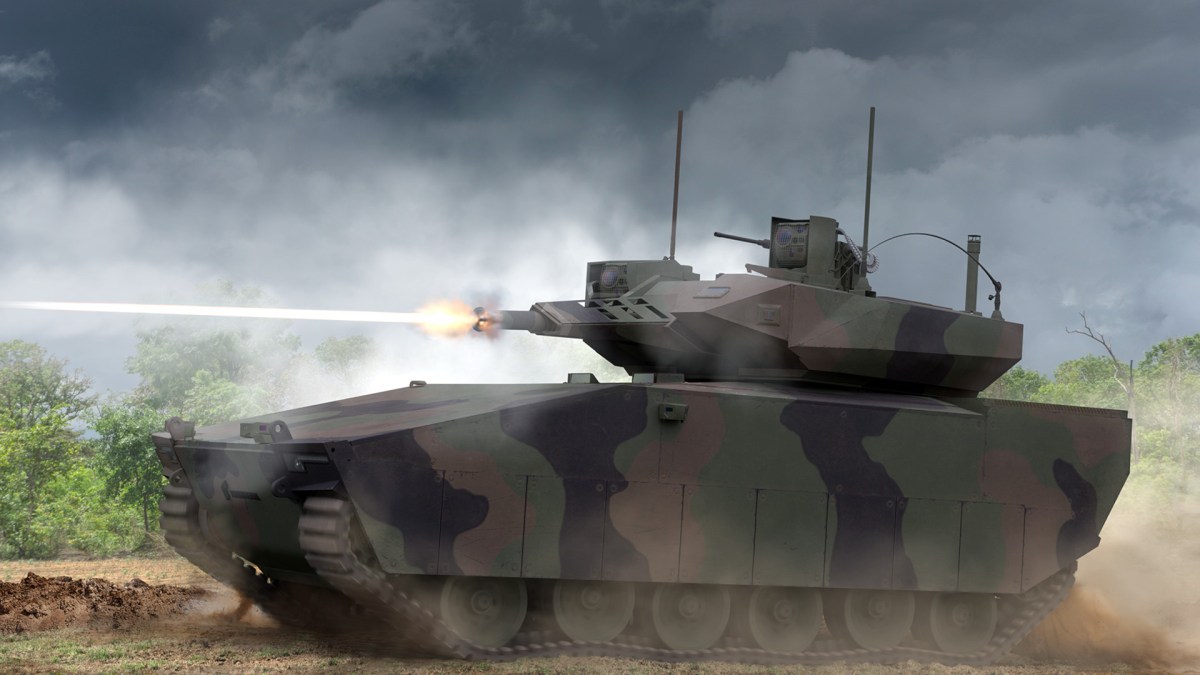
A rendering of American Rheinmetall’s XM30 design, depicting it firing its 50mm cannon and other weapons. American Rheinmetall
Schirmer acknowledged that American Rheinmetall has found some small bugs in its first Lynx prototype at Aberdeen. “We spent a fair amount of time swapping hardware and making adjustments to make sure it was ready [for the VIP event].”
Crew Efficiency and Room for Growth
Both competitors have emphasized the greater efficiency and capacity to add weapons systems and sensors to their MICVs compared with the Bradley. Each has a two-man crew as opposed to the Bradley’s three-man complement. XM30 commander-gunners operate from below the turret as opposed to in it with the Bradley. The new configuration puts a premium on crew situational awareness and task management.
Wolf and Lynx feature side-by-side crew stations for the vehicles’ commander and driver, an aviation-style layout conducive to enhanced crew coordination. Both firms have placed considerable emphasis on intuitive user interfaces with multiple displays and menus with specifically designed symbology and text, as well as ergonomically optimized controls. In addition to higher resolution and longer range gunsight displays, each prototype offers its crew and the squad it carries a 360-degree outside view provided by cameras placed around the vehicle.
A rendering depicting the interior of the Lynx-based XM30 design. American Rheinmetall
“Because we have a reduced crew from the Bradley [which has a commander and gunner in turret] there has to be greater efficiency in how those soldiers execute their tasks. The software and menu logic are very intuitive,” Norman affirms.
Left and right crew positions are identical, so functions can be performed by either crew member. In the Wolf, the driver sits to the left in most cases with the commander on the right. GDLS has drawn lessons from soldier touchpoints with early prototypes of the M1E3 Abrams tank (for which it is the prime contractor), which Norman says shares its graphical user interface with Wolf.
The first early prototype of the next-generation M1E3 Abrams tank. US Army
The Lynx crew compartment features three configurable displays, with a large center display with a common operating picture/map with visual feeds from airborne uncrewed aerial systems (UAS). “You can shoot the gun from the left or right, you can drive the vehicle from the left or right,” Schirmer confirms.
A camera for the Lynx commander’s independent weapons station atop the vehicle with its own sight and machine gun can be pulled up for view by the crew, which can toggle between it and the main weapons sight. Lynx operators have the ability to turn off certain information presentations in their displays for better focus on a particular task.
The effort to improve efficiency for smaller armored vehicle crews was highlighted last week as GLDS announced that it has partnered with Primordial Labs to bring artificial intelligence (AI) voice control to its combat vehicles, ranging from the M1 to the XM30. American Rheinmetall has likewise developed its own AI assistant for Lynx crews, Schirmer confirms. He characterizes it as a “third crewman” helping two soldiers do the work of a trio.
The video below shows Primordial Labs’ voice control technology being used to operate a quadcopter-type drone.
Cooling has become an issue for the Bradley, which, like all armored vehicles, essentially encloses its powerplant and electronics in a box with no airflow. Heat from the drivetrain creates a detectable thermal signature, particularly with the Bradley’s right-front exhaust exit.
Both Lynx and Wolf feature hybrid-electric drivetrains with silent-watch capability, which can temporarily reduce their thermal signatures. Each features rear-exhaust exits, alleviating front-quarter heat plumes.
According to Schirmer, the Lynx cooling stack (which sits adjacent to its powerplant forward in the hull) offers increased cooling for the engine and battery packs while improving the interior environment for heat-sensitive electronics. It facilitates systems growth and greater power consumption.
Wolf has its engine cooling in the rear of the vehicle behind the track. Norman says GDLS specifically engineered its placement so cooling paths to the rear of the hull don’t impinge on passenger space inside. All Wolf systems are designed with a 10 percent growth margin, he adds.
The hybrid drive systems and electronics that both XM30s use will have to resist the increasing threat from adversary directed energy. Electronic attack in the form of tactical electromagnetic pulse, laser targeting of external sensors/apertures, and weaponized electromagnetic interference constitutes a growing threat to weapons systems and basic mobility.
A past rendering of the Griffin III, at left, as Abrams X next-generation tank concept, with cutaways highlighting elements of their hybrid propulsion systems. GDLS
Both contractors expect the Army to stringently test their prototypes’ electromagnetic vulnerability. “I think they’ll nail our vehicles with the best [electromagnetic attack] that adversaries have and if they identify any weaknesses, we will correct those,” Norman says. He points to Aberdeen’s large, sophisticated anechoic chamber as a place where both MICVs will eventually spend considerable time.
American Rheinmetall has its own electromagnetic interference (EMI) requirements for vehicle sensors and communications, according to Schirmer. The Army also has an in-depth understanding of the threats and explicit EMI requirements, he says. “We’re pretty comfortable that our system meets those, but actual EMI testing will take place later in the test program.”
Expanded capacity for exportable power is another growth area for XM30. The prototypes’ hybrid powerplants feature large battery packs that can offer exportable power to potentially help the Army with its serious battlefield circulation of electricity (BCoE) problem. The ever-increasing array of soldier-worn electronic devices, electrically-powered small drones and sensors has created an electricity supply deficit as well as battery weight and availability issues.
Wolf produces “a lot more power than it needs,” Norman asserts. As a result, upgrades to its alternators, starter-generators and high-voltage batteries won’t be needed in the foreseeable future. The exportable power emphasis is on the passengers, he explains.
Wolf’s internal power distribution provides significant charging power to the squad compartment in the back, where each member can charge devices and get access to data. The charge-ports they use are cyber-hardened to prevent plug-in exploits.
External exportable power is surprisingly not a priority for the MICVs according to the contractors. Wolf can offload power via a standard NATO power port (as can Lynx) and other interfaces, Norman says, but “we’re not seeing XM30s in use-cases where they’re used to power command posts or other things. The emphasis from the Army has really been about having margin on the vehicle for future [system] requirements – directed energy, counter-UAS systems or fill-in-the-blank.”
Counter UAS and Fill-in-the-Blank
A September report from the Congressional Research Service cited a potential XM30 oversight issue for Congress, contending that it is not clear if the MICV will have an organic counter-UAS capability. Given the obvious threat of aerial drones to armor as seen in Ukraine, the apparent lack of a requirement for integrated CUAS appears glaring.
We reached out to the Army’s PAE Maneuver Ground and PM XM30 regarding CUAS for XM30 but received no response as of this writing. Both American Rheinmetall and General Dynamics Land Systems believe the Army will undertake its own search and competitive testing to identify a CUAS system for XM30 that it will require the vendors to integrate at some future point.
GDLS’ Norman calls CUAS “fundamental” to the viability of armored vehicles on the modern battlefield. He thinks the Army’s approach of making sure CUAS infrastructure (power/data/physical hookups) is in place on XM30 while evaluating potential systems on its own for rapid integration is wise. He adds that GDLS is working with “expert partners” in the CUAS space to be ready to add the capability.
Intriguingly, AR’s Schirmer says that Lynx already has some counter-UAS capability, which he declined to disclose.
Both XM30s have the ability to launch loitering munitions – Wolf will employ Aerovironment’s Switchblade 300 and Lynx will carry a version of Raytheon’s Coyote Block 3 – but their makers currently have no specific plans for other integrations, though each says it can adapt multiple systems.
A Switchblade 300 seen being fired from a man-portable launcher. USMC
An example of the Coyote Block 3. This particular version is configured as a non-kinetic counter-drone weapon. RTX
TWZ previously noted that the Army envisions XM30s acting as controllers for unmanned ground vehicles. GLDS’ Wolf has an in-house interface to control UGVs (and UAVs) from inside the vehicle, which was demonstrated to the Army over a year ago, according to Norman. Its open software architecture allows for integrating a different control suite if the Army desires.
American Rheinmetall has “not attempted to control an unmanned ground vehicle yet, but the architecture is so similar it would really be just a software modification to get there,” Schirmer says. The company would likely use a mix of its own and UGV provider software.
The Lynx itself can be remotely operated via a tablet that a dismounted crew can employ. While outside the vehicle, soldiers can also remotely use the tablet to see what the vehicle is seeing or to pull up maps for planning, Schirmer explains. American Rheinmetall has yet to finalize and demonstrate the capability, but it appears an appropriate feature for a design that stretches back to the Army’s Optionally Manned Fighting Vehicle ( OMFV ) program.
Recent Army experimentation with small vehicle-toted UGVs on Bradley suggests a capability that could migrate to XM30. Wolf can accommodate “marsupial UGVs” like the Swambotics AI Fire Ants fitted on a 1st Cavalry Division M2A4 Bradley, but Norman points out that small UGV carriage is not part of the requirements for the first iteration of XM30.
A U.S. Army 1st Cavalry Division M2A4 Bradley IFV was spotted carrying five Swarmbotics AI FireAnt anti-armor UGVs on its side storage racks. Weighing around 27 kg, FireAnt is a low-cost attritable robotic system designed for AI-enabled swarm operations, including ISR,… https://t.co/dbikmUtOey pic.twitter.com/WYIRlLJd9A — 笑脸男人 (@lfx160219) August 26, 2026
A U.S. Army 1st Cavalry Division M2A4 Bradley IFV was spotted carrying five Swarmbotics AI FireAnt anti-armor UGVs on its side storage racks. Weighing around 27 kg, FireAnt is a low-cost attritable robotic system designed for AI-enabled swarm operations, including ISR,… https://t.co/dbikmUtOey pic.twitter.com/WYIRlLJd9A
American Rheinmetall has not specifically planned for carrying UGVs on its MICV, but Schirmer asserts that if a Bradley can carry them, Lynx certainly can. Whether it may be able to recharge them during transit is a question that will depend on future Army desires, he says.
Given threats from increasingly capable drones and guided anti-tank missiles, questions as to whether XM30 or other armored vehicles remain relevant on the modern battlefield have persisted for several years.
Such concerns arguably drive the discussion of value-added capabilities for XM30 – from advanced sensors and networking/communications to the ability to deploy and control UGVs/UAVs and the potential BCoE benefits of the platforms.
General Dynamics Land Systems’ Geoff Norman refers to Wolf as “software with a vehicle around it”, noting that GLDS is “continually dropping new software” into its XM30 on a weekly basis to add capability.
Geoffrey Norman, Director for U.S. Strategy & Growth at General Dynamics Land Systems, kneeling beside a Wolf prototype. Geoffrey Norman/LinkedIn
However, American Rheinmetall’s Jim Schirmer reminded us that the traditional armored transport mission is still the overarching role of XM30.
“The purpose of [Lynx] is really to carry infantrymen around the battlefield…to move them faster than they can walk on foot, to protect them in transit from threats – drones, anti-tank guided missiles, from artillery fire – and to [provide] fires support.”
A Lynx-based XM30 depicted in combat in an urban environment. American Rheinmetall
The tension around XM30 survivability versus cost is reflected in the Army’s loose commitment to the new MICV program. Despite having muted fielding of an XM30 by 2029, General Troy Denomy, Program Acquisition Executive of Maneuver, told Breaking Defense that if no clear winner emerged from the upcoming test and evaluation, “then it may be worth not selecting at that point.”
The ambiguity tees up the question of where a 50-ton armored vehicle fits into the potential Pacific fight that the U.S. military is focusing on. It’s a difficult question for the Army and for the XM30 contractors.
American Rheinmetall’s Schirmer took a stab at answering. He points out that there are large islands and other landmasses in the Pacific (like the Korean Peninsula) where a MICV could be employed. However, he acknowledges that it is less likely to be used in an island campaign.
“It still has a role, though it’s less obvious what that would look like than in Europe or the Middle East.”
With testing and evaluations set to ramp up at Aberdeen Proving Ground and Fort Hood, we may soon learn which XM30 prototype is the Army’s obvious choice.
Contact the editor: Tyler@twz.com
Comments couldn’t be loaded. Please refresh the page.
发布于美国东部时间2026年10月12日上午8:01
美国莱茵金属
本周,通用动力陆地系统公司和美国莱茵金属公司在美国陆军协会(AUSA)年度主要研讨会上展示其产品之际,这两家承包商已将他们的 XM30 机械化步兵战车(MICV)原型车交付给陆军,以便在两个地点进行测试和士兵评估,以满足略微修改的测试计划。
XM30项目是美国陆军为替换其布雷德利战车车队而推出的最新举措。正如TWZ在最近的一篇文章中指出的那样,陆军原计划明年春天在加利福尼亚州欧文堡庞大的国家训练中心(NTC)进行例行轮换测试,测试每个竞争者必须提供的八辆原型车中的一部分。
美国陆军计划用XM30装甲车替换其现有的布雷德利步兵战车(图中所示即为其中之一)。
通用动力陆地系统公司(GDLS)和美国莱茵金属公司均表示,两家公司将各自向位于德克萨斯州胡德堡的陆军第一骑兵师第一旅战斗队交付七辆原型车。这些原型车将在那里接受士兵体验和实地评估,预计将于2027年2月至3月期间完成。目前暂无计划将原型车轮换至欧文堡。
TWZ采访了XM30两家竞争对手的高管,并在AUSA大会召开前联系了美国陆军。通用动力陆地系统公司(GDLS)美国战略与增长总监杰弗里·诺曼表示,该公司三辆原型车已在胡德堡接受安全检查,之后将交付士兵进行评估。该公司的产品名为“狼”(Wolf),由其“格里芬III”(Griffin III)改进而来,而“格里芬III”又源自ASCOD 2步兵战车。
通用动力陆地系统公司(GDLS)参与XM30竞标的原型车“狼”(Wolf)于今年早些时候交付给位于马里兰州阿伯丁试验场的美国陆军后,被遮盖起来。
德国莱茵金属公司的美国子公司——美国莱茵金属公司,已提交其“山猫”系列装甲车的改进型参与XM30装甲车竞标。据该公司项目高级副总裁吉姆·希尔默透露,该公司已向胡德堡交付了一辆原型车。另一辆原型车则位于密西西比州谢尔比营的陆军联合部队训练中心,该公司正在那里进行内部测试。其余车辆正在路易斯安那州斯莱德尔组装。
Lynx XM30 版本的效果图。美国莱茵金属公司
两家公司于8月下旬向马里兰州阿伯丁试验场交付了首批XM30原型车,同时还各交付了一个车体和一个炮塔用于弹道测试。过去一个多月里,陆军在阿伯丁试验场对这些微型步兵战车进行了初步测试。
据诺曼透露,GDLS公司的“狼”式装甲车已在阿伯丁实弹靶场进行了50毫米火炮的实弹射击测试。该车也已完成部分车辆功能测试,诺曼表示GDLS公司对这两项测试都收到了“良好的反馈”。他还补充道,“狼”式装甲车的32速SAPA变速箱和复合橡胶履带(CRT)也广受好评,其乘坐舒适性与“布雷德利”战车不相上下。
通用动力陆地系统公司的“狼”式自行火炮以“格里芬III”型坦克歼击车为基础,图中所示为“格里芬III”型的早期型号。“格里芬III”型的主武器也是一门50毫米火炮。
吉姆·希尔默表示,Lynx直升机也收到了积极的早期反馈,尤其是在9月下旬于阿伯丁为国会工作人员和陆军要员进行的演示中。乘客们称赞了其双人乘员舱布局、六人乘员舱的宽敞空间以及空调系统。
希尔默反思了提高车内环境舒适度对在伊拉克作战的布雷德利战车内酷热难耐的士兵们的重要性。他回忆说:“伊拉克室外温度高达125华氏度(约52摄氏度),加上太阳辐射,布雷德利战车内的温度更是达到了138华氏度(约59摄氏度)。走出战车,呼吸到伊拉克的新鲜空气,感觉真是神清气爽。”
这两款原型车都比40吨重的布雷德利战车更大,战斗全重也相应增加到50吨左右。它们都以XM913型50毫米自动炮作为主武器,与布雷德利战车上的25毫米M242机炮相比,火力有了显著提升。
这是一张美国莱茵金属公司XM30坦克的设计图,图中展示了它发射50毫米火炮和其他武器的场景。美国莱茵金属公司
希尔默承认,美国莱茵金属公司在阿伯丁的首架Lynx原型机上发现了一些小问题。“我们花了不少时间更换硬件并进行调整,以确保它能为(VIP活动)做好准备。”
船员效率和增长空间
两家竞争对手都强调,与布雷德利步兵战车相比,他们的微型步兵战车在武器系统和传感器的加装方面效率更高、容量更大。两款战车都采用双人乘员组,而布雷德利战车则为三人。XM30战车的车长兼炮手在炮塔下方操作,而布雷德利战车的车长兼炮手则在炮塔内操作。这种新的布局对乘员的态势感知和任务管理能力提出了更高的要求。
Wolf 和 Lynx 的车长和驾驶员均采用并排的乘员舱布局,这种类似航空车辆的布局有利于提升乘员间的协作。两家公司都非常重视直观的用户界面,配备了多个显示屏和菜单,菜单上的符号和文字均经过专门设计,并采用了符合人体工程学的优化操控。除了更高分辨率和更远距离的瞄准镜显示屏外,每辆原型车还通过安装在车辆周围的摄像头,为乘员和车上小队提供 360 度全景视野。
一张描绘基于Lynx平台的XM30内饰效果图。美国莱茵金属公司
“由于我们的乘员比布雷德利战车(炮塔内有一名车长和一名炮手)少,所以士兵们执行任务的效率必须更高。软件和菜单逻辑非常直观,”诺曼肯定地说。
左右乘员位置相同,因此任何一名乘员都可以执行相应操作。在“狼”式坦克中,驾驶员通常位于左侧,车长位于右侧。通用动力激光系统公司(GDLS)从M1E3“艾布拉姆斯”坦克早期原型车(该公司是其主承包商)的士兵操作体验中汲取了经验,诺曼表示,“狼”式坦克与M1E3“艾布拉姆斯”坦克共享相同的图形用户界面。
美国陆军下一代M1E3艾布拉姆斯坦克的首辆早期原型车。
山猫战车的乘员舱配备三个可配置的显示屏,中央大型显示屏显示通用作战图/地图,并可显示来自机载无人机系统(UAS)的视觉画面。“你可以从左侧或右侧开火,也可以从左侧或右侧驾驶战车,”希尔默证实道。
山猫战车车顶的独立武器站配备了一台摄像头,该摄像头带有独立的瞄准镜和机枪,乘员可以将其升起查看,并可在摄像头和主武器瞄准镜之间切换。山猫战车操作员可以关闭显示屏上的某些信息,以便更好地专注于特定任务。
上周,GLDS宣布与Primordial Labs合作,为其包括M1和XM30在内的多款战车引入人工智能(AI)语音控制技术,此举凸显了提高小型装甲车辆乘员效率的努力。Schirmer证实,美国莱茵金属公司也为Lynx装甲车乘员开发了自己的AI助手。他将其描述为“第三名乘员”,帮助两名士兵完成原本三人组的工作。
下面的视频展示了Primordial Labs的语音控制技术如何用于操作四旋翼无人机。
布雷德利战车的散热问题日益突出。与其他装甲车辆一样,它的动力装置和电子设备基本上被封闭在一个没有空气流通的盒子里。动力系统产生的热量会形成明显的热信号,尤其是在布雷德利战车右前方的排气口处。
Lynx 和 Wolf 都配备了具有静音模式的混合动力系统,可以暂时降低其热信号。两款车型均采用后排气设计,有效缓解了前侧的热辐射。
据希尔默介绍,Lynx 的冷却堆栈(位于船体前部动力装置旁边)可增强发动机和电池组的冷却效果,同时改善对热敏感的电子设备的内部环境。它有利于系统扩展和更高的功率消耗。
Wolf战车的发动机冷却系统位于履带后方的车尾。诺曼表示,通用动力陆地系统公司(GDLS)专门设计了冷却系统的位置,确保通往车体后部的冷却路径不会影响车内乘客空间。他还补充道,所有Wolf战车的系统设计都预留了10%的增长余量。
XM30战机所使用的混合动力驱动系统和电子设备必须能够抵御敌方定向能攻击日益增长的威胁。战术电磁脉冲、激光瞄准外部传感器/孔径以及武器化电磁干扰等电子攻击手段,对武器系统和基本机动能力构成了日益严重的威胁。
左图为格里芬III型坦克(曾作为艾布拉姆斯X型下一代坦克概念设计)的早期渲染图,剖视图突出了其混合动力推进系统的各个组成部分。通用动力陆地系统公司(GDLS)
两家承包商都预计陆军将对其原型车的电磁脆弱性进行严格测试。“我认为他们会用敌方最强大的电磁攻击手段来测试我们的车辆,如果他们发现任何弱点,我们会进行修正,”诺曼说道。他指出,阿伯丁大型、精密的消声室将是这两款微型步兵战车最终进行长时间测试的地方。
据希尔默称,美国莱茵金属公司对车辆传感器和通信设备有自己的电磁干扰 (EMI) 要求。他还表示,陆军也对相关威胁和明确的 EMI 要求有着深入的了解。“我们相当有信心我们的系统能够满足这些要求,但实际的 EMI 测试将在测试计划的后期进行。”
扩大可输出电力容量是XM30的另一个增长点。原型机的混合动力系统配备了大型电池组,可提供可输出电力,有望帮助陆军解决其严峻的战场电力循环(BCoE)问题。士兵佩戴的电子设备、电动小型无人机和传感器的数量不断增加,导致电力供应短缺,同时也带来了电池重量和可用性方面的问题。
诺曼断言,沃尔夫号的发电量“远远超过自身所需”。因此,在可预见的未来,无需对其交流发电机、启动发电机和高压电池进行升级。他解释说,输出电力主要是为了满足乘客的需求。
Wolf 的内部配电系统为后部小队舱提供充足的充电电力,每个成员都可以在这里为设备充电并访问数据。他们使用的充电接口都经过网络安全加固,以防止插入式攻击。
据承包商称,外部可输出电力并非MICV的优先事项,这着实令人惊讶。诺曼表示,Wolf可以通过标准的北约电源接口(Lynx也是如此)和其他接口输出电力,但“我们还没有看到XM30被用于为指挥所或其他设备供电。陆军的重点在于为车辆预留未来系统需求的余量——定向能武器、反无人机系统等等。”
反无人机系统和填空题
美国国会研究服务处9月份的一份报告指出,XM30导弹防御系统可能存在监管问题,需要国会予以关注。报告认为,目前尚不清楚该型导弹防御系统是否具备自身反无人机系统的能力。鉴于乌克兰战争中无人机对装甲车辆构成的明显威胁,该系统明显缺乏集成反无人机系统的要求,这一点显得尤为突出。
我们已就XM30的CUAS(反无人机系统)事宜联系了陆军的PAE Maneuver Ground和PM XM30部门,但截至发稿时尚未收到回复。美国莱茵金属公司和通用动力陆地系统公司均认为,陆军将自行开展搜索和竞争性测试,以确定XM30的CUAS系统,并在未来某个阶段要求供应商进行集成。
通用动力陆地系统公司(GDLS)的诺曼称,微型无人机系统(CUAS)对于装甲车辆在现代战场上的生存能力至关重要。他认为,陆军在确保XM30装甲车具备CUAS基础设施(电力/数据/物理连接)的同时,自行评估潜在系统以实现快速集成,这种做法是明智的。他还补充说,GDLS正在与CUAS领域的“专家合作伙伴”合作,为添加这项功能做好准备。
耐人寻味的是,AR 公司的 Schirmer 表示,Lynx 已经具备一定的反无人机系统能力,但他拒绝透露具体细节。
两款 XM30 都具备发射巡飞弹的能力——“狼”将采用 Aerovironment 公司的 Switchblade 300,“山猫”将携带雷神公司的 Coyote Block 3 的版本——但它们的制造商目前还没有其他集成方面的具体计划,尽管它们都表示可以适配多种系统。
一枚Switchblade 300型火箭筒正从便携式发射器上发射。美国海军陆战队
这是 Coyote Block 3 的一个例子。这个特定版本配置为非动能反无人机武器。RTX
TWZ此前曾指出,陆军设想将XM30用作无人地面车辆的控制器。据诺曼称,GLDS公司的Wolf系统拥有自主研发的界面,可以从车内控制无人地面车辆(以及无人机),该系统已于一年多前向陆军进行了演示。其开放式软件架构允许陆军根据需要集成不同的控制系统。
希尔默表示,美国莱茵金属公司“尚未尝试控制无人地面车辆,但其架构非常相似,只需进行软件修改即可实现”。该公司可能会采用自身软件和无人地面车辆供应商软件的混合方案。
Lynx本身可以通过下车乘员使用的平板电脑进行远程操控。Schirmer解释说,士兵在车外也可以远程使用平板电脑查看车辆视野或调出地图进行作战计划。美国莱茵金属公司尚未最终确定并演示这项功能,但对于一款可以追溯到陆军可选载人战车(OMFV)项目的战车来说,这似乎是一项非常合适的特性。
近期陆军在布雷德利战车上进行的小型车载无人地面车辆(UGV)试验表明,这种能力或许可以应用到XM30装甲车上。沃尔夫装甲车可以搭载类似Swambotics AI Fire Ant这样的“袋鼠式”UGV,后者目前已安装在第一骑兵师的M2A4布雷德利战车上。但诺曼指出,小型UGV的搭载并非XM30第一代产品的要求之一。
一辆美国陆军第一骑兵师的M2A4布雷德利步兵战车被发现侧面载有五辆Swarmbotics公司的AI FireAnt反装甲无人地面车辆。FireAnt重约27公斤,是一款低成本的消耗型机器人系统,专为人工智能驱动的集群作战而设计,包括情报、监视与侦察(ISR)等。…… https://t.co/dbikmUtOey pic.twitter.com/WYIRlLJd9A — 笑脸男人 (@lfx160219) August 26, 2026
美国陆军第一骑兵师的一辆M2A4布雷德利步兵战车被发现侧面载有五辆Swarmbotics公司的AI FireAnt反装甲无人地面车辆。FireAnt重约27公斤,是一款低成本的消耗型机器人系统,专为人工智能驱动的集群作战而设计,包括情报、监视与侦察(ISR)等。…… https://t.co/dbikmUtOey pic.twitter.com/WYIRlLJd9A
美国莱茵金属公司尚未专门计划在其中型步兵战车(MICV)上搭载无人地面车辆(UGV),但希尔默断言,如果布雷德利步兵战车可以搭载,那么山猫步兵战车当然也可以。他表示,能否在运输途中为无人地面车辆充电,将取决于陆军未来的需求。
鉴于无人机和制导反坦克导弹的性能日益增强,XM30 或其他装甲车辆在现代战场上是否仍然具有现实意义的问题已经持续了好几年。
可以说,这些担忧推动了对 XM30 增值能力的讨论——从先进的传感器和网络/通信到部署和控制无人地面车辆/无人机的能力,以及这些平台的潜在卓越中心优势。
通用动力陆地系统公司的杰夫·诺曼将 Wolf 称为“围绕其车辆的软件”,并指出 GLDS 每周都会“不断地向其 XM30 中添加新软件”以增加其功能。
通用动力陆地系统公司美国战略与增长总监杰弗里·诺曼跪在一架“狼”式原型机旁。图片来源:杰弗里·诺曼/LinkedIn
然而,美国莱茵金属公司的吉姆·希尔默提醒我们,传统的装甲运输任务仍然是 XM30 的首要角色。
“[Lynx] 的真正目的是在战场上运送步兵……让他们比步行更快地移动,在行进过程中保护他们免受威胁——无人机、反坦克导弹、炮火——并提供火力支援。”
图中是一辆基于Lynx底盘的XM30坦克在城市环境中作战的场景。美国莱茵金属公司
XM30的生存能力与成本之间的矛盾体现在陆军对新型轻型步兵战车(MICV)项目的松散承诺上。尽管陆军已低调宣布将在2029年前部署XM30,但机动作战项目采购主管特洛伊·德诺米将军告诉《防务新闻》,如果即将进行的测试和评估没有产生明显的赢家,“那么届时或许不该选择它。”
这种模糊性引出了一个问题:一辆50吨重的装甲车在美军重点关注的潜在太平洋战事中究竟扮演着怎样的角色?这对陆军和XM30的承包商来说都是一个棘手的问题。
美国莱茵金属公司的希尔默试图回答这个问题。他指出,太平洋地区有许多大型岛屿和其他陆地(例如朝鲜半岛),可以部署多用途步兵战车(MICV)。但他承认,这种战车不太可能用于岛屿作战。
“它仍然发挥作用,尽管这种作用在何处不像在欧洲或中东那样显而易见。”
随着在阿伯丁试验场和胡德堡的测试和评估工作即将展开,我们可能很快就会知道哪款 XM30 原型机是陆军的明显选择。
联系编辑:Tyler@twz.com
评论加载失败,请刷新页面。