AGVs vs. UGVs: A new class of ground autonomy takes the fieldAGV 与 UGV:新型地面自主运输技术崭露头角
Fully autonomous ground vehicles are reshaping military operations, enabling forces to navigate complex terrain and operate through degraded communications.
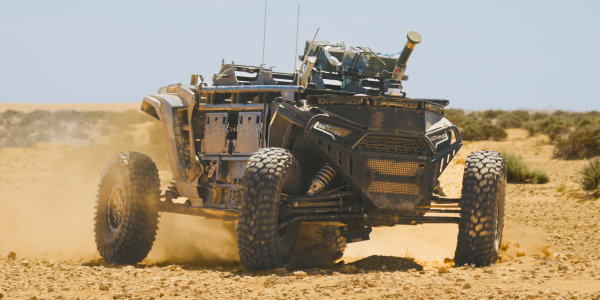
Photo: Courtesy of Overland AI.
Ground robots have proven their value in recent conflicts, handling logistics runs, evacuating the wounded, and keeping troops away from the most dangerous environments. But unmanned ground vehicles (UGVs) have a critical limitation: they aren’t fully autonomous. UGVs are remote-controlled or teleoperated, tethered to a communications link that can be jammed, spoofed, or severed. They also require the full attention of their human operator, which is cognitively expensive.
Overland AI’s fully autonomous ground vehicles (AGVs) represent a significant advancement over UGVs.
Leveraging proprietary software and hardware, Overland AI ’s AGVs can sense and navigate the world around them independently, overcoming obstacles such as boulders, dense vegetation, steep slopes, and unexpected ditches at tactically relevant speeds. They can do this even when signals are degraded or lost entirely. Using natural language prompts, a single operator can task and orchestrate an entire fleet of these AGVs simultaneously—without teleoperation or remote control.
Overland AI’s technology has been refined and validated through rigorous field testing and extensive work with warfighters. In a joint U.S. military exercise in Africa this year, Army officers estimated that two AGVs replaced 40 humans, allowing troops to move faster with more protection. The vehicles reduced distribution time on a drop zone by 52 percent at another recent military event. During breaching, one of the most dangerous tasks for troops, service members face extreme casualty rates. When fully autonomous vehicles are deployed, humans are removed from the most dangerous places on the battlefield, life expectancy skyrockets, and more U.S. troops can return home to their families.
Overland AI recently became the first ground autonomy company to prime a production contract for the U.S. military. Under a $20 million agreement through the Accelerate the Procurement and Fielding of Innovative Technologies (APFIT) program, the company is working with the U.S. Marine Corps to produce and field AGVs in support of the Marine Air Defense Integrated System (MADIS).
The APFIT award is the culmination of a push within the Department of War to move autonomous systems into programs of record and operational use. Missions such as breaching fortified positions, delivering critical supplies under fire, and detecting and defeating enemy drones are ready for autonomous deployment.
Truly autonomous ground vehicles are not a future capability—they are operational now. This is important because however the battlefield evolves, wars are still won on the ground. Territory must be taken, held, and defended by forces operating across austere environments marked by uncertain conditions and degraded communications.
The robotics revolution in land warfare is here, and Overland AI is driving it. The next step is fielding this technology broadly across the services.
图片:由 Overland AI 提供。
地面机器人已在近期冲突中证明了自身的价值,它们负责后勤补给、伤员撤离,并使部队远离最危险的环境。但无人地面车辆(UGV)存在一个关键的局限性:它们并非完全自主。UGV 需要远程控制或遥控操作,并通过通信链路进行传输,而通信链路可能受到干扰、欺骗或中断。此外,它们还需要操作员全神贯注,这会消耗大量的认知资源。
Overland AI 的全自动地面车辆 (AGV) 比 UGV 有了显著的进步。
凭借自主研发的软硬件,Overland AI 的 AGV 能够独立感知和导航周围环境,以战术所需的速度克服巨石、茂密植被、陡坡和意外沟渠等障碍物。即使信号减弱或完全丢失,它们也能正常工作。操作员只需使用自然语言提示,即可同时指挥和协调整个 AGV 车队——无需远程操控。
Overland AI 的技术经过严格的实地测试和与作战人员的广泛合作,不断完善和验证。在今年于非洲举行的美军联合演习中,陆军军官估计,两辆 AGV(自动导引车)取代了 40 名士兵,使部队能够以更快的速度行进,并获得更好的防护。在最近另一次军事演习中,这些车辆将空投区的物资分发时间缩短了 52%。在突防行动中,士兵面临着极高的伤亡率,这是部队最危险的任务之一。当部署全自动车辆时,士兵可以从战场上最危险的地方撤离,预期寿命将大幅提高,更多的美军士兵可以平安回家与家人团聚。
Overland AI 近日成为首家获得美国军方生产合同的地面自主系统公司。根据“加速创新技术采购和部署”(APFIT)计划达成的一项价值 2000 万美元的协议,该公司正与美国海军陆战队合作,生产和部署 AGV(自动导引车),以支持海军陆战队防空综合系统(MADIS)。
APFIT 奖项的授予标志着美国陆军部推动自主系统进入正式项目并投入作战应用的一项重要成果。诸如突破防御工事、在炮火下运送关键物资以及探测和击落敌方无人机等任务,均已具备自主部署的能力。
真正的自主地面车辆并非未来科技——它们现在就已经投入使用。这一点至关重要,因为无论战场如何演变,战争的胜负最终仍取决于地面作战。部队必须在条件恶劣、通信受限的严酷环境中,夺取、守住并捍卫领土。
陆地作战的机器人革命已经到来,而Overland AI正在推动这场革命。下一步是将这项技术广泛应用于各军种。