Mine hunting goes remote as the Navy replaces minesweepers with robots海军用机器人取代扫雷舰,使扫雷行动远程化
The US Navy is replacing traditional minesweepers with robotic mine-hunting and neutralization systems to counter maritime threats and protect personnel.
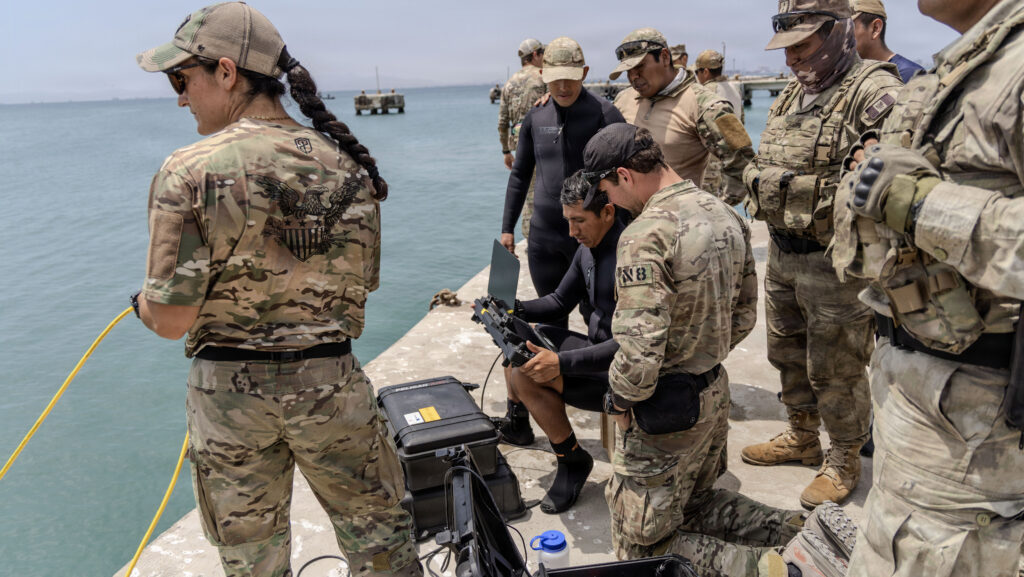
US Navy explosive ordnance disposal (EOD) technicians assigned to Explosive Ordnance Disposal Mobile Unit (EODMU) 2 and Peruvian Navy EOD technicians assigned to Peruvian Special Operations conduct limpet mine training utilizing the VideoRay Mission Specialist Defender while participating in UNITAS 2026, a US Naval Forces Southern Command and US Fourth Fleet-sponsored training exercise at Callao Naval Base, Peru, Sept. 14, 2026. (US Navy photo by Mass Communication Specialist 2nd Class Jackson Adkins.)
Maritime mines are a concern for the US and its allies in a number of regions, including the Strait of Hormuz and the South China Sea. In addition to being a threat to military vessels, mines can slow or halt commercial traffic through important trade and oil routes.
Breaking Defense spoke with Bryan Clark, director of the Hudson Institute’s Center for Defense Concepts and Technology, on the threat of mines, how they can be neutralized and the role of remote mine hunting in keeping personnel out of harm’s way.
Breaking Defense: Why are maritime mines such a serious threat in some of these strategic choke points like the Strait of Hormuz or the South China Sea?
Clark: Partly because they’re so easy to obtain or build, and then deploy. The Iranians even have rockets that can deploy mines at a standoff distance into the strait. That’s just an example of how easy it is to put these mines out there because you don’t need to precision guide them. You just drop them into the approximate area of the channel and that’s going to be sufficient to hold up traffic.
Mines don’t have to be sophisticated. There are obviously very sophisticated ones that look for particular acoustic or magnetic signatures. There are some that’ll measure how many ships go across and detonate on the third or fourth ship, but they don’t need to be smart in order to be effective. All you need is somebody to detect the mine and know that it’s there, and it’s going to cause vessel traffic to stop until the mine threat has been eliminated.
The barrier to entry is low. Countries can easily field a capable mine-laying capability or mine-laying force and then deny access in a critical strait or choke point. You have countries out there for whom mines are the main weapon, like Finland. When they think about having to face off against the Russians, the first thing they plan on doing is mining the Gulf of Finland, which prevents access to and from Sevastopol or St. Petersburg. You’ve cut off one of Russia’s only warm water ports by closing off the Gulf of Finland, and that’s for them their primary offensive capability.
For Iran, obviously the drone revolution has given them another offensive weapon, but mines have always been one of their main go-tos in terms of offensive weapons. It’s always been perceived that they would try to use them to close off the Strait of Hormuz because it is such a narrow choke point and so vital to global commerce.
The other thing about mines that makes them more potent as a threat is that you’d only need the threat of a mine in order to close off access. If you have a mine detection or even a concern about mines, vessel traffic will generally stop until the threat’s been verified or validated, or shipping companies decide to accept the risk and either pay higher insurance rates or accept the potential loss of their own ship. It’ll impact shipping even if you just have the threat of a mine without the physical presence of them. That makes them an effective tool even for small countries.
US Navy explosive ordnance disposal (EOD) technicians assigned to Explosive Ordnance Disposal Mobile Unit (EODMU) 2 and Peruvian Navy EOD technicians assigned to Peruvian Special Operations conduct mine countermeasure operations while participating in UNITAS 2026, a US Naval Forces Southern Command and US Fourth Fleet-sponsored training exercise, El Paraiso, Peru, Sept. 19, 2026. (U.S. Navy photo by Mass Communication Specialist 2nd Class Jackson Adkins.)
How do you determine if a mine is a valid threat?
You can’t discount the threat. Because shipping companies don’t want to accept the risk of them being wrong or you being wrong if you say, ‘there’s not really a mine threat’ You have to take it at face value.
The first thing you do is find a channel that’s mine-free. That’s what the US did early on in the war. They used the remote-mine hunting systems they had to verify that the channel along the Omani coast was free of mines. Once you’ve verified a channel free of mines, it doesn’t necessarily matter that there might be mines elsewhere. You can lead ships through that safe passage, and then if you want to increase traffic or provide for more two-way traffic, then you have to expand the channel and search a larger area.
How does the Navy currently hunt and neutralize mines, and how has that task become less dangerous?
It used to be very dangerous, because you’d have to send a human-operated minesweeper out, which puts people at risk. Mine-hunting ships have been traditionally wooden or fiberglass to avoid creating a magnetic signature. They use a sonar system on the front to detect the mines and then they will have a sweep system they tow on the back or they’ll use neutralization systems to neutralize the mines after they find them.
Now the systems they use are robots. They have active sonars on board that they use to search for mines. It becomes kind of like a Roomba, where the robots go up and down the route looking for mines in the water column. They’ll stay near the surface and then look down into the water, and as long as the water is not extremely deep, they’ll be able to see the first 100 or 200 feet of water and detect mine-like objects.
They’ll identify things that they think are mines. When they do their run and come back, you download all the data off of them into a computer, which has processing software that helps you to figure out what are things that need further investigation.
Then you can send out another set of robots to investigate the things that might be mines to get a better idea of whether they’re really mines or if they were objects dumped on the seafloor or, things floating in the water that aren’t mines. That usually narrows down how many things you have to investigate further.
At the point you’ve determined there’s mine or mine-like objects in the water that have to be neutralized, you then send out a helicopter or a small boat with a mine neutralization system on it, which is a floating vehicle that has little torpedoes that’ll come off of it and those are fiber-optically guided to the target. You have a video screen and a joystick, and you steer those mine neutralizers to the mine and they detonate on that object.
Either they blow up the mine – if it’s a mine – or they punch a hole in it and it sinks to the bottom. These mine neutralizers have been around for 20 years or so, but they do keep the people out of the minefield.
It keeps people out of the minefield because now you don’t have to have the minesweeper driving into the minefield anymore. You can also do it at a greater scale. Because I can buy a lot more robots than I can buy minesweepers, because every minesweeper needs a crew and people are expensive. If you want to expand your mine-hunting fleet, you end up having to buy a bunch of manned ships. If you’re buying robots instead, you can buy a bunch of robots, store them, and then bring them out when you need to do the mine-hunting operation.
As you look forward, what do you see as the capabilities that will be needed most for counter-mine operations?
Onboard processing and communications. One of the limitations of the current way of doing it is you have to have the vessels or the vehicles doing the mine hunting come back and download all their data, then analyze it and then send out another set of vehicles to go investigate the likely mine areas to verify, and then send out another set of vehicles to go do the mine neutralization – helicopters and small boats with mine-neutralization systems. It’s a multi-pass setup the way it is now.
If instead you had onboard processing from these mine-hunting vehicles, the underwater vehicles looking for the mines could come up and transmit data back to you immediately and say, ‘I finished path one. I found a bunch of mines or potential mines. They’re here.’ Then you can quickly decide whether to send another vehicle out there right now to investigate, or to just send the mine neutralization system out immediately.
You should be able to get to a point where you can do this in a way that is just robot after robot after robot.
2026年9月14日,在秘鲁卡亚俄海军基地,隶属于美国海军第二机动爆炸物处理部队(EODMU 2)的爆炸物处理(EOD)技术人员和隶属于秘鲁特种作战部队的秘鲁海军EOD技术人员正在使用VideoRay Mission Specialist Defender进行吸附式水雷训练。此次训练是“UNITAS 2026”演习的一部分,由美国海军南方司令部和美国第四舰队联合举办。(美国海军二级大众传播专家杰克逊·阿德金斯摄)
水雷是美国及其盟友在包括霍尔木兹海峡和南海在内的多个地区关注的问题。水雷不仅对军舰构成威胁,还会阻碍或中断重要贸易和石油航线的商业交通。
Breaking Defense 采访了哈德逊研究所国防概念与技术中心主任布莱恩·克拉克,讨论了地雷的威胁、如何消除地雷以及远程扫雷在保护人员免受伤害方面的作用。
突破防务:为什么水雷在霍尔木兹海峡或南海等一些战略咽喉要道构成如此严重的威胁?
克拉克:部分原因是这些水雷很容易获取、制造和部署。伊朗甚至拥有可以远距离向海峡投放水雷的火箭。这只是一个例子,说明投放这些水雷有多么容易,因为你不需要精确制导。你只需将它们投放到海峡的大致区域,就足以阻碍交通。
水雷并不一定需要多么精密复杂。当然,也有一些非常精密的水雷,它们会探测特定的声学或磁学特征。有些水雷甚至会测量有多少艘船只通过,并在第三艘或第四艘船上引爆。但它们并不需要多么智能才能发挥作用。你只需要有人探测到水雷,知道它的存在,它就能迫使船只停止航行,直到水雷威胁被消除。
准入门槛很低。各国可以轻易部署一支高效的布雷部队或布雷能力,然后封锁关键海峡或咽喉要道。有些国家,比如芬兰,将水雷作为主要武器。当他们考虑与俄罗斯对抗时,首先想到的就是在芬兰湾布雷,切断塞瓦斯托波尔和圣彼得堡的出入口。封锁芬兰湾就等于切断了俄罗斯为数不多的几个不冻港之一,而这正是他们主要的进攻手段。
对伊朗而言,无人机革命无疑为其增添了一种新的进攻性武器,但水雷一直是其主要的进攻性武器之一。人们一直认为,伊朗会试图利用水雷封锁霍尔木兹海峡,因为该海峡是全球贸易的关键咽喉要道。
水雷之所以更具威胁性,另一个原因在于,仅仅存在水雷的威胁就能封锁通道。一旦探测到水雷,或者仅仅是对水雷的担忧,船舶通行通常都会停止,直到威胁得到确认,或者航运公司决定承担风险,要么支付更高的保险费,要么接受船舶可能遭受损失。即使水雷没有实际存在,仅仅是存在水雷的威胁也会对航运造成影响。这使得水雷即使对小国来说也是一种有效的工具。
2026年9月19日,在秘鲁埃尔帕拉伊索,隶属于美国海军第二机动爆炸物处理部队(EODMU 2)的爆炸物处理技术人员和隶属于秘鲁特种作战部队的秘鲁海军爆炸物处理技术人员在参加由美国海军南方司令部和美国第四舰队主办的“UNITAS 2026”联合训练演习期间,进行水雷反制作业。(美国海军二级大众传播专家杰克逊·阿德金斯摄)
如何判断地雷是否构成实际威胁?
你不能忽视这种威胁。因为如果你说“实际上没有水雷威胁”,航运公司不愿承担他们或你判断错误的风险。你必须认真对待。
首先,你要做的就是找到一条没有水雷的航道。战争初期,美国就是这么做的。他们利用远程扫雷系统确认了阿曼沿岸的航道没有水雷。一旦确认某条航道没有水雷,其他地方可能存在水雷也就无关紧要了。你可以引导船只通过这条安全航道,之后,如果你想增加航道流量或提供更多双向通行,就必须拓宽航道,搜索更大的区域。
海军目前是如何搜寻和排除水雷的?这项任务又是如何变得不那么危险的?
过去这项工作非常危险,因为需要派出人工操作的扫雷艇,这会危及人员安全。传统的扫雷船通常采用木质或玻璃钢材质,以避免产生磁性特征。它们在船头安装声呐系统探测水雷,然后在船尾拖曳扫雷系统或使用中和系统来清除发现的水雷。
现在他们使用的系统是机器人。这些机器人配备了主动声呐,用来搜索水雷。这有点像扫地机器人,机器人沿着路线来回巡逻,在水体中寻找水雷。它们会停留在水面附近,然后向下搜索,只要水不是特别深,它们就能看到水面以下100到200英尺(约30到60米)的水域,并探测到类似水雷的物体。
他们会识别出疑似地雷的物体。当他们完成探测任务返回后,你需要将所有数据下载到电脑中,电脑上的处理软件可以帮助你确定哪些物体需要进一步调查。
然后你可以派出另一组机器人去调查那些可能是水雷的东西,以便更好地判断它们究竟是水雷,还是倾倒在海底的物体,又或者是漂浮在水中的非水雷物品。这通常可以缩小需要进一步调查的范围。
一旦确定水中存在需要排除的水雷或类似水雷的物体,就可以派出直升机或小型船只,船上配备有水雷排除系统。这种系统是一种漂浮式载具,上面装有小型鱼雷,这些鱼雷通过光纤引导飞向目标。操作人员可以通过视频屏幕和操纵杆控制水雷排除器,使其对准水雷并引爆。
要么炸毁地雷(如果真是地雷的话),要么在上面打个洞,让它沉到水底。这些地雷清除器已经存在大约20年了,它们确实能阻止人们进入雷区。
这样可以避免人员进入雷区,因为现在无需再派扫雷舰驶入雷区了。而且,这种方法也更适合大规模部署。因为我可以购买的机器人数量远多于扫雷舰,毕竟每艘扫雷舰都需要船员,而人力成本很高。如果想要扩充扫雷舰队,最终还是得购买大量载人舰艇。但如果购买机器人,就可以一次性购买大量机器人,储存起来,然后在需要执行扫雷任务时再调派出去。
展望未来,您认为反地雷行动最需要哪些能力?
船载处理和通信。目前这种方式的局限性之一在于,执行扫雷任务的舰艇或车辆必须返回并下载所有数据,进行分析,然后派出另一组车辆前往疑似雷区进行调查确认,最后再派出另一组车辆(例如配备扫雷系统的直升机和小艇)进行扫雷作业。目前的流程需要多次往返。
如果这些扫雷艇配备船载处理器,那么搜寻水雷的水下航行器就可以立即浮出水面,将数据传输回指挥部,并报告说:“我完成了第一条路径。我发现了一堆水雷或潜在水雷。它们就在这里。”然后,指挥部就可以迅速决定是立即派遣另一艘航行器进行调查,还是直接派出水雷排除系统。
你应该能够达到这样的程度:你可以用一种连续不断地生产机器人的方式来完成这项工作。