Building a predictive defense industrial base begins with artificial intelligence构建预测性国防工业基础始于人工智能
AI-enabled workflows accelerate production, but cybersecurity and governance remain central.
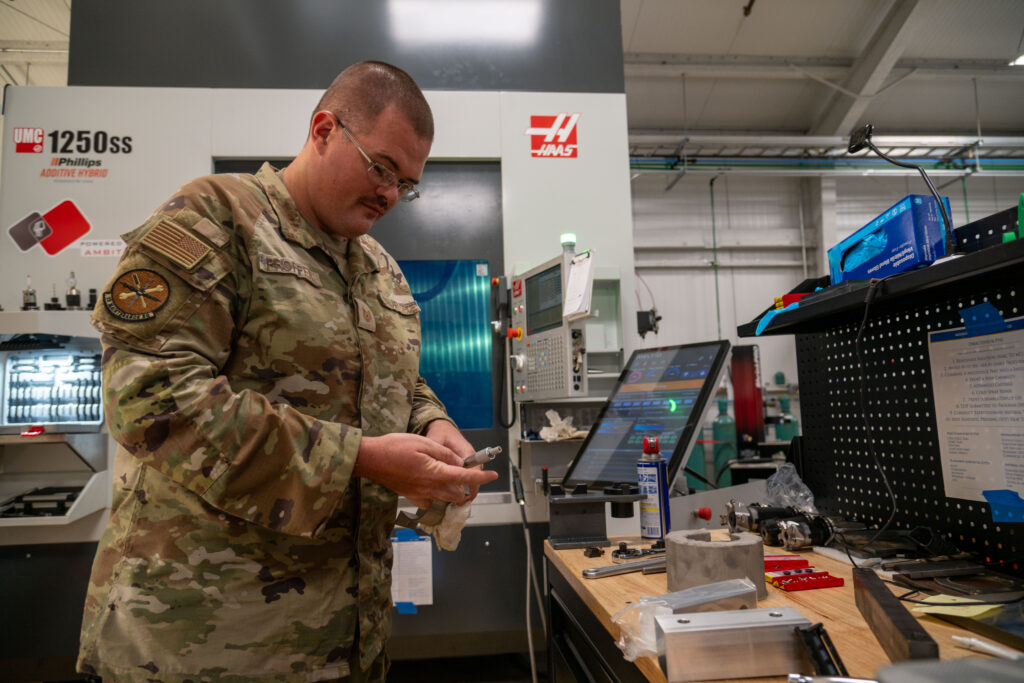
Naval Postgraduate School (NPS) students and faculty supported U.S. Navy exercise Trident Warrior 2025 with advanced manufacturing (AM) teams onsite in San Diego, on board Navy ships, and from the school’s AM lab on the NPS campus in Monterey, Calif. The team at NPS conducted real-world parts repairs using equipment available only at the school and held hands-on training sessions with service members involved. (U.S. Navy photo by Mass Communication Specialist 3rd Class Abreen Padeken)
For warfighters, the defense industrial base’s (DIB) strength comes down to speed: whether industry can anticipate demand, solve production problems, and deliver critical systems on time. Breaking Defense discussed the challenges facing the DIB with Ana Garcia Olson, Managing Director, Navy & Marine Corps Business Lead, Accenture Federal Services, and Amy Bahrani, Managing Director, AI and Data, Defense Industrial Base Lead, Accenture Federal Services.
Breaking Defense: In today’s security landscape, technological dominance isn’t just about who has the best asset on the frontline; it’s about who can design, build, and field capabilities the fastest. How do we move the Joint Force and the defense industrial base away from legacy, multi-year development timelines and into a true pace of rapid innovation?
Ana Garcia Olson, Managing Director, Navy & Marine Corps Business Lead, Accenture Federal Services
Garcia Olson: The reality we’re facing is that the traditional way we build military platforms—where it takes years, sometimes a decade, to move a system from a whiteboard to operational deployment—is a strategic liability. The biggest move underway impacting the DIB is the evolution of the way the Department of War is aligning the acquisition process to prioritize commercial innovation, speed, and outcomes to ensure greater impact for the mission and the warfighter. I see both small and large companies seeking more information on how to move quickly to make that happen. We know the services want to move faster and having those avenues to meet that demand is a bit of a challenge. The ability to out-engineer and out-field the adversary is a baseline necessity. To do that, the DIB has to evolve into a highly agile, software-defined enterprise.
The actual engines driving this acceleration are digital engineering and modern manufacturing. We are talking about putting high-fidelity digital twins, Internet of Things (IoT) sensors, and robotics directly onto the factory floors and into the shipyards. By creating a seamless digital thread that links initial mission requirements straight through to the assembly line, you get total lifecycle visibility. It allows distributed teams to collaborate on sensitive design tasks in real-time, compressing engineering cycles and automating the dense documentation that typically stalls programs.
Bahrani: When you look at the immediate constraints, it almost always comes down to capacity. It’s the material constraints, space constraints, and workforce shortages putting pressure on the system from every angle.
To break through that pressure, we must stop treating the DIB as a reactive or even passive supply chain function. For example, we recently looked at the military’s global supply chain and brought in the same world-class industrial expertise that moves inventory for the world’s largest commercial retailers. By building a predictive global system where AI, robotics, and digital twins work together, we can ensure the right asset gets to the warfighter when every single second counts.
Amy Bahrani, Managing Director, AI and Data, Defense Industrial Base Lead, Accenture Federal Services
We know this works because we are delivering these secure, cloud-based digital engineering environments right now. We are supporting hundreds of concurrent workloads across military organizations and complex weapon systems at the highest classification levels, all built on a zero-trust architecture. When you can securely share cross-domain data and run high-performance simulations, you unlock the ability to field advanced military technology at commercial speed and industrial scale. That is how you build a resilient ecosystem where industry partners can see their innovations reaching the frontline faster.
Breaking Defense: The DIB is massive – how does AI shift that paradigm from a reactive planning to a predictive enterprise that can move as fast as the mission?
Bahrani: We need both government and industry to accelerate their own internal operations into an Intelligent Enterprise so they can collectively support a true National Enterprise. That means driving end-to-end data integration with agentic AI across the entire product lifecycle—from initial ideation and design through engineering, manufacturing, and field service.
Our approach is straightforward: we should simulate before we fabricate. AI allows us to build highly complex system models and expand the simulation space. We can learn hard lessons faster (and with far less expense) in a lab or on a shop floor, catching quality assurance issues at the design stage rather than correcting costly failures out in the field.
Garcia Olson: But to make that work, you must look at how data is used. It’s not enough to drop information into data lakes or insert a human into a legacy business process at discrete points. The most effective AI-powered operations are redesigned from the ground up with humans in the lead. You need real-time data to give leaders decision advantage, but humans must be positioned from the start to steer the system, not just validate a machine’s work.
Skeptics in the defense ecosystem often look at AI as a collection of interesting pilots that struggle to cross the “valley of death” into actual production. Where are you seeing success in deploying AI at scale?
Garcia Olson: We already see it playing out in the resurgence of advanced domestic manufacturing. When you use industrial AI to pipe real-time factory-floor data into a secure digital core, you create a shared intelligence layer. An aerospace facility, a clean-energy plant, or a commercial shipyard can suddenly adapt and surge production based on real-time national demand.
Bahrani: A concrete example puts it in real perspective on where AI is moving the needle. For one defense client, we completely redesigned their end-to-end ordering function. After building a proof of concept, we delivered an operational transformation. The result was a 76% cut in front-end cycle time, a 51% productivity gain, and $53.5 million in ROI in the first year. That is how you scale innovation to support the warfighter.
You mentioned workforce constraints earlier. If the physical infrastructure is modernizing, how do you upskill the workforce on the shop floor or in the maintenance depots to keep pace?
Bahrani: Historically, training meant taking people offline for months of reading technical manuals because we assumed they needed to understand the entire lifecycle before touching a machine. We are flipping that model to focus instead on the tasks a person is responsible for today, showing them the immediate impact, and widening the scope of their training over time.
If a technician encounters an error code they’ve never seen on an assembly line, they shouldn’t have to halt production or track down a supervisor. We are deploying AI-powered systems that ingest standard operating procedures, documentation, and blueprints in real time. The technician can ask a question, get the exact fix surfaced instantly, and keep the line moving.
Woldens Merius, left, and Hector Martinez, 402nd Electronics Maintenance Group electronics engineers, reverse engineer a digital mapping system circuit card to create schematics for producing new prototypes at Robins Air Force Base, Georgia, June 13, 2025. The circuit card was used to develop test program parameters, which were stored in the library to support the manufacturing of new cards that contribute to the sustainment mission and the Department of Defense supply chain. (U.S. Air Force photo by Joseph Mather)
Garcia Olson: To upskill the workforce, blend hands-on peer mentorship with digital training such as bite-sized microlearning and virtual simulations. This allows employees to learn at their own pace on the shop floor without severely disrupting daily operations. It also changes the recruitment equation where there is high demand for critical digital roles The younger generation entering the workforce grew up in a real-time data environment. They are incredibly sophisticated with all things digital. If they step onto a submarine or a shipyard floor and find themselves cut off from basic data access, they are underutilized. We must give them the intuitive, modern tools that match their aptitudes, so they are empowered to solve problems on the fly.
While the major defense primes have the capital to invest in these capabilities, the DIB relies on a tiered network of over 60,000 companies, many of which are small and mid-sized. How do these smaller suppliers adopt advanced AI without jeopardizing cybersecurity or breaking their margins?
Bahrani: That is a critical vulnerability. For a Tier 3 or Tier 4 supplier, the cost of bringing on board an experienced Chief Information Security Officer (CISO) could completely erase their margins, making it incredibly difficult to meet strict Cybersecurity Maturity Model Certification (CMMC) requirements.
If the question is how should we manage sensitive data across a fractured supply chain, the answer has to be automated governance. Security controls and guardrails must be baked directly into the digital infrastructure itself, creating systemic protections that don’t rely solely on human compliance or a single point of failure.
Garcia Olson: We also have amazing dual-use commercial tech companies that want to bring their capabilities into the national security space, but they are locked out by the sheer complexity of facility clearances and timelines that can take up to a year just to get a person cleared.
We routinely hear the frustration from emerging tech leaders who say, “I have the technology to solve your manufacturing bottleneck right now, but I don’t know how to navigate the security barriers to get it to you.”
Breaking down those informational and security silos isn’t a regulatory preference anymore. It’s a requirement for modern national security and homeland defense. We have to build a foundation that allows startup innovators and early tech companies to securely plug into the national enterprise, because operational readiness begins long before a platform ever reaches the frontline.
For more from Accenture on the DIB and closing the delivery gap, click here.
海军研究生院 (NPS) 的学生和教职员工通过先进制造 (AM) 团队为美国海军“三叉戟勇士 2025”演习提供支持。这些团队分别在圣地亚哥现场、海军舰艇上以及位于加州蒙特雷 NPS 校区的 NPS 先进制造实验室开展工作。NPS 的团队利用学校独有的设备进行实际零部件维修,并为参与演习的军人举办了实践培训课程。(美国海军三级大众传播专家阿布林·帕德肯摄)
对于作战人员而言,国防工业基础(DIB)的实力取决于速度:即工业界能否预测需求、解决生产难题并按时交付关键系统。Breaking Defense 与埃森哲联邦服务公司海军与海军陆战队业务主管董事总经理 Ana Garcia Olson 以及埃森哲联邦服务公司人工智能与数据国防工业基础主管董事总经理 Amy Bahrani 探讨了国防工业基础面临的挑战。
突破国防:在当今的安全形势下,技术优势不仅仅取决于谁拥有前线最强大的装备;更取决于谁能以最快的速度设计、制造和部署相关能力。我们如何才能使联合部队和国防工业摆脱传统的多年研发周期,真正实现快速创新?
安娜·加西亚·奥尔森,埃森哲联邦服务公司海军和海军陆战队业务主管,董事总经理
加西亚·奥尔森:我们面临的现实是,传统的军事平台建设方式——从设计到部署,有时需要数年甚至十年——是一种战略劣势。目前影响国防工业基地(DIB)的最大变革是,美国陆军部正在调整采购流程,优先考虑商业创新、速度和成果,以确保对任务和作战人员产生更大的影响。我看到,无论大小公司都在寻求更多信息,以了解如何快速行动来实现这一目标。我们知道各军种都希望加快步伐,但要找到满足这一需求的途径却并非易事。在工程设计和部署方面超越对手是基本要求。为此,国防工业基地必须转型为一个高度敏捷的软件定义企业。
推动这一加速发展的真正引擎是数字工程和现代制造。我们指的是将高保真数字孪生、物联网 (IoT) 传感器和机器人直接部署到工厂车间和造船厂。通过创建一条无缝衔接的数字主线,将初始任务需求直接连接到装配线,即可实现全生命周期可视性。这使得分散的团队能够实时协作完成敏感的设计任务,从而缩短工程周期,并实现通常会阻碍项目进展的繁琐文档的自动化。
巴赫拉尼:当你审视眼前的制约因素时,几乎总是会发现产能不足的问题。材料限制、空间限制和劳动力短缺从各个方面给系统带来了压力。
为了突破这种压力,我们必须停止将国防工业基地(DIB)视为被动的供应链职能部门。例如,我们最近审视了军方的全球供应链,并引入了与全球最大商业零售商库存管理相同的世界一流工业技术。通过构建一个人工智能、机器人和数字孪生技术协同工作的预测性全球系统,我们可以确保在分秒必争的关键时刻,将合适的装备送到作战人员手中。
Amy Bahrani,埃森哲联邦服务公司人工智能与数据董事总经理、国防工业基地负责人
我们之所以知道这种方法有效,是因为我们正在交付这些安全可靠的云端数字工程环境。我们正在为军事机构和复杂武器系统提供数百个并发工作负载的支持,这些工作负载的密级最高,并且全部基于零信任架构构建。当您能够安全地共享跨域数据并运行高性能仿真时,您就能以商业速度和工业规模部署先进的军事技术。这正是构建一个弹性生态系统的方式,在这个生态系统中,行业合作伙伴的创新成果能够更快地应用于前线。
突破国防:国防工业基地规模庞大——人工智能如何将这种模式从被动规划转变为能够与任务同步快速行动的预测性企业?
巴赫拉尼:我们需要政府和企业加快内部运营转型,打造智能企业,从而共同支持真正的国家企业。这意味着要推动端到端的数据集成,并在整个产品生命周期中运用智能体人工智能——从最初的构思和设计,到工程、制造和现场服务。
我们的方法很简单:先进行仿真,再进行制造。人工智能使我们能够构建高度复杂的系统模型,并扩展仿真空间。我们可以在实验室或生产车间更快地吸取经验教训(而且成本更低),在设计阶段就发现质量保证问题,而不是在现场花费高昂的成本去纠正故障。
加西亚·奥尔森:但要实现这一点,你必须审视数据的使用方式。仅仅将信息存入数据湖或在传统业务流程的个别环节安排人参与是不够的。最有效的AI驱动型运营是从根本上重新设计,并由人主导。你需要实时数据来为领导者提供决策优势,但必须从一开始就安排人来引导系统,而不仅仅是验证机器的工作。
国防领域的怀疑论者通常将人工智能视为一系列有趣的试点项目,这些项目难以跨越“死亡谷”进入实际生产阶段。您认为人工智能大规模部署的成功案例有哪些?
加西亚·奥尔森:我们已经看到这种趋势在先进国内制造业的复兴中得到体现。当你利用工业人工智能将工厂车间的实时数据传输到安全的数字核心时,你就创建了一个共享的智能层。航空航天设施、清洁能源工厂或商业造船厂可以根据实时的国家需求迅速调整生产计划并大幅提高产量。
巴赫拉尼:一个具体的例子能让我们更直观地了解人工智能正在如何推动变革。我们为一家国防客户彻底重新设计了他们的端到端订购流程。在构建概念验证之后,我们实现了运营转型。结果,前端周期缩短了76%,生产效率提高了51%,并且在第一年就获得了5350万美元的投资回报。这就是如何通过规模化创新来支持作战人员。
您之前提到过劳动力短缺的问题。如果基础设施正在现代化改造,您如何提升车间或维修站员工的技能以跟上步伐?
巴赫拉尼:过去,培训意味着让员工离线数月阅读技术手册,因为我们假定他们需要在接触机器之前了解整个生命周期。我们正在颠覆这种模式,转而关注员工当前负责的任务,让他们看到工作的直接影响,并随着时间的推移逐步扩大培训范围。
如果技术人员在装配线上遇到从未见过的错误代码,他们不应该被迫停止生产或四处寻找主管。我们正在部署人工智能系统,该系统可以实时获取标准操作规程、文档和蓝图。技术人员可以提出问题,立即获得准确的解决方案,从而确保生产线持续运转。
2025年6月13日,在佐治亚州罗宾斯空军基地,第402电子维修大队的电子工程师沃尔登斯·梅里厄斯(左)和赫克托·马丁内斯正在对一块数字地图系统电路板进行逆向工程,以绘制用于生产新原型机的原理图。该电路板用于开发测试程序参数,这些参数被存储在数据库中,以支持新电路板的制造,从而为保障任务和国防部供应链做出贡献。(美国空军照片,摄影:约瑟夫·马瑟)
加西亚·奥尔森:为了提升员工技能,应将实践性的同伴指导与数字化培训相结合,例如微型学习和虚拟仿真。这样,员工就能在车间按自己的节奏学习,而不会严重干扰日常运营。这也改变了招聘格局,因为目前对关键数字化岗位的需求很高。年轻一代在实时数据环境中成长,他们精通各种数字化技术。如果他们进入潜艇或造船厂车间,却发现自己无法访问基本数据,他们的才能就无法得到充分发挥。我们必须为他们提供符合其能力的直观、现代化的工具,使他们能够随时解决问题。
虽然大型国防承包商有足够的资金投资这些能力,但国防工业基地 (DIB) 依赖于一个由超过 6 万家公司组成的层级网络,其中许多是中小企业。这些规模较小的供应商如何在不危及网络安全或损害利润的情况下采用先进的人工智能技术?
巴赫拉尼:这是一个非常严重的漏洞。对于三级或四级供应商而言,聘请一位经验丰富的首席信息安全官 (CISO) 的成本可能会完全吞噬他们的利润,使他们极难满足严格的网络安全成熟度模型认证 (CMMC) 要求。
如果问题在于如何管理分散供应链中的敏感数据,答案必然是自动化治理。安全控制和防护措施必须直接嵌入数字基础设施本身,从而构建系统性保护机制,而不仅仅依赖于人为合规或单一故障点。
加西亚·奥尔森:我们也有一些非常优秀的军民两用商业技术公司,他们希望将自己的能力带入国家安全领域,但由于设施许可的复杂性和时间安排,仅仅为了让一个人获得许可就可能需要长达一年的时间,他们被拒之门外。
我们经常听到新兴科技领袖们的沮丧之情,他们说:“我现在拥有解决你们制造瓶颈的技术,但我不知道如何克服安全障碍把它交给你们。”
打破信息和安全孤岛已不再是监管方面的考量,而是现代国家安全和国土防御的必然要求。我们必须构建一个基础架构,使初创创新者和早期科技公司能够安全地融入国家体系,因为作战准备早在平台部署到前线之前就已经开始了。
如需了解埃森哲关于DIB和缩小交付差距的更多信息,请点击此处。