If software and agentic AI are key to mission success, accelerate them to the front lines如果软件和智能体人工智能是任务成功的关键,那就加速将它们部署到前线。
Agentic AI could transform defense operations, from autonomous workflows to battlefield decision-making. Accenture Federal Services’ Garrett Berntsen explains what it takes to deploy AI at scale.
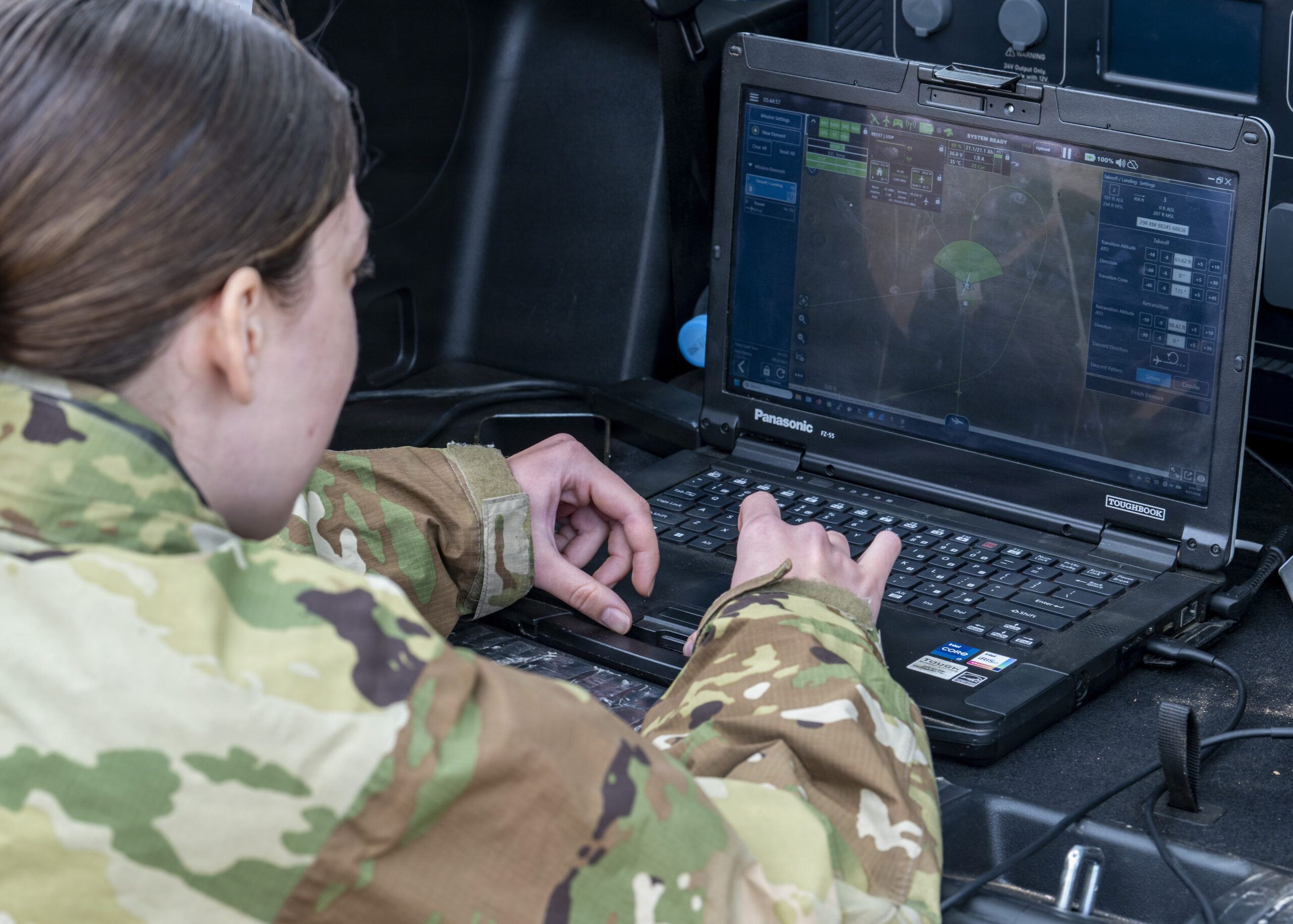
U.S. Army Sgt. Katelyn Brown, an unmanned aircraft systems operator assigned to 1st Battalion, 503rd Infantry Regiment, 173rd Mobile Brigade Combat Team (Airborne), plots a path for a tactical unmanned aerial system while training during African Lion 26 at Cap Draa, Tan-Tan, Morocco, April 27, 2026. (U.S. Navy photo by Mass Communication Specialist 2nd Class Samuel Wagner.)
Artificial intelligence (AI) chat functions have swiftly changed the way we acquire information today. Now the next iteration has arrived in the form of agentic AI, which is already having profound effects on both tactical and strategic operations.
As language models rapidly scale, often via easily accessible open-source models, they hand both friendly forces and adversaries a powerful new toolkit for rapid cyber operations and automated decision-making. Garrett Berntsen, Chief AI Officer at Accenture Federal Services and former Deputy Chief Data and Artificial Intelligence Officer for Scaled Capabilities, discusses how defense leaders can look beyond the hype and build an agile, software-abundant force for 2035.
Breaking Defense: Defense leaders have used AI for years, but agentic AI is fast becoming a dominant focal point. What is driving this urgency around agentic AI across the department right now?
Garrett Berntsen, Chief AI Officer, Accenture Federal Services
Berntsen: Two massive drivers are at play: open-source proliferation and battlefield realities. Historically, cutting-edge technology was locked behind classified programs. Today, powerful frontier models are often open-sourced within months. That means adversarial actors or a teenager in a basement will soon have tools capable of synthesizing vulnerabilities into potent cyberweapons. Our adversaries aren’t just processing data faster, they are acting faster. Defensively, we are on a ticking clock to harden our systems using these same capabilities.
In the physical domain, look at Ukraine. We’re seeing the shift to low-cost weapon systems that are rapidly trending toward full autonomy.
The urgency comes down to math; human-in-the-loop decision chains can’t physically keep pace with swarm attacks or rapid electronic warfare adaptation. The reality is that if we don’t prepare to delegate autonomous workflow execution to machines, we are likely to lose our speed advantage in the long run.
As these systems become more capable it just increases the need to have a human in the lead, doesn’t it?
During my time as an Army officer in Afghanistan, the rules of engagement (ROE) dictated a spectrum of actions based on the threat environment. In the military, you’re trained in the rules of engagement because they are there to help keep you safe while also operating ethically and proportionally.
On D-Day, the ROE was vastly different than on a counter-insurgency patrol in Kandahar. We must establish a similar, dynamic sliding scale for AI autonomy. You cannot deploy autonomous systems in highly restrictive environments without appropriate human oversight. However, in a near-peer, global conflict against an adversary employing full autonomy, our ROE must adapt to protect American and allied lives. There is no one-size-fits-all policy; our operational frameworks must be as agile as the technology itself, ensuring human command always aligns with mission risk.
How do you structure control mechanisms, so commanders retain authority without bottlenecking the system?
Control shouldn’t be treated as a binary on/off switch. It requires a dynamic, sliding scale of autonomy governed by clear rules of engagement.
In low-risk, operational support environments, you can grant high autonomy with humans auditing outcomes after the fact. Think of how that plays out in examples like supply chain logistics, contract analysis, or route planning. In high-risk tactical environments involving kinetic strikes or critical targeting, the system operates under a human-on-the-loop or strict human-in-the-loop constraint where the agent presents fully verified courses of action, but a commander holds sole authorization.
U.S. Air Force Capt. Anthony McHugh, GenAI.mil task force operations lead, Department of War (DoW) Chief Digital and Artificial Intelligence Office (CDAO), center, delivers training on building AI agents to Sailors assigned to U.S. Pacific Fleet on Joint Base Pearl Harbor-Hickam, Hawaii, July 21, 2026. (U.S Navy photo by Mass Communication Specialist 2nd Class Christopher Sypert.)
The goal of agentic AI isn’t to replace human judgment; it’s to clear away the cognitive noise so that when the human makes a decision, it is based on synthesized, real-time ground truth rather than overwhelming data overload.
One of the major advantages of AI is its ability to quickly process and analyze information. Does that speed create challenges where humans can’t keep up? If so, how do you work around that?
When speed exceeds human capacity, the answer isn’t to force humans to work faster, it’s to fundamentally re-engineer the business process. We help clients stop using AI to merely optimize outdated workflows. If an agentic system can instantly process intelligence or generate reports, human operators are freed to do what AI cannot: negotiate, strategize, and build partnerships. We challenge organizations to ask whether a legacy process is even necessary anymore and strengthen the points where human judgment is truly required .
What lessons can we learn from earlier defense modernization efforts to apply new technologies. How do we avoid that with agentic AI?
That is one of the risks with defense technology. If you take a 12-step paper-based approval process and build 12 AI agents to automate each step, you haven’t modernized – you’ve just digitized an outdated process.
Real transformation requires re-engineering the workflow from scratch around machine capabilities. You have to ask: If we designed this mission process today with the tools we have right now, what would it look like? Often, a 12-step process shrinks down to a single automated workflow with one human checkpoint.
What does this mean for how government and industry work differently to move these capabilities out of pilot programs and into the hands of warfighters at scale?
Department leaders should challenge industry partners because they know that a commercial prototype in a sandbox is very different from deploying secure, edge-ready capabilities across classified defense networks. Government, on the whole, needs to move away from rigid, multi-year feature specifications and lean into outcome-based, rapid-iteration contracting.
We need an ecosystem approach – taking commercial frontier models, wrapping them in defense-grade security and domain-specific knowledge, and embedding engineers alongside operators to continuously evolve the solutions. When engineers and operators share the same feedback loop, we can move much faster as a living, strategic capability.
Looking ahead, what does the military force of 2035 look like in an agentic, highly autonomous battlespace?
If I’ve learned anything over my career , it’s that predicting 10 years out takes a lot of strategic humility! But looking toward 2035, I see three major shifts will define the future force.
First, we’ll have a much clearer line between what we purely automate and what remains uniquely human. The critical, high-stakes tactical decision-making will stay uniquely human. But the operational support – logistics, administrative paperwork, routine intelligence sorting – will be heavily automated and augmented by software agents.
Second, the entire economics of defense software is going to fundamentally change. Right now, government procurement follows a multi-year cycle – you write requirements, request funding a year later, build for two years, and then maintain that system forever. With agentic coding, the cost to build software drops dramatically, giving us a world of software abundance. We won’t need to treat software as a permanent asset. You build a capability for a specific mission problem, and if it stops being useful, you just turn it off and tear it down.
The third big shift is pushing software skills directly to the front lines. If software is key to mission success, we can’t lock those capabilities behind headquarters or program offices. Imagine a future where an infantry platoon has a software NCO or Warrant Officer embedded right there with them. If they hit a unique tactical problem in the field, they don’t call back to headquarters to ask if someone can build them an app. They build the digital capability on the spot, execute the mission, and tear it down. That distributed, agile capability is what a modern force truly looks like.
2026年4月27日,在摩洛哥坦坦的德拉角举行的“非洲雄狮26”演习期间,隶属于第173机动旅战斗队(空降)第503步兵团第1营的美国陆军中士凯特琳·布朗正在为一架战术无人机系统规划飞行路线。(美国海军二级大众传播专家塞缪尔·瓦格纳摄)
人工智能(AI)聊天功能迅速改变了我们如今获取信息的方式。现在,下一代人工智能——智能体人工智能——已经到来,并对战术和战略行动产生了深远的影响。
随着语言模型迅速扩展(通常借助易于获取的开源模型),它们为友军和敌军都提供了一套强大的新工具包,用于快速网络作战和自动化决策。埃森哲联邦服务公司首席人工智能官、Scaled Capabilities公司前副首席数据与人工智能官加勒特·伯恩特森探讨了国防领导者如何才能超越炒作,为2035年打造一支敏捷且软件丰富的部队。
国防新闻速递:国防部门多年来一直在使用人工智能,但智能体人工智能正迅速成为关注的焦点。是什么因素促使国防部如此迫切地寻求智能体人工智能?
加勒特·伯恩特森,埃森哲联邦服务公司首席人工智能官
伯恩特森:两大驱动因素正在发挥作用:开源软件的普及和战场现实。过去,尖端技术往往被锁定在机密项目中。而如今,强大的前沿模型往往在几个月内就会开源。这意味着敌对势力,甚至一个躲在地下室的青少年,很快就能拥有将漏洞转化为强大网络武器的工具。我们的对手不仅处理数据的速度更快,行动速度也更快。在防御方面,我们也必须争分夺秒地利用这些能力来强化我们的系统。
从实战层面来看,看看乌克兰。我们看到,该国正在转向低成本武器系统,而且这些系统正迅速朝着完全自主化的方向发展。
紧迫性归根结底在于数学;人机协作的决策链在物理上无法跟上集群攻击或电子战快速适应的步伐。现实情况是,如果我们不做好准备将自主工作流程的执行委托给机器,从长远来看,我们很可能会失去速度优势。
随着这些系统的功能越来越强大,就越需要人来领导,不是吗?
我在阿富汗担任陆军军官期间,交战规则(ROE)规定了根据威胁环境采取的一系列行动。在军队里,你会接受交战规则的训练,因为这些规则旨在帮助你在确保自身安全的同时,也能以合乎道德且适度的方式行事。
在诺曼底登陆日,交战规则与在坎大哈的反叛乱巡逻中截然不同。我们必须为人工智能自主性建立类似的、动态的滑动标尺。在高度限制的环境中部署自主系统,必须有适当的人工监督。然而,在与实力接近的对手进行全球冲突,且对手采用完全自主系统时,我们的交战规则必须做出调整,以保护美国及其盟国的生命安全。没有一成不变的政策;我们的作战框架必须与技术本身一样灵活,确保人类指挥始终与任务风险保持一致。
如何构建控制机制,使指挥官能够在不阻碍系统运转的情况下保持权威?
控制不应被视为非此即彼的开关。它需要一个动态的、可滑动的自主程度尺度,并由明确的互动规则来约束。
在低风险的作战支援环境中,可以赋予系统高度自主权,并由人工进行事后审核。例如,供应链物流、合同分析或路线规划等场景就体现了这一点。而在涉及动能打击或关键目标定位的高风险战术环境中,系统则需要在人机交互或严格的人机交互约束下运行,即智能体提交经过充分验证的行动方案,但最终的授权权归指挥官所有。
2026年7月21日,美国空军上尉安东尼·麦克休(Anthony McHugh)在夏威夷珍珠港-希卡姆联合基地为美国太平洋舰队的水兵讲授人工智能代理构建方法。麦克休上尉是美国战争部首席数字和人工智能办公室(CDAO)的首席数字和人工智能办公室(CDAO)的负责人,也是GenAI.mil特遣部队的行动负责人。(美国海军二级大众传播专家克里斯托弗·赛珀特拍摄。)
智能人工智能的目标不是取代人类的判断;而是清除认知噪音,以便人类在做决定时,能够基于合成的、实时的真实情况,而不是被过多的数据所淹没。
人工智能的一大优势在于其快速处理和分析信息的能力。这种速度是否会带来人类无法跟上的挑战?如果是,该如何应对?
当速度超过人类能力时,解决之道并非强迫人类加快速度,而是从根本上重塑业务流程。我们帮助客户摆脱仅仅利用人工智能优化过时工作流程的思维模式。如果智能系统能够即时处理信息或生成报告,那么人类操作员就可以腾出时间去做人工智能无法完成的事情:谈判、制定战略和建立合作关系。我们鼓励企业重新审视传统流程是否还有存在的必要,并强化那些真正需要人类判断的环节。
我们能从以往的国防现代化努力中吸取哪些经验教训来应用新技术?我们如何在智能体人工智能中避免重蹈覆辙?
这就是国防技术面临的风险之一。如果你把一个12步的纸质审批流程,然后开发12个AI代理来自动化每个步骤,你并没有实现现代化——你只是把一个过时的流程数字化了。
真正的转型需要围绕机器能力从头开始重新设计工作流程。你必须扪心自问:如果我们今天用现有的工具重新设计这个任务流程,它会是什么样子?通常,一个包含 12 个步骤的流程可以简化为一个自动化工作流程,并只有一个人工检查点。
这意味着政府和行业在将这些能力从试点项目大规模地转移到作战人员手中方面,需要采取哪些不同的合作方式?
部门领导应该对行业合作伙伴提出质疑,因为他们清楚,在沙盒环境中测试的商业原型与在机密国防网络中部署安全、边缘就绪的功能截然不同。政府整体需要摒弃僵化的多年期功能规格,转而采用基于结果、快速迭代的合同模式。
我们需要一种生态系统方法——借鉴商业前沿模式,将其与国防级安全技术和领域特定知识相结合,并让工程师与运维人员并肩工作,持续改进解决方案。当工程师和运维人员共享同一反馈循环时,我们就能以更快的速度发展出一种鲜活的战略能力。
展望未来,在2035年,在高度自主的、具有自主性的战场空间中,军事力量会是什么样子?
如果说我职业生涯中学到了什么,那就是预测未来十年需要极大的战略谦逊!但展望2035年,我认为三大转变将决定未来力量的走向。
首先,我们将更清晰地划分哪些工作完全自动化,哪些工作仍然需要人类来完成。至关重要的、高风险的战术决策仍将由人类独立完成。但运营支持——后勤、行政文书、日常情报整理——将高度自动化,并由软件代理进行辅助。
其次,国防软件的整个经济模式将发生根本性改变。目前,政府采购遵循多年周期——先编写需求,一年后申请资金,开发两年,然后永久维护该系统。而采用智能体编码后,软件开发成本将大幅下降,从而带来软件资源丰富的未来。我们不再需要将软件视为永久资产。只需针对特定任务问题构建相应的功能,如果该功能不再有用,只需将其关闭并拆除即可。
第三个重大转变是将软件技能直接推向一线。如果软件是任务成功的关键,我们就不能将这些能力锁在总部或项目办公室之后。试想一下,未来步兵排里会有一名软件士官或准尉与他们并肩作战。如果他们在战场上遇到独特的战术难题,他们不会打电话回总部询问是否有人能帮他们开发一个应用程序。他们会在现场构建数字化能力,执行任务,然后将其拆除。这种分布式、敏捷的能力才是现代部队的真正面貌。