Ukraine seeks upper hand in cat-and-mouse game of naval drones乌克兰力图在海军无人机猫鼠游戏中占据上风
Russian forces have learned from recent attacks with explosive-laden unmanned surface vessels, according to experts.
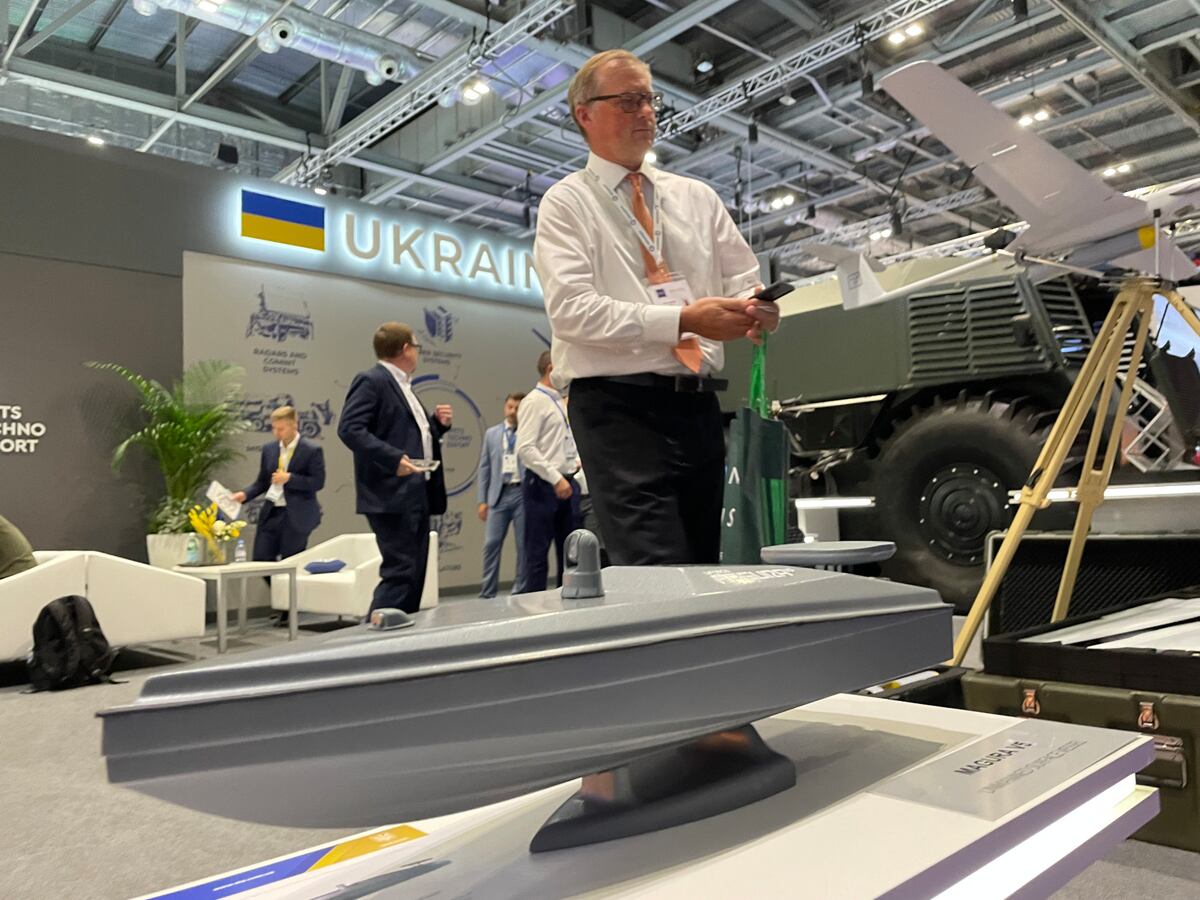
LONDON — Ukraine’s success in attacking Russian forces with naval drones is fast-tracking Moscow’s efforts to repel these weapons, producing lessons for Western navies in process, according to experts.
In August, social media reports claimed that the Main Directorate of Intelligence of the Ukrainian Ministry of Defense released footage showing naval drones carrying out an attack in the Black Sea on Russian vessels.
The unmanned surface vessel in the grainy video is the Magura V5, manufactured by SpetsTechnoExport (STE), a Ukrainian state-owned foreign trade enterprise based in Kyiv. The company, present at the DSEI defense exhibition here, declined to comment the operation, citing security reasons.
However, a white paper circulated by the company here stated that the Magura V5 is “the world’s first maritime drone with public video confirmation of hitting legitimate targets, including warships.”
Although the naval drone was designed for reconnaissance and surveillance missions, it can also carry out strike operations. An STE representative at the company’s stand, who asked not to be named, explained that Magura can act as an explosive drone because of its sizable payload of 320 kg (705,5 lbs) and a range of over 830 kilometers (515 miles).
Samuel Bendett, a research analyst at the U.S.-based Center for Naval Analyses’ Russian Studies Program, noted that as the Ukrainians have lacked the capability to challenge the Russian Navy on an equal footing, naval drones are “an asymmetrical response that can get to the enemy vessels at sea or in port.”
At the same time, he added, the attacks are leading Russia to bolster naval defenses.
“USV tactics are constantly changing to inflict the most probable damage on Russian naval assets that also include stationary targets like bridges. So far, parts of Russia’s navy – such as those in Crimea – are adapting better to this threat than others,” Bendett said.
“However, Ukraine’s use of these USVs is also fast-tracking a Russian naval rearmament program to install kinetic, electronic warfare and sensor defenses on ships,” he added.
The cat-and-mouse game that has been playing out around drones was also raised by Maksym Muzyka, the chief executive officer at Armadrone, which produces the Ukrainian Punisher drone.
“We need to continuously adapt our systems in order to be one step ahead,” he told Defense News at the DSEI exhibit. “In two months’ time, Russian systems could be integrated with more advanced capabilities and we need to be prepared to compete with these or do better.”
Both Ukrainian companies face challenges in meeting the overall demand for unmanned systems arising from the conflict. Muzyka highlights that last year, Armadrone could only satisfy about 30% of the requests of the military for Punishers, and that the company would need to up production by three to five times to reach the desired quantity.
For STE, the situation is even more complex, as USVs are more difficult to build from a technology standpoint, given the weight of the platform and payload.
“Since developing the Magura a year and half ago, we have managed to produce approximately in the 100s of these systems, but we are actively working to increase our production rate,” the STE official said.
Elisabeth Gosselin-Malo was a Europe correspondent for Defense News. She covers a wide range of topics related to military procurement and international security, and specializes in reporting on the aviation sector. She is based in Milan, Italy.
伦敦——专家表示,乌克兰利用海军无人机成功攻击俄罗斯军队,正在加速莫斯科遏制这些武器的努力,并在此过程中为西方海军提供经验教训。
8 月,社交媒体报道称,乌克兰国防部情报总局发布了一段视频,显示海军无人机在黑海对俄罗斯船只发动了袭击。
视频中出现的无人水面艇是Magura V5型,由乌克兰国有外贸企业SpetsTechnoExport(STE)制造,该公司总部位于基辅。STE公司也参加了此次在基辅举行的DSEI防务展,但以安全为由拒绝就此次行动发表评论。
然而,该公司在此发布的一份白皮书称,Magura V5 是“世界上第一款拥有公开视频证实击中合法目标(包括军舰)的海上无人机”。
虽然这款海军无人机最初设计用于侦察和监视任务,但它也能执行打击行动。STE公司展台上的一位不愿透露姓名的代表解释说,Magura无人机可以作为爆炸无人机使用,因为它拥有320公斤(705.5磅)的强大有效载荷和超过830公里(515英里)的航程。
美国海军分析中心俄罗斯研究项目的研究分析师塞缪尔·本德特指出,由于乌克兰人缺乏与俄罗斯海军平起平坐的能力,海军无人机是一种“不对称的回应,可以攻击海上或港口的敌舰”。
与此同时,他还补充说,这些袭击正促使俄罗斯加强海军防御。
“无人水面艇的战术不断变化,旨在对俄罗斯海军资产(包括桥梁等固定目标)造成最大程度的破坏。到目前为止,俄罗斯海军的部分力量——例如驻克里米亚的部队——比其他力量更能适应这种威胁,”本德特说。
“然而,乌克兰使用这些无人水面艇也加速了俄罗斯海军的重新武装计划,该计划旨在为舰艇安装动能防御、电子战和传感器防御系统,”他补充道。
乌克兰“惩罚者”无人机制造商 Armadrone 的首席执行官 Maksym Muzyka 也提到了围绕无人机展开的猫鼠游戏。
“我们需要不断改进我们的系统,才能始终领先一步,”他在DSEI防务展上告诉《防务新闻》。“两个月后,俄罗斯的系统可能会集成更先进的功能,我们需要做好准备,与它们竞争,甚至做得更好。”
这两家乌克兰公司在满足冲突带来的无人系统整体需求方面都面临着挑战。穆兹卡指出,去年,Armadrone公司仅能满足军方约30%的“惩罚者”无人机需求,该公司需要将产量提高三到五倍才能达到预期数量。
对于 STE 而言,情况更加复杂,因为从技术角度来看,考虑到平台和有效载荷的重量,无人水面艇的制造难度更大。
“自一年半前开发出Magura以来,我们已经生产了大约100套这样的系统,但我们正在积极努力提高生产速度,”STE的一位官员表示。
伊丽莎白·戈斯林-马洛曾任《防务新闻》欧洲通讯员。她的报道涵盖军事采购和国际安全等广泛领域,尤其擅长航空领域的报道。她常驻意大利米兰。