Marines Had An “Aircraft Carrier On Land” With Catapults And Arresting Gear In Vietnam在越南,海军陆战队拥有一艘配备弹射器和阻拦装置的“陆地航空母舰”。
Built from scratch, Chu Lai Air Base in South Vietnam was in the thick of exactly where tactical airpower was needed.
新闻视频
Updated Jul 9, 2021 5:59 AM EDT
During the long conflict in Southeast Asia , U.S. Marines Corps jets regularly flew from bases on land in direct support of troops on the ground. However, only one of the airbases that the service operated from in South Vietnam was actually outfitted with arrester wires and even catapult launch gear. This was at Chu Lai, where the Marines built themselves what was basically a land-based “aircraft carrier” that was utilized by A-4 Skyhawk light attack jets and, later, F-4 Phantom II fighters.
The story of Chu Lai Air Base is inseparable from that of the A-4’s service during the Vietnam War, where it was, quite rightly, recognized as one of the signature aircraft of the conflict. U.S. Navy and Marine Corps Skyhawks bore a significant brunt of the air war for the first half of the conflict. In the process, pilots routinely flew into harm’s way on unglamorous missions, and the A-4 eventually accounted for more than a third of all Navy fixed-wing combat losses—Marine attrition rates were similar.
An A-4C from VMA-225 makes what is purportedly the first landing at Chu Lai, on June 1, 1965., U.S. Navy
While Navy A-4s had been operating in Southeast Asia ever since 1964, when the Gulf of Tonkin incident led to more direct U.S. engagement in the conflict, Marine Skyhawks arrived later on the scene, as the ground war was becoming more intense. The Corps F-4 Phantom IIs, as well as RF-8 Crusader reconnaissance jets and EF-10 Skyknight electronic warfare aircraft, were already operating from Da Nang Air Base in South Vietnam when the service elected to throw its A-4s into the fray.
However, with Da Nang’s capacity to support additional aircraft increasingly stretched to the limit, the decision was made to set up a new airbase from scratch. This was Chu Lai, located on the coast, around 55 miles south of Da Nang. It would be a Marine-led effort that included the installation of a Short Airfield for Tactical Support (SATS) system, which would launch jets via a trackless catapult and recover them using aircraft carrier-style arresting gear. Unlike a catapult found on an aircraft carrier, which runs down a trackway recessed in the deck, the trackless version was based on a wheeled dolly and a cable-tow driven by a capstan, powered in turn by turbine engines.
1st Lieutenant Conrad “Ham” Hamilton in the cockpit of an A-4 after the 1,000th mobile arresting gear landing at Chu Lai Air Base., CENTCOM/Rich Lee
The entire arrangement would enable aircraft to get into the air and land back at the base without the need for a lengthy, traditional runway. This would also help address the performance limitations that came from the hot and humid conditions. As well as extra capacity, the new base would bring airpower closer to where it was needed, reducing flying time to targets, as well.
Work on the land-based catapult as a part of the SATS system been launched more than 10 years previously, inspired at least in part by experiences in the Korea War, when pierced steel matting had been laid to form extemporized airstrips close to the troops. By the early 1960s, there were experimental SATS sites at Bogue Field, North Carolina, and Quantico , Virginia. At one stage it was planned for SATS to accept a range of carrier-capable naval aircraft, including the A-6 Intruder , F-4 Phantom II, F-8 Crusader, and even the ultimately abortive F-111B .
Testing the CE-2 trackless aircraft launcher as part of the SATS system at Quantico, in 1963:
However, Chu Lai seems to have been the only facility in which SATS was used operationally and the task of building the new base fell upon the Seabees , the Navy’s Construction Battalions. Working in temperatures of 100 degrees or more, the Seabees laid a runway made of AM-2 aluminum planks — roughly 1.4 million square feet in all — soon nicknamed “the tinfoil airstrip.”
AM-2 aluminum planks are unloaded for onward transit to Chu Lai, May 1965., National Archives
By the end of May 1965, taxiways, a parking ramp, and arrester gear had also been built at Chu Lai. The catapult arrived sometime later. All this was constructed in an area that was not only unstable but also prone to becoming seriously waterlogged after heavy rain.
The basic SATS concept envisaged a rapidly established airfield with a runway that was 2,000 to 3,000 feet long and 72 feet wide. But since Chu Lai was expected to be in use for a considerably longer period than a typical expeditionary operation, and host many more aircraft, the design was adapted, with a planned length of 8,000 feet and width of 107 feet. Initially, however, only 4,000 feet was actually completed, while work continued to stabilize the ground below the other half. Thereafter, constant attention was required to keep the runway planking from sinking into the mud. Later on, Chu Lai also got its own conventional runway , located in parallel to the SATS airstrip.
An A-4E from VMA-121 lands at Chu Lai, using an arrester cable, in March 1967., U.S. Marine Corps
The first jets to arrive at the base were the A-4Cs of Marine Attack Squadron 225 (VMA-225) and the improved A-4Es from VMA-311, both of which touched down on June 1, 1965. Missions began the same day. The E-model Skyhawk featured various improvements compared to the C variant, perhaps most important being five external hardpoints for stores instead of three, allowing a heavier load of weapons to be carried.
In Peter Mersky’s authoritative US Navy and Marine Corps A-4 Skyhawk Units of the Vietnam War , former A-4 pilot retired Colonel Ned Carroll recalls what it was like to operate from the tinfoil airstrip in the early days:
Because of an engineering fluke, the bed material for the fabricated aluminum panel that made up the expeditionary runway had been laid over what we thought was laterite rock. However, once the monsoon arrived, we quickly learned that what we had presumed to be rock was actually clay! Softened by the heavy rains, the bedding material soon began to shoot out between the planks every time an aircraft passed over them. Deep voids quickly formed, which made takeoffs an adventure, with bumps so bad that eventually bombs were jarred loose and rolled down the runway! These bombs still had safening wires through their fuses, so there was no immediate danger of them exploding. Still, aircraft-bomb collision, with disastrous results, was always possible.”
Until the catapult arrived, A-4s were boosted into the air using rocket-assisted take-off (RATO) bottles. Each RATO bottle provided around 3,500 pounds of thrust for five seconds, approximately halving the takeoff run. Even so, the jets had to takeoff with a reduced fuel load, before quickly finding a KC-130 Hercules tanker to take on more gas.
Using the RATO gear was also not without its hazards, and pilots had to keep a close eye on the bottles to ensure both had fired properly. If not, and if carrying a heavy load, they would have to eject, since they would likely not make it off the runway.
Returning to Chu Lai was a case of lining up to catch the wire of the M-21 arrester gear, located around 1,000 feet further down the runway from the standard touchdown point and which could bring a Skyhawk to a standstill within as little as 250 feet. This was especially useful if the jet was returning to base in a damaged state, providing an extra degree of safety.
In the months that followed, Chu Lai’s Skyhawks saw heavy action, flying day and night in support of Marines and South Vietnamese troops sometimes engaged only half-a-dozen miles from the base perimeter. At times, Chu Lai itself came under attack from North Vietnamese forces, and the A-4s were required to defend their own base, which they did successfully.
Jets frequently returned to Chu Lai with significant combat damage, while poor weather led to a suspension of flying activity in late November 1965. By this time there were four Skyhawk squadrons at the base, with the addition of VMA-211 and VMA-214, and each unit had a complement of around 20 aircraft.
An aerial view of Chu Lai, circa 1965., U.S. Marine Corps
Ultimately, four squadrons of A-4s were considered the maximum that Chu Lai could accommodate, but different units were rotated in and out of the base as the demand for close air support continued to grow.
The catapult system finally became operational in May 1966 and was powered by a pair of General Electric J79 turbojets (as used in the F-4, among others), providing almost 35,000 horsepower. This could launch A-4s off the runway in either direction and, from a pilot’s perspective, reportedly made operations remarkably similar to flying to and from a real carrier deck. There was even a mirror landing aid to aid their recovery. Once up and running, the catapult could launch a fully armed Skyhawk into the air once every 90 seconds.
A mirror landing aid onboard the Australian aircraft carrier HMAS Melbourne ., Nick Thorne/Wikimedia Commons
By the summer of 1966, the A-4 squadrons were reportedly averaging between 600 and 700 combat flying hours a month out of Chu Lai, with the close proximity of the fighting allowing pilots to fly multiple sorties each day. The rotational A-4 squadrons began “hot pad” alerts at the base, with a section of jets standing armed and ready to scramble, engines running and with pilots in the cockpits, should the need arise.
A VMA-223 A-4E comes to a halt after an arrested landing at the Chu Lai, circa 1966., U.S. Marine Corps
Much heavier and more powerful than the A-4, the Marine Corps F-4 was the other type to make extensive use of the SATS system in an operational capacity. During tests of the catapult , a Skyhawk was found to require 1,165 feet to take off, while a Phantom II needed 1,485 feet.
Armed with 12 500-pound bombs, an F-4B from VMFA-323 completed a first catapult shot from Chu Lai in August 1966, but it was not the smoothest start, as the pilot, retired Colonel Robert Jonhson, recalls in Peter E. Davies’ US Marine Corps F-4 Phantom II Units of the Vietnam War :
About halfway down the track, the aircraft seemed to lurch to a higher, nose-high attitude, and simultaneously with hitting the end of the catapult track, the starboard engine suffered a catastrophic failure (it exploded). My attention at this time was directed to my immediate front, which consisted of numerous trucks, Marines, and civilians waiting at a checkpoint off the end of the runway. Slowly climbing, I next noticed the base ammunition dump below my flight path. My briefing on emergency jettisoning of external stores did not cover this eventuality, but we were still flying… albeit only briefly. I made a slight turn to the right in the direction of what appeared to be a clear area where we could jettison. As I tried to level the wings the stick bucked and froze in my hand. All I had to say was, ‘Eject, Jim, Eject.’ Jim responded instantly, and after hearing the second explosion, canopy and seat, I followed suit. Out altitude at the time was 100 feet or less. When my seat fired the aircraft was nearly 90 degrees to the horizon. As advertised, seat separation and chute opening occurred automatically, and I got a 90-degree swing in the chute before landing in a the-wire concertina fence. I looked up to see Jim come down in his chute about 30 yards away, The aircraft disintegrated about 50 yards beyond that, but none of the bombs detonated.
About halfway down the track, the aircraft seemed to lurch to a higher, nose-high attitude, and simultaneously with hitting the end of the catapult track, the starboard engine suffered a catastrophic failure (it exploded). My attention at this time was directed to my immediate front, which consisted of numerous trucks, Marines, and civilians waiting at a checkpoint off the end of the runway. Slowly climbing, I next noticed the base ammunition dump below my flight path. My briefing on emergency jettisoning of external stores did not cover this eventuality, but we were still flying… albeit only briefly.
I made a slight turn to the right in the direction of what appeared to be a clear area where we could jettison. As I tried to level the wings the stick bucked and froze in my hand. All I had to say was, ‘Eject, Jim, Eject.’ Jim responded instantly, and after hearing the second explosion, canopy and seat, I followed suit. Out altitude at the time was 100 feet or less. When my seat fired the aircraft was nearly 90 degrees to the horizon. As advertised, seat separation and chute opening occurred automatically, and I got a 90-degree swing in the chute before landing in a the-wire concertina fence. I looked up to see Jim come down in his chute about 30 yards away, The aircraft disintegrated about 50 yards beyond that, but none of the bombs detonated.
Colonel Johnson’s cool head saw him get a Distinguished Flying Cross and it was later found that the catapult shuttle had likely been incorrectly attached to the cable, leading to a near-deadly disaster.
In October 1966, the runway was extended to 10,000 feet and provided with a concrete surface, as well as parking ramps and taxiways. This made the airbase better suited to the Marine F-4s and the additional ramp space permitted three Phantom squadrons to be operated alongside the A-4s, although facilities on the ground remained basic, with most maintenance conducted in the open air.
Chu Lai survived the onslaught of the Tet Offensive that began in January 1968, during which the airstrip came under rocket attack, injuring two and damaging four Skyhawks. However, by September 1970, Chu Lai’s tenure as a Marine airbase had come to an end and it was handed over to the Army as the U.S. began withdrawing combat units. What became of the SATS system is unclear, but the Army would not have had any use for it. Thereafter, the remaining Marine combat squadrons in the country were concentrated at Da Nang. In fact, VMA-311 became the last U.S. combat squadron to leave Vietnam, which it did in January 1973, shortly before the ceasefire came into effect.
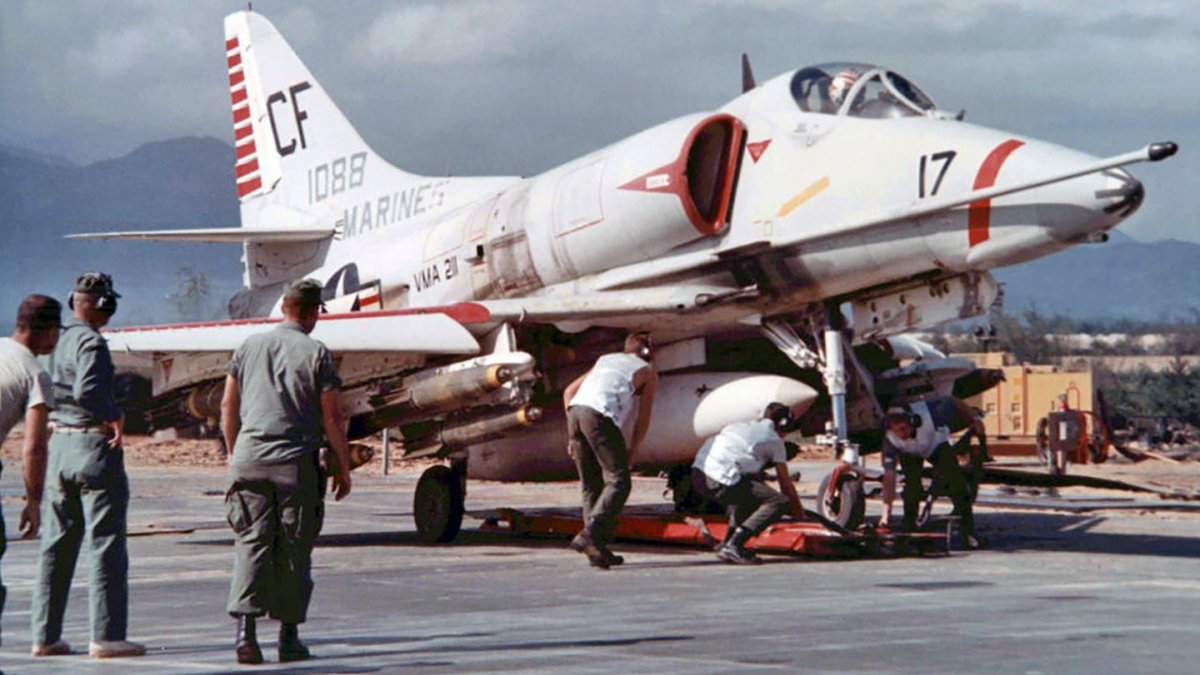
A bombed-up VMA-121 A-4E at Chu Lai., U.S. Navy
The “instant airfield” at Chu Lai was destined to be a one-off, but the lessons of SATS continue to this day, as the Marines continue to work on their Expeditionary Advanced Base Operations (EABO) concept, a modern approach to bringing tactical airpower to bear anywhere it might be needed. The 2019 Marine Corps Aviation Plan describes the EABO concept as follows:
“A future naval operational concept that mitigates peer competitors’ anti-access/area-denial capability by creating a more survivable, resilient, and persistent forward-postured force. The EABO concept is designed to re-establish the force credibility required to have a deterrent effect. Using key maritime terrain in the vicinity of close and confined seas, EABO provides decision-makers with sea denial options that are coercive, but not escalatory.”
Paralleling the way the A-4 and F-4 were adapted for land-based “cat and trap” operations, the Marines have been exploring the potential for the F-35C carrier-capable variant to undertake short-field and austere operations .
To prepare for real-world EABO scenarios, Marine F-35Cs have been using the M-31 expeditionary arresting gear , permitting operations from smaller runways. Moreover, within the U.S. military right now there is now an increasing focus on rapidly building up austere air bases . In particular, as the Pentagon continues its “pivot” toward the Pacific theater , there is an understanding that a conflict with China would likely see established infrastructure, including traditional airbases, quickly destroyed . In Europe, too, expeditionary base concepts are seen as vital for any conflict with any near-peer threat nation.
Meanwhile, although SATS was destined to be something of a footnote to the conflict in Vietnam, the effort to set up an airbase from scratch was indicative of the determined and innovative approach of the Marines in the air war in Southeast Asia.
Contact the author: thomas@thedrive.com
Comments couldn’t be loaded. Please refresh the page.
更新于美国东部时间2021年7月9日上午5:59
在东南亚的长期冲突中,美国海军陆战队的喷气式飞机经常从陆地基地起飞,直接支援地面部队作战。然而,在南越,海军陆战队使用的众多空军基地中,只有朱莱空军基地配备了拦阻索,甚至还有弹射起飞装置。在那里,海军陆战队员们建造了一个类似于陆基“航空母舰”的基地,最初由A-4“天鹰”轻型攻击机使用,后来又由F-4“鬼怪II”战斗机使用。
朱莱空军基地的历史与A-4在越南战争中的服役密不可分。A-4被公认为这场战争的标志性战机之一,这绝非浪得虚名。在战争初期,美国海军和海军陆战队的A-4“天鹰”战机承受了空战的大部分压力。在此过程中,飞行员们经常执行一些并不光鲜的任务,身陷险境。最终,A-4造成的损失占海军固定翼战机总损失的三分之一以上——海军陆战队的损失率也与之相近。
1965年6月1日,美国海军VMA-225中队的一架A-4C攻击机据称在朱莱进行了首次着陆。
自1964年北部湾事件导致美国更直接地介入东南亚冲突以来,海军的A-4攻击机就一直在东南亚地区执行任务。而海军陆战队的“天鹰”攻击机则是在地面战愈演愈烈之后才抵达战场。在海军陆战队决定将A-4投入战斗之前,海军陆战队的F-4“鬼怪II”战斗机、RF-8“十字军战士”侦察机和EF-10“空中骑士”电子战飞机已经从南越岘港空军基地起飞作战。
然而,随着岘港机场的飞机承载能力日益捉襟见肘,最终决定从零开始建设一座新的空军基地。这座新基地名为朱莱,位于岘港以南约55英里的沿海地带。该项目由海军陆战队主导,其中包括安装一套战术支援简易机场(SATS)系统。该系统采用无轨弹射器弹射喷气式飞机,并使用类似航空母舰的阻拦装置回收飞机。与航空母舰上沿甲板凹槽轨道运行的弹射器不同,这种无轨弹射器基于一个轮式滑车和由绞盘驱动的钢索牵引装置,而绞盘则由涡轮发动机提供动力。
中尉康拉德·“哈姆”·汉密尔顿在A-4攻击机的驾驶舱内,此前该机在朱莱空军基地完成了第1000次移动式阻拦装置的着陆。(中央司令部/里奇·李摄)
整套方案将使飞机无需使用冗长的传统跑道即可起降。这也有助于解决高温高湿环境带来的性能限制。除了增加运力外,新基地还能使空中力量更接近所需地点,从而缩短飞往目标的飞行时间。
作为SATS系统一部分的陆基弹射器研发工作早在十多年前就已启动,其灵感至少部分来源于朝鲜战争的经验。当时,美军曾铺设穿孔钢板,在部队附近临时搭建简易机场。到20世纪60年代初,北卡罗来纳州的博格机场和弗吉尼亚州的匡蒂科机场都已建立了SATS试验基地。SATS系统一度计划能够搭载一系列舰载机,包括A-6“入侵者”攻击机、F-4“鬼怪II”战斗机、F-8“十字军战士”战斗机,甚至还有最终夭折的F-111B战斗机。
1963年,在匡蒂科对CE-2型无轨飞机发射器进行测试,该发射器是SATS系统的一部分:
然而,朱莱似乎是SATS唯一投入实际使用的设施,而建造新基地的任务则落到了海军工程兵营(Seabees)的肩上。在100华氏度(约38摄氏度)或更高的高温下,海蜂们铺设了一条由AM-2铝板制成的跑道——总面积约140万平方英尺(约130万平方米)——很快就被戏称为“锡箔纸跑道”。
1965年5月,AM-2型铝制板被卸下,准备运往朱莱。(美国国家档案馆)
到1965年5月底,朱莱机场的滑行道、停机坪和阻拦装置也已建成。弹射器随后也运抵现场。所有这些设施都建在一个不仅地势不稳定,而且暴雨后极易积水的地区。
SATS的基本构想是快速建成一个简易机场,跑道长2000至3000英尺,宽72英尺。但由于朱莱机场预计使用时间将远超一般的远征行动,且需起降更多飞机,因此设计方案进行了调整,计划跑道长8000英尺,宽107英尺。然而,最初仅完成了4000英尺,其余部分则继续进行地基加固工作。此后,必须持续维护,防止跑道木板陷入泥泞。后来,朱莱机场还修建了一条与SATS简易跑道平行的常规跑道。
1967年3月,美国海军陆战队VMA-121中队的一架A-4E攻击机使用阻拦索降落在朱莱机场。
首批抵达该基地的喷气式飞机是海军陆战队第225攻击机中队(VMA-225)的A-4C和VMA-311中队的改进型A-4E,两架飞机均于1965年6月1日降落。任务于当日开始。E型“天鹰”攻击机相比C型进行了多项改进,其中最重要的或许是其外部挂点由三个增加到五个,从而可以携带更多武器。
在彼得·默斯基的权威著作《美国海军和海军陆战队A-4“天鹰”攻击机部队在越南战争中的作战经历》中,前A-4飞行员、退役上校内德·卡罗尔回忆了早期在锡箔纸跑道上作战的情景:
由于工程上的疏忽,构成探险跑道的铝制面板的垫层材料铺设在我们以为是红土岩的地面上。然而,季风来袭后,我们很快发现,我们之前以为是岩石的东西实际上是黏土!暴雨使垫层材料软化,每当飞机飞过时,垫层材料都会从木板缝隙中喷涌而出。很快,跑道上就形成了深深的空隙,起飞变得异常艰难,颠簸之厉害甚至导致炸弹松动,滚落到跑道上!这些炸弹的引信中还连接着安全线,所以暂时没有爆炸的危险。尽管如此,飞机与炸弹相撞,造成灾难性后果的可能性始终存在。
在弹射器到达之前,A-4攻击机依靠火箭助推起飞(RATO)装置升空。每个RATO装置可提供约3500磅的推力,持续5秒,大约能将起飞滑跑距离缩短一半。即便如此,这些战机也必须以减少的燃油量起飞,然后迅速找到KC-130大力神加油机补充燃油。
使用火箭助推器也并非没有风险,飞行员必须密切关注两个助推瓶,确保它们都已正确启动。如果两个助推瓶都未成功启动,且飞机携带重物,飞行员就必须弹射逃生,因为他们很可能无法离开跑道。
返回朱莱机场时,需要排队等待M-21阻拦索的拉住。该阻拦索位于标准着陆点前方约1000英尺处,能够使A-4“天鹰”战机在短短250英尺内完全停止。如果战机受损需要返回基地,这套阻拦索尤其有用,能够提供额外的安全保障。
在接下来的几个月里,朱莱基地的A-4“天鹰”攻击机经历了激烈的战斗,日夜不停地支援海军陆战队和南越军队,有时甚至在距离基地外围仅六英里的地方就与敌人交战。朱莱基地本身也曾遭到北越军队的攻击,A-4攻击机不得不保卫自己的基地,而它们也成功地完成了这项任务。
喷气式飞机经常带着严重的战斗损伤返回朱莱,而恶劣的天气导致1965年11月下旬飞行活动暂停。到那时,该基地已有四个天鹰中队,包括VMA-211和VMA-214中队,每个中队大约有20架飞机。
1965年左右朱莱的鸟瞰图,美国海军陆战队
最终,朱莱基地最多只能容纳四个中队的 A-4 攻击机,但随着对近距离空中支援的需求不断增长,不同的部队轮流进出该基地。
这套弹射系统最终于1966年5月投入使用,由两台通用电气J79涡轮喷气发动机(与F-4等战机所用发动机相同)提供动力,功率接近35000马力。该系统可将A-4战机从跑道上双向弹射起飞,据报道,从飞行员的角度来看,其操作体验与在真正的航母甲板上起降极为相似。甚至还配备了镜像着陆辅助装置,以帮助战机回收。一旦投入使用,该弹射系统每90秒即可将一架满载武器的“天鹰”战机弹射升空。
澳大利亚“墨尔本”号航空母舰上的镜面着舰辅助装置。(图片来源:Nick Thorne/Wikimedia Commons)
据报道,到1966年夏季,驻扎在朱莱的A-4攻击机中队每月平均飞行600至700小时作战任务,由于战事地点距离很近,飞行员每天可以执行多次飞行任务。轮换部署的A-4中队开始在基地进行“热备”警戒,一部分战机处于待命状态,引擎运转,飞行员已就位,随时准备在需要时紧急起飞。
1966年左右,美国海军陆战队VMA-223中队的一架A-4E攻击机在朱莱进行阻拦着陆后停了下来。
比A-4更重、动力更强的海军陆战队F-4是另一种在作战中广泛使用SATS系统的机型。在弹射器测试中,发现A-4“天鹰”战斗机起飞需要1165英尺的弹射距离,而F-4“鬼怪”II战斗机则需要1485英尺。
1966 年 8 月,VMFA-323 中队的一架 F-4B 战斗机携带 12 枚 500 磅炸弹,从朱莱机场完成了首次弹射起飞,但起飞过程并不顺利,正如飞行员、退役上校罗伯特·约翰逊在彼得·E·戴维斯所著的《美国海军陆战队 F-4 鬼怪 II 战斗机部队在越南战争中》一书中回忆的那样:
飞机滑行到大约一半距离时,似乎突然猛地抬高,机头高高翘起。就在撞上弹射器滑道尽头的同时,右侧发动机发生了灾难性的故障(爆炸了)。此时,我的注意力完全集中在正前方,那里有许多卡车、海军陆战队员和平民在跑道尽头的检查站等候。飞机缓慢爬升,我随后注意到飞行路线下方有一个基地弹药库。我接受的紧急抛弃外挂物资的简报并没有涵盖这种情况,但我们仍在飞行……尽管只是短暂的飞行。我向右稍稍转弯,朝着看起来可以抛弃外挂物资的空旷区域飞去。当我试图保持机翼水平时,操纵杆猛地一抖,卡在了我的手中。我只能喊一声:“吉姆,弹射!弹射!”吉姆立即回应,在听到第二次爆炸声、座舱盖和座椅的爆炸声后,我也跟着跳了下去。当时我们的飞行高度只有100英尺或更低。我的座椅启动时,飞机几乎与地平线呈90度角。正如宣传的那样,座椅分离和降落伞自动打开,我在降落伞里旋转了90度,然后落入一道铁丝网围栏中。我抬头看到吉姆从大约30码外的降落伞里落下。飞机在大约50码外解体,但炸弹没有爆炸。
飞机滑行到大约一半距离时,似乎突然猛地抬高了机头,就在撞上弹射器滑道尽头的同时,右侧发动机发生了灾难性故障(爆炸了)。此时,我的注意力立刻被前方吸引,那里有许多卡车、海军陆战队员和平民在跑道尽头的检查站等候。飞机缓慢爬升后,我注意到飞行路线下方有一个基地弹药库。我接受的紧急抛弃外挂物资的简报并没有涵盖这种情况,但我们仍然继续飞行……尽管只是短暂的飞行。
我稍微向右转弯,朝着看起来可以跳伞的空旷区域飞去。当我试图保持机翼水平时,操纵杆猛地一抖,卡在了我的手里。我只能喊一声:“吉姆,弹射!弹射!”吉姆立刻响应,听到第二次爆炸声——座舱盖和座椅都弹开了——之后,我也跟着弹了出去。当时我们的高度只有100英尺或更低。我的座椅弹射时,飞机几乎与地平线呈90度角。正如之前演示的那样,座椅分离和降落伞打开都是自动的,我在降落伞里旋转了90度,然后落在了一排铁丝网围栏上。我抬头看到吉姆在30码外也降落了下来。飞机在50码外解体了,但炸弹都没有爆炸。
约翰逊上校的冷静使他获得了杰出飞行十字勋章,后来发现弹射梭很可能是错误地连接到了缆绳上,导致了一场几乎致命的灾难。
1966年10月,跑道延长至10000英尺,并铺设了混凝土路面,同时还修建了停机坪和滑行道。这使得该空军基地更适合海军陆战队的F-4战斗机起降,新增的停机坪空间也允许三个F-4“鬼怪”战斗机中队与A-4攻击机一同运行。尽管如此,地面设施仍然十分简陋,大部分维护工作仍在露天进行。
朱莱机场在1968年1月开始的春节攻势中幸存了下来。当时,该机场遭到火箭弹袭击,两架“天鹰”战斗机受伤,四架受损。然而,到了1970年9月,朱莱作为海军陆战队空军基地的使命宣告结束,随着美军开始撤出作战部队,该基地被移交给陆军。SATS系统的下落不明,但陆军显然已不再需要它。此后,驻越美军剩余的海军陆战队作战中队集中到了岘港。事实上,VMA-311中队成为最后一支撤离越南的美军作战中队,于1973年1月撤离,就在停火协议生效前不久。
美国海军朱莱机场被炸毁的 VMA-121 A-4E
朱莱的“临时机场”注定只是一次性的,但SATS的经验教训至今仍在发挥作用,海军陆战队仍在继续推进其远征前进基地作战(EABO)概念,这是一种将战术空中力量部署到任何需要的地方的现代化方法。2019年海军陆战队航空计划对EABO概念的描述如下:
“未来海军作战概念旨在通过打造一支更具生存能力、韧性和持久性的前沿部署部队,来削弱同级竞争对手的反介入/区域拒止能力。EABO概念旨在重建部队威慑力所需的信誉。EABO利用近海和狭窄海域附近的关键海域地形,为决策者提供具有胁迫性但不会导致局势升级的海上拒止选项。”
与 A-4 和 F-4 被改装用于陆基“猫捉老鼠”行动的方式类似,海军陆战队一直在探索 F-35C 舰载型战机执行短场和简易作战的潜力。
为了应对现实中的远征作战基地(EABO)场景,海军陆战队的F-35C战斗机一直在使用M-31远征阻拦装置,使其能够在较小的跑道上起降。此外,美军目前越来越重视快速建设简易空军基地。尤其是在五角大楼继续向太平洋战区“转向”之际,人们普遍认为,与中国的冲突很可能导致包括传统空军基地在内的现有基础设施迅速遭到破坏。在欧洲,远征基地的概念也被视为应对与任何势均力敌的威胁国家冲突的关键。
与此同时,尽管 SATS 注定只是越南战争中的一个注脚,但从零开始建立一个空军基地的努力表明了海军陆战队在东南亚空战中坚定不移和勇于创新的态度。
联系作者:thomas@thedrive.com
评论加载失败,请刷新页面。